ROGUES WITH DRAGON SKIN
Having finally gotten my act together what with swatching, recalculating, and general pointless noodling, I’m embarking on the highly modified Rogue. As ten thousand others have noted, it’s a very completely written out pattern for a pocket front hoodie, by Girl from Auntie’s Jenna. I really like the organic way she has used closed form cables to highlight the piece, and how those shaped cables narrow and widen. Killer!
In spite of the beauty of the native version, I am trying to satisfy specifications issued by a child in The Picky Years, so modifications are necessary:
- Gauge. Target child has picked out a yarn that knits at 5 spi instead of the pattern’s 4.5. Math will be needed.
- Fiber. Nice springy wool works best and is easiest to use for cables, but the chosen yarn is 100% cotton. I’ve done complex cabling in cotton before. I’ll cope.
- Zip front. I won’t be the first to modify this and make a cardigan. The pattern’s own home page provides hints on cardigan-ization. I’ll be leaning on them.
- Texture for body. Kiddo is in love with the Dragon Skin all-over pattern (Walker II, p. 136). While I prefer the contrast between the smooth body and dense cables of the original, she’s set on my using the design. Unfortunately, the design as presented by Walker needs 26 stitches to manifest nicely. A bit wider than is convenient for this pattern.
So to start. How to start?
First I bought the pattern. (Always a good thing, as “sharing copies” is a pernicious, evil, illegal but all too often seen antisocial behavior).
Knowing that the Dragon Skin pattern in the original was too wide. I began to play with it, and eventually trimmed it down somewhat. Here’s the result:
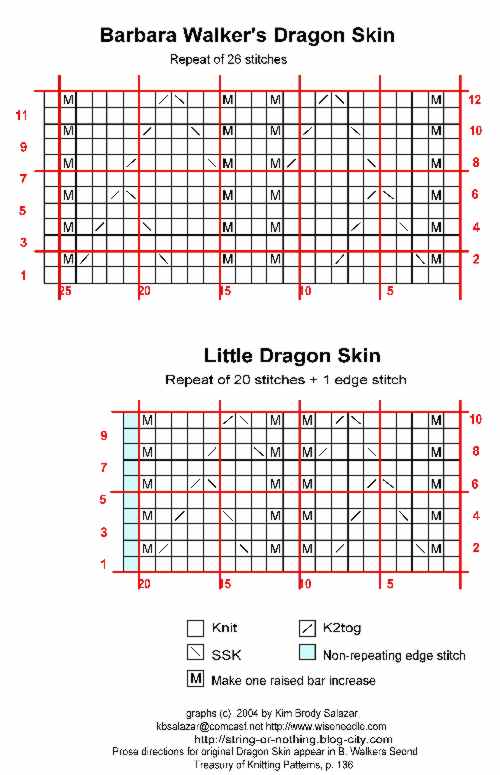
The original is definitely nicer, with wider vertical elements, but the slimmed down version is quite usable and recognizable as the other’s little brother. I’m still dithering whether or not to do the single stitch knit column between the make-ones as a normal or twisted knit stitch.
I swatched my yarn and established an unambiguous gauge for the stuff in my dragon skin patterns. I got a firm 5 stitches per inch total. Not the 4.5 spi the pattern specifies.
What to do?
First I looked at the size appropriate for Target Daughter in the original. Then I looked at the stitch counts of the next two larger sizes. I did the math to see if at 5 stitches per inch, they came anywhere near the circumference of the optimal original size. Serendipity! One did. I am using that size as the basis for all my stitch count estimations. I’ll use that size’s stitch count directions for anything relating to width, but will use the original size’s directions for length. Yes, I’m sure there will be fudging along the way, especially to eke out vertical repeats so that the cables up the side finish nicely, but I don’t think that those tweaks will be too difficult.
Can you take any pattern and do this? Yes and no. It’s relatively easy to translate between Worsted and DK (5 and 5.5spi) and Aran and Worsted (4.5 and 5spi), but harder to make this translation for larger gauge differences. Plus patterns that rely on row gauge like colorwork, or raglan shaping present additional challenges. It’s also easier to do this if you are not at either end of the range of sizes presented. If you already take the largest size in a pattern written for Aran weight yarn, and you wish to use Worsted, there aren’t any sizes left with higher stitch counts for you to play with. (If you were going the other way – you were faced with a Worsted weight 5 spi pattern that was just a tad too small – you might be able to eke out an additional size or two by using Aran weight yarn at 4.5 spi instead.)
I’ve got my basic stitch count now, adjusted for my finer gauge. The next mod is the cardigan one. The advice worked out by others suggests adding an extra stitch to the front and back so that the total stitch count can be divided by two, creating the center front break. I’m going to add three to the front, but two to the back. My width is just a bit skimpy, and I have a feeling that I’d like an extra selvedge stitch in the center front when zipper sewing and I-cord trim time comes. I’m adding one fewer stitches to the back because my new texture design has a center stitch, and I want it run down the center of the back.
The next step is to cast on. I’ll be working my Rogue back and forth rather than in the round (a loss there, I’d much prefer to work it in the round, but steeking would kill the elegance of the cables at the neckline). I note that the thing is written with a hem instead of ribbing. I like that for this cotton. Working it on smaller needles as directed should tame edge flare. Since I prefer a smooth finish inside when using a hem facing, I am using a provisional cast on – the same crocheted onto the needle one I used for Crazy Raglan. Using needles three sizes smaller than my body needles, I cast on the specified number of stitches for my chosen (larger) size, plus five more (three front, two back), and began knitting the facing.
On my first row of the facing, I decided to spot the left and right side areas in which the cable detail will happen. I did the count, figuring out which stitch will be the center sidemost stitch left and right, then counted out the required number for the first row of the cable detail chart, centered on those two stitches. I put markers in my work and left them there. While I’m not up to the post-facing bit yet, I can use the facing rows to re-count and confirm my marker placement. By the time I’m up to the first row of the main body, I should be 100% confident that those markers are in the correct places.
Next headache? Centering the Dragon Skin texture pattern repeat. On the back, I’ll identify the centermost stitch. That will be stitch #11 on my chart above. I’ll count back from that point, and begin my pattern panel on the appropriate stitch. On the fronts, I’ll also plan out from the center, working one plain stitch, then walking backwards from Stitch #21 to figure out where I have to begin my left front; and doing one plain knit then walking forward from Stitch #1 to place the pattern on the right front. One thing to take into consideration – to maintain a stable stitch count there must be an equal number of increases and decreases per row. Because the width of the back and front panels will require that I truncate the repeats, I’ll have to make sure to maintain that stitch count by fudging if that truncation cuts into an increase/decrease pair. I’m hoping that by happy coincidence, I’ll be able to work the pocket openings into the verticals naturally created in the Dragon Skin texture pattern. THAT would be nifty!
Now all that remains is to plug away at the knitting part. Like with all pattern manipulations, there’s no guarantee that my doing this will work out. I’m willing to wing it. By the time I get half-way up the body I’ll have a good idea whether or not finishing IS a good idea. If not – I’ll rip back and design something from scratch. (If you’ve read this far and noticed that I’ve screwed up my logic, please feel free to leave a comment and let me know.)
One final note – for those of you who are wondering how I can slap a copyright notice on a texture design from Walker – I am not copyrighting the pattern. She owns her prose write-up of the thing. I am asserting ownership of only my graphed representation. Have fun. Use it and other patterns shared here for your own knitting; but please do not repost or republish them without my permission.
JAPANESE PATTERNS AND MORE
Japanese Patterns On-Line
Veronik from Canada was kind enough to send us a link to a site offering Japanese patterns on-line. She points out that the most recent collections are for sale, but the earlier patterns are free. She says that these aren’t the most fashionable of the ones out there, but they’re interesting and should be useful for illustrating what graphical patterns look like.
Go to this page. (Don’t worry if the characters display as gibberish in English.)
Select the pattern you want to view by clicking on one of the thumbnail photos.
A page will appear that contains an enlarged photo. The writing next to the picture of the yarn balls will give yarn and yardage info (clicking on the link will usually take you to a page to buy the yarn). Ditto for the picture of the needle (needle size in mm, plus a link to a purchase page); and the button (notions for this piece, if any). The picture of the little page at the bottom of the stack is the one you want. Take a deep breath, and click on the linked text next to it. You’ll be asked to download the Acrobat file containing the pattern page (some but not all of these PDFs produce download errors on my machine).
Ahh. I can sense everyone looking at the result and hyperventilating…
It’s not that hard to interpret. Really.
The garment is presented in one size (a weakness of Japanese patterns) as a series of annotated schematics. Cast on numbers are given, along with lengths to work in pattern. Decreases and increases are described as a series of numbers (like 3-1-2, meaning every third row, decrease (or increase) one stitch. Do this twice). Texture and colorwork patterns are shown graphed. Other info is presented on the charts, like stitch counts both before and after major shaping has occurred; circumferences and depths, both in rows and centimeters, and the spots in which the graphed patterns or other special features are to commence.
Now there are limitations here to be sure. Not offering a range of sizes isn’t acceptable in the US. The format does assume far more knowledge of knitting than do text-based instructions. Most US knitters would find working exclusively from graphical patterns to be difficult. But the idea of using the schematics to present additional shaping or production notes is a good one, and one I’d like to see used more often to supplement written instructions.
Worth of Certifications
Lots of people wrote both on and off-list to say that I’m very wrong about certifications; that they really got a lot out of [insert name of program]. But lots of others wrote to say that they weren’t interested in accumulating merit badges, and didn’t see the value of a formal course of study. Still others wrote to say that they’d only take knitting classes from certified instructors; or conversely that they didn’t care what piece of paper the person did or did not have – so long as they imparted accurate info in a cogent, helpful, and useful manner.
I’m of the "We don’t need no stinking badges" mentality myself, but hey. Opinions, learning styles, and teaching styles differ. I respect yours if you do me the favor of respecting mine. (Notes that start out with a variant of "Jane, you ignorant slut" will be cheerfully deleted at no extra charge.)
Project Progress
Socks continue. One looks much like the other, so photos at this point would be redundant.
I’ve also finally been able to overcome Paypal’s obstinacy and pay for a copy of Rogue. I’m reading through it right now and am very impressed with the thing’s completeness (it’s 19 pages long!). I planning on how to compensate for the gauge difference, incorporate the cardigan modifications (available onthe Rogue home page cited above, via the "mods" link at the bottom of that page), and possibly even re-work the Dragon Skin texture pattern for use with it.
At the same time I’m thinking of taking another graphed pattern from my book, and adapting it for use as a double-sided double-knit scarf. All in my copious spare time, of course….
WHAT WAS THE NAME OF THAT WEBTOY?
Most of the webtoys I see out there in blogland are games, variants on quzzes, or other time wasters of that type. I’ve never seen one anything like the Name Voyager applet.
Name Voyager is a graphical representation of name popularity through time. Here’s sample output for "Kim"

Type in a name, see how its popularity rose and fell from 1900 to the present. It’s a trivial but brilliant example of dynamic data representation. Play with the thing, typing in a few letters. Mouse over graph segments to see popularity ranking by decade. Ultimo cool.
On my own name, I now see why almost everyone believes me to be a "Kimberly."? I’m not, but I’m wildly outnumbered by those that are. Plus I do note that I’m in the Kim vanguard. Most of those I meet are at least a decade younger than I am. Again, now I see why.
Have fun wasting time with this one. I certainly did.
TRENDY YARNS AND STANDARDS AGAIN
Thanks to everyone who sent kind thoughts to String on its blogiversary. I’ll keep going as long as time and fun-factor allow.
Trendy Yarns
I seem to have hit some major chords with my rant about self stripers replacing solid color sock yarns, and by extension – other trendy yarns pushing more classic stuff off the shelves. People both left comments here and wrote to me about it. I understand that yarn shops are businesses, and must respond to market forces in order to maintain their (usually precarious) cash flow. They stock what people are buying, and can’t afford to keep other things sitting around if they don’t earn their keep, too. Right now people are grabbing up the frou-frou yarns, and ignoring the other stuff.
Still, I’ll be very happy when the current wacky yarn fad dies down a bit. I am thrilled at the variety in the stores, but 95% of that variety is stuff that leaves me cold. Aside from a present or two around the holidays, or as a splash here and there for contrast, I have very little interest in fuzzy, furry, sparkly, or otherwise wildly festooned novelty yarns.
I do like texture, but not at the expense of knitability. I like boucles, astrakhans, some slubby yarns, and terry-type and velvet-type textures (especially washable ones for kids). If most loopy yarns weren’t made from mohair, I’d like them, too (mohair and I don’t get along). I also like the texture imparted by the various styles of plying – everything from densely cabled yarns made up of tons of tiny plies, to supersoft singles. Obviously, I also like classic yarns, too – smooth multi-plies in all weights. It’s all of these I want to see more of. In every fiber and blend. In colors rich enough for Byzantium, and juicy enough to eat. But not another skein of technicolor road kill, please.
Standards
As you can probably tell, I’m not a big fan of the standards efforts promulgated by the consortium of mass-market yarn makers and publishers that compose The Craft Yarn Council. While I applaud their efforts to promulgate knitting and crochet, especially their sponsorship of learning events, I find other things they do to be less effective. To be fair, I suspect that like all committee efforts, it was more important to satisfy as many needs of the membership and achieve a bullied consensus, rather than to meet the needs of the service constituency.
I’ve ranted about the yarn weight standards before. From last week’s post, you can also see I’m not keen on skill level ratings. In the same standards document they also outline standard abbreviations for knitting and crochet (no argument there, but the set is very basic); garment sizes (on the small side, but useful).; and needle sizes (which I note is not necessarily the size set used by all needle makers, nor the equivalents marked on all European labels, and which ignores knitting needles below US #1). All useful things, if limited. But the most pressing needs were ignored.
What I really wanted to see was a standardized set of knitting symbols; a standardized knitting font; and recommendations for standardizing schematic pattern representations similar to the methods used in Japan. Now all of these are probably quite controversial. Each publisher does the symbol/font thing in a slightly different way. Switching among the vast variety of symbol sets is tiring (to say the least); and lack of uniformity is one factor that has limited wider acceptance of charted instructions. I’ve tried to encourage the chart-shy as much as possible, but have found that many of them are turned off by having to learn a whole new symbol set for each book or magazine they try to use. The knitting community needs a standard symbol set. If the CYC was truly forward thinking, they’d seek out similar industry councils worldwide, and come up with an international symbol set.
On the graphical pattern layout suggestion, I’m not advocating a wholesale shuffle from text-based or text and charted patterns to Japanese style layout (doing so would probably blow mental gaskets off more than half of the knitters in the US); but many of the elements of that style would be assets if included in pattern format here. The time to suggest a standard is BEFORE a practice seeps in willy-nilly, so that early adopters all follow formats and methods as similar to each other as possible.
I’m trying to find Japanese pattern on line so I can show you what I’m writing about, but so far I haven’t found one. Yarn makers and dealers there don’t seem to provide the freebies that US and European yarn sources do. Still, here are some aids that can help you get the general idea:
- ABCs of Knitting – a Japanese knitting website (in English) that includes a basics of Japanese patterns for us text-slave Westerners.
- Reading Japanese knitting patterns for machine knitting (lots useful here for hand-knitters, too).
I note that the CYC also sponsors a teacher certification process. I’ve got mixed feelings about certifications in general, especially in disciplines that do not involve health/life-threatening, major investment, or life-bending content. Kindergarten teachers, EMTs, and accountants all have jobs that should include minimum competency and content standards. But knitting instructors?
Yes, I know that any know-nothing yutz can hang out a shingle and purport to be a knitting teacher right now, no questions asked. Many do, and have classes that quickly overtake them in competency. But at the same time, I don’t want to see instruction limited to people who have sat through a couple hours of classes and/or forked over for a paper credential from this or any accrediting body. Neither classes nor a piece of paper guarantees competency as a teacher of a hands-on discipline. All requiring such certifications does is limit the pool of teachers to those who have had the time and money to pursue the credential. But that’s the Child of the ’70s talking again…
HAPPY BIRTHDAY TO ME
Well, not me. To String. Sort of.
I’ve heard tell it’s customary on the first anniversary of blogging to link back to one’s first post and prattle on about the experience. My first post was February 12 of last year, but I dithered a bit before really getting the thing off the ground a month later.
First, thanks go out to those who have encouraged me to do this – the gang at my local yarn store – both staff and core regulars (if I began naming them all this would be like the Academy awards), BlogDogBlog‘s Lisa, QueerJoe, Wendy, Linn, esteemed needlework pals of long standing (thanks Kathryn!); folks who are frequent readers/posters here, and the KFlamers (you know who you are).
I wasn’t sure why I wanted a blog. After all, I already had a website – itself celebrating it’s tenth anniversary this year. But it’s cumbersome to update, sometimes requiring the intervention of in-house programming gods, and too structured to allow free play. I certainly rattled on enough in the various knitting-related email lists. But almost every post brought snarking from people who felt I was too long winded and was wasting their time. Plus the lists themselves are less interesting to me these days, as many of the most insightful and thought-provoking posters have moved on to their own blogs. So I decided to cut back on the eMail notes, limiting on-list participation to answering questions, and post the rest here.
String has sort of evolved into a running column on knitting and needlework in general (admittedly, with side trips), rather than a pure diary or personal log. I try to keep it up daily on weekdays, plus whenever I can on weekends. Sometimes life intervenes. I find that even though it’s daily, I’m rarely at a loss for subject matter. There’s plenty among my own projects past and present, old books, how-tos that seem to be a good idea at the time, things I stumble across on the Web, and discussions piqued by questions sent to me by others. Some weeks I have three or four general notes written up to post in advance, fitting my project progress bits in between them. Other days I write as the fit takes me, being neither disciplined enough in my habits to set aside one particular time to do so, or even trying to get something written by a particular time each day.
I guess the best part about it all is that I am no longer imposing on anyone with these diatribes. I can be more critical of things because the mass tyranny of political correctness and public niceness isn’t in force for a personal log. (It’s wonderfully liberating to lose the straight-jacket.) I no longer feel any guilt for imposing on anyone because people have to seek me out and visit. If they don’t like what they read, they don’t visit again. And that’s fine by me.
Things I hope to do with String this year:
- More how-tos.
- Continuing the series of yarn maker website reviews. Possibly starting a directory of manufacturer/distributor sites (not retailers – just makers).
- More patterns. Some of these will end up maturing onto wiseNeedle.
- Whatever other whims take me.
Things you won’t see here:
- Pictures of me.
Trust me on this. The most photogenic thing about me is my children.
DIFFICULTY LABELING
Someone posted a question on one of the knitting eMail lists yesterday, asking why some people think that cables are difficult. Then I popped into the LYS and into a discussion on what criteria were used to assign difficulty levels to knitting patterns in magazines and books. Both things happening on the same day tossed me down another rat hole of thought.
I’m of two minds on labeling patterns with difficulty levels. The first and stronger opinion is probably a product of being a Child of the ’70s. I bare my teeth, hiss and spit if anyone so much as suggests that I might like to abide within a set of limitations defined by others. I see skill level labeling as an arbitrary fence that does more to keep people in than to let them out. I’ve seen far more people decide NOT to knit something because of an "intermediate" or "advanced" label than I’ve seen people who warmed to the challenge.
Who decides what’s advanced, anyway? I’ve looked at the Craft Yarn Council standards document. They define the levels this way:
- Beginner – Projects for first time knitters using basic knit and purl. Minimal shaping.
- Easy – Projects using basic stitches, repetitive stitch patterns, simple color changes, simple shaping and finishing.
- Intermediate – Projects with a variety of stitches such as basic cables and lace, simple intarsia, DPNs, knitting in the round, mid-level shaping and finishing.
- Experienced – Projects using advanced techniques and stitches: short rows, Fair Isle, more intricate intarsia, cables, lace patterns, and numerous color changes.
By this standard, most everything that’s not written specifically for a beginner is either Intermediate or Experienced. The categories are broad enough to have very little meaning, yet are widely used, appearing in books and magazines. Simple things like the 42-stitch hat are Intermediate just because they use DPNs and decreases. (I’ve taught little kids to knit and used this as their second project, after the ubiquitous beginner’s Garter Stitch Scarf).
I think a rating system like this encourages the perception that certain things are difficult. Knitting on DPNs, for example. I see people contort themselves in all sorts of ways to avoid using them. Cables and lacy patterns, too. It frustrates me to no end to see someone who’s an effective, insightful, intelligent person bleat out "But that’s way too hard," when confronted by anything new. Yes, I know that in knitting as in everything else, there’s a bell curve of ability, and not everyone can (or would want to) explore extreme knitting challenges like complex lace; but I think that people are capable of far more than they think they are, and only lack of confidence (bolstered by ratings so generously provided by "experts") keeps them bound inside a limited are that will eventually grow stale and boring.
But then my second set of thoughts squeaks weakly in protest. In a fit of overconfidence I may place myself more towards the leading pointy end of the bell curve; but there are lots of people in the belly and trailing end who are legitimately challenged, who labor on to the best of their ability but may never have the patience, skill, or perseverance to tackle something new. They deserve to be spared frustration, and so welcome skill level labeling so they can choose suitable projects. We then cycle back to my first reaction to such labels. It’s damn patronizing for any one entity to decide what’s beyond any one individual.
Case in point, I’ve got a knitting friend who is blind. She routinely does spectacular colorwork, and is currently working on the Pacific Northwest lace shawl (you can see Wendy’s magnificent version of it here). Difficult for sighted knitters? You bet. Extra difficult for her, working off a recording of the directions read out loud? You bet. But her determination to do it and to do it well trumps all difficulties, and that determination is only exceeded by the absolute joy she experiences from overcoming the challenge.
What would I like to see done instead? It takes more real estate on the page, but I’d like to see a more granular list of skills presented, especially for leaflet or broadside sheet patterns. Something like
Skills required: Increases, decreases, twisted stitches, cables, knitting in the round, reading a chart
That’s a lot more specific than "Intermediate." I can visualize someone reading that list ticking off the skills "Yup, can do, o.k., done that, fine; hmm – maybe this will help me get more comfortable with charts," rather than saying "I’ve just started, Intermediate must be too hard for me."
Yesterday’s Rant – Self Stripers
A couple of people wrote to say that they loved the stripers and didn’t want to see them go away. Neither do I.
I have lots of fun playing with them, too. But they’ve taken over nearly all the available retail shelf space around here, and there’s lots of shelf space, so that’s really saying something. I’d like to see self stripers stay available, and see new and playful reinterpretations of the theme. But I also would like to see more of the solids be available, too, to use by themselves, or in combo with the stripers (or other solids).
OOP BOOK REVIEW – DESIGN KNITTING
Today’s library find is another knitting book from the 1970s – Mark Dittrick was the editor of Design Knitting (New York: Hawthorne Books, 1978). It’s a pattern book, featuring collections of work by Marianne Ake, Barbara Baker, Dione Christensen, Phoebe Fox, Maria Hart, Linda Mendelson, Dandree Rubin and Monna Weinman. I admit most of these names are unknown to me. A couple I’m familiar with but haven’t seen in a very long time, but I didn’t begin to knit until the mid ’80s.
Like any book of trendy patterns, this one is dated. Stuff in it was the ultimate, latest thing when the book was new, but now looks saggy, sad and dated. This should be a caution to those of you who run out and buy hard-cover pattern books. Unless the designs in them are classics, you’ve just spent money on something you’ll be comfortable using for only a year or two.
That being said, there are designs here that may be of interest. No ponchos, though. As someone who endured the ’70s I can say that ponchos, while present, were no where near as popular as the ubiquity of today’s retro patterns makes them appear. Capes were more popular. This book does contain a couple of capes, a belted cape/coat hybrid, and several kimono-style long coats. There are also lots of pullovers and a couple of cardigans. Quite a few are worked in larger gauges from doubled worsted yarn – 3 spi is typical. Sizing is limited by today’s standards, with a large (in theory, size 16-18) measuring only 38 inches around. Most pieces though are one-size fits all. I’d say they probably fit a contemporary 8-12.
The various designers favor different styles. Some are fond of the riot of Intarsia and combos of texture and colorwork popular at that time (especially lacy stitches done in very large yarns). Others use more traditional pieces and techniques. A few of these traditional pieces are very wearable as written. They include several Icelandic-style stranded yoke sweaters, two entrelac pullovers, and a feather and fan pullover. There’s an interesting and simple idea here for using short quantities several colors of yarns either doubled to knit at 3spi (or bulky weight singles) to make a tie-front jacket or vest – in mostly stockinette with scattered single-row purl welts. I can see that one looking quite nice done up? in a series of coordinating colors in someone’s bulky?hand-spun.
Much of the rest of the book might provide inspiration, but would require some modification to make the shapes wearable today. For example, a couple of designers are heavily into the vanguard of the Giant Shoulder Movement. Others use sleeves that are very wide throughout their length, or blouse out above tight cuffs like the sleeves on a Seinfeldian Puffy Shirt.
I dithered over whether to show a page with the wearable stuff, or some of the more outrageous shots that show the dated pieces. The latter is more fun:
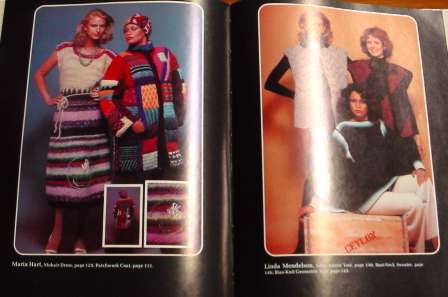
I think the model showing the belted mohair dress at the left has the most extreme "It itches" face I’ve ever seen in a professional photo spread.
THAT BICYCLE
In late breaking news, Elizabeth from Norway has provided us with a translation of the blurb under the knitted bicycle picture I mentioned yesterday. Here are her words:
Here is a translation of the blurb under the picture:
"I haven’t finished anything I started last week. On the other hand, I have finished knitting a bicycle.
It ended up with balloon tires, and it is probably pretty heavy to pedal, especially since I took the pictures before putting on the chain (which by the way is not knit, but crocheted!)"
So the piece is even more spectacular than I thought. It’s not just a bicycle cozy. It’s an art-knitting interpretation of a functional bicycle!
Amazing.
MAILBAG AGAIN
More from my inbox:
What happened to the socks you were making last week?
Finished them on the plane to Tucson and gave them as a birthday present to a long time pal and co-worker I met at the other end of the flight. Sorry. No pix of the completed socks.
Aren’t the Dark Sky socks going to be small for you?
Yes and no. They’re not for me. The recipient I have in mind has feet a couple of sizes smaller than my own flippers. I could wear them in an emergency, but it’s true that wrestling them on would be work, and that they’d be very tight. [Hi, Kathryn! :)]
The Dark Sky Socks Point pattern. I don’t get it. Why are there numbers on every row of the chart?
[A late-breaking addition to today’s post]. The pattern I doodled is worked in the round on the socks. Every round is a "right side" round, and is read beginning on the right and moving across to the left. I’ve used a very old-fashioned element for this stitch. Instead of alternating rows in which something interesting happens with plain knit (or purled) rows like in modern lacy knitting, I’ve graphed out something where there are YOs and decreases on EVERY row. This makes a very embossed pattern, but minimizes the size of what would be the eyelets, had plain knit rows been introduced. One large eyelet remains at the base of each point-bearing scale unit:

In a nifty coincidence that I wish I could take credit for, it looks like each scale unit is bisected at the point where the stripe colors change. As you can see from the zig-zags made by the single rows of pale blue, this would be an even more interesting texture pattern in a self-striper with a shorter repeat cycle. You’d get a jaunty effect with lots of up and down movement, different in look from but similar in effect to the See Saw Socks pattern I did for KnitNet.
When you use fancy stitch markers don’t the dinglebobs get caught in your work?
Yes, if I’m not careful. But being careful is second nature at this point. I also often use my "third hand" to grab markers and transfer them. The hanging doodad makes a good tag for biting.
Why didn’t you go to a yarn shop in Tucson?
This is going to shock some reading along here, but I do have a life outside of knitting. I didn’t even look for a shop down there.
I was in town on a professional assignment. I did my work, managed a couple of hours of down time and chose to use it on something unique. Yarn shops, fun as they are, mostly have the same inventory (or subsets of the same inventory) everywhere you go. Outside of small, local producers, I’m probably not going to find a ton of stuff that’s totally new to me.
I do anticipate future trips to that area. If/when they happen and if/when I have time, I might look for some hand-spun Churro wool – a specialty of Navajo traditional spinners and weavers. But barring that, there’s no real reason to schlep elsewhere to stare at the same yarns and accessories I can see at the exceptionally well-stocked LYS 2.75 miles away.
And the hoodie, possibly the Rogue?
Still swatching, thinking and planning. Target Child is waffling. I don’t want to start unless she really wants the thing. Otherwise we end up with a piece that will never be worn.
MORE KNITTING FUN
I really should hold off on posting until my thoughts have settled down. Yet again I put up the day’s entry (twice edited, too); then go out web-walking and find An Amazing Thing.
This one came cortesy of the recent referrers log to the right. I clicked on one of the links and was taken to a bicycle cozy. I wish I read Swedish, because there MUST be a fascinating story to accompany these pictures.
 String-Or-Nothing