WORKING REPORT – BLUE PONCHO
Well, teens are known for being fickle and changing their minds. My just-barely-teen is typical. She’s decided she didn’t like the patterns I’d been swatching, and picked out another from my stitch dictionary library. It’s “Serpentine Rib” from Barbara Walker’s FourthTreasury of Knitting Patterns, p. 216. The kid hasgood instincts, though. I have to agree with her. The stuff I’d been playing with looked way too clunky in the scale yarn I was using. We’re both happy now, and I’m off an running.
One very minor glitch – I have to say that I’ve caught the sainted Barbara in a rare mistake. Her graph presents even numbered rows (right side rows) of the pattern. The direction for the set-up and subsequent wrong side odd-numbered rows is given in prose.It’s given as “*P2tog, YO, P8: rep from *, end last repeat p2.It’s off by one stitch (not a big mistake), and it’s pretty obvious if you’ve ever worked faggotting in lace knitting. If you start thewrong side row at that point Walker does, you won’t produce theneat wavy lines of openwork as shown in her illustration.
Here’s my own graph of the corrected pattern, showing both odd and even numbered rows. If you try this one, be sure to remember that it does start on an odd numbered, wrong side row:

In the mean time, I’ve cast on for the poncho and have knit about 2 inches, the first of which is in seed stitch so that the edge doesn’t curl too badly. I don’t like the width though. I may end up ripping back and working one fewer repeats, narrowing the body somewhat. Otherwise I have the sneaking suspicion that I’ll run out of yarn. Not a good sign if I’m unsure this early in the project…
OOP BOOK REVIEW – THIS IS KNITTING
Still unplying. Nothing much to report that’s interesting on that front, so I turn to an old stand-by. Yet another review of A Knitting Book that Time ForgotTM.
This one is This is Knitting by Ethel Evans. It was published inNew York by Macmillan, and bears a copyright date of 1948. Here’s a typical page.
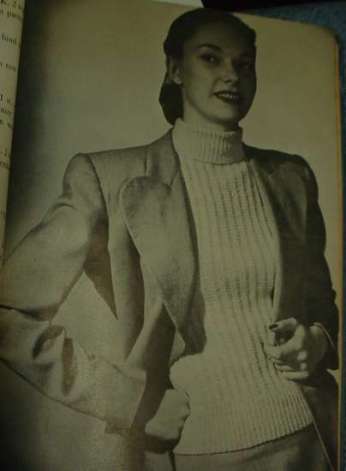
Evans book is clearly different from the Teenage Knitting book I wrote about earlier this week. For starters, it’s aimed at a general knitting audience, not one that’s mostly high school and college aged. It’s divided more or less in half. The first half presents about 40 knitting patterns for women, plus 20 each for babies, and men. The second half of the book is a stitch dictionary, giving photos and directions for about 80 or so knitting standards, including knit/purl textures, simple cables, basic lace stitches, and even some tweedy linen stitchstyle colorwork. There are no stitches in this collection that aren’t also in either Walker ‘s First or Second Treasury.
Directions are entirely in prose and like the other book, avoid confusing shorthand but are incomplete by modern standards. Finishing directions are rudimentary at best "Press pieces, sew up." Shaping isn’t dealt with well. Some photos of the adult garmentsclearly show more shaping than the pattern pieces as written will yield (perhaps judicious tailoring was done during sewing up, but that isn’t mentioned). Buttonhole placement isn’t described at all, although directions for buttonholes follow some patterns. I-cord trim used on some adult jackets is only hinted at, although it is clearly shown on the photos.
Some other odd things stand out about this book. First, there are no patterns for kids garments between about two years of age and late adolescence (when they can wear grown-up stuff). Second, the rudimentary how-to section is illustrated by flat photos of knitting on knitting needles – no hands holding them or in-process shots. It’s tough to see what is supposed to be happening in those photos. My guess is that the how to section is just preaching to the choir. I don’t think the author ever intended for anyone to actually learn knitting from this book. Maybe to use it as a refresher to remember skills learned long ago, but certainly not as a prime source of knowledge.
That being said, patterns here are more of the classics. Simple cardigans, pullovers, jackets and vests, almost all with shoulder pads. There are a couple of patterns written at worsted gauge (5spi); but most hover around 8spi. Mens patterns are restricted to very conservative vests. Even so, if you like fine gauge retro classic, you’ll find several wide-ribbed, body hugging women’s (and men’s) pieces that might pique your interest.
The two more valuable sections of the book are the baby patterns and the accessory patterns. All of the baby knits are very simple, classic shapes that are wonderfully wearable today.There are several layette sets withmatching hats, sweaters, booties and mittens abound. There is a surplice sweater plus several baby blankets that are particularly nice – the blankets being mostly the center panel in a texture stitch/wide garter or seed stitch border type. All of the baby things are very simple in design, but again like the adult patterns, the write-upsaren’t as detailed as new knitters might like. Still, shapesand techniques arebasic enough for an adventurous newbie to use this book, provided he or she is of the plunge-on-through mindset. Sadly the copy I borrowed had several pages torn from the center of the baby pattern section, including the instructions for both the sweater and blanket I liked best. (Death to the mutilators of library books!)
Accessories can be found throughout the thing. There’s a triangular head scarf that my daughter tells me would pass muster in her high school today. Gloves, socks and mittens are here, too. The glove patterns look especially nice. There’s one pair with triplecabled back I especially like. One shortcoming – the argyle sockpattern in this book is severely simplified, and doesn’t sport those nifty cross-hatchings that distinguish a true argyle from a plain olddiamond pattern – probably because NO charts are used anywhere in the directions and the write-up on where to put all those single-stitch wide lines (or to position them using duplicate stitch) would have driven the copy editor mad.
Like most of these older books anyone trying to duplicate patterns will probably run into yarn substitution problems. Looking at the list of yarns used in the book, my starting (and unswatched)swappingsuggestions would be:
| Yarn/typical gauge in book |
Modern Substitute |
| Knitting Worsted/5-6spi | Modern DK weight wool, like Heirloom Easy Care 8-ply |
| Germantown yarn/5spi | True worsted, like Cascade 220 |
| Sport Yarn/7-8spi | Fingering weight wool (too many different styles of item use this in the book to peg it down to just one) |
| Shetland Floss | Light fingering weight wool, like Jamiesons Shetland Spindrift |
| 3-ply Saxony/8spi | Easy care fingering weight baby wool. Dale Baby Ull would work. |
| 2-ply Saxony/10spi | Lighter weight fingering. Patons Kroy 3-ply? Brown Sheep Wildfoot? Regia 3-Ply? |
| 2-Ply Angora/8spi | Fingering weight angora. Austermann Angora Wolle? |
| Sock yarn/8spi | Most modern sock yarns, Regia, Socka, Fortissima |
| Crochet cotton/9 spi knit |
Modern cotton sock yarns. Fortissima Cotton, Regia Cotton |
To sum up – not asuseful nor as easy to follow as the Teenage Knitting Book. This is Knitting has some items of note, especially in the baby section and for glove knitters, but other than those, the book is interesting more as a historical document than as a still-living instruction book.
Side question: Do people find these reviews interesting or useful? Does anyone else care about old books found in musty library stacks, or about knitting’s recent history?
QUESTIONS – DRAGON AND PONCHO
As you probably figured out, I posted a couple of days of entries in advance. So to get back to feedback from Monday, thank you all for your kind words about Dragon. I hope (if nothing else) I’ve proven that projects like this that look overwhelming when done are worked in stages – everything is possible given time and determination. Pick up a favorite chart and try out filet crochet. There’s no law that says you have to do it in teeny string to start. Size #20 or #10 cotton will give nice results and will both go faster than my piece. On to questions:
Dragon Questions
What did you use to block?
The same hardware store brass tubing I used to block the Forest Path stole, and my daughter’s Waterspun poncho. The stole write-up describes them They’re described in more detail at the bottom of this post.
Why are the edges rippled?
As I wrote, I was a bit nervous about how much the piece had contracted in the wash, so when I blocked it I blocked it to the full north-south dimension. I shouldn’t have been so aggressive. I ended up with a piece that’s not under tension north-south in spite of being threaded on stretcher bars. The next time I wash it I will go for east-west stretch instead because I could stand to gain an inch in that dimension, and go for the on-door mounting bars to provide the requisite tension. That should elminate some of the looseness at the left and right edges.
How did you know how big to make the holes for the curtain rods?
After I’d done a couple of rows I tested them out with the bars from the curtain scrap left behind by the previous house owners. They fit. If they hadn’t I’d have figured out an another way to hang the curtain panel.
Are you afraid the curtain rods will discolor the panel?
Not very. It’s true they’re brass, but they’re quite old and the tarnish doesn’t rub off. I don’t intend on polishing them (I don’t want to get polish residue on the curtain). The curtains will get dusty over time. The thread I used is machine washable. In fact,I tossedmy Dragon in the light color/warm water wash just after completion, before blocking. After an entire summer and early fall of being dragged around accumulating hand-dirt, sunscreen, household dust, and the odd fleck of wine it seemed like a good idea.
Did you steal the dragon pattern from these towels?
http://hometown.aol.com/noramunro/Perugia/showsseveral beautiful set of woven towels by Alianora Munro (another member of the SCA). The last set shownhas a very familiar dragon on them. She used the same ultimate source as I did: Johann Siebmacher, Schon Neues Modelbuch, published in Nurnburg, 1597. My version is the one I graphed up for inclusion in my book The New Carolingian Modelbook: Counted Embroidery Patterns from Before 1600. There’s also a nifty drafting of the original in my friend Katheryn’s reissue of patterns from that work under the title Needlework Patterns from Renaissance Germany. (Both books are hard to come by these days, but occasionally surface used or on eBay.)I have also seen at least one commercial chart for a counted thread sampler that has a simplified version of the same motif, but I can’t find it on line right now.
Can you send me the pattern?
No. Why is at the bottom of this page.
Washing machine!! You put THAT in the washing machine?
Well, yes. The string is marked as being warm water machine washable (no dryer, no bleach). I had a load of white and light colored t-shirts with no buttons, zips or adornments to melt, snag, or run, so I put the curtain in along with them for a normal warm water/cool rinse wash. I took it out and blocked it wet. Was I nervous? Not particularly, but I had already made and test-washed a swatch, so I knew that the yarn would survive the process.
Poncho Questions
I’ve only seen the Paternayan yarn in cut lengths ready for needlework. Where did you find whole skeins?
I lucked into it at Wild & Woolly in Lexington, MA – my local yarn store. I don’t know if they had it left over from long, long ago when they might have stocked needlepoint yarn, or if they had it more recently, but by the time I found it at one of their legendary semi-annual sales all that was left was a heavily discountedmixed bag of blues – a refugee from at least two prior mid-winter sales events. I have however seen other retailers on line selling the stuff in large uncut hanks. A quick Google search on "Paternayan wool" will turn them up.
How big will you make the poncho’s rectangles?
I don’t know yet. Probably something like 13 inches wide and 39 inches long each. That’s a nice eye-pleasing 1:3 ratio. When I get up to that point I’ll cut out some paper and tape it together to make sure the target child approves of the size.
Why bother?
Why not? I have to admit that right now I’m on a bit of a yarn diet, constrained by new house expenses to using up yarn from my stash before buying new. The target child saw the bag of mixed blues and fell in love with the color. I knew thatat the fullthree plysI wouldn’t have enough yardage, and that she wanted something lacy anyway. So I began unplying…
Why do you do everything the hard way, figuring out your own patterns or just starting stuff without a good idea of how it will be accomplished?
Again, why not? People knit for different reasons. I enjoy confronting problems, figuring out solutions, and making my own way. Yes, it’s not the most productive method of working as there is more two-steps-forward-one-step-back motion than most people prefer. To me though learning something on the journey is more important than the end product, however nice. So I make a mad plunge forward on almost every project. Sometimes I shelve them for greater or shorter lengths of time. Sometimes everything falls into place and I finish. Usually I do learn something along the way, even if the thing at hand ends upvacationing inThe Chest of Knitting HorrorsTM.
Other Questions
What about the Crazy Raglan and the entrelac piece? Are you going to finish them?
Both were in the same bag and went AWOL during our move. I finally found them over the weekend and will (eventually) finish them. In the mean time, I’ve got other obligations lined up. After the poncho I’m on the hook for a triangular knitted shawl for the sister who didn’t end up with the Forest Path lace stole. I’m thinking of the Heirloom Knitting Bird’s Eye Lace free pattern, done in Lorna’s Laces Helen’s Lace in purples and blues. Possiblyadding a border strip to the long top edge of the triangle. But if I think too much about that project I’ll get derailed from the poncho, and those sad puppy eyes brook no delay.
And the Cursed Socks?
Those I AM working on right now, in between winding yarn for the poncho. After all, I can’t schlep the swift and ball winder with me to appointments. I’m about half-way through the heel of Sock #2, and hope to be done in the next couple of days soI can write up the pattern for wiseNeedle and post it along with the pattern for the Summer Lightning lacy scarf in time for people looking to knit holiday gifts.
What do you call those nifty lookingcross-hatchedwindows next to the door in your house?
My friend Kathryn (who knows lots of neat stuff) tells me that the proper name for a window divided into small panes is "mullioned." Mullioned windows appear to come in many types, including ones with lead as well as wooden dividers. Lozenge is the name for a diamond shaped pane, so I guess I’ve got a circa 1912 Arts and Crafts style two story bungalow (bungaloid?) with casements featuring mullioned lozenge transoms in the living room and dining room. Which is a long winded way of saying "old house with nifty windows that are a pain to dust."
OOP BOOK REVIEW – TEENAGE KNITTING BOOK
Here’s another review of a knitting book that time forgot. This one is The Teenage Knitting Book by Betty Cornell. New York: Prentice Hall, 1953.
Intro to knitting books weren’t invented with Yarn Girl’s Guide to Simple Knitsor any of the other ten thousand beginner books that have recently flooded the market Nor is the retargeting of knitting at a younger group of knitters something new. Yes, books are better illustrated now, yarns are heavier, and the level of knitting skill expected from beginners has decreased somewhat; but the basic idea – writing trendy patterns in a chirpy styleto encourage new knitters and enable them to learn new skills – hasn’t changed.
This book is a case in point. It’s by a woman whose other credits include a large number of girl’s grooming and fashion books. My mother says that her name would have been recognized at the time. She touts all the familiar stuff: knitting is wonderfully relaxing, it’s great to fill up time and/or keep your fingers busy, it presents a grand sense of accomplishment, it fills tactile needs, and it’s fun to get together and knit in groups. As one would expect it also asks "whynot make that ultra-trendy stole in the exact color you want instead of buying what’s available at the store" just likeits recent descendents.
After a brief intro, the book is off and running presenting several dozen patterns for blouses, sweaters, stoles, socks, hats, and dresses. Patterns range from dead simple (a dropped stitch stole flat out identical in concept to the "magic scarf" pattern floating around the Web right now); to severalpullovers that sport some nice shaping and tailored details. Yarns are small. Most pieces are knit in fingering or sport weight yarns. Sizes are also small. Although they’re labeled as being sizes 14-18, those sizes are peggedto finished sizes ranging from 34-36 inches finished chest measurement for the 14 to 36-38 inches finished chest measurement for the 18, depending on how tightly they fit. Remember – this was the sweater girl era, and fit is generally quite sleek, so I’d estimate these as being the equivalent of modern size 8-10-12. In spite of that, there are several pieces in the book that are very interesting. Here’s one of the more unusual:
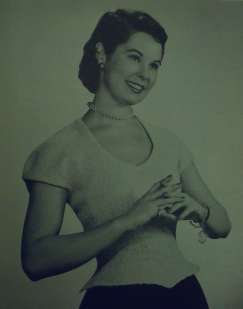
If you get past the strange yearbook pose and black and white presentation, you’ll see a piece with complex waist shaping, an interesting neckline, and set-in cap sleeves. It could be worn today. Not necessarily with pearls and a Pepsodent smile, but could be quite interesting and depending on the yarn choice – could compliment anything from jeans to velvet.
Here’s another – a classic cable sweater. This one has shoulder pads inside and the model is probably wearing a girdle to create extra waist shaping.
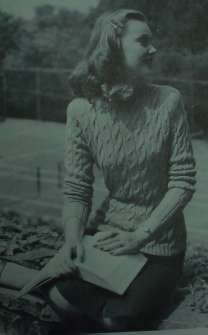
Not a boxy rendition of the standard cable, but a tailored piece featuring two different stitch patterns. Note the push-up sleeves. You don’t get that kind of fit from a bulky yarn. I especially like the way the cables flow down without interruption to the ribbing at the cuff. This piece is knit in fingering weight. Wearable now as a classic? You bet.
There are several cardigan patterns, ranging from little cropped length pearl-button cap sleeve ones to longer stylespaired with knit skirts. Very retro, yet again – wearable today. There are some men’s patterns. The one I like best is a seaman-style sweater with a very long ribbed sections at waist and cuffs – both meant to be worn folded up. It looks like something to be worn ina remake ofOn the Waterfront:
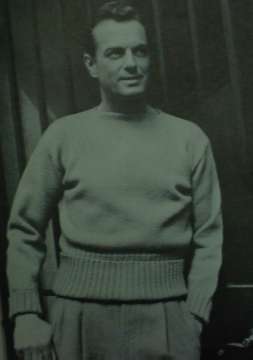
I think that QueerJoe would look killer in this simple piece.
There are also patterns for golf club covers (woefully small for today’s oversized drivers)and a couple of easy tomake afghans. A bonus in all knitting books of this vintage, there are sock, hat, glove and mitten patterns, including a very nice plain anklet, andthe hot, hotmust-have item of the day – the argyle:
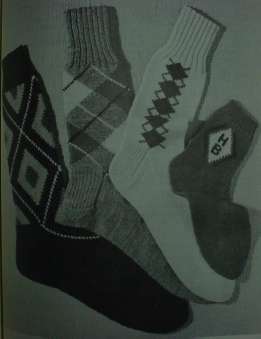
The patterns are more completely written up than most patterns of similar vintage. Colorwork is charted, but except for that all instructions are offered in prose. They don’t use the arcane shorthand common to most late 1940s/early 1950s patterns, instead directions areare presented in complete sentences. There are some major assumptions made – like the entire direction on shaping the waist frill in the top photo reads "Block peplum, then face with taffeta leaving approximately 2 inches free at each side seam to allow stretch and tacking top loosely." It may be a beginner knitting book, but some sewing skills here are clearly expected from the knitter.
The book finishes up with an 8-page how to knit and crochet section, illustrated with line drawings. Unlike most American-made books of its time, it shows Continental style instead of throwing. It’s prose-heavy compared to modern how to books, but the info it offers is succinct and well-written, covering all of the basics needed for the preceding pattern sections.
So like many of the knitting books time forgot, this one is interesting and deserves a second look in spite of its dated black and white pix, aged and plain library binding, and 1953 copyright date. Many local public libraries have vintage books that you may have skipped past in your search for newer stuff. Go back and revisit the older volumes. Not only are they knitting history, they’re an excellent source of inspiration for knitters today. Besides, if they sit on the shelf idletoo long the library staff might cull them from the collection, and we’ll lose valuable info that can be supplanted, but can never be replaced.
WORKING REPORT – BLUE PONCHO
Now with Dragon put to bed, I can turn to my daughter’s blue lacy poncho. Over the weekend we went paging through pattern books and looking at old projects. She lit upon a couple of lacy looking stitches that she liked.
The first is the mock cable I used as the edging for Justin’s Blanket on wiseNeedle. The thing didn’t photograph well there, and the instructions for that counterpane are in prose, so here’s a wider version of the same idea. (Apologies for the lousy quality of these charts. For some reason my standard Visio to Fireworks graphics prep cycle is spitting out oddlynon-uniform results today.)

The second is a lacy panel adapted from a wider pattern appearing in B. Walker’s Second Treasury of Knitting Patterns. The original isn’t graphed, starts in a different place of the repeat, and is set up for multiple iterations of the ribbon. I pared it down to just one repeat to make a self-contained panel:

Both are lace knitting patterns in that they have something happening on every row. If one is knitting in the flat (back and forth on two needles) you can see that maneuvering to do a P2tog tbl (purl two together through the back of the loop) on a wrong-side row might be awkward. Whichever panel is chosen, it will probably alternate between sections of K2 P2 or K3 P3 rib.
As far as swatching goes, I’ve been playing with my de-plyed Paternayan. Thinking that the 2-ply result of my pains was rather thicker than sport, but thinner than DK, and that I wanted a lacy effect, I started swatching on US #9s (5.5mm), and worked my way up through needle sizes to #13s (9mm). I’m wavering between #11s (8mm) and the #13s. More swatching is in order, especially swatching to see if the 11 or 13 looks best with the plain old ribbed part, and to make a nice, even piece to determine gauge over both textures.
In the mean time, I’ve decided to run the color stripes on the vertical rather than the horizontal. That means I’ll figure out how wide the rectangles will need to be for this poncho, figure out some pleasing alternation/panel widths for the chosen lacy part and ribbed sections, then decide which panels need to be in which of my three available colors (blue variegated, plus wedgewood and slate blue). Once that’s decided it’s cast-on time, working the color stripes with Intarsia joins between them – each from its own ball.
Did I mention “Figure out if I’ve got enough yarn?” Gotta do that to, especially because seven skeins (3 variegated blue, 2 each of my two blues) de-plyed into 10.5 skeins (4.5 variegated, 3 of each blue)equals 1,764 yards That’s 756 yards of variegated blue, plus 504 yards each of the two blues. In total it should be enough, but I may need to get very clever with color placements to make sure I don’t run out of anything.
DRAGON RESPLENDENT
The dragon blocked, finished and mounted. From the outside:

and inside:
 |
 |
Close up from inside, showing the brass rods running through the top and bottom double-wide meshes:

Signature (KBS, ’04)

As you can see I was a tad overly aggressive in blocking north-south. I noted that it had shrunk a bit in the wash (yes, I machine washed it), and stretched it severely. I needn’t have because the stretcher bars that are used to mount the thing would have taken care of that.I could instead have stretched it more east-west so that the edges don’t draw in so much. The next time I wash and block my dragon panel, I’ll do just that.
Am I happy with it? You bet!
DRAGON – DONE AND BLOCKING
A lousy picture, to be sure:
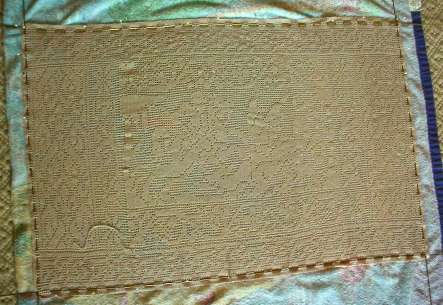
But I’m finally finished. Dragon has been washed and is now laid out with my blocking wires. Trapezoidal distortion is an artifact of standing at one end and photographing at an angle, then presenting the photo rotated 90-degrees.
Oncemy panel isdry I’ll darn in the ends, embroider my initials and a date in the corner, and hang the thing on the door. Why am I waiting to darn in the ends until after the initial blocking? Mostly because I knew that blocking would stretch the thing out considerably. I was afraid that if I darned them in before that stretch I’d risk having a puckered area where elasticity was hampered. I do have a little bit of a ripple along the edge of my original cast-on row, (along the tree behind the knight) but I’m hoping that it will settle in over time.
I promise one last picture of Filet of Dragon once it’s hanging up on the door.
Blue Poncho
The unplying continues. And continues… I can report progress though. I’ve almost got enough to begin swatching, and the Target Daughter has picked out a couple of stitch patterns that she likes from other things I’ve knit and from my library. Leading candidates include "Lace Ribbon Stitch" from Walker II (p. 284); K3, P3 rib; and a mock cable. Both are true lace stitches in that they have YOs, and decreases on every row, with no intervening plain rows. I’ve also got three colors of blue to play with. I’m thinking of running them side-by-side Intarsia style, withthe colors corresponding to the lace orribbing panels used. It may be just another poncho, but who says knitting it has to be boring.
More on this tomorrow, too as I get more of the initial swatching and drafting done.
REFERENCE – PREPARING NEW SKEINS FOR KNITTING I
I’ve noticed a spate of questions from newer knitters of late – via eMail, on wiseNeedle, in the mailing lists and in Live Journal forums – all asking about how to wind balls, or start skeins, or asking about the different yarn put-ups. I thought I’d help.
Part I – Shapes of the Beast
Knitting yarn is sold in many different configurations. Here are a few of the more common.

1. Large amorphous glob. Actually this is a hank or skein, similar to #6 and #7, but it’s massive and rather shop-worn. Like all hanks or skeins, it has to be rolled up into one or more balls before knitting can begin. Examples: Rainbow Mills Pebbles (shown); Schaefer Elaine and Miss Priss.
2. A spool-like ball, with the yarn rolled around an inner form. In this case, there’s a large cardboard tube inside. I’ve also seen yarns rolled around spongy centers and plastic foam cylinders. I would not recommend long-term storage of yarn wound on cardboard for long periods (read 7+ years) because cardboard is acidic, and the yarn in the center might discolor or become brittle over time. Spooled yarn can be knit as-is, without rewinding by finding the end and just starting. The spools will skitter around a bit, so keeping them in a bag while you’re working can be a good idea. Some of the ribbon yarns sold on spools benefit from being unreeled toilet-paper-roll style instead of being pulled off the top while the spool sits on its flat end. Doing so can minimize the number of twists as you work. I sometimes use an improvised axle type arrangement for unreeling (more on this in another post). Example: Plymouth Colorlash (shown); Berroco Suede
3. Cones. The thinner machine knitting yarns are often sold on cones. Sometimes you can find heavier yarns on cones, too – especially from mill-end shops. Coned yarn can be a great buy because the maker didn’t need to pay for the machines or labor to wind it off into balls or skeins. Coned yarn can be knit as-is, although just pulling it off the top of the cone can also introduce twisting. Some people prefer to unreel coned yarn using an axle set-up, or to wind the yarn into balls. While coned yarn also has a cardboard core, the high yardage on a cone means that relatively little of it is in direct contact with the yarn compared to the short yardage spool style balls. If I thought a coned yarn (especially a white or light color yarn)might languish in my stash for a decade or more I might be tempted to wind it off into balls. Example: Classic Elite Believe – bought at the CE outlet in Lowell, MA (shown)
4. Mushroom style puffballs, usually speared in the center by an arrow-ended tag. I hate these. They’re always 50g, short yardage, and they appear to be among the most favored put-ups used by high end makers of expensive yarns. They behave especially poorly on the shelf or in the stash, losing their tags and falling into floppy messes at the drop of a hat. They can however be knit directly from the ball without rewinding. Sometimes if your fingers are clever they can fish the tail end out of the center, and they can be used either as center-pull balls or from both ends at once. Example: Grignasco Top Print (shown): Debbie Bliss yarns; On Line Linie 157 – Tessa.
5.Log-style wound skeins. These come in many sizes and price ranges. The giant format here is most common among lower cost mass-market yarns. The same format (but much smaller) is often found for more expensive yarns – notably European import cottons. These log skeins do not need any preparation. Most have both ends accessible on the outside, and can be knit from either end. Examples: Red Heart Super Saver (shown); Marks and Kattens Indigo Jeansgarn; Southmaid Cotton 8
6. and 7. These are standard issue hank style skeins. They are the most economical put-up for makers to use, and the most common among small producers and hand-dyers, although they exist across the entire spectrum of yarns. Typically they’re made from yarn that’s been wound into a large diameter circle, then twisted a bit with one end inserted into the other. It’s easy to reduce them back to a single big circle. While some people claim they can untie the little strands holding a hank together, place it on the floor and knit directly from it – I wouldn’t recommend the practice. It sounds like an excellent opportunity to make a tangled mess. Save your sanity. Wind hanked yarn into balls before knitting from it. [More on this in another post]. Examples: Bartlett 2-Ply Worsted, Rowan Rowanspun 4-Ply (both shown)
8. Wound cheeses without center cores. Some yarn shops take coned or hanked yarn and wind it into these machine-assisted balls before selling it, often marketing the result as an in-store house brand. If you buy an inexpensive ball winder you can make these, too. Cheeses can be knit from either end and do not require rewinding before use. Example: Ball I made myself from Paternayan 3-ply
9. Small logs. These skeins are cousins of #5. They can be used as-is from the outside end. Very clever fingers can feel around the inside and pull out a glob to retrieve the inside end. That way these logs can be used as center pull balls, too. Example: Lana Grossa Melienweit Fantasy; Schoeller/Stahl Socka/Fortissima
There are other put-ups out there, this is not the full roster of what’s out there, but it’s pretty representative.
Why are there so many forms? Why isn’t everything sold knit-ready? Mostly it boils down to economics. Industry pals tell me that the machinery to make nice, neat ready-to-knit balls is expensive and hard to find. It just isn’t being made any more. For example, I’ve heard tell that Classic Elite uses some winding machines that are upwards of75 years old. If one of those machines breaks beyond repair, it can’t be replaced. They’ve had to reformat several of their yarns because of this problem.
On top of the machinery issue, winding is labor-intensive. Again, older machines require constant attention by operators, and using them is a multi-step process. For the most part, the industry just doesn’t have the volume of say a soda bottling plant. Except for the very largest producers (Caron, Coats & Clark), all knitting yarn makers/distributors rely on a level of labor that’s uncommon today. Labor is expensive. In an effort to minimize these costs, some makers have turned to less labor intensive put-ups, most notably selling in skein rather than in ball.
The sticker shock factor is another force contributing to the multitude of different forms – especially the prevalence of 50g sales units. Yarn is expensive. I’ve seen people shy away from larger 4 ounce skeins with hefty price tags, yet buy the equivalent dollar amount of yarn marked at $5.50 per 50gball. That lower per-ball price is a very seductive thing, even if the same total purchase price was expended. People also hate having to buy extra. If yarn came in 200g skeins and the typical project required 275g, a knitter would end up having to buy 400g to complete it. That’s 125g more yarn than needed. If the yarn came in 50g balls he or she would only have to buy 300 g – only 25g more than necessary. That overage translates to added cost and decreases the chance that the purchase will be made.
Does form factor influence purchase choices in general? I’d have to say yes. It does influence some people. I know several knitters who flat out refuse to wind hanks. They won’t buy any yarn that’s not ready to knit. On the other hand, I also know several that won’t touch a balled yarn, preferring to knit from yarns that come in hanks (I think there’s a snob factor here – they believe that all hanked yarn is superior to all balled yarn, although we all know that blanket statement “alls” are rarely true).
I can also point to one yarn that’s a business-case poster child for the psychology of put-up influencing yarn purchase. That’s Classic Elite Wings. Although there are no reviews yet, it’s a nice yarn – a classic finish alpaca/silk/wool blend that’s soft and comes in attractive colors. It’s relatively pricey, but no more so than other soft alpaca blends of similar weight. I saw it on the shelf at my LYS but noticed that people would pick it up yet buy other yarns instead. So I asked why. It turns out that the new format CE was trying out – sort of a hank folded in thirds and wrapped around the middle with a paper ball band -looked floppy and small compared to other yarns of the same weight/fiber/yardage. Those yarns came in happy little fat balls. They may have been the same 50g and within a yard or two of the Wings, but that wasn’t evident from the put-up. The balls plain old LOOKED bigger, even though they weren’t. Buyers were choosing the other yarn not because of color or price, but because they thought the balls were better buys.
Does form factor influence my own purchases? Generally not. I detest the mushroom ball, but if the yarn is attractive enough and priced right, I’ll buy it and use it. I do admit non-rationality in that I always feel rooked when a big, beautiful, squishy ball ends up being a thin veneer of yarn on a big, fat, sponge center, even if I’ve studied the per-ball yardage and know exactly how much I’m getting. I don’t mind winding hanks into balls. I figure that having to do so myself is saving me around 75 cents per skein; or is part of the entrance price for getting to use a custom-dyed or artisanal yarn.
WORKING REPORT – BLUE PONCHO YARN REDUCTION
I can now safely agree with everyone who has ever told me that I wasn’t in my right mind. The proof is in the venture I embarked on with my daughter’s blue poncho.
There’s no ponco yet. There’s not even a gauge swatch. What there is is this:
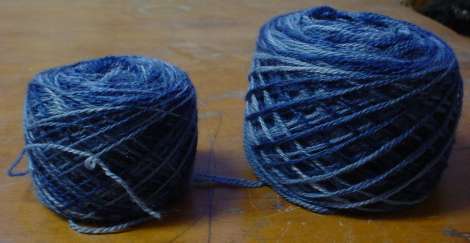
This is one skein of three-ply construction Paternayan RN1685 Wool, after it has been de-plyed into a two-strand and a one-strand ball. While this stuff is most often sold in short lengths used for needlepoint and embroidery, it is occasionally sold in larger hanks for knitters and weavers. Time expended? Just under three hours. Sanity factor, considering this is just one of seven hanks? Nil.
Still, a promise is a promise and sad-child puppy eyes brook no delay. I’m midway through the second skein. Once I get one of each three colors, I’ll begin swatching. With luck by that time ponchos will still be in style.
Dragon Thread
People In Other Countries have asked for more description of the #30 crochet cotton I’m using for the dragon panel. Here’s the scoop straight from the label:
J.P. Coats RoyaleExtra Fine Size#30 Crochet Thread. 100% Mercerized Cotton. Article #160; Color #226 (Ecru). 500 yards per ball. Weight unmarked but registering around 100g on my Kitchen Scale of Dubious Accuracy.
Recommended crochet hook – .75mm/#12. Machine wash delicate cycle, 40-deg C/104-deg F. No bleach, ho dryer, may be ironed on hot. Blocking recommended.
Made in Hungary. Distributed in the US by Coats & Clark, P.O. Box 12229 Greenville, SC 29612; Distributed in Canada by Coats & Clark Canada; Mississaugua, ON Canada L5T 2T5.
While the Coats and Clark website is also listed on the label: http://www.coatsandclark.com, don’t bother looking for Royale there. It’s not listed. Royaleis definately shinier and silkier thanCoats Big Ball Size 30. I’ve never seen Coats Opera thread, so I can’t say how it compares to the Royale. I bought mine at evil big box craft store Michaels. Their own listing says that the stuff is exclusive to their stores.
DRAGON – GETTING THERE
I don’t know when this will make it live. Blog City is doing some maintenance today, and public posting may be delayed a bit.
Back from a fragmented long weekend full of family, and finger-healingI present what progress I’ve made to date:

It’s getting tough to photograph this puppy because it has grown so large. Maybe by the end of this weekend it will finally be done. To calculate how long I’ve been working on my dragon curtain – I started experimenting back at the end of June, and began working on the piece over my July 4th week vacation. That’s over four months andaboutfour balls of size 30 crochet cotton. Given the low per-ball price, I’d say (aside from time)this was the most economical major project I’ve ever undertaken. Costs were something like $2.95 per ball, plus $1.50 for the crochet hook.
On where I was and what I was doing this weekend past – we had a wedding in my extended family. My cousin married a really nice guy from Finland. The wed locally, and my weekend was filled with family and festiviites. Many of the groom’sfamily made the trip over for the occasion. I regret that time and a language barriermade communication withthe new Finnishfamilydifficult, becauselate in the weekend I found out that the groom’s aunt is an avid knitter. Since (believe it or not) one of the largest sources of hits for wiseNeedle’s knitting glossaryis Finland, I would have loved to have discussed knitting with her.
In any case, if word filters back through family channels (some of them are String readers) – feel free to pass the word along. Is there a general renaissance and new generation of younger knitters there, too? What are people making over there – are trends towards the traditional shapes, motifs and garments, or are they leaningtowards reinterpretations? I get to chat (or read along) with knitters from many other parts of Europe, but Finnish is a barrier that’s hard to penetrate.
 String-Or-Nothing