QUESTIONS AGAIN
Still not enough progress on Dragon to make an interesting photo, so I’ll answer questions from my inbox instead:
What yarn did you use for the Spring Lightning scarf?
I usedGreenwood Hill Farm 2-Ply Lace Weight Merino. Greenwood Hill is a small sheep to skein outfit based in western Massachusetts. The yarn is a light, airy handspun that’s much loftier than Skacel’s Merino Lace or the Suri Alpaca laceweight I used for the Forest Path stole. It’s more like an etherial and soft fingering, with some thick and thin bits. I got this stuff at Greenwood Hill’s booth attheannual Sheepshearing Festival at Gore Place, andhand-selected the most uniform of the skeins available for this project. They also maintain a website.
Come on. The disappearing sock thing. Did it really happen?
Yes. I’ve got several suspects in mind for who is responsible for the anonymous return, but I’d rather leave the thing a mystery. It’s a better story that way. And in a corrolary – even though socks and a Massachusetts house built in the teens are involved, I think it’s stretching it to say that my mystery has any talismanic significance fora Red Sox victory.
Does the Flame Tamer work?
To a limited extent, yes. It does allow for a slowerboil than does cooking over an unbated burner. Can I get to a true barely bubbling simmer? Not quite. Thick beans and stews need careful watching,and are better offcooking in a covered iron pot placed in a very slowoven. Reheating though is less of an iffy proposition using my new gizmo.
Would I like to trade photocopies of the IK magazines for photocopies of some other pattern/mag?
Not on your life. My offer isto trade theoriginal magazines, not some pirated duplicates.
This is an issue about which I feel most strongly. Pattern and magazine sharing have killed publishing and innovation in several popular needlecrafts. So far on-line knitters as a group have taken the high road and have established a culture that discourages piracy. Crocheters and especially cross stitchers, needlepointers and people who do plastic canvas work have not been spared the effects of unauthorized copying. Witness the comparative dearth of new stuff published in each of those crafts. One would think that with knitting in the ascendency, crochet wouldn’t be that far behind, but I believe the lag time is in part a response to the vast amount of stolen material available on the web. Publishers just don’t believe they can make money in that market, so they’ve been slow to return to it.
Upshot of it all. I don’t steal and I have absolutely no respect for those who do.

I created this logo for a group of concerned people headed by Linn Skinner. She (and the committee) went to extraordinary lengths to bring this issue to the attention of the needlework publishing industry early on. Unfortunately lack of resourcesindustry-wide coupled with with burdgeoning technologies and the immense size of the problem have hampered prosecutions. But that’s "hampered" not "eliminated." I for one report any serial/habitual infringers I find to the copyright owners. And I don’t always travel under my familiar on-line identities. Beware.
CHEAPER THAN JAL
Today bodes to be a chaotic day, with Real Life intruding on the time I usually squander on blogging, eMailand wiseNeedle maintenance. There’s a Family Event in the works for this weekend, so there are obligations that need to be met that require setting disorder aright, the creation of foods, and dressing/attending the actual group activity. Therefore do no be surprised if little gets posted here over the next 48 hours.
In the mean time, I can report on last night’s midnight ramblings. Some of it is knitting-related, some not.
First, I went off web-walking through Japan again. No I don’t read Japanese, but I do read Picture. Even if the text is beyond me, I always find tons of inspiration (and not an inconsiderable bit of whimsey) in what turns up. Of course I visited my standardsources of Japanese knitting fun- The Hand Knit Lab and the ABCs of Knitting – neither one of which has been updated in a long time. But I did find new stuff, too.
On the inspiration end is the Motif-Motif website. As far as I can tell, it’s a retail site offering finished knitted garments. Quite a few sport interesting features, including asymmetrical closures and a freshuse of textures – including crochetand crochet used in combo with knitting. Some of the crochet might be a little over the top for my tastes, but even done at the scale of these pieces, it has a better drape and flow than the clunky wool stuff I blogged about before. Click on the thumbnails to go to that offering’s page, then click on the gray bar with the little magnifying glass in it for multiple views, close-up. I especially like the button-use idea in this piece.
On the whimsey end, there’s this illustrated story of learning to spin, weave and knit. Again, I haven’t a clue as to what’s actually going on here, but I can (sort of) follow along with the story from the adorable illustrations. Click on the little hand illustration to page through the whole thing, or on the text link below it for a quick dose.
Finally, this has nothing to do withyarn. I was visiting Boing-Boing,always a source of the unexpected. There I found a link to ZoomQuilt. Be VERY VERY patient.ZoomQuilt takes a long time to load, and you may time-out. If you get the plain-text white intro page, click on the link at the bottom, then use your up and down arrows to follow along.
Enjoy!
WORKING REPORT: PATTERN WRITING – SPRING LIGHTNING SCARF
Face it, incremental progress on the Dragon is as boring to see day in and day out as it is to report. The thing is chugging along, but I’m past the part of the process that’s interesting. There are no new challenges or problems to overcome – just plain old slow and steady progress. On my other projects, I’m stll looking for the bag with the raglan and entrelac pieces. It’s here somewhere. Emphasis on the somewhere.
So I turn to another intellectual exercise with a challenge factor increased by prior laziness and poor timing: writing up a pattern for an object that I finished a while back, and on which I took very few working notes.
To be truthful, my Spring Lightning scarf is better documented than most of my efforts. Blogging does serve a purpose after all. I did find the scarf itself – a happy byproduct of my continuing quest for the striped raglan sweater.I’ve got the graphs I printed out to start with, although Providence alone knows where the copy I annotated as I worked has gotten to. And that city’s not talking.
I begin with a photo or two. I’ve posted these before. Unless people here think that these are adequate, I’ll have to take another that shows the piece relaxed and ready to wear. No I won’t take a shot modeling my scarf. I prefer to labor sight unseen.

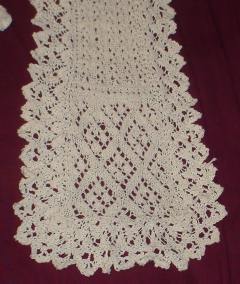
Now I can figure out my original cast-on number from my chart. I remember that I worked slipped stitch selvedge edges, because I used them when I was knitting the edging on to the finished strip. I didn’t document the little welted eyelet bits between the main pattern sections, but that’s easy to retro-engineer. My original charting didn’t include the long (but simple) zig-zag motif used the scarf’s center. I did that one up off the top of my head as I was working. I think I can re-create it though with minimal trouble. With luck my fingers will remember the pattern.
The edging I do remember playing with, so it’s not quite straightforward. I started with something that was much wider than the final version- arelatively deep lacy edging adapted from one in Heirloom Knitting, but I tinkered with it a bit. Plus I used the pull a loop through and knit with the slack method of knitting the edging onto the body that I learned doing the Forest Path Stole. I’ll have to figure out a way to write that up that’s both original and non-confusing. I think that will be the most tricky part.
So it’s off to boot up the house server, pull up the pattern template in DreamWeaver and Homesite, and code the thing up for wiseNeedle. One thing I won’t be doing this time is rewriting the entire pattern in prose format. I doubt that anyone who would want to knit a lace piece of this complexity is going to want to wade through prose directions. Plus there’s only so many hours in my day, even if I do stretch the definition of a day by being among the "sleep optional" part of the population.
PROJECT: WORMING HARLEKIN CARDIGAN
Here’s yet another cautionary tale. This one is about worming.
I’ve seen lots of questions about worming – what is it, why does it happen, how to avoid it. The what question is easy to answer. Here’s a quick little cotton/chenille cardigan I whipped up for The Smallest One this past spring:
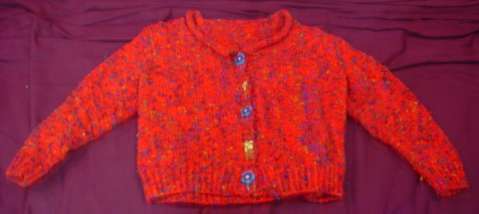
It’s knit from Stahl Wolle’s Harlekin Color, a rather plain generic raglan in stockinette, with a rolled collar and cropped waist. I did up the pattern (such as it is) using Sweater Wizard. That part and the knittingwent well, although the yarn split like crazy and was a *($# to knit. The thing is bright and cheerful.The Smallest One had fun picking out the pansy and bee buttons. I even went back and got more of this yarn with a navy base color and knit a raglanpullover for the larger daughter.
Things however began to go wrong shortly after completion of both projects. Both sweaters began to worm. The little chenille strands separated themselves from the cotton yarn and began poking up here and there. Hand washing however caused all restraint on worming to break. In spite of the lousy photo, the result can be seen here:
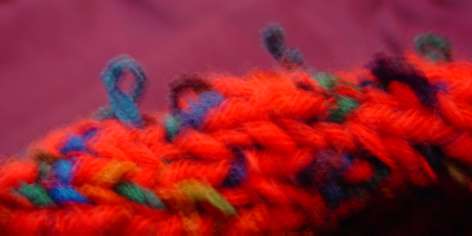
No I didn’t tease these loopies up, nor did I pick a particularly bad part of the piece. The entire surface is like this now – a ratty, trashy looking mess. The kidlet still likes her bee sweater because it’s soft, but it catches on everything it comes near and I shudder each time I look at it.
Moral of the story. Chenille isn’t worth the effort. That’s four for four projects I’ve attempted using chenille or chenille mix yarns that have ended up looking like hell within a fortnight of completion. It’s pretty andthe colors are great, plus Iknow some people love the stuff and swear that they can control the worming. I’ve tried knitting it more tightly than label gauge. I’ve tried knitting it in combo with something else. I’ve tried chenilles of different fiber compositions, but I’ve never had decent results. Buyer beware. This buyer will never purchase nor work with chenille in any of its forms ever again.
More Mags to Trade
Courtesy of a very generouspal, I find myself with duplicates of two Interweave Knits back issues: Fall, 2003 and Winter 2002/2003. I’ve got both in my library, and useful info shouldn’ sit idle.
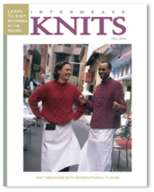
If you’re looking for these and would like to engineer a trade, please let me know. Preference will be given to folks outside the USA. I know that people In Other Countries often don’t get a chance to get these mags, and we here in the US often don’t get the treat of seeing needlework publications from other countries. I’d love to trade one or both of these for one or more knitting, embroidery, crochet, or other specialty needlework magazines published elsewhere in the world – language doesn’t matter. If you’re interested, please let me know.
WORKING REPORT: DRAGON, DRAGON
Still working away at it, I’m afraid. I had hoped to be done by the end of this week, but it looks like another two weeks ofthe bottom borderlie before me.

It’s not procrastination – it’s injury.
To get this piece to look nice and solid, I’m working rather tightly. That means that each double crochet that’s worked into a one below involves a little bit a jab to pierce the previous stitch. Unfortunately, the way I hold my work and form the stitches means that that jab goes right into the tip of my left hand middle finger. Now for most crochet it doesn’t matter, the hook is nice and big. But for this piece the hook is just pointy enough to make long sessions painful. This weekend past I cracked the stitcher’s callousthat I’ve been building up,and had to put my curtain aside so that I wouldn’t stain it as I was working.
There are various solutions to this problem. Quilters, stitchers and crocheters who often run afoul of finger-sticks use a band-aid or piece of tape on the receiving finger. Others use thimbles or leather finger protectors. There’s even a couple of products sold for this purpose – small dot-like patches of adhesive plastic, and paint-on "second skin" acrylics. I’ve tried some of these, but always found that I had a harder time controlling tension and placement with anything that got between my fingers and my work. I guess Irely too much on feel. So instead I try to pace myself to avoid breaks like the one over the weekend. I can’t give up on it now, though. I’m too close to the end to let something silly like bodily injury slow me down.
RETURN OF THE PRODIGAL SOCK
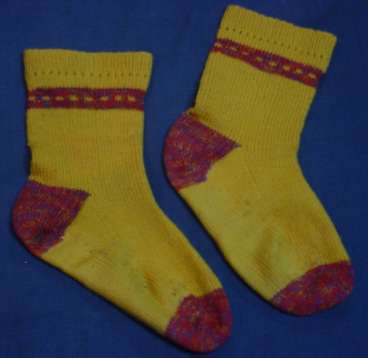
A long, long time ago, I sent in an entry to the Socknitters Museum of Odd Socks. In it I detailed the tragedy of losingone of the firstfingering weight yarn socks I ever knit – an eye-popping mustard yellow thing, with toe, heel, and ankle stripe in a tweedy red left-over. That must have been back in the summer of ’96, just after I moved to my last house, and (coincidentally) just after the sock bug bit me.
In all that time my missing sock never turned up. Although I was sure it would reappearbehind a bureau or underthe washing machine,I didn’tfind it when we moved out, although we left the old house broom clean and bare to the walls. I came within a hairs’ breadth of tossing the mate to my missing sock when I divested myself of others during The Great Sock Exorcism. At last minute though, I took my mustardy friend out of the toss-me pile and tucked it back into my sock drawer as a reminder of life’s eternal mysteries.
Yesterday I got an envelope in the mail. Itcontained the missing sock.
No note. No return address. The postmark was local, but not in town. My guess is that the new owners of my old house found it – where I haven’t a clue – and knowing I probably missed it, mailed it to me. Either that or the colorblind poltergeist finally had enough of the thing and decided to send it home.
REVIEW: INKNITTERS FALL ’04
I’m a sucker for an interesting knitting article. Sadly all too few magazines are providing them.Vogue used to have them. Knitters,too. Of late both have skewed to intro-level stuff, or mindlessrah-rah pieces. Interweave Knits started out hosting articles, but has changed to more of a pattern focus of late. Threads used tohave fabulous articles, but they abandoned handwork in all its forms, including knitting. Piecework has an occasional interesting bit, but not at the depth or breadth of what Threads used to do.Family Circle/Easy Knitting is deady dull and aimed at someone else. Who I’m not quite sure because it’s too dowdy foryounger beginning knitters, yet too simplein style and execution for other age groups. Even the patterns in most knitting pubs of late have left me yawning. So it was with extreme skepticism that I picked up the Fall ’04 edition of Inknitters. Oh boy. Another mag to leaf through and not buy.
What a surprise! I will say that I didn’t much care for the adult sweaterpatterns in the issue. There are lots of them and most are o.k. but none grabbed me with that gotta-knit urge.But that’sfinebecause what sucked me in and kept me flipping pages were the articles. Articles for thinking knitters! Lots of articles!
To start off, there’s Lucy Neatby on her special magic buttonhole for double thick button bands. This stellartechniqueis pretzel clever and makes me want to design up a cardigan just so I can try it out. Lucy’s Tradewind Knitwear even published this trick as a separate broadside pattern sheet. And here it is in this issue, elaborated upon at length and described in depth far beyond even what the pattern sheet offers. This one technique alone is worth the price of the entire magazine.
Then there’s an in-depth article by Joan Schrouder (aka the KnitList’s St. Joan) on steeking, especially for curved and angled areas. Again, just one article that justifies the entire purchase cost of this issue. Going on, there’s an excellent article on finishing tecniques by Jaya Srikrishnan, detailing various no-sew techniques that can be used in various forms of finishing (i.e., picking up stitches, three-needle bind off).
More! There’s an article on cross-pollination among needle arts – using knitted fabrics as a basis for further sewing and embellishment. I may not like all the things that are presented as examples, but the thought of combining skills/crafts is a headyconcept ignored by every other single-focus publication. There’s an article on adapting standard computer spreadsheet programs to track pattern progress, calculate rates of increase/decrease, and to produce knitting pattern charts.
Wait! More!! There are articles on short rows, and their use in directional knitting; ontroubleshooting common mistakes and how to fix them; on designing collars of various types; on inserted seam pockets; and something about knitting machines which I admit I didn’t read through.
I don’t gush, and I don’t do endorsements. But I’m filled with enthusiasm by this rag. I’ll be subscribing and (probably) picking up all the back issues as well. What a happy find.
PROJECT: MAGENTA’S COMING OVER!
No, the kids’ Blues Clues videos haven’t gotten to me. One of my all-time favorites is a sweater done in screaming magenta wool. I did it ages ago, back when I was a regular customer at Washington, D.C.’s late, lamented Woolgatherer in Dupont Circle.
There was a guy helping there who was fantastic. Back then I had the itch to knit, but a ramen noodle?budget. ?I’d walk in, pull my crumpled dollars and left-over laundry quarters out of my pocket and say "I want to make the most magnificent thing I can afford."? And he’d find it. Sometimes we’d find a luxe pattern and a budget yarn, pairing them against all likelihood of success. Sometimes there’d be an odd lot or strange color at an off price, and he’d spend the time to hunt down a project that could be made from that amount. On top of it all, he had fantastic color/style judgement. Not only were his recommendations fun to knit and in my price range, they were also great wardrobe additions in colors that always suited me. He’s gone now – yet another AIDS victim, but I think of him fondly whenever I wear the things he helped me with, or show someone else one of the pointers he shared. Alas, I am truly ashamed to admit that for all the times I visited and all the help I received, I never learned his name.
This item is proof of his expertise. Magenta?? Who can wear something that loud?? It turns out that I can. The yarn is Brown Sheep Lambs Pride. I knit this around ’86 or so from an Aarlan pattern appearing in one of their large-format magazines – possibly from that year’s fall or winter issue (I haven’t found the box with it yet, otherwise I’d be sure).This is?a case where cross-materials substitutions worked well. The original pattern was done in a linen/silk combo. The?yarn?was a very expensive yarn that would have cost me easily five times what the Lambs Pride did. I would never have thought of so drastic a departure back then.The gauges however matched, the wool showcased the texture stitches brilliantly, and the piece just clicked together with no problems whatsoever.
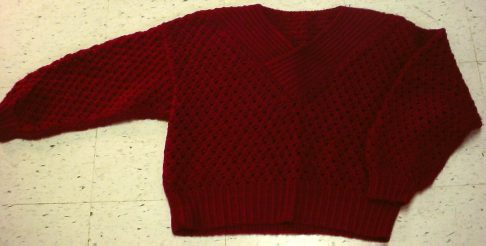
There are several details on it that I’d like to point out. First, note the ribbing. Remember how I said I always liked twisted stitches?? This is the piece that started it. The ribbing is done in P2, K1tbl. That’s what makes the nice, crisp, widely spaced verticals. The color on the detail shot below is closer to real life, although it’s a bit lighter than the original.
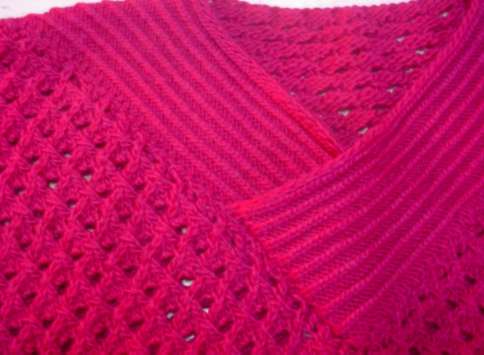
The body is entirely knit in a variant of Wide Waffle (Walker II, p. 152). That’s a stitch formed from a zillion twisted stitches (1×1 cables) plus YO eyelets. Although the pattern was fussy, it was quick to memorize and being on large needles (#9s) was fun and quick to knit. I especially like the contrast of the heavily diagonal, textured?body and the wide bits of crisp ribbing.
The neckline was also done in an unusual manner that was very common on Aarlan pattens of the time. The back of the piece is bound off straight across, with no shaping or edging whatsoever. The front is worked leaving a very wide Vee. Two strips of ribbing are worked as separate pieces (with slip stitch selvedges for neatness, since they show), and are then sewn on to the edges of the Vee, overlapping at the bottom point. It’s an unconventional treatment, and one I was afraid would pose problems of durability, but as you can see – this sweater is still going strong almost 20 years later.
Again, the moral of the story:? if you want your pieces to last, use the best quality materials you can afford; and you can’t go wrong with real wool. That and AIDS has claimed so many of our best and brightest. We miss them all.
EXCUSE? “IT WAS THE ’70S”
I found a box of stuff I’ve?been carting around forever. (At least it seems like forever). In it were mouldering reminders of decades past. Including this little doodle sampler I did to hang on my dorm wall:
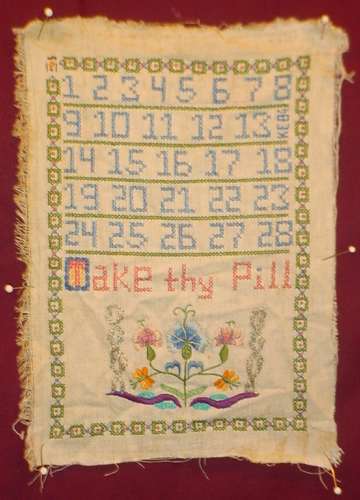
From the stitching standpoint, I can say it’s unremarkable – cross stitch and crewel type stitches, done on muslin ground in standard-issue DMC floss. There’s a bit of couched silk ribbon, too. The turquoise ribbon has faded, leaving only the little turquoise fastening stitches, and the bits of matching color cotton down below. It’s signed "KEB ’74."
As to the sentiment. Like the title says. It was the ’70s.
I?stitched it up?over a weekend and had it on the wall by Monday. I think I did it mostly to annoy my first roommate: a gal who managed to arrive at college with calcified attitudes, white kid gloves, and a life-long desire to take two years of college at the most to?find a husband and then drop out. She did manage to do just that and start a family, although not necessarily in the order she would have preferred. I guess she never quite took the sampler seriously…
More on Sontags
My friend Kathryn the costume doyenne, tells me that?the original?sontag isn’t really exactly like a poncho. Sort of, but not quite. It’s more like a scarf or fichu meant to cover the front of the upper torso that fastened behind the neck. They were usually buttoned or tied in the back. The idea was to avoid shawl points or dangling ends that could pose a danger in the era of open fires. Think of "Gone with the Wind" costumes, with the long shawl-like thing criss-crossed over the front of the body, with the ends tied behind the waist.
That makes sense. Looking at the item in the page from the NYPL it may be pictured from the back. The wearer would be facing away from the viewer, and the spot where the two sides meet would be at the lower back. It still looks like?a capelet/shawl hybrid to me, but worn backwards from the way that seems logical today.
UPDATE – EBOOKS
Without? knowing it, apparently my post of yesterday that mentioned on-line access to eBooks through the Boston Public Library exposed a security hole in their system. It’s plugged now, so that only library card holders registered with the BPL can access the eBooks system.
I can imagine it right now – "Oh my goodness, Quincy!? We’re being overrun by a mob of book-crazed knitters!"? "Batten down the hatches, Sam!? We’re leaking access bytes right and left!"
Oh well. At least our stampede helped them solve an oversight?that might have developed into a more serious problem.
 String-Or-Nothing