FORWARD INTO THE PAST
When I was starting on Dragon you may remember me moaning about how difficult it was to find teeny-size steel crochet hooks. Yes, I know they’re available on line from specialty dealers, but I don’t like to place small orders for things I need yesterday.
Today I found some. I stumbled into a local store and into another era: Balich’s 5 & 10, 1314 Massachusetts Avenue, Arlington, MA 02476. If you were a kid in an Eastern US city during the ’50s or ’60s you’ll remember stores like this – frowzy, little, local everything-stores that aspired to be a Woolworth’s but were too tired to dust or take inventory. I remember them on Avenue U in Brooklyn, NY; in the Bronx, NY and in Teaneck and Hackensack, NJ. Friends have described them to me in Philadelphia, PA, Providence, RI, too. Think of a narrow avenue storefront, with merchandise on wooden raised-rim tables, with overflowing shelves above and bins below. Think of retail chaos, wood floors, dusty stained tin ceilings, insufficient lighting, window glass mostly obscured by advertising posters.
This shop fits the description spot on. Central casting couldn’t have dredged up a place so perfectly frozen in time. It’s dim, the three aisles are just barely squeeze through size, and oddments hang from every available surface.Balichs stocks everything from bra size expanders and pink plastic curlers, to cast iron skillets, Red Heart yarn, squirt guns (remember ray-gun shaped squirt guns?), screwdrivers and pencil sharpeners. O.K., so there were Sponge Bob toys there among the pick-up sticks and checkers sets, but the spirit of the place hadn’t budged a bit since ’62.
While the yarn offerings were surprising (that they existed at all) and disappointing, I was bowled over that they carried three lines of crochet threads down to size 20, plus a full range of Boye knitting/crochet accessories and aluminum knitting needles. They also had a dusty display of steel crochet hooks down to size #14. I bought the last one of every size below #11 (1.0mm down to .75mm).
I also found a thing I knew from childhood, now need desperately, but couldn’t find anywhere else. We’ve got a rather aggressive gas stove in the new house. While it flames up nicely to boil water and saute with speed, it’s impossible to turn it low enough to do a gentle heat. As a kid I’d heard these called “simmer guards” or “flame tamers.” Now for the princely investment of $2.45, I’ve got one, too. I’ll be trying it out tonight and will report back on how well it works.

Here’s a picture of?Balich’s on the rather irreverant blog of some local teen who appears to be terminally bored with life in this burg. As a fellow high school humor magazine refugee, I wipe away tears of laughter, and say “Buck up, kid. It’s not as bad as Teaneck, NJ. 30 years from now you’ll be nostalgic for a decent crummy 5 & 10, too!”
So if you’ve got a need for a whatzis that big box stores just won’t meet, look around under local rocks to see if you’ve still got a store like this hanging on somewhere. Then subsidize history by buying something there.
WORKING REPORT – RETURN OF DRAGON
I’m still plugging away. Here you see the finished top border and the start of the border on the bottom:
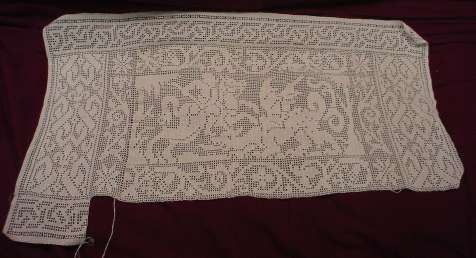
I think the framing contrasts are working nicely. At the current rate of production, I hope to have this puppy finished in two weeks. Three weeks, tops.
In other projects, a couple of people have asked what happened to the things I was working on when Dragon Fever hit. I’d been doing an entrelac project, and a raglan in a self striper. The answer is both are AWOL. I started Dragon just before our July 4th vacation, about two weeks before we moved to the new house. The bag with those projects in it was packed as part of the general relocation. I know that box is somewhere in the new house, but I haven’t found it yet. To be fair, we’ve got upwards of 30 boxes as yet to be unpacked. Most are books, waiting patiently until we can get bookcases.
The rest are miscellaneous and/or poorly marked boxes each?containing a grab-bag of whatever. Most of those are destined for storage in the under-eaves box rooms behind our closets, but we can’t move them there until after the roof is redone. We’re now playing the hurry up and wait game with the roofer. So the boxes (including the Mystery Box with my knitting projects in it) are sitting in out of the way corners, waiting for the post-roofing reassortment of storage.
Ahhh. The joys of moving!
MORE KVELLING
I can’t help kvelling. The kidlets have attacked knitting!? They started at the Boston Knit-Out two weekends ago, and are still going strong. As anyone with children can tell you, that’s an eternity in the attention span of a six-year old.
Here we see the two of them. The older one is wearing her frist scarf and working hard on the second. The?little one is wearing her first product – ?an earwarmer band. Somehow, even afternoon TV doesn’t seem so evil if they knit during the cartoons.
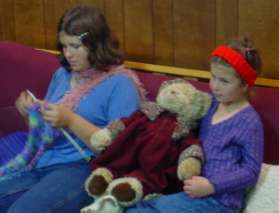
What’s next for them?? Whatever they want to do (within reason of course). The older one is leaning towards a fulled/felted bag. The little one wants to make a felted chainge purse. I’ve got lots of rustic Maine-style wool in my stash, perfect for fulling. If they stick?with it, sooner or later their products will show up here.
DRAGON ANNOYANCE
Grrr.
As of yesterday, I’d finished the top edging, run the solid two-row strip down the left hand side, chained out to establish the bottom edge, and was three rows into the charted part of the remaining border strip.
Today I had to rip out everything done after Saturday. I had made the only absolutely fatal error there is on this piece. I forgot to work the last double-width eyelet hole on the top edge, so there was no way of putting the last inch of my curtain onto its curtain rod.
As of today I’ve finished the ripping back, have created the missing hanging hole, and am in the forever bands of solid double crochet at the leftmost edge. As a result I don’t have the nifty-looking progress shot I’d hoped to share today. Instead, in response to some requests for a closer look at the join between the old and new work (and provided my photog skills cooperate), I present a detail shot of the edging join area:

Remember – you’re looking at the piece sideways compared to the working direction. (Also as it turns out, from the wrong side, but that doesn’t matter). My working direction proceeds from the right edge of the photo to the left edge. There’s a schematic of the stitch logic for this join in a previous post.
One thing that may or may not be seen in the resolution-stripped photo above – the J&P Coats Royale brand name size 30 cotton thread I’m using has a nice sheen to it compared to most crochet cottons. I have to say I really like the stuff. It does appear to have limited distribution though. Even the Coats website doesn’t? list it. So far the only retailer I’ve found that mentions Royale crochet cottons?is the big-box crafts store, Michaels, and I’m loathe to shop there on principle, much preferring to patronize smaller needlework specialty shops.
TERMINOLOGY IN CROCHET
As bad as the knitting stitch?name problem is, crocheters have it much worse. Not only are there no crochet pattern books as authoritative and comprehensive as the Walker series on knitting (the Harmony series of paperbacks is nice, but doesn’t have Walker’s cachet), the basic vocabulary of written? crochet patterns is different depending on their place of origin.
Anyone in the US who has tried to crochet from a British Sirdar pattern has run into this problem; as have?UK/European?residents?who have picked up patterns issued in North America. Still, it’s amazing how many crocheters run afoul of the term problem, even though it’s widely known. Here’s the challenge. Terms that differ are shown in red below:
|
US/Canadian Term |
UK?Term |
| Chain | Chain |
| Slip Stitch | Single Crochet |
| Single Crochet | Double Crochet |
| Double Crochet | Treble Crochet |
| Half-Double Crochet | Half Treble Crochet |
| Treble/Triple Crochet | Double Treble Crochet |
| Double Treble/Triple Crochet | Triple Treble Crochet |
| Triple Treble/Triple Crochet | Quadruble Treble Crochet |
| Quadruple Treble/Triple Crochet | Quintuple Crochet |
| Quintuple Treble/Triple Crochet | Sextuple Treble Crochet |
| Yarn Over | Yarn On/Over Hook |
Now. How can you tell which system of terms a pattern is using?
Clues abound. Aside from the obvious – looking for a copyright statement or publisher’s address, or just plain knowing that Sirdar uses UK notation, and Classic Elite uses US terms – you can look for these things:
- Metric vs. Imperial units. If sizing and measurements?throughout?are given in Imperial only, unless the pattern dates from the ’50s, chances are that it’s using the US system of notation. If it’s metric only, it’s worth looking closer to make your determination because it well may be using the UK system. If both systems of measerement are used – it’s a toss-up. I’d suspect most likely it’s using the US system, but I’d look closer anyway.
- Telltale terms:? The terms "tension," "fasten off," and "miss" are UK usage. The equivalent US terms are "gauge"? "cast or bind off," and "skip."??
- Very few US patterns use the term "treble crochet."? Those that do tend to be pre 1970s. If I see the word "treble" and not "triple" and those monster long double triple and above variants aren’t used, I suspect UK notation and check deeper.
- General spelling. The "u" in "Colour" isn’t a dead give-away for UK origin, but it is a clue that should make you look more closely. The pattern might be Canadian, in which case it might use North American/US notation.
- Yarn weights. Most US-origin patterns use the yarn weight descriptors "fingering, sport, worsted," etc. Most UK,?Australian,?and Euro patterns use terms like "3-ply, 4-ply,?Jumper weight, 8-ply."? Be careful however of double knitting (DK). That can go either way.
- Hook size descriptors. If it uses a letter only to describe hook size (A-N), you’ve got a US pattern. However hook sizes themselves are far from standard among makers, and most contemporary patterns include a metric size in addition to the letter. (Side hint:? ALWAYS go by the metric size, not the arbitrary letter or number size name.)
- Visual inspection. LOOK at any photos or illustrations that accompany the pattern. Look at your standard?single or double crochet. Does the photo make sense?
I don’t have very many crochet pattens on my shelves, otherwise I’d make a table of what makers use which notation. Sirdar I’ve already mentioned. I suspect Rowan uses UK notation, but I don’t know if they print up separate editions using US/Canadian notation for distribution in North America. Patons is a problem because notation in Patons North America patterns may be different from that in Patons Australia patterns.
If you’ve used a crochet pattern recently and have determined which of the two nomenclatures it uses, please feel free to report on that fact by leaving a comment to this note. I’ll compile the responses and post a follow-up table here in the future.
STITCH PATTERN NAMES
I’ve noticed a few posts on the various lists, blogs and forums all asking about stitches by name, either requesting help in finding a particular one, or discussing how sometimes multiple patterns share a name, or one pattern is known by many. I ramble on as the dilettante I am – with nothing to back up these theories other than noting certain similarities of name and pattern in dozens of stitch guides and publications going back to the 1800s.
Knitting texture pattern names are far from standard. Yes, it’s true that some stitches have more than one name, and that some names are associated with more than one stitch. There’s little point in arguing about which is the “true” Old Shale stitch. In one part of the world the exact size of the repeat, proportion of garter to openwork, and depth of the scallops is clearly defined and agreed to by the knitting community. In another, the name is loosely attached to a family of stitches. And in other areas there’s no differentiation made between Old Shale and Feather and Fan.
The same thing goes for the seed stitch/moss stitch debate. I’ve seen all three graphs below called variants of seed or moss stitch (empty squares are knits, dashed squares are purls).

Most commonly, #1 is seed and #2 is moss. But others identify #1 as seed, and #2 as double seed. Some people call #1 seed, but call #3 double seed. In still others #2 is double moss, and #1 is moss, and #3 is broken rib. Confusing, isn’t it? Get 10 knitters in a room and I’m sure you’ll come up with multiple names for these three.
And there’s also the Shaker Rib/Fisherman Rib/English Rib naming overlap used to confound people who want to work one of these deeply textured but simple stitches (all employ knitting into a stitch in the row below).
Why is this?
Well, as close as I can figure, in part it’s because knitting is a relatively new craft. Crochet even more so (more on this tomorrow). Written patterns or guides for doing it are even newer. Exhaustive books on how to embroider were written in the 1700s; modelbooks describing how to stitch and offering up designs date back to the dawn of publishing in the early 1500s. But the earliest pattern books that specifically mention knitting don’t cover texture variations in specific. They offer up simple graphed repeats that can be used for colorwork or knit/purl textures. It isn’t until much later that anyone began trying to describe the creation of a manipulated texture in a manner that others could reproduce it (early-mid 1800s). So until that point, without a written record to nail terminology flat and make sharing those terms across wide areas, regional/cultural variations in naming remained regional. It wasn’t until knitters began running into knitters from other regions either in person or through published works that they began to notice that terminologies differed.
Although knitting possesses a vast amount of possibilities for texture formation, some patterns appear to have been either invented or popularized in multiple areas. We can’t say for sure where many particular textures/stitches first developed, or what name should have the right of primogeniture. Perhaps dissemination was by chance – some adventurous traveler wore a pair of socks featuring a particular design, and that design was admired in the area he or she ended up in. Local knitters loved the novelty and reproduced it. In a generation an introduced pattern could easily loose its association with the ultimate origin and become “Grandma’s Clock” and be considered native.
Most of our modern names for stitches come from three (now four) stitch dictionaries compiled by Barbara Walker. She collected stitch directions, corrected them, classified them, and named them. Although there had been stitch pattern collections published before, no one had ever attempted to undertake the task in such a comprehensive manner. Remember though that even though she was a pioneer, Walker wasn’t working in a vacuum. She did invent many patterns (notably in slip stitch knitting and lace), but she also mined earlier works including 19th century ladies’ magazines, books and needlework leaflets put out prior to the 1960s. She even gathered up submissions sent to her after the publication of her first book.
Walker’s format required that each stitch have a name. Sometimes she adopted the name of a pattern in an earlier source, or used the name by which the stitch was known to her. Sometimes if more than one name was current she noted that fact. In other places she supplied a name where one was lacking or was misleading (you can’t have fifteen textures all named Chevron Stitch in the same book).
Walker’s treasuries are so influential that her names are becoming increasingly ubiquitous. In many cases though, they conflict with names steeped in local traditions. Therefore alternative names and confusion still persist. Plus although four massive encyclopedias of stitches contain lots and lots of individual patterns – there are whole areas of knitting they touch only very lightly. The lace patterns used in Shetland knitting are sparsely covered compared to the in-depth treatment they get in specialty books. Those specialty books offer up the texture/lace pattern names used by people with a direct heritage of Shetland knitting.
Then there’s a further layer of complication. There are no Knitting Police. No one enforces use of any common set of terms. We barely have concurrence on things a simple as increase/decrease (narrow/widen); cast off (bind off); and gauge (tension). Anyone can publish a pattern or stitch guidebook that uses an entirely unique set of names. L. Stanfield sidestepped this issue by using only numbers to identify the original texture patterns in her book. And marketers, especially those writing clothing catalogs ?often pick names out of thin air because 1) they don’t know knitting or crochet (or many times the difference between the two); and 2) they use what they thing will sell, not what might be an accurate descriptor.
So there’s one person’s over-long ramble. Stitch names aren’t standard. They spring from many sources, and have only recently been codified, classified and named. Names are moving towards a greater degree of standardization, but they’re not there yet and will probably never be. Live with it.
DRAGON AND GEN III KNITWITS
More progress on Dragon.
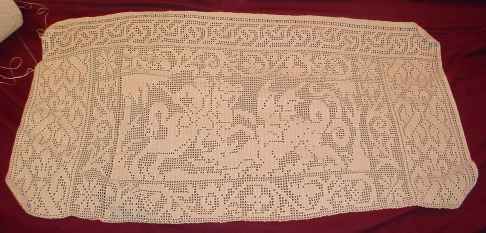
I had hoped I’d have finished off the entire top border by today, but I’m three rows away from finishing.
A couple of people have written to ask for a more detailed explanation of how I’m managing the vertical join between the old and new parts. I’d posted some thoughts on this before, but then contradicted myself and said I was doing it another way. To top it off, I neglected to describe exactly how.
If I’ve got an two empty meshes stacked one on top of each other at the end of my row just before the join, I’m working my penultimate square as usual, then I’m working a horizontal half double crochet to connect the new work to the old. Then I chain up two, and work another horiztonal half double crochet. Finally I flip my work over and proceed back in the direction I came.
If I’ve got two solid meshes stacked on on top of each other at the end of my row just before the join, I work my penultimate square as usual, then work two DCs into either the stitches or the space of the row below. Then I join the last of these DCs to the established edge with a slip stitch. The existing edge of the old work makes the fourth stitch to complete the new square. To make the next row a bit more even, I do a backwards slip stitch into the stitch one before the stitch on my needle; chain up two, and work another slip stitch into the next attachment point. Then I do another backwards slip stitch as before. Finally I flip over my work and work two more double crochets to finish out the filled square that commences the new row.
Here’s a schematic. More or less. Apologies for the lousy picture quality. I’m wrestling with Visio right now. I installed Office XP Service Pack 2 (the big security update) and it messed with Visio. I then installed several layers of Visio upgrades to get it working, but the export to JPG feature isn’t quite fine tuned yet.

Mindless Kvelling over Gen III
The kidlets are captivated by knitting!? Who would have thought it, because before the Knit-Out neither one showed much interest. I myself never could sit still long enough to learn from my mom (Knitting Goddess, mostly retired). I’m amazed that they have come so far, so fast.
The Larger One sprang right from her initial "learn how" bit of garter in livid green acrylic to a garter stitch scarf done in a fuzzy yarn. She polished it off in two days, then went out and got more fuzzy yarn to do another for her friend. The Smaller One found a thick yarn and big needles easier to manage than worsted weight and size #7s. She knit a?6-stitch wide strip from a superbulky yarn, then asked me to end it off into an earwarmer. She began it Friday, and wore it to school this morning. Now that they’re comfortable with the knit stitch, this week’s lesson will be purling and casting off.
I may have created two monsters though. Both are now eyeing my stash and asking what they can make next. The Larger One is searching the web because she wants to do "a bag from that yarn that shrinks."? The little one wants to do a blanket for her favorite stuffed animal, and appears to have an affinity for hand-dyed variegateds. I’ll offer up pix of the proud knitters?once they’re home from school. Now off for a new experience:? Hiding Yarn From Children.
CROCHET – CRITICISM AND DEFENSE
I’ve been having discussions with folks on other blogs, and in eMail about crochet and its strengths and weaknesses. I’d posted about this before.
My objection to most contemporary crochet patterns is that they try to take advantage of crochet’s strengths but ignore it’s shortcomings. For example, they try to present easy to make/quick to finish projects. That plays on two of crochet’s strengths – namely how easy it is to learn, and how quickly it can be worked. But in doing so, they scale up textures and stitches to use with DK and heavier weight yarns. That leads to the lumpen, potato-bag, refugee-from-grandma’s-sofa look, a good example of which is the skirt on the cover of IK Crochet:

This same texture pattern would be exquisite in a much thinner yarn, done up in panels in a sweater or blouse. You may disagree with me and say that I’ve got no taste, but to me this skirt is heavy and unattractive, there’s nothing about it – not drape, not fit, not texture that flatters the wearer.
Now crochet in heavier yarns can be quite attractive. Crocheted fabrics are thick and warm, and resist stretch better than some knitted ones. A dense crochet in a heavier yarn is perfect for a coat or outdoor jacket. Even a hat or bag will benefit from the body and thickness. But not an indoor/outdoor or indoor garment.
What do I like in crochet?? Here’s an example.

The thread size/texture pattern are graceful and in proportion to the garment. I also l ike the style. Sleeves are fitted, and there’s some evidence of a bit of body shaping, even though this cropped pullover is boxy in general shape. Please don’t write to ask for the pattern or provenance. A friend eMailed me this photo, and other than her say-so that it’s from a French-language crochet magazine, I haven’t a clue as to when/where it’s from.
Even the usually dreadful granny square motif can be attractive if it’s scaled in relation to its usage. Here’s a nifty example from the UK’s Knitting and Crochet Guild on-line collection pages:

The caption page attributes this piece to the 1950s. It’s done in 3-ply – a yarn that’s would be considerd light fingering in the US, and would probably knit up at between 8 and 9 stitches per inch on US #1s. The sweater’s multicolor?motifs are crocheted, but?the rest of the sweater is knitting. Be sure to go to the caption page to visit the sweater’s detail shot, so you can see the fineness of both the knitted and crocheted sections, and how the gauge of the two compare. (Also if you want to support this nifty collection, there are notecards illustrating some of their most spectacular pieces for sale at the end of the collection.)? [/End shameless plug of worthy cause.]
NEW YEAR’S DRAGON
So I lied. I said I wouldn’t post another progress picture of Filet of Dragon until I had finished the border across the top. But I’m writing this yesterday and dating it to auto-post today. (That’s an odd time-bending sentence.)? Today is?the Rosh Hashana?holiday, so I’m off doing other things.
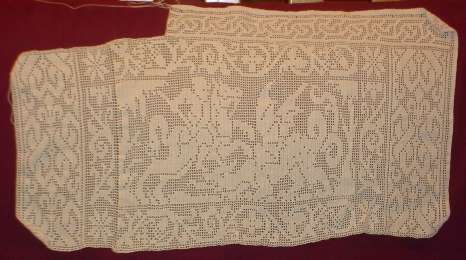
I’m in the danger zone on this project now. As much as I desperately want to finish it and hang it on the front door, I’m thoroughly tired of this border. And I’m not even half-way done.
ENTROPY IN ACTION – PINK BLANKET DEATH
All good things must come to an end, and it’s nearing that point for the baby blanket I knit 14 years ago for The Larger Child. It was the first piece of lacy knitting I attempted, and?is a combo of the double star keyhole motif from Phillips’?Knitting Counterpanes?(slightly modified); plus a perimiter trim I tinkered up from a standad leaf edging.
Pink?Blanket?wrapped?said child when we brought her home from the hospital, slept with her every night until she was?in Kindergarten,?accompanied us on every family vacation, served as a cape, costume, and tent, survived countless wash/use cycles, and even went off to summer camp with her for the past?four years. Now the nameless cotton it’s made from is finally giving up the ghost.
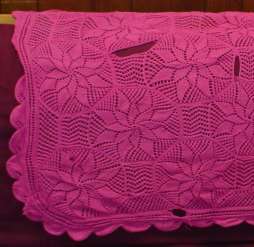
The simple slits between motifs where the stiching has come undone are quick and easy fixes. I’ve even grafted and re-knit bits of the border before?where it got snagged. The other holes in the ladder lace upper part of the trim, and in the motif in the lower left however are bigger deals. I’ve still got some of my nameless cotton if I want to try fixing Pink Blanket again. Amazingly, the piece has not faded over the years, so the color match is still good. Still, 14 years of hard wear for an odd-lot yarn bought at a long defunct yarn discount store in Maryland, and a first attempt at a knitting style – that’s not a bad return on my investment.
Follow-up – Blauband Blanket
To follow up yesterday’s Chest of Knitting HororsTM post, the fragment you see is about 80% of the finished blanket. I have enough yarn for two more courses of hexes, plus half-hexes to finish out the sides square. I’m looking for a coordinating yarn just to do a trim around the entire edge. But Nancy’s "outside the box" idea of edging with satin blanket binding rather than more knitting is well worth considering. Thank you!
Frivolity
A friend sent me a link to this game. If you’re into sheep and have time to kill, you can waste hours there.
 String-Or-Nothing