CHEST OF KNITTING HORRORSTM – BLAUBAND BLANKET
In an effort to use this space to productive advantage while I’m still plugging away at the Dragon and de-plying my poncho yarn, I turn to yet another embarrassment. Here’s another dweller from my Chest of Knitting HorrorsTM.
This pieced motif blanket is knit from Special Blauband, a fingering weight sock yarn. A long time ago it came in an striking color preparation.All of the?consituent plies that made up the yarn were dyed in several colors, then spun together in the usual way. Color repeats on the plies changed quickly, but the cycles were very long. The long cycles plus the random matings of the colors produced by spinning together multiple plies meant the?total color sequences varied greatly – never repeating exactly even in the same skein.Although one color usually dominated in the yarn’s tweedy presentation, each and every skein was different. Socks made from this stuff were always fraternal rather than identical. You either loved or hated the unpredictable results.
? 
All of the motifs in this blanket are knit from the same color number of Froehlich Wolle’s Special Blauband?Longue Degrade Multicolor, but as you can see – they are all very different. This particular lot is mostly brown, although neither of the photos on this page are true, the one above being too blue, and the one below being too yellow/red.
This lot came as a kit. It was called the Kaleidoscope Throw, and was designed by Anne Grout. I posted a review of the pattern on the knitreviews.com pattern review pages (you’ll have to scroll down about 3/4 of the way to get to it). I haven’t seen other Kaleidoscope kits on the market for several years, both it and the Blauband yarn may have been discontinued. The idea was that the variations skein to skein when knit in the round like this would produce a striking set of coordinating but all distinct results.
?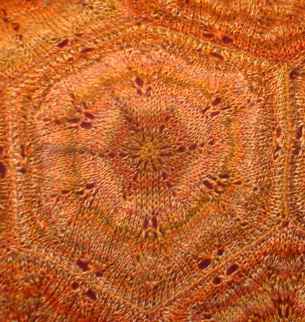
As you can see, that part of the thing worked well. The motf pattern was quick to knit and quit simple to follow. I could knit about one and a half motifs per night. Piecing this throw was easy, and deciding where to put the various resulting color combos was fun.
So why did I stop?? It’s not hard to say. First, I was very disappointed that the blanket-sized throw shown on the kit’s cover required more yarn than was packaged in the kit itself. The kit alone was purported to be enough for a small lap-sized throw, and even then came up quite short. More of this particular yarn was plain old not available. Second, I decided I didn’t like the edge treatment of the kit. It left the hex sides loose and floppy, as in the half-done bit above. They do have a tendency to ruffle when they’re not under stretch, and I thought it looked sloppy.
So I decided to change gears a bit, working out a half-hex and finding a complementary knitted edging to make thing into a true rectangle. That meant I had to find a complementary color yarn, also in fingering weight. Ever since I’ve been keeping my eye open for something suitable. Special Blauband is among the lighter weight of the fingering/sock yarns. Brown Sheep’s Wildfoot might work, but so far I haven’t found **the right** yarn?or color?to finish this piece. Plus to compound the problem, I’ve mislaid my pattern original, and will have to work out the motif again?from my already-completed hexes. [Memo to self:? Remember to make a working copy of?an irreplaceable pattern, then store the original someplace safe. Destroy the copy or staple it to the original when done.]??
I do have another bag of this yarn in a different color that’s not brown. (Brown’s nice, but it doesn’t go particularly well with the stuff in my house.)? Some day I’ll revisit the Kaleidoscope idea, using it with a pattern entirely of my own devising. In the mean time, this bag of discontinued yarn sits in my stash. Just waiting, along with all those little cards of heel-reinforcement yarn that came with the brown Blauband.
There’s one more thing that makes me feel quite guilty about this particular UFO. It’s a surpise gift is for a dear family friend who lived nearby when we were still in Maryland. She loves browns. It was supposed to be a holiday present for her last year, and now with the holiday season this year approaching is nowhere near being completed.
EVENT REPORT – BOSTON KNIT-OUT
The kids and I did end up going to the Knit-Out on Boston Common yesterday. The event had more exhibitors this year than last, but attendance though decent looked to be smaller, even given the larger outdoor venue. This is probably the result of the relatively poor publicity, as most people I spoke to didn’t learn about it until only a couple of days ago.
There were a goodly number of local yarn shops represented, but by far not all of them. There were also several yarn manufacturers showing off knitted examples of their latest yarns. Because there’s no selling allowed at this event, the exhibitors just show tabletop and hanging examples of some pieces, plus a book or skein or two. They also collect mailing list addresses. I really didn’t see anything new or different, but I haunt my rather complete local yarn shop like a ghost, and usually get wind of new products long before more infrequent visitors do.
There was the usual fashion promenade, a show-and-tell, and just as we were leaving – the speed knitter/crocheter competitions. We didn’t stick around for them to finish (although in retrospect, we should have); but a gal with a yarn shop ID or volunteer sticker had a clear lead from the outset. She knit British/thrower style, with the end of her right hand needle firmly buttressed against her lap. I’d often heard that amazing speed could be accomplished using the throwing method, but before yesterday most of the throwing knitters I’d seen do it "in air" rather than with a fixed needle end. Hats off to her, and thank yous for expanding my world.
The highlight though of the event for us was the Kids Corner. In it a group of volunteers assisted children in making their own needles from dowels and beads; crafting small pom-poms from Manos scraps; and teaching basic knitting and crochet. Both of my daughters knit their first stitches, and both were so enthused they continued practicing long after we got home. Here’s Volunteer of Infinite Patience, Tamesin O’Brien teaching The Smallest One basic throwing style:

And here’s The Larger One mid-concentration and mid-row working away at Continental style:

The downside of the festival was the trip home. There was an "unknown powdery substance" emergency that necessitated the closure of the subway line. The whole incident?was handled particularly poorly by the?transit system. A total lack of public information, unwillingness to communicate about the extent of the emergency, and confusion/poor preparedness about shuttle busses led us on a hike from Boston to Cambridge to find an open station. It was an unpleasant way to waste two and a half hours, and left me with absolutely zero confidence on the ability of Boston’s transit system and response personnel to handle a real emergency.
WORKING REPORT – DRAGON, DRAGGIN’ ON WHILE TREES FLY
Another in an interminable series of progress shots. This one shows more of the top border.
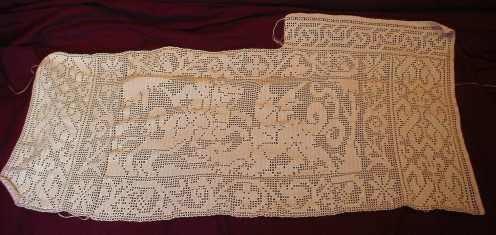
Although I was iffy about it when I first began, I think that it’s working now. Yes, introducing another motif makes the piece rather busy, but in spite of that – I like it. To be immodest, I’ve been scouring the web looking for filet crochet work, and I haven’t seen anything remotely like this – either for complexity of the motifs, or scale of the project. It’s going to look killer on the front door window.
Now to finish out the top and bottom edges. I promise no more incremental photos until (at least) the top edge is finished.
Tree Today, Gone Tomorrow
Some pix of my de-treeing. This majestic 35-year old spruce was certainly pretty from this angle, but it was planted two feet away from the house. It was leaning on my walls and roof, and its roots were invading the basement. It’s sad, but the spruce had to go.
|
|
|


(Sorry about the shot of my neighbor’s SUV.)
Likewise two four-story tall Norway maples in the back yard were given honorable discharges. In their case, they were completely hollow – to the point where the remaining ring of their trunks was about an inch thick. Both had canted, and were looming over my garage and my neighbor’s house. They were disasters poised to happen.
The treeguy used a boom crane to extract them from a tight space, lifting the pieces up and over the house and sparing injury to the surrounding trees. The eighth-of-a-tree limb that’s flying here looks small, but once down on the ground it looked every inch of about 20 feet – larger than some entire free-standing trees. Given yesterday’s winds and the number of branches down in my neighborhood (the result of the last anemic puff from passing hurricane fragments) I’m delighted that the hazard was removed just in time. Plus, I’ve still got six healthy maples and locusts in the back yard, one so huge it dwarfed the two that were taken out.

THINKING – UNPLYING FOR NEW PONCHO
Several people asked how I was going to go about un-plying my three-strand Paternayan yarn. Siince I need to do it to swatch, here’s how I plan on doing it.
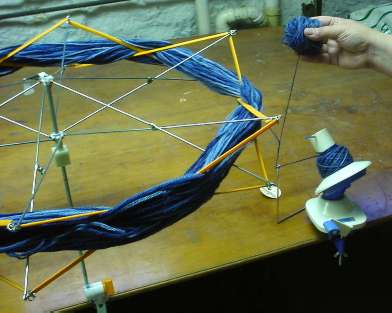
You can see the skein as the maker intended, set up on my swift. I’ve got my ball winder out, too. I usually don’t bother with it unless I’m?dealing with?lace or fingering weight yarn (that’s more yardage than I’ve got stamina for hand-winding). This time however I need it as an extra pair of hands. In fact, ideally I’d have an extra-extra pair of hands.
The plan is to let the skein of yarn spin freely on the swift, while I?take up two plies on the ball winder, and ball up the remaining ply by hand. Now you can see why a friend or biddable child to turn the crank on the ball winder would be a great convenience. As it is, I have to advance a bit on the machine-aided ball, then catch up to myself on the hand-wound single ply ball. All the while, I have to go gently, untwisting and untangling whenever things get too bound up. This is why I’d only attempt this foolhardy maneuver with a yarn as loosely constructed as this one. Even so the sharp-eyed can spot the stuff twisting back on itself just a bit at the point where the one ply is split off the main strand.
O.K. Now when I’ve finished, I’ll have a neat machine-wound little core sample of two-ply yarn, plus a hand-wound ball of one-ply. How to turn the one-ply back into a two-ply?? Simple. I repeat the paring down process on the other skein of yarn, then I place both skeins on the floor or in a box (I’ve heard that cutting the bottom of soda bottles and threading the strand through the neck works wonders). Then I use my ball winder to draw on both at the same time. Minor complication – the variegated won’t match up in color across both plies. I’ll just treat it as another color of variegated, and isolate it in its own stripes or other pattern segment.
Since my original yarn was really just paired rather than twisted together, I don’t think I really need to do a proper twisted plying on my newly formed composite. Of course there may be spinners out there recoiling in horror at this process and half-assed advice. I can envision them ready to leap forward with?sage interjections to save us all and teach us proper plying. I stand open to their suggestions.
THINKING – NEW PONCHO PROJECT
I’m still doing Dragon, but I’m also thinking about the poncho request I mentioned yesterday. I hope people find my?starting with so many unknowns and feeling my way through this project?will be useful.
My daughter went through my stash, and picked out a first and second choice. Her first choice is this lot:

(Apologies for the poor color registration. The photo looks dingy, yellow, and grey compared to the original hues.)? This is a mixed bag of Paternayan 100% wool I picked up at?my local?yarn store’s semi-annual?odd-lot sale. I’ve got?seven skeins – three mixed blues, two wegewood blues, and two smoke blues. The solids both coordinate with the variegated skeins. When I bought this stuff I thought I’d take the time to separate out the?three constituent loose?plies yielding three times?the original?yardage, then use the result to do a top for myself. That idea has sat idle for several years now, un-plying all that yarn having lost its initial appeal. But now I’ve got this bag of yarn of unknown yardage and weight, with no clue as to possible gauge. I have no pattern in mind other than "Small lacy poncho, mom."? ?
Today I’ll start by investigating the yarn. I’m afraid in this case, wiseNeedle’s yarn data/review collection is of no help at all. There’s no entry for the maker, let alone the yarn. I know that Paternayan yarn is usually sold for needlepoint and crewel embroidery, and doesn’t often come in large hanks like I have. So I head out to my old pal, Google.
I find these specs for Paternayan Persian Wool. It comes in 8 yard skeins; 1 ounce/40 yard skeins and?4 ounce 178 yard skeins. Wishing I knew where my kitchen scale ended up, I compare my skeins to other yarns I know comes in 4 ounce put-ups. It seems pretty close to me. Provided I’ve got seven true 4-ounce skeins?I should have?about 1246 yards. That in turn is enough to make about a?pullover of about 45 inches?around?in a worsted weight yarn (no fancy patterns, plain set-in sleeves, generous but not boxy fit). I got this number by playing "what if" using Sweater Wizard,? but I could also have used my yarn consumption KnitKard (a very handy thing).
I’m making a poncho, not a sweater, but it sounds like I’m in the realm of possibility, especially because the target kid doesn’t want a huge blanket thing. Perhaps I’ll go back to my original concept, and increase the yardage by unraveling back just one ply of each skein. For each two skeins of original 3 ply thickness (which I estimate is somewhere between worsted and Aran weight), I’ll end up with three skeins of 2 ply thickness. That would mean an extra 178 yards of each of the solid blues, plus 178+89=267 yards of the variegated (I’ve got three skeins of the variegated, so I’ll end up with?one and a?half-skein’s length if I strip one ply from each). 1246+178+178+267=1869 yards. 1869 of something that appears to hover between DK and Sport should certainly be enough.
You may have spotted?the fallacy in my thinking. "Doesn’t thinner yarn mean a finer gauge?? Why would using it as a two ply cover more ground than using the?yarn full thickness?"?
My out here is in the request for a lacy item. I’m not knitting up a solid garter or stockinette piece. I’m going to do something with lots of openwork. That means I will be using a much larger needle than I would choose were I to knit this stuff up solidly. The thinner yarn will end up going much further than it would were I to use it at a standard opaque sweater gauge. To get a comparable effect from a heavier yarn, I’d have to move up to an even larger needle to achieve a lacy look. While that would make the final piece bigger, I doubt I could find a needle size that would enlarge the piece by the equvalent amount to the?lacy stitch/big needle/finer yarn combo.
Now I haven’t a clue as to the dimensions of the finished piece, nor any idea whatsoever about garment shape (rectangles or knit out from the center), texture pattern, or how I’m going to deal with all the variants of blue; but I think I’ve got a solid enough "Go" to begin swatching. After all, there are no Poncho Police that will assess my final output to make sure it’s legal.
I’ll keep working on Dragon, but I’ll interpose thinkbits on this project as time and progress allow.
TREE DAY
Today is Tree Day here at String Central. A crew of treeguys?is outside even as I type, taking down several large hollow trees that are looming dangerously over?our house, the garage, and the neighbor’s house. While I’m usually a tree-and-let-live person these did represent real risk, and had to go. I look forward to an airier, sunnier, safer yard. Also quieter, once the chainsaws, chipper/mulcher, and boom crane all depart. Before and after pix another day, once the leafy chaos has subsided a bit.
In knitting news, I have to ‘fess up now that June posted her blog entry about the DNA cable. I read her initial complaint, and thought she deserved a wedding present, so I redrafted her cable for her. I wasn’t going to say anything about it, but she was sweet enough to post a credit, and to leave me a Mysterious Present in my mailbox (it turns out we live quite near each other):

I’m thoroughly tickled by the mystery gift (in a favorite color combo, no less!). I’m now honor-bound to knit up this nifty June-dyed fingering weight so?I can report back to her?how effective her color placement strategy was in avoiding blobs. I think that it will be appropriate if I do up a pair of DNA cable socks with it.
It also turns out that I’m on the hook for a poncho. In this case, the fomer tween-ager Elder Daughter? has requested what appears to be the fashion accessory du jour. So I sigh, and like a good parental unit, will make one, no matter how boring. I’m still caught up in Dragon though, and I don’t want to be sidetracked from it. Socks I can make my portable project. A poncho however is another story. Hope I can complete it before fashion obsolescence kicks in.
On Dragon – not enough progress to warrant posting a photo, but I’m getting happier and happier about the twist panel at the top. With a few more repeats done, the design is easier to pick out, and the denseness of the new panel frames the lighter areas nicely. I think I’ll keep it.
WORKING REPORT – DRAGON’S KNOTTY PROBLEM
Fits and starts, but back on track. Here’s the beginning of the top strip:
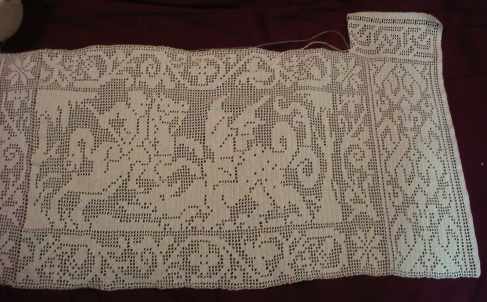
I’m not quite sure where I got this pattern from. It’s in one of my sketchbooks, but the accompanying notes only?say "Dover," so I may have gotten it from one of the Dover collections of graphed patterns, possibly their booklet of Celtic-inspired designs. I know it has no absolute historical citation in any one artifact or early book. In any case, it’s four meshes narrower than my original choice. That’s eight meshes for the whole piece (top and bottom strips both).Eight meshes would have been enough to make the thing too big to fit on the stretcher bars at the top and bottom of the door’s window. The beaded looking bit between the solid edge and the knotwork strip is produced by leaving a double-wide mesh every five rows. Those double-wides are going to be the holes through which the stretcher bar style brass curtain rods?will be threaded.
On whether or not motif strip"goes" with the rest of the piece – I’m not quite decided yet. I picked this pattern because the knotwork was interesting, because the knotwork picked up the curves in the dragon piece and the floral border, and the interlaces echoed the knots in the side panel. Plus, I thought the solid-strip negative-space nature of this design might be a nice contrast with the rest of the piece, in which the filled meshes present the design rather than the empty ones. I do like the solid strip nature of this one as a framing device, but I’m not entirely sure that the negative-space interlace is easily discerned. I’ll do a bit more to see if more repeats aid in visual interpretation. If not, it’s rip out and start again. Again.
One thing of which I’m quite proud – look at the bottommost row of solid meshes that makes up the new top strip. That’s the one that fastens the new work to the old. Not bad for an afterthought join.
WORKING REPORT – DRAGON
Grrr. Apparently no effort of woman nor beast can nail down an exact reference to an item in the V&A database because linking is dynamic and is recalculated for each new session. Therefore if you really want to dig through and find the items I mentioned yesterday, you’ll have to search on their accession numbers yourself. Open any V&A search page, and enter these numbers:
CT55633 – to see the crocheted purse
CT59053 – to see the knitted purses
CT57667 – to see the sampler
Apologies for all wild goose chases that ensued.
Filet of Dragon
Progress on Dragon is both positive and retrograde:

?The good news is that thanks to advice so graciously shared by Vaire and Kathryn, attaching the side strips as I work them looks much better and more even than I hoped. I’m not using the exact method I posited in my last post. Instead, I’m doing a scrumbly combo of techniques. If the joining mesh is empty, I’m doing Vaire’s method of horizontal DC as bride. If the joining mesh is solid, I’m doing a combo of a technique Kathryn sent plus more advice from Vaire. I’m working that join mesh up to the point of the join (first leg, plus first "inside" dc), then on the second "inside" dc, I’m doing a slip stitch to mate it to the mesh leg of the existing work. After that I’m chaining up three, doing another slip stitch to mate the little chain to the old work, then working one "inside" dc plus another as the next mesh leg. The little chain up serves as the first dc of the "inside" pair. And there’s more good news in that the double-height empty blocks I am leaving for the curtain rods fit well and work great.
But all news is not good. See that little strip sticking up in today’s photo?? It’s gone. I’ve ripped it completely back and started again. It turns out that the original pattern I had selected for the horizontal strips is too wide (again the gauge problem). I am going to use an entirely different strip pattern, plus finish the entire thing around with two rows of solid DC to ensure a stable edge.
So there you have it. Dramatic progress, and dramatic failure. All in one day.
SLOWLY UNPACKING
Remember I said that
- I had rescued my knitting things from the storage cubby;
- I was bound and determined to turn a rather dingy basement room into a needlework retreat; and
- I wanted to?outfit my haven?on a budget as close to zero as I could manage.
I can report progress on?all three?fronts. I’m sure you don’t care about seeing six stacked Rubbermaid storage tubs, but this is slightly more interesting:
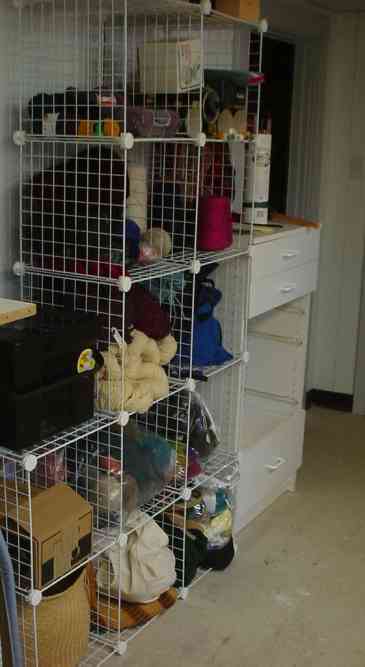
I’ve kept the large table shown in the before shot. The ceiling tile is replaced, the floor is scrubbed, and?all debris is gone. I moved the white wardrobe to the same wall shown in the new photo, above. The white drawer unit is now further down the wall, and the mesh cubes shown here?are betwen it and the gas pipe, which you can see sticking up between it and the other white cabinet in the before photo. My storage tubs of yarn are stacked in the corner of the room where the wardrobe used to sit. No progress on a comfy chair yet, but we’re replacing my daughter’s desk chair this week, so I’ll probably snarf up the abused cast-off for my workroom.
As you can see, the el-cheapo Home Depot storage units we brought over?from the old house are not good candidates for relocation. The drawers are out of the unit you see because?during the move it?shifted from true, and the tracks are now too far apart to hold them. Some minor carpentry is in order before it’s useable again. If you’re thinking of buying this type of peg-together pressboard storage furniture at a home center or discount store, ?remember that it’s build-once-and-leave-it stuff. Regardless of the low cost,?I don’t recommend it for people who are still in the nomadic phase of life, especially?if re-using the piece in a new location is a consideration.
The wire mesh cubes however are a new acquisition, and bode to be both durable and capable of being taken apart and put back together many times. Last week?these?units?were on special at Target. One box of them makes a stand-alone six cube unit, and the cost (on sale) was just under ten dollars. I snapped up two boxes in white (they also come in black). They can be assembled in any of a number of ways. I’ve done my installation in 2, 4, 4 stacks to work around the?large gas pipe on that wall. Because of the geometry of the thing, I’ve got two mesh units left. Not enough to make another cube, but enough to jury-rig two half-height shelves or dividers in existing cubes by using?some nylon cable-tamers to do the attachments.
The stuff in?my cube unit isn’t there for any particular reason. Mostly it was miscellaneous knitstff that got packed separately from my storage tubs. There’s my swift and ball winder; my collection of single-malt Scotch containers housing needles and other tools (upright on the white dresser, and horizontal in a top cube); various UFO bags; a stack of some rustic-type wools that in violation of my own stash-management rule, has overflowed it’s allowed tub. My small black box of sock yarns; and various coned oddiments. I believe that cone of raspberry is in fact Believe, a find from the Classic Elite mill ends outlet up in Lowell, MA. Books, mags,?and leaflets are elsewhere in the house, in their own bookcase; with mags and leaflets?sorted more or less haphazardly into several plastic magazine files.
Eventually I’ll sort through the tubs and pull out Yarns of Immediate Inspiration to put on these shelves; stowing the ones I don’t plan on using in the next fifteen minutes. My stash management rule??
If it doesn’t fit in my existing containers, I can’t buy it.?
That means I either have to knit up new acquisitions immediately, or make room in a tub by using up something that’s already there. However, eyeing the tubs I see that they are increasingly filled with odd lots of leftovers rather than full-project amounts. Perhaps it’s time to organize a yard/yarn sale/swap meet, and invite the world over so we can all redistribute our holdings to better effect. Hmmm….
GALLERY
Remember two days agoI said I’d be delighted to show off any projects that other people did either from or inspired by my designs? I’ve started the blog category "Gallery" for just this purpose. First off, here’s a nifty example of a piece adapted from a stitching design in my book:
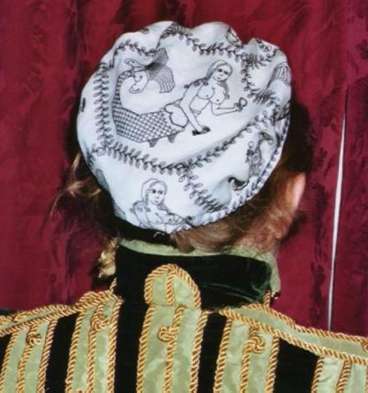
This hat is part of an Elizabethan costume made by a fellow participant in greater Boston, MA area SCA activiites. The stitcher’s SCA name is Lady Lakshmi Amman, and the recipient (and model) is Mistress Morwenna Westerne. Click on the photo for more detail shots ofLakshmi’s work, including graphs forher adaptations ofmy winged undine from Plate 75:1 of The New Carolingian Modelbook. (Lakshmi’s photo appears here by permission.) Because the piece was made to celebrate the artistic accomplishments of Mistress Morwenna, Lakshmi’s undines each carry something associated with Morwenna’s favorite pursuits. There’s an embroidering mermaid, a cooking mermaid, a performing mermaid, and several others. Very clever!
More on Crochet
I’ve gotten some more feedback and help on ways to attach edging and borders to pre-existing filet pieces; and advice on how to better keep 1:1 true square proportionality when forming meshes.
First, advice from Vaire, the Innocent Abroad onmaking my squares square. She says that try as she might, she was never able to achieve true squareness using the base-4 style mesh I’m using. Instead she switched to base-3. That’s one double crochet between the legs of the mesh to form a filled square, and one chain stitch between the legs of the mesh to form an open one (I do two of each right now). She said that this reduced the width spread of her squares.Vaire went on to suggest another method of increasing mesh size: using 3 ch betwen trebles, instead of 2 ch between doubles. This makes a larger, more airy mesh, and opens opportunities for partially as opposed to solidly filled squares (tr, ch, tr, ch, tr). Thank you, Vaire! Both are intriguing ideas, well worth experimentation.
My pal Kathryn also continues to ply me with great ideas too numerous to all list here. Several have been for methods of joining filet sections. There’s been a step-style join that makes a mitered corner. I need to try that one out before I can explain it better. At first I was afraid that my not-square squares would throw the miter off, but used in combo with Vaire’s base-3 idea, it sounds like it would work quite well. She’s also sent me quotations from pre-1920 books that discuss methods like overhand basting to hold sections together; and picking up and working an edging in another style of crochet.
Finally Vaire also suggests using double crochets as horizontal "brides" (reseau) to attach the new bit to the old. This is also a nifty idea, and one I considered, but I was doomed by a poorly planned design choice. I want a two-mesh strip of empty meshes all the way around the piece. I’ve already made that. To do the bride method, I’d have to have done only one, as the row of attachment would provide the second. Since I want most of the joining row to be solidly worked, were I to do it with horizontal double crochets I’d run afoul of the proportionality problem again. Again, thank you! A good idea for a future project, but I’ve pretty much painted myself into a corner on this one.
 String-Or-Nothing