MOTLEY ON THE ROAD
My bag of orts hardly reduced by my progress, here’s more Motley:

It’s rather chaotic, but I like it. For the record, I’m using US #8 needles, which are quite large for fingering weight. But the odds and ends I’m knitting with are not all of uniform thickness. Some are regulation fingering weight sock yarns, like Regia, or Fortissima. Some are heavier, like Koigu, or Dale Baby. But all fall into the 9-6.5 stitches per inch range. Since this is a throw and not something like a sock or mitten that needs a sturdy fabric, using these finer yarns on larger needles is minimizing the gauge difference among them all.
I’m about a third of the way through the center rectangle. When that’s done, I’ll probably fill in the little triangle bits at the top or bottom, then do a narrow mitered edge around using a solid color. After the unifying band is on, I’ll finish off the thing with some sort of edging, also done in haphazard small quantity multicolor.
There’s no guarantee however that the current “bottom” edge will remain so. I can add stripes to either end, so long as I maintain the joining rhythm, with raised join edges appearing on every other seam. The other “rule” I’ve hit upon is that unless the quantity left when I get to the end of a stripe is very small, or the yarn’s color variations are giant, I am beginning a new color for each new stripe. I do note that my color selections are consistent. There are reds, purples, yellows and greens in there (and the occasional snippet of turquoise), but most are variations of those tones that harmonize well with deep blues. For example, there aren’t any baby pastels or desert tones in the thing.
Working on this is bringing up memories of the various projects that fed my bag of leftovers. Socks and baby projects knit at particular places, for specific people come to mind as I address each tiny remnant. Although I hope I’ve got a way to go to the Madame Defarge stage, coding the names of the damned next to the guillotine, I do remember details of conference presentations and lectures I knit through as their sock leftovers come to hand.
And finally the explanation for the cryptic “on the road” designation, and for the uncharacteristic bright photo of the piece. I’m in Florida, visiting my mom, and took the photo here in her bright and cheery marble-floored apartment, rather than our darker New England home. Here we are enjoying the view off her balcony and being spoiled rotten. Not necessarily in that order.

MOTLEY!
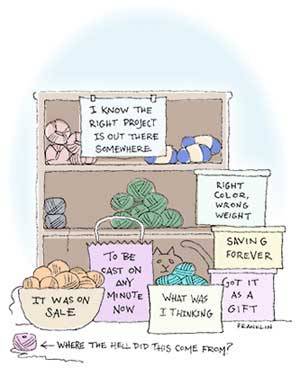
Things being rather unsettled here right now, but still in need of stress abatement, I looked around to see what evening needlework distraction I could find. I don’t want to start a forever project with only a limited amount of time before The Big Displacement. I’ve sent the embroidery floor stand on ahead to India, so working on Big Green is problematic. I’ve been doodling up knit scarves and socks – giving most of it away. Additional inspiration for this one came from the Resident Male, who always bemused by my yarn hoarding habit, forwarded this.
I’ve got a big bag of little bits of fingering weight – mostly left over from sock projects. I’ve dipped into it every now and again to make booties or to supply a stripe or toe for later socks, but for the most part, the bag has grown steadily larger in the 18+ years I’ve been knitting socks.
So. Given the need for totally mindless knitting, very few needles in the house (also mostly sent on ahead), and the guilt-induced constraint to use my stash yarn remnants, what could I come up with?
Motley!

This is ultra simple – 12 stitches across (10 plus 2 slipped edge stitches), knit in garter stitch; 10 ridges with each right side row beginning with an increase and ending with a decrease; followed by 10 ridges with the wrong side rows beginning with an increase and ending with a decrease. After the first ripple is done, subsequent ones are joined to the established chain selvedge edge with a simple pick up/pass last stitch over move, followed by purling that stitch on the next row. The basic zig-zag concept is Frankie Brown’s Ten Stitch Zigzag, which I’ve played with a bit.
Using relatively giant US #7 needles (giant for sock yarn, that is) I’m reaching into the big bag of leftovers, pulling out whatever I find, and adding it on. Eventually I’ll add little triangles to square out the piece to make a center golden ratio rectangle. Then I’ll figure out some sort of similarly chroma-chaotic edging, so that I end up with a little lap throw.
It’s a quick knit, and totally without thought. What you see above is the the consumption of nine mini-balls of leftovers over the course of three evenings.
GIMP CHARTING TUTORIAL 108 – THE TEMPLATES
Inspired in part by Hastings Sanderson over at Is That an Apres?, who is thinking of embarking on an extensive graphed needlework project, I went out web-walking to see if others were using GIMP for needlework graphs.
In addition to my own set of tutorials on using it for line unit patterns (backstitch, double running, punto scritto, Holbein stitch, etc.) I note this tutorial on using GIMP to transform photos into cross stitch graphs, and a GIMP plug in for that purpose. I’ve also adapted my method for use with square unit graphs (cross stitch, needlepoint, lacis, burato, knitting), but it’s not as elegant as the commercial programs designed in specific for needlepoint or cross stitch.
However, in all cases, I find very few folk have successfully used GIMP for needlework charting. The most prominent feedback on my method is that few people have the time or patience to establish the base templates. So, to give others a leg up on creating their own charts, I offer up my base pages. These are 8.5 x 11 (US letter size) pages, each set up with the layers needed for graphing. They are intended to be used with the grid spacings and brush sizes specified in my tutorial. They are based on the ones I’m using right now for T2CM, the sequel to my New Carolingian Modelbook.
Because of WordPress limitations I can’t post the GIMP *.XCF files, so I’ve bundled both the line unit and square unit templates into one standard Windows *.ZIP:
Remember – after opening these templates go back and change your grid spacing and brush sizes to those specified in the GIMP series here. Then have fun!
HECTIC!
It’s been a hectic several weeks here at String Central, encompassing major transitions and a very small crumb of Hurricane Sandy.
First on the transitions – I’ve left my job to concentrate on our India migration preparations. I’ve not made a secret of being a professional proposal manager, but I’ve avoided naming my former employer here to date. I will miss my colleagues at iRobot, where I worked on the defense and safety side of the house. I supported robotics research; and the various robots used for bomb disposal, infantry support, and nuclear clean-up. It’s hard to beat the combo of brilliance, passion, and creativity at a place like that, or knowing that the work you were doing helped people save lives on a daily basis.

In the midst of emotional upheaval of leaving, the recent storm provided a reality check.
We had it nowhere near as bad here as folks further south in New York and New Jersey. Shout-outs of support and sympathy to those in my childhood neighborhoods of Sheepshead Bay, Brooklyn and Teaneck, NJ (Bergen County); to Long Time Needlework Pal Kathryn in New Jersey and to Mathilde, also near the landfall area; and to all others suffering the storm’s aftermath.
AN ASIDE:
Please join me in offering assistance to those in need by donating to the charity of your choice, or to the American Red Cross: http://www.redcross.org/
Unfortunately, times like this bring out lots of bottom feeders. I strongly suggest heeding the advice here before unlimbering your wallet.
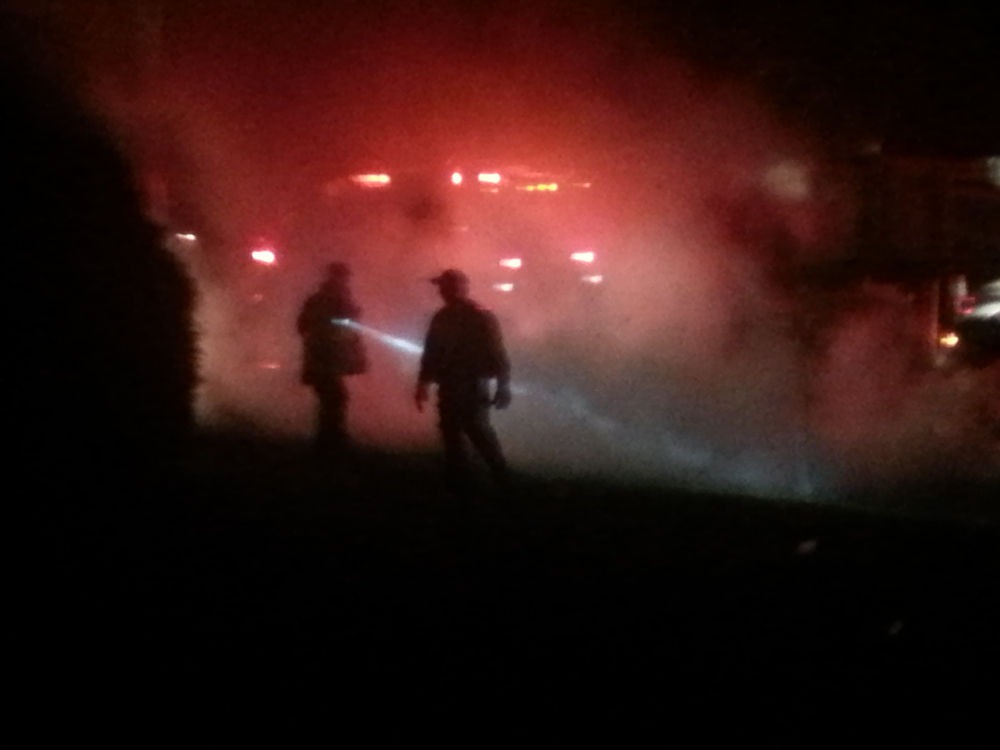
We were without power until Thursday here – the result of a small but spectacular power line fire in front of our house, that occurred at the height of the storm. It took about 2.5 hours before the utility had a truck free to turn off the electricity. In the mean time, we had a leaping, sparking power line; and a spreading turf fire. Luckily the ground was wet, so the fire burned down into the lawn instead of spreading the short distance to the house and cars, but it was so intense that the copper itself burned (green flames) and the turf vitrified into solid, red-hot masses. When the power was safely out, the fire department came to dig out and extinguish the blaze. The only casualties ended up being a swathe of grass, our collective nerves, and some refrigerator perishables that didn’t survive the lingering power outage.
Thanks to the first responders who came to shepherd the hazard and stayed with it through the worst of the wind, and to the crews that dealt with the fire and its aftermath.
We still have no land line phone, but that’s just a minor annoyance.
Halloween did happen here, although with a dark street, only the most intrepid and candy-hungry kids came to our door. But we were ready:

(Sadly, the head sensor gizmo on Younger Daughter’s pumpkin Dalek did not survive the first wave of trick-or-treaters).
And finally, after all this blather – report on what needlework progress I was able to manage by candlelight:
The finish of the cotton Kombu Scarf:

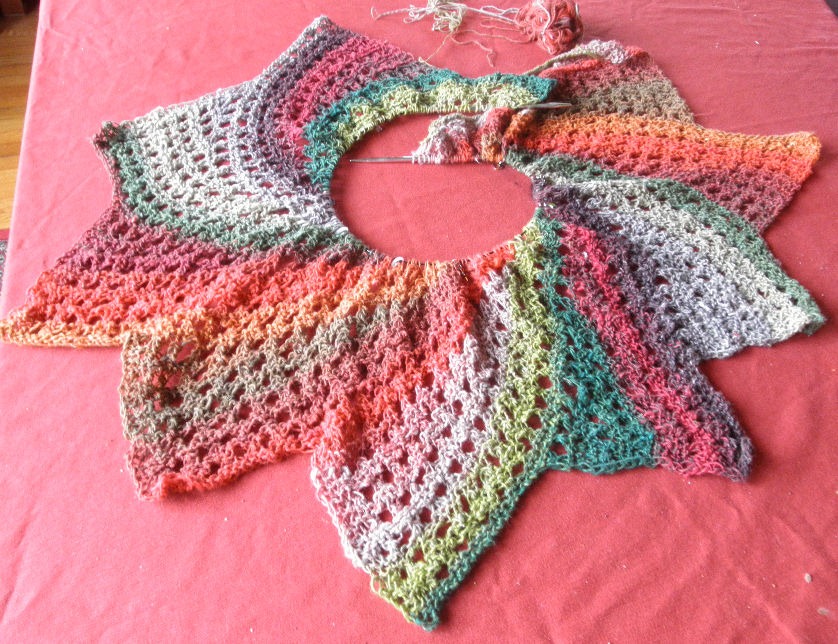
And most of yet another Lattice Wingspan:
I plan to invest my new found daylight hours in additional post-storm clean-up, attending to India related preparations, fixing the vintage yarn chart/needle size chart for reposting here, studying Hindi, and working to get T2CM out the door. In more or less that order.
WHAT WOULD YOU PACK?
I have sent off our second shipment of household goods. With luck they’ll arrive at the apartment in Pune, India by the end of November. The flat is furnished, so there was no need to send furniture, but it’s a spare and barren space. The Resident Male is fixing that, but it will take time.
In shipment #1 we sent pots and pans, some linens, a TV, and other items of immediate need. This second shipment is mostly clothing for Younger Daughter and me, plus linens for more beds, some bits of kitchenware that we forgot before, and most important of all – Survival Boxes. Younger Daughter and I each got one.
What’s a Survival Box? It’s a box full of the hobby, reading, or idle time amusement things intended for maintaining familiarity and sanity far away from home, where supplies might be difficult to come by. That’s not to say that we wouldn’t be able to find hobby things at our destination, but I rather suspect that selection and proximity will both be limited.
Younger Daughter packed painting and sketching supplies, including paints, pens, and paper. Also some selected books, and crochet yarn and hooks, along with a book on intro amigurumi (Japanese inspired small soft toys, usually knitted or crocheted).
What was in my box? Really – you have to ask?
In all truth, packing the thing was the hardest move task to date. What to take and what to leave behind? On one hand, I want to have a variety of things to do because I work on stuff at whim. It’s hard to predict flights of whimsy for the 18 months to come. On the other hand, there’s no point bringing a ton of stuff because whatever I bring, I have to schlep back.
Here’s what I settled on:
1. My unfinished North Truro Counterpane. It’s about 40% done right now, destined to be queen bed size when completed:

The pattern is here, if you’re interested.
2. My giant green sampler. I packed the frame stand, but not the sampler and stretcher frame. I’m still working on (albeit slowly) and it will accompany me in person.
3. Lace yarn. I’ve got a huge hank of black merino lace yarn, plus a big spool of hunter green, some blue, and some accent threads that go well with the hunter. Not sure what I’ll do with them yet, but I am bringing my copy of the Sharon Miller Princess Shawl, just in case I want to attempt an impossible project in an unconventional color.
4. Extra ground cloth and threads. I rounded up my stashed bits of cotton and linen even weave. They range from 26 to 50 threads per inch. I’m bringing white and black DMC linen floss, plus a pile of red, black and green cotton floss. Just in case inspiration strikes. I don’t have a stash of silk floss and didn’t buy any because of everything that I use, that’s the most likely thing to be available in India.
5. Sock yarns. About four pairs worth. The best in my stash, including some hand-dyed, and a ball of (near) solid Zauberball in deep emerald.
6. Lots of knitting needles, holders, embroidery needles, a pair of sewing shears, a couple of hand-hoops, my magnet board folder (thanks Kathryn!), my swift and ball winder (absolute necessity with the lace yarns) and other notions.
7. The stitching kit I picked up at Winterthur, to make a reproduction of the Sarah Collins sampler. Still not sure if I’ll do this myself, but it’s a self-contained project and easy to transport. Compared to the stuff I usually do it doesn’t look like it will take very long to stitch up.
8. Selected reference books. I can’t bring my whole library, but I did pack a few big-bang-for-the-volume pieces – my Duchrow trilogy, a German knitting stitch treasury, and TNCM. Plus some others on a thumb drive.
With the exception of a couple of balls of sock yarn and the accent threads, this is all from my stash, accumulated over the years. Which is why we have these hoards in the first place. Right?
So.
Given a trip for up to two years away from home, to a place where distraction would be appreciated and supplies might be hard to get, what would YOU pack?
BLOCKING MAKES ALL THE DIFFERENCE
Compare.


This is the same scarf. At the left, it’s fresh off the needles. On the right, it’s been through this torture:

All lace benefits from a savage blocking. Is your Wingspan looking flabby? It’s probably not your knitting technique. Try blocking it and see.
For the record, I used my visually horrific checked sheet and damp-blocked my finished Lattice Wingspan. First I dampened the thing and squeezed it out gently (no wringing). I patted the center curve into shape and pinned it first. Then I used a minimal number of pins – just one at each point – to pull the points out from the center. Finally, I let it dry overnight.
The ends? I don’t darn in ends until after I’ve blocked. Especially on lace. Finishing off the end may introduce a small area that does not stretch like the rest of the piece. Better to let them hang, then deal with them after blocking is over.
STILL MORE WORDS FROM ANOTHER WORLD
Having sent off our household goods shipment in advance of our great migration, here’s another installment of words and usages from India that are new to me. Again – these are skewed to the sensational and seasonal because my main sources are all newspapers, which there like here tend to lead with grabbers on taxes, violence, scandal, tragedy, alongside gossip and pieces on communal celebrations.
Hoardings – Large scale printed media advertising, especially billboards, although the extra big, freestanding ones appear to be called “gantries.” Trucks whose body is a large sign rather than a cargo payload are “mobile hoardings.”
Tender Rate – Hard to tell from context, but this appears to be a tax rate or licensing fee. I found it in an article on government crackdown on illegal hoardings (above), in which a higher tender rate was recommended, coupled with increased enforcement, including removal of illegal (unpaid) displays.
Lakh and Crore – Indian currency (rupees) are individually quite small in value. At the time I write this, the exchange rate is roughly 1 rupee = 1.9 cents US. Therefore prices for big ticket items – cars, houses, jewelry – are expressed in very large numbers. One lakh = 100,000 rupees, or at today’s exchange rate, about US $1,886.79. One crore = 10,000,000, or US $188,679.00. It’s very common to see headlines like “Rs 1.5 lakh of jewelry stolen,” or “Rs 4.3 crore seized”. The abbreviations are lk and cr.
Names for cardinal numbers – Numbers in general in Hindi and Sanskrit (two of many languages there) are handled differently than in English. We have unique number words for numerals 1-12, then use a combo form to make the rest of the teens; then have a unique word for tens place numbers (20, 30, etc.) but form compound words for the numbers in between them (21, 33, 67). In India each number to 100 has a unique name.
Body offences – A broad legal class of crimes that appears to cover the equivalent of the US terms “Bodily harm,” and “aggravated assault” although the definition also includes armed robbery, extortion by threat of injury, poisoning, slavery, and kidnapping
Various common British usages – Thrash instead of beat (“Dacoits thrashed the victim with a stout rod”); shift instead of move (“I shifted the furniture, but I didn’t think you’d mind.”); dustbin instead of trash can; attach instead of confiscate (The Enforcement Directorate attached all remaining funds, after the embezzler was identified.”)
Ota – Earthen platform or raised mound. A temporary structure used as a platform for devotions, especially during religious celebrations.
Pandal – A structure or enclosure erected for religious purposes. These can be permanent, but at this time of year, festival season in India, many are temporary. The legal definition includes structures that serve business purposes, too, although newspaper citations I’ve seen have all been about temporary shrines erected for celebrations, where they are, or what provisions/fees are being levied for electrification, or other infrastructure and public safety support for them.
REINTRODUCTIONS
Welcome to the flood of folks directed here by the generosity of Mary Colbert, over at Needle ‘n Thread! She blogged about Ensamplario Atlantio, and the visitor count here ballooned from about 70 per day to over 5,000.
Given the large number of new folk, I thought I’d make a general re-introduction of myself and the site.
My name is Kim Brody Salazar. I’ve been knocking around the web since it first crawled up from the primordial pre-Internet seas. Professionally, I’m a proposal manager specializing in engineering and high-tech. I escape from project pursuit deadlines into needlework, SF, good cooking, and halfhearted attempts at domesticity. Past passions include the Society for Creative Anachronism. I rarely attend SCA events these days, but is still home to many of my closest friends; and Aikido. I am abetted in these efforts by Elder and Younger Daughters, and by The Resident Male, the husband whose programming ingenuity was responsible for the plumbing behind wiseNeedle. As a family we are currently preparing for an extended sojourn in India, where he is now working.
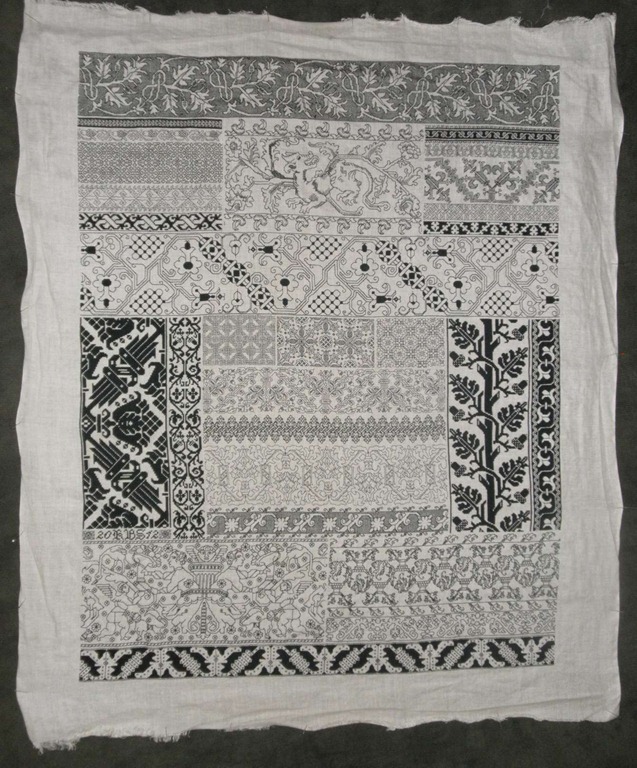
I’ve done many types of needlework, but my favorite stitching techniques remain the counted styles – especially from the great Modelbook Era (1520s-1650s). I adore blackwork in all its manifestations, and strapwork (the long strip patterns found on household and body linens).


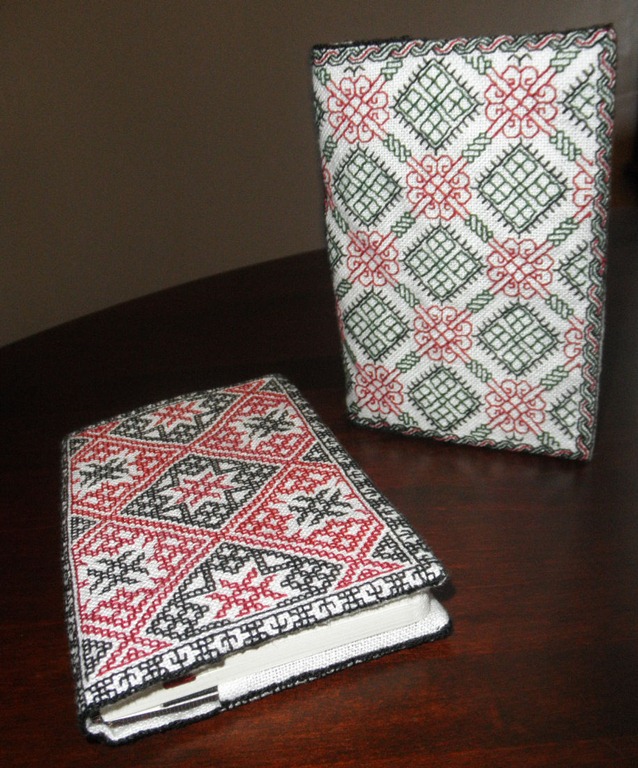
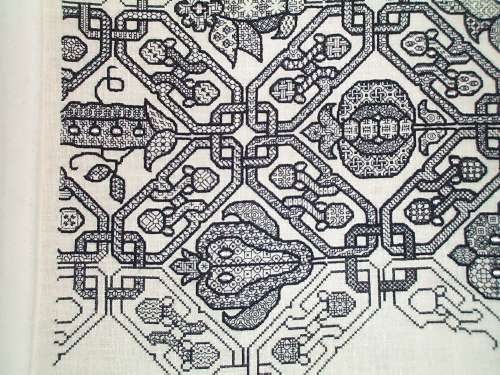


I’ve also played with several forms of needle lace and crewel, but in the days that pre-dated photo blogs.
I am an avid though haphazard researcher, drafting up historical patterns from artifact and early book sources. I’ve put together several pamphlets of these designs. The most recent complete book was The New Carolingian Modelbook: Counted Designs from Before 1600. It was published for an SCA audience, but to my great surprise was discovered by the stitching community at large. I won’t go into the details, but TNCM is now out of print. I am working on a sequel, which I hope to have out soon via a print on demand or self-publication service. The Second Carolingian Modelbook: More Designs from Historical Sources will not duplicate the designs in my earlier book.
Along the way, just for fun and to refine the methods I wanted to use for T2CM, I drafted up Ensamplario Atlantio. It’s a collection of filling designs for inhabited blackwork, along with quite a few that have stand-alone or strip application. I’ve released it for free as a series of PDFs, along with other free embroidery patterns, here.
I also knit and crochet. I’ve done a bit of amateur design, and have had several of patterns published by Classic Elite, KnitNet, and Schaefer Yarns. I ran the wiseNeedle knitting info website (in various incarnations) from 1995 until just earlier this year. wiseNeedle featured an extensive needlework advice board, plus the glossary and patterns now here, along with a huge database of user-contributed non-sponsored yarn reviews. The yarn review database was salvaged by Nimblestix. Please feel free to consult to it and add to it over there. I also release knitting patterns for free here on String.
In terms of technique, I tend to favor texture knitting over stranded colorwork (although I like them both). I especially like lace knitting, and mining the 16th century sources and late 19th/early 20th century knitting publications for designs elements, which I toss into the creative Cuisinart.
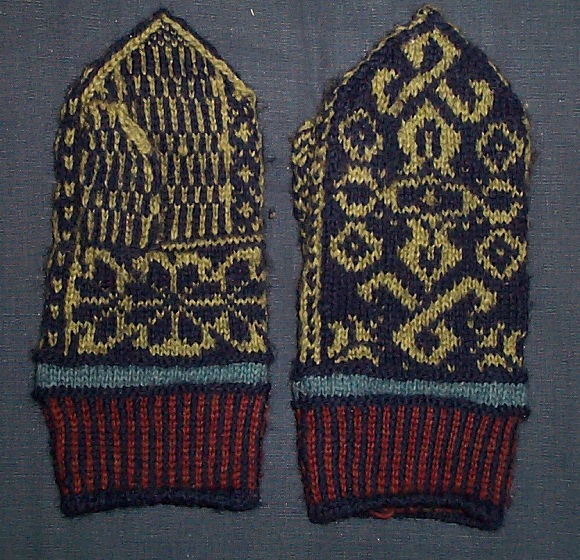

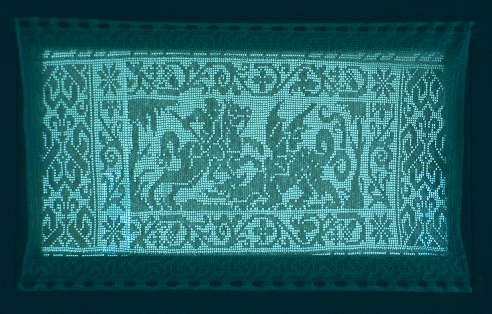
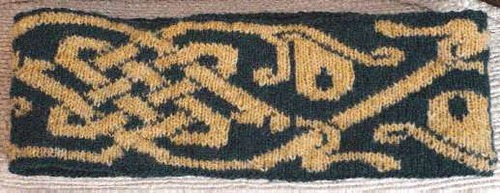

That pretty much sums up my approach to all needle arts. I love the intricacy of many traditional styles, but I am not all that interested in producing stitch-literal reproductions. Instead I prefer to add to my design vocabulary to produce new works. Some of these I hope that – if they were to be TARDIS-transported back through time – would be accepted as just another piece in the target style, without being a dead-on copy of an extant artifact. Others are more playful, taking designs intended for one needlework medium and using it in another, or sneaking in incongruities just for fun. If you’re a needlework purist, I’m sure I’ll ruffle your feathers, and we’ll have lively debate. This is a good thing, because it will expand both our horizons.
I also do not believe the common line that modern needleworkers have no skill or patience for large, intricate projects. I find the dumbed-down tone of most mass market stitching, crochet and knitting books to be patronizing and demeaning. If passion and interest are there, no skill curve is too steep to climb, and there’s no reason to set the bar of attainment artificially low. Steps up are good, but too many instructors top out on the lower plateaus, never expecting their students to advance beyond threshold skills, or offering up the higher levels as anything other than impossible high bars that we today can never achieve.
Time can be found for whatever you want to do or whatever skill you want to perfect, even if (like me) it’s only 15 minutes here or there. Needlework is like music or the martial arts – practice is required, there are no instant skills or guaranteed outcome. But like any training pursuit, the act of committing to the training hones the mind and the character, and teaches far more than the mechanics of the skill itself. I encourage everyone to set high goals for themselves. It’s the reaching that makes it worthwhile, whether or not the goal is grasped. I may never reach mine, but I’m sure having fun on the journey up.
In any case – enough rambling. Welcome to my new readers and any long-lost friends!
GALAXY OF WINGSPANS, MORE KOMBU
Where have I been? Busy, mostly.
I’ve been getting our India-bound household goods shipment organized – buying what’s needful, and sorting the rest out from our domestic inventory. There are tons of details that have to be settled before we go, and not enough time to do them, of course.
But that doesn’t mean that stress abatement isn’t happening. I’ve taken to watching Dr. Who with Younger Daughter, after dinner is picked up and homework is complete. I’ve worked a bit on stitching, but mostly knitting. Holidays are coming up after all, and there are gifts to be stockpiled. Plus in all of the rushing around there’s a fair amount of “hurry up and wait.” I don’t do that well, so I always go armed with some sort of handwork. My big frame isn’t portable at all, so small knitting projects have been accompanying me on my rounds.
So far the tally for September/October is two pairs of socks, four Wingspan scarves (three were my variant on the basic pattern), and two pairs of booties. The socks below – finished yesterday – are my standard 72 stitch circumference short-row heel/figure-8 cast on toe-ups, with an improvised Old Shale/Feather and Fan variant on the cuff. The other pair of socks is making its way cross country to Elder Daughter (chasing the first Wingspan, sent several weeks ago), and the booties have been distributed. The two remaining Wingspans will be blocked this weekend.


Last night and this morning in the splendor of the Sears auto repair shop waiting room I worked on an old friend – my Kombu Scarf.
I’ve knit a few of these since first posting the pattern in 2004. The initial one was in Schaefer Little Lola, a space dyed mix of greens and browns, that combined with the undulating shape of the center, gave the scarf it’s kelp name. Since then I’ve done it up in other yarns, ranging from sport to worsted weight.
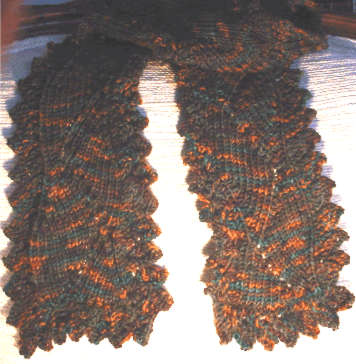
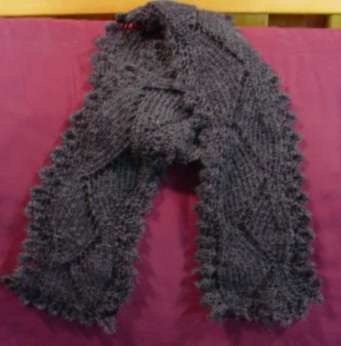

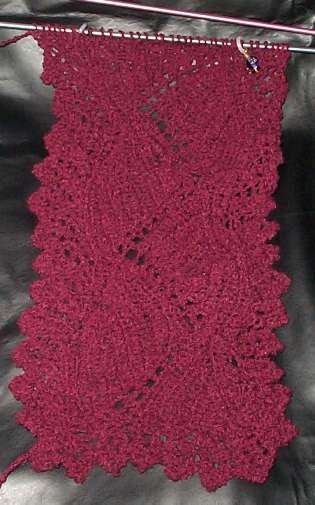

Kombu is a graceful, narrow scarf that can be made from as little as around 280 yards of yarn. The design is both bold and a bit fluttery. The pattern knits up well in every fiber I’ve tried (cotton, wool, acrylic, alpaca, cashmere blend). It’s reversible, attractive on both front and back. There’s no seaming – the bottom edging is knit as a narrow strip, then the scarf body is picked up and knit north from there, with the side borders worked at the same time as the scarf center. At the end, the final bit of edging at the top is worked across as a finish on the remaining live stitches, right from the needle. There’s no need to sew on or pick up and knit an edging, and if done from a large ball of yarn – there are only two ends to darn in when it’s done.
Here’s the latest. It’s in Marks & Kattens Indigo Jeansgarn – leftovers from one of my all time favorite projects.
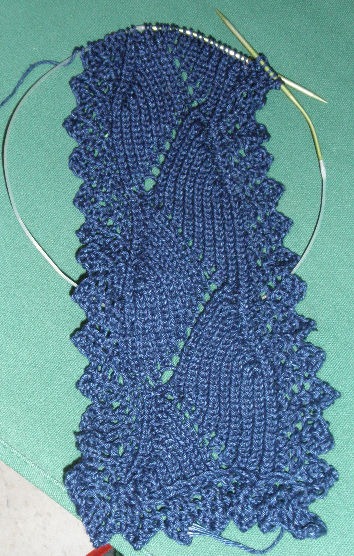
I started this one in part because I needed something on the needles, and I wanted to add to my pile of presents-to-be. But also I got a shout out from a Ravelry reader who was wrestling with her own Kombu project and needed help. It’s been a while since I knit one of these, I had to cast on in order to lend a hand. Happy to say, she appears to be over her problem, and is now knitting away again.
If you’re interested in the Kombu pattern, it’s available as a free PDF download, at the “Knitting Patterns” link at the top of the page. There’s a German language version there, too.
LATTICE WINGSPAN VARIANT
LATE BREAKING UPDATE: The Lattice Wingspan Variant instructions are now available as an easy-to-download PDF, at the Knitting Patterns link, above.
Another Wingspan. I’m trying to codify what I have been doing because I wanted to post it as yet another enhancement to the pattern, hence the multiple iterations. UPDATE: Test knitting complete, pattern corrections are now in!
Before and After (pre-blocking):
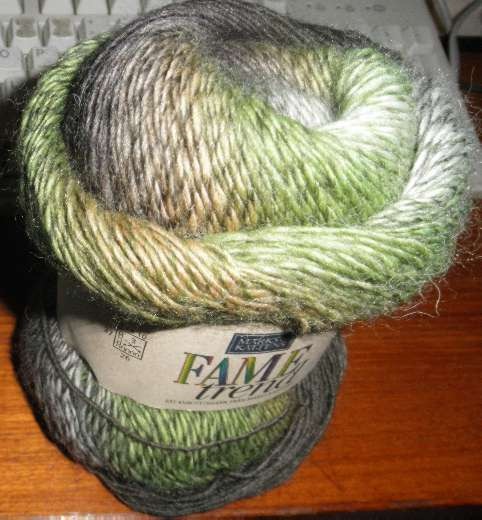
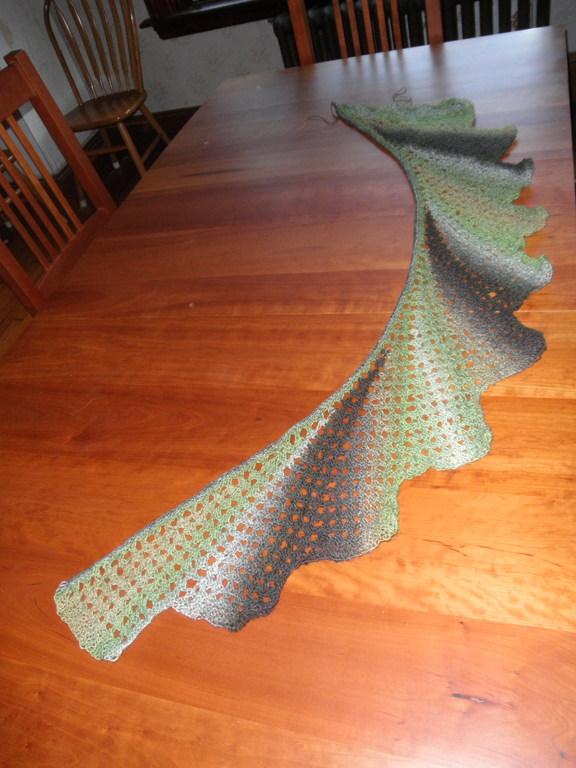
This one was knit from Marks & Kattens Fame Trend. Its labeled as a heavy sock yarn to be knit on 3mm needles, at 26 stitches = 10 cm, but it’s really somewhere between sport and DK, with some thick-thin variability. What drew me to it was the very long repeat – evident in the skein. I like the way extra long color gradations play out in this project, and the slow progression from green through olive, warm chocolate and tans played well. Because this yarn is heavier than the original recommended yarns, I used a 5mm needle, instead of the recommended 3.5mm.
I knit my Fame Trend Wingspan starting with a cast-on row of 75 because I wanted my piece longer and more scarf-like than Maylin’s Tri’Coterie shoulderette mini-shawl original. Here are my mods. I was inspired by Lenora’s Angel Wingspan variant, and decided to take the eyelet idea to the extreme, using larger eyelets and lots more of them, plus adjusting stitch count to work better with the project’s natural tendency to “clump” into three-stitch units. I also transposed this to all garter stitch because I liked the way the welts framed the double eyelets.
Again, the basic concept and shape here is Maylin’s. Click on the link above to retrieve her free pattern (free Ravelry sign-in required). You’ll need it to use my supplement, below. And the idea of piercing it with holes came from Lenora. I just took their concepts and ran with them.
LATTICE WINGSPAN
If you are using standard fingering weight yarn, use a needle larger than the 3.5mm needle recommended for the original, in order to increase laciness and yield a softer more fluid drape. For my Zauberball Crazy edition of this variant (true fingering weight), I used a US #5 (3.75mm). For the Marks & Kattens Fame Trend I had to go up to a US #8 (5mm) before I got the result I liked.
Triangle 1:
Rows 1-4: Work as per original instructions, rows 1-4
Row 5: Sl1p, K2, YO, *SS-K1-PSSsO, YO2*, until 6 stitches remain before the marker. Finish last 6 stitches by SS-K1-PSSsO, YO, k3, remove marker. Turn. (If you like any other double decrease may be used instead of the slip-slip-knit one-pass-both-slipped-stitches-over, I’ve experimented with K3tog and SSSK, and both look fine)
Rows 6 and 7: Work as per original instructions, row 3-4, but knit instead of purl – working a K,P in each double yarn over and a K in each single yarn over when you encounter them. Advance the traveling marker as described in the original on each wrong side row, until you work a final wrong side row with only 3 stitches, and have no place to put it.
Triangle 2:
Row 1: Sl1p, YO, *SS-K1-PSSsO, YO2*, until 6 stitches remain before the marker. Finish last 6 stitches by SS-K1-PSSsO, YO, K3. Turn
Row 2: Sl1p, K2, place non-traveling marker. K3, place traveling marker, knit to end, working a K,P in each double YO, and a single K in each single YO. Cast on 18 stitches.
Row 3 and 5: Work as per triangle 2, row 3 of the original.
Row 4 and 6: Work as per triangle 2, row 4 of the original, but do it in all knit rather than purling.
Repeat rows 1-6 until the traveling marker walks all the way back to the starting edge.
Triangle 3 and all subsequent triangles:
Row 1: Work as per Triangle 2, Row 1 above, until 24 stitches remain before the marker. Finish last 6 stitches by SS-K1-PSSsO, YO, K3. Place a new non-traveling marker, and turn. After you place the non-traveling marker, there should be 18 stitches between it and the previous non-traveling marker.
Row 2: Work as per Triangle 2, Row 2 above.
Continue working Triangle 3 (and subsequent triangles) in the method established for Triangle 2, following the original pattern’s logic. Because my version of the Tri’Coterie pattern is narrower and uses big eyelets, you should get 9-10 triangles out of a 420+ meter skein of fingering weight or sport weight yarn, instead of the pattern’s described eight.
Finishing:
After the completion of a triangle, when you decide your piece is long enough, and you still have about a third of a triangle’s worth of yarn left, it’s time to finish.
Row 1: Repeat Triangle 1, Row 5 above across the entire backbone of the piece, removing all markers as you encounter them.
Rows 2-4: Sl1p, knit to end. AT THE END OF EACH ROW OF GARTER STITCH REASSESS YOUR REMAINING YARN. Depending on available yardage, needle size and gauge, I’ve been able to knit at least one row of garter stitch prior to the bind-off row. You will need approximately 4 times total project width for that final bind-off row. The Marks & Kattens had enough for me to work four rows of garter prior to bind-off. Noro Taiyo had enough for two rows of garter prior to binding off.
Bind off loosely. Because of the big eyelets, damp block this piece to within an inch of its life to make them spread. Try to do it following the design’s natural helix for best effect.
Hope someone else is tempted by this project in my variant or in the original. It’s dramatic, quick, and not as difficult as all those abbreviations make it look. It’s a great one-skein holiday gift project that uses yarns that are tempting/beautiful in the ball, but are a true challenge to use effectively. And like the best of those, is as addictive as potato chips.
Next post will muse on the changing nature of the on-line knitting community, with sincere appreciation to some old coteries who helped me think it through, and who wrote to me to express support. Stay tuned!
 String-Or-Nothing