GRAPES – REPEATING ON AND ON ON REPEATS
Now that there’s more stitched it’s probably easier to see the pattern repeat style that I wrote about last week (click on thumbnail below for larger version):

After working with lots of historical graphed strip and border patterns, I can say that the overwhelming majority of the form repeats in three standard ways:
The first one is a straight repeat – no mirroring, and no flipping. It’s common for edging components on larger patterns, like the little acorns on the larger strip below (adapted from V&A T.133-1956), and (no surprise) for totally symmetrical pieces like the multicolor one (adapted from a Siebmacher design from a post 1600 edition that’s not on line):


The second order repeat is a bounce-mirror. There are two vertical centerpoints and the design bounces back and forth between them, but never inverts. Lots of these feature mythical beasts, people or animals – motifs that have a strong up-down identification. Here are two examples from an earlier Siebmacher collection that’s available on line, one with a nifty yale, and one with an abstract heart and flourish.

In the pattern with the yales (heraldic goats) the mirror columns are the center of the flowerpot behind them, and the center of the fountain like object between them. Even this pattern, for all of its complexity is a type 2 – a very wide type 2, with the two mirror columns being the center of the trefoil interlace near the right hand side of the photo, and the center of the heavy stem interlace about a third of the way from the left edge:

The third order repeat can be the most confusing to stitch, but is extremely well represented in historical artifacts. It’s an elaboration on the two mirror bounce repeat in the second example, with alternating iterations flipped north/south for good measure. Although these repeats employ that flip, they’re actually simpler than type 2s, above.

Why am I calling this one simple? Because there’s really only one mirror column: the centermost axis of the flowers. The north facing and south facing flowers are identical. The design may be visually more complex because of the flip, but when stitched there is less variation – less following of unique chart elements – than in a large type 2 pattern.
Here are some more examples of type 3 repeats:

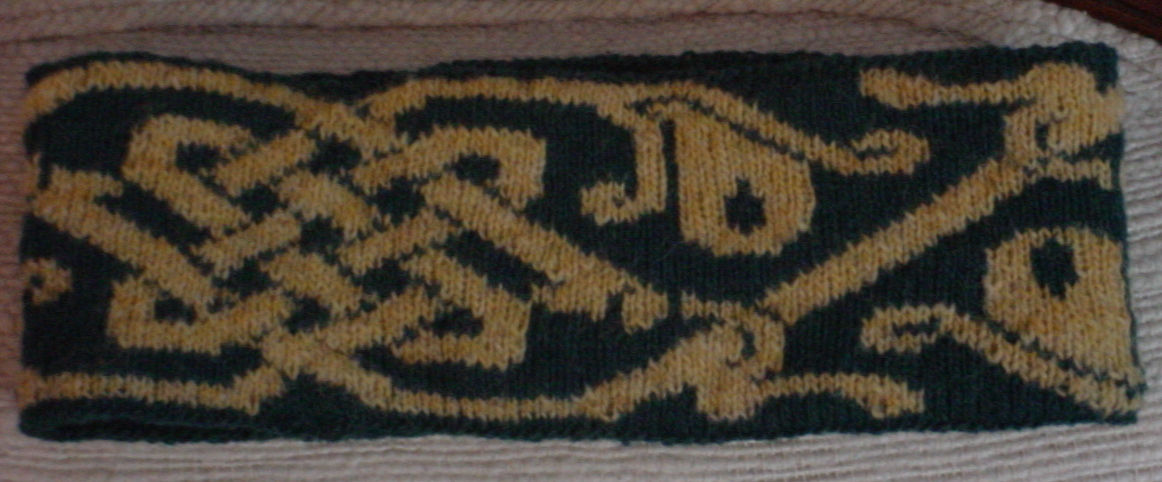

Now to loop around to my current strip, this one is a hybrid:
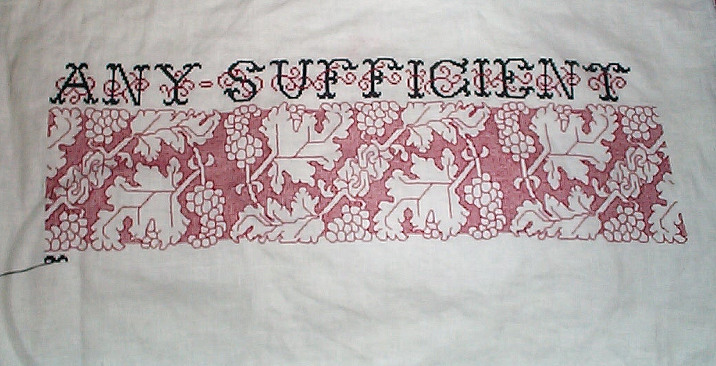
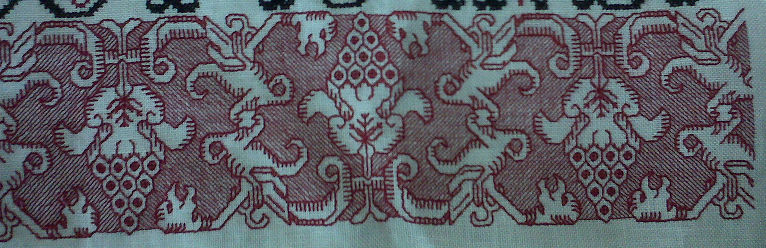
The entire four leaf grapevine unit repeats as a type 1 – verbatim, with no flipping or mirroring. BUT inside each unit we’ve got type 3 mirroring/flipping. The mirror column (which the mathematically inclined might call an axis of inversion) runs down the center of the unit, and to make things more complex, is skew, rather than a nice bisecting 90-degree line from top to bottom. This is the same symmetry that my current pattern shows.

Both are rather like sideways Z or S units, with a strong diagonal element down the center (in this case the heavy geometric beads, and for the red grapes, the main stem), with items mirrored and flipped to either side of the axis of inversion. The difference between this and red grape pattern is that the individual units in this one are connected. If I chose to, I could have worked the red grapes with every other unit mirrored (in fact, in the original the pattern is shown with a companion center cluster and the clusters I use repeated on each side of it, but mirrored around the center unit). I don’t have that choice in my current strip of black grapes. The repeats are anchored to each other by those stems.
To sum up, there are many ways that repeats are formed in historical patterns, ranging from the simple to the complex. All are legitimate, with sourced examples of employ in historical artifacts (or in my case, pieces stitched from sourced historical designs). Understanding the symmetry helps deconstruct the complexity of the pattern, and (I find) makes working it easier.
So. Why else should we care? Frankly, I haven’t a clue unless you’re a historical embroidery dilettante like me. I find the way that patterns are used, the way that repeats are made, and the way that symmetry is harnessed for general effect to be endless sources of fascination. But I’m a pattern geek. Your mileage may vary.
STEEL WOOL?
No, no metal sheep were shorn and knitted up here at String this week. It was however February Break Week for the public schools. Younger Daughter attended a “Staycation” program at Minuteman Technical High for the week.
It’s a very nice program, even for kids not on the vocational school track. Lots of hands-on opportunities to try out various skills. She’s taken some of their programming and robotics classes before, but it’s been cold lately so I think that warmth was on her mind. This session she opted for a day split between welding in the morning, and baking in the afternoon. She loved them both. Good classes with excellent instructors, and ample scope for independent creativity.
Welding was a serious class, not a coddled, watered down experience. She handled arc welding equipment and plasma cutters, first gaining safety awareness and operational skills, and then moving on to her own projects. Here are her final two projects:

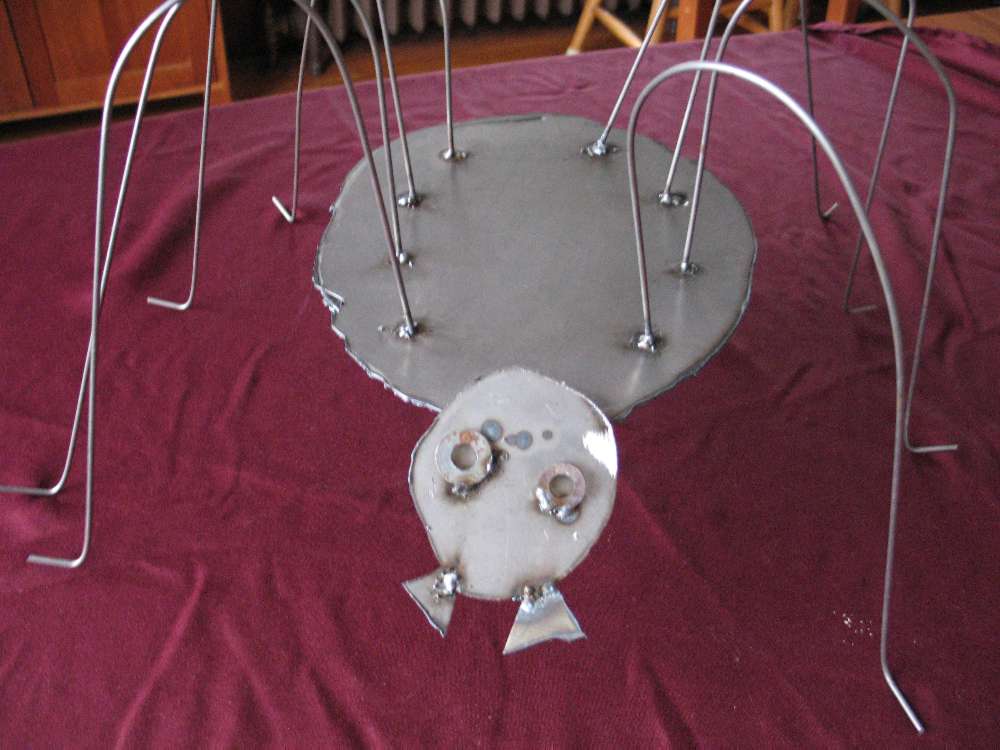
Dragonfly has a two foot wingspan, Spider is similarly sized. Both will adorn the garden come summer.
Baking was also fun. And very prolific, with quite credible, professional looking (and tasting) results. We’re swimming in cookies, rolls, scones, bread, muffins, danish and cheesecake. We’ve fed friends, family, co-workers, frozen a ton of stuff, and even sent a care package off to Elder Daughter at college. To continue the creature theme, two of today’s loaves were a bit creative, too:

I suspect Death Hamster will not outlive supper tonight, with Turtle guest-starring at lunch tomorrow.
A BIT DIFFERENT
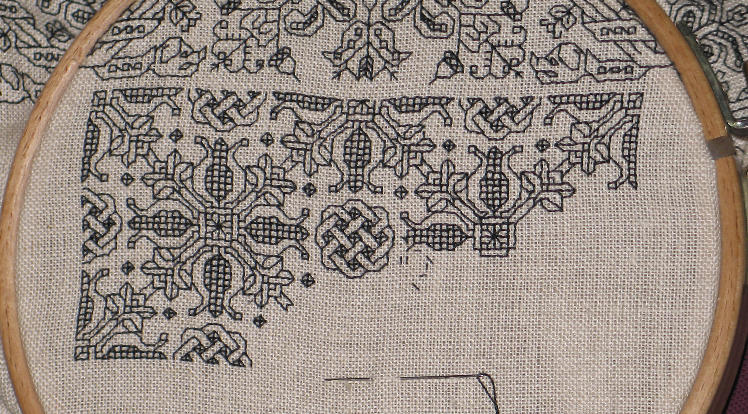
Here’s the latest bit –
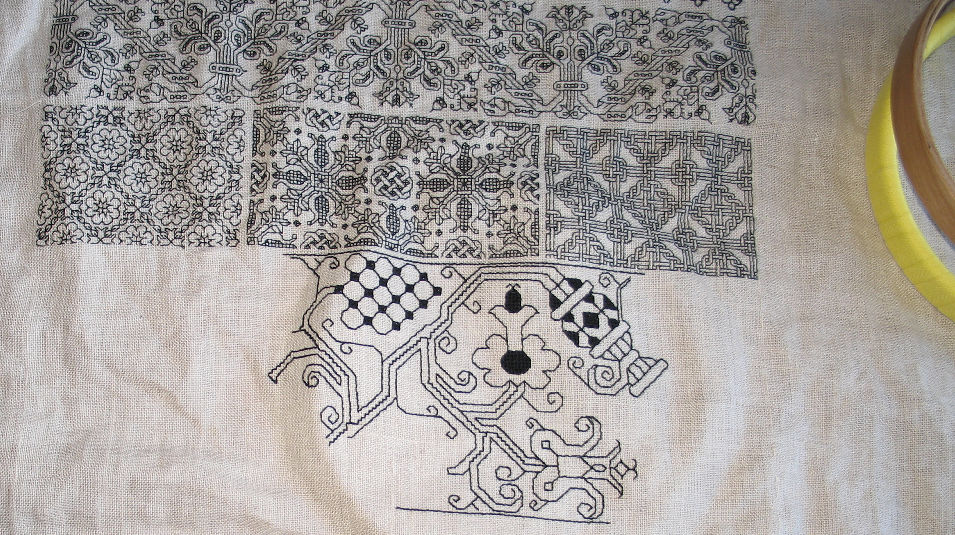
You can see the three fillings from the blackwork filling collection immediately above this new strip. It’s very different in feel from the previous pieces. The proportions are huge. It will span edge to edge (half again as wide as the already-embroidered area, with 25% extra to the right and left of the stitched area. This pattern is one of the ones that will appear in the upcoming book. I’ve charted it from a 16th century artifact in the collection of the Metropolitan Museum of Art in New York.
The original is strip worked in red silk on linen, probably a band of edging on domestic goods – a tablecloth, cover, towel, or sheet (the museum has about 31 inches of this pattern – a bit over four full design repeats). The repeat itself is one of the less commonly seen constructs – more of a large sideways “S” than the standard mirror around two centers bounce repeat.
Here’s a simple two-centers bounce repeat, with a minor bit of complication in the “bindings” that unite the two sprigs between the acorns:

There’s an “up” acorn and a “down” acorn. The design is mirrored to the left and right of each acorn’s centermost spine. The directionality of the bindings is a very minor departure from the bounce-repeat symmetry. Here’s another, more elaborate example of the same type of simple repeat:
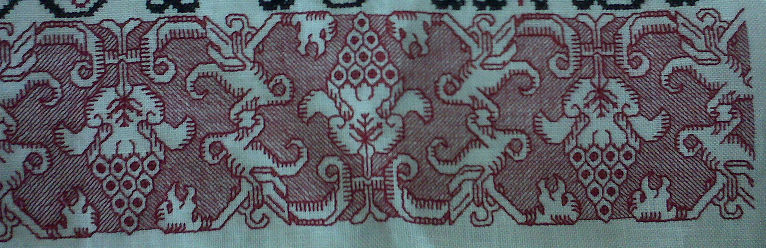
Again, there’s a center line down the middle of the main motif flower, and the design is mirrored left and right of it. This one is a little bit more complicated because the “up” and “down” versions of the pattern are different, but it’s still a simple two-center bounce repeat:

The pattern I’m working on now has a center, and does feature a limited mirror repeat It’s an axis that runs through the bunch of grapes. You can see that I started there, at the not well-defined visual center – it aligns with the center of the pattern immediately above it. I don’t have enough stitched yet to show you how this pattern falls out, but if you zip over to the artifact page, you will see that the grapes and flowers section is in fact a mirrored repeat, BUT the bead line columns do not mirror. (You can see I’ve started one to the right of the trumpet flower). All of the bead-columns in the original slant in the same direction. This method of building a repeat is quite uncommon. Which is one of the reasons why I’m playtesting this particular snippet.
The other reason is the sold black stitching. As discussed, I’m trying to work out the method used to produce the mesh like grids so often used in period voided work. I don’t believe that the originals I’ve been looking at employ a withdrawn thread method to produce the perforated ground, so a pulled thread stitch is most likely. This piece used what looked like the same method, but limited to little accents. I have to say that I do like the look of what I’ve stitched so far in Italian Two-Sided Cross Stitch (ITSCS), pulled as tightly as possible, but I’m not satisfied that I’m using the same stitch as the artifact. Problems of thread thickness and tensile strength for pulled work aside (I’m using two strands of standard DMC cotton floss on 36 count linen), I can’t get enough of a “pull” over my 2×2 thread background to produce the mesh-like ground effect. I’ll finish out this strip with ITSCS, but will continue experimenting, seeking that mesh-like look.
THIRD SMALL INSERT, ON TO THE MYSTERY STITCH
Thanks for the lively discussion! Last week’s post was the most commented upon String has ever had. It’s nice to know that others meet enjoyable people (and poorly socialized idiots) through stitching and knitting in public. And that many of us think alike during these encounters.
I’m moving along on my projects, both on fabric and paper. Progress has been severely slowed as of late due to work related deadlines and a bout of the Evil Flu that’s been going around. But there is some slim progress none the less:
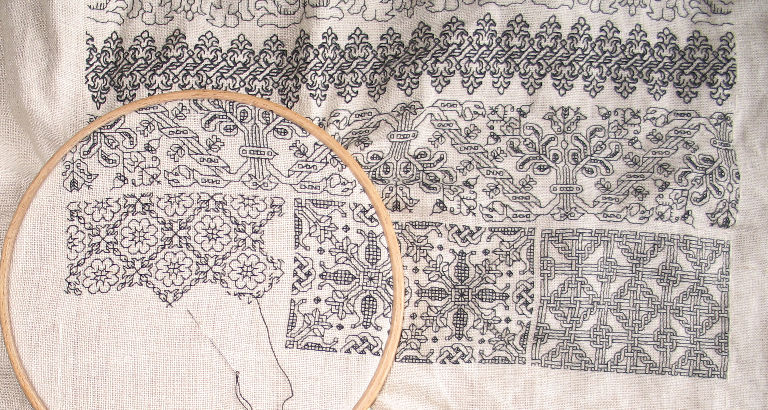
You can see that I finished the eye-boggling interlace, and am now working a relatively tame flower in frame segment. All three are patterns from the blackwork filling collection. I should be finished with this segment by mid-week at the latest.
Next up is a new one though. It’s a double running stitch design graphed out from a photo of a period artifact (part of the upcoming book) but I haven’t tried it yet. The new panel will feature some small areas that are filled in. In the original they are stitched in the same stitch that is used to make a totally overstitched mesh like background on many other contemporary pieces. This style of stitching is most often seen worked in red, so densely stitched that in the mesh like areas no background linen is seen, and it’s most often used as the background on a voided style work, although there are examples of it being used as foreground, and (as in my upcoming trial – a spot accent).
Here’s a good example from the Manchester Art Gallery – you can see that some of the foreground detail is filled in using plain old cross stitch, but the background and the solid fill detail areas are clearly different. This style is a pulled thread technique rather than a withdrawn thread one (neither warp or weft threads of the background material was removed during production of the stitching). Needlework authors cite several stitches as the working method to achieve these mesh like backgrounds including
- Italian Two Sided Cross Stitch
- Four Sided Stitch (aka Quadra, Punto Quatro, or Simple Fagot Stitch)
- Russian Drawn Ground (but this is a withdrawn thread rather than pulled thread technique)
- Double Fagot Stitch (sort of Four Sided Stitch on steroids, with each pass taken twice)
The first two are the most commonly cited. My limited experience with those two makes me lean towards the Two Sided Cross Stitch because Four Sided Stitch usually leaves a little dot of background fabric exposed in the center of each bundled stitch unit (here’s an example – beautiful and regular, but the centers aren’t covered with thread.)
Embarrassing as it is to admit – I’ve not tried any of these in context. Long Armed Cross Stitch, yes. I use it all the time. But the family of pulled thread stitches has always intimidated me. I’ve played with them a bit, but aside from an occasional spate of Italian pulled thread hemming, I’ve never employed them on a “real” work. But there is first time for everything, and I intend to try out the Italian Two Sided Cross Stitch. Stay tuned for more developments!
NO, I’M NOT NUTS
Toodling along on my current sampler…
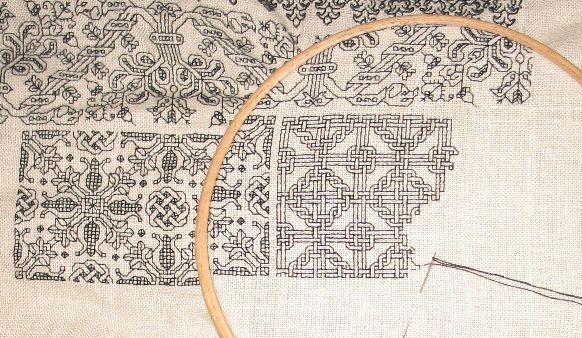
…working on another pattern shared in my blackwork fillings collection, just stitching along. Once the base repeat is established, I find I can copy off my own work, rather than referring to the printed pattern. Sure, this one is on the complex side, but it’s a regular repeat and not what I’d consider particularly difficut; and without having to refer to a printed sheet, the project is totally portable. So I brought it with me to my kid’s school chorus concert. There’s always a long wait between the participants’ early drop-off time and the public concert’s start. Lots of parents stay rather than going home and returning later. I was not alone.
I’m used to knitting and stitching in public. I’ve gotten all sorts of comments over the years, ranging from real interest to veiled hostility. The overwhelming majority of people are interesting to talk to, and my project is always a convenient conversational icebreaker.
There are the folks who ask after the item being worked, or volunteer stories of their own about knitting or stitching. They’re usually pleasant and I enjoy talking to them. There are invariably people who say things like “Oooh. I could NEVER do that.” (What runs through my head is the reply, “With that attitude, I bet you’re right” but I rarely voice it.) Depending on how dismissive they are I either smile sweetly and don’t reply out loud, or try to explain that it’s not anywhere near as difficult as it looks.
There are kids who are fascinated by what I’m doing. Knitting socks especially seems to boggle them. I have fun with them, explaining he project and chatting about the craft in general.
Unfortunately, not everyone is pleasant. Some people say that they hate wasting time. I usually point out that at this very moment (mid commute, in the doctor’s office – whatever) I appear to be far more productive than they are. A couple of decades ago there were more derisive and ideological comments. Mostly from women, who were eager to point out that domestic tasks like knitting and stitching were ineherently demeaning, and should be shunned, especially in public. I would usually engage with them, responding that “freedom from” also means “freedom to,” that I had a highly technical career thank you, and that I found relaxation in traditional crafts. We usually parted on less divisive philosophical grounds.
But this week, just sitting there stitching, I found a whole new public comment beast. The ones who decide that anyone doing something alien to the commenter is clearly nuts, deranged, crazy, a lunatic, or otherwise mentally abberant; and should be pointed out to everyone else. It also seems that these folk (aside from their insenstivity towards the differently abled) delight in being loud and obnoxious. Maybe it was the ambience of the high school in which the performance was taking place, but I felt like I’d fallen back among locker room bullies again.
What did I do? First of all, I didn’t move my seat. I’d come early and sat underneath one of the few lights bright enough for stitching. When it became clear that glaring and not responding wasn’t working, I asked the commenters to kindly be quiet, that they were disrupting the people around us – in my best Miss Manners icy-haute tone. “Bitchy, too” was the reply, and they went away. Like vultures everywhere they probably flew off to circle over someone else’s carcass.
I won’t stop stitching and knitting in public. Idiots are everywhere, and I refuse to let them win.
Have your own stitching/knitting in public story? Positive or negative, feel free to share.
REVERSING ENTROPY
All in all a hectic week, even for one with a snow day smack in the middle. Work deadlines aside (constant drumbeat that they are), our domestic plant experienced a bit more chaos than usual, with major appliances deciding in concert to abandon their prime functions. But we’ve now beaten back the forces of entropy and now can wash clothes on the premises again.
That being said, work does progress on the book collection. I now have about 27 plates (roughly 60 individual patterns) substantially drafted or in progress, along with a good start on the documentation that accompanies them. Also a start on the bibliography. My notes are far from exhausted, and there are lots more pages to go.
I also continue to playtest some of them. Here’s one I couldn’t resist. It’s from Plate 25 of my blackwork fillings collection. Work continues on that final PDF, too.
Even though this design is original and not sourced to a specific historical artifact, I think it would make a smashing all-over design for a coif or sweet bag. Especially if the little diamonds that surround the quatrefoil pomegranates were replaced by spangles. You can see the full effect in this larger rendition. The pattern collection’s thumbnail made it hard to see the whole design’s geometry.
Finally, in a new development, I’ve decided to give the blackwork fillings collection a name. I named my first book after the SCA group here in Boston, a group especially blessed with artists, artisans, researchers and folk who just plain enjoy hands-on exploration of the arts and sciences. The Barony of Carolingia is and ever will be my SCA “home.” But I did spend some time down in the Washington D.C. region, and promised my House Oldcastle friends down there that someday I’d write “Ensamplio Atlantaea” – a pattern collection named after Atlantia. the kingdom that includes the D.C. area. So the blackwork filling collection will come out under that name (provided it passes muster with my language maven pals).
And in the interests of continuity, the new book will be entitled “A Second Carolingian Modelbook.” That should make it easier to find for folk who found the first one to be useful.
PLEASE, MAKE IT STOP.
I think we’ve had about enough snow this winter…


WHAT MAKES A BLACKWORK PATTERN DIFFICULT?
Yaay! The first evidence of a project using fillings from my blackwork filling collection!
Kathy of Unbroken Thread is posting a series about her current blackwork project, a hearts and flowers theme. You can find her full archive of blackwork related posts here, including a nice piece on the minutae of setting up a project (something I habitually gloss over). Kudos to her! If you are working something using these patterns, I’d love to hear about it, and even to see it. If you give me permission I’ll post a photo of your piece in my gallery of stuff worked using my knitting and embroidery patterns.
Kathy’s latest post, referenced above, describes a mis-count and the subsequent unpicking. Her post made me think about what makes a specific pattern written for double running stitch (aka Spanish Stitch, punto scritto, Holbein Stitch) difficult to do.
Now some people say that large patterns are harder to stitch than small ones. That patterns like those on my current sampler are difficult. I say they’re not especially harder than small patterns. Accomplishing them is a matter of care and perseverence, but a the size of a large pattern doesn’t automatically make it difficult. To me, three things make a pattern difficult to stitch, the type of repeat, length of unadorned runs over bare ground, and the presence of off-count elements.
Eccentric “knight’s move” (multiple of X units over, X units up) type repeats require more attention on my part than do straight symmetrical repeats. Here’s a “knight’s move” repeat next to a symmetrical one:
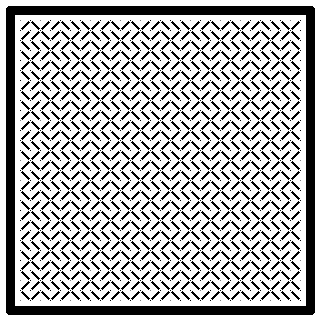
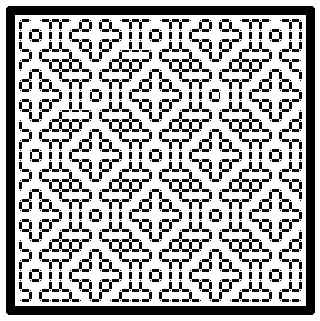
The one on the left is a very simple pattern with a relatively simple skew, but even so, takes me far more concentration to work than does the seemingly more complex symmetrical pattern on the right.
I also find that long runs of straight stitches over bare ground – especially over diagonals – are a challenge. When I find a part of my design not aligning when my stitching roams back near an established area, it’s almost always because I messed up on one of the long runs. I suspect that historical stitchers had the same problem, and that’s why so many patterns feature little hatching type shading stitches or “hairs” that stick out from long straight lines – these being easier to count. The shading lines around the edges of the motifs in the design below (from my Clarkes Law sampler) are a good example. In addition to provding texture and the appearance of roundness, they make it FAR easier to keep on target:
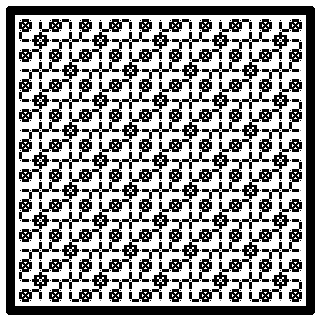
Finally, off-count elements can drive me batty. This pattern is a particularly egregious example. Not only is it a knight’s move design, the skew-to-the-count little boxes where the four rotated squares meet can throw me off and make me forget where I am.
So thank you Kathy for posting your piece, and best wishes for project success!
HOW BIG IS BIG?
I’ve been working on the book, so my spare time is eaten long before I get around to posting here. There are now roughly 24 plate pages in process, either partially or fully complete and I’m working on the annotations.
In other progress news, I’m most of the way through this band:

Me-Zoe-You asked about the scale of the work, so included a penny and a standard foot long ruler. I’m working on a relatively coarse 36 count linen, at about 18 stitches per inch. The voided flowers in the current strip are slightly smaller than the penny. You can see that the four strips are each about a foot wide. This is going to be a BIG piece!
The cloth is quite a bit larger than the part shown – with enough room for four six-inch zones side by side. This pattern grouping occupies the centermost two. I’m not sure which pattern to do next. I’m also not sure if I’ll work the rest of the thing all in parallel, or if I’ll run some bands perpendicular to these. A couple of the patterns I’ve been playing with are so large that they’ll need two or perhaps all three sections to show their repeats.
Plus with symmetrical bands and no words on this one yet, there’s nothing so far that says which end is up. I still haven’t found a motto I want to enshrine in this piece. It may end up being mute. Suggestions are most welcome – especially secular, non-political, slightly geeky (yet pithy) sentiments that are not the sort of thing one would expect to see embroidered.
BLACK AND WHITE
Another band on my new blackwork sampler. This one is graphed from an artifact.
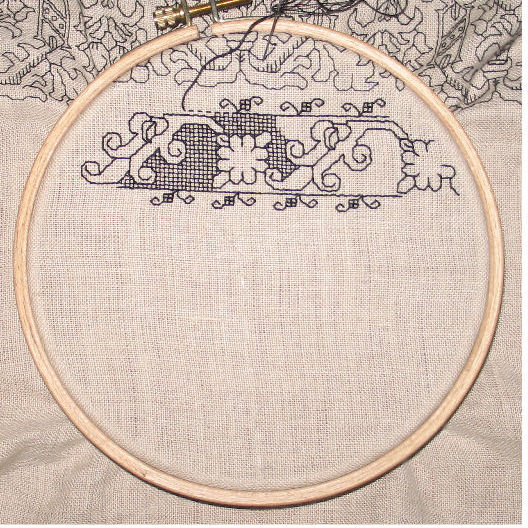
This one is graphed from an artifact. I’m using the same background fill and edging as the original, and I haven’t corrected the proportions. If I were to do so, the branch’s straight run at the top of the flower would have been worked one unit shorter, reducing the leggy leap from flower to descending sprout like thing. This one is in the new collection, with full source annotation.
To answer Anna from the Netherlands – I can’t say exactly when the book will be out. I will be self-publishing it through one of the various print-on-demand services. I wish I could work on it full time, but little things like earning a living have gotten in the way. I have about an hour each evening to research, graph, transcribe, write, and do lay-out. So I suspect that a final product won’t be ready before a year is out. Sorry to disappoint. You will however get to see a few of the patterns in it as I play test them on this sampler and post my progress. I won’t be able to do them all (there are lots) but you’ll see a few of my faves.
In terms of change in the pix and presentation here – I’ve upgraded blogging software and the camera. The new one is much higher resolution than the old, and I’m still figuring out how to work with it efficiently, and how to keep that odd moire like effect from obfuscating the weave of my ground cloth.
Finally, just for fun, here’s another snow shot from this week’s storm:

This isn’t the plow berm at the end of the driveway. It’s what happens when (at least) 22 inches of snow drifts. Smaller Daughter (about 5’4″ – 1.6m) shows off just one end of our excavation project. However Massachusetts doesn’t reel long from these things. School is back in session and everything’s narrower, but back to normal.
 String-Or-Nothing