A PATTERN’S PEDIGREE
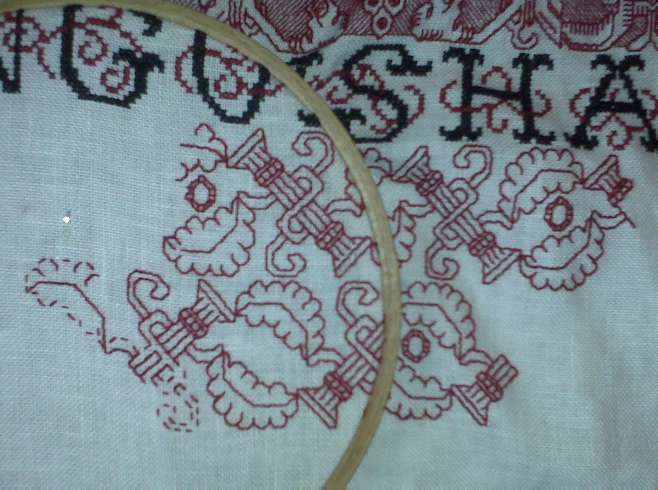
The latest strip. As you can see, a relatively un-normal quiet week allowed me to finish up the last lettered strip and begin the next. This one is done in standard double running stitch (aka Spanish stitch, Holbein stitch) using one strand of plain old DMC cotton embroidery floss. I was thinking of working the background, but I think I’ll leave it plain. I don’t want to overwhelm the delicate scrollings.
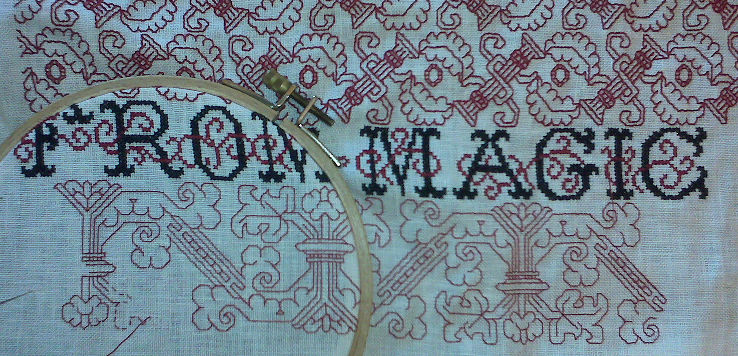
I graphed this from the same photo of a Victoria and Albert Museum sampler that many of the other strips here and in TNCM came from. If the link above doesn’t work, search for item #T.14-1931 (it’s also pictured in Drysdale’s Art of Blackwork Embroidery). It’s listed as Italian, 16th Century in the museum records, but Drysdale lists it as later. Another source lists it as Spanish, which is where the attribution in TNCM came from, but that’s wrong and if I were to re-issue the book, would be corrected. If you squint at the photo you’ll see the sources for my tilting columns, grapes, and the hops flowers and plume flower strips.
But this pattern doesn’t appear only on this one source (right edge, lower four up from the bottom, and just below a red pattern, also see the snippet below). The unknown keeper of the www.drakt.org website took some photos of other samplers at the V&A among them is a page of showing shots of two cases of voided work. Thank you Unknown Keeper! If you look at the centermost of those three photos, you’ll see a pattern very much like the one on 14.931, but instead of outline only like that sampler’s (and my) rendition, this one has a filled in background. Here are the three versions of my current pattern side by side:
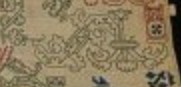
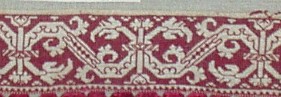

The 14.931’s version is on the left. The unnumbered V&A bit from the Drakt site is in the center, and mine is at the right. I charted mine from 14.931, as best I could. Thankfully I have a better photo from which to work, provided by long time stitchpal Kathryn. For the record, I have not seen this exact base pattern with its distinctive frilled/curvy leaves in my amateur’s wanderings through historical modelbooks, although there are quite a few designs in them that are vaguely similar to it.
Let’s look at the two historical pieces. The V&A calls out 14.931 as possibly being a professional’s work sheet – a sampler in the truest sense of the word, collected by a stitcher of high proficiency as a record, as a reference. The stitcher did just enough of each pattern to set the repeat. The Drakt photo is of a finished band, tricked out with accompanying side flourishes. I’m not sure what the finished band would have adorned. Possibly a pillow or bedcovering, or some table linen. It’s not impossible that it came from clothing, but linens are more likely.
Discounting the worked background, the similarities between the two outweigh the differences. Those are minor – the treatment of the center binding band and stems/bodies of the central flowers, and the treatment of the diagonal arm that links each up-down motif. 14.931 uses a more architectural binding in the center, with more delicate center stems. Its diagonal arm is adorned with an S-shaped squiggle rather than chained solid fill diamonds. But even with the differences between the two historical renditions, it’s clear to me that the two stitchers involved were cribbing from the same source, with minor changes creeping in much like the modern game of telephone, in which a comment whispered to one end of a line and then passed up along the chain often turns out different than the original message. I happen to prefer 14.931’s lines and proportions, so that’s the pattern version I started with.
My amendations are mostly in the treatment of the two terminal flowers in the pattern’s center, a minor elaboration of the binding bars in the center, and the filling in the diagonal arms that connect each central motif. I didn’t like the sponge like “down flower” at the center of 14.931, and I had trouble seeing exactly what was going on with the “up flower.” Plus I didn’t like the smashed tulip look of the comparable center bloom in the Drakt photo. I tried several variations on the S-squiggle in the diagonal arm, but didn’t like any of them. I ended up with th ladder shape in order to make the airy and open terminal acanthus-like leaves look lighter by comparison. And then I added the second narrow binding bar to correct proportions in the motif’s center. I could have raised the original bar two stitches, but I liked the way that it lined up with the separation between the leaves, so instead of moving it I increased its depth and intensified 14.931’s horizontal lines.
I consider my own changes very much in the spirit of the original, and well within the range of variation presented by the two historical samples. I’ve preserved the look and feel of the pattern without debasing the delicacy or detail of the original, and left it a totally identifiable scion of its parents while tweaking it just a bit to my own taste. Your mileage may vary.
UPDATE (2 June 2023):
I have found another example of this design. This snippet is in the collection of the Rhode Island School of Design, Accession 47.292. They do not assign it a geographic or temporal attribution. Because of the way the detail has eroded, it does look a bit shopworn to me, like a copy of a copy of a copy.

ACTUAL PROGRESS!
Thanks to a relatively quiet week with only two late nights and one day of weekend work, I managed to make significant progress on my sampler.

I finally finished the band of tilting columns and started on the final line of lettering.
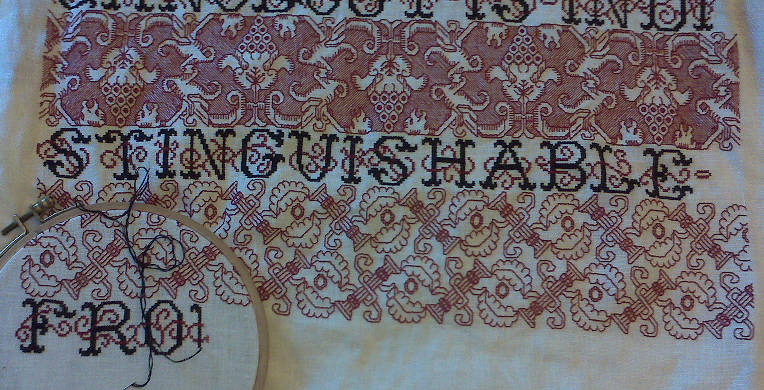
After the lettering I have room for several more patterned strips, the exact number depending on how wide each one is. I’d like to include a row of strawberries, but I haven’t found a historical pattern for them that I really like, so I’ll probably doodle up one myself. I’m also considering several inhabited bands, with dragons, lions or mythological creatures, not unlike the mermaid strip I included in TNCM.

Another possibility would be a series of two-tone patterns, using both black and red in the same strip; or another long armed cross stitch band of a pattern similar in style to the one at the top, but worked voided. That would be very heavy though, and if done at all, should probably be relatively narrow. Maybe I’ll save that for the last one, to give weight to the bottom of the composition.
(SOFT) BOOK OF AGES
Obviously I bored most of the reading audience here totally to tears with the last post. How about something simpler today?
Quite a while ago I tried my hand at submitting patterns to print and on-line magazines. I quickly found out that it’s impossible to arrange creativity on a schedule, and that because my career is 100% hard-stop deadline driven, adding deadlines to my hobbies sucked all the fun out of them faster than teenage vampires exsanguinate each other. Be that as it may, I had limited success – some of my designs were published. See Saw Socks in an early edition of KnitNet, a pattern that helped launch the popularity of self-striping yarns:

I had some pieces published by Classic Elite, a few of which remain in their print collections, and one small item – also published by KnitNet – that I thought had disappeared entirely.
But nothing in my house disappears forever. It might become entombed in a box somewhere, but forgotten in this case is not the same as gone. I was doing some spring cleaning and de-cluttering this weekend and found the soft book baby toy that I knit long before the arrival of Younger Daughter (now in middle school).
This piece does not photograph well, and for my limited camera skills poses an additional challenge. It was knit in a long strip, with “pages” each framed by garter stitch. There are three of them, each with a different motif:


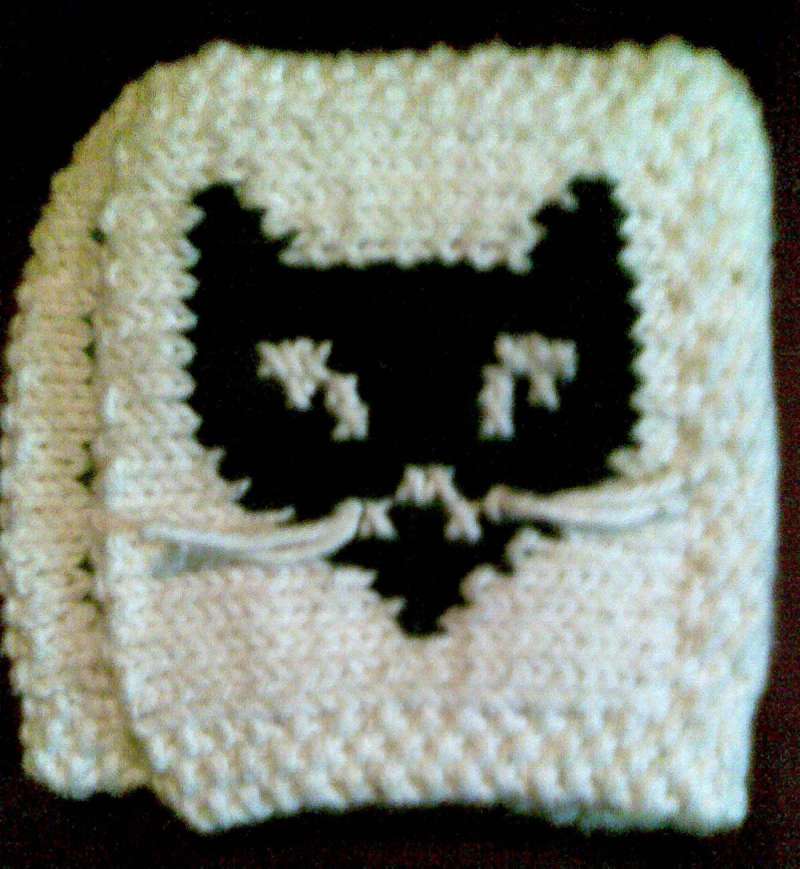
After the strip was knit, it was folded accordion style, and the tops and bottoms of each page were seamed together. Finally the leftmost edge of the front page and the rightmost edge of the last were sewn up to make the spine (I’d left the garter stitch edging on those two ends longer to compensate for the bulk of the book).
I used Bernat Handicrafter cotton at about 5 stitches per inch. The pages are each approximately 5 inches square. The two number-bearing squares each sport bobbles, one on the 1 page, two on the 2 page. The whiskers on the cat face are solidly knotted bits of the same yarn. The idea being that nothing on the book should come loose if it was mauled by the target recipient.
I had plans to offer up a whole bunch of additional simple graphed motifs in concert with the knit sample, but KnitNet was only interested in the original six. I have no idea if anyone else ever made this, but the original book was well loved (and chewed) by Younger Daughter when she was in the toy-ingestion phase. As you can see, the Handicrafter held up well, surviving lots of hot washes, although the yellow triangle and pink 2 pages both are no where near as vibrant as they once were.
OCULAR PROOF?
The latest strip. Unusual because of the columns:
Angelique asks when this type of needlework was popular. I respond that double running stitch came into vogue in the early 1500s, and continued to be worn for the next 130 years or so, although the actual designs worked in the stitch changed over that period. The strips I’m doing now are late, mostly adapted from a photo of a sampler, and that sampler is dated to the late 1500s, early 1600s. Which would put it at Shakespeare’s time and just after.
So. Does my favorite style of needlework appear in Shakespeare? Possibly. People have looked to his texts and found all manner of things that might or might not be there, but I have a feeling that double-sided counted work of this type did make an important cameo.
My case? Othello.
As those of you who know the play remember, Othello is swayed to believe in his wife’s supposed infidelity by scheming Iago, who points to a particular handkerchief as proof. Othello had given the piece to Desdemona. It was filched by her lady in waiting (Iago’s wife) and planted as manufactured evidence that Desdemona was having an affair with Cassio, Othello’s trusted favorite whom Iago envies and despises. The play’s central tragedy results.
The handkerchief is mentioned in a couple of places. It’s in Act 3, Scene 3:
IAGO
Nay, but be wise: yet we see nothing done;
She may be honest yet. Tell me but this,
Have you not sometimes seen a handkerchief
Spotted with strawberries in your wife’s hand?
OTHELLO
I gave her such a one; ’twas my first gift.
IAGO
I know not that; but such a handkerchief –
I am sure it was your wife’s–did I to-day
See Cassio wipe his beard with.
And is described further in Act 3, Scene 4:
OTHELLO
That is a fault.
That handkerchief
Did an Egyptian to my mother give;
She was a charmer, and could almost read
The thoughts of people: she told her, while
she kept it,
‘Twould make her amiable and subdue my father
Entirely to her love, but if she lost it
Or made gift of it, my father’s eye
Should hold her loathed and his spirits should hunt
After new fancies: she, dying, gave it me;
And bid me, when my fate would have me wive,
To give it her. I did so: and take heed on’t;
Make it a darling like your precious eye;
To lose’t or give’t away were such perdition
As nothing else could match.
DESDEMONA
Is’t possible?
OTHELLO
‘Tis true: there’s magic in the web of it:
A sibyl, that had number’d in the world
The sun to course two hundred compasses,
In her prophetic fury sew’d the work;
The worms were hallow’d that did breed the silk;
And it was dyed in mummy which the skilful
Conserved of maidens’ hearts.
Later in the same Act: Cassio comes upon the handkerchief and gives it to his doxy Bianca:
CASSIO
Pardon me, Bianca:
I have this while with leaden thoughts been press’d:
But I shall, in a more continuate time,
Strike off this score of absence. Sweet Bianca,
Giving her DESDEMONA’s handkerchief
Take me this work out.
BIANCA
O Cassio, whence came this?
This is some token from a newer friend:
To the felt absence now I feel a cause:
Is’t come to this? Well, well.
CASSIO
Go to, woman!
Throw your vile guesses in the devil’s teeth,
From whence you have them. You are jealous now
That this is from some mistress, some remembrance:
No, in good troth, Bianca.
BIANCA
Why, whose is it?
CASSIO
I know not, sweet: I found it in my chamber.
I like the work well: ere it be demanded–
As like enough it will–I’d have it copied:
Take it, and do’t; and leave me for this time.
So allowing me the license used by many Shakespeare pretenders, what we’ve got here is a handkerchief – essentially a two-sided piece work, embroidered with strawberries. There’s an allusion to the embroidery being a deep crimson silk (“the dyed with mummyconserved of maidens’ hearts”), although Lord alone knows whether or not mummy was actually used as a dyestuff, and if it was, what color it might have produced or abetted. We’ve got a link between the work and a mysterious Egyptian/Moorish origin. It’s worth noting that the name for double running stitch at the time of the plays debut was “Spanish Stitch,” and it was wildly fashionable and popular. Plus it’s clear that whatever type of embroidery it was, it was easily copied.
Taken together – reversible, red (along with black, one of the most fashionable colors for Spanish Stitch), stitched in silk, easily copied, link with Moorish origins – that’s my style!
If the local amateur troop ever decides to stage Othello, I think I’ll volunteer to stitch the handkerchief. And I plan on doing a strawberry panel on the current sampler, for good measure.
BRIAR ROSE BISCORNU
Work continues to gnaw on my life and spit out the bones, but I do have something to share. Caroline, a regular reader of the blackwork discussion group on Yahoo, used a line unit pattern from TNCM to make a sweet biscornu:

The pattern she chose is the Brier Rose Twining Border (Plate 51:1). It’s one of my own as opposed to a pattern with a specific period source, and it’s one of my faves. I really like the way she’s taken the corner and adapted it to fill the top of her pincushion with a chaplet of roses. I’ve used the rose pattern several times, but always as a longer border run either with or without the corner; and I’ve never played with working the flowers and stems in different colors.
What’s a biscornu? It’s a little eight sided pillow-type pincushion, made up from two squares of fabric of the same size. They often have a bead, button or stitch dimpling the center to accentuate the shape. Some are stitched on both side, some on one. Biscornus have become more popular recently, with the enthusiasm for them starting in Europe a couple of years ago. Their popularity has blossomed because they’re a charming little project, ideal for showing off counted or freehand embroidery. They’ve been featured in recent issues of both print and on-line stitching magazines and blogs, with lots of free patterns on line. There’s a nice article about making biscornus here.
To get the odd shape (which is the origin of the name, from the French for “quirky,” or “odd shape”), the two squares are sewn so that the points of one square align with the center of the sides of the other (think about taking the two and matching them exactly, then give one of the squares an eighth of a turn clockwise or counterclockwise). Caroline has finished hers especially nicely, with neatly done stitching along the seam. You can see the point of her bottom square matching up with the center of the stitching on her top, ornamented one.
In any case, great job Caroline! A lovely (and useful) little project. I’m delighted that she thought to share the joy of her needle with me, and that she consented to give permission for me to share it with you.
If you’ve stitched, knit or otherwise worked something from one of my patterns and would like to see it posted in String’s gallery, please let me know.
FROM THE BACK
Suzie asks to see the back of my Clarke’s Law sampler. Here it is in the dawn light:

I’ve not been very assiduous about making it 100% two sided, but double running stitch does lend itself to highest efficiency if one follows that logic. I’m also using knots, for which I am wildly unapologetic. Also, I’m not one of the back-is-perfection nazis. Neat, yes. Long jumps and stringy bits can be shadow-visible from the front of the work. Plus work should have a logical progression that uses thread efficiently. Rabid about it though – no. Historical works weren’t perfect.
If you notice, both the plume and hops flower patterns contain elements that cannot be worked 100% double sided – isolated lines or units not attached to the main work area. For example, in the hops flowers those are the little detached diamonds that inhabit the central motif. If I were to work this pattern double sided I’d modify it slightly, adding a vertical connecting each of those diamonds to the lozenge that surrounds it. That way front and back could be completely alike. But since the back on this won’t be visible once it’s mounted, I’m not making an extreme effort. Still, you can see that with the exception of the voided backgrounds, I’m pretty close:

Plus as you can see from the back of the piece at the top, I’m on the letters that follow the hops band. What to do next? I haven’t decided yet.
STITCH BY STITCH
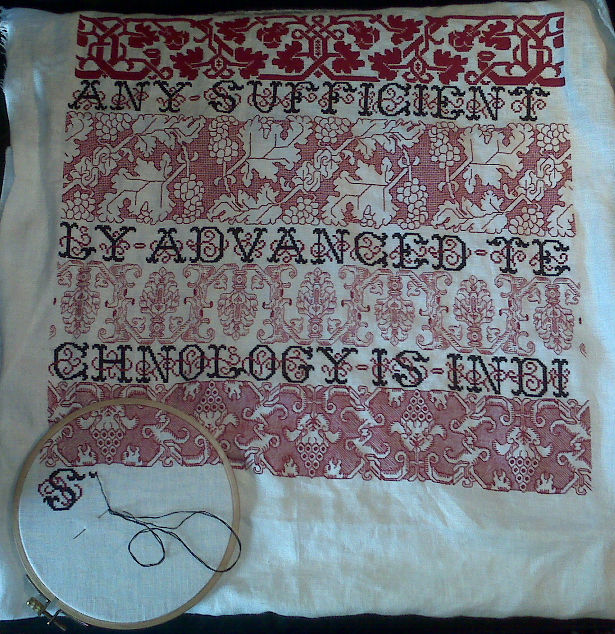
Hobbled as I am by lack of time (work has invaded every corner of my life), I haven’t had much time to do much stitching. Ten days since the last progress point and I’ve only managed to finish out a postage stamp sized area on the last strip and to begin the next row of letters:
For WindyRidge who asked for a close-up, here’s the hops flower panel:

After a couple of cursory searches for these embroidery styles on line, I’m beginning to get the feeling that not too many ‘net-enabled stitchers are playing with them. There are folks doing double running stitch and voided embroidery to be sure, but not from patterns of this complexity or vintage. If there are any of you out there I’d love to hear from you; especially if you’re composing new works incorporating patterns from historical sources, as opposed to working up samplers designed by others. While working up pre-designed samplers is a pursuit of high order, it doesn’t face the same sort of problems as original collation/composition. Those are the problems I’m most interested in right now.
HOPPING ALONG
Through it all progress is being made. I do try to grab 10 minutes at lunch and another half hour in the evenings to decompress. Plus two weekends ago I had an actual half-day off on Saturday. My most recent strip is growing. I’ve got one more hops flower to go on the right hand edge, then it’s back to more lettering:

This is a strange strip to be sure. You can see the similarity between this and the plume flowers strip:
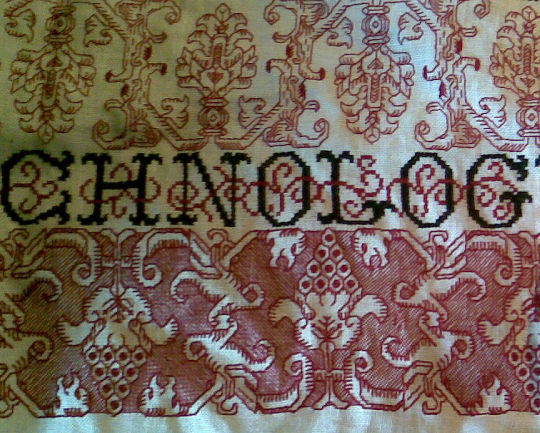
Both feature the same type of up/down symmetry, with a center vaguely vegetal motif separated by mirrored stem-like surrounds. Both use small parallel stitches on the inside edges of the motif as shading. Both combine flat decoration (the sprig at the center of this strip’s flower’s base, and a similar sprig in the same spot on the plumes), with more rounded, natural forms. And both sport a sort of baroque exuberance and total unconcern with true plant shapes. Not unsurprising since both of these were cribbed from the same source sampler.
It is interesting though to see how variants in working method change the look. The plumes were done in one strand of floss, the hops flowers outlines in two, with the background of the latter in one strand. Although detail in the two strips is roughly comparable, and if anything the plumes have MORE detail than the current strip, the plumes are lighter and airier. The current strip is by contrast, meaty looking. Those ocarina like turnip things on the stem divides are particularly fleshy, in a somewhat unsettling way.
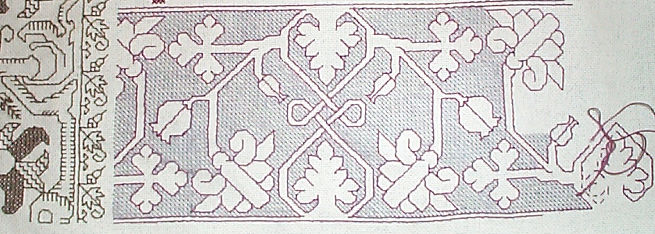
I’m not sure what the strip after the next bit of lettering will be. I am considering a bastard mutation of two blackwork styles – perhaps working an outline for a very open and unadorned long repeat strip similar to this one:
But instead of working the background, working the foreground as if it were one of the freehand inhabited blackwork styles, similar to this:

Not sure yet, but with no historical accuracy constraints on this piece, why not?
CASKETS AND SNAILS
Spring floods here. A minor one in the basement, brought on by the inordinate amount of rain we’ve had in this area this month, and at work, with more deadlines rushing one upon the other. Which must be good for business, but is exhausting none the less.
Last post I promised two things. The first one is a dream project. Something I will probably never have the time or resources to accomplish (especially the time): my own embroidered casket. Not the kind you’re thinking of.
Back in the 1600s the crowning achievement of what passed for female education was the completion of a small box covered with embroidery. These were called cabinets or caskets, and often featured dimensional embroidery. They were about the size of a large tabletop jewelry box and were truly spectacular. The Peabody Essex museum in Salem has one one dated to 1655.. Here’s a particularly nice one in the Minneapolis Institute of Art’s collection. They’re highly sought after by collectors.
Via Needleprint, I stumbled across this:
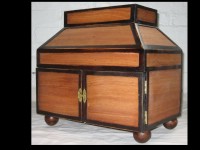
It’s a modern chest base, made by a woodworker specifically for creating cabinets. If you click on the link you’ll see that the individual panels are made to be removed. All that needs to be done is stitch up a piece of the correct dimension and lace it onto the panel, then refit the panel into the cabinet. Now all I need do is set aside two years, a pile of silks and metal threads, some excellent linen, and $800 for the box base (including shipping). Another item on my ever growing never-never list…
The second thing I promised was word of a snail invasion in the Antipodes. Again, not the kind you’re thinking of. Garden plantings are safe. But Friend-of-Friend Fred Curtis, resident in Australia happened upon my book and is doing all manner of happy things with my snails. Here’s a trial for a man’s necktie to be covered with snails. He also stitched a camera straps using TNCM patterns (shown in process), and has used another of its patterns on a baby bib. But back to the snails. Here’s another of his pieces, offering up early spring inspiration to those of us in the Northern Hemisphere.

(Photo reproduced with permission). I’m always tickled to see stuff worked up from patterns I’ve posted, both for knitting and embroidery. If you’d like to see them posted here in the Gallery, please feel free to send me an image or a link. Fred – thanks for the smile!
STRIP BY STRIP
Poking my head up from yet another marathon sprint at work here. With promise of another one hard on the heels of the last, I’m probably surfacing just long enough to note limited progress on my sampler and report other news.
First the progress:
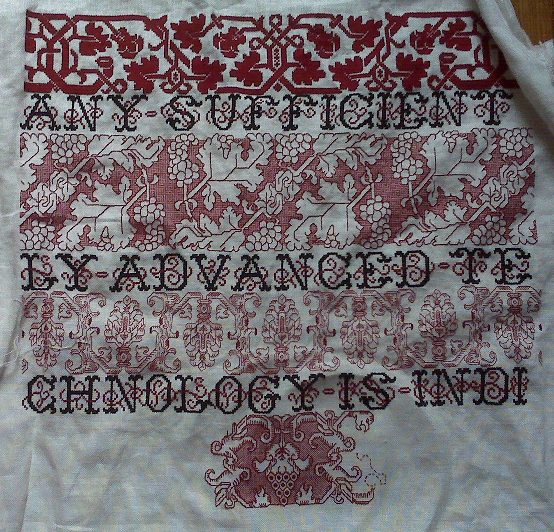

You can see that I’ve completed another row of text, and I’m on to another double running stitch panel. I’m working this one voided too. It’s a mishmash, with the bulk of the elements taken verbatim from the sampler that provided the previous strip. The hops flower(?) and the strange ocarina-like turnip things on the side are direct quotes. The finials on either side of the hops flower were very difficult to copy though, so I took the liberty of substituting bird heads for them. Lots of patterns of this style/era include animals, humans or birds (all or in part) sprouting from vegetation. My treatment of the voided area is however a total flight of fancy. I chose to use half-cross stitch, massed into a field of diagonal lines. I used a diagonal fill on the Do-Right sampler, too:
Unlike the graph paper like squared fill I on the grapes strip, I haven’t seen historical precedent for the diagonal line treatment. But it’s not totally illogical. If you’ve seen an artifact worked this way, please let me know. Other unusual treatments of the voiding include working the background narrower than the foreground and the direction of my diagonals. I’ve only seen one historical piece worked this way – a late 16th early 17th century panel photographed in Cavallo’s Needlework. I graphed that one out, it’s in TNCM on Plate 74:1 – I worked a bit of it a while back, and am considering doing it again on this piece:

Mirroring the diagonals on either side of the central motif is new. I haven’t done this before, and I’ve never seen it done on any other piece. Again – I can’t claim originality, there’s only so many ways to do things in needlework, and it’s a sure bet that the most obvious have been tried before. One last thing I’m planning on doing is NOT filling in the voiding in the background behind the little triangular areas above and below the strange, mutant turnip things. That will make the central hops flower motifs on their lozenges of darker background look a bit like a series of very large beads.
Given my impossible work schedule, the stitching density of both the foreground motif (again worked with two threads of my DMC floss), and the background (worked with one thread), this panel should take me quite a while. After this one comes the rest of my quote. So far I’ve stitched “Any sufficiently advanced technology is indi-” Next comes “-stinguishable from magic. In all probability, the “magic” won’t fit on the next line of text. I’ll deal with that problem when I get there.
Next post – snails in the Antipodes! My dream casket! (Not the kind you’re thinking of…) Stay tuned.
 String-Or-Nothing


