FLASH MOMENT
Yup. You guessed it. Twisted again and back to square one. That’s the bad news. The good news is that I’ve established my flash value. However I’m at the point where since I know my stitch count, I"m ready to knit several rows of waste yarn (twisting be damned), then start in on the good stuff.
My excuse? Too many stitches crammed onto too short a needle, and the fact that I usually take the lazy person’s way out. When I start a large circumference item on circs, I usually purl back the first round and join on the third (sometimes even the third or fifth for finer yarns). Having a larger bit done helps keep thnigs aligned when time comes to do the join, and cleverly done with the cast on-tail, the one or two row notch can be rendered invisible, or incorporated into the project as a design detail.
One final possible start again cue – I think the thing would look better knit on a US #6 (4.0mm) rather than a US #7 (4.5mm). Less leggy, more opaque. If so – it’s back to establishing a new flash value based on that new gauge.
Knitting is easy. It’s projects that are hard. But if it WERE easy, I woudn’t be tempted to keep at it.
FLASH DANCE – PART III
Well, I wish I had had more time to knit last week. Swamped as I was with a special crisis assignment, many things fell (again) by the wayside. Knitting was one of them.
Still in what little time I had I did find out that I had comitted two of knitting’s cardinal sins:
- I didn’t take enough time to gauge properly, relying instead on the hubris of previous experience, and some inconsistent partial counts.
- When I cast on and then joined my piece together to knit in the round, I introduced a half twist.
So what I ended up with was a piece that was both way too big and being twisted – unusuable. So I ripped back. It just goes to show that no matter how many times you do something, and how well you think you know it, every new venture is another opportunity to make the same old misakes.
In the mean time, here’s a photo of the yet-again cast on and two rows knit new start.
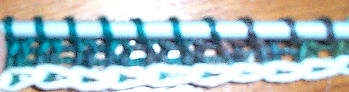
Yes I know it’s blurry, but you can begin to see the colors build. As I suspected, the larger teal areas are lining up nicely, with the browns and greens somewhat less regimented between them. A better photo of a bigger slice tomorrow. Unless of course I’ve managed to twist the miserable thing again and will need to begin all over.
Traffic here
Looking over the logs for last week I was amazed to see the traffic here spike up to almost three times the expected number of visitors. There don’t appear to be many new referral entries, nor can I think of any ready explanation aside from a growing fascination with the Kureopatora Snake scarf pattern. A couple of scarf exchanges seem to have picked it up as an item of interest. My own experimentation and that of the other knitters suggest that there are lots of yarns that work well with the basic idea – the main difference among them being to vary the number of stitches across, depending on the chosen yarn’s gauge and repeat length. You can make the thing out of any yarn from fingering/sock self-stripers all the way up to bulky weights (superbulkies might be a bit too thick for comfortable wear as a scarf, but that’s a matter of personal preference – not a limitation of the pattern itself.) Of course, it’s obvious that yarns heavier than DK will require fewer stitches, and lighter ones will need more. For me in this pattern, I get the best results using an even number of stitches, but that’s a mnemonic, not a hard and fast rule. If you can keep the K1, P1 rib working off an odd number stitch base, go ahead and use it.
My snake is fun in any yarn, even a solid color, but it become ssomething special in a long-repeat varieggated. My hard-to-find, discontinued Kureopatora DK weight works for the pattern, as do other long-repeat Noro yarns like Silk Garden, and Kureyon. I’d recommend reducing the number of stitches across in both. I find that for them, the 30 stitches I used for Kureopatora is too many. For example, my Kureyon scarves, were done on 26 stitches across. I’ve also heard that Daikeito Diamusee also would be a good candidate, although there don’t seem to be any local distributors of the stuff and I haven’t seen it myself. Other possibilities include Regia 6 Ply Crazy Colors, Lana Grossa Dasolo Stripes, Katia Mexico, Euro Mexican Wave, some of the long repeat as opposed to tweedy colors of Encore Colorspun in any of its weights (an economical choice); or for those with bigger budgets than I – Classic Elite Embrace. I am sure there are more.
DO NOT ADUJST YOUR SET
Yes, I know I’m missing. What’s happening can be explained in part by the fact that I haven’t finished digging my way out of a last-minute work-related crisis yet. At 1:50 am on a Tuesday I’m still at the keyboard. String will be back ASAP, once this new bit of chaos is beat into submission. And after I catch up on sleep.
One hint of what’s coming: it’s a "gang aft agley" moment on my flash project.
FLASH DANCE – PART II
Yesterday I wrote about establishing the flash value. Today I write about what might go wrong while you’re doing so.
First, there’s the gauge problem. When I do it, the gauge of the row that I pick up off the provisional chain isn’t exactly the same as my plain old stockinette gauge. The waste yarn choice or tension of how I knit that first row can cause all sorts of oddities. This is especially true for me when I use larger size needles (anything over a US #3). As I knit the second row I might find my color alignment drifting because there are too many or too few stitches in the pick-up row. Not many, but enough to throw things off. For example, row two might hit a designated color change point several stitches before that same spot appeared on the cast-on row. If that happens I might cheat on the knit row immediately following my cast-on. If I see the color repeat drifting too much to the right, I might knit two stitches together. Conversely, if I "over-run" a color match point, I might rip back a couple of inches, then do a make-one to add a stitch, bringing the target sploches into better alignment.
I do however have to take care if I change the stitch count. If you look at my parrot-color sweater, you’ll see wide swings where the colors lurch from side to side. That’s normal. Two things make the zig-zags happen. First, one’s tension is not always uniform. Most of us have near imperceptible changes in gauge as we sit through a knitting session. We knit more tightly when we sit down, then loosen up a bit as our hands relax. Finally when we get tired, we tighten up again. Tighter knitting migrates the colors to the right. Looser knitting migrates the stripes to the left. I knit my parrot sweater’s body in two sessions. They’re easy to pick out.

Hand painted yarns also have a playful imprecision in color placement. They are never as regimented in their color placement as machine printed yarns (sock self-stripers). That’s the second factor, and what makes the edges of the stripe so step-like. Color segments seep into the hank at different rates at different places, yielding different saturations and slightly different lengths of the color segments from strand to strand. And some blobs may not go all the way through the hank and may seem to disappear after several repeats.

You can see clearly, above. Look at the 8:00 position on my skein. There’s a spot of brown. It encroaches on the teal and bleeds into the khaki, but doesn’t do it uniformly through the hank. It’s most evident on the top of the skein. Underneath it looks like the teal touches the khaki directly, with no intermediary fling into brown at all.
This brings me to the second thing that can go wrong. Not every hand-painted skein is ideal for this type of knitting. The longer the repeat and wider the individual color splotches, the better suited a yarn is for flashing. My new yarn is borderline. I expect some parts will align nicely. The big teal areas show special promise. I am expecting the brown and khaki bits to dance between the teal areas because they are so short and so haphazardly sized. I am not going to get the clear zig-zag stripe of my parrot sweater. Instead I’m expecting something with more of a softer forest floor/camoflauge look.
UPDATE: The third factor that limits flash is generated by how the skein is dyed, in conjunction with the total garment circumference. Strands that are adjacent in the original hank when it was dyed are more likely to be close or near-close matches than are strands that are further apart. If you have a garment that’s small enough to be traversed around by only two repeats, the color stacking you will see will be much more in alignment than will a garment knit from the same yarn that takes five full repeats to complete one round. That’s wny it’s not uncommon to see flash kits for toddler sweaters but less common to see them for adult sizes. If I were into dyeing and wanted to aim for flashing yarn in an adult circumference, I might try winding my yarn into hanks that are significantly wider around than the sizes most commonly used.
Now after several fits and starts of my own project – all the result of the pitfalls outlined abouve (you have to be willing to rip out several times if you’re going to start a flash sweater), I think I’ve got the stitch count thing down. I hope to have actual pix of it in the next post.
FLASH DANCE – PART I
First a cool thing: stud earrings in the shape of the end buttons from old Susan Bates US #1 straights (bottom of the page).
Flash Dance
I’m working with my latest yarn present – the hand-dyed cotton brought home from Arizona by the Resident Male:
My goal is to turn it into a t-shirt that flashes. By that I want to have the color segments line up one on top of each other so that the finished product looks like it was painted:

Based on new yarn’s look and circumference, I’m reasonably certain that I can do this, but two questions remain.
- Will the final dimensions dictated by having to use full multiples of the skein length for each round of knitting be useful sizes. In other words, my final sweater size will be dictated by how many stitches it takes to achieve flash. Will that size fit?
- How does one go about figuring out how many stitches to cast on to achieve this effect anyway?
The two questions are closely related. This skein is similar to a yarn I’ve used before. In that yarn (not the one above), it took about 60 stitches to consume an entire repeat (give or take). At five stitches per inch, that works out to about 12 stitches of linear knitting per repeat. A flashing garmet knit from that yarn could be roughly 24 inches, 36 inches or 48 inches around. 24 inches would be too small for Younger Daughter, but a 36-inch sweater will Older Daughter. 48 inches will fit me.
But will my new yarn hit that target. Not closely enough to be absolutely certain. This skein is a tad smaller in circumference than the old one. (To determine the skein diameter of the old one, I took my balled up leftovers and wound some around my swift, lining up the color slices. When the colors aligned, I knew I had "reconstructed" the original skein’s width.) The old skein was about a full yard in circumference. This one is about 30-31 inches so I’d expect that the color cycle would be smaller. For a rough approximation, I divided 36 inches by 60 stitches. I get about .6 inch of yarn consumed per stitch. That seems a bit high but not outside of reason. 30 inches "eaten" at the same rate would result in 50 stitches. I suspect that my flash value will be somewhere in the 50-stitch neighborhood. Five repeats of 50 stitches and a gauge of 5 stitches per inch would yield a garment circumference around 50 inches. A bit big, but not outside of wearability.
Now all the math theory in the world can’t substitute for actual experimentation. Having done the base noodle work, it’s time to try it out. I know that whatever I end up knitting, I will want to be as yarn-economical as possible. It might be necessary to eke out my limited amount of flash yarn with something else for ribbings or edgings, so I’ll start with a provisional cast-on.
I like the crochet chain provisional cast-on, preferably worked right onto the needles to avoid the fiddly bit of picking up stitches in the chain’s back bumps. I cast on far more stitches than I needed because with the crochet chain cast-on, you can slide any excess off the needles (or not pick up in the bumps) with no adverse effect on the project. So using a plain old bit of cotton string for ease of removal later, I cast on about 270 chain stitches and set it aside.
Another complication. In a screamingly bright color combo like the parrot sweater above, it’s easy to figure out where a color cycle begins. That yellow is killer and can’t be missed. My new yarn however contains colors that are much closer in value. There are three repeating segments per full cycle: teal, khaki, brown. How will I know when I’ve gotten back to the beginning point? Having wound my yarn into a big ball already it is no longer obvious where the cycles end. An artificial flag is necessary.
Just like I did to determine the skein length of my old yarn, I hauled out the swift again, and re-wound several turns of my new stuff, taking care to adjust the swift until I could align my color patches. I put a safety pin into the yarn at the end, and another into the yarn five turns (five full cycles) later, making sure that both pins marked matching spots in the cycle. I now had five repeats marked out. Starting with the point marked by my pin, I began to knit the loops off my provisional chain and continued until I cit the second safety pin. Counting up, I had about 260 or so stitches on my circ before joining. Or so? Why the imprecision? Am I ready to knit off happily watching the flash pattern grow?
Not exactly. Tune in tomorrow to find out why, and what I did next.
SPORT AND GANSEY WEIGHT; FRONT END WASHERS
More questions from the inbox.
Sport weight = 5 ply gansey weight?
Not really. As the "5 ply" weight designator implies, Gansey/Guernsey is in between sport weight (6 ply) and fingering (4 ply). There are yarns labeled as sport that are on the thin side that work up nicely at the 6.5 spi Gansey target as well as yarns labeled fingering that are thick and also cover that gauge. But not every sport or fingering can be used as a sub for it. Plus Gansey weight usually imples a classic smooth finish, dense yarn that supports superior stitch definition. Wendy/Peter Pan still makes traditional Guernsey 5-Ply, now a superwash. It is labeled at 7spi, but is denser than fingering/sock yarn at that gauge.
Washing yarn in a front loader washing machine with a wool cycle?
Front loaders are known for gentle action compared to aggressive water-hogging top loaders, so I suspect that you’ll be able to wash the spinning oil from loosely wound hanks using one. I know people who complain about the flip side of this problem, that it’s impossible to get their front loader to full yarn for felted projects. BUT there are caveats. The machine has to have settings that control water temperature in both the wash and rinse cycles, so that you can set the same temperature for both. It has to have the ability to retain water for soaking (some use very little water and getting a a pool for the yarn to sit in may be problematic).
One other challenge: it also has to have controls that let you either eliminate agitation, or that let you advance the cycle past the agitation stage of the wash to plain old drain then spin. If the machine relies on side-mounted flanges on the inside of the drum to churn the contents as the drum spins, it will be impossible to eliminate agitation-like movement of the stuff being washed. I don’t have a front loader, so I can’t speak to whether or not the agitation inherent in that type of action would allow washing yarn with no risk of fulling.
As for pre-programmed wool cycles on all machines, I’m very skeptical about them. My own top-loader has an alleged wool cycle that’s pretty much useless. All it does is put the wash through a shorter (though not less vicious) agitation cycle. It does nothing to govern water temperature, and the rough treatment although shorter is still enough to induce fulling. I wouldn’t risk using my machine’s wool cycle for finished items, and especially not for more vulnerable un-knit hanked yarn. I know some of the more expensive European washers handle wool extremely well. Experimentation here is warranted. Since seeking reliability of results in knitting always leads to a pile of swatches somewhere, here’s a chance to put them to constructive use. If you want to determine the usefulness of your washer’s wool cycle, gather up a bunch of swatches then put them through a cycle and observe the result.
WASH FIRST/KNIT FIRST
Tracey asks if I plan on washing my Webs-acquired Highland Tweed before I work with it, or if I plan on washing the sweater after it has been knit.
I think in this case, I’ll wash my yarn first. A couple of years ago, I knit something in a yarn that like the Highland Tweed was full of whatever they use to make machine spinning easier It was a cone of some unidentified 100% wool I got at the old Classic Elite mill end store. I swatched it up, got gauge, washed the square, re-gauged and knit up Flor’s gansey pullover for my older daughter. (Flor’s pages are off-line, but the pattern can be found in the Internet Archive.) Then I washed the thing. I was never quite pleased with the fit. The yarn relaxed and fluffed out a bit, but looked "strangled" in the sweater. Proportions shifted slightly in unexpected ways. I’m sure if I had taken the time to wash the yarn first, then take a gauge on it rather than doing the lazy route, everything would have worked out better.
That being said – how to wash yarn? It’s easy.
I take my swift (or two chairs back to back in my pre-swift decade) and wind a fair bit off the cone. Then I’ll take some cotton string and loosely tie the newly made hank in two or three places. I note that many hanks I buy are tied in a two or three "stitch" manner rather than in one big clump. It looks like the person who did it took a length of tie string and looped it around the accumulated hank. Then, he or she bunched up about a third of the hank’s yarn and plunged one end of the tie string through the thing from top to bottom, and the other end through at the same spot, from bottom to top. Then they grouped up the next third, and repeated the process. The whole idea is to keep the yarn in an easy to unwind hank, but not tie it so tightly that the yarns rub up against each other and encourage fulling.

Once my hank is loosely tied, I’ll wash it the same way I wash my finished items. I’ll fill my washing machine part way with cool water and add a wash agent. Right now my favorite is Kookabura Wool Wash, but I’ve also used Eucalan in the washer. If I were doing this OUT of the washer in a tub sink or bucket and had no wool wash to hand, I’d try a liquid dishwashing detergent or inexpensive shampoo. Warning though, adding either dishwashing liquid or shampoo to a washing machine can mean a Lucy Moment as you deal with the resulting overflow of lather.
With the washer’s wash cycle off, but with the wash agent mixed well in the water, I submerge my hanked yarn in the tub and let it soak for a while. I might swish it a bit very gently in the water to encourage the process but I don’t turn the washer on, or otherwise squeeze, rub, or agitate the yarn mass. Once the yarn has soaked for a bit (usually about a half hour, or until I remember I’ve put it in), I advance the washer dial to rinse. I let the machine empty, then refill partway with the SAME temperature water in which I did the wash, but stop it before agitation begins. I let the yarn sit a bit in the cleaner water (again with perhaps the most gentle of hand swishes), then advance the machine to final spin. This time I let the water drain out and let the machine go through its final spin, to fling as much water out of the yarn as possible.
After the wash I take my hanks and loop them around plastic hangers, then hang the hangers somewhere to dry. Over the shower rod with a towel underneath is fine. The trick is to find somewhere out of direct sun that’s un-humid enough to encourage quick drying. My basement in this case is right out, as it is too damp down there for quick drying. On a very humid day I might direct a fan to blow at my drying hanks in order to speed the process.
Am I doing this right now? Not yet. I admit I’ve been sidetracked (the story of my knitting life). I’m playing with the nifty cotton I described yesterday, messing with gauge measurements and stitch count, trying to establish my flash dimension. It’s a bit harder than before because although the yarn has the right dimension and color placement to flash, the color set doesn’t have a wildly obvious marker like a screaming orange stripe. A visually distinctive bit helps eyeball where the repeats should overlap. More on this as I work the problem through…
MORE YARN
It’s been a week of yarny goodness here at String. Not only did I go on a shopping expedition on my own, but The Resident Male went on a trip to Arizona and brought me back a present. Now this is a Big Thing because althogh he’s been supportive of my needlework obsessions over the years, he’s never before been a direct enabler of them.
So I am picturing him at the knit shop he found out in Scottsdale, Arizona. He says he went in and asked the committee sitting around the back project table for help selecting something unusual. He was shown a pile of various foofy/fuzzy/overadorned novelty yarns, and being observant knowing that I rarely use them, insisted on something less "demonstrative" but still unique.
The committee came through. He ended up buying this:
It’s a hank of mercerized 100% cotton, hand-painted in blues, teals, and greens, with a touch of a mauved brown. The effect when wound is a ball reads "camoflage." It’s got a house label on it (no brand name), stating that it knits to Aran gauge (4.5spi on a US #8), and that it’s got 997 yards total.
Looking at the stuff though it reminded me of Rainbow Mills Crayons Lite, the yarn included in their "Grandma’s Little Darling" toddler sweater kits (shown here on Younger Daughter when she was three):

Sure enough, a side by side comparison of my leftovers from the sweater above and my new yarn shows that they’re near identical. Amazingly enough not only are they structurally the same, the wind-off hank diameter is the same, and the hues of the teal, brown and khaki in the two are spot on identical (the toddler leftovers includes magenta and orange in addition to all the colors in the new stuff). I wrote to the yarn shop, and they confirmed that the base stock for this yarn is the same as the Rainbow Mills product. I haven’t seen Crayons Lite sold outside the toddler kits, and having a known weakness for variegated yarns, I’ve always wanted to use it again.
For the record, to make the yarn flash in the toddler pullover, I needed to get 5spi on US #7s, and predicated the circumference on a factor of about 12.5 inches, then steek the armholes. This sweater is done on 125 stitches (about 25 inches around). I think that I’ll try to use my hank to make a short tee on 250 stitches, and see if I can get the same kind of flash. I’ll use a provisional cast-on so that I can go back and add ribbing or edging later so I can maximize use of the yarn I’ve got on the body itself. I even have enough of my coordinating (but brighter mix) leftovers to do the rib or edging, should I so desire. If that doesn’t work and I come up short, I’ll see if I can do something on the same narrow strip principle as my Typeset Tee.
The upshot of all this is that Resident Male came back with just about the perfect choice: a yarn that isn’t available locally, in colors that I enjoy, and in quantity that’s just right.
Keepers, both!
YARN CRAWL – QUESTIONS
I’ve gotten some questions via eMail about yesterday’s yarn crawl.
How do you know what to buy? Do you go with a list?
Some people do. My pal Kathryn did. She had a prepared list of patterns and requirements, and went looking for yarns specific to those needs. I don’t. When I go to an "exotic" yarn shop I look for things that aren’t available at my local yarn store. Most of the stuff in the front retail store area at Webs is available in my own neighborhood. (I am lucky enough to live in one of the most yarn-shop-dense areas in in the US.) I went looking for back room bargains, off labels, mill ends, and other oddiments that I am leery of purchasing sight-unseen over the ‘net.
In terms of what I was looking for, I do admit that experience with yarns is a plus. I know a bit about different types of yarns and their properties. Not as much as a spinner – but enough to know what yarns are likely to improve with washing, and which ones will remain prickly for their entire life. I’ve got a rough grasp of what both yards per pound figures and the number system of yarn descriptors used for woolen and cotton yarns translate to in standard hand-knitters terms and gauge. I’ve played with wraps per inch (though I admit I didn’t use that measure this trip). I’ve got a calculator and know how to convert pounds to grams, so I can figure out a rough equivalent cost per mythical 50-gram skein. Plus I have a good idea of what colors appeal to me, look well on me (or my target), have classic appeal, and would be fun to knit.
So what I did was wander the back aisles in the walk in warehouse, looking for goodies on special. The goodies had to be of excellent quality, in an appealing color that will transcend trends, of versatile type or construction (not a novelty yarn that will look dated in a fortnight), and represent a significant cost savings. If any "spoke to me" (inspired a particular creative idea upon first sight) all the better. But I was not buying for immediate consumption and went with no particular projects in mind.
Have you ever bought "the wrong yarn"?
Yes and no. I’ve got all sorts of things that have sat in my stash for extended periods of time, but I’ve never bought anything I wished I could return. For example, right now I’ve got two bags of well-aged Classic Elite Artisan in a deep green somewhere between khaki and hunter. At the time I bought it (circa ’99) I had an idea that I’d use it for a cabled sweater. But since then I’ve reconsidered. It’s a bulky weight (3.5spi) and has alpaca in it. A cabled thing in it would end up being both weighty and ultra-warm. Too warm to wear as an indoor/outdoor sweater. Plus I’ve found I prefer knitting in smaller gauges. So it sits, awaiting inspiration, but I wouldn’t say it was a bad purchase or it was "the wrong yarn." Eventually I’ll figure out what to do with it, or I’ll swap it for something else.
How much did Webs pay you to post yesterday’s ad?
Nobody pays me nothin’. I go where I want, and I write what I want on String – bad or good. Please send my greetings to the other conspiracy theorists whose company you must enjoy.
So what are those number system/yards per pound bits you mentioned?
(This wasn’t actually asked, but I’m sure it will be if I don’t address it here). There are several very cogent explanations of the number system and how it’s calculated elsewhere on the Web, but here’s a quick cheat sheet of equivalents for wool. Remember that although this chart makes it look like there are absolute definitions of size, these are approximate average numbers. There is considerable overlap with the values shown above and below each category, dependent on all sorts of things including fiber blends, texture, or how tightly the stuff is twisted (how dense the yarn is).
| Weight (ply weight descriptor equivalent) |
Most Common Gauge |
Approx. Average Yards/Pound (Wool) |
Approx. Average Wraps/ Inch |
Some Count Numbers* For This Weight (100% Wool) |
| Fingering (4-ply) | 7 spi | 1,920 wool |
16 | 4/30, 2/15, 4/24 |
| Sport (6-ply) | 6 spi | 1,500 wool | 14 | 6/24, 2/16, 3/9, 3/11 |
| DK (8-ply) | 5.5 spi | 1,400 wool | 12-13 | 3/8, |
| Worsted (10 ply) | 5 spi | 1,280 wool | 11-12 | 2/10, 10/24, 4/8 |
| Aran (12 ply) | 4.5 spi | 850 wool | 10-11 | 12/24, 2/4, |
| Bulky (14 ply) | 3-4 spi | 680 wool |
9-10 | |
| Super Bulky (16 ply+) | 3 spi or fewer | 500 or fewer | 8 or fewer | 2/2 |
*In wool the first number refers to the number of plies (physical construction, not "ply weight equivalence"), in cotton, the second number refers to the number of physical plies
Please feel free to send me corrections and additions. I’ll be adding to this chart as time goes on, and possibly supplementing it with one for cotton when I get a chance.
YARN CRAWL
I’m catching up on lots of things this week – appointments, activities, deliveries – plus I’m regaining equilibrium. As part of my stress dissipation strategy I went to Webs. Actually I went with my houseguest – long-time needlework buddy Kathryn (she of "too many centries, too little time.").
Of course no trip to Webs would be complete without an acquisition report.

The garnet yarn on the right is the 2/4 Highland Tweed 100% wool currently on special. The website lists it as an Aran weight at 4.5spi, but to me it seems a bit light for that. I have this cone plus a partial – in total a sqidge more than 2.5 pounds total at 992 yards per pound, roughly 2,511 yards. Thats way more than enough for a sweater for me at any gauge down to Gansey. The twist is a bit soft. It’s a nice deep color (not as tomato as the picture), accented with flecks of emerald, sapphire, turquoise, and topaz. On the cone it’s a soft wool, but not Merino-gentle and is imbuded with a touch of spinning oil. It’s possible that the spinning oil has flattened the stuff out and is making it look more like a DK, so I need to either wind off some and wash it then knit up a swatch, or knit a swatch and then wash it so I can determine final gauge. Based on the texture though, I am expecting this yarn to soften up considerably once it has been washed. 2.54 pounds is about 1,152 grams or roughly 23 50 gram balls. My purchase works out to the equivalent of about $1.33 per equivalent 50 gram ball. This stuff is listed on the Webs site. Mine is the cardinal color pictured there..
The yarn at the left is another back room bargain bin find. It’s a 80% silk, 20% wool blend, in a fingering weight with a slight boucle texture, about 2,400 yards per pound. It’s a nice denim blue. I bought two cones, again just under 2.5 pounds total. That’s a mind-boggling 5,928 yards. Again using the 50-gram skein as a standard, my purchase works out to 1120 grams, about 22.4 skeins. Rounding down, my 50-gram skein equivalent cost was about $1.12 per skein. My color isn’t shown on line although there was lots of it on the shelf.
Now. What am I going to do with all of this?
The red should be pretty simple to use regardless of gauge. It’s light enough in color and weight and not so busy that it can’t handle a bit of texture pattern knititng. I’ve got enough that if I wanted to go hog wild with cables, I could. I’ll be stashing it until a perfect idea emerges, although that Gansey idea is beginning to have a bit of appeal.
The blue however may be closer in terms of actual use. Remember past musings on the compatibility between crochet and knitting? About how crochet needs to be worked in finer yarns to produce a fabric comparable to knitting? Here’s a chance for me to experiment with that. I’m thinking of doing a summer top that combines both. I’d use this stuff single-strand for a classic crocheted yoke, adapted from an antique chemise or nightgown pattern, then using the same thread doubled, knit the body of the garment. The weight of the products of the two should match much better than trying to use both techniques with the same thickness yarn. My only handicap here is that I prefer not to wear sleeveless things, so some additional adaptation may be in order if I wish to wear the final result myself. Anything leftwover would make a nifty lace shawl.
I also got a bag of Rowan Rowanspun 4-Ply in Holly – an intense blued deep green. I’ve been collecting colors of this stuff for a while, all in the jewel family. (notice a theme here?) I finally have enough to do something spectaular. What exactly, I haven’t a clue.
So there you have it. Skid marks on the old Visa, and depending on the sizes/gauges used – most or major parts of 3-5 adult size garments, all for about $80. I’m stoked, I’m de-stressed. Now on to the knitting!
 String-Or-Nothing