MORE YARN
It’s been a week of yarny goodness here at String. Not only did I go on a shopping expedition on my own, but The Resident Male went on a trip to Arizona and brought me back a present. Now this is a Big Thing because althogh he’s been supportive of my needlework obsessions over the years, he’s never before been a direct enabler of them.
So I am picturing him at the knit shop he found out in Scottsdale, Arizona. He says he went in and asked the committee sitting around the back project table for help selecting something unusual. He was shown a pile of various foofy/fuzzy/overadorned novelty yarns, and being observant knowing that I rarely use them, insisted on something less "demonstrative" but still unique.
The committee came through. He ended up buying this:

It’s a hank of mercerized 100% cotton, hand-painted in blues, teals, and greens, with a touch of a mauved brown. The effect when wound is a ball reads "camoflage." It’s got a house label on it (no brand name), stating that it knits to Aran gauge (4.5spi on a US #8), and that it’s got 997 yards total.
Looking at the stuff though it reminded me of Rainbow Mills Crayons Lite, the yarn included in their "Grandma’s Little Darling" toddler sweater kits (shown here on Younger Daughter when she was three):

Sure enough, a side by side comparison of my leftovers from the sweater above and my new yarn shows that they’re near identical. Amazingly enough not only are they structurally the same, the wind-off hank diameter is the same, and the hues of the teal, brown and khaki in the two are spot on identical (the toddler leftovers includes magenta and orange in addition to all the colors in the new stuff). I wrote to the yarn shop, and they confirmed that the base stock for this yarn is the same as the Rainbow Mills product. I haven’t seen Crayons Lite sold outside the toddler kits, and having a known weakness for variegated yarns, I’ve always wanted to use it again.
For the record, to make the yarn flash in the toddler pullover, I needed to get 5spi on US #7s, and predicated the circumference on a factor of about 12.5 inches, then steek the armholes. This sweater is done on 125 stitches (about 25 inches around). I think that I’ll try to use my hank to make a short tee on 250 stitches, and see if I can get the same kind of flash. I’ll use a provisional cast-on so that I can go back and add ribbing or edging later so I can maximize use of the yarn I’ve got on the body itself. I even have enough of my coordinating (but brighter mix) leftovers to do the rib or edging, should I so desire. If that doesn’t work and I come up short, I’ll see if I can do something on the same narrow strip principle as my Typeset Tee.
The upshot of all this is that Resident Male came back with just about the perfect choice: a yarn that isn’t available locally, in colors that I enjoy, and in quantity that’s just right.
Keepers, both!
YARN CRAWL – QUESTIONS
I’ve gotten some questions via eMail about yesterday’s yarn crawl.
How do you know what to buy? Do you go with a list?
Some people do. My pal Kathryn did. She had a prepared list of patterns and requirements, and went looking for yarns specific to those needs. I don’t. When I go to an "exotic" yarn shop I look for things that aren’t available at my local yarn store. Most of the stuff in the front retail store area at Webs is available in my own neighborhood. (I am lucky enough to live in one of the most yarn-shop-dense areas in in the US.) I went looking for back room bargains, off labels, mill ends, and other oddiments that I am leery of purchasing sight-unseen over the ‘net.
In terms of what I was looking for, I do admit that experience with yarns is a plus. I know a bit about different types of yarns and their properties. Not as much as a spinner – but enough to know what yarns are likely to improve with washing, and which ones will remain prickly for their entire life. I’ve got a rough grasp of what both yards per pound figures and the number system of yarn descriptors used for woolen and cotton yarns translate to in standard hand-knitters terms and gauge. I’ve played with wraps per inch (though I admit I didn’t use that measure this trip). I’ve got a calculator and know how to convert pounds to grams, so I can figure out a rough equivalent cost per mythical 50-gram skein. Plus I have a good idea of what colors appeal to me, look well on me (or my target), have classic appeal, and would be fun to knit.
So what I did was wander the back aisles in the walk in warehouse, looking for goodies on special. The goodies had to be of excellent quality, in an appealing color that will transcend trends, of versatile type or construction (not a novelty yarn that will look dated in a fortnight), and represent a significant cost savings. If any "spoke to me" (inspired a particular creative idea upon first sight) all the better. But I was not buying for immediate consumption and went with no particular projects in mind.
Have you ever bought "the wrong yarn"?
Yes and no. I’ve got all sorts of things that have sat in my stash for extended periods of time, but I’ve never bought anything I wished I could return. For example, right now I’ve got two bags of well-aged Classic Elite Artisan in a deep green somewhere between khaki and hunter. At the time I bought it (circa ’99) I had an idea that I’d use it for a cabled sweater. But since then I’ve reconsidered. It’s a bulky weight (3.5spi) and has alpaca in it. A cabled thing in it would end up being both weighty and ultra-warm. Too warm to wear as an indoor/outdoor sweater. Plus I’ve found I prefer knitting in smaller gauges. So it sits, awaiting inspiration, but I wouldn’t say it was a bad purchase or it was "the wrong yarn." Eventually I’ll figure out what to do with it, or I’ll swap it for something else.
How much did Webs pay you to post yesterday’s ad?
Nobody pays me nothin’. I go where I want, and I write what I want on String – bad or good. Please send my greetings to the other conspiracy theorists whose company you must enjoy.
So what are those number system/yards per pound bits you mentioned?
(This wasn’t actually asked, but I’m sure it will be if I don’t address it here). There are several very cogent explanations of the number system and how it’s calculated elsewhere on the Web, but here’s a quick cheat sheet of equivalents for wool. Remember that although this chart makes it look like there are absolute definitions of size, these are approximate average numbers. There is considerable overlap with the values shown above and below each category, dependent on all sorts of things including fiber blends, texture, or how tightly the stuff is twisted (how dense the yarn is).
| Weight (ply weight descriptor equivalent) |
Most Common Gauge |
Approx. Average Yards/Pound (Wool) |
Approx. Average Wraps/ Inch |
Some Count Numbers* For This Weight (100% Wool) |
| Fingering (4-ply) | 7 spi | 1,920 wool |
16 | 4/30, 2/15, 4/24 |
| Sport (6-ply) | 6 spi | 1,500 wool | 14 | 6/24, 2/16, 3/9, 3/11 |
| DK (8-ply) | 5.5 spi | 1,400 wool | 12-13 | 3/8, |
| Worsted (10 ply) | 5 spi | 1,280 wool | 11-12 | 2/10, 10/24, 4/8 |
| Aran (12 ply) | 4.5 spi | 850 wool | 10-11 | 12/24, 2/4, |
| Bulky (14 ply) | 3-4 spi | 680 wool |
9-10 | |
| Super Bulky (16 ply+) | 3 spi or fewer | 500 or fewer | 8 or fewer | 2/2 |
*In wool the first number refers to the number of plies (physical construction, not "ply weight equivalence"), in cotton, the second number refers to the number of physical plies
Please feel free to send me corrections and additions. I’ll be adding to this chart as time goes on, and possibly supplementing it with one for cotton when I get a chance.
YARN CRAWL
I’m catching up on lots of things this week – appointments, activities, deliveries – plus I’m regaining equilibrium. As part of my stress dissipation strategy I went to Webs. Actually I went with my houseguest – long-time needlework buddy Kathryn (she of "too many centries, too little time.").
Of course no trip to Webs would be complete without an acquisition report.

The garnet yarn on the right is the 2/4 Highland Tweed 100% wool currently on special. The website lists it as an Aran weight at 4.5spi, but to me it seems a bit light for that. I have this cone plus a partial – in total a sqidge more than 2.5 pounds total at 992 yards per pound, roughly 2,511 yards. Thats way more than enough for a sweater for me at any gauge down to Gansey. The twist is a bit soft. It’s a nice deep color (not as tomato as the picture), accented with flecks of emerald, sapphire, turquoise, and topaz. On the cone it’s a soft wool, but not Merino-gentle and is imbuded with a touch of spinning oil. It’s possible that the spinning oil has flattened the stuff out and is making it look more like a DK, so I need to either wind off some and wash it then knit up a swatch, or knit a swatch and then wash it so I can determine final gauge. Based on the texture though, I am expecting this yarn to soften up considerably once it has been washed. 2.54 pounds is about 1,152 grams or roughly 23 50 gram balls. My purchase works out to the equivalent of about $1.33 per equivalent 50 gram ball. This stuff is listed on the Webs site. Mine is the cardinal color pictured there..
The yarn at the left is another back room bargain bin find. It’s a 80% silk, 20% wool blend, in a fingering weight with a slight boucle texture, about 2,400 yards per pound. It’s a nice denim blue. I bought two cones, again just under 2.5 pounds total. That’s a mind-boggling 5,928 yards. Again using the 50-gram skein as a standard, my purchase works out to 1120 grams, about 22.4 skeins. Rounding down, my 50-gram skein equivalent cost was about $1.12 per skein. My color isn’t shown on line although there was lots of it on the shelf.
Now. What am I going to do with all of this?
The red should be pretty simple to use regardless of gauge. It’s light enough in color and weight and not so busy that it can’t handle a bit of texture pattern knititng. I’ve got enough that if I wanted to go hog wild with cables, I could. I’ll be stashing it until a perfect idea emerges, although that Gansey idea is beginning to have a bit of appeal.
The blue however may be closer in terms of actual use. Remember past musings on the compatibility between crochet and knitting? About how crochet needs to be worked in finer yarns to produce a fabric comparable to knitting? Here’s a chance for me to experiment with that. I’m thinking of doing a summer top that combines both. I’d use this stuff single-strand for a classic crocheted yoke, adapted from an antique chemise or nightgown pattern, then using the same thread doubled, knit the body of the garment. The weight of the products of the two should match much better than trying to use both techniques with the same thickness yarn. My only handicap here is that I prefer not to wear sleeveless things, so some additional adaptation may be in order if I wish to wear the final result myself. Anything leftwover would make a nifty lace shawl.
I also got a bag of Rowan Rowanspun 4-Ply in Holly – an intense blued deep green. I’ve been collecting colors of this stuff for a while, all in the jewel family. (notice a theme here?) I finally have enough to do something spectaular. What exactly, I haven’t a clue.
So there you have it. Skid marks on the old Visa, and depending on the sizes/gauges used – most or major parts of 3-5 adult size garments, all for about $80. I’m stoked, I’m de-stressed. Now on to the knitting!
PROBLEMS WITH THE LETTER L
Corrections made
J Scholes is absolutely correct! The book I mentioned two days ago is Odham’s Encyclopaedia, not Oldham’s Encyclopaedia. I plead an absent title page, a rubbed spine, and bifocals. Of course I have no excuse about missing the obvious on the various Internet sites I looked at to document the probable date of origin. I’ve fixed Sunday’s entry accordingly.
An evening with Christine Duchrow
In other news, in an idle l moment I took up a book I bought a couple of years ago and tried to decipher the knitting instructions. It’s The Knitted Lace Patterns of Christine Duchrow, Volume I, edited by Jules and Kaethe Kliot (Lacis, 1993).
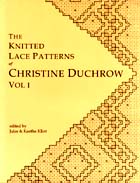
Duchrow wrote in Germany in the early 1900s. She’s one of the early proponents of charted instructions for lace knitting. The editors do say that some of the book’s patterns contain errors or are incomplete or damaged. To top it off the text is very sketchy and in German, and the symbol set used is a difficult one. For example, purls are represented by a lower case L and YOs are represented by the number 1. The printers didn’t always get the distinction correct, and even when they did – the blackletter font style l and the 1 are perilously close in appearance in the photo-reproductions presented in the book.
But not to be daunted, I try any way.
I started out with a relatively straightforward scarf/jabot pattern named "Muschelschal" (Mussel Shell). The photo isn’t very good, but the pattern looked simple. After wrestling with it for a couple of hours, I retrenched and went back to the basic edgings shown at the beginning of the book. I am ashamed to admit that I didn’t make much headway with them, either.
I’ve got the easy stuff down pat – that the patterns only show right side rows (wrong side rows are plain knit); that there is potential confusion between 1 and l (compounded because it looks like many patterns frame YOs with purls), and that I do need to rely as much on the picture as I do on the directions to figure out what’s going on. But I can’t make the stitch count numbers work. The cast-on value is clearly stated for each design, with each pattern starting off with a row of plain knitting. However, when I count up the stitches consumed by the first patterned row, I never come out with the number currently on the needle. Sometimes I’m one short, sometimes I’m one over. If I were always one short, I’d make the assumption that the slipped edge stitch isn’t calculated into the cast on number – but I’m not. Clearly more experimentation is needed as I am missing something here that’s very fundamental.
In the mean time, more on reading Duchrow’s patterns can be found on Judy Gibson’s site (thank you Judy!). Additional advice is always appreciated. If you’ve ever worked from this book successfully, please feel free to chime in with tips.
ANCIENT LEFTOVERS – WARMED OVER
It’s true I’ve had precious little time for much of anything lately. Including knitting. And the last thing I wanted was something challenging. Since small, soothing, quick to finish, and materials-on-hand were the orders of the day, I did several miniprojects. Most have already ended up as gifts – more booties, a baby hat, and several scarves.
The scarves were all done from my Kureopatora Snake pattern, some in various variegateds, and one in a solid color. I even bowed to the begging of Younger Daughter, and finished out the hideous short-repeat white, pink and grey Red Heart scarf for her to wear. (I may think it’s detestable, but she likes it).
I also went stash diving and came up with the remnant from this vest.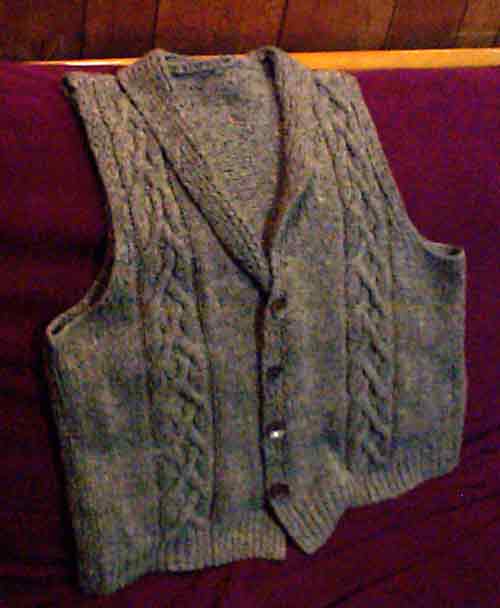
The vest was knit in 1987 or so, and at the time was a Major Investment for which I skimped on lunches, saving up for the purchase. The yarn is an old Silk City yarn I bought at Washington D.C.’s late, lamented Woolgatherer shop in Dupont Circle. It is worsted weight, mostly raw silk, with a touch of wool. The label departed company with the stashed remains years ago so I’m not quite sure which yarn it was. The stuff itself is soft and spongy, and over time becomes even nicer. Down sides include an abundance of very sharp chaff – almost thorns; plus the general non-stretchy nature of silk. The vest was adapted from a commercial pattern, now lost. I do know that I substituted yarns, messed with a new gauge, introduced the cables and removed some pockets.
Now for the hat.
I’ve had a haphazardly wound ball of leftover yarn sitting in my stash, too expensive to fritter away, but not enough with which to do something major. I grabbed it to work on in my small project frenzy.

Still riffing on the Snake scarf idea and no particular pattern, I started with a strip of bias-knit ribbing. I made it large enough to go around my head, earwarmer style and seamed it up. Then I picked up stitches along one side at a ratio of about three stitches picked up for every four rows of the strip. I ended up with 84 stitches, divided among four DPNs. Then I did a couple rows of purl welting and broke back into K1 P1 ribbing. When the hat was about 5 inches deep, measured from the bottom edge of the earwarmer band, I began my decreases. Since the thing was on four needles and I was lazy, I settled on four decrease points, and knit the last two stitches on each needle together, doing so every other row.
When I had onl y four stitches left on each needle, I decided to be silly. I worked about 16 rows of I-Cord using the four stitches on the first needle. Then I folded it in half, and without breaking the yarn, knit I-Cord from the four stitches on the second needle. I continued until I’d made four I-Cord loops, then did one row of plain knit to unite them, and one more decrease row. I drew my end through the remaining 12 stitches to end off the piece. I also did a little stealth fudging with the dangling end and a tapestry needle to snick up some looseness at the base of the I-Cord loops before darning the remainder in to finish the piece.
The result is a slightly goofy hat, with a finial on the top that looks like a Chuck Jones Instant Martian. I think I’ll take that tiny bit still left and add a row of knit-on I-Cord around the bottom edge. That will echo the look of the welts and the deely-bob at the top, plus it will give a nice, strong bit of definition around the bottom. As usual apologies for the lousy photos. The tweedy yarn is hard to capture well enough to see details,
One final note – The abalone shell buttons you see here are the third set that’s been on this vest. Previous sets included embossed black leather, and shiny black plastic. I’ve updated them several times over the years as styles have changed. Changing buttons can be an inexpensive way to freshen the look of classic knits, opportunity shop finds, or hand-me-downs.
BACK FROM THE DEAD & ODHAM’S ENCYCLOPAEDIA
From the "This too shall pass" department, I announce the end of the work project that ate my life. The final submission was yesterday. I am now left with a horrific clutter in my office, several thousand megs of files that need to be classified and archived, and the need to make up for eight weeks of sleep deficit. But all that aside, I also can now get back to String and wiseNeedle.
I’ve processed in the backlog of posted yarn reviews on wiseNeedle, and am about to start tackling the questions inbox. Since so many questions are duplicates of ones already answered at the site, there will be lots of "Did you look here?" notes. If you’ve posted a question since around mid-January and you haven’t heard from me, apologies. I am whittling away at the stack…
In the mean time, courtesy of my long-time stitch pal Kathryn, I can post another review of an out of print Knitting Book that Time ForgotTM.
ODHAM’S ENCYCLOPAEDIA OF KNITTING
We’ve all heard of James Norbury from his other knitting books. The most notable one is his Traditional Knitting Pattens from Scandinavia, the British Isles, France, Italy, and other European Countries. That’s the one that’s been widely reprinted by Dover Books. I mentioned it in another round-up of older knitting books two years ago. In January Kathryn sent me a copy of another of his products – Odham’s Encyclopaedia of Knitting, written in concert with Margaret Agutter. My copy is missing its title page, but searches in used book store inventories turn up 1955 to 1959 as the probable date of publication for my edition. Oldham’s is copiously illustrated with line drawings, sketches and a few black and white photos of finished garments. Based on the style of of the little thumbnail cartoons and some of the on-the-needle drawings of knitting in progress, I suspect that one of the many illustrators on this project also worked on the Mary Thomas books.
The book starts with a section on knitting history – nicely done and less folkloric than most contemporary works, although not entirely without hyperbole. 19th and early 20th century knitting is outlined, with references to many works the authors considered seminal in developing modern knitting technique – books and pamphlets I am now hungry to read. The meat of the book is somewhat choppily arranged. The first 70 some odd pages covers basic techniques, and is arranged alphabetically under broad subject areas. The instructive tone is very British-centric. For example, Continental style is mentioned as an aberant variation of "normal knitting," with the caution that it is inferior for maintaining even gauge. Grafting is described both for stockinette and K1, P1 ribbing (done in two passes on each side of the work rather than as a linear row). You have to look hard for it though, as the heading that starts the grafting section seems to be missing. As in all non-North American publications of its time, the name "Kitchener" is not associated with that technique. Crochet stitches are shown in this section, too.
The next section deals with fabrics and patterns, and covers some of knitting’s basic styles. It commingles them with texture pattern family descriptions (including directions for some of them), offered up as separate mini-articles. Therefore you’ll find small bits on Aran (it’s resemblance to Austrian knitting is noted); Argyle; bead knitting; Bohus; Faroe; Florentine/Jacquard (we’d call it Intarsia); Scandinavian styles; Shetland; and Tyrolean knitting all mixed together with general descriptions of the families of cable stitches, feather and fan stitches, leaf stitches, bobbles, etc. Instructions for samples of the various stitch families are presented mostly in prose, although graphs are used to show colorwork and motif placement.
Lace knitting is next. While the section does go into several styles, it looks almost like it was written by committee. There are at least four different illustration styles used, some being so representational as to be almost useless to the knitter. Most lace directions are given in prose, with a limited number at the end of the chapter being done in charts with symbols unique to this book. It’s difficult to tell from the bulk of the patterns exactly what they will look like, but the majority are covered in much better clarity in recently published lace books. The exception is the group of "Viennese Lace" texture patterns. Eventually I’ll explore these further.
Norbury/Agutter go on to describe the design of classic knitted garment shapes. There are sections on Cardigans and jerseys Yarns employed range from three-ply to DK, and sizes/styles are 1950s tight. While sizes are small, there’s a fair amount on darts and tailored shaping here that might be of use to people trying to do retro design today. Of more immediate use are sections on gloves, socks, berets and tams, and baby clothes. Directions for a single basic garment are given in prose.
The final part of the book is a compendium of garment patterns, again all in prose and to 50’s size and fit. Patterns are provided for the items shown in the black and white photos. Gauges are small by modern standards, with most items knit from fingering weight. But there are several cardigans and pullovers in DK weight, plus a couple in doubled DK weight (3.5spi, the equivalent of what one would expect from a modern bulky weight yarn.)
Like many of these older knitting compendiums, there’s a strong ideological bent , a smattering of fashionable garments to keep one interested , and enough detail to pass itself off as a general purpose handbook. But books like this weren’t aimed at people with absolutely no knitting experience. The level of detail they provide is insufficient for a beginners’ guide. Rather they were shelf references. Places an intermediate knitter could go to broaden a skill set, or brush up on a forgotten technique. Finishing for example is given very short shrift. Blocking is explained, but how one goes about accomplishing the "sew up" command at the end of each pattern is never quite elucidated.
Are modern books better? Yes and no. Some are, both as shelf references and as beginners’ guides. Some are shorthand cribs on just a few basic concepts, quick to master and trendy enough to look dated after only a year or two. Others do contain a fair bit of info, but like this particular book, aren’t organized in a way that works as a reference or as a skills guide.
Would I recommend buying this book used? While it’s certainly worth the time to look through on library loan, unless you’re a needlework history book buff (like me), I’d give it a pass. For me though it is valuable, partly for its interesting history of (mostly British) knitting before WWII, and for its mystery lace chapter. So thank you Kathryn! Although you were right that this book isn’t for everyone, it is a worthy and appreciated addition to my library.
NOT QUITE SURFACING
Where have I been? Working. There are some times in a proposal writer’s life when the project at hand grows to the point of devouring all other life. I’m writing from mid-peristalis right now, deep in the belly of the beast. My house is a shambles, and it is only through the cooperation and understanding of my family that any shred of normalcy remains. Side entertainments like blogging are out of the question right now.
Through it all though when I do get to sit down for a minute I’ve been stress-taming with trivial knitting. No projects worth a darn, but calming none the less.
Mostly I’ve been playing with odds and ends from my stash. For example, to answer some questions about other yarns suitable for the Kureopatora’s Snake Scarf, I’ve been playing with Noro Kureyon.
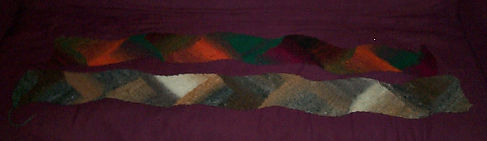
Apologies for the dark photo, again I just don’t have time to tend to details properly. As you can see, the long color repeat of the Kureyon worked nicely for this project, with single color slices lasting almost the entire duration of each segment. The upper scarf with orange on it was knit exactly according to the pattern I posted here – on a US #6, 30 stitches across at the widest point. The lower scarf in browns and grays was knit on a US #7, 28 stitches across at the widest point but otherwise following the logic of the posted pattern exactly. Each scarf took two skeins of Kureyon.
You’ll notice that in spite of the 28-stitcher having in fact fewer stitches across, it’s a tad wider. That half inch of difference is entirely due to the different gauge produced by the larger needle. Surprisingly, the 28-stitch scarf is also about seven inches longer than the one knit on the smaller needle.
In terms of drape, they are pretty close. One would think the scarf knit on the US #6 would be stiffer and denser than the one knit on the US #7, but in fact there is very little defference between them. BOTH are relatively un-supple compared to the Kureopatora original, but that is more a function of the difference between the two yarns rather than a difference among needle sizes. The heavier and less uniform yarn also had an impact on the amount of "wiggle" right and left in my snakes. The deformation that makes the snakey shape is less evident in this yarn than in the original, and is the same for both size needles used. Given the small differences between the two needle sizes and the extra width/length gained by using the larger needle, I’d recommend the #7 and the 28-stitch width for anyone looking to do a Kureopatora’s Snake scarf from Kureyon.
Now, how did I like working with the Kureyon? Not especially. In spite of hype, this is the first time I’ve used it. I accept the thick/thin variation and differences between skeins as being part of the yarn’s unique look. I am less happy with uneven spinning, with some parts so overtwisted that they kink almost uncontrollably, and others so untwisted that they shred into breaking from just the normal action of knitting. I’m also not fond of the fine grained agricultural dust that I feel between my fingers as I knit (very present in the orange/green scarf) and the abundance of sharp, thorn-like chaff in all four skeins used. I was also not pleased that one of my skeins had six knots in it (each skein had at least one). Finally, I find the texture of this yarn is too harsh for next to skin wear. My scarves are interesting, but are clearly "outside the coat" articles, and not something I’d be comfortable pulling up around my chin muffler style.
And in part to answer the folk who have asked about using yarns with shorter repeats for this pattern, I present the following eyesore, knit for edification only, and shortly to be ripped back:
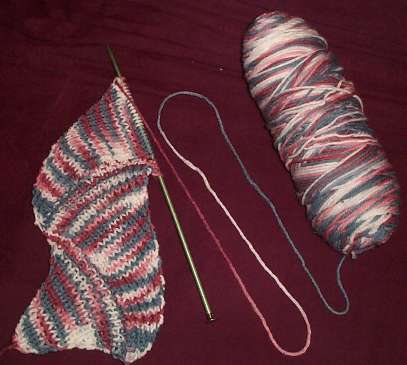
This particular yarn is a Red Heart acrylic "worsted" in pinks, white, pale blue and gray, picked out for her own projects by Younger Daughter. Because this yarn like so many mass market acrylics is actually a 16st = 4 inch yarn and not a 20st=4 inch actual worsted, I’m using a US #9 here, and working on 28 stitches across.
There’s nothing wrong with knitting Red Heart – it’s a very serviceable and inexpensive yarn. Like any cost/value trade, it has performance and aesthetic strengths and weaknesses. It’s not particularly soft, although it is more wearable than the Kureyon. It feels squeaky on the needles. I don’t like the color set used, but that’s a personal preference item.
But what makes this horrific isn’t the quality or price of the yarn, it’s the length of the color repeat. As you can see from the exposed length, color segments last about 8 inches or so before shading into the next one. Stripes are choppy and colors pool at the edges, giving it a very haphazard and to me overall unattractive look. For this pattern to show best you need one of two things – a solid color, so that the interest comes from the movement of the ribbing segments and the way they deform, or a variegated yarn in which the color segments run for at least a yard before changing.
SHORT ROW HEELS
Turtlegirl asks what patterns I use for fingering weight socks. I shamelessly answer – my own. New readers here (and there appear to be many of them) may not know that I also am the keeper of wiseNeedle. wiseNeedle is the original yarn review site, active on the web as an all volunteer consumer to consumer, unsponsored service since 1995. In addition to the yarn review collection and a searchable glossary of knitting terms in 14 languages, I keep some patterns there, too. Among them is a slew of toe-up, short row heel socks in several yarn weights. There are three patterns there for fingering weight, and any of them can be used as-is, or by elimination (or substitution) of patterning on the ankle parts, made as simple or as complex as the knitter desires.
And in response to other requests, here’s a close-up of the short row sock heel, showing the mitering you can achieve with a little advance planning and a modicum of luck:
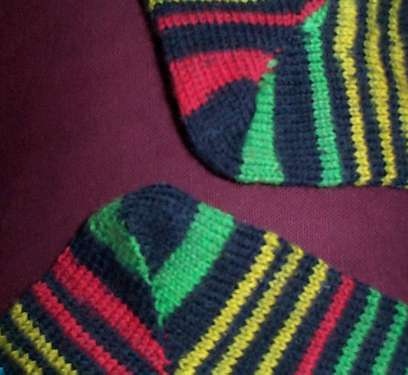
Why do they not match exactly? Because I didn’t take the time to make my socks identical twins. I started each sock off its own ball of yarn at the exact start of the ball. The repeats were slightly skew. I don’t have a problem with making these self stripers into fraternal rather than identical pairs.
Now, how to finagle this effect using a self striper? Lots depends on the width of the striped section. The narrower the stripe, the easier this is to do. You can better see what I did in the top sock, above. I knit the foot (on the left, heading up towards the top of the photo), ending it in synch with the completion of a red stripe. Then I began the back and forth short rowed section with the following section of black. I ended the decrease section of my short rows roughly half way through the black bit that followed the red, finishing up the black on the part of the short row section that re-awakens dormant stitches. Then I finished out my heel. This synch of the pattern to the printed repeat required that I fudge a bit on foot length. In a sock of this type, a row or two extra in the foot, combined with a heel a row shorter than normal isn’t going to make a major difference in fit. Since the repeat pattern is so narrow, I can get pretty close to perfect miters. On wider patterns it’s harder. In a wider pattern I do still try to end the foot at the completion of a stripe (or if it’s a VERY wide stripe, half way through a repeat). I let the short rowed section fall out as it may, hoping more for serendipity rather than planned perfection. Most of the time things work out well enough.
WHAT I’VE BEEN UP TO
The work crisis has not yet abated (in fact, it’s just settling in for the long haul). Even if I’m not writing about it, I AM knitting. Plain, boring, unadventurous, run of the mill, miles of stockinette, unchallenging (but comforting) knitting.
In my case, that usually means socks, and reverting back to the sock style I can do in my sleep – toe up with a figure-8 cast on, and short-rowed heel. I’ve been averaging completion of a pair every six days or so. I only knit for an hour or so each evening, so each sock is taking me three evenings to complete.
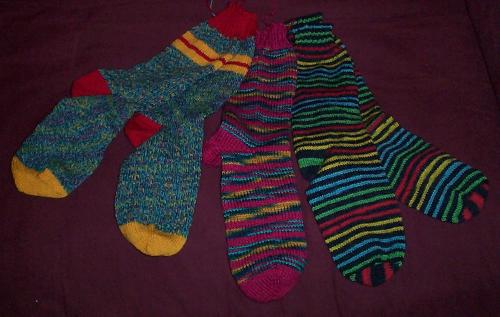
At the left what we’ve got is a pair of fingering weight socks composed from various leftovers. The vile mustard is a 100% wool yarn I’ve had forever. The label still lists the distributor with a pre-zip code address format. The tweedy green/blue is a partial ball of something (I know not what) I got in trade swapping leftovers with a friend, and the red is some Dale Baby Ull, left over from a sweater knit for the smaller daughter. This is the pair I was referring to when I wrote that in January my color taste departs, and I feel compelled to mismatch in the most garish ways possible. Perhaps it’s a seasonal longing for light and color that happens just after the holidays, when the world returns to winter-drab. In any case, the moire-like patterning of the red tweedy parts isn’t a camera artifact, it actually exists. For some reason the tweedy red bits worked themselves into swirls on the foot of one sock and the ankle of the other. I think they moved in and out of synchronicity this way because in this multi-ply yarn (a true 4-ply four ply), each ply was carrying the same set of colors. While the plies never aligned so that a blob of red hit across all four at the same time, it does appear that if two aligned **just right** I got my swirls. An unexpected effect to be sure, and one I would have preferred either lasted for the entire duration of both socks, or didn’t appear at all. Still, the things are garish enough to begin with, so the red striping is just another element of eye offense.
In the center is half a pair of light worsted weight socks. The other is still on the needles. In this case I had a skein of Little Lola, a variegated yarn. I’ve used it twice before to make Kombu scarves, but the colors for those were tamer. This particular skein presented a problem. The colors in it are less of a set, and more of a street fight, with fuschia, teal, olive, mustard and navy all scuffling for attention. I had set the skein aside when I used its two brothers because I didn’t know how exactly to use it. When I was rummaging through my stash to fuel my holiday knitting I came across two skeins of a yarn I got in a discontinued inventory sale back in 1994 or so, at the late lamented Yarn Shop in College Park Maryland. It’s Classic Elite Paisley Light, a mix of wool and rayon, and matches the all superwash wool Little Lola exactly in gauge and structure. In my case the Paisley Light also matched the fuschia in the Little Lola spot on. By working the toes, heels, and ribbing in Paisley, plus alternating stripes of three rows of Paisley and six of Little Lola, I’ve managed to tone down the discord of the variegated skein a bit. It’s still a riot, but more of a quiet one. (Review of Paisley Light coming soon to wiseNeedle).
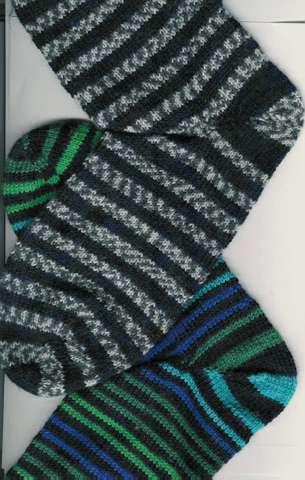
Finally the pair on the right is standard issue Regia Mini Ringel. Nothing special here whatsoever. Due to my bad photography you can’t even see the nifty way the stripes miter on the short-rowed heel.
One last bit of blather, the old fashioned way of doing stripes (actually using two skeins of yarn, alternating between them on some sort of fixed count) is a wonderful way to make socks match in length. It’s relatively easy to count four or six rows of color A, then some number of color B. Then when time comes to make sure that the second sock is the same length as the first, all that need be done is count the stripes. Much more accurate than eyeballing or measuring, and far less tedious than counting rows. A final hint, sometimes counting even a small number of rows in stockinette can be difficult if you’re using a dark color yarn, or one that’s highly variegated. Instead of counting on the front side, I take a needle tip and insert it into a column of purl bumps on the reverse side of my stockinette. It’s easy to count off my rows by counting the purl bumps.

STILL SWAMPED
Yes, I’m still alive, but I’m swamped at work and haven’t had a moment to spare for updates here, or even for blog-wandering of my own. I have been knitting though. Nice non-challenging things like stockinette stitch socks, mostly in eye popping stash-remnant color combos. What is it about January that makes me hunger for color, and every year – leads me to make things that would normally cause me to twitch from the jarring contrasts and strange combos used?
In any case, something knitworthy, yet interestingly nerdy crossed my desk this morning. I present for your delectation a knitting machine made from Legos. Actually it’s more like a chainette maker, or a super-sized automated knitting Nancy (spool knitter), but it is a bona fide member of the knitting machine family. And it likes Red Heart.