ZIG ZAG BABY BLANKET
Still not much time for knitting around here, but I did get to finish off my doodle lace scarf (pix when I get a chance to block it), and do up a quick baby blanket.The blanket is still in process, but I’ll be posting more details of the finished pattern here if people are interested. I’m also still chugging away on the Kyoto for Elder Daughter. I’m about a third of the way through the sleeves. All that remains is to finish off the sleeves, piece the thing together and knit the collar strip.
On the new blanket – I am still enthralled by my Duchrow trilogy, so I went trolling through the pages of those books looking for candidate strip and coordinated edging patterns to do up in a large gauge yarn. Large for me, that is. I found something interesting in Knitting Patterns of Christine Duchrow, Volume 1 on page 30 – a large zig zag. The zag is shown as one big Z shaped insertion, framed by two columns of diamond lozenges, pierced with eyelets. As printed, the one repeat edge to edge is 63 stitches. I decided to toy with it a bit, using one column of diamond lozenges as a centerpiece, framed by symmetrical repeats of the zig-zags. At my gauge of 5.5 spi the framed zig-zag made a nice size for a small basket/car seat type utility blanket. To finish off the piece, I scaled down the edging featured in Duchrow, eliminating the extra column of lozenges, opting for one fewer side to side zig-zag elements. For those of you who are still wary of charts, doing something like this with a knitting pattern written out in prose is a relatively difficult exercise. Editing down a charted edging is easy. Slap two sticky notes on the thing, one masking out unneeded vertical columns, and one to keep one’s place row by row, and (provided you’ve not cut off the inception spot where the entire thing is narrowed or increased – you’re good to go. (Let me know if you want more details on this.)

The picture shows the edging, plus one half of the blanket, from the edging to the line of lozenges that form the center. The big zig is mirrored on the other side of that center spine. It’s bundled up snood style because I’ve picked up stitches all the way around the perimeter, using two circs; and am now knitting the edging onto the body. I’d estimate this piece so far (center plus one side of the edging) has taken me about six actual hours of knitting time, spread over two weeks, which for a lacy blanket is pretty quick, even given my dismal work schedule.
As to what I’ve knit this piece from – I’m not entirely happy with it. I’m working at consuming some of the yarn that I have here in the house. A dear friend of the family recently gave me a huge bag of mixed acrylics that she had accumulated from yard sales and flea markets. It included a number of skeins of 1993-vintage Lion Jamie Pompadour. It’s marked at 20 stitches and 28 rows = 4 inches or 10cm. I’m getting DK standard gauge of 5.5 stitches per inch in stockinette on US #7 needles. While it does knit up quickly, I’m not that pleased with the feel. It’s a Sayelle acrylic with a shiny rayon binder strand. The feel is rather spongy and a bit plastic like as opposed to woolly. The drape is relatively stiff given the yarn’s density and weight. Still, yardage per skein is high, it’s not itchy, it is machine washable, the color is pleasant if you like baby pastels, and having been stored well over the years none of the yarn is discolored, snagged, stained or smelly. I’ll probably use all of my inherited skeins for baby blankets for people I know might not have the time or inclination to hand-wash. For the record, the center of the blanket took a few yards more than three full skeins of Jamie- I’d estimate it as having eaten about 525 yards. The edging along one long side has taken a little over 3/4 of another skein. Final consumption figures will be forthcoming when I’m closer to the end.
BEST FRIEND DORM SWEATER
Just because I was eaten by work doesn’t mean there was no knitting going on at my house. I’m very proud of Elder Daughter (currently in 11th grade), who completed her first sweater this weekend past.
She used Sirdar Denim Ultra – a very soft and lofty cotton/acrylic blend, and made a top-down original, working off a pattern produced using Sweater Wizard. She did all the steps – knitting gauge swatches until she had one with a hand she liked, then calculating the gauge; taking body measurements; inputting the gauge and measurements into SW, and then tinkering with different lengths, eases, and necklines until she got the look she liked (comfy/baggy, for relaxing after class). Then she cast on and followed her pattern to the end.
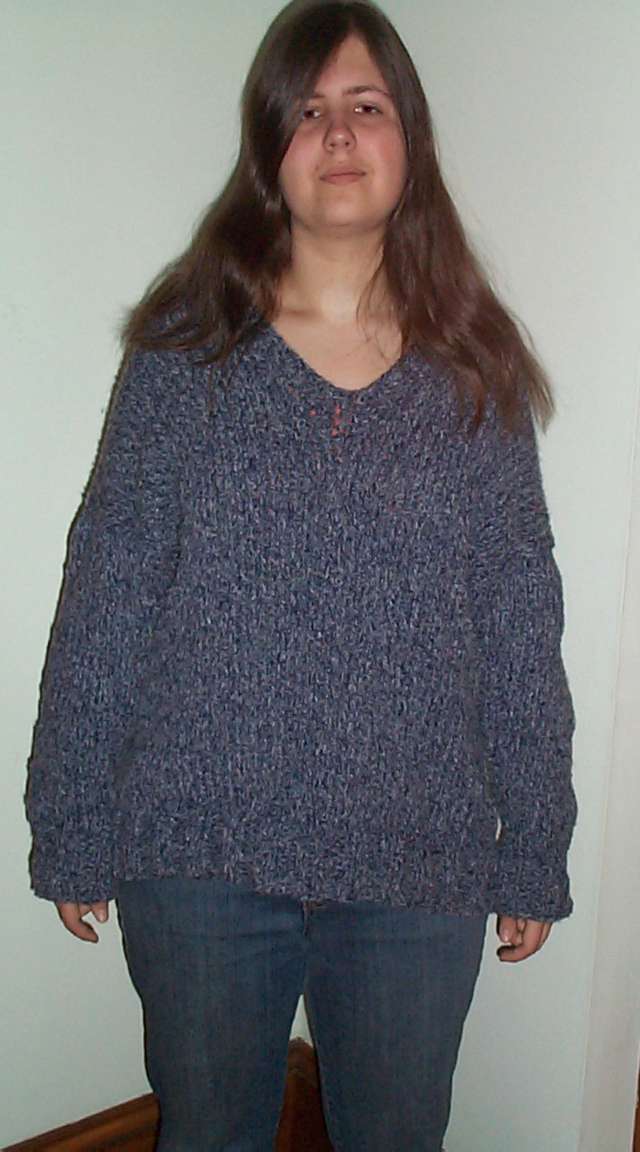
She had a ton of fun working through the project, and is extremely happy with the end result. Her only criticism of the yarn is that it’s a bit splitty, and being composed of lots of individual smaller strands, does have a tendency to catch on things.
I know that Sirdar Denim Ultra is discontinued now, but in the chance anyone has a similar lofty acrylic/cotton blend that works up to 10 stitches/12 rows for 4 inches or 10cm, Elder Daughter shares her pattern:
My Best Friend Dorm Sweater
Needles: 11, 13 Size: 40 Gauge: 2.5 sts 3 rws per 1″ Estimated Ydg required: 718
Note: Sweater begins at the top back and is worked to underarm back. Cast on sts are picked up to work to front underarm. Remainder of garment is worked in the round.
Start Back
With larger straight needle, using a provisional cast on 54 sts. Work Back to Underarm Working back and forth, work until piece measures 10.5″. Place sts on a string.
Front Shoulder & Neck Shaping
Slip 19 left shoulder sts (from cast on string) on needle, skip 16 back neck sts. Slip 19 right shoulder sts onto needle. Using two balls of yarn, begin neck shaping as follows: Inc 1 st at neck edge every 3 rws, 3 x. Then every 4 rows, 5 x. Complete Front Top: Work even until piece meas same as back. Slip front body sts onto scrap yarn.
Work Sleeves.
Pick Up Sleeve Sts [pick up 4 sts, skip 1 row] 4x [pick up 5 sts, skip 1 row] 2x to shoulder. From shoulder down [pick up 5 sts, skip 1 row] 2x [pick up 4 sts, skip 1 row] 4x (52 sts) ending at underarm. Place marker, join.
Shape Sleeve
Work 1 rnd. Begin sleeve shaping: Dec 1 st on each side of marker every 2nd rnd 6x, then every 4th rnd 8x. Cont in pat st until piece meas 15.5″[rnd 46]. Change to smaller needles for cuff. Sleeve-to-Rib Dec Round: [Work 7 k2tog, work 6, k2tog] 1x, work 7. Work rib for 10 rounds[3″].Bind off 22 sts.
Work Body
Slip front and back body sts onto a circular needle. Work across front, pm(side seam), join front and back, work across back, pm (beg of rnd). Join. With larger needles, work one RS row. Begin shaping: Dec 1 st each side, every 20th rw 1x. Inc 1 st each side, every 20th rw 1x. (108 sts).Cont until piece meas 14″ from underarm
Work Ribbing
Body-to-Rib Dec Round: [Work 8, k2tog.] 10x, work 8. (98 sts) Change to smaller needles. Estab rib pat: *
K2
, P2. Repeat from * to end. Work 10 rnds.[3″]. Bind off.
Standard Neck Finishing
With smaller circular or dp needle and RS facing, pick up 16 sts from back neck, pick up 22 sts from left neck edge, place center marker, M1 st in center, pick up 22 sts from right neck edge, place end of round marker. (61 sts) Rnd1: work in k1, p1 ribbing to within 2 sts of center marker, ssk, pm, k1, k2tog, work in k1, p1 ribbing to end of round. Rnd2: work in estab ribbing to within 2 sts of center marker, ssk, pm, k1, k2tog, work in estab ribbing to end of round. Repeat rnd 2 for approx. 1″. Bind off loosely in ribbing.

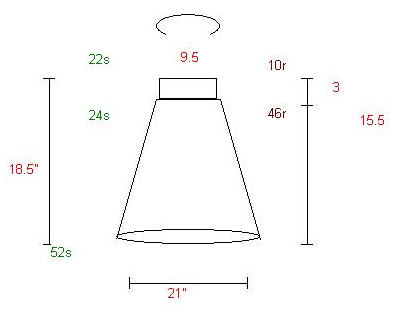
Pattern and schematics produced using Sweater Wizard software. Pattern copyright 2008, Alexandra Salazar and Kim Brody Salazar.
MORE DOODLING – DUCHROW HEART EDGING AND MITERING A CORNER
Yet another spate of horrific deadlines has washed past me. I survived (barely), but I haven’t had much time to knit.
I’m still working on that second lace doodle scarf – the one composed from patterns out of the Duchrow books. (Which I wholeheartedly recommend for lace fanatics.) I’ve finished the center panel, and have applied the edging down one long side, around the narrow end, and am now starting back up the second side:
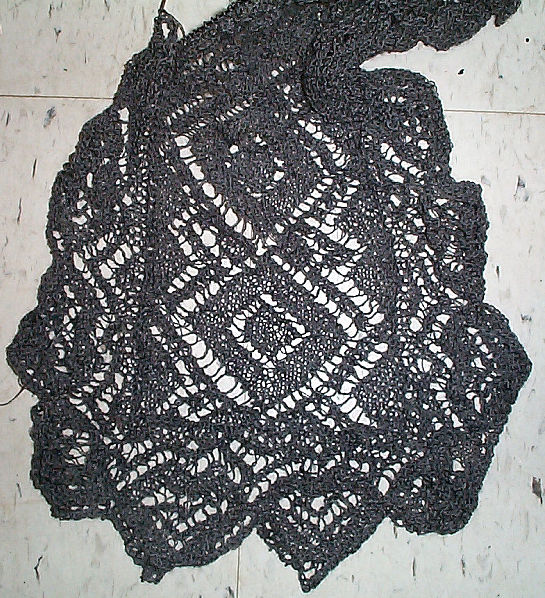
The edging in this case is a bit unusual. It’s predicated on motifs that are somewhat heart-shaped, and sports a very deep dag. I managed to fiddle around with the attachment rate so that I ended up at the corner of the body at the exact narrowest point of the edging repeat. That let me miter the corners using short rows. I wish I’d stopped and taken pictures of that process, but I’ll try to explain it sight-unseen.
To miter the corner on this symmetrical lace, I knit this edge onto my main body piece, either directly calculating the pick-up ratio, or (more likely) fudging the rate of attachment so that I ended with my narrowest row (the valley between two points) at the exact corner stitch of the corner I wish to go around. Sometimes this is easy – if I’m a stitch or two off, those can be made up in the last repeat just before the corner. If I’m more than just a couple of stitches off, I might need to rip back a repeat or two and space the required extra rows or skips (or k2togs) over a larger interval. Obviously, it’s easier to fit an edging with fewer pattern rows into any given arbitrary length than it is to fit a longer one, because there are fewer rows between the widest and narrowest points of the repeat.
Back to actual performance. Arriving at the narrowest point of my edging in concert with reaching the absolute corner of my piece, I’d knit the next right-side row of my edging as usual. BUT on the return journey instead of working all the way back to my attachment point, then purling the last stitch of the edging together with one from the body, I’d wrap that attachment stitch (Row 2, Column A). Then I’d turn the work over and head back on the next right side row, taking care to keep my place in the edging pattern. I’d continue like this, but on each successive wrong-side row, I’d work one fewer stitch, and wrap the next one prior to turning. All of this is complicated of course, by the increases and decreases that form the lace pattern itself. Liberal fudging is usually in order to maintain the pattern as established – or a close to it as is possible.
Eventually I’d reach the row that on a “normal” repeat, would be the longest row – the one that happens in the centerpoint of one of the protruding dags. My actual row worked is much shorter than usual because I’ve been wrapping stitches to form my miter. It’s at this point I go back and begin the second half of my short row sequence, working each row one stitch farther along, waking them up one by one by working them along with the wrap at their base. If I’ve done this correctly, by the time I have reawakened all of the stitches on my row, I’ll also have arrived at the narrowest row of my lace edging repeat, and all of my previously parked short row stitches will have been reincorporated. When that happens, my mitered corner is complete, and I can I begin resume working the edging along the side of my piece.
I’ve taken the liberty of translating the historical pattern from Duchrow into modern notation. She doesn’t present a mitered corner for this edging, but I’ve noted where the short row shaping should take place so you can see (more or less) what I am writing about. Click on the image below for a full size pattern. Apologies for the file size.

 String-Or-Nothing