THE PROMISED STRAWBERRIES
Another quickie. First apologies to the mathematicians and topologists among us. I should have more correctly stated “any continuous wall maze can be solved by following a right hand (or left hand) wall.” Discontinuous mazes are like double running stitch patterns with breaks in them. They can’t be stitched (traversed) 100% double sided.
I’ve made some progress since the last picture which was taken this Friday past. I’ve selected the penultimate strip for my piece. This one is wide, and I’m working it two-tone.
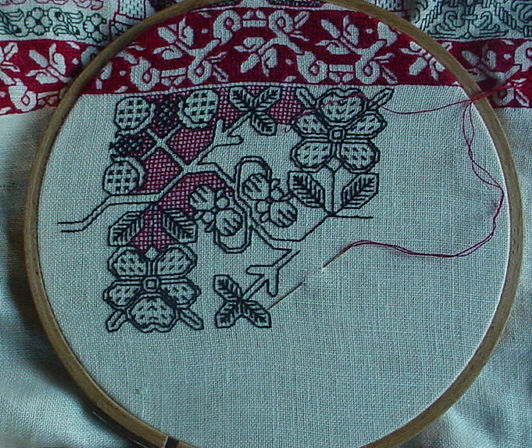
You get extra points if you can spot (from this partial repeat) something about its baseline. Hint: It’s not that the strawberry pips and texture on the pansy type flower keep this from being a candidate for 100% identical double sided work. With a little bit of cleverness, the two sides could be made to read mostly similar, although the pips and textures would by necessity not be identically placed.
Double points if you can identify the source I used as point of departure. TNCM owners, ssshhhh!
In other news, I’m still working on a follow-up post with more info on baselines, and on the accreted section stitching method.
BALANCE IN ALL THINGS
While writing and graphing the last post took up the better part of a week’s discretionary time, I did make progress on my Clarke’s Law sampler. Here’s the area to the left of the center motif – the area that balances a similar section to the right. You’ll note that the pattern I used for the tutorial is the lower of the two narrow red double running stitch bands.
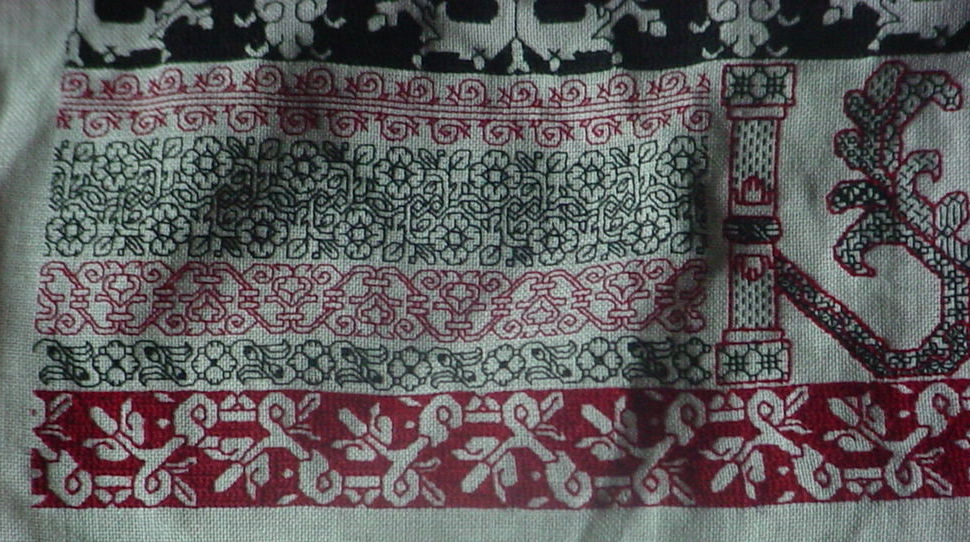
Lovely photo courtesy of Younger Daughter, who is much better with a camera than I am.
This week’s follow on post covering the accreted section double running stitch tutorial will be late. I’ve begun it, but some obligations this week will make it hard for me to finish it by Friday.
Apologies!
DOUBLE RUNNING STITCH LOGIC 102 – WORKING FROM THE BASELINE
Well, with luck this mini-series will be useful to someone out there. There is someone out there, right?
Continuing from the last post, now that we’ve figured out that our design can be worked double sided, and we’ve identified the baseline, how do we go about the stitching? What logic can we follow to ensure that no areas of the pattern are orphaned, and that all lines are covered?
The method most often followed is the baseline method. The other I’ll call “accreted section” and deal with it in a later post.
BASELINE
I find baseline to be pretty easy – nearly foolproof, provided the stitcher can remember the nested logic of detours-within-detours encountered along the way. Some stitchers keep a paper copy of the design, and overtrace it to keep track of where they’ve been. Some use a paper copy to try out their logic before committing needle and thread. I have to admit I do neither. I just go for it.
Let’s look at this pattern. It’s from my very first booklet on Blackwork, a hand-drawn photocopied piece done in my teens and distributed entirely within the SCA. I know I got this particular design from a historical source, but my original annotation wasn’t complete enough for me to include in later books or in fact to find the source again, so this design has sat on the shelf ever since. I’d consider this one to be a pattern of intermediate complexity, but well within the reach of most beginners (click on pix below for enlargements).
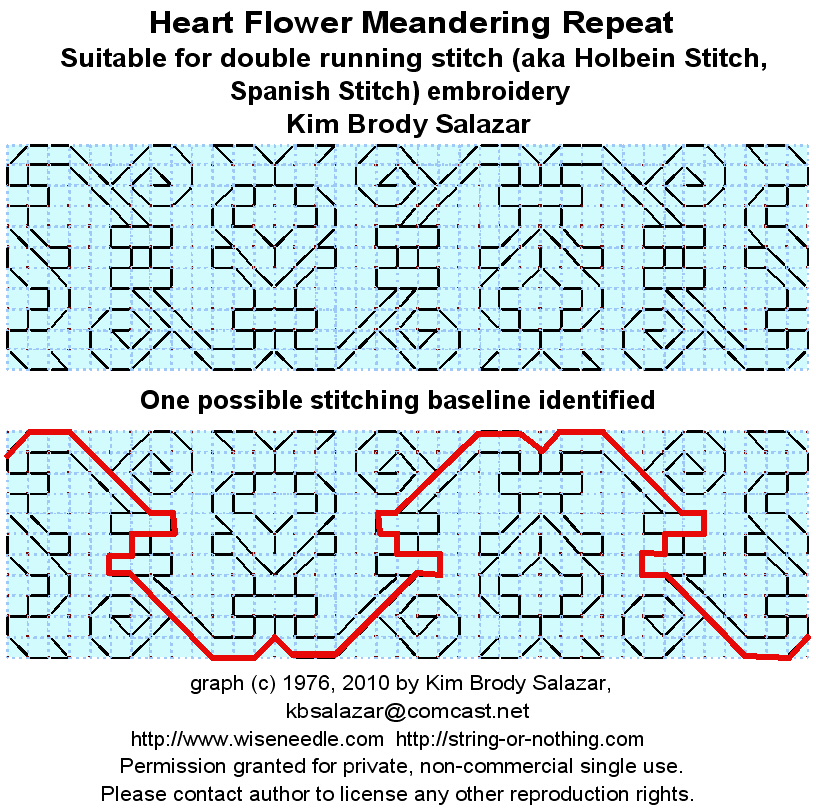
To parse out the stitching logic, let’s look at a half repeat. I’ll illustrate the entire stitching path for one half repeat. The logic to complete a whole repeat is very much the same. In the pix below, green indicates my first pass of double running, and blue marks a return path, in which I retrace my steps. The first stitch and its direction in any pass or return is marked by an arrow. Click on any of the drawings to enlarge. And please keep in mind that the method below is just one of a huge number of possible paths through this particular pattern. Path planning and trying out different strategies is what keeps this style of stitching fresh to me. Which is to say there’s no guarantee at all that I work every repeat in exactly the same manner. YMMV.
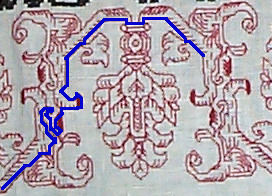
To work this design double sided, I’d start along the baseline leaving at least three inches of thread extra on the back (no knots). I find it helpful to wind the excess around a pin placed in an inconspicuous spot. I travel along the baseline (1) in double running stitch until I encounter a branch. My preferred logic is to then follow the branch to its end, then turn back and fill in the “every other” running stitch, to eventually return to the baseline (2). Then I continue on to the next branch decision and follow that detour (3).

In this case I’ve gotten to the first of the double bracelets on the main stem. Unless a branch is a turn left only branch, given a choice, I tend to turn right. Gamers, the mathematical and those who study behavioral sciences or robots/autonomous navigation will recognize this – it’s a classic. Any maze can be successfully navigated by putting one’s hand on the right hand (or left hand) wall, and following it, without taking one’s hand from the wall. The path traced may not be the most efficient, but sooner or later, the wall-hugging, maze-wandering mouse, robot, or high school topology student will emerge from the exit.
So here I am at the top of the brackets. I could continue down and wander around the bracelets, or I can turn right again and follow the main stem back to the half-heart motif on the left edge of the swatch area. I take a right hand turn from my line of travel, and stitch back up to the main motif (3). When I get there, I notice one little tiny detour – the single stitch between my current line and my starting point. (4) makes quick work of that. Then I continue around the necklace at the base of the heart motif. Again I turn right (5), then double back on my path and continue down and around the wing at the base of the heart (6).

After completing the first pass at the base of the heart and ending up at my “bounce line” – the centermost point of the strip repeat – I do a mini-step back to the heart’s outline (7), then I continue around the heart’s perimeter, eventually reaching the detour point to complete the small inset detail in the heart’s center (8). Again I stitch to the bounce point, and then return to the heart’s perimeter (8).

Once I’m back at the edge of the heart, I can do the antenna that sticks up from its top (9). Heading back from there turns out to be a long run all the way back to my baseline, filling in all of the “missing” stitches to complete the first half of the left hand heart motif (10). Now for a minorly tricky bit – one that folk unfamiliar with double running stitch logic occasionally miss – the little detours that fill in the bracelets around the stem. It’s easy to miss stitches in these, and very easy to get lost, not remembering which way to turn next. We’ll step through.
The first bit is to progress along our baseline. The initial stitch is marked with the arrow. I work it, then the two stitches along the bottom of the upper bracelet, followed by the stitch that completes the three that define the top of the bracelet (12).

Time to head back to the baseline, but it’s not very far away. One stitch brings us back to it (13). On the next step because it’s extra confusing, I’ve marked two stitches with arrows. First I head south from the upper bracelet, then work around the lower one (14). There’s now one stitch left to finish defining the box between the two bracelets. I take that one stitch (15).

Now I’m ready to return to the baseline again. A couple of quick stitches takes me there (16). If you look at the work now, you’ll see only one “unfilled” path through the two bracelets area. That’s the path of our baseline. All of the other stitches have been completed, and none are orphaned, unworked. Now to progress along the baseline again. I detour for the little side curl, worked there and back again style just like I did before (17, 18) landing me back on the baseline again.

The logic should be a bit more obvious by this point. I progress along the baseline, making a detour back up to complete the outline of the stem unit (19). And back again to the intersection just below the necklace at the base of the next heart flower (20), and up around it (21).
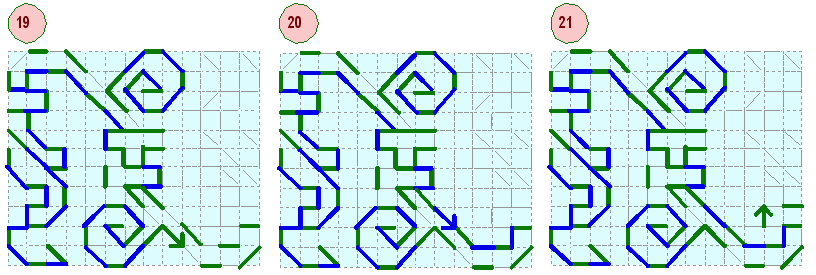
Now I move on to the wing section that defines the lower edge of the flower (22). As before, having hit the center point, I head back to the outer edge of the heart (23), then continue around the heart’s perimeter, and down into its center detail (24).

Almost done now, there’s just heading back out to the edge of the heart (25), and doing the first half of the antenna (26). Our grand finale is here! Starting at the antenna, we work all the way back around the heart’s edge, and then all the way back to the beginning of our pattern, following the established baseline. At this point there’s no more counting, just following the snail trail laid down before (27):

It’s done! The entire half repeat – worked 100% two sided in double running stitch, with no little orphaned areas left unstitched. We worked through the baseline concept on a pattern of moderate complexity, stitching along detours as they present themselves, always returning to the baseline before moving on, and leaving one long final unifying run along that baseline to finish off the pattern. Yaay!
O.k., some of you ask. “Smarty pants, that all works great for the half-repeat shown above, but what about the full repeat?” I answer – the logic is the same. With the exception of the antenna which needs to have both “ears” worked one after another the first time they’re encountered, the stitcher can follow the “to the center” logic above, verbatim, or can work each heart flower as an entire unit when it is first encountered, following around its entire perimeter up to the point of return to the baseline before doubling back around the heart to arrive at the original spot of departure from the baseline.
If you’ve got questions about this logic, please post them. I’ve already gone on long enough for one post. The next post will be on the accreted section method and when to use it or the baseline approach. The series will end with how to finish off ends invisibly for double sided work. Hope this is helpful!
DOUBLE RUNNING STITCH LOGIC 101 – TWO SIDED WORK AND BASELINE IDENTIFICATION
Surfacing…
There’s been a discussion of late on the Yahoo Blackwork embroidery discussion group about stitch order, direction and stitching logic in double running stitch – especially reversible (two sided) double running stitch. I contributed to the discussion with these thoughts, but the answer below is a bit of an elaboration on my original discussion group post.
Double Sided Double Running Stitch – Is it possible for your chosen pattern?
The first thing to do is to determine whether or not your contemplated design can be done 100% reversible. Those that can have every design element connected. There are no floating little diamonds or sub-motifs off on the side un-connected to the main design. This simple design is easy to do two sided:

This one, although vastly more complex, only presents a couple of challenges. The center diamond in the nodule at the base of the plume flower is one. Every other element is connected, but that one diamond stands alone. If I were to work this design double sided, I’d add a stitch to the top and bottom points of the diamond to connect it to the rest of the design. The visual impact of that modification would be minuscule. The other challenge is the presence of some detached stitches in the “bark” area of the branches – the little floating verticals unattached to the main body of the work. If I were to do this one double sided, I’d either omit them, or lengthen them to intersect with a segment of the branch’s outline. A pain, but not totally fatal, and both changes wouldn’t be very evident.

By contrast the column and wreath design below, though simpler, presents a greater challenge for two-sided stitching. Each of the small circlets in the centers of the wreath units stands alone. Attaching them to the rest of the work would diminish the impact of the design. Although the rest of the design can be worked entirely two sided, the circlets are problematic because they’re free floating and rather small. If they were worked independently, with their own lengths of thread, there isn’t enough real estate in each one to cleanly hide the thread ends.

Much of this mermaid panel can be worked double sided, but by now you can spot the facial features, fruit dimples, flower centers (and prominent nipples) as presenting problems that can’t be solved by modifying the design. BUT the small dolphins, although separate from the main pattern aren’t a problem. They’re big enough to stitch with their own threads

O.k. Now we’ve determined which designs can be done double sided without modification – the ones that have no isolated design elements. On to stitching logic.
Stitching Logic – Baseline
I use two methods for completing a double running stitch pattern – baseline and accreted section. I’ll tackle baseline first
Baseline Identification
In the baseline method, the stitcher identifies a line that travels the entire length of the pattern. That’s the baseline. It can be obvious, like a stem from which all of the pattern’s flowers grow, or part of an outline; or it can be less obvious. In this oak leaves and acorns border, one baseline is blindingly obvious:
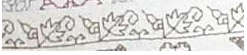
It’s the ground line from which the little motifs sprout.
In this pattern it’s slightly less clear. Any one of several options can be used as an effective baseline:
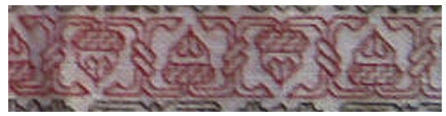
Here’s one possible baseline:
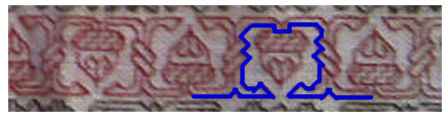
Every other element of the design can be worked as a detour off this main highway. You’ll note that the baseline needn’t march around the perimeter of the acorn. In fact the entire acorn is one nested set of detours. And this isn’t the only possible baseline. Here’s a more efficient though less intuitive one:
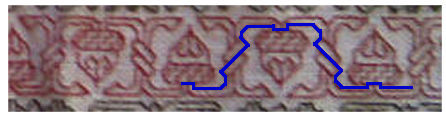
Both are perfectly logical. I might use the one at the top if I wanted to quickly establish the height of my piece. It’s just one unit shy of total pattern height. But the only reason to chose one or the other is personal preference. Please note that the logic of these to baselines applies equally well to the horribly complex plume flower:
I’d suggest folk new to double sided work start with patterns with easily identified baselines, and work up to some of the more daunting patterns.
Next post – stitching logic. Traveling along the baseline and its detours.
YOU GUESSED IT, MORE SLOW PROGRESS
Well, my day job continues to eat my life, leaving precious little time left over to do much else. I do keep plugging away on the Clarke’s Law sampler. I finished out the small panel of narrow bands on the right, and am working on the border defining the bottom edge of the similar space on the left. I have to admit that I’m very bored with this narrow strip. It’s LOTS of repetitions of the SAME unit, with LOTS of long armed cross stitch background to fill in. I am sincerely looking forward to when this band is over and done with, so I can move on to the next bit of fun.

For Eleanor, who wanted to see the source material for the current band, it’s here. Fourth strip up from the bottom. I wish I could read the V&A accession number on the label in the photo.
The set of narrow bands in the blank space immediately above the bit I’m working now will be different from the ones on the right of the center motif. There will be four and they’ll alternate between black and red, but they will be of different widths than their counterparts, with the narrowest on the bottom rather than on the top.
Apologies to the few remaining readers here. This project has bored everyone but me to tears. Thank you for putting up with it.
 String-Or-Nothing
