DRIFTING LEAVES
Or in our case today, drifted leaves. Covered by snow during our unseasonable pre-Halloween snowstorm. Very odd to have to shovel a path for trick-or-treaters.
In any case, here are some leaves as yet untouched by the weather:
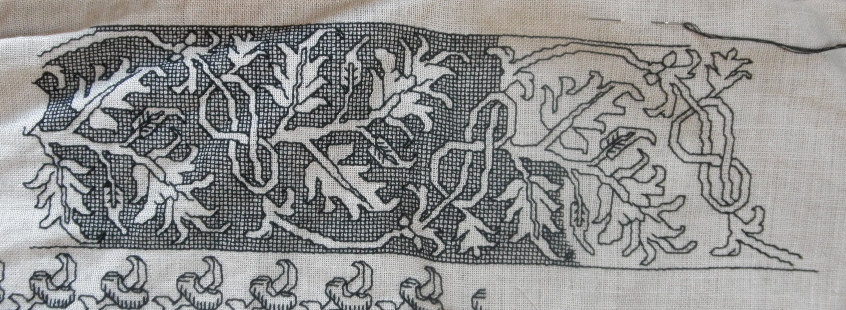
Progress on this current strip is slow. Like all voided background designs, it takes a lot of stitching to do the area cover. Still, I’m moving along. Here’s the thing in full sampler context:
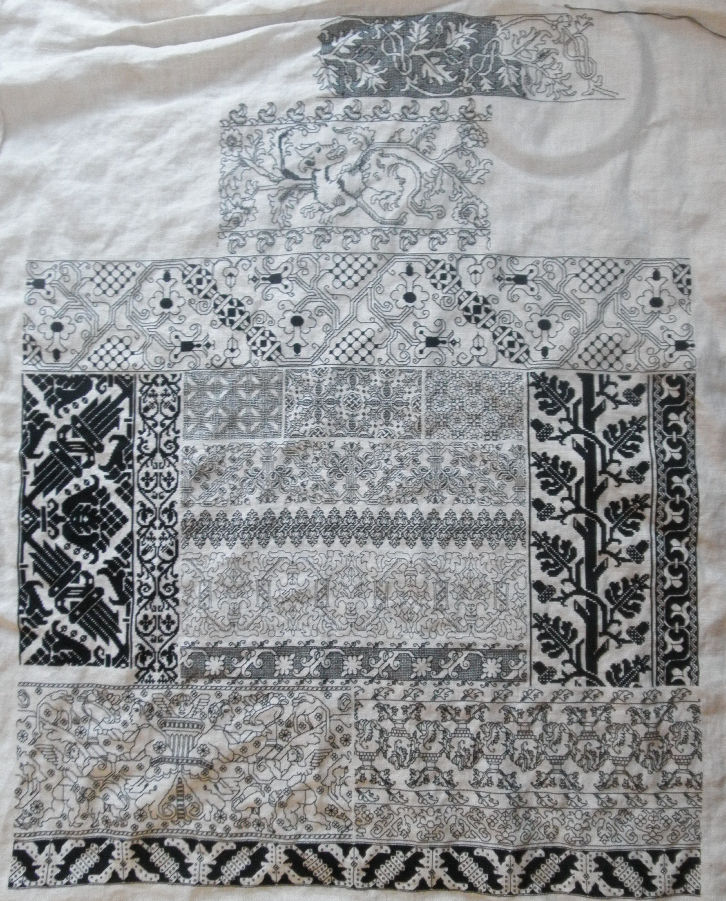
I’m still considering what to put left and right of the dragon, but have decided that whatever designs I end up using, both sides will be collections of narrow bands with short repeats, worked horizontally. But given the pace of the current strip, I probably won’t be getting to them until January. Not only due to current production speed, but also because of holiday interruptions and some end-of-year knitting obligations.
WINTERTHUR NEEDLEWORK CONFERENCE REPORT
Where was String last week? At a conference! This was a new experience for me. I’m pretty much a lone-wolf stitcher. I don’t belong to guilds or stitching circles, and have no local pals who pursue this stuff. I toodle along on my own, with a couple web-pals and chat boards for company, and have persisted this way for decades. So it was a huge departure for me to splurge on attending the Winterthur Needlework Conference With Cunning Needle: Four Centuries of Embroidery.
First off, I was amazed that so many people were there. I expected maybe 100, tops. But there were many more, possibly as many as 600+(doing the math on the rows of chairs at the big lectures). It was a big treat to be surrounded by so many knowledgeable and enthusiastic folks!
Here’s my report. I hesitate to post pix, not being sure if “private research use” covers blog use. Also apologies for massive blocks of text. Feel free to skip this and head off to eye candy elsewhere. I won’t be offended. Oh. And I didn’t take notes, opting instead to concentrate on the presentations. The summary below is from memory. Apologies if I get the details wrong. If you were there, please feel free to correct me or add on.
Day One:
The first two lectures focused on the Faith Plimouth Jacket. The first one was by Dr. Tricia Wilson Nguyen and the second by Jill Hall – the two leaders of the Plimouth Plantation jacket re-creation project. Fascinating. Together they presented a general overview, but not a content free skim over the top. All parsed in terms of the socioeconomic context of the world in which the jacket was produced. Which sounds dull, but wasn’t. Why were the English embroidery styles used on the jacket largely detached? Why were the gold and silver laces and spangle of the period so sketchily done? Why did the jackets disappear from the historical record so quickly? Why were the techniques represented in the jackets used? What was the purpose of wardrobe pieces like this, and how did that purpose persist in the face of changing styles?
Wilson opined that in part the creation and popularity of these sumptuous jackets has to do with the lack of an English banking system in late Tudor, Stuart and Cromwell eras. We wandered off into regulations of the gold thread drawing industry, the economics of frippery (second hand clothing), the apprenticeship system, thread production and use patterns, and the time/thread consumed by competing techniques. In short, these were rapid production pieces, made by workshops, valued as much (if not more) as walking bank accounts – the detached embroidery, lace and spangles could be snipped off and melted down – cashed in against need, in the days before reliable deposit accounts existed. When deposit banking became more stable and wealth could be more safely kept, the jackets (and I’m betting some other forms of household plate and ornament) fell out favor.
Another major takeaway from Wilson’s talk was the prevalence of marled threads. You now all those subtle color to color transitions? The stitching ateliers and private embroiderers did not maintain massive stocks of zillion shade increment threads. Instead they used a smaller number of colors, but custom split and twisted stitching lengths on an as-needed basis, often blending colors to achieve “in-between” color values. The silks did not come pre-spun in ready-to-stitch skeins. Silks came in raw reeled but dyed hanks, tightly twisted into almost baton like lengths. The stitchers would tease out the requisite fibers, and twist up just the length they needed, plying colors as needed. This technique is also used in historical and contemporary Japanese embroidery. In addition to the marled colors, you can see evidence for custom split and twisted thread on samplers made by beginning embroiderers, who were not yet skilled enough to produce lengths of uniform thickness.
Some of Hall’s main takeaways were the shaping nature of bodies (corsets) worn under garments like the jacket, and how knowing of their presence can make sense of (to we unbound moderns) posture, movement, and actions shown in historical art pieces. She went more into jacket shapes and construction, showing variants. She also explained how silhouettes changed over time and how even with changing fashions (and creative ways to wear them), the jackets maintained their presence.
The 2+ hours of lectures flew by so quickly I didn’t notice how dense pack the morning was until it both were over.
After lunch there were two more lectures – Old London to New London: Tracing Needlework Patterns and Skills in Early America by Susan Schoelwar and Artful Adornments; Embroidered Accessories of Boston Schoolgirls by Pam Parmal, curator of textiles at the MFA, Boston.
The first talk centered on several styles and object classes common to Eastern Connecticut valley in the early to mid 1700s – showing how this rather insular frontier community (which it was back then) produced several identifiable clusters of work that can be related via formal schooling (needlework teachers and pattern drawers) or via familial relationships. The second discussed what Boston area schoolgirls were embroidering other than samplers, especially what older girls boarding with teachers were up to. I would have preferred more pix of the latter rather than descriptions or household inventories, but both lectures were engaging and well-delivered, and quite informative.
After lunch I went to a workshop on the Sarah Collins sampler, led by Joanne Harvey. She also put the piece into a social context, tracing the lineage of other contemporary 1600s American samplers, both through points of origin and ownership/lineage. Then she reviewed double running stitch for those who had never done it before, and for the folk who had – presented a variant of four sided stitch done both horizontally and on the diagonal. This variant produces diamonds on the reverse when the stitch is done on the diagonal. I hadn’t done that before.
My main take-away from the whole day is that no artifact can be examined out of context. That context can be economic, didactic, familial or any other set of circumstances, but all aspects play in every piece. Examine a stitched item on only one vector (say craftsmanship) and you miss a wealth of associations that reveal greater import to the piece than mere beauty. Even though that beauty may be what attracted attention in the first place.
Day Two:
A very long day, indeed.
The morning lectures started with a talk from Karen Hearn, the curator of 16th and 17th century art at the Tate museum in the UK. Her topic was embroidery depicted in period portraits. She presented a range of pictures from the gallery’s collection, and discussed whether or not portraiture can be used as a reliable resource for period needlework investigations.
The verdict was “not very.” All sorts of things intervene. First there can be a huge shift in colors, due to pigment color migration over time. She showed some blues that were vivid azure when new, that are now a totally unrelated beer-bottle brown. Other complications include artists that were more or less skilled in needlework depiction or who had varying levels of interest in rendering needlework with stitch accuracy (some pix are flat out representational and not literal). This could have been a product of whether or not the artist had access to the textile independent of the sitter (increases veracity). I can imagine that some sitters may not have actually worn all of the clothing pieces in which they are depicted at the same time. Some may have taken all their best, wearing it all at once for their sitting. Others may have been painted with family items or accouterments, in an effort to look richer or more influential than they really were. Takeaway from this lecture is “view all with grain of salt.”
The second talk was William Kentish Barnes – the master gold thread maker who supplied the jacket project. He spoke on the history and methods of his craft. While an engaging anecdotal speaker, he had rather more content and enthusiasm than public speaking experience and ran out of time before his talk finished. Still, it was interesting, if rather rambling. His main point is that motive power (human, animal, steam, electricity) may have changed, but the physical production of drawn wire threads remained stable until the invention of plating via electrolysis; and there’s nothing in the 1600s that we can’t make now, given demand to spark manufacture. He hinted quite broadly that if the stitchers in the audience wanted quality, historically accurate materials, that demand would suffice.
After break the third speaker was a PhD student, Nicole Belolan with a talk from her amusingly named thesis, The Blood of Murdered Time. Her talk explored Berlin woolwork (19th century needlepoint). Now Berlin is long maligned as a debased, populist craft. Although widely practiced, it had the same disparaged reputation in its time as plastic canvas tissue box holders have today. Belolan put it in social context, and looked at it through the experiences of a woman invalid, who although isolated through illness, maintained a long-distance social life and community via pattern sharing and gift exchanges with friends and family. I’m not likely to run out and stitch a sentimental spaniel among the posies, but Belolan did do a good job of showing the value of this populist style, and the populist, accessible appeal that it had at the time.
The last talk was by Dr. Lynn Hulse Archivist of the Royal School of Needlework. She spoke about the late 19th century revival of Jacobean-inspired crewel work, largely fostered by the Royal School of Needlework and some famous practitioners, most notably, Lady Julia Carew. Imagine one of today’s E! or gossip page luminaries, but highly talented at needlework, setting a style through personal production and sponsorship. With prodigious personal output including an entire room full of floor to ceiling panels, plus dozens of pieces of furniture and smaller pieces. Very interesting, and laudable – a product of the arts and crafts movement for sure. A very interesting talk about a very interesting woman. I’ll be looking for more info on Lady Carew.
After lunch I had selected two tours instead of sit-down workshops.
The first was a session in the rare book rooms of the Winterthur library (which is largely accessible on-line). No 1600s era modelbooks, but lots of slightly later works, plus 1600s era emblem and natural history works – both used for needlework inspiration.
The high point of the entire weekend came for me in the second half of the library tour, when we went down into the room to view ephemerata (really old non-book stuff, like pamphlets, scrapbooks, pattern pages, snippets, and broadsides). There, in an assembled book of textile fragments, awaiting restoration/mounting was an actual piece of 1600s era Italian voided work, done in red silk on linen. Exactly the style that I research and graph. It was done on around 50+count linen. While the pattern was rather more like some of the ones I used on my last piece, it had a squared background, exactly like the strip I am working now. I was able to see both front and back. There were knots! And the background was identical front and back – NOT in four sided stitch with little x’s on the reverse. I was THRILLED, I’d never been up close and personal with an exact representation of the stuff I’ve been graphing! We WERE able to take pix in the library, so I have photos of this piece. I intend to write to Winterthur and ask permission to include a chart for this unpublished work in TNCM2.
After that the second tour I took was rather anticlimactic. Which is strange to say for specialty a needlework tour of the Winterthur estate, of artifacts, interiors, textiles, and furnishings collected by the Dupont family. Samplers by the dozens. 1700s era, 1800s era. Some famous, some not. Mourning pictures, armorial pages, allegorical scenes. Fishing ladies. Hand-stitched and heirloom knotted rugs. Bed hangings. Quilts. Pinballs and etuis. Purses, pockets and pocketbooks. Clothing. Household linens. Stitching and knitting tools. After touring the on-display rooms, we went to the back stacks and looked at the off-display collections. More than any one human could process in the two hour tour. I now have stitching overload – SO many images running together in the brain that I can’t form a clear description of any one.
Conclusions:
My big gains from the weekend are the importance of studying artifacts in context – knowing why and how they were produced, and for what purpose. That historical linens were rather gauzy compared to modern ground cloth of the same count. That historical pieces aren’t beyond the technical skill level and reach of modern stitchers, although the time investment may be on a greater scale than most of us can easily invest.
I learned that experiences like the Winterthur conference are extremely valuable – full of learning opportunities both in and out of the lectures. If you get a chance to attend something like it, and can manage to attend, by all means, do so! That there are lots more people pursuing the needle arts with serious scholarship and intent than on-line presence indicates, and the electricity of gathering them together is very special.
I also came away with a ton of contacts. Special hellos to the gang from Calontir, Jeanne, Ria, Janet, Sharon and all the other people who took time to chat with me. Apologies if I’ve left names out – I’m better at content and faces than names. I’m astounded that folk in the real world know of my book. Totally shocked in fact that almost everyone I mentioned the book to, owned a copy. Never having done book tours, nor having received any reports of sales, I had no idea…
EDGE OF THE KNOWN WORLD
I’ve reached the top edge of my giant blackwork sampler:
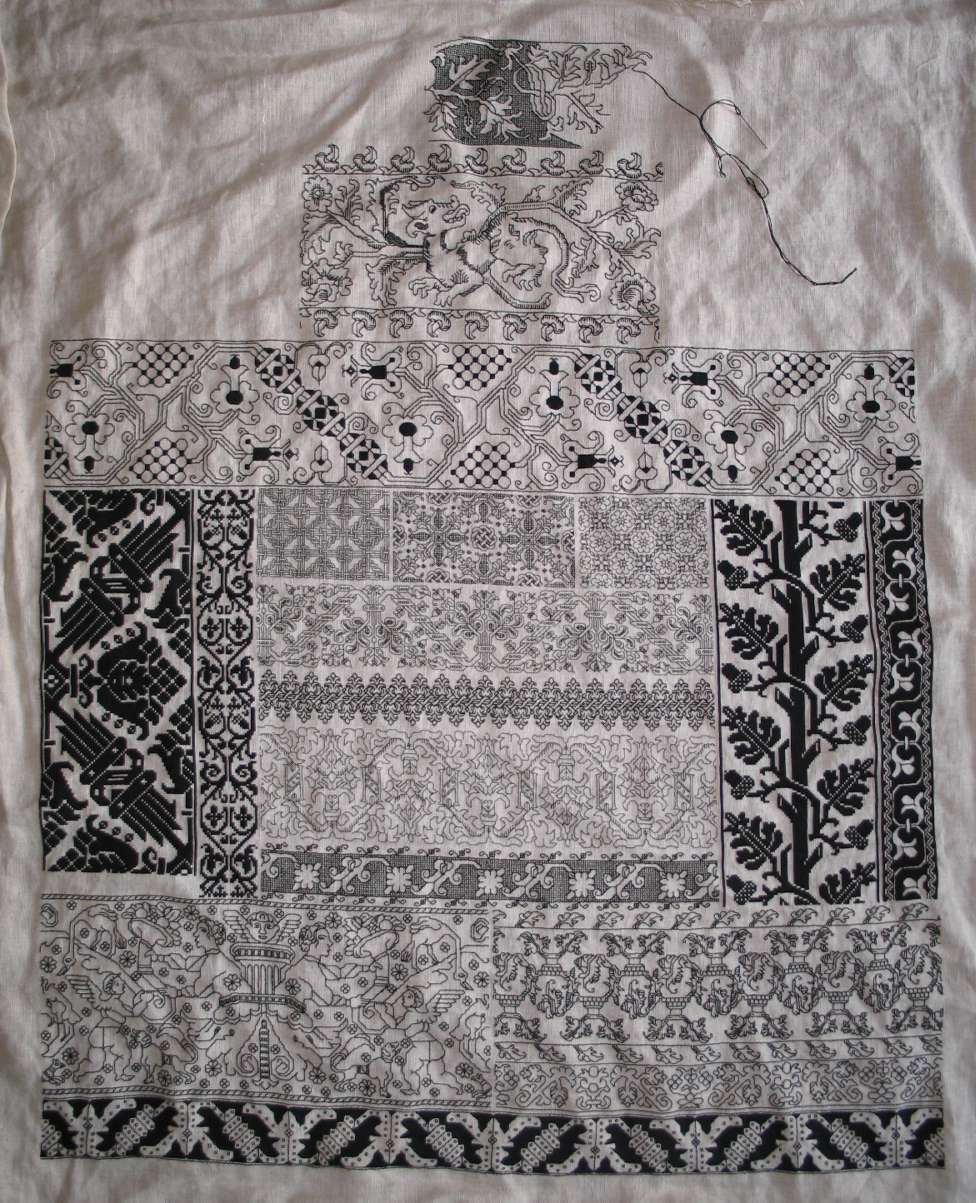
The current panel will span the entire width of the piece:

It’s adapted from a Lipperheide pattern. The original is shown with a pulled thread mesh background, rather than the squared fill I’m using. That background made the book’s illustration very difficult to work from, so I had to redraft the pattern before I could begin. The squared voided fill takes a long time to stitch, so I am guessing that it will be a couple of weeks before I can address the areas to the left and right of my dragon. Not sure yet what will go there – possibly gangs of narrow borders, either horizontal or vertical. We’ll see…
In other news, I am very proud of the whole String family. Smaller daughter has spent the last two weeks farming a sourdough starter “It’s not fair! Other kids get kittens or puppies. Why do I get Francis The Yeast Culture for a pet?”
Yesterday we decided it was time to try it out. The Resident Male took charge of mixing up the dough, the various rises, loaf forming, and baking. Here is the result, crunchy-fresh and hot from the Dutch oven in which he baked it:
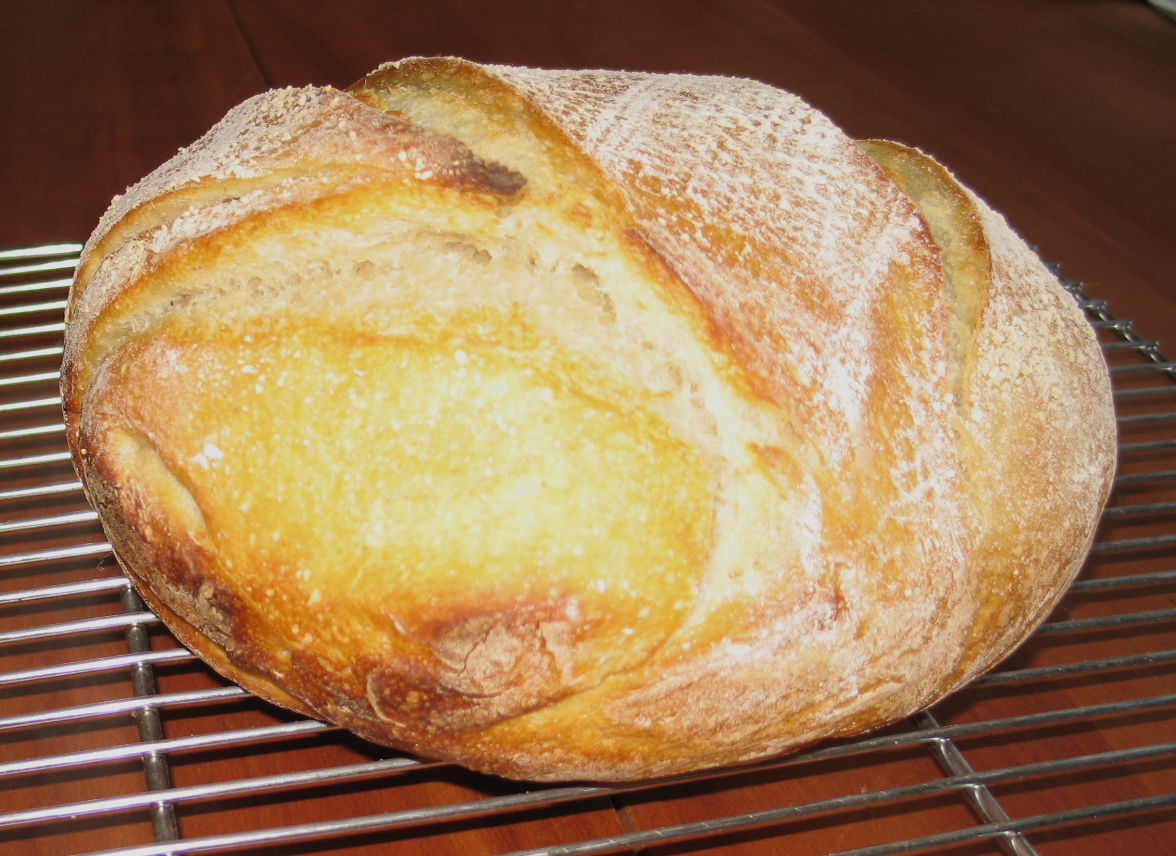
I wish this was Smell-o-‘Net because the house is heavenly right now. Marian would have been proud of him, too!
DRAGON DONE
The dragon panel is finished!
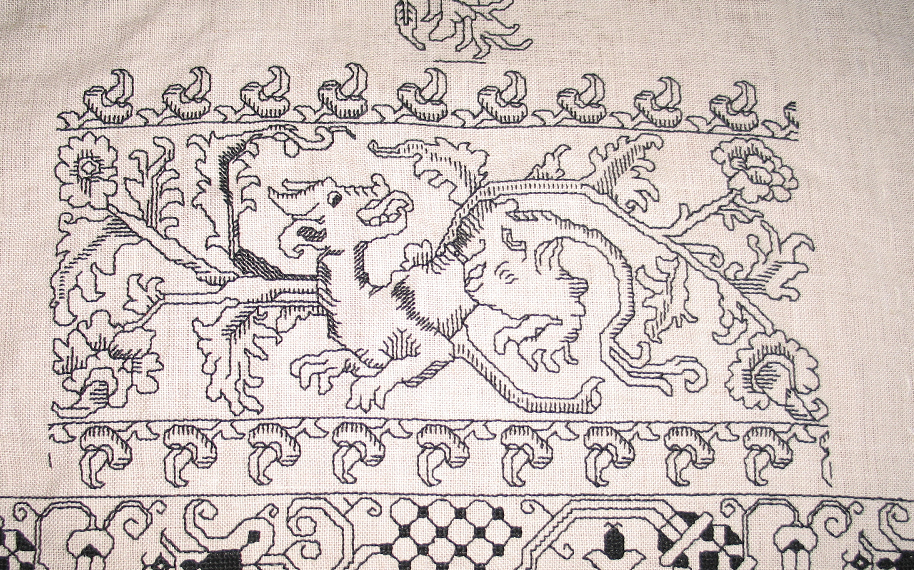
I wish the shading on the tail end of the beast better balanced that on the head end, but what I have here is true to the original. If I ever stitch him up again, I may modify the pattern somewhat and either lighten the branch on the right, or darken something on the left. Still I’ve been fond of this guy since I first saw him in the ’70s, and am delighted to have finally successfully charted and stitched him. He’ll be the last two charts in TNCM2 (he’s too big for one page).
What’s next? A panel that will run the width of the piece at the top edge. This one will be another crib from Lipperheide, but unlike the last bits I borrowed from that source, it was too difficult to stitch it directly from the engraving. The background of that illustration is shown in the drawn squared filling (some museums label th stitch “punto milano”, possibly Italian 4-sided stitch, drawn very tight). It sort of looks like a drawn thread ground, but it would have been VERY difficult to achieve all that thread removal given the scale and convolutions of the un-voided motif areas. In any case, I had to regraph it from the Lipperheide panel prior to work. Even though I drafted it up I do not think I will include this one in TNCM2 because it’s available in another contemporary source.
ADA LOVELACE DAY – CELEBRATE WOMEN IN SCIENCE, MATH AND ENGINEERING
October 7th is Ada Lovelace Day!
 Although every day should be a day to celebrate the achievements of women in the sciences, sadly few folk think hard or long about them. Most people can rattle off the names of a dozen famous male scientists or inventors, but come up with a short list that begins and ends with “Marie Curie” when asked to name accomplished women. Several years ago a group was formed to bring greater awareness of women’s contributions to technical fields. They started Ada Lovelace Day (http://findingada.com hashtag #ALD11 ).
Past ALD posting events have called for folk to honor particular (usually unsung) historical women of accomplishment. I had great fun doing so. This year’s call is different, and far closer to home. The request is to name a personal heroine – a woman in science, math, technology, or engineering – who has shaped you to become who you are today.
As a proposal specialist, I’ve had the privilege to work with many outstanding women in technology – pioneers all – in fields as diverse as civil engineering, robotics, oceanography, and medicine. But I will write about one of the first whom I met in my early career, and who changed my life tangent. Anne, if you read this – apologies! I tried to contact you first. Just sit still and be flattered. 🙂
My Ada Lovelace honoree is Anne Street.
I met Anne back in the ’80s, when we both worked for an engineering firm specializing in infrastructure. She has a dazzling technical background, with multiple degrees from MIT, at a time when women MIT graduates were few and far between. Her specialty then was business development for applied engineering, and she took me under her wing as she made her rounds of the nuclear industry and associated Government and research entities.
Anne taught me a lot. There’s the obvious – how to read and answer Government requests for proposals. And there’s the not-so-obvious. How to engage engineering vision. How to distill the musings of the stratosphere-inhabiting set and transmit their thoughts to non-tech folk, without being didactic or condescending. How to be the only (or almost only) woman in a field dominated by men; taking neither nonsense nor prisoners, but doing so by subverting from within rather than wasting energy on pointless direct confrontation. How to lead the unwilling. How to build a team of people who might not be happy about putting in after hours and weekend work; shaping them so that in the end they were damned proud that their output was of the highest quality, because that way all the overtime was a badge of honor, and not wasted effort.
Through all of this ran a wicked sense of humor. She held a wake when a particularly large and desperately desired potential opportunity came in as a loss – complete with black balloons, a model coffin, and wilted flowers. The telephone play of her convincing the florist that she WANTED dead, droopy flowers was priceless. Her parties were legendary: Tinkertoys as icebreakers; mystery role playing gatherings; just the things to make totally unconnected creative folk from many walks of life unwind together, even though they had just met as strangers. I still have the glass lampwork beads and jewelry we made. Three houses and 20 years later – her daylilies still bloom in my yard. And I’m still writing engineering proposals.
But most of all Anne was always the epitome of encouragement. There was no field, no technical arena, no bit of knowledge too arcane to tunnel into and to share. She taught me to step aside and engage the brain when I read, to assess not only face value content, but possible sub rosa influences; and to always look for the proof or the root cause. And that in the end, everything can be researched because there is no priesthood. Women and men without tech degrees can through curiosity, enthusiasm and perseverance, always find meaningful and substantiated data.
Anne today is president of the MIT alumni association, where I am sure she’s using connections and influence to further the cause.
Way to go, Anne!
THE DRAGON, VANQUISHED
What have I been up to while posting the informational notes last week?
Fighting a long-standing battle – and at long last – conquering my nemesis.
I’m not sure if this is a dragon, or a lion, or some other beastie, but whatever it is, I’ve made failed attempts to graph it from its original source. I’ve gotten close a couple of times, but never close enough to do the panel justice. I think I’ve hit it this time – fifth time’s the charm!
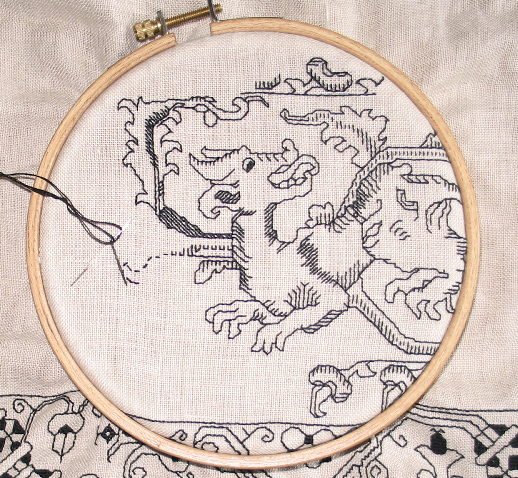
I’ve paired it with a border from the same source, but not shown in association with the dragon on the original sampler. Like most of the other strip patterns I’ve stitched over the past 18 months both of these will be in my Second Carolingian Modelbook (TNCM2).
How did the bottom panel turn out?

and how is the piece as a whole coming along?

 String-Or-Nothing
