IN WHICH WE BUY EMBROIDERIES–PART IV
I’m not done yet!
Here’s another piece we found on our Delhi/Agra trip. This came from a dealer in Agra, and not the fair trade market in Delhi.
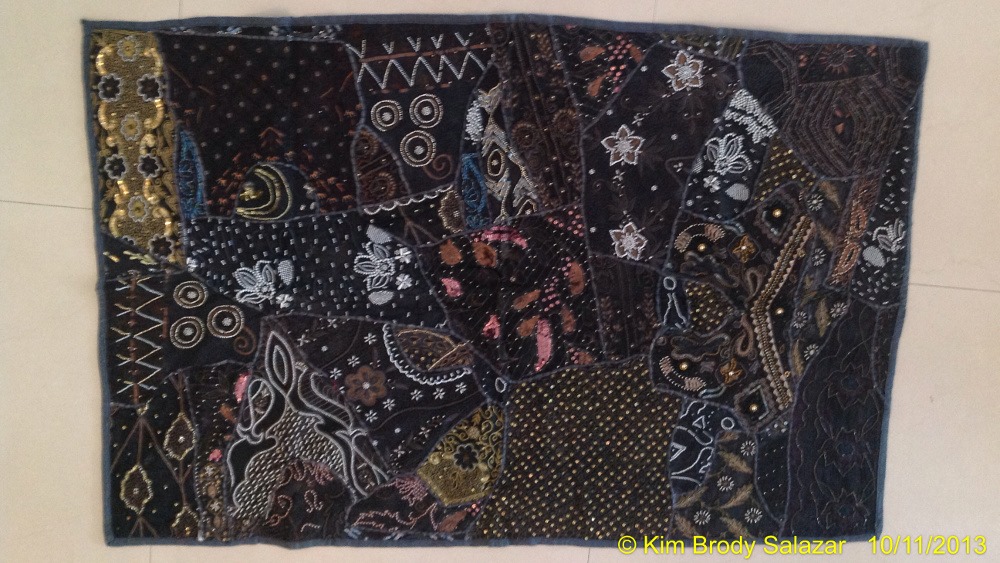
This is a patchwork wall hanging. It’s sort of in Crazy Quilt style, although the piece is one huge block, roughly 4 feet x 2 feet. It’s made up of fragments of highly embellished antique textiles, much of it overdyed in black; plus some newer pieces to eke things out. The fragments are appliqued to totally cover a background, and that ground cloth is in turn backed by another heavier cotton cloth. There is minimal quilting between the layers to hold them together – mostly some tacking stitches along the rolled borders between the fragments.
Close up you can see the amount of beadwork, sequins, gold stitching and other encrustations:
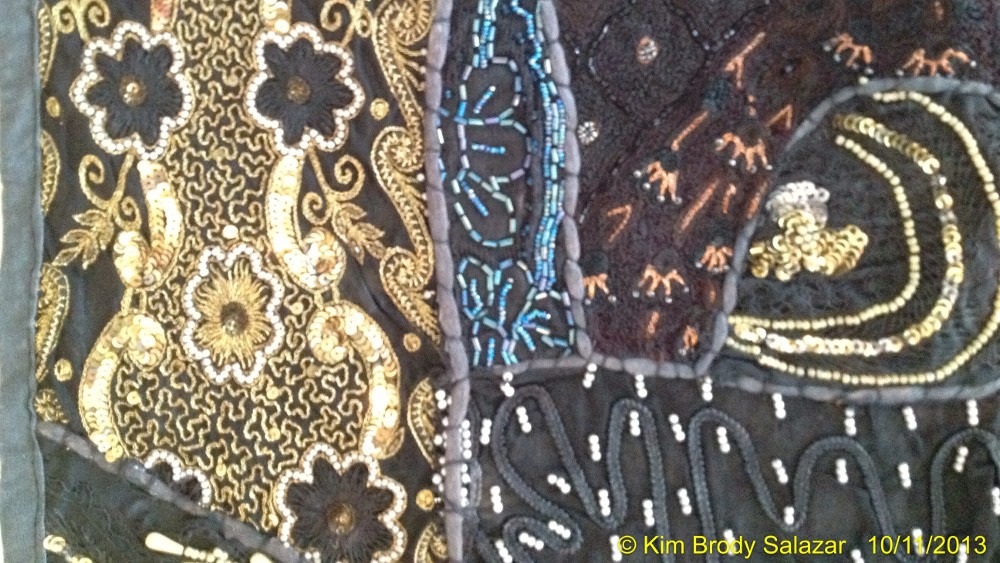
The dealer had several like this. Believe it or not – this was the plainest. It was also the one in best condition. One problem with antique pieces is that often the cloth is not stable. Silk is friable, and crackles with age. All the more so when it has been overdyed. Threads securing hand-hammered sequins or rough edged metal beads can break easily. I looked long and hard at the five offerings, and picked the one in the best shape from a curator’s perspective.
The number of techniques in this piece is hard to estimate. There’s tambour in silk, cotton and metal threads; beadwork and sequins applied in myriad ways; satin stitch, laid couching of various types; buttonhole stitch; something very much like or nuée, with gold threads affixed with colored silks in patterns or to create shaded effects; appliqued lace; some very old mirror work (shisha); and heaven knows what else.
The way this piece is put together reminds me a lot of a cherished gift at home. Jackie of the late and lamented Wild & Woolly, gave me this knitting bag for services rendered when I helped her with a major home reorganization:

It’s also of Indian origin, assembled patchwork style from small pieces of sari borders and other embroidered snippets. In this case the backing fabric is cotton velour, instead of heavy flat-woven matte-finish cotton. I have a feeling that this bag is somehow related to the black hanging, if only distantly.
But as jaw-dropping as the black piece is, it’s not our ultimate acquisition (so far). You’ll have to wait until the next post to see that!
IN WHICH WE BUY MORE TEXTILES–PART III
O.k. So technically, these aren’t embroideries. But they are still textiles.
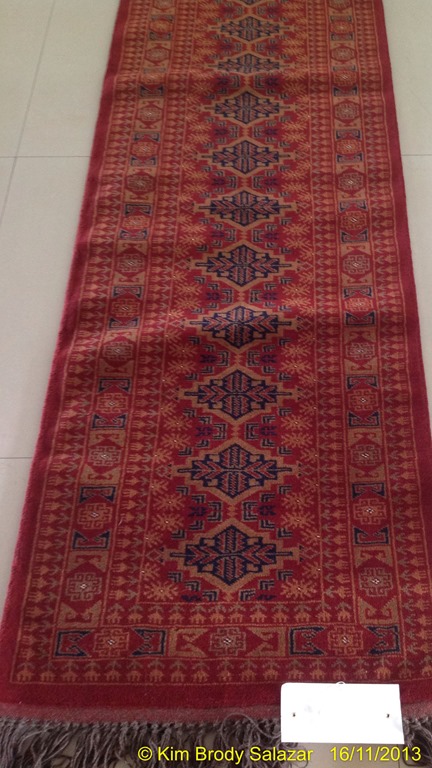
Among the various indulgent purchases we made on our Agra-Delhi vacation was this Kashmiri rug, bought after much hard bargaining from a traditional Smiling Rug Merchant:
The bargaining is part of the theater. I don’t believe for a minute the merchant’s protestations that we were taking bread out of the mouths of his children (their graduation photos from US universities were behind his desk), but the play of price, offer, counter offer, reticence and commitment must be played out for any large purchase. It’s like high school dating, but for merchandise.
This piece is a runner, for use in the long hall outside our library. It’s an heirloom quality, all-wool warp hand knotted rug, with long, luxuriant fringes, and dyed with traditional vegetable colors. It’s hard to say how such muted reds and tumerics glow, but they do. We’ll probably leave it out for a couple of days to admire, then roll it back up in its muslin bag to await shipment home with the rest of the household goods, come June.
The next day we bought some woven pieces at Dilli Haat as gifts and souvenirs.

The small woven bags and coasters are cotton and straw. The four larger hobo-style soft tote bags are cotton with inset hand-woven bands. If my notes are correct, these are backstrap-loom produced pieces from Nagaland, near Assam.
[UPDATE] I’ve done some research on the small woven straw clutches. I didn’t write down the region of origin when I bought them, but I’ve now pegged them to the c0astal region of Orissa. They are made of sabai grass and cotton, and are part of an economic initiative that assists families in flood-ravaged areas reclaim economic self-sufficiency.
These smaller items we did not bargain for, other than putting together a group and asking for a price for the larger purchase, rather than toting up each item individually. All were quite reasonably priced, and sold as they were by the village or guild co-ops, we were happy to provide fair recompense directly to the crafting artisans themselves.
I’m not done yet. There are more pix of textiles to come. And if you want to see the larger sights of our trip, the husband has posted an excellent two-parter on our trip to the Taj Mahal.
IN WHICH WE BUY EMBROIDERIES–PART II
Here’s the second group of purchases.
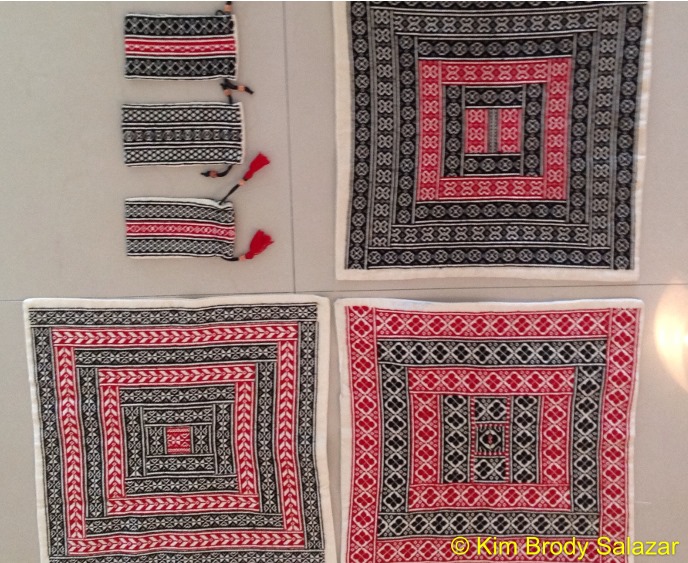
These are three cushion covers and three small glasses-case-sized pouches, all done in pattern darning. We also got these in Dilli Haat, in Delhi; from a Government-registered ethnic arts stall. In this case, the pieces were done by a Toda cooperative. The Toda people are from South India in the Niligiri Hills and surrounding areas. Their traditional culture is pastoralist, centering on dairy herds.
Their stitching, seen on a Toda’ woman’s outfit below, has been adapted for retail sale. The Dilli Haat vendor was selling the square cushions and small bags I bought, plus tote bags, larger throws, and bolster cushion covers (think cylinders, with the stitching going around the circumference).

Image credit for the lady above: 6 Assago via the Fair Trade Forum – India, which also works with Toda cooperatives to market their crafts.
Anyone who is familiar with my love of black, red and white geometrical stitching will know I was especially delighted to find these pieces. It will be difficult for me to part with any of them, even though I bought them as gifts.
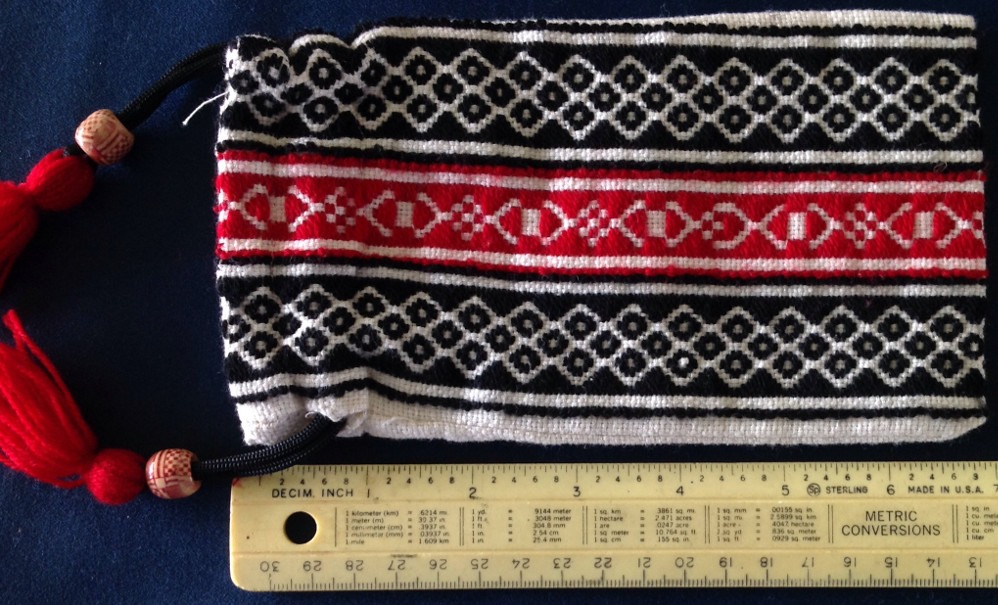
In terms of technical specs, the white ground cloth is a bit like Aida cloth, even weave with a well defined “stitch here” hole structure; at roughly 20 doubled threads per inch. The thread used looks to be an acrylic lace-weight plied yarn. It’s a bit friable, so gentle care is in order to minimize surface fuzzing. The pouches and cushion covers are lined, so seeing the reverse is problematic.
Now, there are several embroidery styles in India that use pattern darning. For example, Kasuthi also employs Negi (weaving) stitch for individual stand-alone motifs or for borders in which the stitches form the foreground. But the Toda style is a bit different. It’s characterized by strips of uniform patterning, with the stitching making up a solid background against which the unworked ground cloth peeps through in geometric designs.
And I love it.
IN WHICH WE BUY EMBROIDERIES – PART I
Just back from a five-day Diwali break trip to Agra and Delhi. In Agra we toured the Taj Mahal, Agra Fort, Ram Bagh (a magnificent Mughal era garden), and Chini Ka Rauza (mausoleum of Shah Jehan’s prime minister Afzal Khan Aalmi, himself a noted poet). In Delhi, we did a hilarious, whirlwind auto-rickshaw tour of Government center area, including the India Gate, houses of Parliament, and the embassy area; then a day in the National Museum, the Crafts Museum (a must-see if you are a weaving or textiles fan), the Red Fort, and at the end – a shopping trip to Dilli Haat. If you are ever in Delhi, insist on going to Dilli Haat. Your driver may try to steer you to a different crafts or souvenir store, but stand firm. You’ll find better quality goods at much lower prices, and without the “foreigner tax” so often encountered elsewhere.
The week was unforgettable, and I’m sure I’ll be posting some select tourist pix over the coming week. But folk here are reading for needlework content, so I’ll lead with that.
I wanted to bring home examples of Indian needlecraft that are a bit more interesting than the usual items sold to tourists – the hastily stitched pieces of sketchy construction in lurid colors. I had wanted to find examples of Kasuthi, of course, but so far, I haven’t. Perhaps when we go a bit south in Maharashtra later in the spring I’ll find some. But other than the iconic piece at the National Museum, pictured on the cover of my Kasuthi book, I haven’t seen a single example. Nor did I find quality shisha (mirror) work, although I did see a couple of pieces locally here in Pune that I may go back to buy. In crafts, like in all other areas of economic opportunity, bad drives out good. It’s hard to find honest quality pieces when less well executed items command the same price. But I did look hard, and we did buy several items, almost all from government designated regional or ethnic artisanal cooperatives in fair trade markets or sponsored cooperative stores. Here is the first selection:
My dodo curtain. Now anyone can find elephants or peacocks,even tigers, on cloth here. They’re everywhere. But this cotton curtain (about the size of a king size bedspread) is totally covered with roundels inhabited by dodos. Why dodos, I haven’t a clue. But in addition to the pudgy charm of the off-beat motifs, it was the best stitched and best composed of the large pieces I saw. My big disappointment is that I didn’t get a provenance on it, but I suspect Uttar Pradesh from the style:


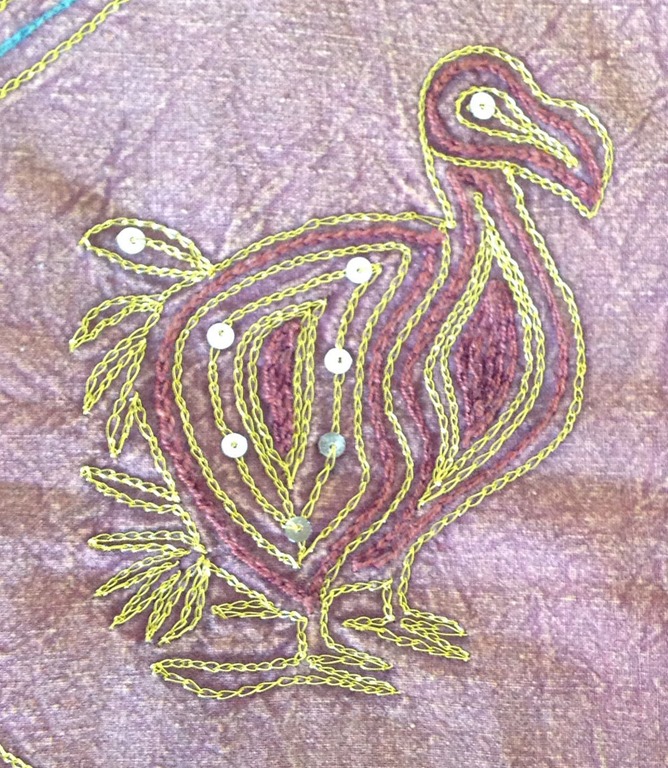
The pictures above look rather pinkish, but the actual background color is more dun than salmon or orchid. The dodos are worked in tambour-worked chain stitch in gold and brick, olive and mustard perle cotton on a double-thick cotton ground, then heavily washed. The sequins are affixed along the lines of the gold stitching. That along with the treatment of threads on the back clinches the working method for me.
I hope to mount this as a room divider curtain on a brass rod between our living room and dining room. Long ago there was just such a brass rod in that wide opening, and now I have something worthy of replacing it.
Long live the dodo!
 String-Or-Nothing