Those of you who are tuned into various historical embroidery info feeds may have seen a call go out a few weeks ago. Toni Buckby, a serious embroidery researcher and PhD candidate was looking for volunteer embroiderers to join a blackwork project that will lead to an exhibit at the Victoria and Albert Museum, plus provide fuel for her dissertation. I’ve long been a fan of Ms. Buckby, having first seen her work on the animated Wet Nuns music video “Why You So Cold?”. Her piece was one of the inspirations for my own static Memento Mori strip of dancing skeletons.
I am delighted to report that I raised my hand and was accepted. Obviously being a US resident, I’m not at liberty to attend the in-person workshops, but I hope to attend the project’s Zoom meetings.
Now for the specifics.
The project’s title is “An Unstitched Coif…” There will be an official website, but at the time of this post, it is still under construction. Ms. Buckby’s goal is to collect experiences, plus process info and images from the army of 140 volunteers. There will be both in-person workshops for folk resident in the UK who can attend face to face, and remote sessions for we further flung folk. At the conclusion of the effort the completed pieces will be displayed for a time at the Victoria & Albert. Those that are not kept by the museum will be returned to the stitchers.
What are we making?
Our own renditions of this coif (V&A accession number T.844-1974 in case the link breaks, image quoted from their website). The original shows evidence that someone indeed did begin working on it, but the threads of the stitching have been lost. I am really looking forward to Ms. Buckby’s forensic observations on the holes left behind.

The dimensions of the stitched area are approximately 44 x 25 cm (17 1/3 x 9 5/6 inch), and the project is to be completed by September. I will be working like a demon, for sure.
The instruction packet with a full size cartoon of the stitching design landed today. The workshops and zoom meetings begin in late April. I have ordered the linen recommended for folk interested in doing historically-inspired stitching. With luck it should be here next week. It’s moderately pricey, and shipping from Italy doubles the cost. Still, if I’m in for this, I’m gonna do it full on, although if the shipment is delayed I’ll have to find some other ultra-fine ground. Fingers are crossed. Still, I’ve always wanted an excuse to work on 70 count. Now I have a very good one.
As far as techniques and materials go, guidance is “use of historic Blackwork techniques is encouraged…but final choice of technique, colours, stitches in-fills and other embellishments are up entirely to you.”
I’m not sure exactly what I will do. Yet.
I need to see the ground and figure out whether or not countwork over 3 or 4 threads is feasible for me. I have experience working over 2×2 on muslin at that gauge (below), and based on that that I can say the effect of the fills is lost any further away than about six inches – they blur into indistinct gray scale notes. Three or 4 should be much more visually appealing. Plus, my eyes are no longer 25 years old.
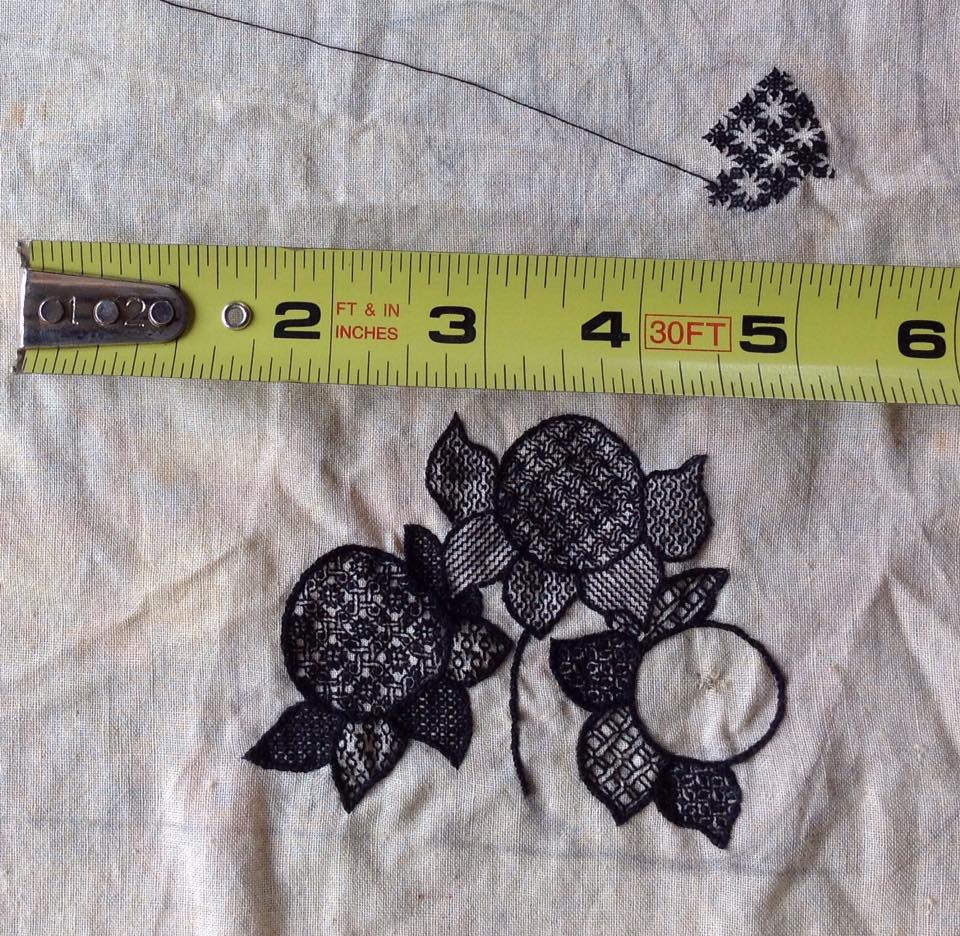
If countwork is precluded, I will use freehand fills and/or stippling: the other popular historical modalities for working blackwork foregrounds.
If I do go with black thread (highly likely), I will be experimenting with my stash of finer silks. They are thinner than cotton floss strands, and probably better suited for the finer ground, whether they are worked counted or freehand. I have two lots of black filament silk I have been saving for The Mythical Perfect Future Project. I think it’s their time. One lot is Allori Silk (from Tied to History). The other looks very similar but its provenance has been lost to the erosion of time. I also have a small quantity of the historical recipe spun silk hand dyed by my no-longer-stealthy stealth apprentice. It’s fine enough for this, and I would want to honor those efforts by including it in the piece. (Note that being small batch produced and very popular, it flicks in and out of availability, please don’t be disappointed if you hit the website and it’s not there. It’s worth waiting for.)
Depending on scale and stitch experimentation, I might also include passing gold stitch work on the stems. Possibly a narrower one like Elizabethan Twisted Chain from Carey’s Elizabethan Stitches. I have some Japanese #5 gold in my stash. It plus a few 2mm paillettes are left over from my Fishies piece. That one was done over 2×2 on 40 count, so over 4 x 4 on 70 count should visually present just a smidge larger. The paillettes are AWOL right now, but I think I can lay hands on them with a bit of searching.
And to round it out, I have a pair of magnifying goggles. Not optimal since I like to stitch and watch TV at the same time, but if visual acuity stands between me and completion, they WILL be deployed. I don’t remember where I got these though. Possibly a gift or hand-me-down from a pal. They’ve been sitting unused in my gear boxes for several years at least.

So there you have it. New project. I am bound by word and honor to complete. And I will.
 String-Or-Nothing
How exciting! Great to be involved in something of this scale.
Great news! I thought of you immediately when I read about this project.
What an exciting project!! Is it only being done as black work? It looks suspiciously like a pattern for a polychrome coif to me. I’m looking forward to your updates!! Go you amazing thing.
The project organizer requested historic-inspired blackwork, although it would be lovely as a polychrome piece.
Looks amazing. Would have loved to be involved. Sadly this is the first I have heard about this project. Wishing you the best of luck. I have brought a pattern for a blackwork coif recently, for a personal project. Will def be following your progress on this.
Okay, I’ll bite. How do you get the pattern if the site is not open yet? Also, what amount did you write in the box labeled “Qta” On Mani de Fata website? I just ordered linen from Italy, a batiste from Sotema and from Elisabetta Sforza…I think this is a Graziano 45 ct. They are both here. Somewhere.
The project has been in touch with all registered participants via email. Last week we received a welcome, the required authorization and release forms, and an early draft copy of the participant guidance. That included the source for the linen for those of us who are furnishing our own materials. This week’s communique to registrants included the pattern cartoon and further instructions.
I suspect the public site will be informational about the project, and updated with group progress for those not affiliated, but who are following along.
And after getting initial word last week, I ordered the smaller of the two offered quantities from the linen source. Advice was that it would be more than enough for the project. My order has shipped and I am hopeful that it will arrive sometime in the latter part of next week. There’s a lot of work to finish here between now and 1 September. I’ve got to get on it as quickly as I can.
Thank you.
[…] the Historic Embroidery Group in Facebook, and came across a link to this post by Kim Salazar: “An Unstitched Coif…” I was immediately fascinated and wanted to be a part of this exciting […]
70 threads per inch (29 threads per cm, per the Mani de Fati website). Of course I had to buy a meter of it to try. If you hear reports of a woman in Nevada who has quite happily gone blind while stitching, it’s me.
Happy to have corroborating testimony. Folk have disputed my reports. And in actual measurement, I’d guesstimate that it is really 72 x 74 threads. My square motifs come out just a tiny bit squished in one direction. Higher count is the weft.
While I won’t be stitching my Mani di Fata linen any time soon (first priority is my V&A inspired smock project, already underway), I can report back on the linen, and the 60 x 80 count Tied to History Linen Voile in comparison. The Mani di Fata is more substantial and more opaque. It will do splendidly for a coif. It does have more large slubs/joins/blobs/flaws, though. I just stitch away through those in any linen I’m using anyways. The Tied Through History linen voile is softer and more sheer, with fewer slubs/joins/blobs/flaws. It’s also a softer white compared to the Mani di Fata optical white. At this point, the Mani di Fata linen is in the lead for coif-making. Anything else will either be used for coifs, linings of said coifs, blackworked cuffs, bands and the like.
Next up: to buy pieces of the yet-to-arrive Tied to History 65 count even weave linen, and some of Burnley and Trowbridge’s Linen Lawn, as well as their (ramie) white voile (and other things I “need”–one can never have too many notions or too much linen fabric)
I don’t anticipate needing a magnifier for stitching, even counted thread work, on either. I just tear off my glasses (I’m horribly nearsighted) and very nearly stick my nose in the work. That gives me the best resolution I can obtain–fine enough to see bacterial colonies others can’t see in petri dishes, cells suspended in solution, and the finest of threads. Weirdly enough, I also see all of these things better in low, rather than normal or bright light. I can still hear my grandmother scolding me: “Turn on some light! You’ll go blind like that!”
Slubs are annoying but threads of varying thickness introduce an element of variety into the work that can camouflage any less than perfect stitches, and leaven what might otherwise be a too machine-like look . In that they are my friend.
I too have been extremely nearsighted and was able to stitch 70+ muslin without supplemental magnification in my 20s and 30s by taking off my glasses. I’m 67 now and still work up to about 54 tpi with just my normal bifocals. However I no longer have useful close vision uncorrected, in addition to being nearsighted and astigmatic. For the Mani, the magnifier is a necessity.
And thanks! Keep us posted on your experiments with high count linens. The info you are sharing is gold.
Just a tiny update: none of the other linens I ordered are nearly as nice or as dense as the Mani di Fati linen. I decided to use one of the other pieces of linen to make a veil/kerchief. It is much softer than the Mani di Fati linen, and I haven’t worked a thread count on it yet. That other piece is linen voile from Tied to History. It is definitely linen, but it’s not line linen. As I pull the threads to true the cloth, they break in a way that indicates it was spun from linen roving. It could still be European Linen, just not line linen from strick. It will be perfect for its intended use, but not coif-quality.
Thanks for the comparison between the Mani linen and the Tied to History fabric. I had wondered. There is enough left over from the coif to do other projects. Some of the early withdrawn work is on my list.
Kim, I just never put two and two together…until a few days ago. Now, I’m obsessed looking up information about this incredible project. You’ve posted about it over the months and I’ve been in awe of it (you are a hero-stitcher for me) but I just figured out what an awesome project this is! Thank you for being so generous with your posts, your experience, books, suggestions, advise and your stitching.