Once again discussions on Facebook have brought a portrait to my attention. Elspeth over at Elizabethan Costume has found something I’ve been seeking for a long time. An portrait of an individual with a Spanish name, with a sitter that is wearing what we would describe as blackwork.
While 19th and 20th century discussions of blackwork in the Tudor period often call it Spanish Blackwork, and offer “Spanish Stitch” as another name for double running. But there are very few portraits of Iberian individuals wearing it, as one might think there would be if the folk attribution of Catherine of Aragon’s introduction of a style already popular in her homeland was to be corroborated. This portrait, dated 1530-1532 is by Jan Gossaert, and is part of the J. Paul Getty Museum’s collection, accession 88.PB.43. It depicts Francisco de los Cobos y Molina, who served in Charles V’s Holy Roman Empire court as a trusted secretary and advisor. The Morgan Library and Museum notes the absolute identification of the sitter. Note that shortly after this was painted, Catherine far away in her English court was only a year away from Henry’s declaration that their marriage was invalid (1533) and her subsequent sequestration.
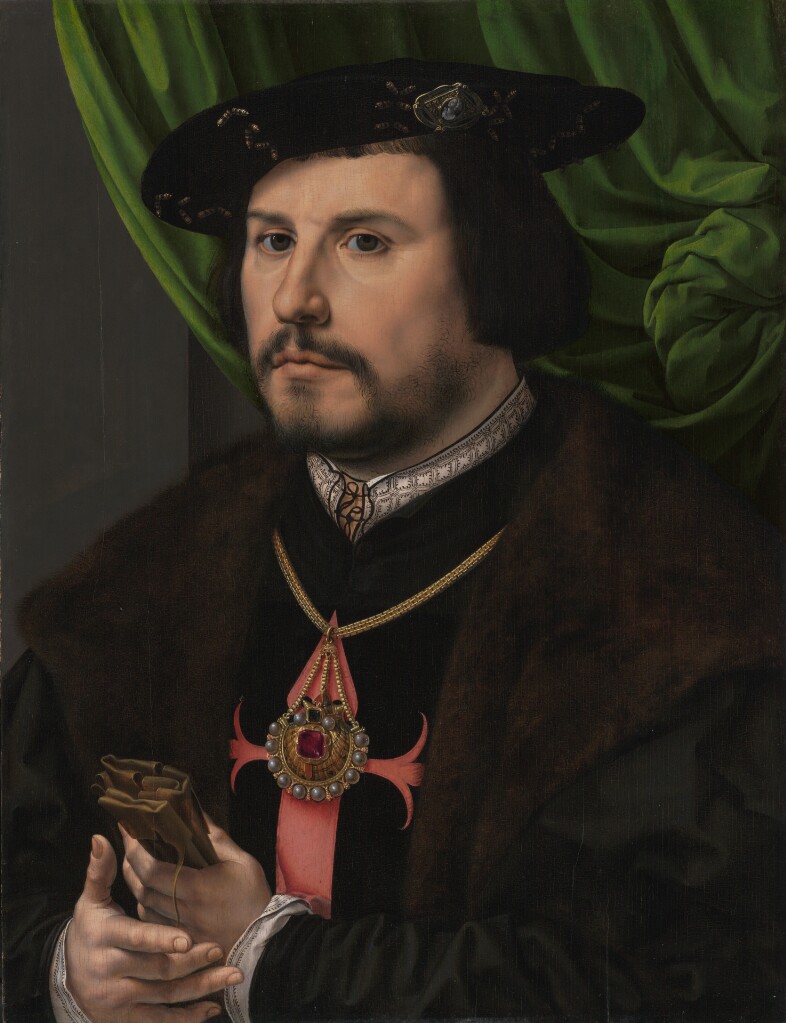
There are higher resolution pictures at the museum link, above.
To say thank you to Elspeth and to spread my joy in finding a heretofore unknown bit of delight, I share a graph for that collar.
Click here for a full size downloadable PDF of the pattern below.

Now. How “authentic” is my representation?
I’d say it’s no more than an honest representation. Remember that the original I am working from is a painting. The painter did his best to capture the alignment of the verticals with the horizontal interfaces, but he fudged almost all of them. What I’ve done is to show the design elements in as close to the original proportions as I could manage, with the correct number of “pips” inside the boxes formed by the repeat, and represent as well as I could the marching row of them more or less evenly spaced across the top edge of the collar band. Like the painter, I have fudged the geometry of the thing to make it fit. And of course the nature of those pips is open to interpretation. Little hoof-like triangles? A three pronged fork, bent to one side? Should the ones in the square be closer to each other than I show? Should the middle one of each box side be taller? All of these would be as valid as what I show. After all, a tiny blob of paint can be seen in many ways.
I will be adding this pattern to the Embroidery Patterns page here at String, so it can be easily found in the future. If you choose to try out this design, please feel free to share a photo. I do so enjoy seeing what mischief these doodles attempt out there in the wide, wide world.
 String-Or-Nothing
A lovely elegant design – thank you! Comparing your chart with the hi-res of the painting puts me in (even greater) awe of your skills in drafting and interpreting such sources.
Whether exactly what the gentleman wore or not, I do like your version.
Do we know where this idea that Catherine of Aragon brought blackwork with her originated?
No clue. It appears in print in various Victorian era writings on the history of needlework, and is still being parroted today. Since the highly romantic authors of those early books do not cite sources, tracing it back further is problematic. I do note that Tudor inventories and wills do specify pieces worked in Spanish Stitch, which is a name associated with double running, but there isn’t a smoking gun that says anything more than the rise in popularity of the style coincided with Catherine’s early years in the court. Which is why looking for actual representations of the style in Iberian portraits or writings that pre-date her arrival is such a magical quest.
Since the edging/ties on the shirt are undoubtedly black, what color do you think the other embroidery actually was? Great interpretation by the way.
I can tell you from experience that thread dyed black with historical iron and tannin dyes can have a brownish overtone that sometimes blooms if the dye is uneven, or after washing. And the pigments used in paintings also mutate over time. Especially in thin/narrow brushed spots. So was the stitching done in black? I would say “Yes, for certain local and temporal versions of black.”
Part 2. Enlarging the Getty webpage, all the embroidery does appear black but the brush strokes are so fine they appear grey.
[…] A Spanish Gentleman’s Collar. An actual example of Spanish blackwork. Redacted from a portrait. (An easy downloadable PDF is also on the Embroidery Patterns tab). […]