I’ve finally figured out what to stitch!
Two years ago Friend Merlyn and I went to the Boston Museum of Fine Arts, and saw an exhibit that featured (among other things) this Italian masterwork.

It’s described as a towel done in Punto Scritto and Punto a Spina Pesce MFA Accession 83.242, Italian, 16th century, silks on linen. In terms of size, this piece is big enough to be a table spread to seat eight, much bigger than anything I’d think of as a bath towel.
These stitch terms are used in MFA descriptions, but not many other places, and probably haven’t been updated since the initial acquisition and accession in 1883. Punto Scritto is clearly double running stitch. Punto a Spina Pesce (as far as I can figure) appears to be what we would call a form of long armed cross stitch (LACS) because the stitches that form each adjacent unit employ the same insertion/emergence spots, although modern stitches using that Italian name appear to spread the entry/exit points out, like herringbone stitch. I also note that the directionality of the individual stitch units as it rounds corners makes me think that execution was most like the Montenegrin stitch variant of LACS (more on this below).
I shared several photos of this at the time of our visit. And I put it on my list for redaction. Well, now is that time. I’m going to chart this one up, and then use the designs on a MUCH smaller cloth of my own. And as I look closer at this one, I think I will try to use a similar range of colors (but in cotton for washability), and the stitches I think look the closest to those of the original. At least on the front. I don’t see any photos of the back on the museum page in order to make totally accurate identifications, and am not impelled to write to request any. One thing I did note is that for the solid filled areas, the tightly pulled two-sided cross stitch variant I call Meshy was used. That isn’t credited on the museum page.
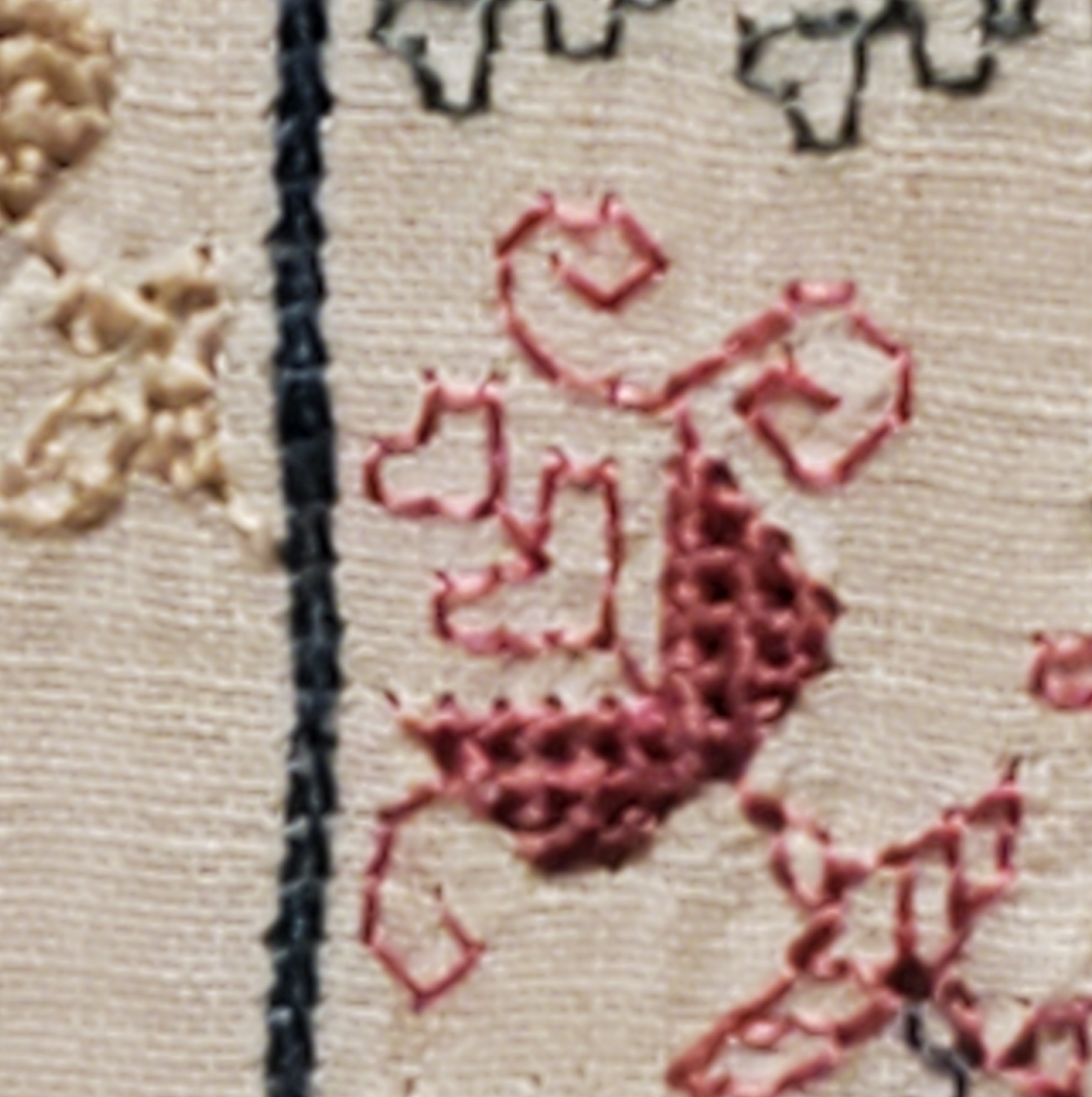

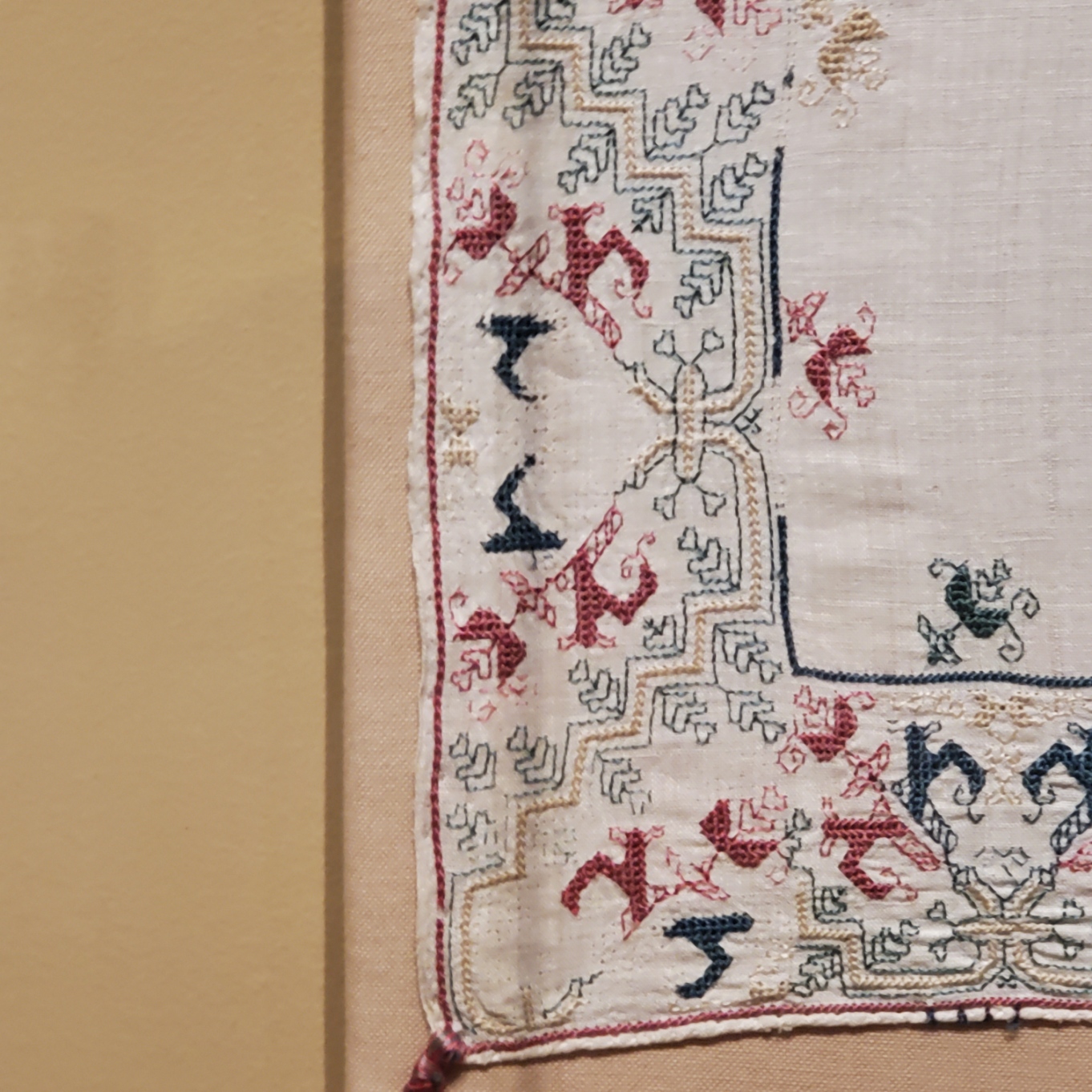
Another thing my close-ups show is that the piece was stitched over squares of four by four threads. There appear to be quite a few mis-hits and subsequent corrections where four by three or three by three threads were covered. This seems to pop up mostly in the curly bits that spring off the lily like flowers. I don’t know the actual count of the ground, and obviously couldn’t get up close enough to take a dimensioned photo, but I think that 2×2 on my 40 count linen will look close to the scale of the original.
Given that the Meshy and double running stitch bits can be done truly double sided, I have to think further on the use of something in the LACS family that is presentable on both sides. I’ll probably settle on Montenegrin. Both front and back of that are presentable, although the front does feature an additional vertical bar. It’s hard to make out on the photos, but some of the solid lines, especially the dark green ones that run the length and width of the piece do seem to sport a bar in places. But the deep yellow bits that run inside the motifs, don’t. Maybe the stitcher, noting the difference between the appearance of the two sides of the stitch chose to use the more open “reverse” on the front for the yellow bits, and what we consider the front of the stitch’s more solid effect for the framing lines. Fortunately, I have both practice with the stitch plus Amy Mitten’s excellent flip book on executing Montenegrin, covering all possible directional angles, so the transitions in this design will be easy, even upside down.
Now off to chart, and once the main motifs are captured, figure out how to compose them into a viable “small snapshot” piece on my 19 x 27 inch (48.26 x 68.58 cm) cut of linen.
 String-Or-Nothing
A lovely piece. The colours work together so beautifully in the original.
I’m always amazed that you and the historic stitchers are able to work the meshy ground without pulling the rest of the fabric hopelessly out of shape. Yes, you do have instructions in SCM but I haven’t yet plucked up the courage/will to try it.
Oh, splendid!
[…] I am sticking with a project inspired by the big Italian towel/cover in my last post. I’m working it on a much smaller piece – a quotation rather than a full reproduction. […]