CHALLENGED!
UPDATE: The graph below is available at the Embroidery Patterns link above, in easy to print PDF full page format.
The gauntlet was thrown. I was challenged to produce a chart for The Flying Spaghetti Monster, in all his noodly glory. At the risk of destroying any crumbs of credibility I might have as researcher, I respond.

Hah!
MORE INSPIRATION FROM HISTORICAL SOURCES
Once more I go web-wandering, looking for counted thread inspiration from around 1500 through 1620 or so. This time I present some lesser known examples of counted stitching.
What I really wanted to find were examples of household linens – towels, sheets, pillows or other bedding, cushions, tablecloths, and the like. You’d think with all those innumerable domestic scenes so common in iconography there’d be some. So I looked for Annunciations, domestic scenes of the infant or young Jesus, plus other Bible and Saint’s lives scenes or parables; and tableaus from mythology. Anything that might show a made-up bed, a dining table, someone drying off, or someone getting dressed.
Given the popularity of counted edging patterns and huge number of household linen artifacts in museum collections, one would think these items would be common in paintings and prints. But they’re not. Perhaps the detail of these patterns was too tedious for most artists to attempt to reproduce. And it’s possible that for some of the religious art, the absence of decorated linen is of meaning. Lives of humility might not be graced by otherwise ubiquitous domestic embroidery, and it’s possible that the audience for these paintings noticed the omission. But I leave such interpretations to art historians. (I’m sure there’s more than one dissertation out there on household contents shown in classic religious art scenes.) Here is what I found in my troll of the Web Gallery of Art.
Domestic linen:
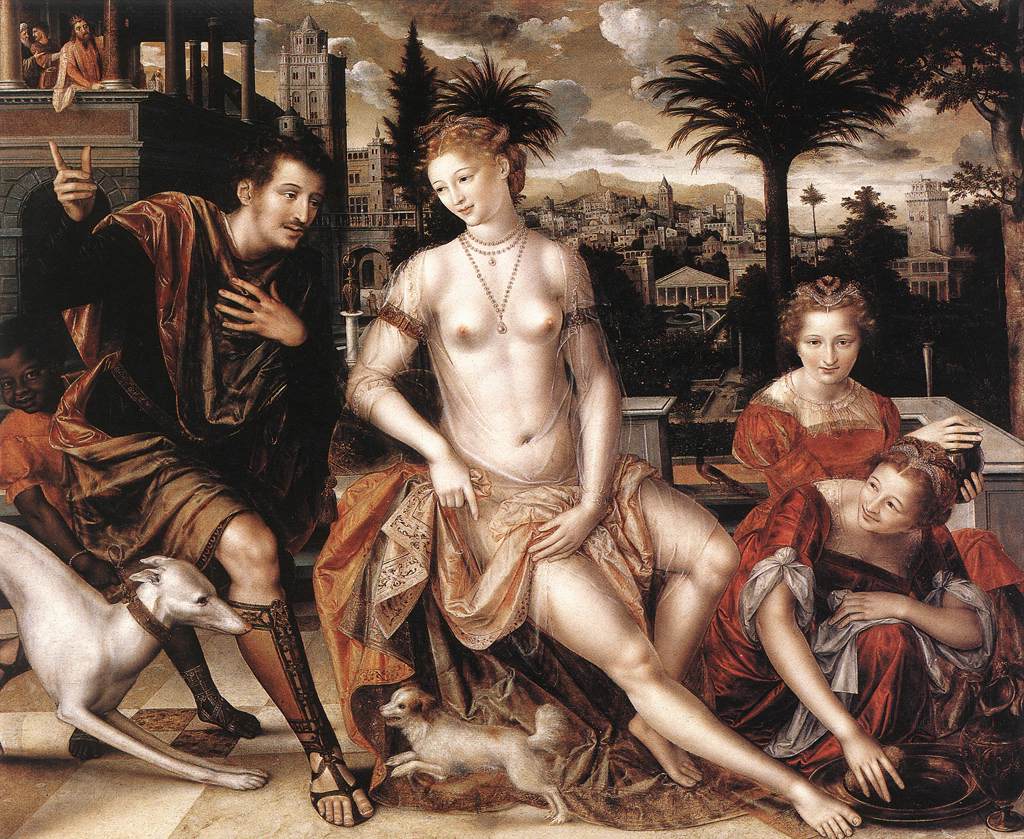
Here’s a nifty Bathsheba, she’s bathing, unaware of the peeping King David. She’s wrapped in either sheets or towels – some of which have elaborate embroidered red trim, with just enough detail to make out that the designs are regular enough to be counted. Although this work is undated in the collection, Jan Masseys other paintings are dated from 1550s and 1560s:
http://www.wga.hu/art/m/massys/jan/bathsheb.jpg
Masseys had a thing for David with Bathseba in disarray. Here’s another with towels or linens, although the detail is a bit more ambiguous that the last. This one is from 1562:
http://www.wga.hu/art/m/massys/jan/david_ba.jpg
And the barest hint of a bit of blackwork on a napkin from a Last Supper painted by Jacopo Bassano in 1546:
http://www.wga.hu/html/b/bassano/jacopo/1/08lastsx.html
A painting by Carvaggio – Supper at Emmaus, 1601. This one looks like it may be a table carpet, upon which a plain white cloth is spread. Even so, the pattern on the carpet is interesting:
http://www.wga.hu/html/c/caravagg/06/35emmau.html
This is by the same artist and same subject the one above, but is a later work (1606). The table cover under the white cloth looks a lot more like a voided pattern stitched on linen:
http://www.wga.hu/html/c/caravagg/08/47emmau.html
Bath linen(?) in lower right corner, edged with geometric. Master of the Fountainebleau School, Diana at the Bath, around 1590:
http://www.wga.hu/html/m/master/fontaine/diana.html
An embroidered pillow with a dainty counted edging along the seams, in Ambrogio Bergognone’s Madonna del Velo, from the 1500s:
http://www.wga.hu/html/b/bergogno/virgin_v.html
Personal linen:
Lots more of these in portraits, although not every painter took the time to do more than indicate the presence of intricate patterns. Certainly not with the graph-able precision of the famous Holbein Anna Meyer portrait on his Darmstadt Madonna panel. Still, detail on scale, placement, and colors can be harvested from these pix. Also I do note that while outer garment styles change and vary from region to region, and placement of the embroidery varies from piece to piece, the styles of the borders patterns and edgings used on chemises and shirts remains surprisingly stable across time and geography.
Black wide geometric stitching on chemise’s high collar neck band. Also edging embroidered on cloth worn as a turban style hat. Carvaggio, The Fortune Teller (detail) 1596-1597
http://www.wga.hu/html/c/caravagg/02/11fortu2.html
Geometrics on man’s wing-style collar. Portrait of Henri II, 1547:
http://www.wga.hu/html/c/clouet/francois/henri2.html
Chemise heavily embroidered in black, but probably not counted. Hans Eworth, Portrait of Lady Dacre, 1540
http://www.wga.hu/html/e/eworth/l_dacre.html
Geometric stitching in red on narrow high collar. Catarina va Hemessen, Self Portrait, 1548:
http://www.wga.hu/html/h/hemessen/caterina/selfport.html
Wide man’s collar and cuffs, in geometric patterns with center panel and complimenting narrow edging bands, worked in red on white linen. Giovanni Battista Moroni, Portrait of Don Gabriel de la Cueva, later Duke of Albuquerque, 1560:
http://www.wga.hu/html/m/moroni/portduke.html
Woman’s chemise with broad center panel and collar band, in black on white linen. Peter Bourbus, Portrait of Jacquemyne Buuck, 1551:
http://www.wga.hu/html/p/pourbus/pieter/portrai2.html
Narrow geometric band at top edge of woman’s low chemise (also may be detail in red on hat). Vittore Carpaccio, Portrait of Young Woman (artist dates are 1472-1526)
http://www.wga.hu/html/c/carpacci/5/021woman.html
Boy’s shirt – narrow collar band, voided in black on white. Jean Clouet, Dauphin Francois. (Artist dates are 1485-1541)
http://www.wga.hu/html/c/clouet/jean/dauphin.html
Man’s shirt – narrow panels with black on white geometric stitching, divided by heavier narrow strips of gold or yellow silk embroidery. Lucas (the Elder) Cranach, Portrait Diptych(detail). 1509:
http://www.wga.hu/html/c/cranach/lucas_e/11/05dipty2.html
Man’s shirt- narrow panels parallel to center front slit. geometric black on white. Lucas (the Elder) Cranach, Portrait of a Clean-Shaven Young Man, 1522
http://www.wga.hu/html/c/cranach/lucas_e/12/03young1.html
Man’s shirt – horizonal panel of either two color stitchery, or one color on brown, appliqued over narrow cartridge pleats to keep them in place. Albrecht Durer, Self Portrait at 26, 1498:
http://www.wga.hu/html/d/durer/1/02/05self26.html
Woman’s chemise, with small black edging allt he way around. Martha and Mary Magdalene, 1596 by Carvaggio:
http://www.wga.hu/html/c/caravagg/02/16martha.html
Another scoop neck chemise in the same style of the one above. St. Catherine of Alexandria, 1598 also by Carvaggio:
http://www.wga.hu/html/c/caravagg/02/15cather.html
A different style of higher neck chemise, this one decorated by wide double bands down the center, plus a band around the neck, and narrow strips of stitching, possibly
on seams. From Portrait of the Artist’s Sisters Playing Chess, by Sofonisba Anguissola, 1555:
http://www.wga.hu/html/a/anguisso/sofonisb/chess.html
A man’s high-neck shirt this time, with a wide band of black geometrics on white. Portrait of a Man, dated 1520-25 by Girolamo Romanino:
http://www.wga.hu/html/r/romanino/manportr.html
Edging on a veil, black on very fine, almost transparent linen. Not too many paintings that show stitched veils! Portrait of Martha Thannstetter (nee Werusin), dated 1515 by Bernhard Strigel
http://www.wga.hu/html/s/strigel/bernhard/portrai2.html
Another stitched veil – this one in multicolors, and possibly dual sided work. Andrea Previtali’s Madonna Baglioni, 1515-1520:
http://www.wga.hu/html/p/prevital/baglioni.html
Multicolor bands on boy’s shirts, done in a style that looks counted to me. Bernhard Strigel’s Portrait of the Cuspinian Family, 1520:
http://www.wga.hu/html/s/strigel/bernhard/cuspinia.html
Voided work edging around a neckline, in black. (Reminds me of the bit at the far right of my current piece). Sanzio Raffaello’s angel – a fragment of the Baronici Altarpiece, from 1500-01:
http://www.wga.hu/html/r/raphael/1early/02baron2.html
Two different narrow edging patterns, both in black, both very simple and easy to duplicate right from the portrait. Sanzio Raffaelo’s Portrait of a Woman (La Muta) from 1507:
http://www.wga.hu/html/r/raphael/2firenze/2/36lamuta.html
Raffaello was very good at clearly depicting intricate stitching. I really like this St. Sebastian (1501-1502) – the tshirt elaborately embroidered in yellow (gold?) with little black cross stitches is clear enough to chart:
http://www.wga.hu/frames-e.html?/html/r/raphael/1early/01sebast.html
Very clearly counted work – a man’s shirt with a wide, heavy two-tone neckband. It looks applied to the shirting underneath to me. Hans Maler’s Portrait of Moritz Welzer von Eberstein, from 1524:
http://www.wga.hu/html/m/maler/welzer1.html
And a lady with a high multicolor stitched collar. This looks like highly embossed stitching to me, not jewelry. And regular enough to make me think that the underlying cartoon was worked on the count, with the embossed stitching done over the cartoon. I have no basis for this opinion other than observation, so feel free to disagree. Willem Key’s Portrait of a Lady, undated, but the artist lived from 1515 to 1568:
http://www.wga.hu/html/k/key/willem/portlady.html
A particularly good view of upper body construction of a woman’s chemise, embroidery framing center slit, following around the collar and radiating out from it. In this case, with one single pattern maintained uniformly throughout. Black on white. Bernardino Luini’s Salome from 1527-1531:
http://www.wga.hu/html/l/luini/father/2/salome1.html
Another killer high neckband on a man’s shirt. Again multicolor with red and yellow (gold?), worked on the count. Jan Gossaert’s A Noble Man dated 1525-1528:
http://www.wga.hu/html/g/gossaert/2/baudouin.html
and finally
Ambrogio de Predis’ Portrait of a Man, from 1500. The pattern on his sleeves is in the forthcoming collection of blackwork filling patterns:
http://www.wga.hu/html/p/predis/portra_m.html
I have references to at least as many again pix as are presented above. Let me know if you’d like me to share them too.
DANCING PIRATE OCTOPODES
As you can see, the narrow scrolling border I used mirrored to fill in the empty area is only a few stitches shy of completion:

The eagle-eyed will note two small omissions I have to go back and complete. I blame working on the thing while watching a subtitled movie.
In other news, the PDF of the book of filling patterns is complete. I hope to post it here some time in the next week or so as I iron out some technical difficulties in posting a 10M file. I present the cover as a teaser:

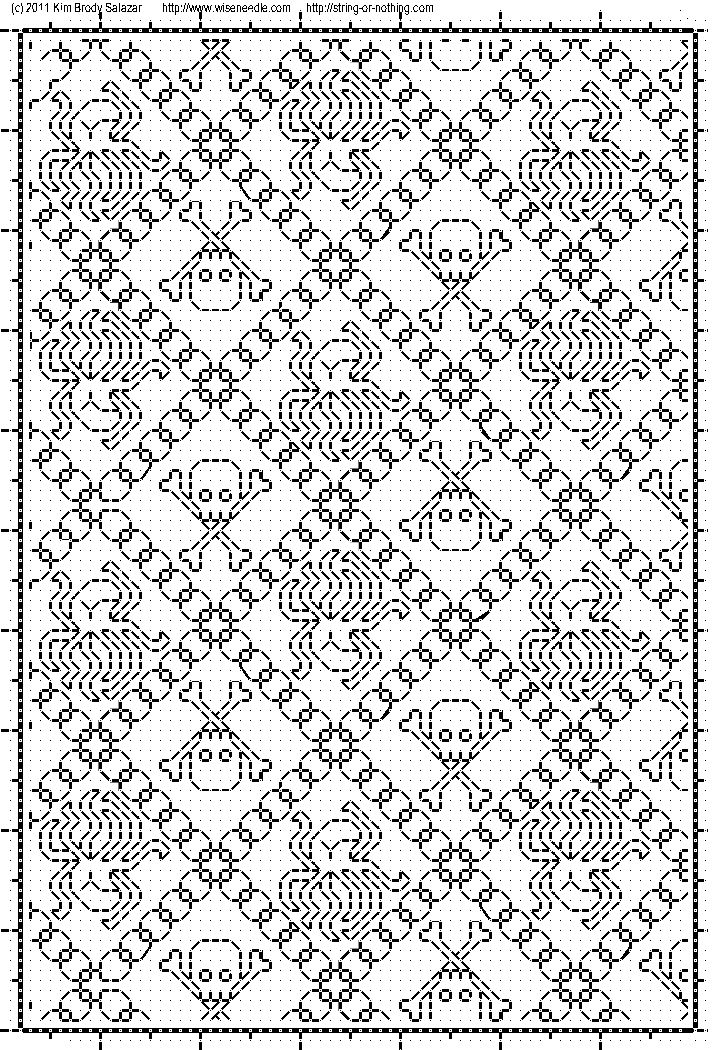
Also – and just for fun – I present a pattern that did NOT make it into the filling book or the upcoming TNCM2. This one was done up as a silly present with several constituencies in mind – my eldest, who wanted more pirate skulls; a co-worker who cherishes the octopus as his totem beast; and my youngest, who has embarked on a world-wide quest for greater acceptance of “octopodes” as the proper plural when more than one cephalopod is sighted. (click on chart below for full size copy).
SHOEHORNING
As you can see, I’ve finished out the dark, narrow strip on the right of the oak leaves. (I put a US penny on the frame for scale.)

It was a quick one, especially compared to the extra wide bands of long-armed cross stitch I’ve been working since March.

I like this design quite a bit, and I think it would be an exceptional choice for the top edge of a chemise (undergown), just barely peeking out at the neckline, as in Bronzino’s famous portrait of Eleanora of Toledo. Eleanora had a killer wardrobe and sat for many paintings. I’m hard pressed to choose a favorite because each one is spectacular. (Thanks to the Elizabethan Portraits website for collecting these links.)
Now I’m filling in the strip on the left. You can’t make out the design here, but it’s already clear that I’m mirroring along a horizontal axis.
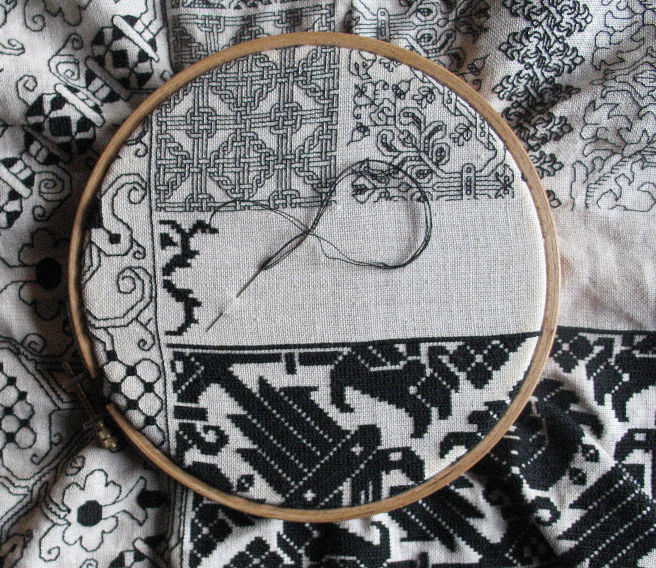
Now, how did I know to leave enough room for these strips? I didn’t. I’m building this piece as I go, with little or no forethought on pattern choice other than a general idea of where darker and lighter strips should go. I still don’t know which way is up. To date all of the designs are non-directional, with neither up nor down. That will change soon. I’d like to include some patterns that feature mythical beasts, but I haven’t chosen them yet, and I haven’t figured out where they will go. But my fave beast strips are not up-down agnostic, so once I’ve picked one and stitched it, my up/down decision will be final.
Back to shoehorning designs in. To fill in these odd spaces, the first thing I had to do was to determine their width. Easy. I counted the stitches available in the target space. That’s design height, not length. I am not going to worry about centering these fill-in strips left-right. The just-finished area turned out to be 26 stitches tall. I had the center double bud design in the upcoming book. I also had a different pattern that used the little wiggle ancillary frame. I decided to use them together. However, each wiggle in its original form is 6 units tall. The center strip was 16 units tall – 28 stitches. Too many. I decided on a gambit often used in these period strips when borders are married to a main design. I stripped out a solid row of stitches between the wiggle and the main pattern but kept it at the outermost edges. This reduced the count to my target. An easy fix.
For this current strip, I’ve got a space that’s 27 stitches tall. But I don’t want to do another dark strip here. Something a bit less dense is in order. So instead of looking for (or drafting up) a single 27-stitch-tall pattern, I decided to take a 13 stitch tall meander from my first book and mirror it. (TNCM Plate 27:3). I’ll write more about this one as more stitching gets done. Mirroring in this manner is another perfectly common way 16th and 17th century stitchers used to to build wider repeats from narrower ones. I may play a bit though. There are a couple of bits where I could work in a gratuitous interlace to join the two mirrored repeats. We’ll see if that happens as I go along.
The blackwork fillings book…
I haven’t forgotten. I’m putting the finishing touches on it right now. I’ve asked some native Italian speakers for advice on the proper form for the name. Some say that Ensamplario Atlantio is the correct form. Others say it should be Ensamplario Atlantico. I’m leaning towards the former because the latter looks to be a form of Atlantic, not Altantia, and the book isn’t going to be named after the ocean. If you’re knowledgeable on proper Italian (especially Renaissance Italian), please feel free to chime in. It’s now up to 35 plates of designs, plus five pages of intro material. Ten of those pattern pages have NOT been previously posted here. So even if you’ve been downloading over the winter, there are ample new goodies for you in the final collection.
PROGRESS TOWARDS NORMALCY
Steady progress on the latest strip:

Now that life is beginning to get back to normal (or what passes for normal in this house) I can also report progress on the book front(s).
First, on the PDF collection of blackwork filling patterns, to be named Ensamplio Atlantaea, I apologize for the delay. This one will include all of the filling patterns published here over this winter past. And as an extra bonus for everyone’s patience, I will toss in several more pages of additional patterns, not seen here before. It will be free, and will be available for download here at this site. Right now I have 27 pages of patterns (the original 150, plus a dozen more), and hope to make it an even 30. Plus cover and some sort of intro essay. It will NOT include free drawn outline patterns for use with these fillings, nor will it include detailed working methods, although I may abstract some of the double running stitch guidance previously posted here. I hope to have this one up and ready sometime in the coming month.
On the big book – my sequel, to be named A Second Carolingian Modelbook: More Counted Patterns from Historical Sources, I’ve got about 45 pages of patterns drafted out in whole or in part. Each pattern has annotation, noting its origin artifact or source, or if it’s one of the few originals, that attribution. That’s about 100 individual patterns, some of which are main strip plus accompanying border. I also have all over patterns suitable for cushions and body linen, narrow strips for cuffs and collars or seam decoration, and wide pieces that would make nifty tablecloth, sheet or towel borders. Right now about 2/3 of the patterns are for double running stitch, although there are some that are good for Italian two-sided cross stitch, long armed cross stitch, lacis, or other square-unit styles. There are also quite a few that were worked voided, some with straight or double running stitch defining the foreground from the background, and some not. Working methods/colors of the originals are also described, and full sources are provided for all graphs, so stitchers can look them up. I do not anticipate finishing this one any time soon. Feedback is that readers want essays on techniques, materials, and methods of employ. All that will take time. As will figuring out how to do the actual publication. (Right now an on demand service like Lulu or one of its competitors looks most likely). This book will not be free, but I am hoping to keep it affordable.
And in other news, it’s the beginning of Birthday Season here at String. A much recuperated Smaller Daughter celebrated her 13th last Saturday, mostly by laughing with evil intent at the thought that others had decided that her becoming a teen was the cause of the end-of-the-world predictions for that date. Larger Daughter is now back from college for the summer, and celebrates mid-week. I note the passing of yet another anniversary of my 21st birthday at the end of this month. Today’s home-cooked lobster feast was in recognition of all three fetes. The Resident Male, the odd man out in so many respects, does not have to share his natal day with adjoining festivities. We will recognize that occasion later in the summer.
INCHING ALONG
Thanks to everyone who sent get well wishes to Younger Daughter. I can report that each day she feels a bit better, but it will take a while.
This weekend’s kid recuperation gave me ample time to work on my stitching:
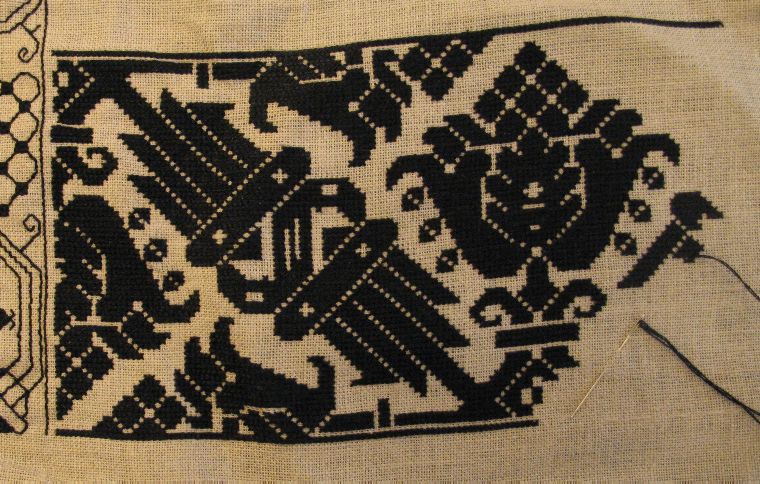
I’ve got the repeat established now, and all mistakes have been corrected. Now it’s just a matter of finishing out this strip.
MORAL OF THE STORY…
“Don’t burst your appendix if you can avoid it.”
Younger Daughter is back home, after 19 days at Children’s Hospital in Boston. She’s still got a way to go before she’s school-ready, but she’s happy to be home with quiet, limited interruptions, and familiar food. Thanks to everyone who sent get well wishes!
I’d like to especially thank the staff at Children’s, not all of whose names I caught. They’re a very caring bunch, and did all they could to make the kid better and more comfortable. Here’s her much cherished souvenir – a little squeezy ball they gave to Morgan to exercise her fingers.
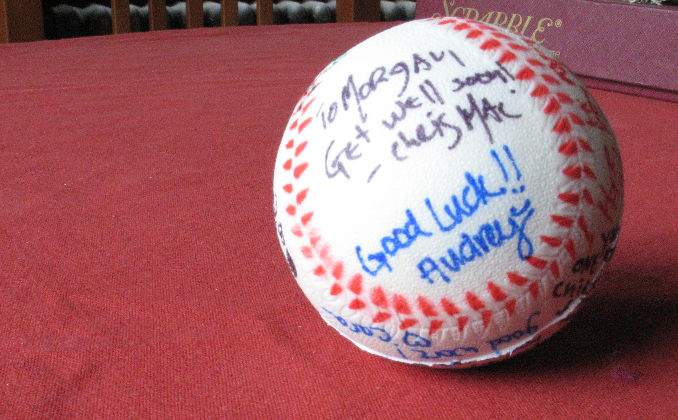
We asked the nursing staff we were assigned to, to autograph our “game ball.” We managed to get most but not all of them. Special thanks to Chris Mac, Sharon, Michelle, Josh, Maria, The Original Chris, Meredith, Rachelle, Caitlin, Paola, Cleanne, Cara, Audrey, Dr. Arnold, Dr. Hamilton, all of the residents on 10NW, and all of the other folk whose names slipped me by when I was in a sleep-deprived fog. The kids still has to go back to have the tatters of her appendix excised, but that’s a one day bit, not another extended stay.
As you can see, while we were there I had lots of time to stitch. I finished out the oak leaves and acorns at the right, and started another band at the left. That one is very dense, in long armed cross stitch, so it’s not exactly zipping along. Also stitching when sleepy led to tons of mistakes and ripping back, so what’s here is probably only about half of what I actually stitched.

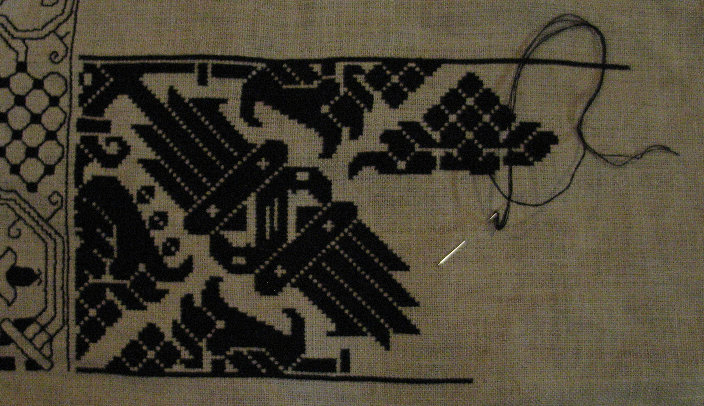
Even with all of the rework, stitching was a much needed self-administered sedative while I was being a bedside mom.
The plan is to make this strip the same length as the oak leaves. Eventually I’ll either find or noodle out an even denser band for the narrow area immediately to the right of the oak leaves, and a less dense but similarly black band to put between the current strip and the established horizontal bands. I might take a break from dense work for a while though, and opt to work something in double running elsewhere on the piece before attempting those two strips. There’s tons more room both north and south of these.
One thing to note. So far, all of the finished strips are bi-directional. At this point there is no up or down on my sampler. Either end could be at the top. I could even opt to finish this out in landscape rather than portrait orientation. Jury is still out on what I will do, but I do have a couple of strips I’d like to include that are figural, with clearly defined ups and downs. Stay tuned to see how I work them in.
WHERE’S STRING?
Here but on brief hiatus.
Younger daughter and her appendix are not on speaking terms right now. The three of us have been resident at Children’s Hospital in Boston since the 14th. She’s on the mend, but slowly.
I’ve been occupying some nap hours to stitch, and progress on the blackwork sampler will be posted when I’m back at String Central, equipped with the proper cameras and software. In the mean time, feel free to explore past posts via the Categories list at the right.
MY VEGETABLE LOVE…
…should grow. Vaster than empires and more slow.
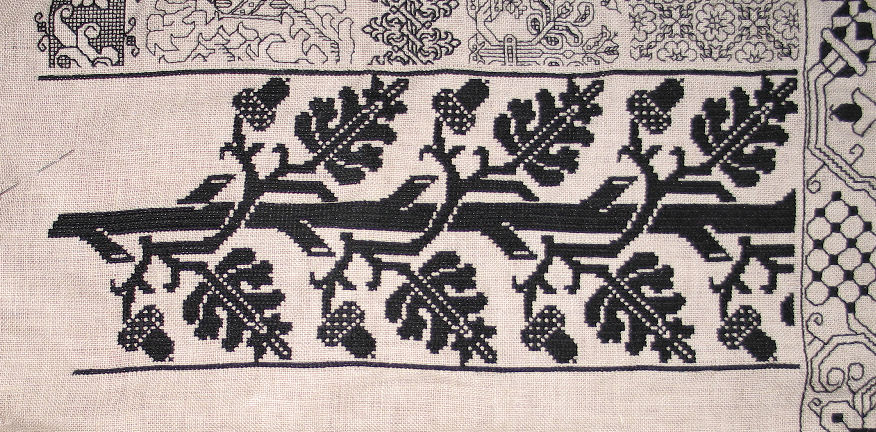
This week’s progress is brought to us by an in-Barony performance of Shakespeare’s Measure for Measure, enacted by The Baron’s Players. The troupe is made up largely of friends, and the performance was quite enjoyable, played as a farce it had some laugh-out-loud moments. And as I watched, listened, and laughed, I stitched. This is not considered a faux pas in the SCA, where diligent quiet needlework is an acceptable audience activity, provided the attendee is not so absorbed in it as to be insensible or unappreciative of the performance.
Here you see a sideways view of the accumulated stitchery to date, so you can get an idea of scale and placement:

One more full leaf, plus an acorn sprig and part of a second, and I’ll be done with this strip and on to the next.
To Adelle, sorry to disappoint. I won’t be drafting this project up as a kit and selling it, but all of the designs in it will figure in my forthcoming book.
For those of you who follow such things, barring major crises – I have every intention of being at the Carolingian 40th anniversary at the end of the month, where I will be part of the “dim memories from the ancient past” contingent. I will be wearing my dress with the blackwork underskirt, and in all probability will be seated somewhere comfy where I can watch the fighters and embroider. Stop by and say hello.

LEAF BY LEAF
This week’s progress largely brought to you courtesy of a kid orthodontist appointment. The removal of Younger Daughter’s braces was good for a leaf and a half:
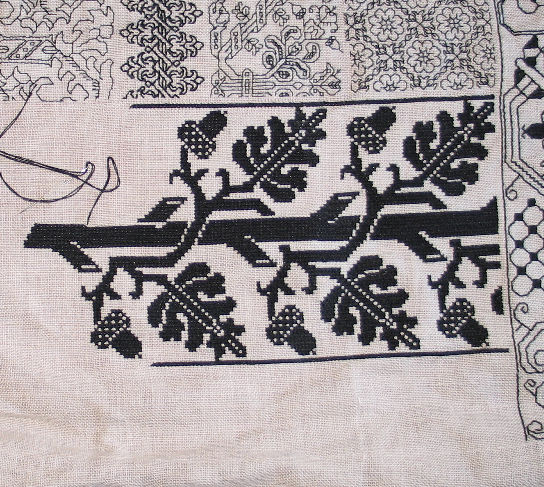
In the photo above you can see the room left for the next narrow band. It’s going to be darker than this one. But what to put there hasn’t been decided on yet.
On the SCA side, I will be at the 40th anniversary of the Barony of Carolingia later this month, where I will be part of the “Long Forgotten Artifacts of Elder Days” contingent. Provided I can rustle up a dress.
 String-Or-Nothing