PLEASE, MAKE IT STOP.
I think we’ve had about enough snow this winter…


WHAT MAKES A BLACKWORK PATTERN DIFFICULT?
Yaay! The first evidence of a project using fillings from my blackwork filling collection!
Kathy of Unbroken Thread is posting a series about her current blackwork project, a hearts and flowers theme. You can find her full archive of blackwork related posts here, including a nice piece on the minutae of setting up a project (something I habitually gloss over). Kudos to her! If you are working something using these patterns, I’d love to hear about it, and even to see it. If you give me permission I’ll post a photo of your piece in my gallery of stuff worked using my knitting and embroidery patterns.
Kathy’s latest post, referenced above, describes a mis-count and the subsequent unpicking. Her post made me think about what makes a specific pattern written for double running stitch (aka Spanish Stitch, punto scritto, Holbein Stitch) difficult to do.
Now some people say that large patterns are harder to stitch than small ones. That patterns like those on my current sampler are difficult. I say they’re not especially harder than small patterns. Accomplishing them is a matter of care and perseverence, but a the size of a large pattern doesn’t automatically make it difficult. To me, three things make a pattern difficult to stitch, the type of repeat, length of unadorned runs over bare ground, and the presence of off-count elements.
Eccentric “knight’s move” (multiple of X units over, X units up) type repeats require more attention on my part than do straight symmetrical repeats. Here’s a “knight’s move” repeat next to a symmetrical one:
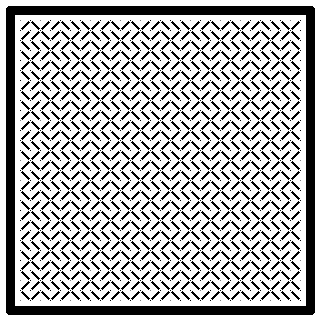
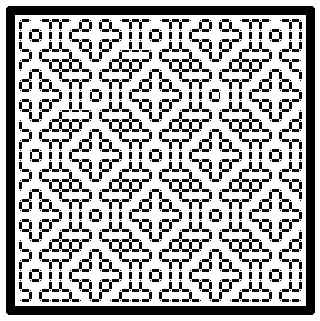
The one on the left is a very simple pattern with a relatively simple skew, but even so, takes me far more concentration to work than does the seemingly more complex symmetrical pattern on the right.
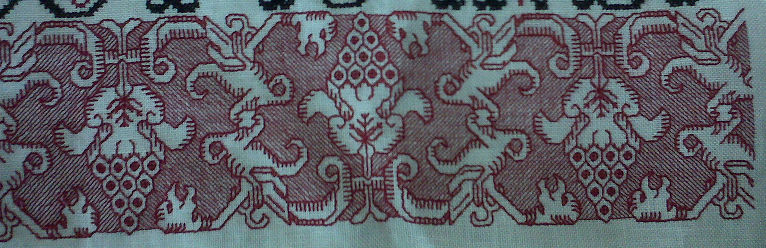
I also find that long runs of straight stitches over bare ground – especially over diagonals – are a challenge. When I find a part of my design not aligning when my stitching roams back near an established area, it’s almost always because I messed up on one of the long runs. I suspect that historical stitchers had the same problem, and that’s why so many patterns feature little hatching type shading stitches or “hairs” that stick out from long straight lines – these being easier to count. The shading lines around the edges of the motifs in the design below (from my Clarkes Law sampler) are a good example. In addition to provding texture and the appearance of roundness, they make it FAR easier to keep on target:
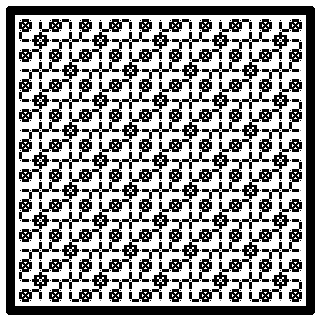
Finally, off-count elements can drive me batty. This pattern is a particularly egregious example. Not only is it a knight’s move design, the skew-to-the-count little boxes where the four rotated squares meet can throw me off and make me forget where I am.
So thank you Kathy for posting your piece, and best wishes for project success!
HOW BIG IS BIG?
I’ve been working on the book, so my spare time is eaten long before I get around to posting here. There are now roughly 24 plate pages in process, either partially or fully complete and I’m working on the annotations.
In other progress news, I’m most of the way through this band:

Me-Zoe-You asked about the scale of the work, so included a penny and a standard foot long ruler. I’m working on a relatively coarse 36 count linen, at about 18 stitches per inch. The voided flowers in the current strip are slightly smaller than the penny. You can see that the four strips are each about a foot wide. This is going to be a BIG piece!
The cloth is quite a bit larger than the part shown – with enough room for four six-inch zones side by side. This pattern grouping occupies the centermost two. I’m not sure which pattern to do next. I’m also not sure if I’ll work the rest of the thing all in parallel, or if I’ll run some bands perpendicular to these. A couple of the patterns I’ve been playing with are so large that they’ll need two or perhaps all three sections to show their repeats.
Plus with symmetrical bands and no words on this one yet, there’s nothing so far that says which end is up. I still haven’t found a motto I want to enshrine in this piece. It may end up being mute. Suggestions are most welcome – especially secular, non-political, slightly geeky (yet pithy) sentiments that are not the sort of thing one would expect to see embroidered.
BLACK AND WHITE
Another band on my new blackwork sampler. This one is graphed from an artifact.
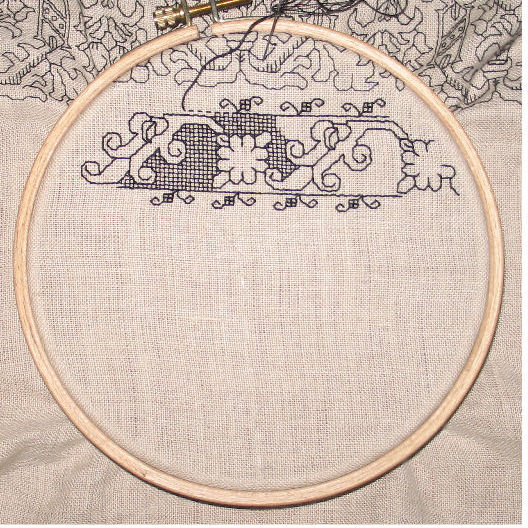
This one is graphed from an artifact. I’m using the same background fill and edging as the original, and I haven’t corrected the proportions. If I were to do so, the branch’s straight run at the top of the flower would have been worked one unit shorter, reducing the leggy leap from flower to descending sprout like thing. This one is in the new collection, with full source annotation.
To answer Anna from the Netherlands – I can’t say exactly when the book will be out. I will be self-publishing it through one of the various print-on-demand services. I wish I could work on it full time, but little things like earning a living have gotten in the way. I have about an hour each evening to research, graph, transcribe, write, and do lay-out. So I suspect that a final product won’t be ready before a year is out. Sorry to disappoint. You will however get to see a few of the patterns in it as I play test them on this sampler and post my progress. I won’t be able to do them all (there are lots) but you’ll see a few of my faves.
In terms of change in the pix and presentation here – I’ve upgraded blogging software and the camera. The new one is much higher resolution than the old, and I’m still figuring out how to work with it efficiently, and how to keep that odd moire like effect from obfuscating the weave of my ground cloth.
Finally, just for fun, here’s another snow shot from this week’s storm:

This isn’t the plow berm at the end of the driveway. It’s what happens when (at least) 22 inches of snow drifts. Smaller Daughter (about 5’4″ – 1.6m) shows off just one end of our excavation project. However Massachusetts doesn’t reel long from these things. School is back in session and everything’s narrower, but back to normal.
OUR NEW HOBBY!
Excavation!

Greetings from snowy Massachusetts.
GUEST OF HONOR
We’re slowly getting back to normal here at String Central, but I am still woefully behind on posts. The holidays were a bit squished due to work pressures, but fun none the less. Apologizing for tardiness, I present some highlights.
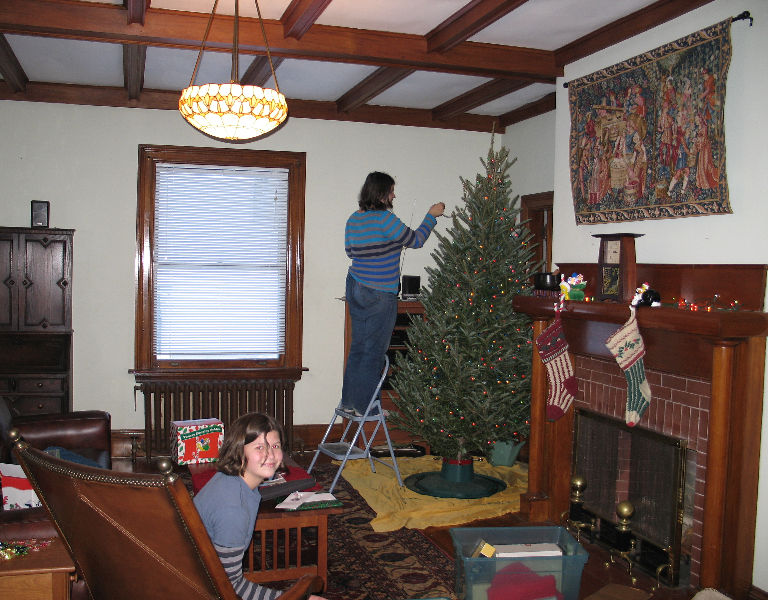
Here you can see the resident staff getting ready to welcome the guest of honor. This includes basic decorating:
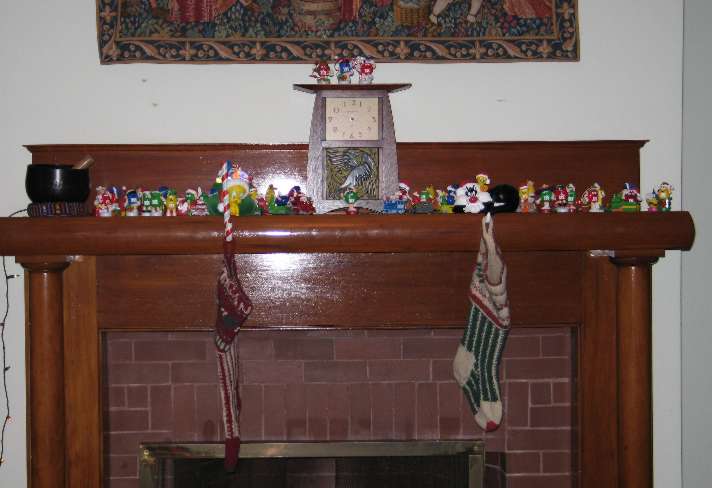
Deploying the M&M army, provided over the years by Good Friend Jean:
And finally welcoming Gaston, who came to dine with us:

Or rather, whom we came to dine upon. Here’s another glamor shot:
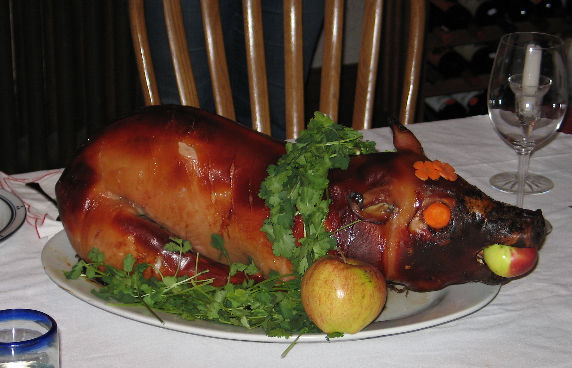
Gaston was slow-roasted very simply, with sage, onion and apple inside for flavor. I can say he was simply delicious, served with creamed onions and celery, plus red rice with wild mushrooms. We picked him up, dressed from Savenor’s in Cambridge on Thursday, then brined him in cider for a day before he went into the oven for dinner on Christmas Eve. Over the course of the week we consumed him entirely, saving hocks, extra skin, and bones for bean pots to come, and making a terrific terrine out of the liver. We will miss Gaston, but we’re very happy that our paths crossed.
Speaking of happy, the usual holiday triumphs also occurred:
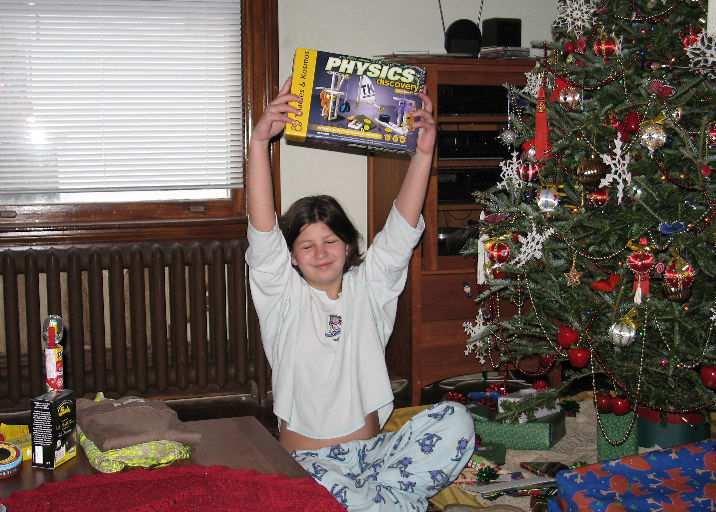
Every girl should have a gift pile that includes jewelry, fun clothes, books, games, and own physics discovery set. The kids are now thoroughly spoiled by family, friends, and their parents alike.
All in all a good holiday!
PATTERNS PLATE 25, GIMP HINT 107
Taaa Daah! The last page of my pattern collection – page 25:

All are new for this collection. #146 was inspired by an original pomegranate border I published in TNCM. #148 was similarly inspired by the beaded border from TNCM that I have previously shared here (repeated below, click on image to get it larger):
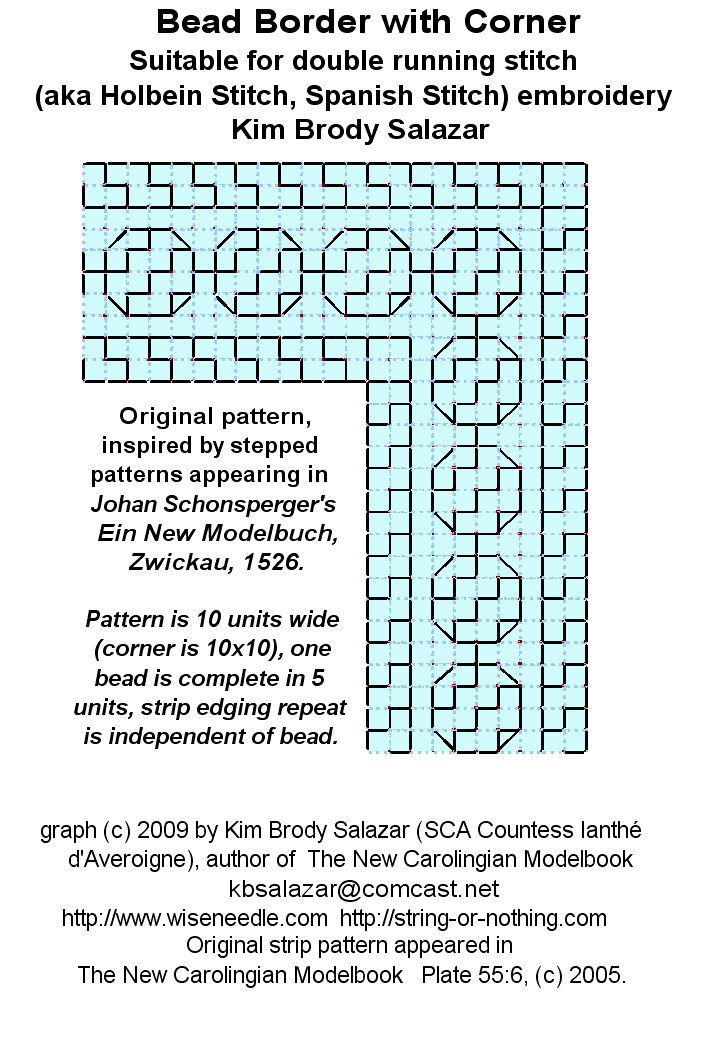
#149 was inspired by an edging in Schonsperger’s 1526 Ein New Modelbuch. His was a strip. Mine takes the main motif from his strip and inserts it into a lozenge. #147 builds on the interlace construction principles in pattern #67 of my first booklet, although this one is rendered as a line unit design instead of in block like square units.
So there you have it. 150 different blackwork filling patterns; some simple, some complex. And I could easily come up with another 150. But it would be more fun to see what others devise. I hope to have the PDF format booklet, with cover and intro essay out by the end of the holiday season. It will be available for free download here.
GIMP 107 – PRINT HINT
Printing or Saving: If you print out the pages constructed by the method in my tutorial you will probably find that the designs are rendered too small for easy use unless you use an enlargement factor via your printer driver dialog (the print settings dialog invoked when you issue a print command). BUT if crop your pattern, removing any unused page area, then you save your piece as a *.jpg or *.gif, like I did for the individual squares, the pattern won’t shrink down to teenytiny, and will be as readable as mine.
IN SUMMARY
Please let me know if you’ve found these pages or the GIMP tutorial to be useful. I’d especially enjoy seeing works done using one of my 150.
However, I do request that all users abide by the restrictions noted in my kick-off post. If you are using these patterns for your own personal enjoyment or as a gift, have fun!
If you are intending on selling works derived from them – including stitched finished pieces, or issuing kits or publishing your own patterns using any of these designs – either for profit or charitable sale or donation for eventual sale – please do me the courtesy of sending me a note prior to doing so. In all probability I’ll be delighted and ask nothing more than a bibliographic source statement in your pattern’s literature or hang tag noting the source of some of your fillings, and providing link back here. As soon as the book is up and the link is stable, I will be happy to provide the bibliographic citation’s format. But asking permission first would be a positive, noble and honorable act, for which I thank you in advance.
PATTERNS PLATE 24
The penultimate page! Here’s page 24:

All are new on this page. #139 and #140 are close cousins, sharing a central motif. The strawberries in #143 have their pips marked by little circles. I’d use very tiny knot stitches, an X over a 1×1 thread intersection or possibly even seed beads for them.
PATTERNS PLATE 23
Just two more pages after this one. Here’s page 23:
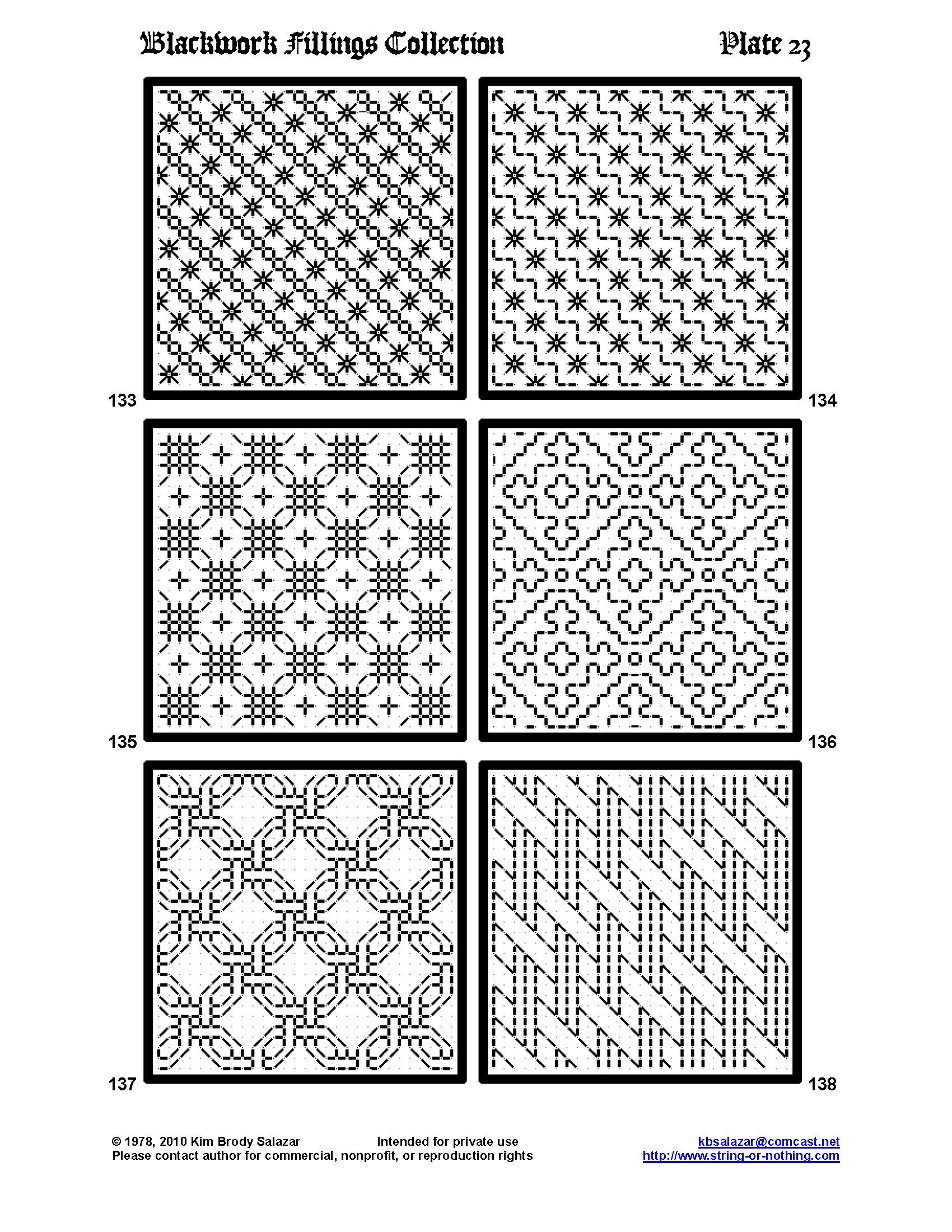
All of these are new doodles, although #137 is a truncation of the framing device I used in my Buttery pattern. #133 and #134 are almost identical. The only difference between them is a second double running stitch line, turning the diagonals between the eyelet stars from steps to little squares. You can never have too many interlaces. #137 and #138 aren’t the last one in the collection, I promise.
PATTERNS PLATE 22
Getting close to the end. Here’s page 22:
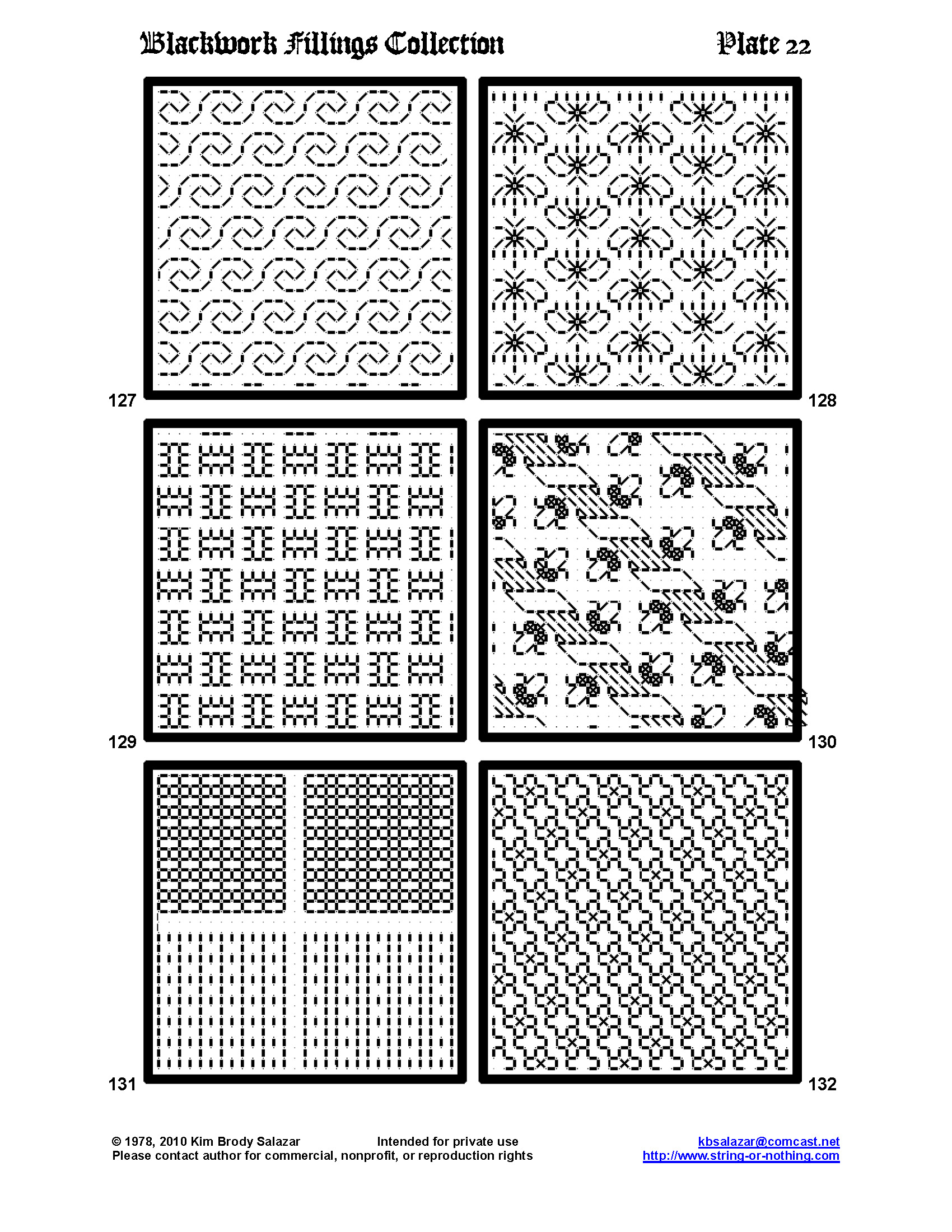
All of the patterns on this page are my own. Two of the smaller fillings in #131 are in my coif. Like my snails which I’ve recently found have crept all the way to Finland, the gnats in #128 were inspired by the period English embroiderers’ love of insects (related thought – look into this worthy cause). I’m also fond of #130, which would be a wonderful all over or strip panel treatment for chemises, perhaps mirrored down the center of the garment.
 String-Or-Nothing