WHERE’S STRING?
Computer failure at this end. Please bear with me. I’ll return to offering up tangled knitting thoughts ASAP.
MINOR ACCOMPLISHMENTS
A person left a comment on one of the counterpane pages here, asking
for help identifying the technique or stitches used in blanket she
owns. She neglected to leave an eMail address. I’d be interested in
seeing a photo and possibly posting it here for discussion, but without
contact info not much can be done.
Yes, in the midst of all the
charting stuff I was knitting. I finished up the Harvey Kombu, and I
did a pair of plain toe-up socks from Lana Gross Meilenweit. I’m not
sure which color variety it is, as I lost the label in an airport. It’s
not Fantasy, the repeat is too short. It’ s not Multieffect, or
any of the MultiRingel colors, either. It’s possible it was part
of last winter’s Jacquard color crop.
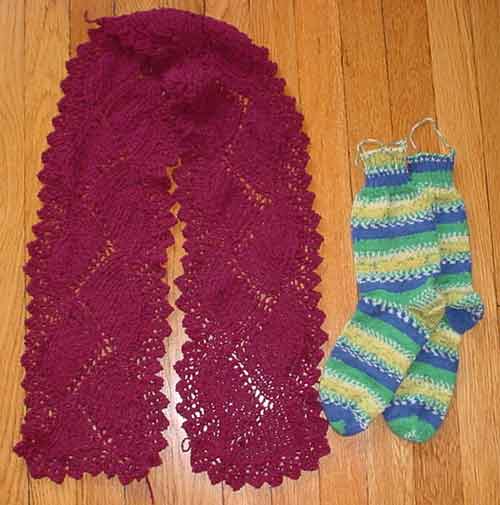
You’ll notice ends dangling off both pieces. I really can’t say
why I do this (perhaps it’s a personal superstition, perhaps it’s a
reminder not to use the item myself), but when I make gifts in advance,
I don’t darn in the final ends until I have decided whom the recipient
will be. I’m not quite sure who will be receiving these, so the
ends are still there. Go figure.
The socks were done on US #0s (2mm) needles – 72 stitches around.
That makes them rather large in gauge for me. I used the standard
figure-8 toe and short-row heel I use in all the sock patterns on the wiseNeedle pattern page.
Nothing fancy here, just miles and miles of plain old stockinette,
finished off with a K2P2 ribbing at the top. The pattern for the
Kombu scarf is also there. In this case, I used a US #6 (4mm),
and used just under two full balls of my ancient stash-aged Lang Harvey yarn.
Finally, one other person asked about how I construct my charts.
As I’ve described at length before, I use Microsoft Visio. I’m sharing my Visio stencils. If you’ve tried graphing knitting or stitching patterns using them and have feedback or questions, please let me know.
OLD EMBROIDERY – DENIM JACKET
To recover from the charting series, I present tiny mental vacation in
the past. 1972 to be exact. That was the year I embroidered
this jacket.

It was well before The Warner Brothers Store and WB characters being
available on licensed merchandise. I drew my Roadrunner freehand
from cartoons on TV. As you can see by the variant color (the
official Roadrunner is blue), my Looney Tunes years were spent in front
of a black and white TV.
I had a lot of embroidered clothing back then – a pair of jeans with
large phoenix that wound up one leg, starting in flames at the
cuff and finishing with a peacock-frilled head on the hip pocket; a
blue workshirt covered with wildflowers copied from herbals; and a
denim vest done in Shisha mirrorwork.
Except for the denim jacket all are long gone, sold while I was in
college to pay for books. You might have seen the other pieces if
you wandered past the window of the Red Dog second hand clothing
boutique in Harvard Square,
Cambridge, MA, sometime between ’75 and
’78 (back when the Square was more edgy and gritty than it is in
its current Urban Redevelopment/Mall of America glory). I’ve always
wondered who bought my pieces.

My Roadrunner is done in plain old 6-strand cotton floss, mostly in
chain stitch. The two-tone tail happened when the store that sold
Coats & Clarks embroidery thread dropped it in favor of the DMC
line. I
ran out of my original stock and had to do the closest color match I
could. You can barely make out the blue sig block below the front foot.
When I stitched this, the denim ground was the same color blue as that
block.
Elder Daughter wears this now (fraying and all), and would
kill for the other pieces. They may be long gone, probably
discarded from the homes of others, but I still have some of the Medieval history
textbooks they funded.
SOCK YARN RUN DOWN
Some random questions popped into my inbox this week. I try to answer:
You said you
knit a lot of socks, and the colorful bits on the booties are
leftovers. Leftovers from what? What are your favorite sock
yarns?
I like the Euro-style classic finish hard twist wool/nylon blend sock
yarns best (I don’t care for either wearing or knitting cotton
socks). My short list includes Socka/Fortissima, Regia, Meilenweit, and the like. I’m slightly less fond of Reynold’s
sock yarns, finding them a bit coarser than I like. I knit with
Opal once, the yarn’s texture was nice and the colors were interesting,
but not so much that I’d pay a premium to find more. I’ve
also tried Kroy 4 ply (aka Kroy Sock), Special Blauband, and Brown Sheep Wildfoote.
I’m not as fond of those. Brown Sheep is too thin, splitty and
flabby. Special Blauband is also thin compared to my usual (their
Blauband Ringel
yarns though are more comparable to the Socka type). Kroy is a
bit less densely spun than the Euro yarns, but it’s economical and is
stocked in solid colors. Once it was difficult to find multicolor
sock yarn, now it’s tough to find solids. I use solids for
contrast, so I was very happy to find Kroy.
I’ve also tried some of the higher priced yarns, like Koigu and Lorna’s Laces.
In truth, though the Koigu colors were fantastic, I was less pleased
with its performance in a sock than most. I found it too thick to
make socks I can wear in most of my shoes, plus even under careful
hand-wash, I found it fuzzed and lost that surface sheen that makes the
colors pop. The socks are wearing well, but they’ve lost that
special something that the yarn had in the skein. I’d use Koigu
again in a heartbeat – but not for socks. The Lorna’s Laces yarn
was a bit loftier than my usual hard twist stuff, but worked up
nicely. It’s wearing quite well.
I’ve also tried a salad of other sock yarns – Alpine, Marathon, Happy Strumpf, Trekking
– whatever wandered into my local yarn store that looked
interesting. While all made suitable socks, none stood out as
things I’d want to seek out for repeat use. Alpine was a Euro
style yarn – good texture, boring colors; the others were heavier than
I prefer.
I haven’t tried the less expensive sock yarns from KnitPicks or Elann. I tend not to buy yarn via the Web if I can get the equivalent locally, and I live in a very sock yarn rich region. (Actually touching yarn before I buy it is a requirement.)
The links above just go to one representative of larger, similarly
named sock lines. If you need more info on sock yarns, try
wiseNeedle. Go to the search page and
look up a sock yarn by name, or select "sock" from the drop down list
of yarn types. About 135 are currently listed – 85% with at least
one review. You can also find a chart showing some repeat lengths of common sock yarn self stripers here.
Still working on the scarf?

I like it better when you write about little stuff. The big projects are boring. What little stuff are you planning?
Unfortunately, I don’t plan my knitting to fuel this blog. I knit
wherever I want to wander, and the blog gets pulled along behind.
That being said, I have to finish this latest crop of booties plus the
Harvey Kombu, then rescue Elder Daughter’s Rogue before returning to my
large blanket. Plus the holidays are coming. I’ve promised
a ton of socks, plus there are some other special gifts that I really
should make. You’ll see quite a few quickies over the coming two
months, I guarantee.
Late breaking addition:? Ooooh. Mittens!? Haven’t done full patterend mittens yet. Thank you , Wendy!
STILL WASTING TIME
I’m still sweeping out mental cobwebs, occupying my fingers with
interim quickie projects. Saturday’s was another pair of booties, in
the bootie pattern I’ve blogged about before:

This
pair is in lime green Dale Baby Ull, and the leftover of some tweed
sock yarn long since separated from its label of origin. It just takes
a couple of yards to do one of the purl welts. I’ve worked them in
contrast (as shown here), even working each welt in a different color
yarn. Sometimes I do the ties in the same color as the contrast,
sometimes not. It all depends on how much I’ve got. This is why I never
throw away sock yarn leftovers. The smallest bit is enough to accent a
pair of these booties.
I’m still repacking my stash after our
near escape from a basement flood. In doing so I’m running across all
sorts of goodies I had forgotten about. In the same box as my
Kureopatora leftovers, I found about seven or eight balls of Harvey. Lang Harvey
was a wool blend salad with a boucl? finish – 40% wool, 32% acrylic,
15% polyamide nylon, 10% alpaca, and 3% viscose. I’m pretty sure I
scavenged it from a bargain bin at a (long gone) yarn shop I used to
frequent in College Park, Maryland. And I’m also pretty sure that I
bought it circa 1990 or so. Possibly earlier, so the chance of anyone finding more outside their own stash is slim to none. The original intent was
to make a vest, but although I liked the yarn I didn’t like the way it
worked with my chosen pattern, so I stashed it.
What’s boucl?
you ask? It’s a style of yarn that has fallen out of favor. You don’t
see that many of them around any more, the textured yarn niche having
been consumed entirely by the fluttery fur monster.
Boucl?s have an
airy hand. If you think of classic finish multi-strand yarns
(like Cascade 220) as dense cream cheese, boucl?s would be the whipped
variety. Unlike chenille where the fluffiness is made by little
strands that are bound by some kind of "keeper thread," boucl?s have no
fuzz to come unbound. The yarn’s structure is of one or more
two-ply strands. One ply is relatively taught, usually a very
fine nylon thread. The other ply is looser spun, almost slubby,
and is under far less tension. The looser strand is sort of
gathered and lumped around the nylon base thread, resulting in
something that has more loft and that has higher yardage per unit
weight.
Here’s Harvey:
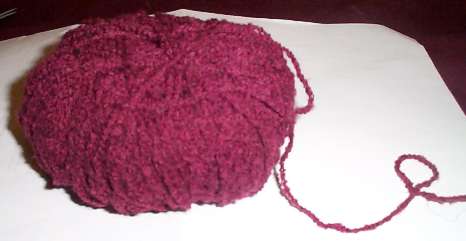
Harvey has two two-ply strands. You can see how nubbly and slubby
it looks. While it reminds me in color and visual appearance of
the iron-upholstered sofa in my grandmother’s apartment (the one that
would sand your thighs off if you sat on it while wearing a skirt in
the summer), it is in fact an exceptionally luxurious feeling, soft and easy to wear yarn.
Some boucl?s are even more fluffy or bumpy than this. Some
have a loopy construction (I’m not sure at what exact point something
stops being a boucl? and becomes – for example – a mohair loop, but I’m
sure one of the spinning folk who read here will enlighten
us.)?? My Harvey is marked at worsted gauge (20 st x 34 rows
= 4 inches or 10cm) . It’s about 126 meters or about 138
yards. A classic worsted like Cascade 220 is about 110 yards for
50 grams. Even taking the fiber salad composition of Harvey into
consideration, 28 yards in 50 grams is a major difference in
yardage.
Now. How does Harvey knit up??
The first time I tried it out I was disappointed, but I had picked a
pattern for which it wasn’t suited at all. I tried it out using a
knit/purl texture pattern that was totally eaten by the yarn’s
texture and dark color. While it isn’t optimal for showing detail
on something like my Kombu, I thought it might be fun to try out in
that pattern:
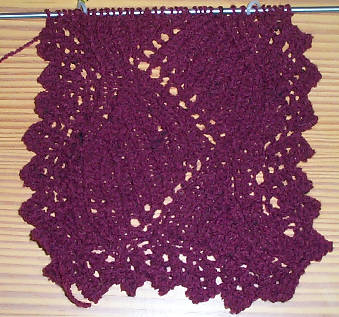
Again, the ribbed detail is partially obscured, although it shows up
better in person than it does in a photo. But the softness and
drape can’t be topped. I’ll be finishing out my Harvey Kombu and
stowing it for the upcoming gift season. I’ll probably have
enough to do a matching hat, too.
Oh, and for an exceptional Kombu that really shows off the pattern’s
texture better than my own attempts at both knitting and photography
(and not to mention her superior execution of the idea) check out Kerstin’s Strickforum. Beautiful!
KUREOPATORA OUT FROM THE NILE
Thank you to all who saw something redeemable in yesterday’s blanket. I
think the most telling thing of all is that the entire time I was
working on it, my parents smiled sweetly and offered up yarn leftovers
and encouragement. At no time did they grimace, giggle, or point. That
sort of unconditional support must be something one learns in Secret
Parent School, because I find myself smiling sweetly at earnest yet
flawed first attempts made by my own kids.
On
the knitting front, I’m still blowing the cobwebs out of my brain. This
weekend past we narrowly averted a minor flood, and in doing so learned
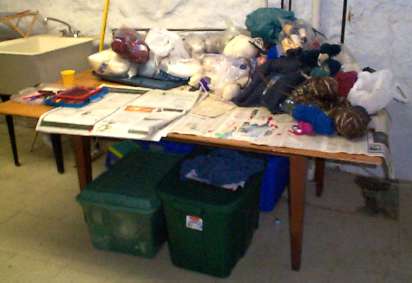
yet another advantage of keeping a large yarn stash stored in plastic boxes. What we see here is several tubs of yarn,
dumped out on the projects table in the basement, and an "after" shot
of the flood site, with the now empty and drying tubs perched on top of
the sump they helped drain.
 |
 |
Had I not had a bunch of tubs lying around the house I would not have been able to stem my mini-tide.
In the course of the whole thing, I ran across two and a half balls of
Noro’s Kureopatora Plus. This is a multicolor wool/cotton blend
yarn that’s about six years old. The label calls it out at 23 st
= 4 inches, but it knits up more like a heavy DK or even a
worsted. It’s long since discontinued which is unfortunate.
Although it won’t full like the Noro multis popular right now,
Kureopatra’s cotton content makes it softer than they are. The
colors are distributed not through dying but through spinning.
It’s double ply in construction. It looks like the spinner did a
thick/thin thing on each ply, starting with one color and introducing
fiber of the second in the thinner sections. Change is gradual
(with occasional slubs) from color to color. Then two strands
were plied, with the thin strand of one matching up with the thicker
section of the other, so that the contrast color of the thinner strand
is very evident against the puffy part of the other strand.
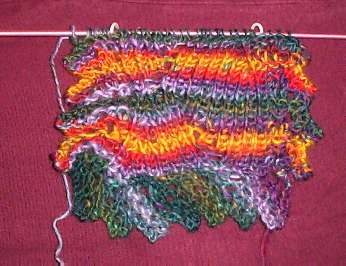
I started my latest bit of gratification by working up another of my
Kombu scarves. Hey – it worked with a multicolor before,
right? But I didn’t like the look. The rainbow of this yarn
is too strident for the textured Kombu:
 |
 |
So I ripped it out (hard going with this loosely plied fuzzy stuff);
and began again. This time with my own off the top of my head
variant on the single repeat entrelac rooted multidirectional
idea. Mine is done in ribbing on 30 stitches. Provided I
have enough yarn, I intend on finishing it with some sort of edging
knit on after the main body is done:
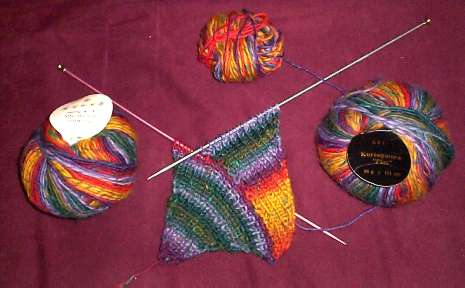
I like this much better. Thank goodness my color sense has matured since 14.
EMPLOYMENT OPPORTUNITY
News flash via NPR!
Love to knit?? Is stranding a way of life for you?? Want to
retreat from the hubbub of the big city?? Fair Isle – yes, THE Fair
Isle, is looking to increase its population. Not much there in
the way of employment opportunities outside knitting and the building
trades, but oceans of beautiful vistas, friendly people, and the depth
of character that living on the edge in a non-cushy environment can
bring. Listen to Anne Sinclair, knitter extrodinaire on this All Things Considered audio clip, broadcast last evening.
EIGHT (GIVE OR TAKE) PLUS ECONOMICS
Although I was out of town tending to family matters last weekend,
knitting was accomplished – mostly on the flights and in the airports
as I waited between planes. In addition to yesterday’s swatches,
I did some work on my counterpane.

As you can see there’s a pie slice that’s missing from the leftmost
motif. My guess is that my missing triangle is now loose in the
Orlando airport – a stopover on my way to my final destination. I
doubt my feral triangle will cause more than a moment’s pause as it is
swept up and tossed away. So it goes.
As this piece grows larger, I can say I’ve definitely overbought my
white cotton coned yarn. I have four enormous cones. I’ve
gone through about a third of just one of them. I think I’ll end
up using just two of them to make the whole thing. Here’s
consumption so far. The untouched cone on the left weighs
1250g. It’s the smallest of the four, with the others ranging up
to about 1300g. The nibbled into cone on the right weighs 825g,
and started out at around 1300g. Which all makes sense because my
blanket so far weighs about 475g. (It’s always pleasing when the
math actually works out).
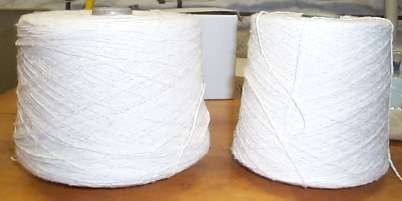
Since I’ve got about 20% of my estimated total surface area done, but
have used only about 8.3% of my yarn (a third of one of four cones –
roughly a 1/12 of my total available yarn), I’ll have LOTS
leftover. Still, I don’t mind. It’s nice yarn and there
will be enough for another project (perhaps another counterpane).
As an added bonus, the stuff was a very inexpensive back room find at
Webs. I paid about $10 per cone for it. Since this project
will last for about eight months at the current rate of production and
I anticipate using only two cones, that works out to $2.50 per month of
knitting enjoyment. It doesn’t get any more economical than that.
How to knit on the cheap?? Don’t buy what’s trendy. Big fat
yarns and glitzy yarns command a premium, but plain finish yarns, even
first quality good wools and cottons can be had at very reasonable
prices (even without resorting to reclaiming yarn).
Think smaller gauges. This stuff isn’t particularly small being
very close to DK weight (5.5spi), but even DK is lighter than many of
the more favored yarns today. And think of? projects that
get their zing from the knitting rather than from the yarn. Yes,
they take a bit more time and attention than some plainer pieces, but
isn’t the entire idea to have fun knitting? No, if you are
on a limited budget you won’t be able to knit that fancy fulled
cardigan from imported Japanese hand-dyed, but I bet with a little
effort you could find a 100% wool sport weight yarn that would make a
smashing texture stitch or stranded colorwork jacket and not break the
bank – especially if you consider how many weeks of knitting time you’d
get by investing in such a project.
PROFESSIONAL DEALINGS
I think I’ve mentioned that I’ve done some minor design work for
Classic Elite. I know that some people are curious about how the
pro design thing works. Bearing in mind that my experience isn’t
typical, this is how it’s been for me.
I’m not a first-stringer. In general, I don’t pursue the company
by submitting design proposals. I’d say I’m more of a
third-stringer. They call me with specific assignments based on
ideas or inspirations generated by others – usually at last
minute. My guess is that I get called when more famous and
prolific names are overbooked; when embroidery is involved; or when
deadline crises are afoot. That’s o.k. by me, as I don’t have the
time/energy to devote to knit design as a full career path. I’ve
also done some contract knitting, crocheting and embroidering for them,
producing finished items based on other people’s designs, and in the
process proofing (or fleshing out) the pattern’s early drafts.
What have I done lately? Nothing big, that’s for certain. The current collections include two of mine.
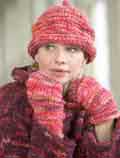
This is a hat and mittens set (I’m not responsible for the sweater
jacket). This assignment was mildly challenging – take one skein
of the bulky (almost superbulky) luxury yarn Tigress
and work up an adult hat and
mittens set that’s easy to knit. Since 200g of Tigress is only
181 yards this was a squeeze. I managed it though, with a very
simple rolled brim hat with some garter ridge details, plus a matching
rolled cuff basic mitten. I have to say I am not a fan of
big-needle knitting and won’t be making another set, but my 14 year old
loved the hat and mitts and was loathe to send them off when I was done.
This one was both easier and more difficult:
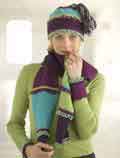
This assignment was to create a striped hat/wristlets/scarf set using
yarns of two different weights, but of the same fiber composition and
dyed in the same colors. The yarns didn’t have names attached
when I was using them, but I think they’ve been dubbed "Princess" and
"Duchess"
since. My homework was to take as inspiration a series
of photos showing striped knitting adorned by looped embroidery
stitches. In truth, I don’t remember which pieces use which
weight yarns (the submission deadline was back in the Spring), but I do
remember trying to plan the pieces to make the most efficient use of
the yarn. Again, simplicity and beginner-friendliness were the
marching orders. These use plain old seed stitch. The hat
and wristlets were knit in the round. The looped embroidery
stitches aren’t difficult to do, and are (of course) optional. You have
to **love** seed stitch though as there are miles of it in the
scarf. Of the two yarns, I did like working with Princess (the
worsted weight version). I didn’t retain any (see below) and I
don’t have the finished item, so I can’t comment on durability or
washablity. Duchess was also nice, but I’m not fond of heavier
weight yarns in general.
Past projects I’ve done include a long striped scarf in Bazic,
ornamented with pattern darning and fringed down one long side. The photo of that one in the
pattern leaflet didn’t show the embroidery, so I have no idea if anyone
was ever inspired enough to try it. I also did a series of
nesting baskets crocheted in a very heavy cotton yarn a couple of
summers back. I’ve worked on other projects as well.
I’m sure people have lots of questions about the design process. I’ll try to head some off here:
For real?? They say what to make, and you just make it?
For me that’s how it’s been. Real designers with lengthy
portfolios and industry-wide reputations must have more latitude.
How do I get involved? How can I get my stuff published?
Yarn makers and magazines have design guidelines (by issue for the
magazines). Look them up and submit written proposals outlining
your idea. Make sure your idea includes a sample swatch, and
enough info to make it intelligible to someone else. This may
mean lots of sketches and schematics. It does NOT include sending
a whole finished garment. Be prepared for hundreds of rejections
before an acceptance. Also be prepared to feel like you’ve tossed
your ideas into A Great Black Hole. Also, your proposals will not
be returned unless you include return envelopes and postage (another
reason not to send full garments at this stage). You WILL be
taken more seriously if you’ve got a "knitting resume" behind
you. That might mean a track record of publication elsewhere (a
chicken or egg problem). I do note that some of the on-line
venues are a bit more welcoming of submissions than are the yarn houses
or paper mags. They might be a good place to start. (Oh,
and if like me you’ve ever been a burr under the saddle of any
publisher or maker at any time in the past, you can pretty much forget
about placing anything in their venue.)
In general after you submit your proposal it’s mulled over for a while.
If it’s selected, you get your marching orders to proceed, plus a
contract outlining what you owe (written design or written design and
finished sample), the number and range of sizes the item needs to be
written for, specifications for the exact yarn and possibly even the
color desired by the publisher, and the deadline for submission.
Be warned:? that deadline may be as little as two weeks away, and
may involve a yarn that requires you to recalculate your entire design,
so advance knitting is not always entirely productive. The
deadline cycle is the main reason why I don’t try to do this on a
professional basis. I just can’t commit to doing anything major
to hard, short deadline.
How much does it pay?
Not much. Even though it is taxable income (reported under
"Miscellaneous" or as a home business), if you work out the hours
invested in proposing, designing, drafting, swatching, test-knitting,
pattern writing, and proofing you’ll quickly figure out that you’ll be
working at less than minimum wage. Way less.
Do you get free yarn or get to keep the finished item?
Yes and no. If you work for a yarn company directly like I did,
they do send more than enough yarn to make the project. But under
contract, I’m obligated to return any leftovers and swatches, so I
don’t get to keep any. i also don’t get to keep the
finished item – that’s the photo shoot/trunk show/demonstration model
and gets returned to the pattern publisher as part of the agreed-upon
deliverables. The sample belongs to the publisher, not the
knitter, even though the knitter worked on it.
It’s worth noting that not every designer knits up his or her own
samples, some subcontract out. Others just do the design and the
publisher arranges for the sample to be knit as a separate
contract. Also, if you’re knitting for some other entity than a
yarn maker, you might have to buy the yarn yourself and factor that
into your total contract price.
You sell-out. Isn’t this a big commercial for CE stuff?
I don’t think so. They’re not paying me to push these patterns,
and I don’t get extra for increased sales. Plus I rather doubt
that anyone is going to buy anything based on this rather non-gushy
blog entry. I have also recused myself from posting any reviews
of Classic Elite products on wiseNeedle since my very first
professional interaction with them. I’m mulling this policy over
though, as not all of my experiences with their products have been
uniformly joyous. Still, I thought the general experience might be of interest to some.
Why are you talking about this now?
Because I’ve just gotten another assignment from Classic Elite. All I can
say about it is that fulling and embroidery are both involved.
It’s going to kill me not to be able to blog about this particular
design process real-time because there will be all sorts of lessons
learned on the way. So please be patient with me. There
won’t be much counterpane progress until this has passed, and I’ll be
scampering around looking for other things to write about.
Suggestions there are welcome.
FOUR TODAY FOR TODAY
Four motifs done. My guesstimate is that four represents about 15% of
the total finished area. That means I’m looking at something like 26 or
so in total, with some of them being halfies.
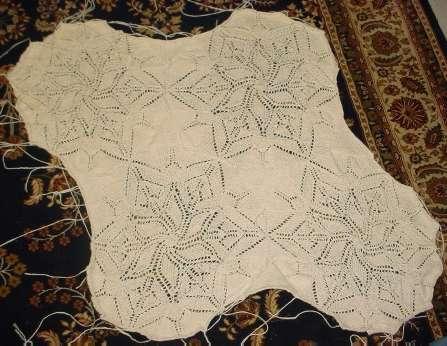
It
looks like the trillium background shapes will form rings around the
star motifs. I’m really looking forward to seeing that develop. My next
step though may be to work out the half-width motif set. That would
include a half-hex, three normal triangles, one normal square and two
half-width squares.
UPDATE – Looking for past posts here
I do try to post stuff here that I hope is useful. I also realize
that much of it might not strike a reader as being useful today, but
might stick in memory somewhere and pop up when the specific need is
encountered. I’ve gotten a couple of questions (including a
comment early today) about how to find past posts. I’ve tried to
provide tools to do that.
First, for the knitting projects and some broad subject areas, I’ve set
up category tags. You can see them in the right hand sidebar (you
might have to scroll right a bit because of an over-large graphic I
posted last week). Projects all are named something like "Project
– Lacy Scarf" and index all the posts that mention each project.
The broad subject categories also work that way. Clicking on the
"Reference Shelf" tag will bring up all the posts that I thought people
might find especially helpful, likewise "Embroidery" should find all
the posts that discuss that subject.
Some particularly popular posts have merited direct access under the
major category "References," also in the right hand sidebar. Yarn
Labels 101 and 102 for example are two posts that get lots of traffic
from people just becoming familiar with yarn labels and how to read
them.
Finally for all those search needs that keyword indexing didn’t
anticipate, there’s a search box in that same sidebar. You can
type a word in there and bring up all posts that mention it, or you can
click on the "advanced search" tag right below that box to do more
complex multi-word or time-limited searches. Typing "booties" in
the search box should find the posts I did on A. Krekel’s pattern for
booties that really do stay on.
 String-Or-Nothing