CROCHETED ROOM
BoingBoing (my favorite souce of offbeat news) just posted this link to what they call a knitted 1950s era sitting room. Actually most of the decor examples shown in ABC Tasmania’s article on this bit of unusual art are crocheted and not knit, but they’re amusing none the less. ?
LILLEHAMMER MYTHOLOGY
Posted in absentia. I’m off on a business trip, but left this behind.
A couple of people did write to say they would be interested in reading more about the symbols on the Lillehammer. Please bear in mind that this is just one person’s interpretation. I may be reading more into the little bits than the designers intended. And I am not someone schooled in this stuff. This is just one Avid Reader’s observations. Apologies if I’ve forgotten my Eddas and sagas, or have messed up the spellings.
Here’s my Lillehammer:
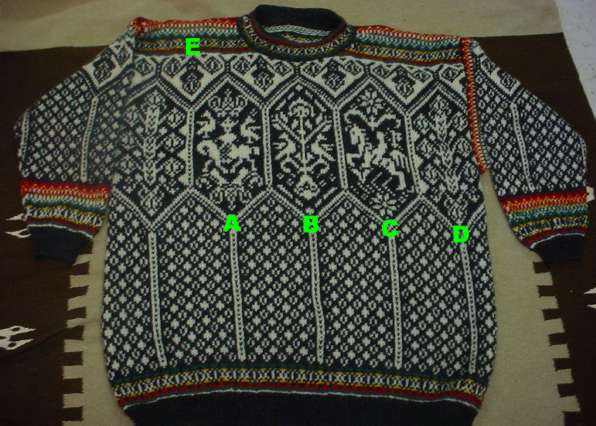
Starting with Lozenge C, just because I like to skip around, we see Odin chief and father of the gods, and god of battle and honorable death. He is riding on his ultra-speedy, eight-legged horse Slepnir (the extra legs are implied by the zig-zags). He carries his customary spear Gungnir (hard to see, but I think it’s here because he’s holding something long and thin in his hand) and has a raven following him. (More on Odin’s ravens below). I think he’s shown in profile because Odin has one eye (more on that below, too). The flower shapes might be an obscure reference to poetry (flowering words), as he was the source of bardic poetry and runic writing; and was the special protector of bards and poets.
Slepnir has a nifty parentage of his own, involving Loki masquerading as a mare to distract the dray stallion of a giant (the adversaries of the gods), to get him to default on a building deadline. The trick worked, the giant was unable to complete his project and received the penalty specified in the bargain, but Loki (a male god) was too tempting to the stallion, and ended up with foal.
Lozenge B carries Yggrdasil or Hoddmimir, the world tree. It’s a giant ash tree, most often described as white and covered with flowers. It grows from three roots in springs of knowledge, while its top shades all nine worlds, including Asgard (home of the gods), Midgard (where people live), Jotunheim (where the giants live) and Niflheim (the underworld). One of the roots was in the spring of Mimir. Mimir was an all-knowing god, whose head (some say skull) was thrown in the spring after he was beheaded. His knowledge though wasn’t lost, and some of it could be obtained by drinking from his spring. I see Mimir’s head in the ovoid object at the tree’s base.
On Yggdrasil are flowers that drip a honey-dew of inspiration, and are the ultimate source of all bees’ honey (and the exaltation that comes from drinking mead – a fermented honey-wine). Odin’s two ravens, Huginn and Munin perch on its branches. These two birds overfly the earth every day, observing everything and whispering that information back to Odin every night.
Odin is also closely associated with Yggdrasil because he sacrificed part of himself to obtain knowledge from the springs that feed the tree. In some tales he allows a raven sitting on the Yggdrasil to peck out one eye in exchange for a sip from Mimir’s spring. In others he hangs for nine days on the tree, transfixed to it by his own spear. During this ordeal he learns nine songs of power and the basic runes.
Lozenge A holds Freya, wife of Odin, and foremost female deity of the pantheon. Freya is a fertility goddess and wards agriculture and birth. I’m kind of stumped by the creature she’s riding because Freya’s mount was Hildesvini – a former lover disguised as a fierce boar. Either that or she got pulled around in a cart drawn by cats. The thing she’s riding on is way too long-legged to be a big pig. But the pattern calls out this motif set as being her, so I’ll try to find more in it. Freya did have the ability to transform herself into a bird by use of a magic cloak of bird feathers. She does have a large flat thing in her lap (perhaps the cloak); and there are birds around her. Perhaps the strange shapes at her mount’s feet are supposed to be cats as well. Her palace of Folkvang is supposed to be flower-strewn, so perhaps that’s a big flower below the cats. The royal crown above her is not uncommon on Norwegian embroideries, and so might signify her queenship over the gods.
Lozenge D and the partials up along the neck/shoulder line and sleeve tops all carry the same sort of organic growing thing. To me they look like fruit. The most famous fruit in this cycle of tales would be the apples of Idun. Idun was the goddess of youth, married to the Bragi, whose special charge was poetry. She kept a tree and stock of golden apples, which the gods ate to stay eternally youthful. Idun was once captured by a giant, and without her apples the gods aged quite quickly. There’s a whole cycle of stories about the quest mounted to get Idun and her apples back.
That’s about all the figural elements I can pick out from the design. The rest is just generally decorative. I do however particularly like the use of the close color banding at the top and edges. It looks reminiscent of tablet weaving, in a geometric that wouldn’t be inappropriate for before 1000AD. Likewise with the lozenge framing mechanism and brocade-like voided and filled dots. That’s not to say that knitting of this type was done back then (it wasn’t); but the style of the ornament on this sweater echoes weavings and textile decorative composition of a time when worship of these deities was widespread.
If you want to read more about Norse mythology, there’s always the public library – that wonderful resource in your own back yard. On line there’s also the Prose and Poetic Eddas, translations of which are both available on-line.
FINALLY, AND CHALLENGES/BEGINNINGS
51 days, and eight increasingly irate telephone calls later I finally am typing this on my base station machine using my replacement monitor from Samsung. UPS brought it yesterday morning.
Then they came back at 4:30 and brought another. Apparently one was shipped last week, but Samsung neglected to send it second-day air as agreed; and forgot to note that one had been shipped out at all. So when I called on Monday they sent another because they had no record of anything being sent since mid January, when they shipped two monitors sequentially to different wrong addresses. I refused Box #2.
The saga isn’t over yet. There is supposed to be special return paperwork and labels included in the replacement’s box. I need those to ship back the broken unit. Without those tracking numbers, I run the risk of my return not being logged in and my credit card being dunned for the full cost of the replacement unit. Call #9 looms….
On the knitting front, the socks progress. I may have to defer start on the hoodie for at least a week because of a very welcome business trip. Welcome because it’s always nice to earn income, and because it is to a much warmer part of the country. Somehow I don’t feel so bad leaving family home to freeze in Massachusetts if I bring back a paycheck from the sunny Southwest.
Favorite Patterns
Still, this starting off on another project and considering Rogue is making me think of my all-time favorite (boughten) patterns. I’m trying to distill what made them so much fun, as they range all over the spectrum, from stranded colorwork to fine lace. Some were easy, some were more challenging. Not every one was flawless, either in write-up or in my final excecution. And I can’t even say that I’d knit any of them again (been there, done that…).
I’ve mentioned the lace patterns before -? most notably Hazel Carter’s Spider Queen, and Fania Letoutchaia’s Forest Path Stole. I’ve also done the Tudor Rose pattern from Kinzel II, although it’s sitting on the needles in my Chest of Knitting Horrorstm, waiting for me to find enough of the right weight cotton to do a final round of leaves and an edging. All were scads of fun. Each inch was an accomplishment, and I loved seeing the complexity build.
Watching the complexity accumulate was also key to my enjoyment of Dale’s Lilliehammer pullover. (Here’s a link to Wendy’s fantastic implementation of that pattern. I’ll dig mine out for photos another day). I also had lots of fun with the mythology behind the figures on it. Not everyone can say they’ve knit a sweater with an eight-legged horse, a giant’s skull, and the apples of immortality on it. (If anyone’s interested, I’ll do a myth dissection of this piece on another day).
I’ve also written here about the Ridged Raglan from Knitters #54 (Spring, 1999). I’ve done three of them to date – one of the few patterns I’ve knit more than once. It wasn’t complexity this time that drew me in, but the clever construction method held my interest. I never used the color combos, yarns, gauge, or number of colors shown in the mag, so perhaps a bit of "let’s see how this turns out" was in my enjoyment mix.
Other sources of particularly noteworthy patterns in clude Penny Straker: Inverness and this Blackberry Jacket. I show this picture because I can’t find it anywhere else on the Web. It may well be discontinued. While I don’t have the sweater anymore, I do have lots of fond memories of it. Blackberry was my first knit project, and I did it in raspberry-color Germantown wool worsted (very much like Cascade 220), and finished it out with black leather knot style buttons. I picked this pattern because I thought that the bumpy texture of the trinity stitch would disguise any irregularity of my own knitting. It did.

That first project took about three months to complete. I was knitting solo, with occasional over the shoulder help from a friend. I figured out stuff like "make left side to match, reversing shaping", seaming the textured pieces, making/seaming the spread collar, and buttonhole formation/placement on my own, and the sense of accomplishment at having done so was so intense I can still feel it today. Alas, this particular piece is long gone. I think I might have lent it to a sister, years ago. Too bad.
My Blackberry Jacket’s biggest legacy is my belief that so long as you don’t tell? new knitters that something is difficult they will buzz away happily confident that it is within their ability. Yes, there are things that might take longer to work through than others, and materials that drive even experienced knitters stark raving mad,? but I think that a keen desire to make something specific trumps most challenges, especially for people as stubborn as I am.
I’ve wandered a bit away from the original premise of this entry – what makes a pattern fun, but not very far as I think about it.
What makes a pattern fun is the sense of accomplishment, of surmounting challenges, and watching something build under my fingers. The commercial patterns I’ve enjoyed the most have all been challenging, either through internal complexity or complexity imposed by making changes or taking side explorations in an unconventional piece. This has remained true throughout my knitting life, starting with the very first piece.
REPORT AND PATTERN – FINGERLESS WHATEVERS
UPDATE: REVISED PATTERN FOR FINGERLESS WHATEVERS IS NOW AVAILABLE AS AN EASY TO DOWNLOAD PDF AT THE KNITTING PATTERNS LINK, ABOVE.
On this 43rd day of the Great Monitor Dearth, and second day of post-blizzard digging out, I share these mitts:
Fingerless Whatevers
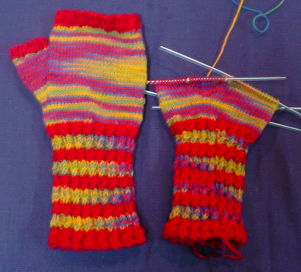
Approximately 200 yards of sock weight yarn – roughly one 50 gram skein. This pair looks to be using half a skein each of Lorna’s Laces Shepherd Sock and Dale Baby Ull. (I can’t guarantee that this is a spot on perfect quantity estimate as I am not yet done with the second mitt.) This would be a good project to use up odds and ends of several self-stripers, pairing them with one solid color common to them all. Five US #1 double pointed needles?(2.5mm). May be knit using the two circ method by considering each two-needle unit = 1 circ
Gauge in stockinette:? 9 st = 1 inch
Twisted cable ribbing:
Round 1: (K2, p2), repeat
Round 2: (K2, p2), repeat
Round 3: (Right twist using this method: [K2tog, leaving unit on left hand needle. Re-insert right hand needle tip into stitch closest to end of left hand needle. Knit this stitch. Slip entire now-twisted two-stitch unit to right hand needle], p2), repeat
Round 4 and 5: Repeat Rounds 1 and 2
Wristlet/Pulse Warmer or wrist part of Whatevers:
Cast on 64 stitches and knit one round, using the method described in yesterday’s post. You should have 4 dpns, each with 16 stitches (or two circs with 32 if using that method.) Work twisted stitch ribbing for 9 repeats (45 rounds). I alternated my two color yarns, switching colors after Row 5 and stranding up rather than breaking the yarn at every stripe. Note that you can end off right here and have a perfectly nifty pair of pulse warmers, instead of continuing on to make the thumb hole and palm part of these mitts.
Left Thumb Gusset and Palm (Mitt #1 only):
Knit 9 rounds in stockinette.
10th Round: Knit all the stitches from Needle #1. Knit 12 stitches from Needle #2. Place a marker. M1, K2, M1, place another marker. Knit remaining 2 stitches on Needle #2. Knit all stitches on Needles #3 and 4.
11th Round: Knit all stitches
12th Round: Knit to marker. Transfer marker to right hand needle. M1, Knit to marker, M1. Transfer marker to right hand needle. K2. ?Knit all remaining stitches on Needles #3 and 4.
13th Round: Knit all stitches.
Repeat rounds 12 and 13 until there are 24 stitches between the two markers.
Knit 2 tog at the beginning of Needle #1.Knit remaining stitches on Needle #1. You should have 15 stitches on Needle #1. Knit to marker. Slip the 24 thumb stitches onto a stitch holder or piece of string. Stranding very tightly to avoid gapping, knit the remaining two stitches of Needle #2 together. You should have 14 stitches on Needle #2. K2tog, knit remaining stitches on Needle #3. You should have 15 stitches on Needle #3. Knit all stitches on Needle #4. There will now be 60 stitches total.
Knit 10 rows. On 11th row begin working rounds 1-5 of Twisted Cable Ribbing (I chose to switch back to my solid color for this). You will find this easier to work if you slip the first stitch of Needle #2 to Needle #1 and the last stitch of Needle #2 to Needle #3 just prior to commencing this round. Bind off in pattern.
Right Thumb Gusset and Palm?(Mitt #2 only):
In theory you could just make two lefts, since there are no fingers in this piece to skew the fit one way or the other. But I think it’s more satisfying (and marginally better fitting) to do a mirror image. Plus it’s good practice for anyone planning on graduating from fingerless whatevers to real gloves.
Knit?9 rounds in stockinette.
10th Round: Knit 2. Place a marker. M1, K2, M1, place another marker. Knit remaining 12 stitches on Needle #1. Knit all stitches on Needles #2, 3 and 4.
12th Round:? Knit all stitches
13th Round:? Knit to marker. Transfer marker to right hand needle. M1, Knit to marker, M1. Transfer marker to right hand needle. K2. Knit all remaining stitches on Needles #2, 3 and 4.
14th Round: Knit all stitches.
Repeat rounds 13 and 14 until there are 24 stitches between the two markers.
Knit 2 tog at the beginning of Needle #1. Slip the 24 thumb stitches onto a stitch holder or piece of string. Stranding very tightly to avoid gapping, knit the remaining 12 stitches of Needle #1. You should have 14 stitches on Needle #1. Knit 14 stitches on Needle #2, K2tog, knit You should have 15 stitches on Needle #2. Knit all stitches on Needle #3, and 4. There will now be 60 stitches total.
Knit 12 rows. On 13th row begin working rounds 1-5 of Twisted Cable Ribbing (I chose to switch back to my solid color for this). You will find this easier to work if you slip the last stitch of Needle #1 to Needle #2 just prior to commencing this round. Bind off in pattern.
Thumb:
Evenly divide the 24 stitches of the thumb onto three DPNs. With a fourth work the following rounds of Twisted Cable Ribbing:
Round 1
Round 3
Round 5
I chose to work these in my solid color. Bind off in pattern. Darn in all ends, taking care to snick up the hole that has formed at the base of the thumb where the ribbing began.
Please note that this pattern is copyright 2005, by Kim Salazar, and may not be reproduced or distributed in any format without her permission. It is intended for private end-consumer use only. Please contact the author for permission if you intend to make up this item in quantity for sale or charitable donation.
Mailbag Questions
Michelene asks how I keep half hitch cast on stitches from loosening and turning into big loops. The answer is knitting them very slowly, firmly, and carefully. They will distend somewhat, but if your second row is neat and even, the cast-on row will snick itself back into reasonable shape. The long string gap between needles will also resolve itself; and the beginning/end round gap is addressed by the trading stitches trick also described.
Important note on this – If you try to work a normal purl on a half hitch cast on stitch, the cast on stitch will disintegrate because the motion of the purl undoes the twist that formed the stitch. That’s why the first round of the sock method described two days ago is all knits. If you MUST purl, do a twisted purl through the back of the loop. Awkward, yes – but it shouldn’t disintegrate.
On finding teeny size needles, I get most of mine at my LYS – Wild & Woolly, in Lexington, MA. They get them every now and again as part of their DPN order. When I see a set in a size I haven’t got yet, I buy it. I’ve also found some in yard sales and other yarn shops. If your local shop stocks Inox accessories they should be able to special order them for you. There are also lots of on-line sources for specialty needles. I’ve never dealt with either, but both Lacis and JKL Needles! both have quite extensive offerings.
QUESTIONS – BOTH INTERESTING AND ANNOYING
Interesting Question
Yesterday Marcia asked about the K2P2 rib I posted about. She wants to use it on a hat where the brim is worn folded up. She’d like to have the pattern visible on the flipped up part, and wants to have the twists on the hat body and brim oriented with the same leg on top.
I haven’t tried this, but I think that if this stitch were worked two-sided – with crossings on both sides, Marcia’s effect would be achieved. To do this you need to make it a six-row rather than a five row pattern. Marcia was also concerned with the leg direction, but if the thing is worked two-sided this way, when flipped up the reverse will display the cable twist crossings going in the same direction as the front. (Try it by making slash marks on both sides of a piece of paper, then folding it.)
To do it flat, I’d work:
Cast on a multiple of 4 stitches
Round 1: (K2, P2), repeat
Round 2: (K2, P2), repeat
Round 3: (Right twist using this method: [K2tog, leaving unit on left hand needle. Re-insert right hand needle tip into stitch closest to end of left hand needle. Knit this stitch. Slip entire now-twisted two-stitch unit to right hand needle], p2), repeat
Round 4: (K2, P2), repeat
Round 5: (K2, P2), repeat
Round 6: (Right twist using this method: [K2tog, leaving unit on left hand needle. Re-insert right hand needle tip into stitch closest to end of left hand needle. Knit this stitch. Slip entire now-twisted two-stitch unit to right hand needle], p2), repeat
In the round I’d work:
Round 1: (K2, P2), repeat
Round 2: (K2, P2), repeat
Round 3: (Right twist using this method: [K2tog, leaving unit on left hand needle. Re-insert right hand needle tip into stitch closest to end of left hand needle. Knit this stitch. Slip entire now-twisted two-stitch unit to right hand needle], p2), repeat
Round 4: (K2, P2), repeat
Round 5: (K2, P2), repeat
Round 6: K2, (Right purl twist using this method: [Skip the first stitch but retain it on the left needle and purl the second one, also retaining it on the left hand needle. Then purl together both the skipped stitch and the second stitch and move the resulting two-stitch unit to the right hand needle], repeat
Of course another way to deal with the problem is to knit the cuff area using the pattern as described yesterday. When it was deep enough, you’d add three rows of purls to make a welt (the fold line); then reverse direction and knit the cap part, using the opposite twist stitch wherever the original called to use one. That would put the right side of the cuff showing when folded up against the hat body.
Another Interesting Question
FeliciaSix says “Wow. Eyes. Monitor. Bright. Hurt. Why did you pick that most unsubtle of color combos for the Fingerless Whatevers?”
Because it’s cold, dark and dreary in the winter and I wanted to wear the opposite.
Annoying Questions
None of them are worth repeating. Some days I wish every computer came equipped to display this error message:
You can build your own error messages, too.
WORKING REPORT – FINGERLESS WHATEVER
UPDATE: REVISED PATTERN FOR FINGERLESS WHATEVERS IS NOW AVAILABLE AS AN EASY TO DOWNLOAD PDF AT THE KNITTING PATTERNS LINK, ABOVE.
Day 41 of the monitor hostage crisis. Will the unholy alliance of Samsung and UPS actually deliver?? Odds are not in my favor…
Seriously, thank you to eveyone who has offered up a monitor or pointed me at low-cost sources. This is a highly computer-enabled household, my not wanting to use one of the kids’ machines, The Resident Male’s deck or even the house server is more a matter of territoriality. This is MY set-up, and I want it to work. Right now I’m using MY laptop – older, slower, but enough for when I need to tote a machine with me on a consulting assignment. I can access my stuff on my base machine via VPN, and drive it remotely. It’s slow, a pain, but it works. So my whining is mostly about lousy service, not deathless need.
If you do have a spare monitor, please consider donating it to a local school, library, literacy program, shelter, or other worthy cause. They need it far more than I do.
Fingerless Gloves/Mittens/Wristlets (Whatever)
I still don’t quite know what this project is. I’m torn bamong doing?the fiddling to make gloves with abbreviated fingers, settling for truncated mittens, or something shorter like a pulse-warmer or cuff. In any case progress is being made. I have settled on an eye-popping combo of the Lorna’s Laces Socknitters Rainbow, and bleeding scarlet Dale Baby Ull. Interestingly enough, the red Baby Ull is perceptibly thicker than the charcoal black. I’ve used the black in combo with the Lorna’s on a sock, and found them much closer in weight. This isn’t unsual, many yarns sport thicknesses affected by the specifics of dyeing one color or another. Blacks, whites and natural undyed hues are sometimes different from other colors.
Here we see the proto-wristlet. After much experimentation, I’ve arrived at something that’s working:

In a counter-intuitive leap, I ended up having to use LARGER needles to make something that stretches enough. I moved up to US #1s, and used the stretchiest ribbing I know. It’s a K2, P2 variant with the two Ks twisted every 6 rows, making them into 1×1 mini-cables. To avoid looseness, I work the crossing as a twist stitch rather than as a true cable by knitting two together, but NOT slipping the result from the left hand needle, then re-inserting the needle tip into the end-most of the two just knit together. That stitch is knit, then the entire two-stitch unit is slipped onto the right needle. I picked up this trick from the stitch glossary in Walker III.
The pattern so far:? Cast on 64 stitches, work in the cabled rib described above, alternating colors every 6 rows. Exact length of how far to go or what to do next has not yet been decided. (It must be pretty evident by know that I leap long before I look, knitting-wise.
Big Box Stores and Yarn Stocking Patterns
Yesterday’s comments and letters brought several speculations on why big box stores stock a different mix of yarns than do specialty yarn shops, and observations of a convergence.
I think the posters were right. It’s got to be an “economics of scale” phenomenon. Big box crafts and discount department stores buy in huge lots. They use the size of their purchase to negotiate price concessions from the manufacturers. Lion, Caron, and a couple of others can supply yarn in ISO shipping container sized lots (the huge boxes that stack the decks of freighters, that are lifted off to become truck bodies). That’s the quantity larger stores typically purchase.
Even medium-sized big box stores can buy in larger quantities than LYSs. Here in Eastern Massachusetts we’ve got? small sewing specialty chain called “Fabric Place.”? They’ve always stocked yarn, but over the past five years have greatly expanded their department. They’ve also cornered the local market for Reynolds Lopi because they were able to offer it at a far lower price than smaller shops. Although Lopi had been a good seller at most local yarn shops, sales fell to zero in the face of competition – especially from FP’s special sales, in which it was marked down to $1.50 per ball. All the smaller shops dropped the line, and the only source of Lopi around here is now FP (which hasn’t offered the ultra-low price in a long time.)
Right now in this area the big box crafts store/distributor combo?that is evoking the most ire is A.C. Moore. They appear to have cut a deal with the distributor Knitting Fever. Now that doesn’t mean you’re going to find Noro yarns at Moore. It does mean that many of the other lines that Knitting Fever handles – Sirdar, Schachenmayer, their catch-all Euro category, and even On Line products are showing up there, at prices below what LYS can meet. I predict that as a result, LYS will be decreasing their stocks of Knitting Fever yarns – they just can’t afford to fight a store with Moore’s retail clout.
Is this good for knitters?? Yes and no. Yes in the short term. It means yarns for less. No in the long term. It kneecaps a major source of support for knitting and knitters. Big box stores are notoriously fickle, and known for limited at best customer service. I dread what will happen if they suck up too many yarn lines. LYS, already under attack from?web-based competition?will have additional pressures in their fight to stay open. Some will die. ?And when the knitting trend crests and the big box stores move on to scrapbooking or whatever fad is next, we’ll have even fewer sources for both yarn and advice.
What can we do about it?? Support your local yarn store. If you’ve got one nearby and?can afford it, buy there. Think of that extra 25 cents per ball as an investment in having hands-on help, and a source of other yarns?available. Please, no whining about lousy and or snooty?LYSs, how you live on a fixed or student income, or that the closest one is 100 miles away. We’ll save those complaints for another day.
Manga
Japanese-import or derived comic books. More like?graphic?novels, actually. There’s a big cross-over between manga and anime (Japanese animation) in stories, artists, and look/feel. ?If you know the TV cartoons Sailor Moon, Ruroni Kenshin,?and Yu Yu Hakusho you’re familiar with the aesthetic. Subject matter is all over the map – everything from romance novels to mysteries, the supernatural, history, and hard science fiction. Many are quite adult in theme and depictions, but others are aimed at a more teenage audience. They’re all the rage in the junior high and high school sets. The Older Daughter loves them.
Don’t tell her but I like them too. Maybe someday I’ll confess about the eight collectors’ boxes of ’80s vintage comics we’ve got squirreled away. I think she’d like Lone Wolf and Cub, and the not-Japanese?Stinz.
OOP BOOK REVIEWS – TWO GENERAL OMNIBUS VOLUMES
Sometimes useful things can be found in strange places. I don’t consider used book stores to be particularly strange places, but I’ve found all manner of things there overlooked at the end of the craft book shelves.
Case in point – those multicraft omnibus type books. You know the kind – Needlework 101 with a sagging binding, pix of frumpy looking or laughably outdated garments, and short chapters on everything from plain sewing to macrame, with side trips to knitting and crocheting. The Great Great?Godmother of all of these (though not the first book of this type) is the classic de Dillmont Encyclopedia of Needlework, aka The DMC Encyclopedia of Needlework. That book is still in print, and remains a very valuable resource in spite of the fact that it was first published in the 1890s.
There have been thousands of books of the same general type published since. Many can be found languishing in used book stores, upstaged by their far more popular sisters. But many of these books are more useful than their sad covers, dated projects, and scattershot presentation suggest. Today I’ll look at a couple of these.
First is?Stitch by Stitch:? A Home Library of Sewing, Knitting, Crochet and Needlecraft.? I believe this to be a hardback periodical or installment-bought crafts series, issued in at least 20 volumes by Torstar Books. The copyrights start in 1984 or 1985. I only have Volume I (shown), so I can’t speak to the rest of the series.
Volume I?is a standard exemplar of its type, but it’s better illustrated than many, with the knitting?and crochet?sections stuffed full of?photos showing how to hold the needles or hook, and how to form?the stitches. That’s the kicker in this particular book. It’s got the best illustrations I’ve seen of the pencil grip, throwing/flicking?with the fingertip?knitting style. Volume I just covers the absolute basics – crochet chain, single, double and triple crochet; plus knit, purl, cast on, cast off, and ribbing, arranging the subject matter into six lessons for each craft?that use simple scarves and other projects to teach (some are very dated). There are also sections on needlepoint and plain sewing. ?Now not everyone NEEDS an on-shelf resource showing an alternative way to knit, but I’ve used it to help teach people who were uncomfortable with both Continental/picking, and the more popular methods of holding the yarn for British/American/throwing. Plus there’s a bonus here. Among the patterns is a very nice lacy throw, shown as a baby blanket.
|
|
|
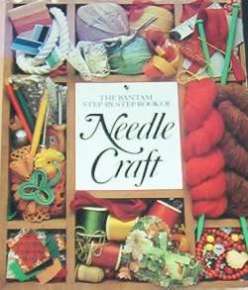
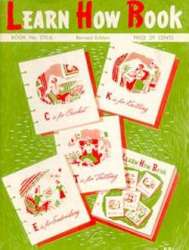
More useful is The Bantam Step by Step Book of Needlecraft by Judy Brittain; New York, Bantam, 1979 (left). This was also published in the UK as The Good Housekeeping Encylopaedia of Needlecraft, (possibly bearing the name of A. Carroll as editor) by Dorling Kindersley, Ltd, 1979. It’s been re-issued under a couple of different covers over the years. Along with a ’40s era Spool Cotton Company "Learn How Book" (right)given to me by my mother this is the book that taught me to knit.
Like Stitch by Stitch, this book covers several crafts and is copiously illustrated with color photos and (sadly dated) projects. It goes into much deeper detail than SbS.?? For example, the knitting section includes a small stitch dictionary, and covers all the basics, plus everything from designing one’s own pattern to gloves, socks, traditional lace shawls and edgings, bead knitting, and fixing mistakes. It describes both throwing and picking?styles, but?after a couple of cursory how to hold the needle?drawings?avoids showing finger placement again, probably to avoid committing to one method or the other.There’s a tremendous amount in there for only 90 pages of text and illustrations combined.
Although briefer, the crochet section is similarly nicely done. The book goes on to cover needlepoint and macrame (it was the ’70s); weaving, tatting, several styles of embroidery; pieced quilting; applique; and plain sewing. I find it a handy reference, even though I’ve got lots of more specialized and more complete books on my shelves.
I still have my mother’s?old green "Learn How Book."? That one is only 65 or so pages. It exists in many, many editions, varying mostly by the projects included at the end. Some editions also vary in the crafts detailed. Mine includes knitting, crochet and tatting, with side trips into embroidery for embellishment. The earlier ones were published by the Spool Cotton Company, which was bought by Clarks some time in the 1940s. Clarks in turn was gobbled up to become part of Coats & Clarks. The booklet continued to be published with updated projects and under the new owners’ names in turn. It’s useful but is now more of a sentimental curiousity than a living resource. I do however buy other editions of the thing when I stumble across them and the price is reasonable. I’ve got four or five now, ranging from the ’40s through the early ’60s.
Little to Do With Knitting – Firefly Series on DVDHow did we miss this one?? A very good friend gave us a Firefly?DVD set containing this entire very short lived SF series originally aired on Fox in 2002.
Fantastic!
We must have blinked at entirely the wrong nanosecond the half-season this was on the tubus. What an inopportune blink that was. Interesting scenario and stories, strong characters, excellent writing (too witty to have survived on regular TV), and even good acting with compelling and believable chemistry among the cast members.
The only bad thing about the DVD is that there were only 14 episodes, including a two-part pilot. But all is not lost. Sniffing around the web I note that a movie derived from the series is in production right now, scheduled for release in September.
Why does this have little to do with knitting instead of absoutely nothing?? In one of the episodes a particularly lumpen and lurid hand-knit hat makes a cameo appearance. It’s such an incongruously memorable thing that knitting fans of the series have posted patterns for it.
MORE QUESTIONS – SNOWFLAKES AND FOOD
Did you crochet those snowflakes on your tree?
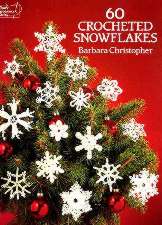
Yes. I’ve done them in several batches. I often invite holiday visitors to take one home with them, so replacement/supplement sets have been made. A couple of the flakes are my own invention, one or two are single motifs intended for bedspreads or tablecloths, but most are from these books:
 |
 |
Of the two, I like the patterns in the green Leisure Arts booklet better than the red American School of Needlework leaflet. The LA flakes are smaller, lacier and a bit more delicate. Both books are pretty easy for experienced crocheters to follow, but I’d recommend the red one if you’re relatively new to thread crochet. Warning – this IS thread crochet, although it’s pretty large scale for that style. These snowflakes all look better done with smaller threads and hooks. You can work them with relatively large threads, size 10 and bigger, but you won’t get flakes of a pleasing scale for hanging on a tree (they’ll look nice as door or window ornaments, though.) Mine were done with size 20 crochet cotton, although the next batch I’ll make will be with size 30 cotton, comparable to the stuff I used on the dragon curtain.
There are also lots of patterns for snowflakes on line, although I haven’t tried any of them yet. Noel Nevins maintains a nice index to them at her thread crochet website.
How was the cassoulet?
Wonderful. Worth the year’s wait. Beyond that, words fail me. And when that happens you know I’ve been conked royal.
Is cassoulet the most complicated thing you’ve ever cooked?
No. In what now seems like a previous life, The Resident Male and I were very active in the SCA (East Kingdom, Barony of Carolingia). Among the many things we did was host a Valentine’s Day event for the local group.
It was a themed day, and included several activities as well as a sit-down three course dinner for 125 people. The feast offered up nine main dishes from historical sources (of which I can only remember seven), plus three in-between-course sweets. The theme of the day was Chaucer’s Parliament of Fowles poem, in which the birds hold court to debate the nature of love. It’s more than 25 years ago, but as close as I can remember the “Feast of Fowles” ran something like this:
First course
- Ostrich eggs on salad nests – many chicken eggs cracked and separated, then the yolks poured into round golf ball sized molds and cooked to set. The whites were poured into huge half egg-shaped molds. When they were mostly cooked, the centers were set inside two half-whites.
- Not Chickens – a chicken skin with legs and wings intact, stuffed with a forcemeat style sausage, sewn back into chicken shape and roasted.
- A barley-thickened chicken soup with leeks (broth made from the bones and scraps from the Not Chickens)
- First sweet – spun sugar nests with tiny marzipan birds
Second course
- Ham dressed in pastry to resemble sleeping swans
- Chicken pies – the meat from the Not Chickens after the soup was made, cooked with onions, leeks and bread,?made into open face pies
- [memory fails on the third dish]
- Second sweet – Feather shaped shortbread cookies (again memory lapses, I think this was what we served)
Third course
- Roast duck stuffed with kasha and onions
- Beef birds – roulades of thinly sliced beef, wrapped around garlic and mushrooms, then braised
- [memory fails on the third dish]
- Third sweet – Peacock in its pride – three magnificently shaped and painted gingerbread cakes, each sporting heads, wings, and a fan of real peacock feathers behind.
There were also sallets (vegetable side dishes), brewed mead and ale, and nibbles offered earlier in the day. Before your mind boggles, please note that we didn’t offer these dishes in full-serving-per person portions. There was enough of each for everyone to have a fair taste, and to be full at the end of the meal, but not enough to stuff everyone silly (For example, for each table of ten we sent out one pie, one duck, one Not Chicken, etc.)
The Resident Male and I did not do all the cooking ourselves. Lots and lots of friends helped. They did the marzipan birds, the splendid peacock cakes, the beef roulades, the mead and ale, and half of the Not Chickens. Most of the rest we were able to cook together ahead of time and warm at the hall; the remainder we did on-site. RM ran the day-of kitchen, I ran the hall, the service, and arranged the entertainments, which included copious dancing (and flirting); a Court of Love adjudicated according to the rules of Capellanus; a poetry competition; and other gentle activities suited to the day and theme.
Needless to say, life has interfered with other pursuits and we don’t do this sort of thing much any more.
LESSONS LEARNED
It’s the last day of the year, and like everyone else I should be looking back over the year past, and ahead to the year future.
Lessons Learned for 2004
First and foremost – blogging is fun and (I hope) less of an imposition on people than is?writing interminable posts to the knitting-related mailing lists. At least the audience here is self-selected. Plus I’ve never kept a knitting-specific journal before. I find myself going back and looking up what I’ve written before to see how or why I did something in a specific way. Who knew?
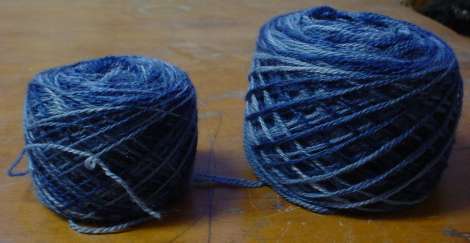
I learned a lot this year about the periodicity and use of variegated or hand/dyed yarns. Although the projects on which I employed them aren’t completed yet (Crazy Raglan, Entre deux Lacs Tee, and Birds Eye Shawl), I did spend lots of time figuring out how to get the color effects I wanted given the color cycle repeat lengths. This remains a fascinating topic for me, and as each skein of hand-dyed offers up new challenges, won’t be an area that becomes boring any time soon.

Filet crochet. I’ve done piddly little things in crochet before. Even blankets count as "piddly little" because they are generally very simple in motif and technique. Snowflake ornaments, a table-topper round cloth of simple design, several blouse yokes in the ’70s, a couple of ill-conceived faux Aran style kids’ sweaters, but nothing as complex as the filet dragon curtain. It turned out to be an even bigger project than I thought, and consumed the better part of five months. Lessons learned include the fact that no two companies’ crochet hooks are the same size (even if so marked); the effect that near imperceptible differences in hook size can make on gauge; how to do a near-invisible join on adjacent strips of filet crochet; and how well the old graphed patterns for Lacis and other Renaissance needle arts can look in filet.

Along the way to the filet crochet project I learned that none of the methods of filet knitting I tried worked particularly well, nor were they fine enough in gauge to handle the complexity of the dragon graph. I’m not through with this subject yet. I did do some experiments in alternate techniques that were less cumbersome than the methods I had read about. I’ll probably revisit this in the future.

Entrelac is much faster if you can force your fingers to knit backwards. I’m still no speed demon at left-to-right knitting, but I’m faster at it than I am at knitting and flipping at the end of each mini-row. Especially when those rows are only six stitches across.

I also learned (via my Suede Tee) that novelty yarns can bring a world of interest to a simple, well-drafted pattern, but at the same time can be a *(#@ to knit. Side note:? I am also not that pleased on how the Suede is wearing. The microfibers do tend to be grabby, and catch on even the slightest roughness.

I learned several methods of knitting a lace edging directly onto a piece, rather than making it as a strip and sewing it on later. The most fiddly but most satisfying came via the Forest Path Stole. I used it again on my Spring Lightning Scarf:

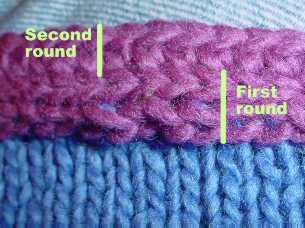
Under "miscellaneous," I learned a nifty I-cord trick that applies a band of cord to both sides of a strip of knitting (apologies for the blurry photo):

I also used?a highly trendy but extremely boring to knit kiddie poncho to experiment with double width I-cord treatments to help tame edge curl in large stockinette pieces.
And finally, I learned an important lesson about something to avoid in the future. If any of you have ever looked at a loosely plied yarn like the Paternayan’s normally sold for needlepoint, and thought about how nice only one or two of those plies might be for lace knitting – take heed. Spare yourself. The yarn for the Larger Kid’s simple drop-stitch rectangle poncho took longer to de-ply than it did to knit up. For this one, I still bear the scars…
Next year?
Who knows. If you’ve been reading along, you’ll have noted that I’m more of a whimsy knitter than a planner. Projects leap up and seize my interest. Sometimes that interest wanders before I finish, but I (almost always) go back and work to completion. Eventually.
I’m finishing up a couple more unanticipated last minute gifts right now – more socks, and a pair of quickie Coronet hats from Knitty (one hat = one evening). Then it’s back to the Birds Eye shawl and the Crazy Raglan. While I don’t as a rule knit to deadline, the Raglan is for The Small One, and the one thing certain about 6-year olds is that they’re a moving target growthwise. The shawl is a present that I really should finish by the summer. Unless another killer project like the dragon curtain ambushes and drags me off first…
REGIFTING YARN
Another pair of quickie socks. Unfortunately technical difficulties preclude my posting pix, but this is another pair knit from Lion Magic Stripes. Again the same as before – o.k. sport weight sock yarn; very inexpensive; ho-hum striping pattern (although to be fair, the repeat for Stonewashed Blue is about 6.5 inches long as opposed to the 1 inch repeat for Lumberjack Black). Ripped through the whole pair in one afternoon while playing with the kids on their new PS2 unit.
So ends my foray into Lion’s sock yarn line, as both skeins (received as a gift) have now been knit up and presented to happy recipients. Which brings me to a question. Is receiving a yarn gift, knitting it up and then giving the resulting item as a present considered "regifting?"
I note that some regard the idea of regifting as being somehow suspect.I can agree that receiving something truly awful and then foisting it off on someone else just to get the thing out of the house isn’t the most generous gesture in the world. But there have also been lots of occasions on which I’ve?received something perfectly nice that wasn’t either to my taste, or wasn’t useful to me. At the same time I knew that those items would be both deeply appreciated and used by others. Regifting in those circumstances seems less egregious.
But getting a yarn gift… Does it imply that the donor wants you to make something for yourself?? I’ve used yarn gifts to make presents for the person who gave me the yarn (but only for people who clearly would not expect such a thing). I’ve used yarn gifts to make things for third parties, or for charitable donation. Do those uses devalue the original gift?? Or is yarn once given entirely free of obligations or nuance, and eligible for any use the receiving knitter might desire?
 String-Or-Nothing