BLISSFUL QUIET
Sort of.
Holiday knitting is four rows away from being finished; all cookies have been baked, packed and distributed; holiday cards are sent; the presents are all wrapped; the holiday wine is selected; the remaining incoming boxes have been retrieved from the post office; the roast is resting prior to cooking; the tree is decorated; and the kids have just put the final touches on the gifts they’ll be giving to each other. And the replacement for my dead monitor showed up a week early!
So, what’s a family to do?
Play Killer Bunnies!
Now for those of you who say that doing so violates the pan-humanist side of the end of year holidays, please note that no actual bunnies were harmed in the creation of the game.
There will be a hit or miss pattern of new String posts?over the coming week because we will all be home. The resulting chaos will probably preclude any regularly scheduled pursuits.
I wish all a year filled with health, prosperity, and the hum of happy fiber-related activities.

LAST OF THE HOLIDAY KNITTING; GENETICS
One last scarf to go. Since (at this point) I’m brain dead and desperate for something quick and easy, it’s a great thing that Knitty’s latest came with a fast-knitting piece that offers great bang for the time unit investment. Add me to the legion of folks doing up a Wavy Scarf.

I’m using that same sport-weight alpaca I used for the Kombu I finished last week. Because it’s of finer gauge than the standard-issue worsted written up in the pattern, I’ve added an additional six-stitch pattern repeat to make up the width. Mine is done on 48 stitches instead of 42. I’m also visually lazy, so I graphed out the pattern so I don’t have to rely on the prose write-up. Note that if you want to use a different weight yarn, modifying the thing is quick and easy – either add or remove multiples of six stitches.
In other knitting-related news, most of my knit presents are winging their way cross country right now, or are about to be distributed to those nearby. Once this scarf is done I’ll be done, done, done. (Huzzah!)
Cookie Liberation Front
Today’s cookie was an experiment – a coconut/oatmeal drop, based on a standard brown sugar drop cookie recipe, with toasted oatmeal and unsweetened coconut tossed in. Since I had some whole blanched almonds left over, each was topped with a nut. Younger Daughter said the rough-shaped cookies with almonds atop them looked like birds nests, so that is now their name.
Tomorrow’s cookies – Chocolate rounds stuffed with marzipan. I haven’t decided to do them flat or folded in half like little chocolate/almond gyoza yet. Also another experiment, but this one will be a shortcut cheat. I’ll be taking a sheet of frozen puff pastry, painting it with a beaten egg, then spreading it with sugar, cinnamon, and chopped pecans, folding it a bit and cutting it into elephant ears. Pix for sure, as this is something impressive looking even the Cookie Challenged could do.
Genetic Component of Crafting?
Marilyn the Knitting Curmudgeon posted an interesting thought the other day (one of many for her, I might add). She mused about whether or not the urge to do something like knit or make other crafts might have a genetic component to it. That got me thinking…
I’d guess that there would be a large inborn aspect to the desire to do these things. But I think there’s more than one influence at work here. To simplify, I’d guess that there are at least two:
- Some set of things governing the process that generates original ideas
- Some set of things that governs the "gotta-do-it" urge
I know people who have a strong concept-generation bent. They fairly sweat ideas, finding new viewpoints or perspectives, synthesizing disparate influences, or distilling previous exposures in innovative ways. The most affected of them sometimes have a hard time sticking to one idea long enough to bring it to full fruition, and may not have even mastered all of the skills necessary for optimal completion, but neither limitation strikes them as a problem. A person like that is off and running, captive to the next idea before the earlier one is completed.
I also know people who have the "gotta-do-it" urge, but the idea generation set in them is less strongly manifested. They are in constant motion, producing endless streams of items verbatim from directions or patterns. They often have extremely accomplished sets of technical skills, but can be stymied by roadblock problems. I have a friend who would seize upon an idea and explore it in hundreds of minute variations. She’d make wonderful little toys or identical baby sweaters by the dozens (in the case of toys – by the hundreds). All were beautifully crafted, yet it often seemed that once she started, "retooling" to make something else was difficult for her. She’d hum along happy to make even more of the item under current exploration rather than switching to a new thing. For her I think that fulfilling the "gotta-do-it" urge to keep busy was the true reward.
And then there are the folks who have both influences working on them in various proportions. Some feel particularly pressured or depressed because they have an inexhaustible source of new ideas and the urge to see each through to completion, but rarely have the time available to accomplish them all. Others are at constant war with themselves, reining in their urge to start something new before the item at hand is completed, and (sometimes) growing to hate the almost-finished item for blocking the beginning of the next.
Why do I think this might be genetic? Because I’ve seen these urges run through families. Not every person in the family need have the exact same hobby, but the mindsets do replicate through the generations. I know my father was a very compulsive "gotta-do-it" guy. Detail oriented in the extreme, he was a classic definition engineer. He never just sat still, he was always reading something, tinkering with something, or meticulously graphing something (he would have adored PCs and spreadsheets but died before they were sold). I know families where the parents or grandparents are method makers or idea shedders. Their households are sometimes chaotic places, but their kids also scatter innovation behind them and flit from project to project.
Why do I think these things are inborn rather than learned? Because in some cases I see these traits skipping generations; manifested in a household where the older influence was physically absent while the younger example was growing; or emerging later in life. Plus I know from experience it’s very hard to teach either creativity or perseverance. These are bents that people are born with. You can encourage these characteristics, but you can’t transplant them into someone who doesn’t lean that way to begin with.
I’ve got a very strong "gotta-do-it" bent. Perhaps it’s related to the milder forms of ADD, but I find HAVE to be making something, and I’ve been this way as long as I can remember. Even as a little kid I had all sorts projects underway (and heaven help the adult who put them away before I was done). I even fell into needlework at a very early age, and completed my first clumsy cross-stitch sampler before Kindergarten.
Just sitting has always been extremely difficult for me. Even just sitting and listening/watching something is hard. My hands have to be occupied. When my fingers are distracted, my mind is free and I concentrate better. Conversely, if my fingers are free, my mind is bound by the minutiae around me and zeroing in on some one thing in specific is harder. That fly buzzing around the lecturer’s podium; the interesting detail on the curtains behind her; the texture of the cracked wood at the edge of my seat; the air currents around my ankles; an amusing joke the guy sitting across the room told me last week; where I might be meeting with friends after the lecture; the faint sound of sirens outside the lecture hall; what color combo would be best for the thing I’m planning to make the day after tomorrow – all of these at once descend upon me and compete with the content being delivered in the lecture itself. Mindless autopilot knitting has always been my best defense against them.
I have to believe that I was born this way because I certainly didn’t learn this behavior from anyone. I can’t help this, it’s just the way I am and I’m glad to have found the coping mechanism of knitting. So I guess I agree with KC’s basic thought. There’s an enormous genetic component to many people’s affinity for crafts of all types. Why fight it?
Panforte, Piping, Presents, and Paeans
Panforte
I promised a post-tasting report. Yesterday I spread melted bittersweet chocolate over the tops of my two cakes, dusted them with cocoa, and stuck some left-over almonds on top as a decoration. Did I mention that for the past week, I’ve been drizzling rum over one of them – a little bit each day? No? The secret’s out now.
Wow.
This is an adult chocolate dessert. It’s not soft, gooey, and sweet. To be truthful, it’s hard and chewy from all the fruit and nuts. The taste however is out of this world. It’s spicy, more bitter than sweet, yet with just enough sweetness from the fruit to round out the flavor. The faint hint of rum was a good addition, and seemed to bring out more of the toasty notes from the nuts. We served our cakes with a selection of white wines. It would also be great with hot coffee or tea.
This one is a make-again keeper, but unless you’ve got a huge crowd coming or want to freeze or give away cake #2, I’d suggest halving the recipe. I’d also suggest sticking with the hazelnuts and almonds. You can use any dried fruit you wish (I used prunes, dried cherries and apricots because I don’t like citron and figs were too expensive), but I think that substituting walnuts or pecans would overwhelm the cocoa’s flavor and change the character of the cake.
Socks!
More holiday gift socks.
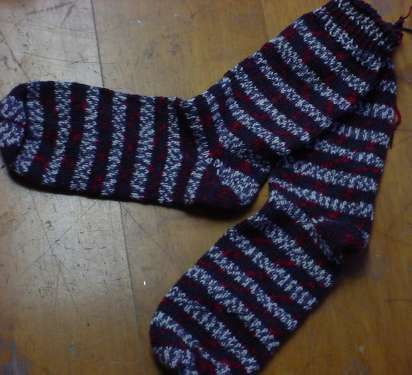
I knit these Saturday night from Lion Brand Magic Socks, while watching Present #1 below. These socks are worked at 7spi/10rpi on 2.5 mm needles (in between a US #2 and #3). The yarn is serviceable enough – a standard wool/nylon blend sport weight as opposed to fingering weight sock yarn. The color patterning is pretty uninspired compared to most. I get two speckled fake “Fair Isle” sections in this repeat, one in gray and white, the other in red and black. The entire repeat cycles in about 1 inch. Not terribly exciting, but at $7.00 US per 100g ball (enough to make up to about a man’s US size 11 shoe) – a very good value.
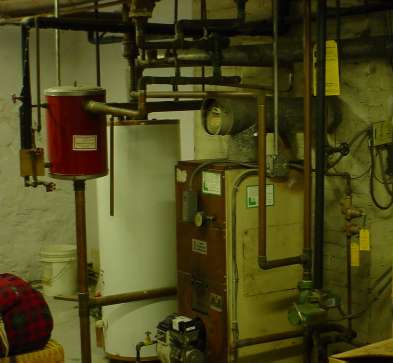
This pair is for a new neighbor who showed me how our 100-year old hot water heating system works, and helped me figure out the Rube Goldberg device that’s our boiler:
Presents and Paeans
The Resident Male and I buy gifts for the two of us together, but don’t wrap them or bother to save them for holiday debut. This year’s presents were the extended DVD edition of Return of the King (better than the theatrical version, but unsatisfying if you yearn for much of the books lesser themes and characters); the long awaited Lurulu by Jack Vance; and the Vance Integral Edition. The latter most was a major splurge that will count on the present roster for years to come.
Vance is writer whose works are easy to satirize because of his unique style, and who is dismissed all to lightly for it. At the same time, he has a devoted following of readers who appreciate them for what’s deeper underneath. His following in is bigger the UK and Europe than in the US.Vance appears to be especially popular in the Netherlands, Germany, and France – all in translation. That surprises me as so much of the texture of his prose is in his precisely worded detail and structured phrasing – things I wouldn’t think would move well from English to other languages. Even his old fashioned space opera style stories have a depth of character and sardonic insight into the ironies of human nature that push them beyond the genre.
If you’ve never read anything whatsoever by Vance, I’d suggest you start with the widely collected short story “The Moon Moth.” You can find a list of books containing “The Moon Moth” on this page. If you can’t find a copy, you can listen to a dramatization here. After that, pick up anything. His better known works include The Dragon Masters, the Demon Princes series, the Planet of Adventure series, Lyonesse and its sequels; the Alastor cycle; and the Dying Earth books. I’d start with his earlier, shorter works. They’re each masterpieces of tightly crafted plot construction, and fit an amazing amount highly evocative storytelling into some truly slim volumes. Enjoy!
MORE SOCKS
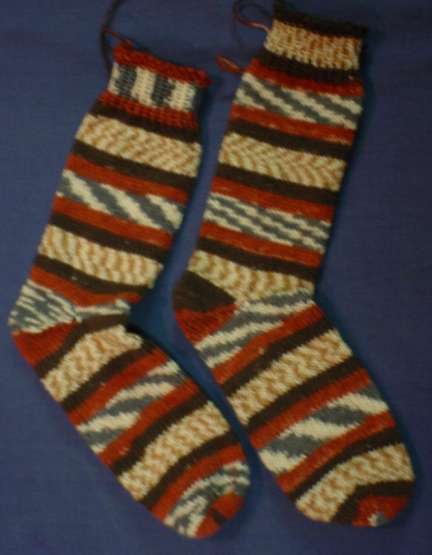
More holiday gift socks. Nothing special, nothing exciting (and nothing learned).
I knit these last night from Schoeller+Stahl’s 6-ply version of Fortissima Colori/Socka Color. It’s a smidge lighter than DK weight. I’ve added into on the length of its color cycle to the striper repeat chart I posted earlier. All in all a very quick and satisfying pair. A bit heavy for my own sock wearing preferences (I prefer 4-ply regular sock weight yarn knit at tiny gauges), but nice none the less. Another blurry photo:
I find it easier to knit self-stripers when I’m watching TV or a computer game. Otherwise I’m tempted to watch my fingers and micro-adjust my tension to modify the striping effect. That never quite works out right. So I save this type of autopilot knitting for when I’m otherwise distracted.
Cookies
I’ve gotten some good-natured ribbing back on the cookies. For the record, I’m no domestic diva. Martha Stewart makes me think of those Victorian women’s magazines, filled with advice on decorating a status-conscious parlor, complete with directions for crocheted chair leg cozies and decorated cardboard toothpick holders. Then I shudder.
I’m more of a tallish, glasses-wearing, workbooted, aging grrlnerd with a weakness for needlework, history, books and good food. Not necessarily in that order.
THE BEHINDER I GET
I can’t say I’m going any faster, but I’m in the swim of things with my gift knitting. I have to admit a tinge of guilt this year. In years past, I’d done a fair bit of it far in advance, sometimes using especially mindless gift knitting (like socks or scarves) as bliss-out-on-the-beach pieces during our summer vacation. Or I’ve doodled up little projects between larger ones, while I was waiting for my ideas to set. By this time I’ve usually got a basket of goodies ready for holiday giving. Unfortunately, this year nothing got done ahead of time, and I’ve been forced to do something I detest – knit to deadline.
I hate knitting to deadline because in my professional life, all I do is march to deadlines. I’m a proposal manager, and I’ve lived my career in 30-day increments. Other people will say things like, “Dear, remember ’91 – that was the year little Brunhilde was born,” or “Yeah, 91. Cousin Ildefonse was in Desert Storm.” I say, “Fall ’91. That was that big military IT/hardware support proposal, we had an extension that got eaten up by the sheer bulk of the revised reporting schedule requirements.” From this you can well deduce the heart-stopping excitement of my daily life.
Knitting has always been a blissful interlude, a no-deadline finish-it-whenever sort of pursuit. That’s one of the reasons why I’ve shied away from pursuing commercial publication for my patterns. Squeezing my knitting life into a tight deadline sucks all the joy out of it.
So here I am. Doing frantic knitting on a couple of Hannukah presents (it’s early this year, adding further complications). The Kombu scarf, four hats, and two pairs of socks are done. That leaves three scarves, two more pairs of socks, and possibly couple of kid’s size earwarmer bands to go.
Today I plan on casting on for a very simple scarf done in Sandnes Lime (a mostly cotton, very soft yarn) for a friend who is wool-sensitive. I’ve used and reviewed the stuff before and not been wildly pleased with it, but for a scarf it should work out fine. Although most of the detail will be obscured by the textured yarn, I’ll probably work it in this simple knit/purl pattern – just to give it a bit more interest:

I like this one for scarves because it adds a bit of loft and like all patterns with near equal amounts of knits and purls on each row – it lies nice and flat without curling.
HOLIDAY HANGOVER
The holiday has come and gone, and now only we remain. The good news is that I discovered that:
- Brussels sprouts taste surprisingly good if they’re tossed in olive oil and roasted briefly in a hot oven, then sprinkled with coarse salt.
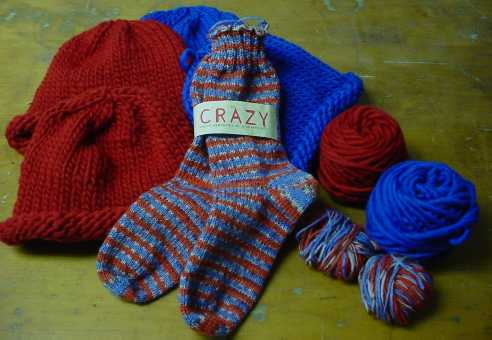
- I can knit four giant gauge hats in one afternoon.
- If you’re under 10, wearing a princess costume and a rhinestone tiara to a regional theater matinee isn’t considered overdressing.
- This year’s Beaujolais Nouveau is lighter and less banana-riffic than last year’s and as such is more pleasant for afternoon sipping while the bird is being basted. But find something with more backbone to go with the dinner itself.
The bad news is:
- I don’t like Idena Crazy (also and confusingly marked with the Asa Gjestal distributor name), a heavy sport/light DK weight yarn intended for socks. While it knit up fast into an attractive but rather pedestrian striping, it’s relatively scratchy for sock yarn, plus it had knots and uncomfortable sized slubs. Not one I’ll be buying again.
- If your roasting pan is too large and impedes the flow of hot air in your oven, your turkey ends up cooked with a dried out, hard integument instead of a deliciously toothsome skin, even if the meat is juicy perfect.
- There is nothing so kitschy on earth as a bad crafts fair.
The story behind it all. We had a lovely Thanksgiving holiday with my husband’s mother. In spite of the turkey disappointment dinner was quite nice.
Friday we went to a large crafts fair. I was expecting something like the ones I’d gone to in Northern Virginia – a mix of holiday stuff, trite crafty nonsense, but with a nice proportion of pieces displayed by artisans with talent.
Instead what we found was an indoor quarter acre of Polarfleece doll clothes; badly covered footstools tricked out with sports logo prints; cutesypoo faux rustic signs suitable for hanging in (some people’s) bathrooms, dried floral arrangements that looked more like what’s left over after the haystacks are neatened; fuzzy scarves worked up from Lion Fun Fur, marked at $30. each (since they weren’t selling, I’d say the fad has finally passed); cheap silver jewelry imported from China and India; and countrified things with ruffles but without purpose. No decent watercolorists, pewterers, silversmiths, potters, or printmakers. The kicker was one booth that was stocked entirely with beer cans into which someone had put clock hands and mechanism. One fellow had nicely turned wooden bowls. One person was showing not horrific pieced glass ornaments. One outfit had some interesting wooden puzzles and brain teasers. The only thing we ended up buying was a jar of respectably hot horseradish mustard, made in Vermont. Our amusement came mostly from pointing and laughing.
Saturday made up for Friday’s craft fair fiasco. We took the kids and MIL to a regional theater production of Beauty and the Beast. The cast was quite talented, much better than I expected, and there was something refreshing on seeing a play that relied on their talents rather than $10,000. costumes and intense special effects. If you’re local to the Boston metro area and want to bring kids to live theater without breaking the bank on big-production ticket costs, check out this production. It’s well worth it, even if you end up having to borrow the kids.
GIFT STAMPEDE
Caught unawares by the early date for Hannukah, plus the realization that Christmas isn’t far behind, I take a detour into knitting small gifts for friends, family, and other deserving folks.
[Side brag] The Older Daughter just finished her second project – the classic Cleckheaton Gusto 10 42-stitch hat. She learned to knit on DPNs in the round, and I got a great hint for a flock of small presents.
Gusto 10 is a very dense superbulky yarn. It’s not very expensive, but at $9.00 US per hat (55 yards), it can add up quickly. I’m making several of the same hats, but instead I’m using Brown Sheep Burly Spun.? It’s just a tad less dense than the Gusto, but at $14.00 for 132 yards, I can get two hats from each skein with a bit left over. Last night I did the first two in about 45 minutes each. I’ve planned to make four – two deep red and two royal blue. I may get an extra skein in another crayon color and make three more – two more solids, plus one striped one from the leftovers of all three skeins. Or I might make a couple of earwarmer bands from the red and blue leftovers. All in all, not an exciting set of projects, but a satisfying and quick one.
Other gifts in the works – several pairs of socks, knit at sport gauge rather than my standard personal-consumption teeny gauge. (Again the time factor). Plus I think I’ll give the Spring Lightning Scarf as a gift.
On the kid’s knitting, she’s getting too quick to keep feeding her superbulky yarns and giant gauges. I won’t be able to afford both our knitting habits. [grin]? So I’ve started her on a set of wristlets, done in sock yarn in the round on US #2 DPNs. We’re adding purling to her skills set with this ribbed project. Those should keep her out of trouble for a while.
OOP BOOK REVIEWS – CREATING & KNITTING YOUR OWN DESIGNS…
Back at station. There’s a giant hole in the world today where a dear friend of mine used to be. "Kinsmen die, cattle die. Every man is mortal, but one thing never dies: the?good name of one who has earned it." Havamal, 75.
My heart aches for his wife, son, family, and household.
As promised, here is the second review of the set – Montse Stanley’s Creating & Knitting Your Own Designs for a Perfect Fit, New York,?Harper and Row, 1982.
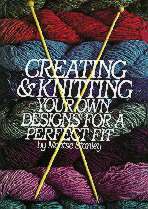
In the days before knitting software, books like this one, personal apprenticeship, or trial and error were the ways one learned how to draft out one’s own patterns. Not knowing anyone who was doing designs to ask for help, I relied exclusively on the "books plus making lots of mistakes" scenario for most of what I knit. A couple of books in particular were worth their weight in gold. This was one. The pictures and projects illustrated in C&K are now a bit late ’70s funk/frumpy looking, but the basics of this book are as good as ever.
This book is so good in fact that I have used it in training classes for budding technical and professional writers, to illustrate how a complex set of technical concepts can be conveyed to an audience that includes both the experienced and novices without losing either of those readerships. The blurb says Stanley was an architect. I believe it, and would love to find out what sort of things she designed because the clarity of her thought processes rings from her pages.
It’s a survey course in knit design and technique, packaged up in an amazingly brief 175 pages – including index and custom graph paper. Like Perfect Fit, this book covers taking measurements and turning them into dimensioned schematics. Like PF, it skips over making a sloper – but unlike that book it translates the measurements directly to specific vectors on the garments, rather than to an abstract and idealized shape. Therefore short waisted people end up with garments that start out being custom-fit to that figure type, rather than taking a standard shape and altering it to meet their needs. Stanley goes further, taking the brilliant step of introducing ratio-based graph paper into the garment design. You knit up a swatch, figure out your stitch:row ratio, and select the graph paper that matches the closest. You can then lay out your collar shapings or other details "in real time."? Need a 40-degree angle?? Slap a protractor on the graph paper and draw your line. The graph boxes under it each represent a real stitch, and the rate of increase or decrease needed to achieve that angle are easily seen and counted. The book includes about ten pages of ratio graph paper for photocopying. I don’t know if anyone else wrote a knitting book that advocated the use of ratio-based graph paper before Stanley, but nothing else I’ve found has so clearly explained how to use it.
Stanley didn’t just publish a graph paper book, she includes an extensive section on knitting technique, including finishing, grafting, short rows (darts),? mitering, picking up, and types of increases and decreases. She’s got a stitch dictionary section? (all prose, none graphed); sections on materials and suitability, color, composition, and garment shapes – including a huge array of body, sleeve, closure, neckline, collar, and pocket options. Each garment shape is illustrated with a little line drawing, and has a brief prose description – usually enough to get one started drafting out that option on one’s own. The placement of critical measurements on these little drawings enables seeing how the garment works in relation to body shape/size.
There’s a section on moving beyond combos of these garment shape units; how color, knit direction, motif/texture placement and trim can greatly alter the look of a basic garment. Again this is illustrated with little line drawings, some woefully ’70s in feel. Even though some are out of date, the wealth of them can start the reader’s thought processes ticking.
The book closes out with a section on troubleshooting – what to do to correct styles (too long/short, narrow/wide), miscalculations (messed up texture or colorwork patterns), misplaced openings or buttonholes and the like. Add on some basic size charts, growth allowances charts for kids’ clothing, ease allowance charts, a few other quick calculation look-up charts, some color photos of finished items and discussions of them (but not whole patterns) and you’ve got this book.
I admit that a book like this is less valuable today than it used to be. Knitting design software has enabled a much wider audience to do basic pattern drafting without resorting to calculators, graph paper and pencil. But this book will still be very useful for anyone who wants to move beyond? the "black box" mystery mechanism use of that software. For example, you can start off with a knitting software-generated simple cardigan, then get inspired by this book to turn it into a jacket with an asymmetrical closure slanting from hip to shoulder. Stanley won’t tell you the exact stitch count or formula for that translation, but you will emerge from reading the her brief on that style with enough knowledge to make the change on your own. I suspect that everyone who has written a knitting design software package has?C&K on her or his shelf.
Montse Stanley’s work (in combo with?that of a couple of other authors) has made a tremendous difference in the way I knit, the way I look at and use patterns, and the scope of what I feel is within my own limited competence.One warning – this book IS?hard to come by, and sells used at a premium above cover price. But if you can find it and afford it, and?want the inspiration and enabling it contains, I strongly recommend adding C&K to your library.
RELAX. YOU’RE BLOCKING
From my inbox, based on yesterday’s post:? Does knitting really need to be blocked?? It seems so inconvenient to take all these finishing steps when we all want to get the current piece (finally)?done, try it on, and cast on for the next.
It’s?up to you. I find that while blocking is far from an absolute remedy for all knitting ills, it does even out stitch imperfections, improve drape, and even does a little bit to help tame curl. I do a wash/wet block, in which I wash the garment as I intend to for the rest of its life, then pin it out to dry. I never use any of the steam blocking/finishing methods. You can set yarn for life using steam, a mistake is yours forever. But wash/wet blocking can be undone by another trip through the laundry.
I don’t block everything I knit, but I almost always block wool or wool-blend things larger than socks. I also almost always block things I intend on sewing together. If I’ve knit in the round, I’ll block the body and sleeves before attaching them. If the sleeves go on early (like on a Wallaby, where they are joined before the yoke is knit I’ll block the sleeves first, attach them, then block the entire garment when again when all the knitting is done.
I always block lace and cotton knitting – especially counterpane motifs before assembly. Yesterday’s poncho looked MUCH better after it was stretched to even out and maximize the spread of the laddering.
I rarely block hats unless they require post-knitting shaping (like stretching a tam over a plate to give it a beret fold). Some synthetics I block, others not. I didn’t block my Suede T because it was heavy enough to lay flat without encouragement, plus I’d heard that immersion in water changes the yarn’s drape. (I’ll probably dry clean that piece). I did block the Waterspun poncho. Classic Elite Waterspun?is a yarn that looks worlds better after washing and blocking. I’ve made several things from it and always block it before assembly.
So. Do I always block?? No. Do I think blocking is worth the effort?? For most, but not all pieces.
HARDWARE AND SOFTWARE
I am too miffed at the xenophobic, fundamentalist?Red States to be very coherent this morning, so I beg your indulgence. I’ll do more yarn maker site reviews when I’ve cooled down and can be more objective. ?Also, posting a shot of a large piece of stockinette in blue is guaranteed not to awaken those who also stayed up to watch election returns, so I’ll skip a boring progress report on the blue poncho until I can show it raveled and sewn together.
Hardware
Yesterday however I did pop by the hardware store. I find it almost as much fun as a knitshop, and almost as full of Useful Knitting Gadgets. I thank The Knitting Curmudgeon for?writing about the wealth of gizmos in hardware stores back in her pre-blog days.
Yesterday’s acquisition was an inexpensive caliper:
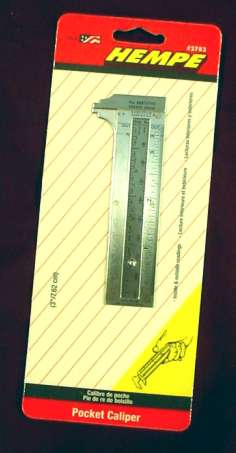
What for?? I’ve got lots of tiny needles, smaller than US #0 (2mm). I had hoped that it would be precise enough to parse out the difference between a 1.5mm and a 1.25mm. Unfortunately, it’s not. It does help me see which sets belong together (something that can be hard to do with fingers alone), but for the tiny needles it’s just not accurate enough. What it IS accurate enough for is discovering the real metric size of various needles. As we all know, just because something is marked as 3mm, it doesn’t mean that the marked size is true. I know I’ve got "big sevens" and "small sevens". Now I know what the difference is between them.
I’ll still need to shell out for a sub-zero needle gauge or micrometer, but this tool at $6.00 is still useful.
Other useful thingies in hardware stores include washers and o-rings of various sizes (stitch markers, especially for giant size needles); tool boxes and roll-up pouches for needle storage; measures of all types; the yardage?estimators used by fishermen; slabs of drywall or other soft, flat materials for blocking or pin-out boards; PVC pipe for building blocking frames for shawls and other huge flat things; lengths of thin non-rusting wire or tubes to use as blocking wires (ask for brass music wire or stainless steel welding wires); wooden dowels for create-your-own needles; and hard finish cotton twine or thin wire for knitting.
Software
This has nothing to do with knitting, but I’ve finally wrestled the camera into submission and can show you the Pumpkins that Ate My Sunday:

Let this be a cautionary tale. If you tell children, "We’ll carve anything you want on the Jack o’Lanterns this year," be prepared for major surgery.
The wolf was a canned pattern that came with the little carving tool set, and was a special request of the smaller daughter. The dragon was an original drawing by the larger daughter.Both kids helped, but I did the bulk of the finer work. ?I can wholeheartedly recommend those carving sets. The small plastic doodads and saws really make the impossible possible, and saved me from lopping of fingers, hands, and the heads of the pumpkin requesters.
 String-Or-Nothing