NEEDING A JUMP START
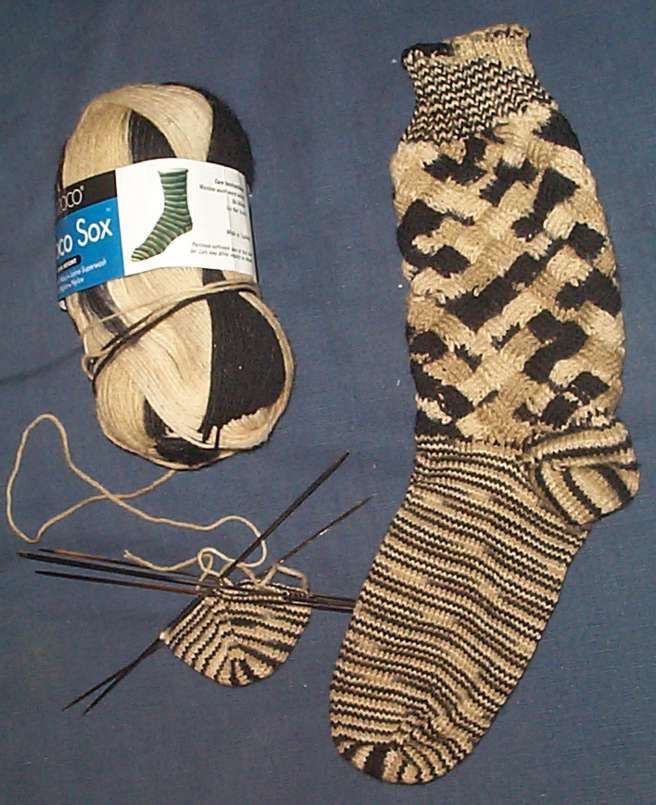
Another week of low inspiration here. I’m half way through the brown/tan/ecru entrelac socks. They’re working up nicely, but as I mentioned last week, the yarn has had lots of knots in it, one or two interrupting the color progression, but most clearly knotted before the stuff was dyed. I’m not pleased and will consider greatly before buying Berroco Sock again, even though I like its other properties that are so similar to more expensive European label sock yarns.
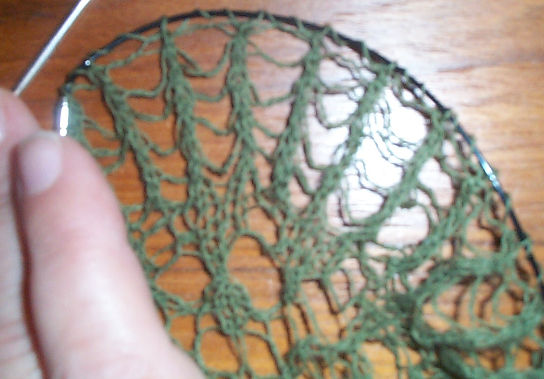
I’ve also picked up my olive tablecloth again. Rounds are still interminable, and nothing much interesting has happened since I put it aside last year. I’m still in the spiderweb section, with at least eight more rows of that two-row pattern before I have enough width to consider moving on to the final design element. I share my last olive picture again. The piece now looks the same, except the spiderweb around the outer edge is now about twice as deep.
And finally, in yet another traditional blurry String picture, I show off a partially completed embroidery. This one is a true sampler – a piece that exits only to try out random counted patterns. I had no particular goal in stitching it, it wasn’t intended to be displayed and remained a work in progress. The super long repeat in maroon shown separately is one of the design candidates for my curtain project mentioned here before. That work is still in the larval planning stages, mostly pending finding an affordable close to even weave linen or linen look alike.


Gauge on this sampler is approximately 15 stitches per inch on 30 count linen, in DMC Danish Flower Thread. Stitches used are cross stitch (green at top left), double running (grapes down center of piece and the two-tone framed flowers bit), and long-armed cross stitch (the extra long repeat). At this gauge the red repeat is just under 3.25 inches wide. To make my curtains less of an aeons project and to achieve the heft I want for my curtains, I’m looking for a plain weave even weave of about 12-15 threads per inch. That would make my stitched ribbon about six inches wide. Considering that I would need four panels to cover my windows, each 71 inches long x 35 inches wide, the six inch strip width would be in proportion to the rest of the project. But I haven’t found the linen yet, and certainly haven’t had the time to start, so my embroidered curtains remain a mental exercise for now.

Graphs for all of the patterns on this piece except for the small bans of field filling squaring out the area immediately to the left of the frame flowers can be found in The New Carolingian Modelbook. DMC DFT is now discontinued, which is one of the reasons why my play sampler ended up in my Chest of Knitting Horrors(tm).
DRAGON GRAPH
For those who have asked, the dragon panel pattern from the Siebmacher modelbook I regraphed for The New Carolingian Modelbook has been posted over at Bibliodyssey.

Apologies to anyone who wondered why this was posted three times. I’ve had problems wrestling with the “post away from home” feature.
Enjoy!
ANOTHER FOR THE GALLERY
Long-Time Needlework Pal Kathryn (she of “too many centuries, too little time”) is mid-sock, knitting up a pair loosely following Paton’s own recipe for Kroy Socks. She’s using Kroy in Retro Red, plus navy and Blazing Blue. The nifty cloverleaf motif she’s using is the reason for this post. She’s adapted it from my New Carolingian Modelbook, Plate 1!
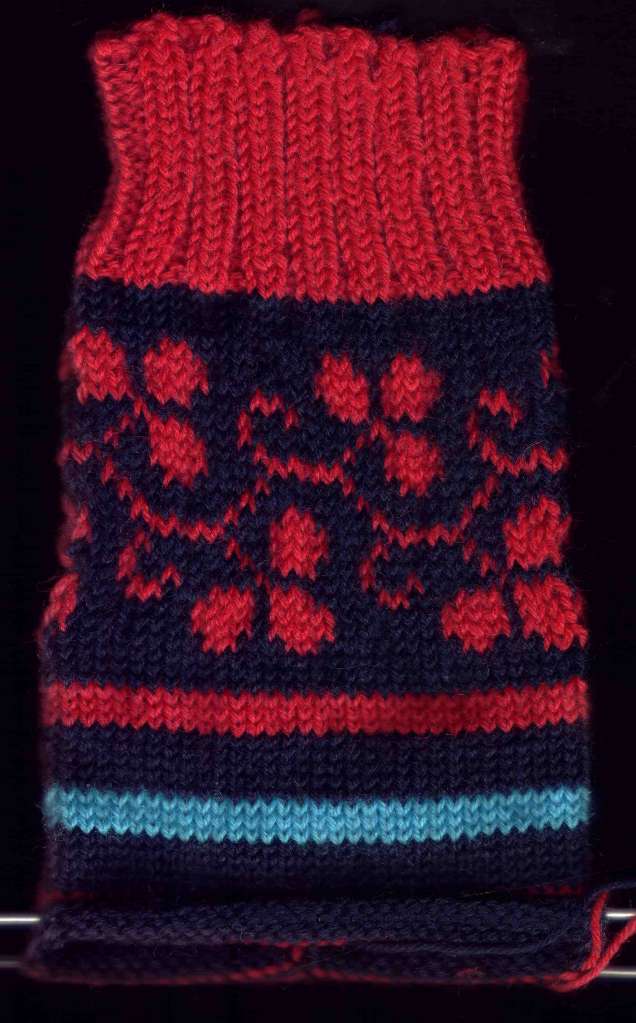
As ever, I’m tickled to see one of my pattern children make it out into the real world. Great socks, Kathryn! You made my day. (Photo is Kathryn’s, reproduced with her permission.
BEGINNING TO BECOME HUMAN AGAIN
UPDATE: AN EASY TO PRINT FULL PAGE VERSION OF THIS DESIGN IS NOW AVAILABLE AT THE EMBROIDERY PATTERNS LINK, ABOVE.
I met my major deadline today, and am beginning to decompress. The best way to do that is to think of something completely different, so I’ve begun to contemplate patterns in general, with some idle thought to my Spanish hat. So I began playing with motifs I have lying around. Like this one
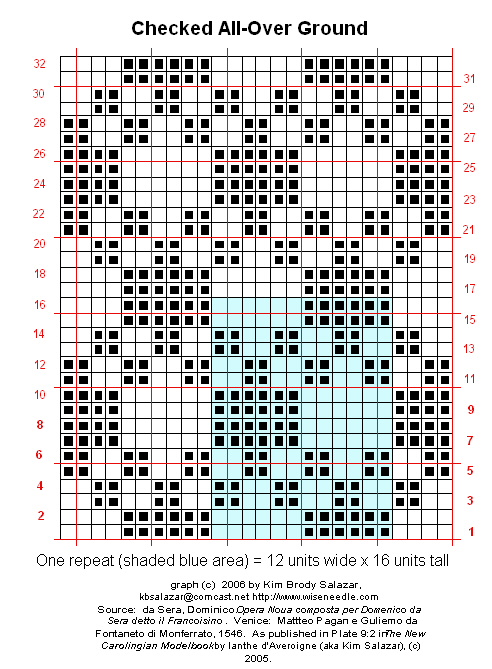
I don’t think this particular one is great for the hat, but I have an odd fondness for it, plain as it is. As the source annotation states, it’s one of the patterns I included in The New Carolingian Modelbook. While it looks like it would be at home as a border on the wall of a 1950s era tiled bathroom, it does in fact date back to 1546 by specific annotation. It may well have appeared elsewhere, although most of the da Sera patterns are pretty unique to his books. (If you think pattern piracy is rife these days, you’ll not be surprised by 16th century publishing ethics).
This particular pattern would work as nicely for stranding or for knit/purl textures as it does in cross stitch or other forms of counted thread embroidery. In fact it would have a number of advantages if done in knit/purl:
- Complete reversibility
- Low curl factor – roughly equivalent amounts of knit and purl
- Deep texturing – the knit/purl sections would pull in a bit like ribbing unless strongly blocked
- Ease of memorization – purl rows mimic the lay of the knit rows below them, and there are only two different row patternings, alternating blocks of k2, p2, and alternating blocks of k6, p6
So I put it here in part to make up for the consternation I caused with yesterday’s subject line.
NEW CAROLINGIAN MODELBOOK
Another entry from long ago. The link provided is no longer good, but the advice still holds. Copies do surface every now and again on eBay and on AbeBooks. Nothing has changed about my royalty situation or the low esteem in which I hold the owners of the publishing firm and their total lack of responsibility. This first appeared on 24 June 2004.
Some people have asked me where to buy my book of charted embroidery patterns. I have to say that there aren’t many places that sell it. It’s a long, sad story involving publishers who were sloppy and unprofessional at best, and downright unscrupulous at worst. Copies do surface every now and again. I wish I could say that I was selling them, or that I had a prayer of getting royalties from those transactions, but I don’t.
However a friend just notified me that some copies have surfaced on eBay. The seller isn’t the original publisher, they appear to be an independent bookseller. I also apologize that the books appear to be going for well over the original cover price. I have absolutely no affiliation with this seller, nor will I benefit from these sales. But if you’re desperate for a copy, it’s the only source I know.

WORKING REPORT – SPRING LIGHTNING LACY SCARF
Hmmm. As I was writing today’s entry, I wanted to refer back to a post I remembered writing back in June of 2004. Apparently not all of the posts for that month imported correctly when we transferred our archives over. So the posts you’ll see today are hand-carried ports of the AWOL material. Apologies for the deja vu. True new content tomorrow. I promise.
Material originally appearing on June 14, 2004. For the record, the pattern for the Spring Lightning Lacy scarf is now in the main wiseNeedle pattern collection.
WORKING REPORT – SPRING LIGHTNING LACY SCARF
My lacy scarf is done!

As planned, the ribbed center section pulls in a little bit, making the two diamond panel ends flare out. Stretched and blocked, across the widest point of the edgings it measures 14 inches at the end and 12 inches at the center. It’s about 80 inches long. That’s big for a scarf and narrow for a stole, but I like the size. I really enjoyed this project. It was just the right combo of super-easy and super-exacting. The Greenwood Hill Farm 2-ply laceweight yarn was wonderful. I Can t say enough about it. It’s the softest, most buttery Merino I’ve ever worked with. It’s hand-spun look is unique. You can see the slightly whiter areas in the photo – those are spots where one of the plies of the two-ply yarn gets a bit fluffy. There’s a lot of variation skien to skein in the amount of the fluffy bits, so if you order it or buy it at a sheep and wool show, you may want to try to pick skeins that are similar (or not, as your taste and project needs dictate).
I’m not sure whether I’ll keep this scarf or give it as a gift. On one hand I really like it. On the other hand, while it would be an interesting contrast with my guy-style brown leather aviator jacket, I know several people who might appreciate it as much as I do. Plus I’m not tired of my Kombu Scarf yet. Good thing I have the summer to think about it before scarf season resumes.
FILET KNITTING
Here’s an obscure style. Mary Thomas in her Knitting Pattern Book mentions Filet Lace Knitting. It’s a style of knitting more or less equivalent to filet crochet, which is itself an adaptation of earlier lacis and other filled net or withdrawn thread style darned embroidery. In this set of styles, the needleworker follows a graphed pattern, working solid or “empty” squares. The pattern is built line by line by these blocks of squares. This butterfly insertion is a good example of filet crochet:

(Pix from http://www.knitting-crochet.com – attributed there to Star Needlework Journal, 1917)
On page 263 of her book, Thomas describes a way to do something like this using knitting. Solid blocks are formed by units of three stitches x four rows. Spaces look to be formed by a combo of yarn overs and bind-offs. I haven’t quite figured them out yet, but Thomas gives several illustrations and a couple of easy practice pieces.
I’m asking if anyone has ever actually tried this because I have never seen any lacy knitting that was done this way – not as a piece of actual knitting, nor in a photo either on the web or in any other book. I have never seen a lace pattern for a project done in this style either. So I’m asking. Have you done this? Do you know of any pix or other sources for the style?
The reason why I’m asking? I’m in the middle of one of those panting-and-eyes-wide moments of gotta-do-it-but-how? inspiration. Yesterday we closed on the new house. I am now the proud owner of a massive Arts and Crafts style front door, with a glass window that’s 30 inches wide by 18 inches tall. There’s mounting hardware there for a lace curtain panel, currently holding a dingy scrap of Woolworth’s best. The door cries out for a better curtain.
But not just any lace panel will do. I’ve **got** to make one, and not only do I want to make one, I want to make one from THIS panel from my book of embroidery patterns:

The ultimate source is a book published in Nuremberg Germany around 1597 by one of the more prolific and well-known makers of embroidery pattern books. Not only did Johan Siebmacher put out several (this pattern was in his Schon Neues Modelbuch vol allerly listigen Modeln naczunehen Zugurcken un Zusticke”), his books traveled all over Europe so they’re very well represented in museum collections. Many plates from them were copied and re-issued during the counted pattern “Renaissance” of the mid 1800s. This particular panel has cropped up several times over the years – often simplified or truncated. The most recent adaptation from it of which I know is a pattern for an cross stitched kitchen tablecloth and curtains set in an Anna magazine from the mid 1960s.
I haven’t a clue as to how I’d go about making my George and Dragon panel, but I’ve got the will, the how-to book, the cotton yarn (Crystal Palace Baby Georgia), and the blissful confidence born of total ignorance.
NEW CAROLINGIAN MODELBOOK
I know there are folks who are looking for my book on embroidery. Every now and again a copy or two surfaces in Albuquerque, where the fly-by-night publisher was. Always at the same bookseller. It looks like that same bookseller has "found" a couple more copies. I get nothing from these sales, but I do know that people are rabid to lay hands on the thing. Even if this sale is closed by the time you get there, keep an eye on these people because if more copies resurface anywhere, it will probably be with them.
Please note that I have no affiliation with the seller. In fact on my previous attempts to contact them, they told me that I was dead (which was news to me); and rebuffed my request for the publisher’s last known address.
My thanks to embroidery pal Mistress Karen Larsdatter for spotting the sale notice!
SOMETHING DIFFERENT
The Kureopatora snake scarf continues. It’s longer, but otherwise
looks the same. I will probably finish it up tonight and post my
how-to thereafter.
In the mean time, here’s another of the embroideries that litter my
house. This one is another doodle – a sampler in the true sense,
done to try out patterns that ended up in my book. It’s done in a
single strand red linen on a linen ground, at about 15 stitches per
inch on linen that’s about 30 threads per inch. The long dark
band at the bottom was done in long-armed cross stitch. The lion,
the knot at upper left, the narrow diagonal band next to it, and the
dark band at the left edge were in more standard regular cross
stitch. THINK was stitched on the count using chain. The
rest of the patterns were worked in double running (aka Spanish Stitch,
Holbein Stitch).

The dense rose corner surrounding the lion is original, the rest
(except for THINK) all have historical precedent, and are all graphed
out in The New Carolingian Modelbook. In general I’m not that
fond of this one. Done as a true sampler as it was, placement of
the motifs was very haphazard. I stitched whatever I felt like
trying out, and if the pattern didn’t fit – I didn’t care (the leggy
grapes are truncated at the bottom edge). I didn’t plan anything,
and the imbalance of the whole thing reflects that.
THINK ended up hanging in my husband’s office for a time. That
company he was working for in ’89 used the heraldic lion as a logo element, which is why
THINK and the lion both ended up on the thing. He’s no longer there and has another,
better embroidery at work now. THINK along with its obsolete logo
has been exiled to the upstairs hallway.
BLACKWORK MERMAIDS
In the absence of any knitting progress, I offer up another embroidered tidbit.
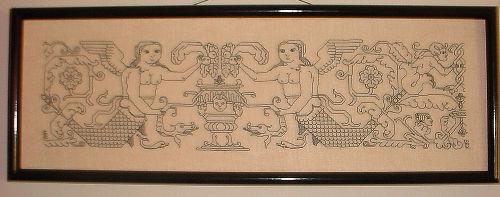
This is the last pattern in my New Carolingian Modelbook. It’s the same one that the SCA Lady Lakshmi used to make a hat for her friend Mistress Morwenna.
As you can see (in spite of my lousy camera work), my panel isn’t centered on the middle of the repeat. Instead I’ve skewed it a bit to focus on one mermaid, and to show the second bounce center – the twist at the panel’s extreme right. This is in part because I wanted to work one full cycle, but was limited by the size of the piece of linen I had available. For the record, this is done on 30 count linen (about 15 spi) using one strand of standard DMC embroidery floss.
This is one of the pieces I entered in the Woodlawn Plantation embroidery exhibition over the years. It won an honorable mention prize (feedback was that the judges didn’t like the skewing of the repeat). Amusingly enough, my brazen, bare-breasted mermaids must have offended some sensibilities. The piece was displayed at the very top of the wall in a room with 15-foot ceilings. The prize ribbon was clipped athwart the bosom of one mermaid, and a yellow sticky note was affixed to her sister’s.
QUESTION GRAB-BAG
A few knitting and non-knitting related questions from the inbox:
How did Killer Bunnies go?
Tons of fun. We played as a mixed-age group, with the youngest
being 7. We had hoped to get the Red Expansion Pack at Puzzle Me This
in Provincetown, but they were out. We settled for Violet, the
next one in sequence. The game plays more smoothly if you add
them in order because each pack builds on the last, but we were able to
use most of the Violet cards anyway.
What size needles did you use for the two versions of your counterpane?
The old version in the heavier cotton was knit on one of my odd size
needles, it’s a set of old long steel DPNs, they’re probably antique 9s
– and just a bit larger than standard US #4s (3.5mm), but closer to #4s
than #5s (3.75mm). The new piece is knit on 3mm needles, which in
some makers’ lines is a US #2, and in some is somewhere between a US#2
and a US #3.
Did you finish that embroidery doodle while you were away?

Are you planning on assembling the counterpane in the same way as the last try?
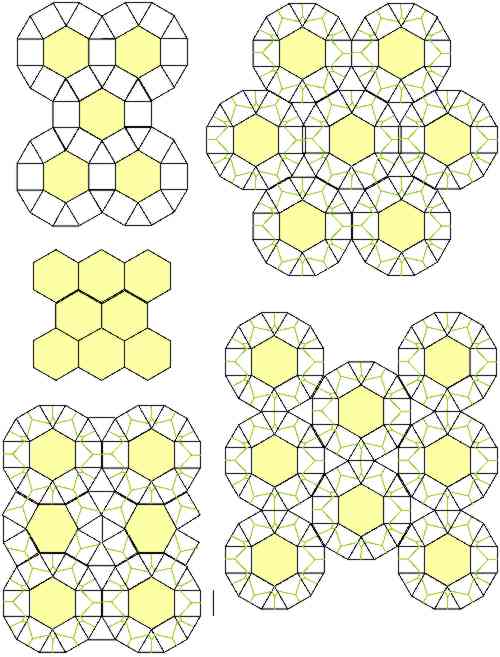
No. These units can be joined in many ways. Last time I
butted the triangles together. This time I plan to join
squares. My goal is to do the layout shown at the upper
right. Last time I used the one at the lower right. Both
use some plain solid triangles in addition to the pattern bearing units.
Where did you buy the counterpane pattern?
I didn’t. I made it up, starting with a standard spiraled
star. I added the outline-like bars to emphasize the motif, and
played with several treatments for the ground behind the star.
This one like my Mountain Laurel counterpane plays with a textured
ground and smooth star, but unlike that piece, plays a bit more with
the ground. I also wanted to do a counterpane that was an
tessellation of more interest than a flat tiled hex or a plain octagon
and hex. That’s why there are four units – the center hex, a
patterned square, a patterned triangle, and a plain triangle. The
layout above is actually an early draft showing how I played with the
concept, looking at ways in which I could use the patterned units to
extend the lines of the center hexes.
Can you send me the pattern?
Be patient. I plan on posting it to wiseNeedle this year –
probably after I’ve gotten considerably more done on the thing and have
a decent representation of the piece’s final look. I’d also like
to noodle up a complementing half hex and border.
 String-Or-Nothing