TWISTS, FLOWERS, FRUITS AND NUTS
Very slow progress on Do Right. A bison-stampede of work related obligations has me tooling flat out, days, evenings, nights and weekends. But here and there I grab a bit of stress abatement, and stitch.
I’ve decided to play with the Buttery pattern. I’ve used most of the flower/filling designs that were published in TNCM, plus several from my old notes that didn’t fit on the final as-published pattern. Now I’m off and running, drafting out more. Since I’ve got no obligation to stick to forms and flowers familiar to the Tudor period (or standard but imaginary geometrics), I’m playing. Some are sort of recognizable, some are just flights of fancy:
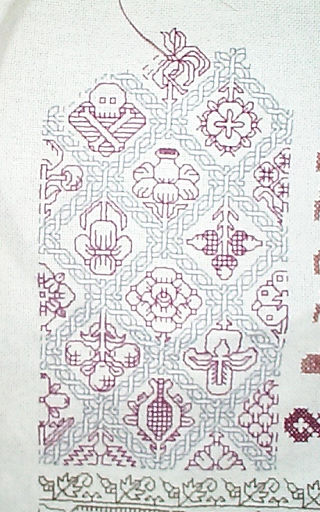
I think Elder Daughter will be especially pleased by that one truly incongruous motif.
Here’s a (very blurry) shot of the whole piece, so you can see the proportions and coloring of this strip in relation to what’s there:
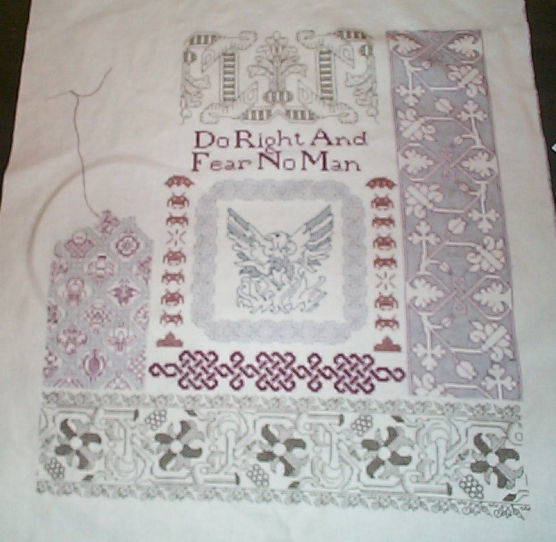
This strip will continue straight up to the top of the currently stitched area, which means **LOTS** more flower/fruit fills.
My only moment of pause right now is that I’m thinking of picking out the acorn spot in the current strip. When I first drafted it up I committed an awkwardness. The vertical acorn has no point on it. It annoys me, and I may restitch that unit one block down and make some other adjustments so that the up-down acorn is outfitted the same as its brothers.
Aside: For those who enjoy historical patterns, check out this collection of vintage European embroidery guides. Most are graphed alphabet collections, but there are some other gems in and among the lettering – even some charts suitable for double running stitch. I’m considering a couple of the latter for my final lacy feel narrow strip across the top of this piece. And the alphabets are great. I’m thinking of doing up an entire cloth of different forms of just one letter, as the ultimate initial-laden gift sampler.
TNCM BUTTERY PATTERN
I’ve finished the right hand strip on my Do-Right sampler, plotted a strip of equivalent width on the right side, and settled on a pattern. I’m using another from TNCM – the Buttery pattern (Plate 59:1). This one is original, inspired in equal parts by historical motifs, a happy communal house where many friends have lived over the years, and boredom.

The historical part is the twisted framing mechanism, with each diamond shape hole holding a different flower or fruit motif. Many of the motifs are very traditional, too. The completed pomegranate in the center of the worked strip, for example is a very common motif, and in execution would be easily accepted as an authentic motif. What’s not historical is that there are no exact sources for anything in the Buttery design, not even the exact structure of my twist frame, or that pomegranate. There are historical pieces that are close, but nothing is spot on (the large number of different fills in a counted piece is for example, something for which I’ve never found precedent). But the overall effect isn’t wildly out of phase with expected period aesthetics. I wouldn’t advocate using it on a historical re-creation, but for someone with the freedom to play in the style without accountability to authenticity hawks – why not?
The Buttery part is the home of many friends over the years. Presided over by Marion and Mark, it’s been the base of an ever changing constellation of people, each very different yet all living in harmony. Sort of like the collection of motifs in this piece – each unique, but each complementing the rest and contributing to the whole.
And for boredom, this is a function of having done lots of stitch by stitch repros of historical patterns. No matter how long the repeat, eventually “Are we there yet?” syndrome sets in. This piece was a think-exercise, to see how many different individual and distinct fruit or flower motifs I could come up with, given the established space constraint of the frame. The version published in TNCM has 18 different motifs. I’ve got a few more that didn’t make it onto that page. Maybe I’ll use them on this strip, or maybe I’ll doodle up some others. We’ll see as I begin to get to the point where I need to recycle previously stitched ones.
For the record this is the third thing I’ve stitched using Buttery. One was a book cover in black silk on 40-count linen, edged with black silk cording. The entire surface of the book cover was done in this pattern. I worked it around 1994/1995, around the time we moved back to the Boston area. I gave away the book cover around a blank book, as the first prize in a storytelling competition, aptly won by Richard, who coincidentally happened to be an on-again/off-again Buttery resident. I also did a small sweet bag in this pattern (sort of an Elizabethan gift bag, just big enough to hold a handkerchief or small treat). In that case I did a strip of the framing with a selected subset of the fillings at the top and bottom of the bag, leaving the center area unworked. The sweet bag was monochrome brick red stitching on a cream linen background. I forget the count, but it was also relatively fine, small enough for five motifs to march across the thing, and the bag was less than a fist wide. The sweet bag was given away as a gift, long before I began photographing my work.
MANY THINGS ALMOST DONE
Slow going, not because working voided strips this way is slow, but because of work related time constraints. Still, I’m inching up on completion of the most current strip in Do Right:
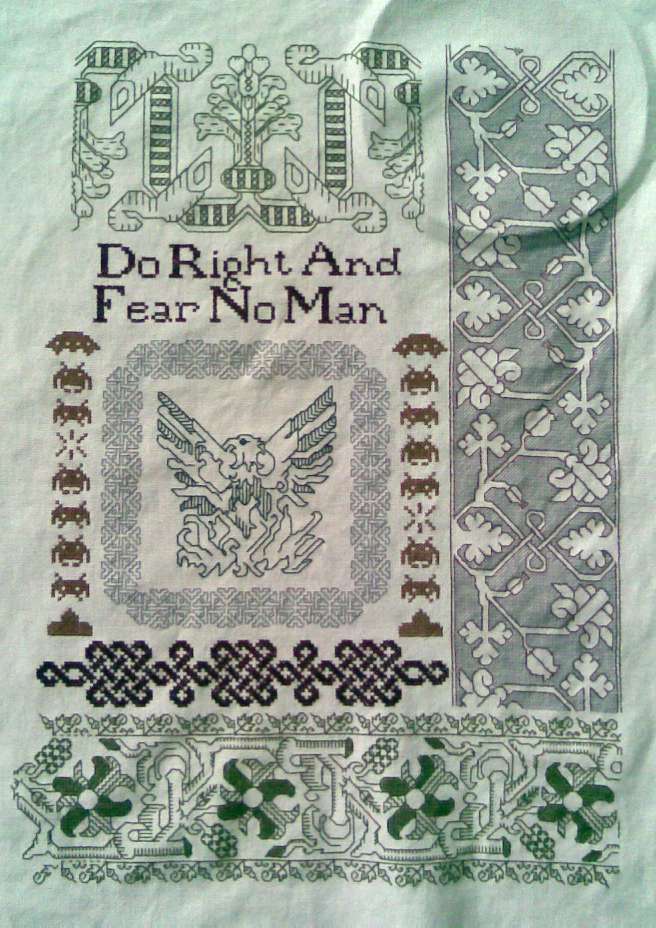
Next is to pick out what will happen on the left, to balance the current strip, do a small bit, then extend the bottom strip across to cover the same width. I’m still not sure what exactly will happen there. Stay tuned.
And for long time readers here, I present the transformation:
Was: Is Now:

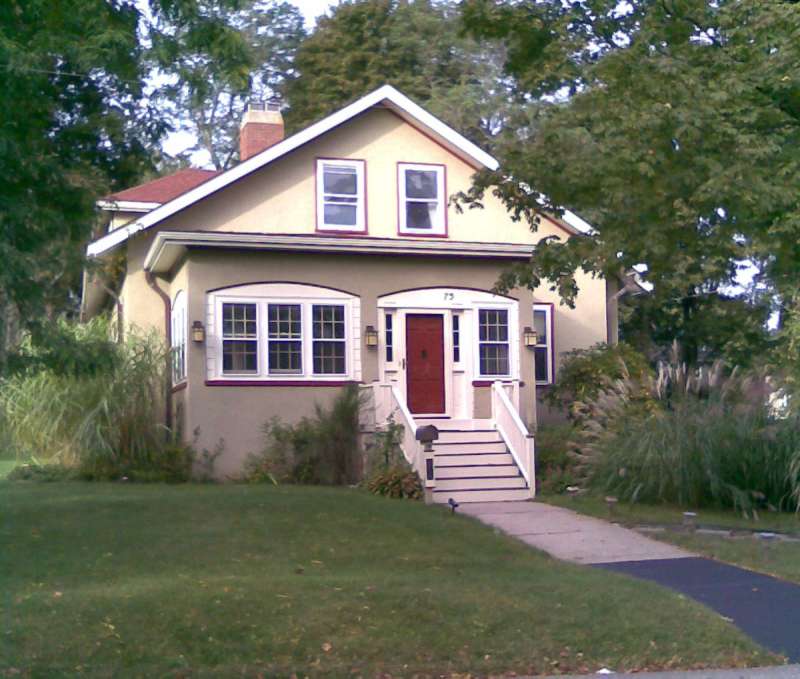
Over the past five years we’ve replaced the leaky roof and gutters, and the rubble driveway; removed the sheep-dip useless fence leading to the front door and the big spruce tree that was leaning on the house. We also had several near dead dangerous trees in the backyard removed, pruning the rest for the first time in three decades. We’ve pulled down the stucco-eating ivy and repaired the stucco, then had the house painted with a stucco-preserving finish to match the original color. We had the trim pointed in red and cream to emphasize the original lines of the house, and refinished the front door, painting it a matching red. We pulled out a flock of overgrown bushes, replanting new ones, flowers, lawn, or giant grass. We moved the mailbox and added house numbers, sawed off the gratuitous signpost (no sign, just a post); and restored the front porch.
Other improvements unseen in this shot include replacing the rotted out garage door, redoing the upstairs bath so that showers are now possible, replacing all of the wiring in the house (good-by knob and tube!), replacing the plumbing under the first floor bath so it too is now usable, insulating the attic and crawl spaces, installing attic vent fans, replacing the kitchen appliances with ones that work, replacing the furnace burner, adding a hot water boost pump so that the second floor receives heat in the winter, and relining the chimneys. All in all, the house no longer looks like some place the crazy lady up the street lives, although in fact the crazy lady up the street does live here. 🙂
Now FINALLY we’re up to the small aesthetic things – like painting and papering. And contemplating future upgrades, like restoring the front porch – taking those odd standard 1960s windows and shingle surrounds out and putting in some sort of modern non-insulated arched windows that fill the entire space, along with a period-appropriate front door. Or redoing the quasi-finished basement. But none of that until our financial capacitors recharge.
IMPROVISED GADGETS – THREAD REELS
More progress on my Do Right sampler.
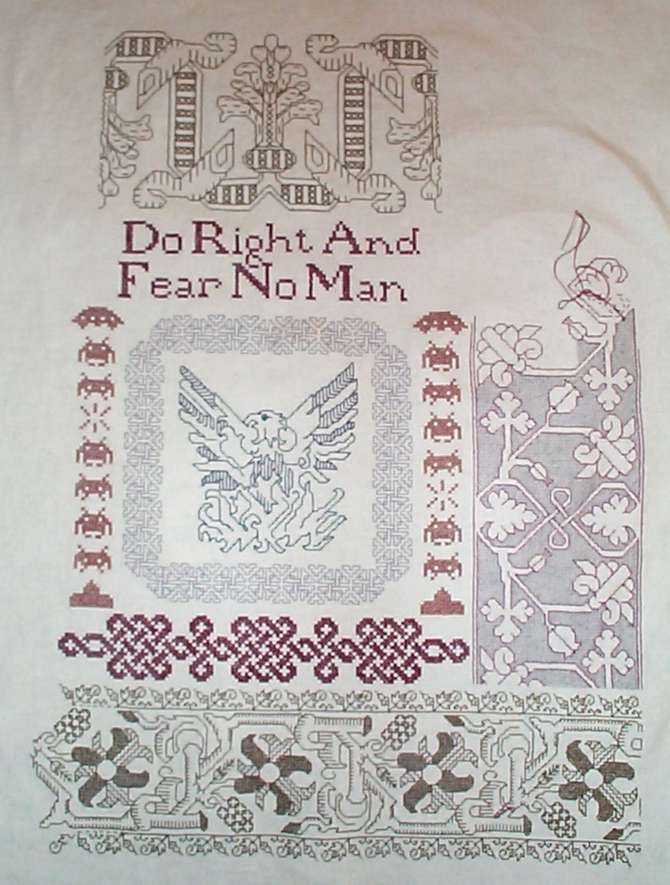
It’s going slow due to mounting work-related deadline pressure, but it’s moving along. Here’s a close-up of the latest strip:

Half cross stitch doesn’t provide anywhere near as dense a background cover as regular cross stitch or long-armed cross stitch, but it does give an interesting twill-like effect to the ground. Plus it uses far less thread.
And in the realm of improvised tools and gadgets – today’s is the lowly thread reel. Flower Thread comes in pull skeins. Or I should say – alleged pull skeins. They are not as well behaved as standard 6-ply floss skeins. Because I hate putting my work down to wrestle with my materials I tend to wind each skein of the Flower Thread as I use it. This is a very traditional thing to do. Little flat thread winders of various configurations were common work basket items prior to the introduction of spooled and reeled threads. You can still buy bone, mother of pearl and wooden thread winders. They’re a wonderful addition to one’s general stitching ambiance, especially for those who pursue needle arts in costumed settings.
But me – I’m cheap. Very cheap. I also am mostly retired from SCA events these days, and no longer need to keep up appearances. I make my own thread reels from business cards. Business cards are a renewable resource for me, new ones cross my desk almost daily. Once I transcribe the giver’s information into an electronic storage, I have little need for the small cardboard rectangles. But they are made from thicker, higher quality paperboard than index cards, manila folders, magazine inserts or other similar items. As a result business cards make sturdier, more durable thread reels. And did I mention that they’re free?
One business card yields two thread reels. As you can see from my samples, precision snipping is optional.


MORE EMBROIDERED DOODLES
During the feral burrowing to exhume some of my long put by stitching supplies, I came upon a few never-finished pieces of embroidery. For fun I share them here:
This piece is a true sampler. It’s a doodle cloth I use to try out some techniques and patterns prior to full implementation on a larger piece. It’s done in black linen thread on a rather coarse piece of not-quite-even weave imitation linen – about 26 tpi – 13 stitches per inch.

All of these are patterns in TNCM. The sharp eyed will recognize the same Dragon/George panel that made it onto my filet crochet door curtain, shown partially completed here:
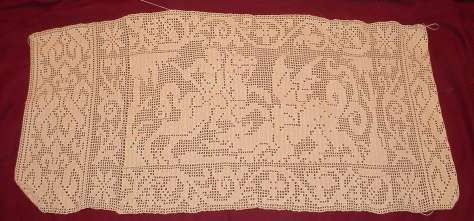
The original modelbook page is here.
I’m especially fond of the background fill vine and bud pattern, second from the bottom on the left. That’s a very small slice of the one I want to use on my library curtains, which I’m inching up on actually starting, once I find the right linen for the work.
I never intended that this cloth be shown in finished form. It lived in my work bag, pulled out and doodled on when I felt like playing with it.
This one on the other hand did start out as an Actual Project. It was going to be a challah cloth or matzo cover for a couple of pals, intended as a wedding gift back in the days when I had more time than money for gift giving Sadly, the engagement only lasted for about as long as the stitching shown here. I can’t say I’m superstitious, but after my friends’ break-up I never had the energy to finish off the project for another recipient.
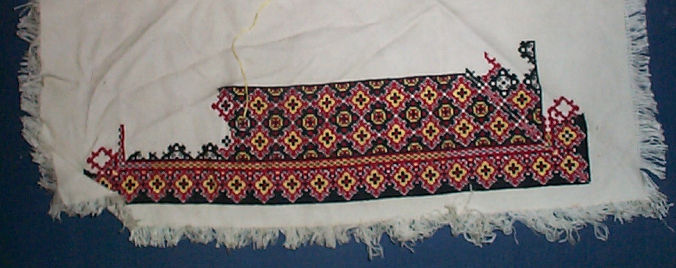
This piece is worked in DMC embroidery floss on Hardanger cloth (roughly 22 units per inch). It’s in cross stitch – 22 per inch, inspired by (but not a duplicate of) a Siebmacher modelbook pattern. The edging is the closest to the original, but it’s not exact. The field pattern in the inner ring is my own elaboration. The corners and mitering too are my own invention. Mitering patterns for knitted lace is different in execution but very similar in theory, so doing them isn’t a wild leap into the unknown for me.
This close-up shows the pattern and corner slightly better (a rare un-blurry photo for String):

Three of the edge motifs takes up a bit under two inches, and I finished the edging for one 13 inch long side, but was only about 70% done with the inner loop for that side. I used three colors – black, red and yellow. The small white accents are bits of the ground cloth showing through. The idea was to run the border and the inner motif ring all the way around the square, leaving the center bare, with the intention of stitching something relevant to the couple there – a Hebrew verse, or perhaps the date of their wedding. But it was not to be.
WIDENING OUT
Yes, in addition to finishing up the phoenix graph I posted yesterday, I was able to make a bit of progress on the sampler over the weekend. Not much because work obligations intruded, but some.
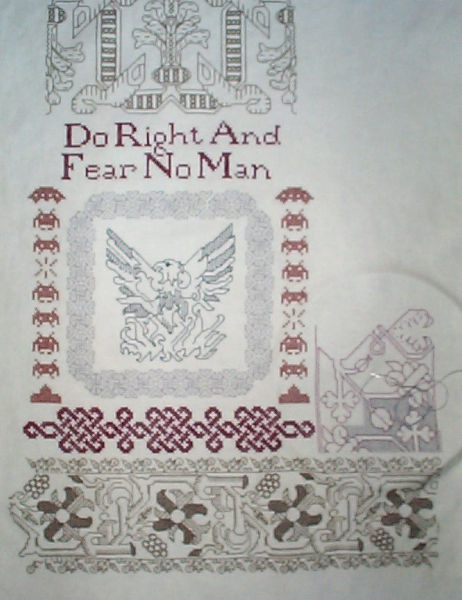
In this typically blurry String photo you see the center strip, with the handkerchief panel stretching across a wider area. I’ve started filling in another strip panel on the right. Since I’m winging this rather than planning it out fully prior to execution, I wanted to begin that panel so I would know how wide to make the bottom strip. There will be another two-tone panel of some type (pattern as yet unspecified) at the left hand edge. I’m going to try to make these both the height of the entire sampler, minus perhaps another as-yet unidentified narrow strip across the entire top.
This new pattern, like the majority of the others is pictured in The New Carolingian Modelbook. This one is the other pattern on Plate 63 (63:1). The ribbon bit at the center top is on that same page. This one I graphed up from a photo of an artifact appearing in Lanto Synge’s Royal School of Needlework Book of Needlework and Embroidery. It’s a curious piece, stitched without background in blue silk. The curious part is the reverse gives clues that it might have been done in something like reverse chain stitch, with the chains on the back, showing a top appearance similar to double running. I’m working it in plain old double running, and have chosen to accent the pattern with a background of half-cross stitch. I’m working the background with verticals and horizontals on the reverse rather than reversibly as true double running because I’m short on the gray thread, and want to economize as much as possible. Better pix on this panel soon, I promise.
DETAILS, DETAILS
Progress continues to mount on my Do Right sampler. The band at the bottom will be wider than the present stitched area, and the upper part will be flanked by two longer vertical strips. These may be two-toned, possibly with foreground in double running and some sort of background, but I’ve not decided yet for sure. My thread quantities are very limited, to the point where doing full up long-armed cross stitch is precluded.
Here’s what I’ve got so far. Details of the honeysuckle strip from the V&A handkerchief photo, and of my phoenix are presented for NeedleGal and Maria, respectively. Enjoy!
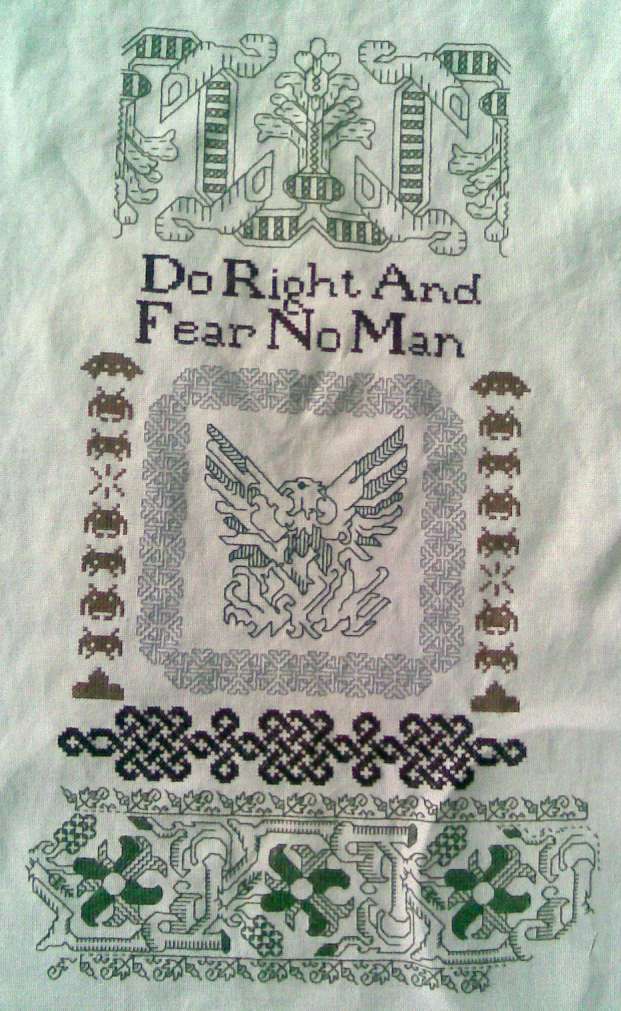


Stitches used so far are the obvious ones – double running (aka Holbein Stitch, Spanish Stitch), and plain old cross stitch. Nothing fancy at all. The back is neat, but not compulsive, due to the nature of the stitching it’s almost reversible, although I’ve taken no special pains to make it so, and yes – I do practice the stitching heresy of using knots on the back of my non-reversible pieces.
Oh. And I’m cleaning up my graph for the phoenix, translating my pencil scratchings and the as-stitched presentation into something usable by others.
A FAMOUS PATTERN TURNS UP ON DO-RIGHT
The latest addition to the Do Right sampler is this strip, which will run across the bottom of the piece.

The few who might be familiar with this type of work will spot it right away as being a Famous Design. The original is in the Victoria and Albert Museum – it’s a handkerchief, dated to between 1580-1600. Among embroiderers it’s a near iconic artifact, and has been pictured in many books including Digby’s Elizabethan Embroidery, and King and Levy’s The Victoria and Albert Museum’s Textile Collection: Embroidery in Britain from 1200 to 1750. I’ve got a graph of the design noodled out from artifact photos in TNCM (Plate 64:1), and there’s a simplified version of a very similar pattern in Pesel’s Historical Designs for Embroidery, Linen and Cross Stitch, although Pesel cites her source as a sampler dated 1658. (Perhaps there’s a point of origin for this design in a now lost pattern book or broadside that both historical stitchers used).
In any case, you can see one whole repeat here, and I’ve started on the second. In complex double running stitch designs of this type I proceed in one of two ways, both of which can be seen on this piece. The first is the baseline method. I identify a baseline, then if I encounter a branch or digression along that baseline I follow it to completion. If you look at the narrow strip acorn and leaf border at the top of this segment along the left hand side you’ll see that I’ve been working in that manner. The baseline here is very easy to see – it’s the single solid line at the base of the acorn/leaf units. I’ve traveled along it, then up into each sprig as I encountered it, completing the sprig and returning to the baseline. When I work on that strip again I’ll start on the baseline and fill in the remaining few double running stitches before continuing on to work more sprigs.
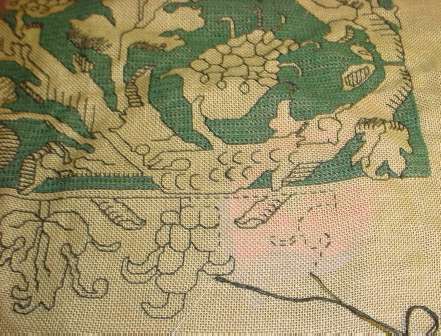
The second method works better on more complex designs. While I could establish a baseline and then fill in every deviation from it on the honeysuckle and vine center motif, if I were to do that and then discover that my stitching was out of alignment, there would be much swearing and stomping around, not to mention endless hours of meticulously picking out previously finished areas. So for these bits, I generally try to rough in major areas with a line of stitching that establishes their boundaries. Then I go back and fill in the detail. You can see this on the second flower. I’ve done a jog around the outside edge of the flower, confirming its position relative to previously stitched bits. Once I’m satisfied that there are no mistakes in the placement of the flower, I go back and do the more detailed infilling bits. Here’s another detail of the working method, from a piece previously featured here:
As I’ve said before, while I dearly enjoy knitting, it’s a vacation from my first love – embroidery.
NO FEAR MARCHES ON
Knots are now finished.

It’s time for the larger framing strips across the bottom and on the left and right. I’m not sure what I will do. Left and right should balance in density and I’ll probably also work them them in the same color, but I haven’t decided on the actual designs yet. Ditto for the bottom. Lighter than the knots, perhaps as dense as the ribbon strip at the top. In terms of space, I’ve got free ground at the bottom that’s about 80% as wide as the ribbon strip, and space left and right that’s about 50% as wide as that strip. The bottom strip will be the same olive green as the top unit.
I’ll start by thumbing through TNCM and see if anything hits me. I’ll also look through my earlier hand-drawn booklet. Most of the patterns in there made it into TNCM, but there were several that on further investigation turned out to be too late, or of uncertain provenance. Since provenance doesn’t matter on this work, I may use one or more of them.
Or maybe I’ll finally graph up the indistinct large band that’s just above the red strawberries on Jane Bostocke’s sampler from 1598.
It’s also time to start contemplating finishing. In all probability I’ll back this with another fabric for stability, maybe with some kind of thin interfacing, then do the bars-top-and-bottom-with-a-hanging-string treatment. One small sticky hook should do for actual suspension on the wall. Framing would be too elaborate for dorm use. It can always be remounted down the road.
KNOT MORE KNOTS!
UPDATE: AN EASY TO PRINT PDF OF THIS PATTERN IS NOW AVAILABLE AT THE EMBROIDERY PATTERNS LINK, ABOVE.
To follow up yesterday’s post and to answer the question “What do you mean by deconstructing and reassembling the knot motif?” I present this:

Click on the image above to get the pattern JPG at a useful size.
The original motif is presented in my book in negative, as it is in the 16th century originals – with the background blocks filled in and the foreground left plain, but this way works, too. They had to do this by hand-carving a wood block, the fewer flimsy little lines interrupting clear areas, the better. I have the luxury of Visio.
The strip at the top is representative of how the pattern was shown in those originals – a three unit knot with a one unit spacer. But that design is full of possibilities. The center interlaces, end units and terminal twists can be recombined into an infinite array of patterns. I present some that I just doodled up tonight.
So look at those old pattern books, historical or contemporary with a new eye. See how the pattern repeats – where it can be broken apart and recombined. You may end up with something entirely new and pleasing, perfect for your next project.
 String-Or-Nothing
