KNOTTY PROBLEMS
Invaders having been secured, I add another panel pattern. This time it’s a nifty knotwork interlace, also graphed out in TNCM, on plate 31:1.

What exactly it looks like will become clearer as I move along. This block unit pattern appears in several early books. I spotted it in a Ensamplario di Lavori published by Vavassore in 1532, and also in a different modelbook entitled Convivio Delle Belle Donne, also dated between 1530 and 1540. If you look at enough of these early pattern books, you can see all sorts of reprintings, adaptations, regraphings, possible block trading, and very probable plagiarism as the various semi-itinerant publishers interacted.
If you consider that each print block was very laborious to create (these patterns not being amenable to moveable type), the habit of publishers of re-issuing some of their old pages in new collections is easy to understand. Trading is, too. I can imagine two publishers based in different areas, but who traveled around a circuit (or who had agents who did) exchanging blocks so that each would have new material at minimal additional invested effort.
The “borrowing” is also easy to conceptualize. These pattern books were very popular, and the designs in them were highly sought after. It’s quicker to copy a design from a competitor’s book than it is to come up with a totally new one yourself, especially in the days when pre-printed graph paper was a rarity (some of the pattern books are mostly just that – blank graph paper, with a few pages of pre-done patterns as intro.)
How to identify copying versus trading? You have to get up close and personal with the patterns. As I regraphed them for TNCM I noticed small variants among different versions of the same basic design. Peter Quentel’s two-birds panel from 1527, reproduced on this page from blog Feeling Stitchy is well represented, and exists in many very close variants. There are very slight differences among them in the layout of the flowers, the position of the birds’ feet. This same pattern persisted in middle European folk embroidery, gaining and losing detail over time as it was copied and recopied, in sort of a multi-generational needlework game of telephone.
This particular knotwork pattern has always been a favorite of mine because of its versatility. You see a three-loop knot at the center of the piece I’m stitching now. The knot itself is easy to deconstruct and reassemble. I’ll be using the three-loop center, with a one-loop iteration on either side. Then depending on spacing and relative room, I’ll either do another two or three-loop knot followed by a one or more little terminal center loops to finish.
And finally to answer the person who wrote to say that they liked my stitching but found it woefully modern, and thought TNCM was “contaminated” by my including my own designs – I have to respectfully disagree. I took extreme pains to carefully document every design in the book. The ones that were “inspired by” rather than transcribed bear that notation. Original work is always marked and is less than 10% of the book. Most of it is there to fill out pages so that no space would be wasted.
[controversial thought warning for the following]
I do not believe that producing a slavish copy of a period original is the highest form of expression or understanding. Yes, it does demonstrate extreme mastery, perseverance, and skill that deserve praise. But to create a totally new piece that were it compared side by side with its historical siblings, and see that piece as an absolute exemplar of the type – to the point that were it transported back to the point of origin, it would be unquestioningly accepted – that’s mastery of the inner form. It’s parallel to martial arts practice. Knowing the katas and training forms perfectly is a matter of high skill, but that skill might not equate to being able to abstract the lessons in those forms and apply them in an un-choreographed street fight.
I do not pretend that my doodle samplers and contemporary stitching approach the new-artifact level (with the possible exception of my forever coif). But I do think that the few original designs presented in TNCM do come close, and the reaction some readers that they feel “cheated” proves my point. If those designs were somehow substandard and not tempting, people would not be expressing frustration. Do those looking for meticulous documentation to substantiate and produce a pedigreed work for an SCA Arts and Sciences competition want use my original designs? Some might, from an aesthetic standpoint, but they wouldn’t do so because those patterns can’t be sourced back to a specific stitch-for-stitch or published historical original. But that’s why they’re marked as mine.
MAN THE BATTLEMENTS!
Invaders!
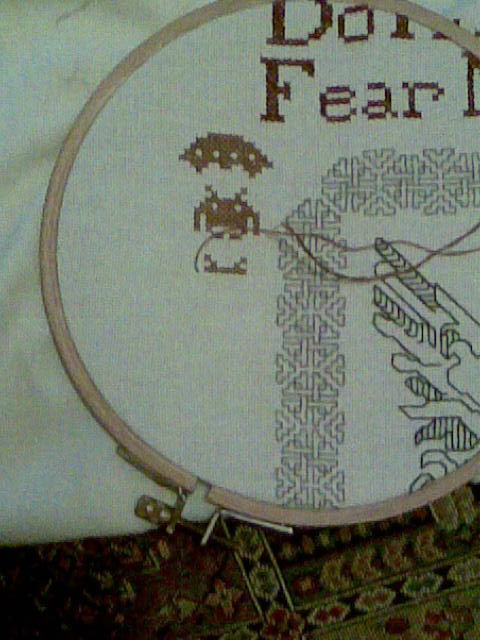
I never claimed this was going to be a period piece, or a compendium of solely historical stitching. And what better thing to give a gamrchx than something ornamented with sprites?
In other news, the best season of all is creeping up on New England. The tops of the sugar maples are beginning to go red; the air is crisp and clear; kids are headed back to school; and lobster is reasonably priced. What’s not to like?
DO RIGHT (BUT NOT OF THE MOUNTIES)
Not much to report here on the knitting end, but I have been stitching. The Do Right sampler for Eldest Daughter continues to grow:
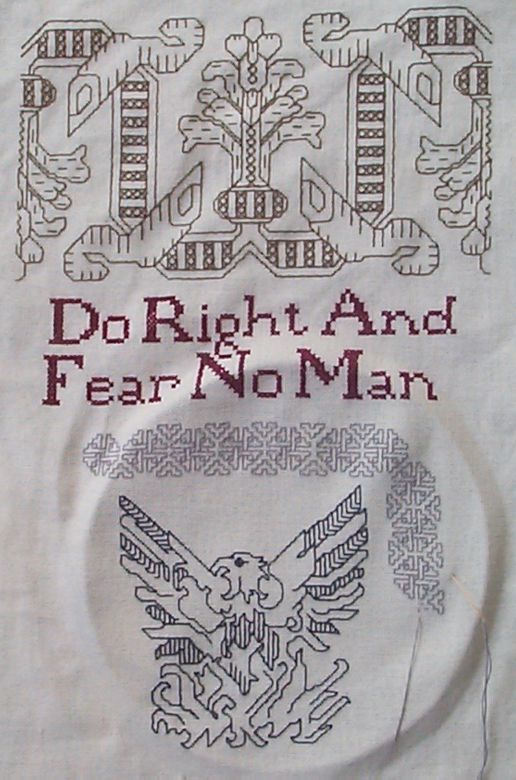
In answer to a question, I’m probably going to use the two stitch styles shown (cross stitch and Spanish Stitch – aka double running, Holbein stitch) and possibly long-armed cross stitch. The jury is still out on the latter because it’s dense and heavy compared to these lighter styles, and I don’t want to overwhelm the piece with it. No, this isn’t all that will be, there’s ample blank cloth surrounding this center part that I am going to defile with additional stitching.
The large green ribbon motif and the gray frame around the phoenix can both be found in my book The New Carolingian Modelbook. The ribbon is shown in plate 63:2, adapted from an early Spanish sampler; and the frame is adapted from the strip motif in plate 52:3 (it’s original, but inspired by historical motifs). The phoenix is new. I drew it up this week past just for this project. If there’s interest, I can post it here, along with another Visio stencil optimized for the production of line unit patterns.
Do Right and Fear No Man
Knitpals please bear with me, I’m taking an excursion into counted embroidery.
As reported here before, Eldest Daughter has gone off to college. Nagging has gotten considerably harder to do, being parceled out via eMail and texting, so I decided to invest all that correctional energy in a more tangible reminder. I’m doing a stitched piece for her wall. I’m still wrestling with this camera, but you can see the beginnings here:

I’m working on 32 count linen, using discontinued DMC Flower Thread (I’ve got a stitching stash, too). The mark of the tambour frame is very evident, although I took it off so you could see the words. The astute may note that the alphabets used for the first and second lines are slightly different, with the top line being compressed by one unit. That and the non-standard, non-lockstep alignment of the words (including the g encroaching on the N) were done on purpose, to give the thing a less rigid look.
This piece will be multicolor, but in subdued ashen hues, and aside from the motto, mostly in linear stitching like double running. If you’ve got a copy of my book The New Carolingian Modelbook, you may recognize the snippet above “Right” as being from Plate 63:2, a meandering repeat I charted from a late 16th/early 17th century Spanish sampler photographed in Drysdale’s Art of Blackwork Embroidery.
I’m not sure what I will do to fill the cloth. This like so many other of my embroidery pieces is going to grow through accretion rather than planning, but I will not be constraining myself to historical motifs only. Expect some surprises as I find them.
What will target Elder Daughter think of all this? Probably that she’s being nagged in front of the whole Internet…
NEEDING A JUMP START
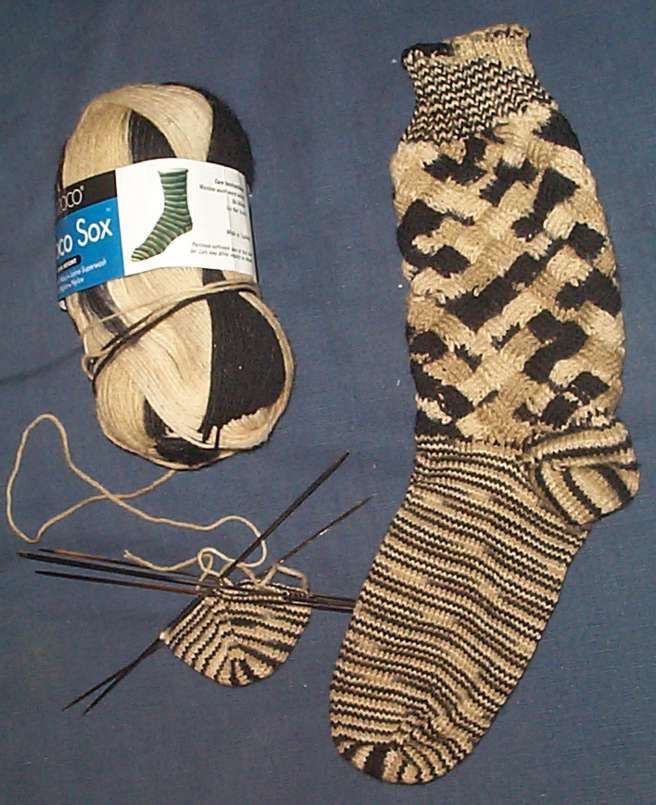
Another week of low inspiration here. I’m half way through the brown/tan/ecru entrelac socks. They’re working up nicely, but as I mentioned last week, the yarn has had lots of knots in it, one or two interrupting the color progression, but most clearly knotted before the stuff was dyed. I’m not pleased and will consider greatly before buying Berroco Sock again, even though I like its other properties that are so similar to more expensive European label sock yarns.
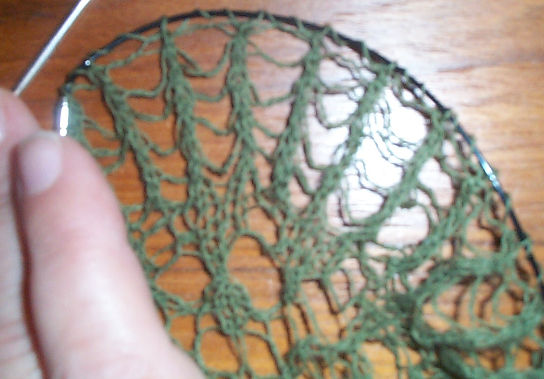
I’ve also picked up my olive tablecloth again. Rounds are still interminable, and nothing much interesting has happened since I put it aside last year. I’m still in the spiderweb section, with at least eight more rows of that two-row pattern before I have enough width to consider moving on to the final design element. I share my last olive picture again. The piece now looks the same, except the spiderweb around the outer edge is now about twice as deep.
And finally, in yet another traditional blurry String picture, I show off a partially completed embroidery. This one is a true sampler – a piece that exits only to try out random counted patterns. I had no particular goal in stitching it, it wasn’t intended to be displayed and remained a work in progress. The super long repeat in maroon shown separately is one of the design candidates for my curtain project mentioned here before. That work is still in the larval planning stages, mostly pending finding an affordable close to even weave linen or linen look alike.


Gauge on this sampler is approximately 15 stitches per inch on 30 count linen, in DMC Danish Flower Thread. Stitches used are cross stitch (green at top left), double running (grapes down center of piece and the two-tone framed flowers bit), and long-armed cross stitch (the extra long repeat). At this gauge the red repeat is just under 3.25 inches wide. To make my curtains less of an aeons project and to achieve the heft I want for my curtains, I’m looking for a plain weave even weave of about 12-15 threads per inch. That would make my stitched ribbon about six inches wide. Considering that I would need four panels to cover my windows, each 71 inches long x 35 inches wide, the six inch strip width would be in proportion to the rest of the project. But I haven’t found the linen yet, and certainly haven’t had the time to start, so my embroidered curtains remain a mental exercise for now.

Graphs for all of the patterns on this piece except for the small bans of field filling squaring out the area immediately to the left of the frame flowers can be found in The New Carolingian Modelbook. DMC DFT is now discontinued, which is one of the reasons why my play sampler ended up in my Chest of Knitting Horrors(tm).
DRAGON GRAPH
For those who have asked, the dragon panel pattern from the Siebmacher modelbook I regraphed for The New Carolingian Modelbook has been posted over at Bibliodyssey.

Apologies to anyone who wondered why this was posted three times. I’ve had problems wrestling with the “post away from home” feature.
Enjoy!
ANOTHER FOR THE GALLERY
Long-Time Needlework Pal Kathryn (she of “too many centuries, too little time”) is mid-sock, knitting up a pair loosely following Paton’s own recipe for Kroy Socks. She’s using Kroy in Retro Red, plus navy and Blazing Blue. The nifty cloverleaf motif she’s using is the reason for this post. She’s adapted it from my New Carolingian Modelbook, Plate 1!
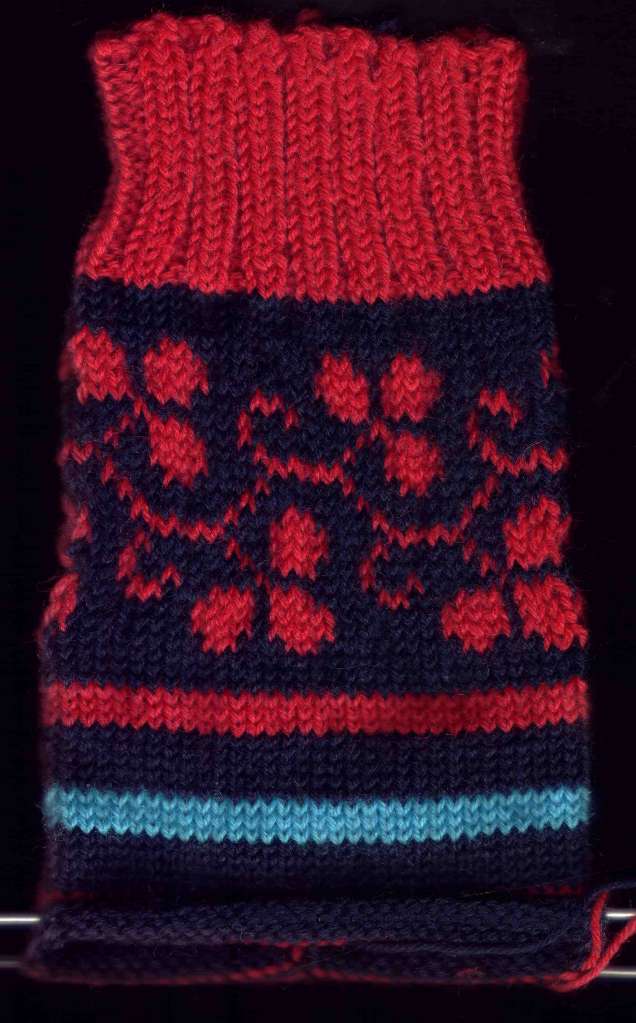
As ever, I’m tickled to see one of my pattern children make it out into the real world. Great socks, Kathryn! You made my day. (Photo is Kathryn’s, reproduced with her permission.
BEGINNING TO BECOME HUMAN AGAIN
UPDATE: AN EASY TO PRINT FULL PAGE VERSION OF THIS DESIGN IS NOW AVAILABLE AT THE EMBROIDERY PATTERNS LINK, ABOVE.
I met my major deadline today, and am beginning to decompress. The best way to do that is to think of something completely different, so I’ve begun to contemplate patterns in general, with some idle thought to my Spanish hat. So I began playing with motifs I have lying around. Like this one
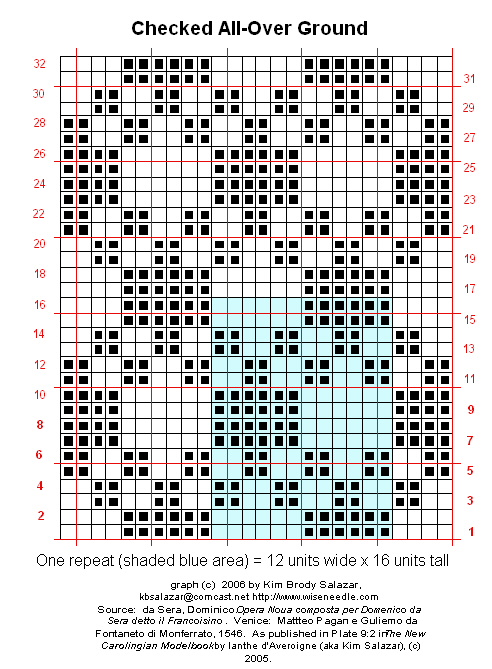
I don’t think this particular one is great for the hat, but I have an odd fondness for it, plain as it is. As the source annotation states, it’s one of the patterns I included in The New Carolingian Modelbook. While it looks like it would be at home as a border on the wall of a 1950s era tiled bathroom, it does in fact date back to 1546 by specific annotation. It may well have appeared elsewhere, although most of the da Sera patterns are pretty unique to his books. (If you think pattern piracy is rife these days, you’ll not be surprised by 16th century publishing ethics).
This particular pattern would work as nicely for stranding or for knit/purl textures as it does in cross stitch or other forms of counted thread embroidery. In fact it would have a number of advantages if done in knit/purl:
- Complete reversibility
- Low curl factor – roughly equivalent amounts of knit and purl
- Deep texturing – the knit/purl sections would pull in a bit like ribbing unless strongly blocked
- Ease of memorization – purl rows mimic the lay of the knit rows below them, and there are only two different row patternings, alternating blocks of k2, p2, and alternating blocks of k6, p6
So I put it here in part to make up for the consternation I caused with yesterday’s subject line.
NEW CAROLINGIAN MODELBOOK
Another entry from long ago. The link provided is no longer good, but the advice still holds. Copies do surface every now and again on eBay and on AbeBooks. Nothing has changed about my royalty situation or the low esteem in which I hold the owners of the publishing firm and their total lack of responsibility. This first appeared on 24 June 2004.
Some people have asked me where to buy my book of charted embroidery patterns. I have to say that there aren’t many places that sell it. It’s a long, sad story involving publishers who were sloppy and unprofessional at best, and downright unscrupulous at worst. Copies do surface every now and again. I wish I could say that I was selling them, or that I had a prayer of getting royalties from those transactions, but I don’t.
However a friend just notified me that some copies have surfaced on eBay. The seller isn’t the original publisher, they appear to be an independent bookseller. I also apologize that the books appear to be going for well over the original cover price. I have absolutely no affiliation with this seller, nor will I benefit from these sales. But if you’re desperate for a copy, it’s the only source I know.

WORKING REPORT – SPRING LIGHTNING LACY SCARF
Hmmm. As I was writing today’s entry, I wanted to refer back to a post I remembered writing back in June of 2004. Apparently not all of the posts for that month imported correctly when we transferred our archives over. So the posts you’ll see today are hand-carried ports of the AWOL material. Apologies for the deja vu. True new content tomorrow. I promise.
Material originally appearing on June 14, 2004. For the record, the pattern for the Spring Lightning Lacy scarf is now in the main wiseNeedle pattern collection.
WORKING REPORT – SPRING LIGHTNING LACY SCARF
My lacy scarf is done!

As planned, the ribbed center section pulls in a little bit, making the two diamond panel ends flare out. Stretched and blocked, across the widest point of the edgings it measures 14 inches at the end and 12 inches at the center. It’s about 80 inches long. That’s big for a scarf and narrow for a stole, but I like the size. I really enjoyed this project. It was just the right combo of super-easy and super-exacting. The Greenwood Hill Farm 2-ply laceweight yarn was wonderful. I Can t say enough about it. It’s the softest, most buttery Merino I’ve ever worked with. It’s hand-spun look is unique. You can see the slightly whiter areas in the photo – those are spots where one of the plies of the two-ply yarn gets a bit fluffy. There’s a lot of variation skien to skein in the amount of the fluffy bits, so if you order it or buy it at a sheep and wool show, you may want to try to pick skeins that are similar (or not, as your taste and project needs dictate).
I’m not sure whether I’ll keep this scarf or give it as a gift. On one hand I really like it. On the other hand, while it would be an interesting contrast with my guy-style brown leather aviator jacket, I know several people who might appreciate it as much as I do. Plus I’m not tired of my Kombu Scarf yet. Good thing I have the summer to think about it before scarf season resumes.
FILET KNITTING
Here’s an obscure style. Mary Thomas in her Knitting Pattern Book mentions Filet Lace Knitting. It’s a style of knitting more or less equivalent to filet crochet, which is itself an adaptation of earlier lacis and other filled net or withdrawn thread style darned embroidery. In this set of styles, the needleworker follows a graphed pattern, working solid or “empty” squares. The pattern is built line by line by these blocks of squares. This butterfly insertion is a good example of filet crochet:

(Pix from http://www.knitting-crochet.com – attributed there to Star Needlework Journal, 1917)
On page 263 of her book, Thomas describes a way to do something like this using knitting. Solid blocks are formed by units of three stitches x four rows. Spaces look to be formed by a combo of yarn overs and bind-offs. I haven’t quite figured them out yet, but Thomas gives several illustrations and a couple of easy practice pieces.
I’m asking if anyone has ever actually tried this because I have never seen any lacy knitting that was done this way – not as a piece of actual knitting, nor in a photo either on the web or in any other book. I have never seen a lace pattern for a project done in this style either. So I’m asking. Have you done this? Do you know of any pix or other sources for the style?
The reason why I’m asking? I’m in the middle of one of those panting-and-eyes-wide moments of gotta-do-it-but-how? inspiration. Yesterday we closed on the new house. I am now the proud owner of a massive Arts and Crafts style front door, with a glass window that’s 30 inches wide by 18 inches tall. There’s mounting hardware there for a lace curtain panel, currently holding a dingy scrap of Woolworth’s best. The door cries out for a better curtain.
But not just any lace panel will do. I’ve **got** to make one, and not only do I want to make one, I want to make one from THIS panel from my book of embroidery patterns:

The ultimate source is a book published in Nuremberg Germany around 1597 by one of the more prolific and well-known makers of embroidery pattern books. Not only did Johan Siebmacher put out several (this pattern was in his Schon Neues Modelbuch vol allerly listigen Modeln naczunehen Zugurcken un Zusticke”), his books traveled all over Europe so they’re very well represented in museum collections. Many plates from them were copied and re-issued during the counted pattern “Renaissance” of the mid 1800s. This particular panel has cropped up several times over the years – often simplified or truncated. The most recent adaptation from it of which I know is a pattern for an cross stitched kitchen tablecloth and curtains set in an Anna magazine from the mid 1960s.
I haven’t a clue as to how I’d go about making my George and Dragon panel, but I’ve got the will, the how-to book, the cotton yarn (Crystal Palace Baby Georgia), and the blissful confidence born of total ignorance.
 String-Or-Nothing
