GREEN CONTINUES
[UPDATE: A pile more patterns have been added to the Knitting Patterns page (Button above).]
Yes, I’m still porting old site content over here, but to reassure my embroidery audience, my massive green sampler is still in the works. With the quickie book covers out of the way, I’ve turned back to it:

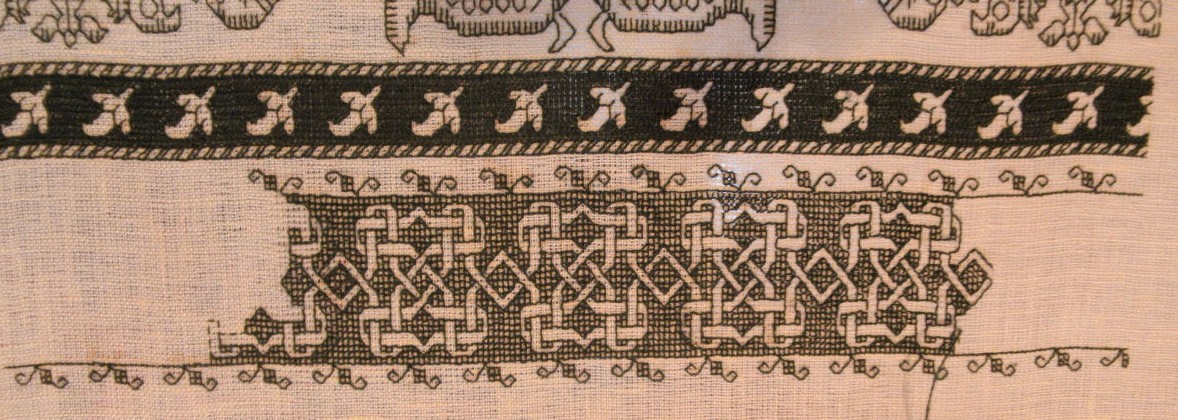
The pulled background fill does go slowly, but progress is being made. You’re looking at about half of the strip. The large downward pointing clump of lettuce at the left is actually the center. So I’ll be working on this one for a while.
Extra bonus: See that dangling thread? That’s how I end off without adding more knots, or adding bulk that obscures the drawn mesh effect. I take several running stitches down the center of an area that will be tightly overworked. Then after I do that stitching and the loose end is captured, I snip it close to the work. Starting a new thread is done in the same way.
Extra extra bonus: If you click to zoom on the photo, you’ll see a little arrow pointing out a mistake. I’ll be ripping that little bit out. My work isn’t perfect, just proofread.
BOOKED!
[NEWS FLASH: Kombu Scarf, Justin’s Counterpane and Mountain Laurel Counterpane patterns have been ported over. All are under the “Knitting Patterns” button above.]
The embroidered notebooks are finished and ready to send off to the recipient:

Each one took a bit over two weeks to finish out. The stitched area is approximately 5.3” x 8.25”, made to slipcover a standard 5”x 4” pocket journal style notebook (Moleskine is the most well known brand, but these were “work alikes” I found in Staples). Before you ask – they’re the same front and back – completely stitched. 🙂
Website Port
Thanks to everyone who sent encouragement on the port. The first three knitting patterns I reformat and post will be the Mountain Laurel blanket, Justin’s Octagon Blanket and the Kids’ Faux Chain Mail. I wish it were an instant process, but a bit of redrafting is in order. I’ll have all up ASAP.
Also thanks to the folks at Craftgossip.com who picked up the folded ribbon trim method I used on the Steampunk dress. If you’ve found String due to their link, welcome! I’ve got a lot more to show you.
MESHY!
As some have pointed out, doing the fill in the voided background of this rather large strip will be a marathon effort. But I’m chipping away at it, slowly but surely:

The downward facing center spray is in fact the middle of the strip, so you’re only looking at about half of the total width. As graceful as this looks without voiding, with the background fill, it’s far more dramatic. I really like it.
Here’s another shot of the fill, held up to the light so you can see how meshy it is:

I’ve gotten better at the Italian two-sided framed cross stitch. While I had been waxing the last inch of the silk to assist in threading my needle, I’ve found that waxing the entire length really helps avoid splitting. I’ve also learned that the silk is mega-strong, and can take it when I pull firmly. So now my holes are larger and more uniform than when I began. Unfortunately I’ve also learned that this stitch is near impossible to tease out once done, so I won’t be able to go back and replace my “learning bits” stitched when I started.
For Susan – I’m using Two Sided Italian Cross Stitch, as shown in Christie’s Samplers and Stitches, 1920. I’m using the version shown in Figure 130, on page 85, but I am pulling it VERY tightly so that it behaves like a drawn thread stitch, compressing and bundling the weave while accentuating the holes. I’m using one strand of Soie d’Alger, color 1846, on a rather loosely woven (approximately) 40 count linen, and stitching with a small eye ball-point needle more commonly used for hand-hemming tricot fabrics. This particular pattern is being worked over 2×2 threads, laying down outlines first in double running, then going back and working the fill. If I had bothered to start and end my double running bits invisibly, this work would be totally identical front and reverse, with no way of telling which side is which. This is why this style was so popular in the 16th and 17th centuries for bed hangings, linens, napkins, cuffs and other items that showed on both sides. Prior to this piece I attempted this look on more standard densely woven modern even weave, with little success.
LETTUCE
And so on to the next strip:

(With a gratuitous shot of the last strip finished out, for good measure.)
This latest pattern is rather wide, with an interesting companion edging. You can also see that the double running foreground is quite quick to work up. This is less than five days stitching, and a very short five days at that thanks to the standard run of work related deadlines. Progress will slow down now because I’m beginning to work in the background. I’m doing it in Italian two-sided framed cross stitch, pulled tightly to achieve a mesh-like effect. I’d be happier with a more profound “draw” and a more meshy presentation. I could probably get that if I were working over 3×3 threads, but I’m stitching over 2×2 here, a stitch size chosen to present as much of this large pattern as possible. But the mesh is still very evident:

There are several examples of this pattern family in museum collections, but I don’t have time to pull them up right now. I’ll save them for a future post in our “Long Lost Twins” series. Here’s the one I’m using for this stitching: Punto di Milano, Museum of Fine Arts, Boston Accession #99.176. They tentatively identify it as Spanish, from the 1600s. I’ve seen similarly lettuce-like over foliate patterns identified as being North African or Italian, from around this time and persisting (in simplified form) for the following 100 years or so. But remember – these patterns are from an area in which scholarship is still developing from its Indiana Jones/Avid 19th Century Collector roots. With the paucity of provenance and documentation left by the original collectors, I’d expect to see attributions wander a bit over the next few decades, before modern methods make temporal and location points of origin more clear.
PROGRESS
We’re quite busy these days at String Central. I continue to work on the long green sampler. Here’s the latest strip, photographed in early dawn light. This pattern is also in TNCM2, albeit without the gridded voiding. The little complementing border was stolen from a different TNCM2 pair.
TNCM2 as a whole also progresses. And to top it off, Younger Daughter and I are hard at work on an outfit for her to wear to the Waltham Watch City Festival steampunk gala.
Long time readers here may remember that last year at this time, Younger Daughter spent quite a bit of April and May in Children’s Hospital, in the throes of an argument with her burst appendix. She had wanted to attend the festival last year, and was very disappointed to have missed it. As a distraction, we planned out the outfit she would have liked to have worn. Being on the young side, what we designed for her was more steampunk than steamy-punk (no exterior corsets, hip high hemlines, or fishnet stockings). As incentive for cooperation with often uncomfortable hospital requests, I promised to make said outfit.
Now a year later, she’s totally better and my promise has been called in. We’re about halfway through the venture. A blouse/waist has been obtained (an antique barn bargain retread). We’re just finishing up a camel wool walking skirt, and will be trimming it next week with black and brown point folded ribbon. She’ll be decorating a brown suede bolero with copious brass buttons, plus a watch, a compass and a magnifying glass. The bolero and buttons were also flea market finds. Pix of all of these as they near completion. But I can present her hat:
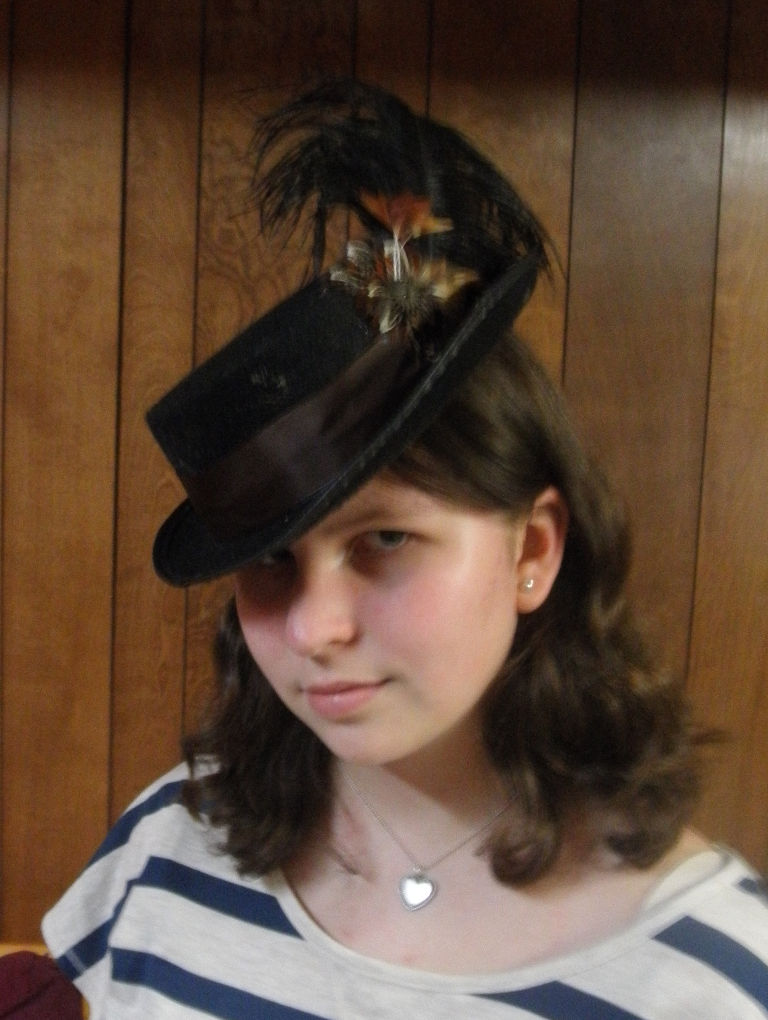
She started with an costume top hat, and excised about 2 inches of height. She covered the surgical scar with a brown ribbon, complete with a bow and streamers in the back; then added feathers and gears.
Cute, no?
URNS DONE
Done with this strip, on to the next!
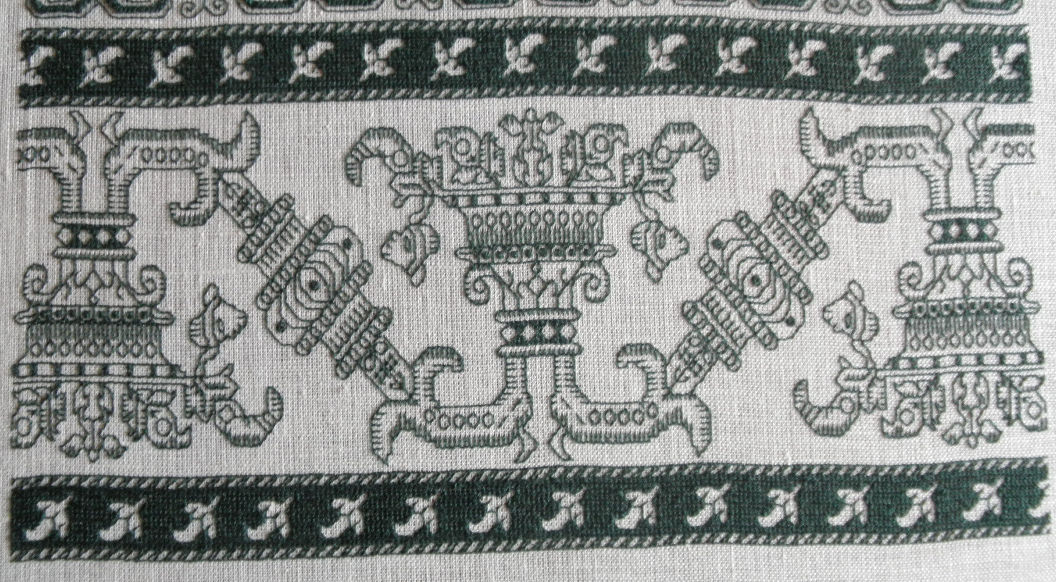
I spent some time noodling out what the next one will be. I tried out some complex Punto Spina Pesce patterns – the ones that use either Montenegrin or a Montenegrin-like long armed cross stitch variant to trace interlaces and intersecting lines, to make a linear design that’s fairly heavy. Unfortunately more experimentation is warranted. I’ve got a basic understanding of these stitches and how they merge horizontal, vertical and diagonal elements, but the designs I’m looking at make those changes very quickly, sometimes after a run of only one graph unit. The methods I’ve learned from the Autopsy of the Montenegrin Stitch Exhumed book take two or three units to complete directional transitions. I’ll have to play with these more off line to figure out “speed changes” and triple line conjunctions.
What am I working as the next strip instead? Stay tuned!
LONG LOST TWINS, PART VI
In Part III of this series I mentioned two pieces now held in two different museums that I suspect were cut from the same original artifact. That would make them bona fide twins, separated at birth. I don’t believe that was an unusual happenstance. Here is another example of a pair of items, now separated in two different collections, that I believe to have a common origin:
“Border,” Art Institute of Chicago. Accession 1907.664. 17th century, Italy. 8.5 x 31.4cm (3 3/8 x 12 3/8 inches).

“Embroidery,” Museum of Fine Arts, Boston. Accession 95.1126. Undated. Italy. 17 x 78 cm (6 11/16 x 30 11/16 inches). Dimensions include several repeats and a considerable chunk of unworked linen.

The Art Institute’s photo is sharper, but these are spot-on identical in pattern count and execution, color placement, stitch and edging detail. The Chicago write-up details the stitches used as being “back, hem, satin, and split stitches; edged with silk floss in buttonhole and detached buttonhole stitches.” The MFA says “worked with line stitch, chain stitch, and laid work, and with red and yellow silk… The linen is joined by fagoting, and is edged with buttonhole stitch and loops and knots.”
I am not daunted by the discrepancy. This is pretty typical. Terminology for stitching techniques and stitches isn’t universal over time or place. One expert’s “line stitch” may well be another expert’s “back stitch.” And neither one may be back stitch as we know it today. Sometimes that term is used for double running, even though the two stitches are produced differently and can be distinguished from each other by looking at the work’s reverse. It’s almost impossible to know from the descriptions posted on line when they were written or by whom. In fact, descriptions within a single museum’s collection may not be consistent – having been written by different curators of varying degrees of familiarity with the type of work, decades apart. I would trust Santina M. Levey’s descriptions the V&A in totality. But I’m not so sure I’d trust an unattributed blurb in another museum that may or may not have accompanied the piece when it was originally donated in 1909, and may not have been revisited since.
I’ve worked in a museum and I know that the archivists and curators, no matter how educated and experienced, do not know everything about every artifact; and not every artifact in the collection has been studied and corroborated by experts in that specific area of endeavor. Lots of times an artifact languishes for decades in a storage case with the tag that was on it when it was donated. It would not be unusual for something acquired before 1925 to have a “best guess” attribution that’s never been re-evaluated. Documentation standards have risen over the years, but these older acquisitions are not upgraded and retagged unless they have a bearing on a specific line of (funded) inquiry. So artifacts just sit there with speculative provenances and dates. One of the problems dilettantes like me face is that having no academic yardstick, we accept all published or museum attributions at face value. Or we reject them, or cherry pick the ones that fit our pet theories. (I’m no different in this. My pet theory du jour is that these are from the same original.) My point is that without validated and serious study, even the grandest and most augustly respectable museum’s taggings can be incomplete or open to question.
I’d love to see these two items in person, and I’d love to see their reverse sides. Just looking at them I know I could re-create them using several techniques, depending on whether or not the originals were one or two sided. Double running stitch for the red and yellow linear elements, and carefully laid satin stitch on the count for the yellow diamonds? Sure! Providing ends were carefully managed, that would be the same on the front and back. Back stitch and pattern darning? Also would work on the front, although that would result in a one-sided finished product.
So until I have the entree to actually peruse these in person, I’ll just contemplate the photos. I don’t know if these two museums know of the commonality of their holdings. But I do posit with some amusement that somewhere back around the turn of the last century, a dealer in Europe made a killing, snipping an original (possibly already damaged), and selling the fragments to two wandering American collectors; who in all probability each went home each thinking he or she had snatched up the only remains of this masterwork.
URNS AND PEPPERS
Yes, I’m still chugging along on the long green sampler. Here’s the progress on the latest strip, and an “on the edge” view of the last one, so you can see the dimensionality of the Montenegrin stitch accents in the last one:
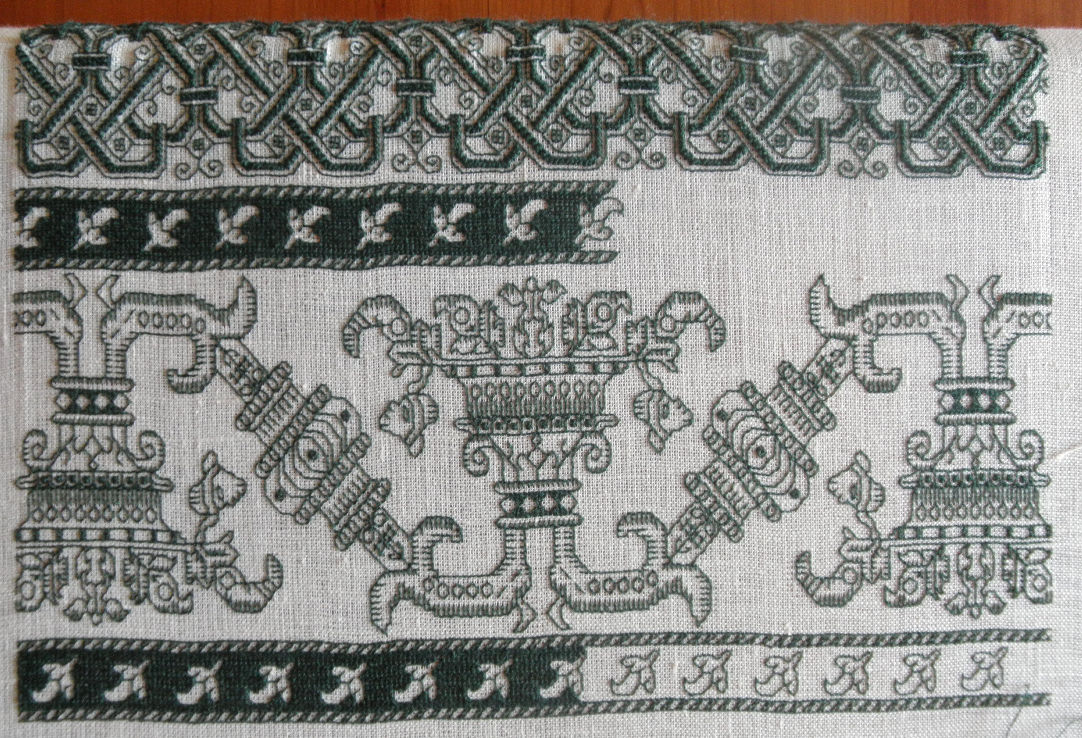
I was originally going to work the entire background of the center urn motif voided in long-armed cross stitch, just like the pepper-sporting companion edge strips. I’m still thinking on that one. That much green might overwhelm the piece. It’s hard to judge visual balance when the previously completed parts are rolled on the scroll bar, but here are all the strips to date, in order (apologies for varying lighting, angles, etc. – a photographer, I’m not).


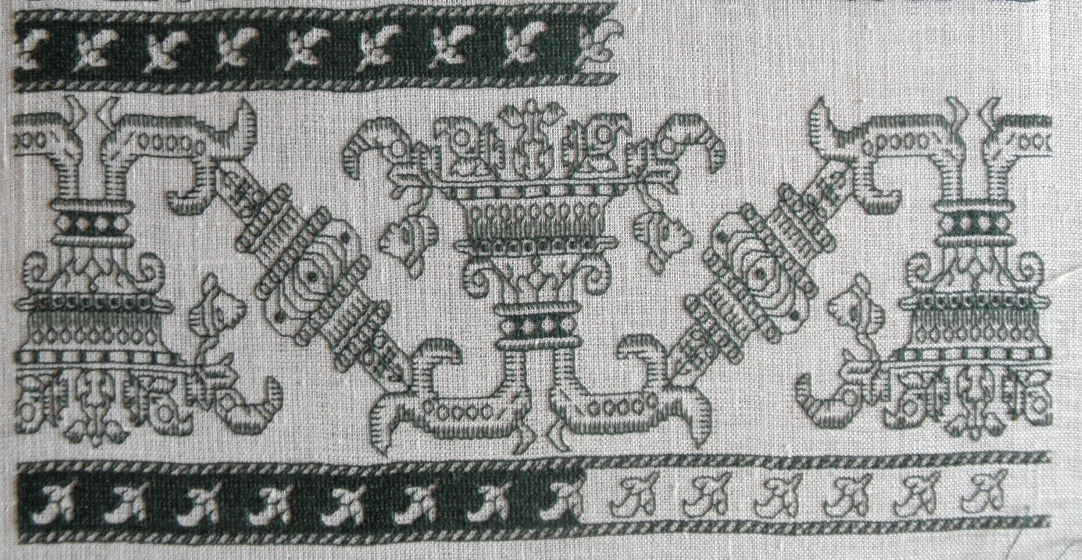
Opinions on working the urn section voided would be gratefully accepted.
Finally – are these odd bud shapes really peppers? I haven’t a clue. New World peppers would have been a recent introduction when this design was new. They might be, or they might be some other vegetation as yet unknown to me.
LONG LOST TWINS, PART V
More duplicates!
First off, I’ve found two more examples of the spinx, urn, and pelican pattern I showed in the first note of this series. Both of the new examples are in the Cooper Hewitt. Here are just the center urn sections from both. Please visit the links to view the entire works:
Border, Smithsonian Cooper Hewitt, Accession 1931-66-144. 17th Century, North Africa


For comparison, here are the urn/bird sections of the three I’ve previously posted:
Valence Embroidered with a Grotesque Motif, Hermitage Museum, 16th century, Italy

Border, Metropolitan Museum of Art, Accession 14.134.16a, 17th century, Italy.

Valence Embroidered with a Grotesque Motif. Hermitage Museum, 16th century, Italy.
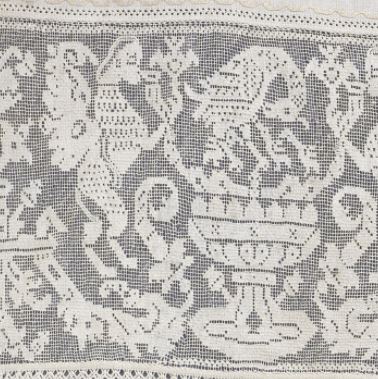
Of the red mesh background examples, two retain their companion edgings, but they are different and unrelated to each other and to the main pattern panel. No two are alike, neither in the main motif or the companion edgings, although all of the main motifs are clearly descended from a common source.
As to North Africa vs. Italy as the source of the Cooper Hewitt pieces, Iv’e noted that some panels cited by Freida Lipperheide as being Moroccan in origin are now attributed by other museums as being Italian. The style of stitching apparently was called “Moorish,” or “Moresque” at one time, and that label may have influenced the early attributions. Again, without academic and detailed materials analyses we’re at the mercy of the occasionally musty museum attributions.
It’s interesting to note that the most detailed piece is the 17th century Cooper Hewit holding; and that iteratino is most like the 16th century darned net sample (two baby birds; pomegranates growing from the urn base; other similarities)/ The other pieces are closer to each other (one baby bird, downward growning side urn decorations, etc.). I note that the tendency fo these patterns is to lose rather than gain detail over time. But in the absence of any scholarly examination of these pieces, I can’t challenge the museum dates. But I can safely say that considerable leeway exists in pattern interpretation.
On to a new example. This one is an even better example of pattern conservatism over time. Centuries, in fact.
Band. Metropolitan Museum of Art. Accession 09.50.1363, 16th to 17th century, Italy.


Band. Metropolitan Museum of Art. Accession 09.50.61. 1th Century, Greek Islands
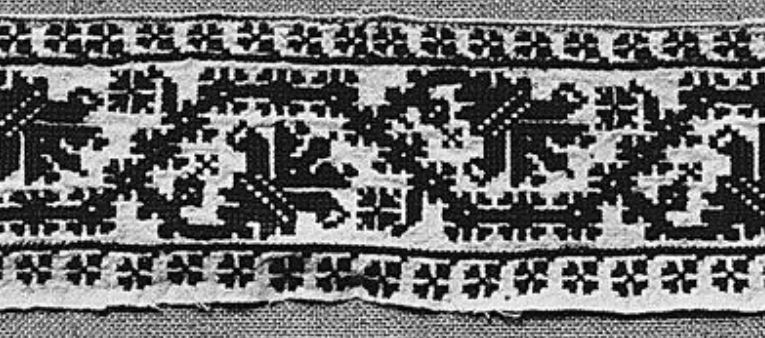
As you can see, I’ve found at least three examples of this one, spanning a possible 200-year range, done in different styles. The top one appears to have been worked in Italian two-sided cross stitch, but not pulled tightlly. Some of its side sprigs are in plain old cross stitch. The middle example features a pulled background mesh stitch – possibly the same Italian two-sided cross stitch, but tightly drawn. Jury is still out on this one, but up-close viewing reveals bundling rather than withdrawn or missing threads). The bottom example is worked in plain old cross stitch, with evidence of having been stitched in two colors (the vertical element in the fragmentary corner appears to have been done in a second color).
Now, not every pattern maintains recognizability and integrity over 200 years. But some clearly do, in spite of minor variations in detail (the side sprig flowers), and in stitch choice. Of course it’s also possible that the original collectors bought items wihtout clear documentation of provenance or origin time; and that some of the examples we think of as being earlier, are in fact of later manufacture. Again we need serious inquiry on this, armed with all of the dating techniques at modern disposal. So I ask as a self-taught dilettante – Is anyone out there looking for a really meaty doctoral thesis topic in textile history?
I’ve got more of these multiples to show. Stay tuned!
INTERLACED!
Yes, I’m still working on my long green sampler. Both of the patterns below will be in TNCM2:

Thanks to the Montenegrin book I’ve been able to do all those twisty, bendy parts where diagonals meet horizontals or verticals. It was a lifesaver! I really like this interlace. You’ll note by comparing my piece with the original below that my ground cloth is off square – not quite even weave. So it goes. I’m working that distortion into my pattern selection and placement.
“Strip,” Metropolitan Museum of Art, Accession 79.1.13. 17th century, Italy, possibly Sicily
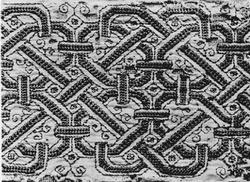
It’s very hard to see, but it looks like there might have been spangles in the empty spaces between the internal curlicues. There may be a spangle in the upper left (better seen at the full photo at the link), where the work is the least damaged, plus some evidence of now empty holding stitches, and some corrosion aligning with where the spangles would have been. This pattern would make a killer coif or all-over sleeve panel with spangles there, and maybe a few more replacing the little four box free floating squares. I’m thinking of working it in black and gold with spangles for a modern envelope clutch style evening bag.
In any case, that strip is now done and I’m on to the next – a rather complex urn and branch with a very dark and solid background. It’s going to take a lot of stitching to cover all that real estate in long armed cross stitch, so progress on the piece, once the double running foreground is all laid in will be very dull to watch for a while. Good thing I have other content lined up.
I am however less than pleased with the Zoundry Raven blogging composition software I’ve been using. The last few posts have killed it. I can get them composed and loaded if I do all the work in one session, but I can’t call up a previously started piece for additional work – not even to copy out text and recompose in a new post. That means that I’ll have to re-draft the next several Long Lost Twins pieces. Stay tuned!
 String-Or-Nothing