Y MARCH
More progress!

The new band is marching across the bottom nicely, bringing a dark footing to the thing. Here you can see that I outline first, then fill in the voided long-armed cross stitch (LACS) background:

Trust me, it’s MUCH easier to work LACS inside an outline. I did it “feral,” (without outlines) on the large dark panel in the center of the left edge. Plain old cross stitch is easier to count than LACS with its braided surface texture. That one panel probably took twice as long to do in LACS as a result. This band is moving along much faster. Another two weeks tops, and I should have the entire bottom edge finished. An aside – there’s a mistake in the current strip. Pat yourself on the back if you can spot it!
In other news, The Resident Male has a project to showcase this week. In the spring we finally replaced our Carter-era washer and dryer with ones that work. Because we had to fit them into an existing alcove, and I wanted efficient front loaders, that took a bit of shopping around. Most front loaders on display in this area are giant capacity/top of the line units or are mini capacity apartment size stackers. Big ones wouldn’t fit in the space we had available, and with kids, we wanted more capacity than the smaller, stackable models. We finally tracked down some mid-size GE units, well reviewed with good repair records, and ordered them.
Now one problem with these front loaders is that the openings are knee height, and users have to stoop to put the laundry in. This is why the makers offer height-raising pedestals as options. Unfortunately, pedestals for our smaller size units are not offered in the US. So the Resident Male, freshly inspired by countless evenings of home improvement TV, tackled the project himself:
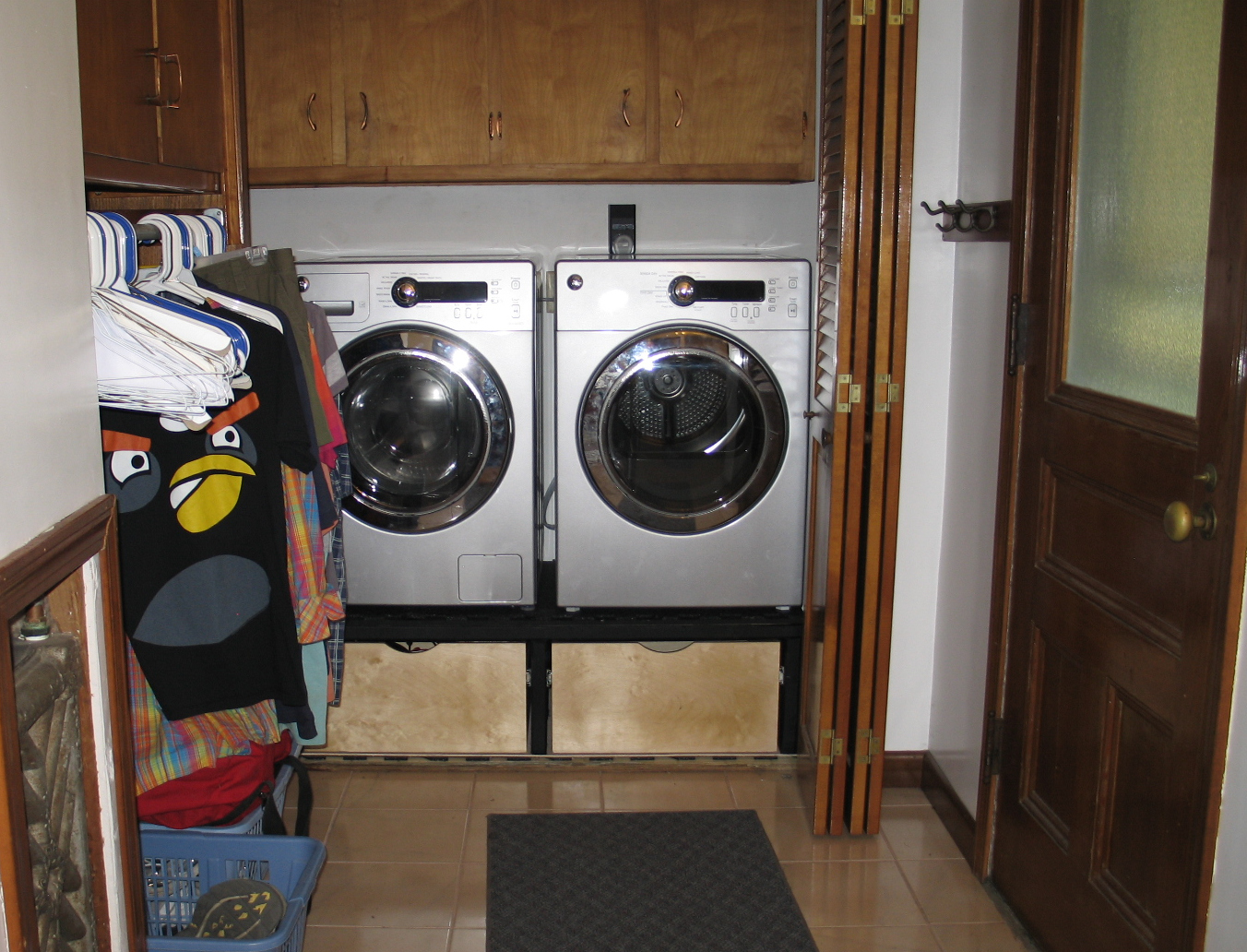
We now have two drawers for storage of once-a-year type kitchen impedimenta – like the big turkey roasting pan. And no more reaching in for that last sock on hands and knees! I declare this project a success. Now how does the new washer perform? It cleans much more thoroughly than my late 1970s/early 1980s vintage Kenmore did, even removing stains I thought were lost causes. The washer/dryer pair sip water, detergent, and energy, noticeably decreasing our consumption of each. And they’re quiet. We can now sit in the kitchen (behind the photographer) and have a conversation while the machines are running. But there are also a couple of minor drawbacks. Cycles take twice as long to complete; the mid-capacity model holds less than the old top loader, so there is one more wash per week; and for some reasons, sheets twist themselves into Gordian knots in the dryer, and do not dry well, unless I take the time to re-assort them several times mid cycle. Drawbacks aside, the new set-up is far superior to the old one, and the raised platform is the icing on the cake.
STREAKING ACROSS SKIES- CROWDSOURCE #5
Although it is in the periodic nature of comets to come and go, I owe apologies to The Person Who Wishes to Remain Anonymous for inadvertently omitting her tribute to the Bayeux Tapestry from the crowdsource project updates. The inbox management blunder that made that mistake has been taken out and shot.
This week brought five additions to the project, including the belated comet:
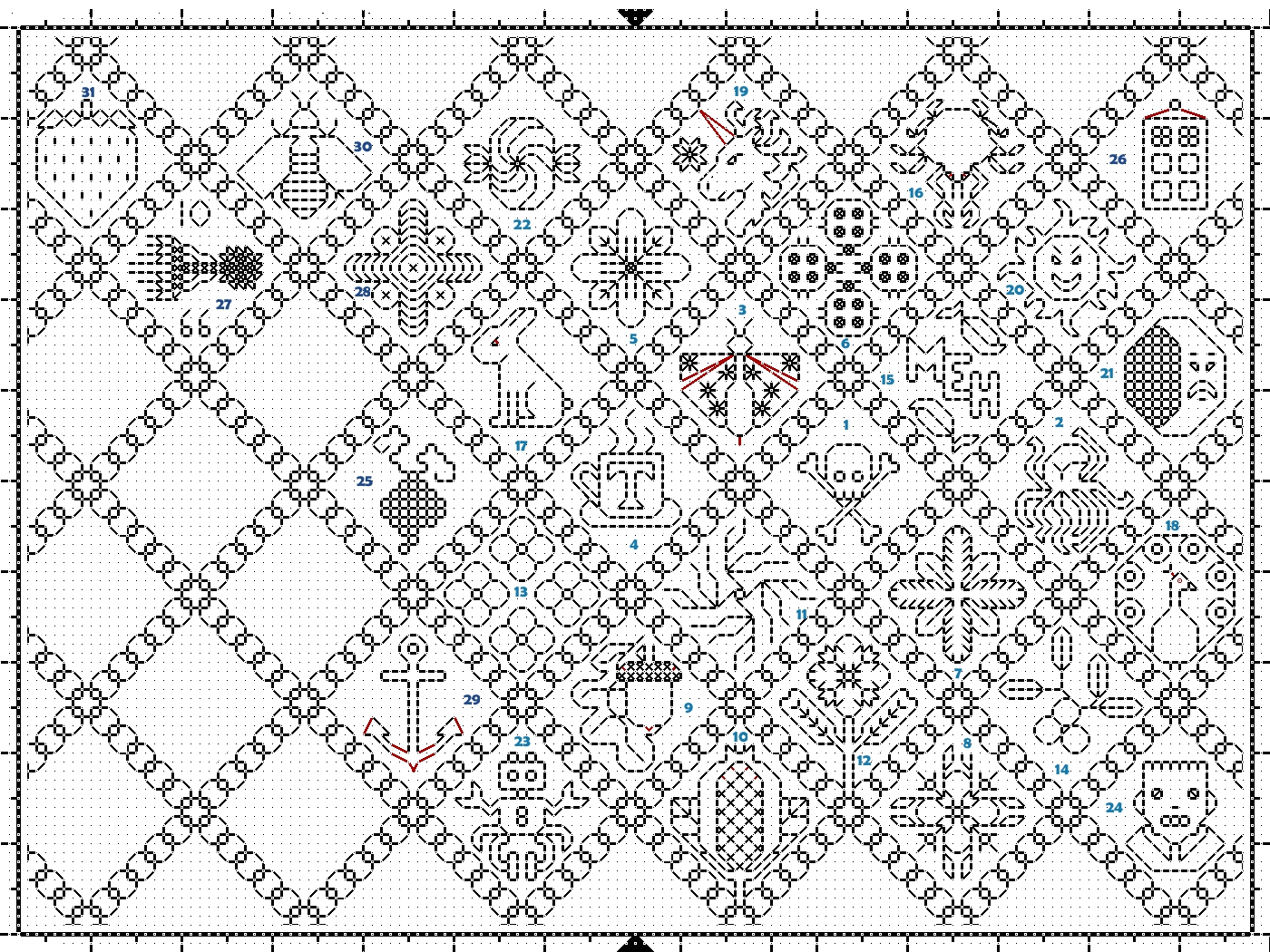
- 27. Comet – a tribute to Halley’s Comet as it appeared in the Bayeux Tapestry – Karen Isaacson.
- 28. Mesmer-Flower – A mind bending cross-style flower from from Alexandra Rule
- 29. Anchor – A continuation of our maritime sub-theme also from Alexandra Rule
- 30. Bumblebee – We need more insects if we want to pay homage to the spirit of historical era stitching. This one is from Laura Kathleen Brashear.
- 31. Strawberry – Another for the traditional motif sub-theme, again from Laura Kathleen Brashear.
I’m having way too much fun with these. You can see that we’ve still got room for eight more full-diamond designs, and for about five more that are symmetrical and that can be represented in the half-diamond boxes at top and bottom.
With some overlap among categories, our sub-themes so far seem to be piratical/nautical (1, 16, 20, 21, 3, 29), science fiction (26, 23, 24, 11), sweetness-and-light (31, 22, 6, 10, 18, 13, 4), traditional (31, 30, 26, 5, 6, 3, 25, 13, 7, 16, 9, 12, 14, 10, 12), astronomic (27, 20, 31, 11), beasties-and-bugs (30, 19, 16, 6, 17, 3, 2, 16), and floral-fruits (26, 5, 25, 13, 7, 9, 12, 14, 10, 8). This leaves poor ennui (15) sitting in the corner and sulking, unless you think that by virtue of “Meh” being a popular Think-Geek t-shirt, he belongs in with SF.
If anyone has started stitching something using these, I’d love to hear about it.
BIGGER INSIDE THAN OUT? – CROWDSOURCE #4
First, thanks this week to our crowdsource design contributors – the patient Jane Wyant, and (as always) Long Time Needlework Pal Kathryn Goodwyn:

- #25 – Grapes – Kathryn’s own needlework sigil, offered up to our collection. (Kathryn’s deep love of grape motifs is legendary).
- #26 – TARDIS – From Jane Wyant, a Whovian tiny inter-dimensional call box should we wish to stitch in two places at the same time.
We’ve still got a few open diamonds. With some repositioning I think I can fit in seven more motifs. Feel free to send yours along.
On my own blackwork sampler, progress is being made. My Lipperheide panel is proceeding apace.
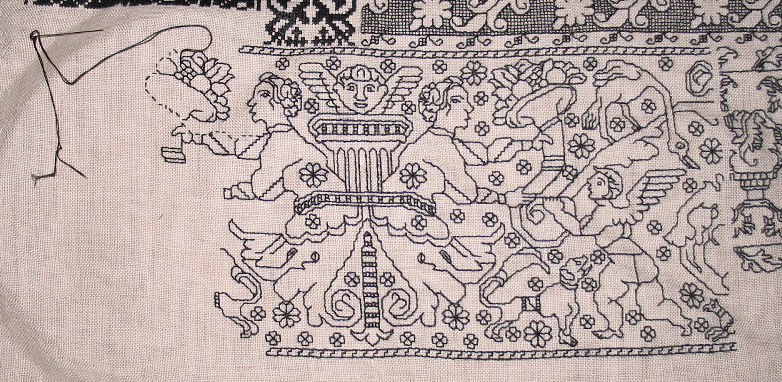
I am not going to have room for the entire repeat. There’s a head of one of the four winds (possibly Boreas), and a horn tooting satyr that will have to wait their turn on a future piece. Unless Kathryn gets there first. 🙂

After I finish out this strip to the left hand edge of the stitched area I will fill in a narrower band below the sprigged chimney pots. Then I’ll edge across the entire bottom with something nice and dark – probably worked voided style. I haven’t picked out the designs for either of those strips yet, but as folk following here know, I enjoy bungee jump style stitching. Once the dark area is done that will leave only the top. Believe it or not, the part you see stitched here is only about 65% of my total piece. I’m not sure what I’ll do up there, but that’s still down the road.
PLANET OF THE CROWDSOURCE
A few more submissions this week. It’s not too late if you want to play along!
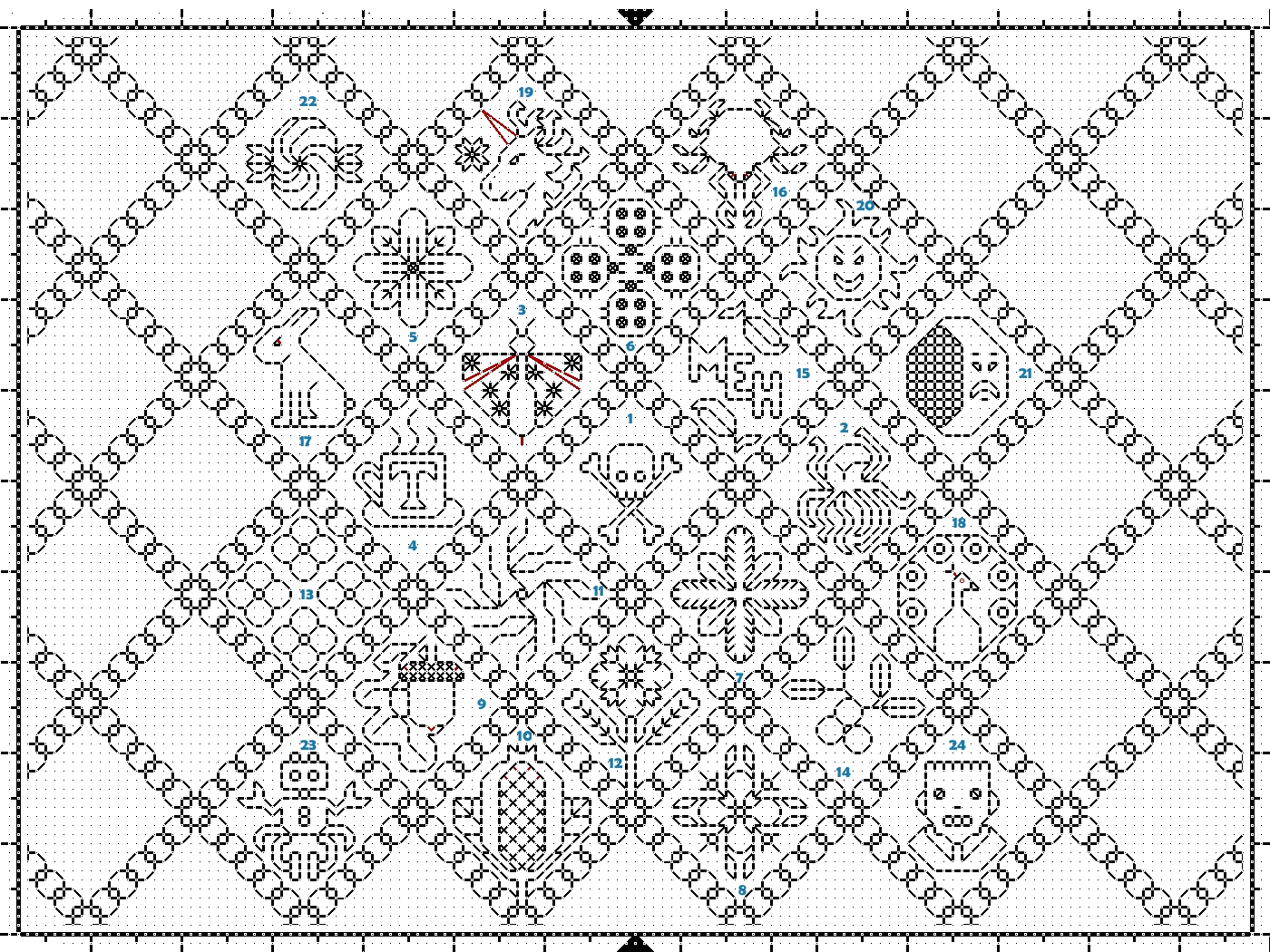
All of these are from anonymous donors.
#20 – A very aggressive sun.
#21 – A mustachioed moon.
#22 – A spiral mint candy.
#23 – Tiny robot!
#24 – Frankenstein’s Monster/
The sun, moon, robot and monster are from someone who doodled these up on the floor of a recent science fiction/comics convention that shall also remain nameless. The candy comes from someone who was charmed by the ladybugs, unicorn and the bunny, and was inspired to continue the counter theme of sweetness and light. (As opposed to poison, pirates, and ennui).
I welcome more input – traditional flowers, non-specific geometrics, animal, vegetable, domestic, wild, fantasy or reality.
CROWDSOURCE PROJECT SO FAR
Thank you all! As you can see, our crowdsourced blackwork pattern page is starting to fill up:

I’ve made no attempt to balance these or place them in any particular way. Numbering starts in the center, and works (more or less) in order of receipt. Half stitches, and stitches off the grid are shown in red. I’ve also taken the liberty of naming these, and including comments if provided by the donors. So we have:
- Death’s head – mine, fromDancing Pirate Octopodes
- Octopus – also mine, from Dancing Pirate Octopodes
- StarBee – sent in by the fabulous Twerp, our first submisison!
- A Cup of Tea – from Sandy
- Crosshatched Flower – from Anonymous
- Ladybugs – from #5 Anonymous’ 10-year old daughter
- Shaded Flower- from the prolific Jeannette de Beauvoir
- Geometric – “It starated life as a flower, I don’t know what it is now…” – from Jeannette de Beauvoir
- Acorn Sprig – “The acorn looks a bit big but a smaller one was too small.” – Jeannette de Beauvoir (I think the size is just fine).
- Pomegranate – Jeannette de Beauvoir is on a roll!
- Zap! – :”Kind of reminds me of a circuit diagram.” – another from Jeannette de Beauvoir
- Flower Sprig – Jeannette de Beauvoir again.
- Four Flowers – Jeannette de Beauvoir
- Mistletoe – “I think this could stand to be moved down a space or two in the frame” – Jeannette de Beauvoir
- Meh. – This one came in earlier but fell to #15 due to lack of enthusiasm 🙂 – Another (totally different) anonymous donor
- Blue Crab – “To continue your ocean theme.” – from Maryland Stitcher, who managed to fit in the requisite number of legs!
I’ll release the whole page as a well-behaved PDF as soon as it’s full. It’s not too late to add your patterns to our pile. I’m more than happy to finish out this page, and to start more pages if needed. The instructions are here.
And if you landed on this page looking for Ensamplario Atlantio my free book of blackwork fillings – do not despair. You can find it here.
CROWDSOURCE #2 – TEA, FLOWERS, LADYBUGS AND A YAWN
Patterns for the Crowdsource Blackwork Pattern project continue to trickle in.
Sandy (no link) sends a cup of morning tea.

And a family wishing to remain anonymous sends a flower (from the mom) and ladybugs (from the 10-year old daughter):


This anonymous donor was inspired enough to register his or her lack of enthusiasm:

Got an idea – simple, elaborate, silly, or serious? Here’s the blank frame again:

Copy it local and edit it in any graphics program, or do like these folk did – print it out, draw on it, and send me a scan or a photo ( kbsalazar (at) gmail (dot) com). I’ll graph up the final. When we have a pile, I’ll compose them all together into a page or two of patterns and post them back here.
CROWDSOURCE #1 AND SOCK DISAPPEARANCE
Back from vacation! A week of Cape Cod sun, sand, salt water and doing as little as possible except enjoying those things.


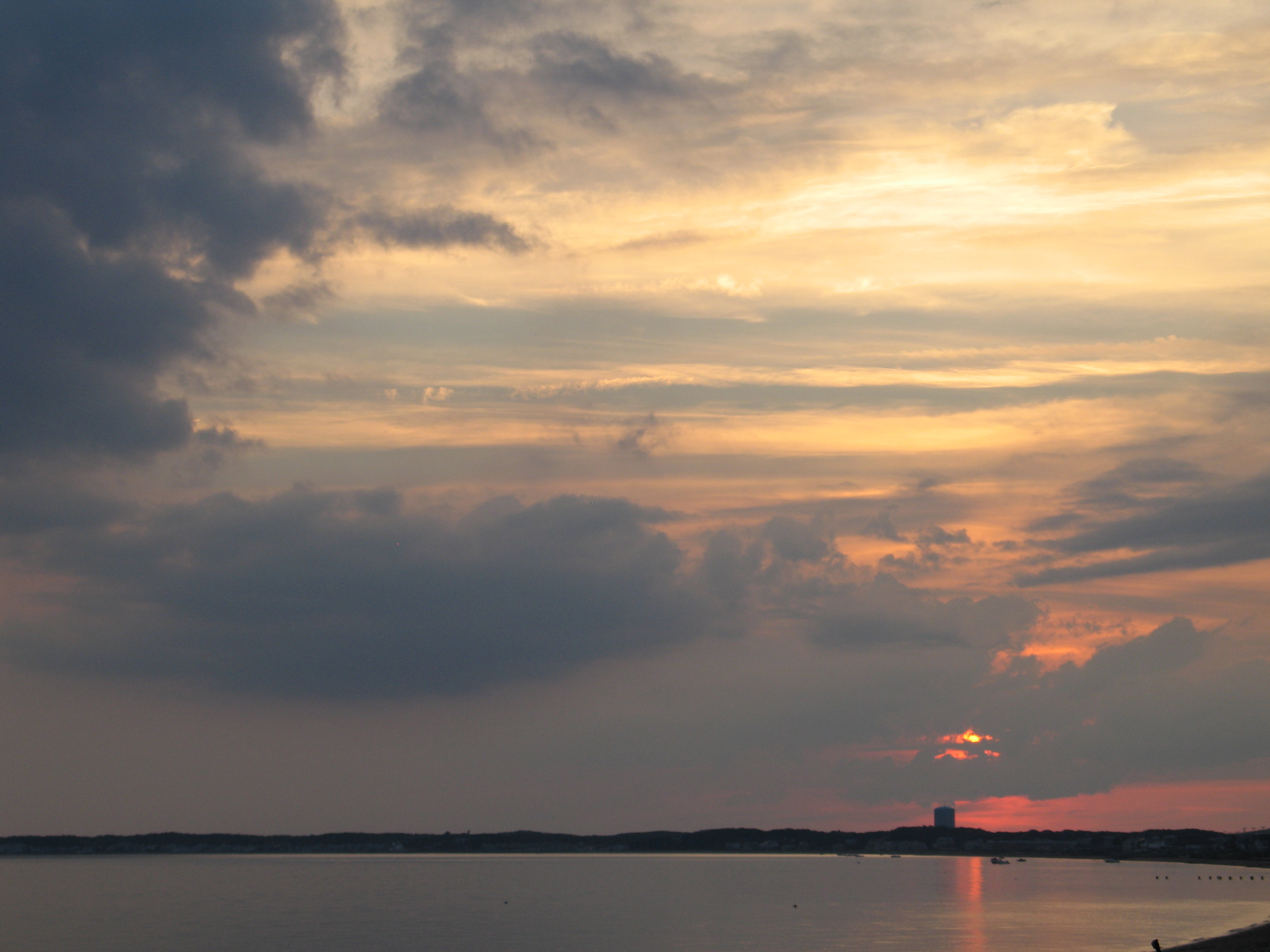
This year my mom came with us and we had a great time. We spent most of our time on the sands right at our hotel, sitting, swimming, kayaking, even watching Provincetown fireworks from our room’s deck. We did our now traditional beach paella, salmon teriyaki on the grill, and flank steak kabobs. I am rested but could be easily persuaded to do a wash-rinse-repeat of the whole week’s experience. Seven days is not enough.
Arriving back home, I checked gMail to see if anyone had volunteered a graphed pattern for the crowdsource project. Lo and behold! There was one:

I present Design #1 – Twerp’s StarBee. The first design in the series. Red lines indicate straight lines “off the grid” or not at 180/90/45-degree angles. I like this cheeky little fellow. A nice one, Twerp!
If you want to draw up one of your own to be posted here, please feel free to download the JPG at the project’s kickoff page, then draw on it by hand or using any graphics program. You can email the resulting file, a photo or a scan of your design to me at kbsalazar (at) gmail (dot) com. Let me know whether or not you want your name or a link posted with your offering. I do reserve the right to do light editorial selection (this is a family-rated website).
Now, what progress have I made on my own stitching?
Some, mostly prior to our departure. I concentrated on two pairs of socks while we were on the beach.

I knit a pair of guy socks, with a simple broken rib ankle and k1p1 ribbing to finish. There is only one in this picture. The other is now at parts unknown. At best guess, I dropped it at dusk on the beach and didn’t notice that it was gone. Either seagulls or the sea made off with it. Somewhere there is either a lobster or a tern sporting a new brown habitat. And I need to get another ball of the same yarn and knit a third to make a pair. (Grrrr.) The other pair has a lacy pattern in the ankle. More on that another day.
And here’s the latest strip on my sampler:

To which I will return once the socks are done.
One last note – to date (using the click-through count of the fourth part) – over 1,000 people have downloaded the complete Ensamplario Atlantio since I posted it two weeks ago. If you are looking for it, it’s here. It’s a PDF file – you need a recent version Acrobat Reader to open it. You can get Reader for free, for both Mac and Windows. Although I’ve gotten some thank-you posts and a couple of questions from people unfamiliar with Acrobat, I’ve had very little other feedback, and only one bug report – of fonts not displaying properly on an iPad II running the latest version of Safari. I’m looking into that problem and may repost the files later this week.
ENSAMPLARIO ATLANTIO – BLACKWORK FILLING COLLECTION PDFS FOR DOWNLOAD
UPDATE: 13 JUNE 2023. The old four-block system for downloading the original Ensamplario Atlantio, an artifact of bandwidth limitations common in 2011 is no longer needed. I’ve taken a moment, stitched the four pieces together into one book, made a couple of minor corrections AND added four pages of additional filling patterns. Please enjoy this new edition.
——————-
At long last, and as promised. Ensamplario Atlantio: Being a Collection of Filling Patterns Suitable for Blackwork Embroidery is here in PDF format!
I have to admit that my ambition ran away with me. The entire thing is 40 pages long, with 35 plates of designs – over 220 or so individual all-over or filling patterns for double running stitch embroidery. Some are very large repeats and would be better suited for free-use, others are smaller in scale and would work well as fillings in traditional outline/infilled blackwork (like on the pix of the cover, below):
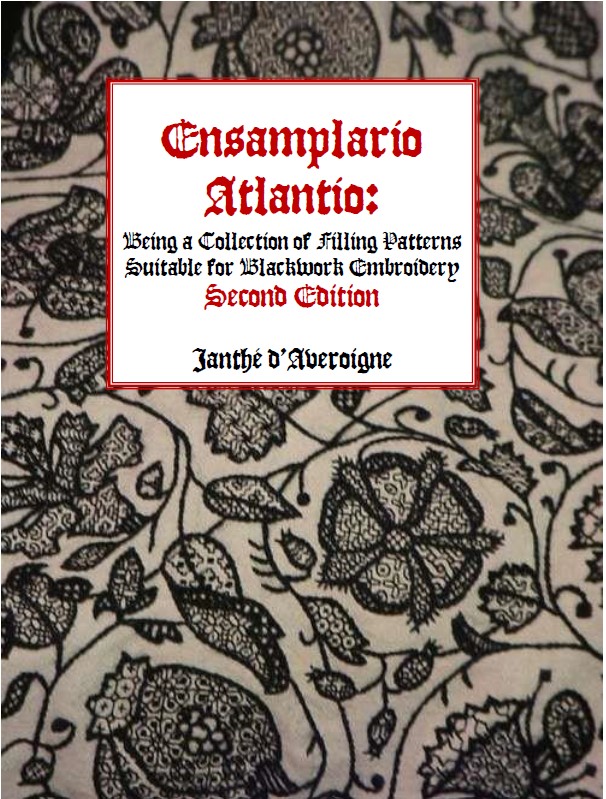
Formerly issued in four parts, the new, expanded edition of EnsAtl is now available as a single downloadable PDF file:
I would dearly love to see any projects that use fillings from the collection. Since I’m making this available as a free download, seeing what my pattern “children” are up to in the real world is my biggest reward.
And also a reminder – just because this is being made available freely doesn’t mean that I have relinquished my author’s rights. This book may not be re-issued, re-posted, or sold by others without my specific permission. I ask that needlework instructors wishing to use the thing get in touch with me so I can keep a log of by whom/when the book has been circulated.
UPDATE:
Longing for more? There’s a sequel. 200 more plates of designs – more fills, plus borders and even some neckline yokes. Also a free download. Pop over to this link to download.
CHALLENGED!
UPDATE: The graph below is available at the Embroidery Patterns link above, in easy to print PDF full page format.
The gauntlet was thrown. I was challenged to produce a chart for The Flying Spaghetti Monster, in all his noodly glory. At the risk of destroying any crumbs of credibility I might have as researcher, I respond.
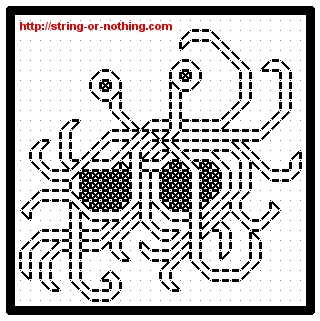
Hah!
MORE INSPIRATION FROM HISTORICAL SOURCES
Once more I go web-wandering, looking for counted thread inspiration from around 1500 through 1620 or so. This time I present some lesser known examples of counted stitching.
What I really wanted to find were examples of household linens – towels, sheets, pillows or other bedding, cushions, tablecloths, and the like. You’d think with all those innumerable domestic scenes so common in iconography there’d be some. So I looked for Annunciations, domestic scenes of the infant or young Jesus, plus other Bible and Saint’s lives scenes or parables; and tableaus from mythology. Anything that might show a made-up bed, a dining table, someone drying off, or someone getting dressed.
Given the popularity of counted edging patterns and huge number of household linen artifacts in museum collections, one would think these items would be common in paintings and prints. But they’re not. Perhaps the detail of these patterns was too tedious for most artists to attempt to reproduce. And it’s possible that for some of the religious art, the absence of decorated linen is of meaning. Lives of humility might not be graced by otherwise ubiquitous domestic embroidery, and it’s possible that the audience for these paintings noticed the omission. But I leave such interpretations to art historians. (I’m sure there’s more than one dissertation out there on household contents shown in classic religious art scenes.) Here is what I found in my troll of the Web Gallery of Art.
Domestic linen:
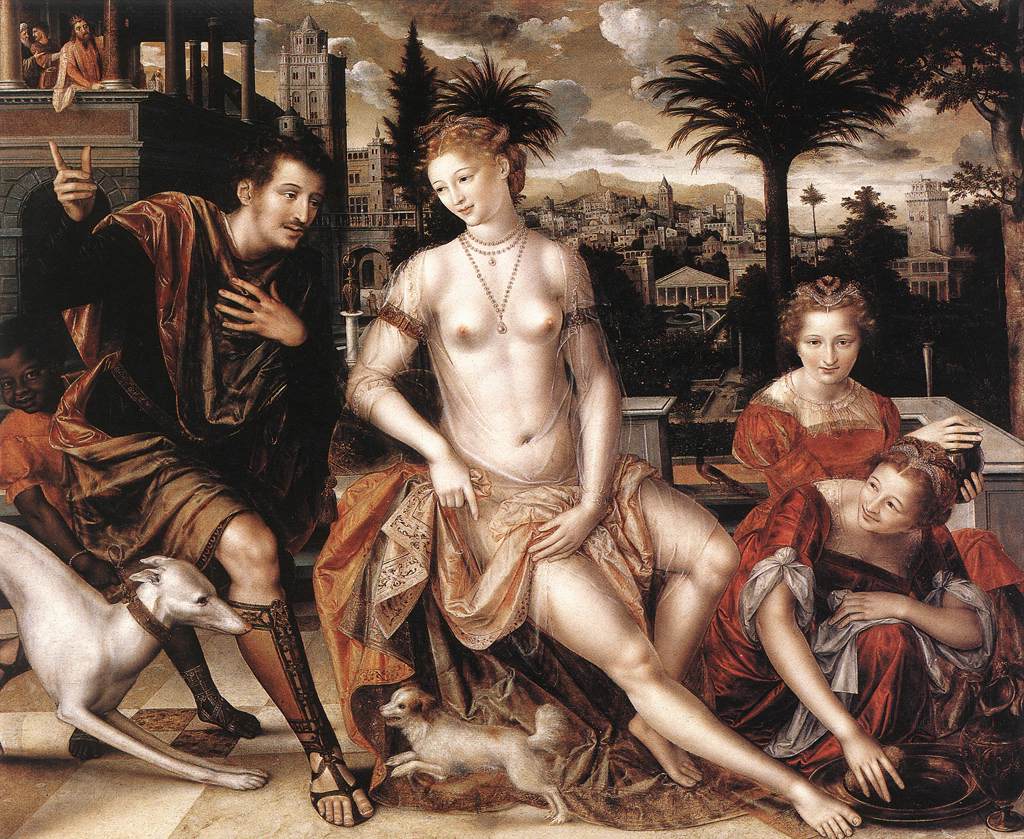
Here’s a nifty Bathsheba, she’s bathing, unaware of the peeping King David. She’s wrapped in either sheets or towels – some of which have elaborate embroidered red trim, with just enough detail to make out that the designs are regular enough to be counted. Although this work is undated in the collection, Jan Masseys other paintings are dated from 1550s and 1560s:
http://www.wga.hu/art/m/massys/jan/bathsheb.jpg
Masseys had a thing for David with Bathseba in disarray. Here’s another with towels or linens, although the detail is a bit more ambiguous that the last. This one is from 1562:
http://www.wga.hu/art/m/massys/jan/david_ba.jpg
And the barest hint of a bit of blackwork on a napkin from a Last Supper painted by Jacopo Bassano in 1546:
http://www.wga.hu/html/b/bassano/jacopo/1/08lastsx.html
A painting by Carvaggio – Supper at Emmaus, 1601. This one looks like it may be a table carpet, upon which a plain white cloth is spread. Even so, the pattern on the carpet is interesting:
http://www.wga.hu/html/c/caravagg/06/35emmau.html
This is by the same artist and same subject the one above, but is a later work (1606). The table cover under the white cloth looks a lot more like a voided pattern stitched on linen:
http://www.wga.hu/html/c/caravagg/08/47emmau.html
Bath linen(?) in lower right corner, edged with geometric. Master of the Fountainebleau School, Diana at the Bath, around 1590:
http://www.wga.hu/html/m/master/fontaine/diana.html
An embroidered pillow with a dainty counted edging along the seams, in Ambrogio Bergognone’s Madonna del Velo, from the 1500s:
http://www.wga.hu/html/b/bergogno/virgin_v.html
Personal linen:
Lots more of these in portraits, although not every painter took the time to do more than indicate the presence of intricate patterns. Certainly not with the graph-able precision of the famous Holbein Anna Meyer portrait on his Darmstadt Madonna panel. Still, detail on scale, placement, and colors can be harvested from these pix. Also I do note that while outer garment styles change and vary from region to region, and placement of the embroidery varies from piece to piece, the styles of the borders patterns and edgings used on chemises and shirts remains surprisingly stable across time and geography.
Black wide geometric stitching on chemise’s high collar neck band. Also edging embroidered on cloth worn as a turban style hat. Carvaggio, The Fortune Teller (detail) 1596-1597
http://www.wga.hu/html/c/caravagg/02/11fortu2.html
Geometrics on man’s wing-style collar. Portrait of Henri II, 1547:
http://www.wga.hu/html/c/clouet/francois/henri2.html
Chemise heavily embroidered in black, but probably not counted. Hans Eworth, Portrait of Lady Dacre, 1540
http://www.wga.hu/html/e/eworth/l_dacre.html
Geometric stitching in red on narrow high collar. Catarina va Hemessen, Self Portrait, 1548:
http://www.wga.hu/html/h/hemessen/caterina/selfport.html
Wide man’s collar and cuffs, in geometric patterns with center panel and complimenting narrow edging bands, worked in red on white linen. Giovanni Battista Moroni, Portrait of Don Gabriel de la Cueva, later Duke of Albuquerque, 1560:
http://www.wga.hu/html/m/moroni/portduke.html
Woman’s chemise with broad center panel and collar band, in black on white linen. Peter Bourbus, Portrait of Jacquemyne Buuck, 1551:
http://www.wga.hu/html/p/pourbus/pieter/portrai2.html
Narrow geometric band at top edge of woman’s low chemise (also may be detail in red on hat). Vittore Carpaccio, Portrait of Young Woman (artist dates are 1472-1526)
http://www.wga.hu/html/c/carpacci/5/021woman.html
Boy’s shirt – narrow collar band, voided in black on white. Jean Clouet, Dauphin Francois. (Artist dates are 1485-1541)
http://www.wga.hu/html/c/clouet/jean/dauphin.html
Man’s shirt – narrow panels with black on white geometric stitching, divided by heavier narrow strips of gold or yellow silk embroidery. Lucas (the Elder) Cranach, Portrait Diptych(detail). 1509:
http://www.wga.hu/html/c/cranach/lucas_e/11/05dipty2.html
Man’s shirt- narrow panels parallel to center front slit. geometric black on white. Lucas (the Elder) Cranach, Portrait of a Clean-Shaven Young Man, 1522
http://www.wga.hu/html/c/cranach/lucas_e/12/03young1.html
Man’s shirt – horizonal panel of either two color stitchery, or one color on brown, appliqued over narrow cartridge pleats to keep them in place. Albrecht Durer, Self Portrait at 26, 1498:
http://www.wga.hu/html/d/durer/1/02/05self26.html
Woman’s chemise, with small black edging allt he way around. Martha and Mary Magdalene, 1596 by Carvaggio:
http://www.wga.hu/html/c/caravagg/02/16martha.html
Another scoop neck chemise in the same style of the one above. St. Catherine of Alexandria, 1598 also by Carvaggio:
http://www.wga.hu/html/c/caravagg/02/15cather.html
A different style of higher neck chemise, this one decorated by wide double bands down the center, plus a band around the neck, and narrow strips of stitching, possibly
on seams. From Portrait of the Artist’s Sisters Playing Chess, by Sofonisba Anguissola, 1555:
http://www.wga.hu/html/a/anguisso/sofonisb/chess.html
A man’s high-neck shirt this time, with a wide band of black geometrics on white. Portrait of a Man, dated 1520-25 by Girolamo Romanino:
http://www.wga.hu/html/r/romanino/manportr.html
Edging on a veil, black on very fine, almost transparent linen. Not too many paintings that show stitched veils! Portrait of Martha Thannstetter (nee Werusin), dated 1515 by Bernhard Strigel
http://www.wga.hu/html/s/strigel/bernhard/portrai2.html
Another stitched veil – this one in multicolors, and possibly dual sided work. Andrea Previtali’s Madonna Baglioni, 1515-1520:
http://www.wga.hu/html/p/prevital/baglioni.html
Multicolor bands on boy’s shirts, done in a style that looks counted to me. Bernhard Strigel’s Portrait of the Cuspinian Family, 1520:
http://www.wga.hu/html/s/strigel/bernhard/cuspinia.html
Voided work edging around a neckline, in black. (Reminds me of the bit at the far right of my current piece). Sanzio Raffaello’s angel – a fragment of the Baronici Altarpiece, from 1500-01:
http://www.wga.hu/html/r/raphael/1early/02baron2.html
Two different narrow edging patterns, both in black, both very simple and easy to duplicate right from the portrait. Sanzio Raffaelo’s Portrait of a Woman (La Muta) from 1507:
http://www.wga.hu/html/r/raphael/2firenze/2/36lamuta.html
Raffaello was very good at clearly depicting intricate stitching. I really like this St. Sebastian (1501-1502) – the tshirt elaborately embroidered in yellow (gold?) with little black cross stitches is clear enough to chart:
http://www.wga.hu/frames-e.html?/html/r/raphael/1early/01sebast.html
Very clearly counted work – a man’s shirt with a wide, heavy two-tone neckband. It looks applied to the shirting underneath to me. Hans Maler’s Portrait of Moritz Welzer von Eberstein, from 1524:
http://www.wga.hu/html/m/maler/welzer1.html
And a lady with a high multicolor stitched collar. This looks like highly embossed stitching to me, not jewelry. And regular enough to make me think that the underlying cartoon was worked on the count, with the embossed stitching done over the cartoon. I have no basis for this opinion other than observation, so feel free to disagree. Willem Key’s Portrait of a Lady, undated, but the artist lived from 1515 to 1568:
http://www.wga.hu/html/k/key/willem/portlady.html
A particularly good view of upper body construction of a woman’s chemise, embroidery framing center slit, following around the collar and radiating out from it. In this case, with one single pattern maintained uniformly throughout. Black on white. Bernardino Luini’s Salome from 1527-1531:
http://www.wga.hu/html/l/luini/father/2/salome1.html
Another killer high neckband on a man’s shirt. Again multicolor with red and yellow (gold?), worked on the count. Jan Gossaert’s A Noble Man dated 1525-1528:
http://www.wga.hu/html/g/gossaert/2/baudouin.html
and finally
Ambrogio de Predis’ Portrait of a Man, from 1500. The pattern on his sleeves is in the forthcoming collection of blackwork filling patterns:
http://www.wga.hu/html/p/predis/portra_m.html
I have references to at least as many again pix as are presented above. Let me know if you’d like me to share them too.
 String-Or-Nothing