ADVENTURES IN THE UNSEEN
I was wrong and I freely admit it. Remember the post in which I described a method for estimating the depth of stripes that would be produced by a skein of space dyed or multicolor patch yarn? I applied that method to my skein of Noro Kureyon Sock, and it flat out missed the mark.
Based on skein size and color strand counting, I estimated that each solid color stripe would last 4-6 rows or so before shading into the next. I still stand by that for the yarn on the outside of the skein, but I didn’t factor into my estimation how seemingly random Noro yarns can be. Here’s the skein:

I see lots of turquoise and magenta, with side trips to royal blue and deep green. The color segments of the yarn on the outside of the skein appear to last for the lengths I indicated.
But here’s the resulting slouch sock (a sock with a deliberately wide ankle part), knit from the center of the ball out. It’s brother is just a tiny turquoise cast-on speck right now:
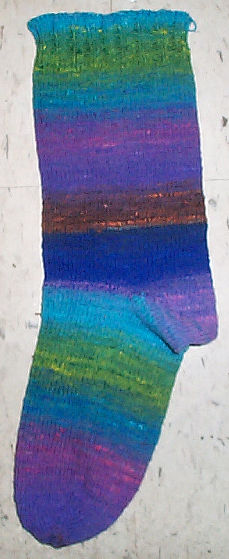
Huh? where did that huge lump of royal blue above the heel come from? And the green/orange mix directly above that? And why is the pink/purple section so unexpectedly wide? Counting the strands on the inner layer visible on the un-dissected skein, pink/purple should be equal in width to green. What gives?
I might have been less surprised had there been more than one skein of this color number available on the day I bought the yarn. Looking at several, each starting at a different spot in the color progression might have revealed larger (or different) color segments than I anticipated. In any case, the color repeat has gone through about one and a half cycles in this sock, hitting the toe’s hue blend about halfway between orange stripe and densest part of the magenta, although factoring in the wider circumference of the ankle part than the foot, the second appearance of the pink/purple is longer than that combo’s debut.
So there’s my caveat. I still say my estimation method works. Mostly. Except for Noro, where all bets are off.
Pattern footnote:
How to do a slouch sock? Easy. US #00s. Standard figure-8 cast on toe, worked on a set of five DPNs. Increase to 17 stitches per needle until just before the heel (68 st total). Increase one stitch per needle to 18 (72 st total), work a standard short row heel across two needles (36 stitches), instead of decreasing away the two sneaky stitches used to minimize any top-of-heel-decrease gaps, keep them, and increase one stitch each on the two non-heel needles for a total of 19 stitches per needle (76 st total). Work leg part equal in length to foot (folded along the heel’s natural equator), then work about 20 rows of K2, P2 ribbing and end off.
Why do a slouch sock? Between the wild colors, thick/thin spin, and overtwist, any lacy or texture pattern would be lost in this stuff. Also this yarn isn’t a good candidate for stranding or striping with another (although two different but closely related skeins in a simple stranding pattern might be interesting). I’ve had some breakage, and I’m not inclined to use this stuff for a nice, snug sock that takes a lot of stretching to put on. The roomy top will diminish that strain.
BABY GIFT #2 (MOSTLY) DONE
The yellow baby blanket is mostly done. All that’s left is to graft the beginning of the edging to its end, and darn in the dangling ends. Here it is patted out and pinned to the back of the sofa, which accounts for the strange dimensional distortion.
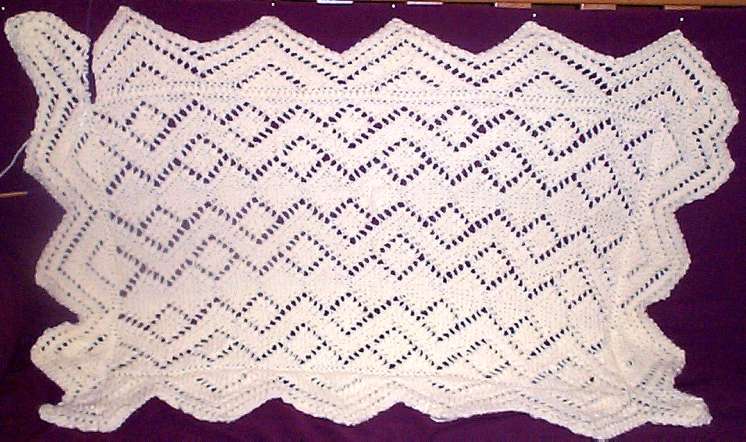
I’m 80% satisfied with it. It’s small, more like basket or car seat size than crib size. I only had four skeins and used all but about ten yards of it. I’m only halfway pleased with the corners. The math worked out to be a multiple of a half repeat. That means that two corners were mitered starting at the narrowest point of the repeat, and two were mitered starting at the widest point. I will say that mitering at the narrowest point for this symmetrical edging worked better. That corner is in the upper left of the photo. Its opposite at the upper right looks clunky by comparison. If I had the thing to do over again (with more yarn) I’d work another three inches of the center panel so that all four corners could begin at the narrowest spot on the edging repeat.
The stitch patterns for this one also came from the the first Duchrow book. The center is pretty much verbatim, and can be found on page 35. The edging is inspired by the companion edging presented on the same page. My version is truncated by about a third of the original width. I arbitrarily cut off about eleven right hand side stitches, turning what were diamonds framed by a zig zag on the dagged side and triangles on the join side into plain old triangles, and eliminating a column of fagoting. Along the way I noticed that a smaller “junior” version of the same thing could be worked by using only a portion of my rows. I present both in the pattern graph below (click on it for full size version).
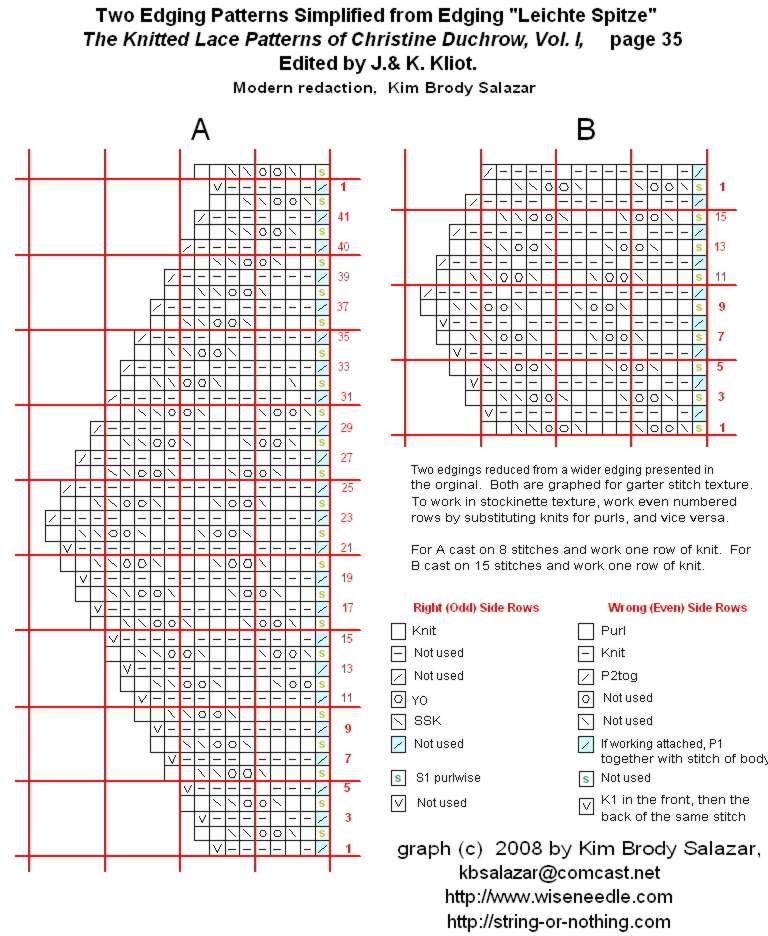
How to miter the corners? It’s easier than you think on a symmetrical pattern like this. I do them on the wrong-side rows, working one stitch fewer each wrong side row and wrapping the last stitch I work in each wrong side row until I reach the reflection point of the repeat (the shortest or tallest point depending on where I start), then I reverse the process, re-incorporating one previously wrapped stitch (along with the wrap at its base) on each wrong side row until I’ve reclaimed my full width and returned to the same point in the repeat where I started. Sounds confusing, but give it at try.
Now on to Baby Gift #3 – the little sweater kit. It turns out that there’s yet another in queue, after the sweater it looks like I’ll be knitting at least one more small blanket, plus some other thing to be determined when inspiration strikes.
WOMEN IN ENGINEERING – THE FUTURE?
UPDATE: THE PANEL INSERTION PATTERN BELOW HAS BEEN ADDED TO THE PDF COLLECTION AT THE KNITTING PATTERNS LINK, ABOVE.
Like most parents, I spend a lot of time rolling my eyes at what passes for homework and school assignments. There are way too many feel-good tasks – making posters and collages, even well into high school. Where are the analytical reading pieces? Where is learning how to write a convincing essay? But every once and a while something engaging and creative is requested.
This month Smaller Daughter (now 9) had to construct a Rube Goldberg device, with a goal of popping a balloon. I sat on my hands and watched her experiment for the better part of a week. She scribbled out her designs and went down several possible paths before settling on her device components. She constructed (and re-constructed) each station scrounged from toys and oddments at hand, testing out each one individually, then assembled them into her final chain reaction. Eventually, after much tinkering she got it just right, and the whole thing worked as intended.
I wish I had a video camera, but you’ll have to use your imagination. Especially the part where the balloon makes a satisfying pop, and she leaps up in triumph.
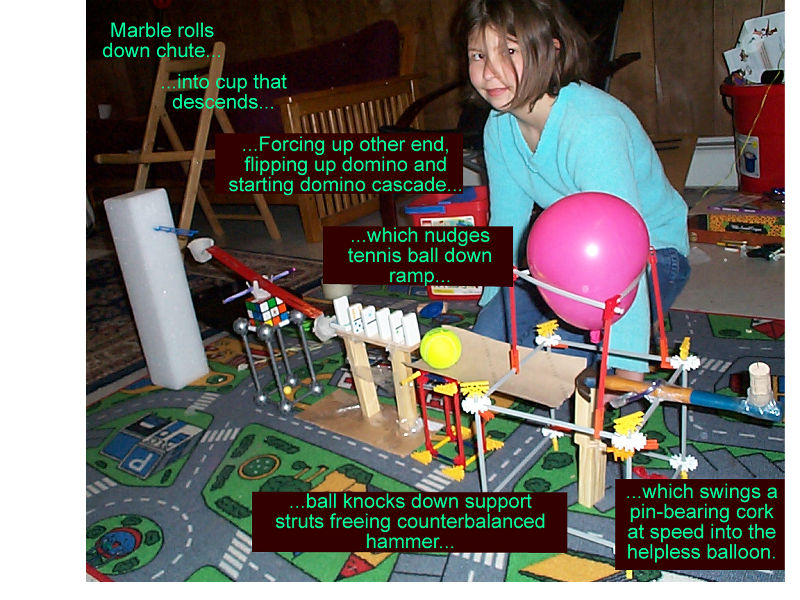 Click on any thumbnail on this website to see detailed pix.
Someday I will loose this proto-engineer on the world. I hope the world will be ready.
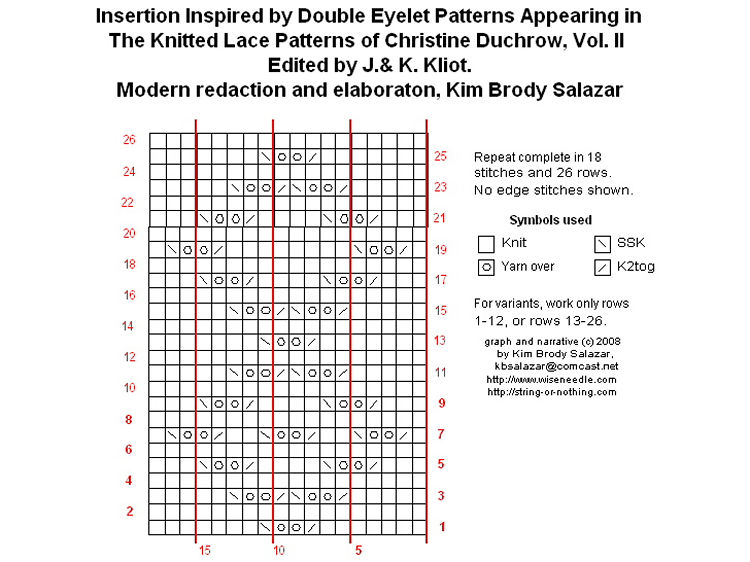
In knitting news – not much. I’ve been working like a demon. All I’ve had time to do over the past two weeks is one mindless sock. For me to take two weeks to knit one sock says a lot. This one is a standard 72 stitch sock with a figure-8 toe and short rowed heel, worked using five DPNs. That calculates out to 18 stitches per needle. My insertion strip is 18 stitches wide as graphed below, so I do the pattern in its entirety once on each of the four working needles. I’ve stuffed a piece of white paper inside the sock so you can see the diamond patterning. and provided a chart for the simple design .
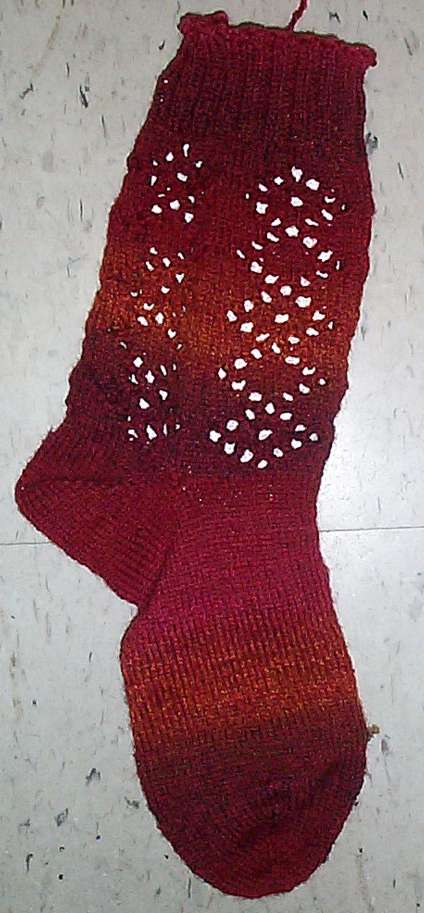
I used Meilenweit Mega Boot Stretch, knit at about 9spi. The shaded reds with the touch of orange is color #709. I’m not wild about this yarn. It feels nice and cushy knit up, but I don’t enjoy tensioning it. The stretch is throwing my gauge off a bit, especially on my heel’s purl rows. It also is rather lofty unstretched, and prone to catch and split on needle tips. I’ll post a review of the stuff when the pair is finished.
BEST FRIEND DORM SWEATER
Just because I was eaten by work doesn’t mean there was no knitting going on at my house. I’m very proud of Elder Daughter (currently in 11th grade), who completed her first sweater this weekend past.
She used Sirdar Denim Ultra – a very soft and lofty cotton/acrylic blend, and made a top-down original, working off a pattern produced using Sweater Wizard. She did all the steps – knitting gauge swatches until she had one with a hand she liked, then calculating the gauge; taking body measurements; inputting the gauge and measurements into SW, and then tinkering with different lengths, eases, and necklines until she got the look she liked (comfy/baggy, for relaxing after class). Then she cast on and followed her pattern to the end.
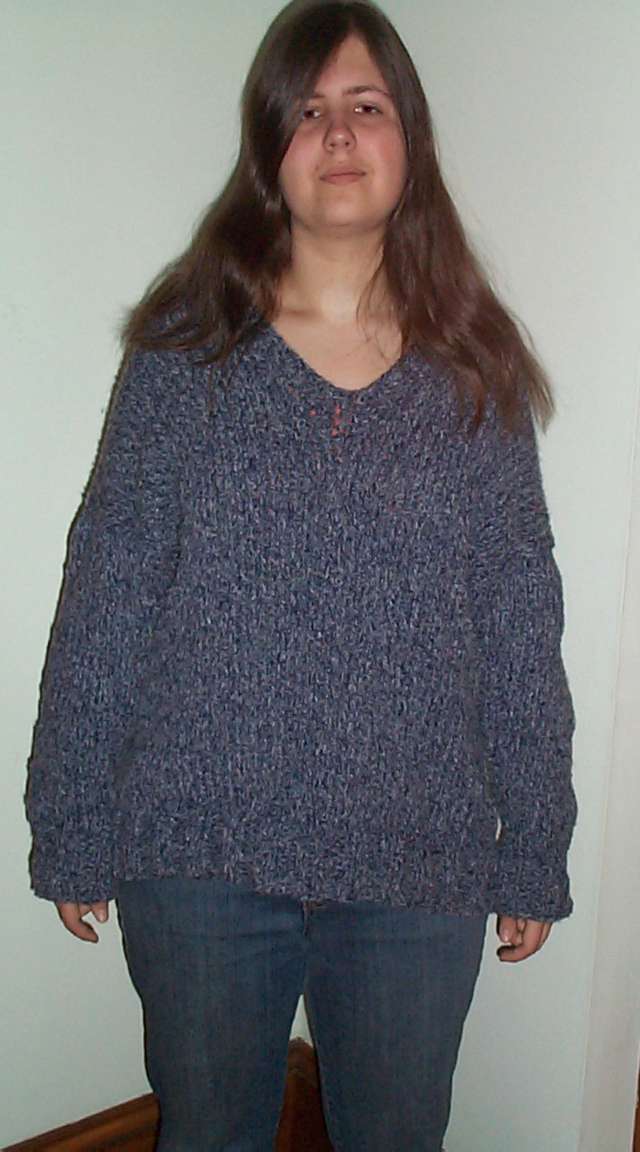
She had a ton of fun working through the project, and is extremely happy with the end result. Her only criticism of the yarn is that it’s a bit splitty, and being composed of lots of individual smaller strands, does have a tendency to catch on things.
I know that Sirdar Denim Ultra is discontinued now, but in the chance anyone has a similar lofty acrylic/cotton blend that works up to 10 stitches/12 rows for 4 inches or 10cm, Elder Daughter shares her pattern:
My Best Friend Dorm Sweater
Needles: 11, 13 Size: 40 Gauge: 2.5 sts 3 rws per 1″ Estimated Ydg required: 718
Note: Sweater begins at the top back and is worked to underarm back. Cast on sts are picked up to work to front underarm. Remainder of garment is worked in the round.
Start Back
With larger straight needle, using a provisional cast on 54 sts. Work Back to Underarm Working back and forth, work until piece measures 10.5″. Place sts on a string.
Front Shoulder & Neck Shaping
Slip 19 left shoulder sts (from cast on string) on needle, skip 16 back neck sts. Slip 19 right shoulder sts onto needle. Using two balls of yarn, begin neck shaping as follows: Inc 1 st at neck edge every 3 rws, 3 x. Then every 4 rows, 5 x. Complete Front Top: Work even until piece meas same as back. Slip front body sts onto scrap yarn.
Work Sleeves.
Pick Up Sleeve Sts [pick up 4 sts, skip 1 row] 4x [pick up 5 sts, skip 1 row] 2x to shoulder. From shoulder down [pick up 5 sts, skip 1 row] 2x [pick up 4 sts, skip 1 row] 4x (52 sts) ending at underarm. Place marker, join.
Shape Sleeve
Work 1 rnd. Begin sleeve shaping: Dec 1 st on each side of marker every 2nd rnd 6x, then every 4th rnd 8x. Cont in pat st until piece meas 15.5″[rnd 46]. Change to smaller needles for cuff. Sleeve-to-Rib Dec Round: [Work 7 k2tog, work 6, k2tog] 1x, work 7. Work rib for 10 rounds[3″].Bind off 22 sts.
Work Body
Slip front and back body sts onto a circular needle. Work across front, pm(side seam), join front and back, work across back, pm (beg of rnd). Join. With larger needles, work one RS row. Begin shaping: Dec 1 st each side, every 20th rw 1x. Inc 1 st each side, every 20th rw 1x. (108 sts).Cont until piece meas 14″ from underarm
Work Ribbing
Body-to-Rib Dec Round: [Work 8, k2tog.] 10x, work 8. (98 sts) Change to smaller needles. Estab rib pat: *
K2
, P2. Repeat from * to end. Work 10 rnds.[3″]. Bind off.
Standard Neck Finishing
With smaller circular or dp needle and RS facing, pick up 16 sts from back neck, pick up 22 sts from left neck edge, place center marker, M1 st in center, pick up 22 sts from right neck edge, place end of round marker. (61 sts) Rnd1: work in k1, p1 ribbing to within 2 sts of center marker, ssk, pm, k1, k2tog, work in k1, p1 ribbing to end of round. Rnd2: work in estab ribbing to within 2 sts of center marker, ssk, pm, k1, k2tog, work in estab ribbing to end of round. Repeat rnd 2 for approx. 1″. Bind off loosely in ribbing.

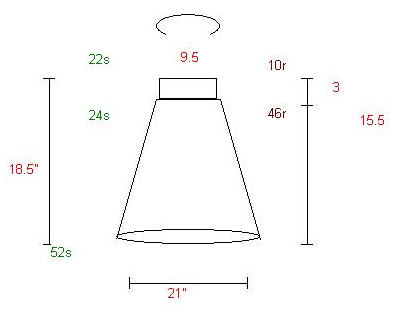
Pattern and schematics produced using Sweater Wizard software. Pattern copyright 2008, Alexandra Salazar and Kim Brody Salazar.
MORE DOODLING – DUCHROW HEART EDGING AND MITERING A CORNER
Yet another spate of horrific deadlines has washed past me. I survived (barely), but I haven’t had much time to knit.
I’m still working on that second lace doodle scarf – the one composed from patterns out of the Duchrow books. (Which I wholeheartedly recommend for lace fanatics.) I’ve finished the center panel, and have applied the edging down one long side, around the narrow end, and am now starting back up the second side:
The edging in this case is a bit unusual. It’s predicated on motifs that are somewhat heart-shaped, and sports a very deep dag. I managed to fiddle around with the attachment rate so that I ended up at the corner of the body at the exact narrowest point of the edging repeat. That let me miter the corners using short rows. I wish I’d stopped and taken pictures of that process, but I’ll try to explain it sight-unseen.
To miter the corner on this symmetrical lace, I knit this edge onto my main body piece, either directly calculating the pick-up ratio, or (more likely) fudging the rate of attachment so that I ended with my narrowest row (the valley between two points) at the exact corner stitch of the corner I wish to go around. Sometimes this is easy – if I’m a stitch or two off, those can be made up in the last repeat just before the corner. If I’m more than just a couple of stitches off, I might need to rip back a repeat or two and space the required extra rows or skips (or k2togs) over a larger interval. Obviously, it’s easier to fit an edging with fewer pattern rows into any given arbitrary length than it is to fit a longer one, because there are fewer rows between the widest and narrowest points of the repeat.
Back to actual performance. Arriving at the narrowest point of my edging in concert with reaching the absolute corner of my piece, I’d knit the next right-side row of my edging as usual. BUT on the return journey instead of working all the way back to my attachment point, then purling the last stitch of the edging together with one from the body, I’d wrap that attachment stitch (Row 2, Column A). Then I’d turn the work over and head back on the next right side row, taking care to keep my place in the edging pattern. I’d continue like this, but on each successive wrong-side row, I’d work one fewer stitch, and wrap the next one prior to turning. All of this is complicated of course, by the increases and decreases that form the lace pattern itself. Liberal fudging is usually in order to maintain the pattern as established – or a close to it as is possible.
Eventually I’d reach the row that on a “normal” repeat, would be the longest row – the one that happens in the centerpoint of one of the protruding dags. My actual row worked is much shorter than usual because I’ve been wrapping stitches to form my miter. It’s at this point I go back and begin the second half of my short row sequence, working each row one stitch farther along, waking them up one by one by working them along with the wrap at their base. If I’ve done this correctly, by the time I have reawakened all of the stitches on my row, I’ll also have arrived at the narrowest row of my lace edging repeat, and all of my previously parked short row stitches will have been reincorporated. When that happens, my mitered corner is complete, and I can I begin resume working the edging along the side of my piece.
I’ve taken the liberty of translating the historical pattern from Duchrow into modern notation. She doesn’t present a mitered corner for this edging, but I’ve noted where the short row shaping should take place so you can see (more or less) what I am writing about. Click on the image below for a full size pattern. Apologies for the file size.

ADVENTURES IN LACE – CORRECTING HISTORICAL LACY KNITTING PATTERNS
First, let me reassure everyone that it’s not my intent to supplant the need for the books I’ve been using lately. I strongly recommend that people interested in lacy knitting buy them, and have as much fun learning to knit from them as I am having. But I also realize that it’s very daunting for many people to think of picking up a book in a language they don’t read, that uses an unfamiliar symbol set, and that can be full of unexpected differences from modern knitting logic (to the point that would be thought errors in modern books.) Mining these older works for usable ideas is a form of Extreme Knitting* – one that I want to encourage more people to try. I hope these posts help bridge some folk over to beginning their own explorations.
For example, here’s another lace redaction problem that turned into a paddle in the lace design pool.
I intended to finish out my black lace doodle scarf with an edging appearing in the same book as the insertion strip I modified for that scarf’s body. But the graph of the original isn’t quite logical, especially when compared to the engraving of the finished item. The edging I originally intended to use is on page 12 of Knitted Lace (Kunst Stricken) by M. Niedner anf G. von Reden (edited by the Kliots).

If I flat transcribe each of their chart symbols into modern notation, I get the chart in the diagram below (click on it to make it bigger).

Although the chart looks good, it’s not knittable. Not if you want to make an edging that looks like the one in the engraving. Why? Look at each graphed row. If you count up the increases (the YOs) and the decreases (ssks) you quickly find that there is an equal number of both in each row. That’s perfect if you’re doing a straight insertion with parallel sides, but this is supposed to be a dagged edge that grows and shrinks to make triangular points. In order to achieve the ragged left edge indicated the stitch count should increase or decrease each row. But you say – it does! The little points are being formed. MY point is that there is no indicated origin for those extra stitches. For Row #3 to have one more stitch on it than Row #1 as shown, there should have been an increase without an accompanying decrease on Row #1. Otherwise that stitch just appears **poof** without a logical point of origin.
Now, if we want to knit this edging, we need to add that missing stitch. In fact, if you look at each and every line of the pattern you’ll see that there’s either a missing increase or decrease on each illustrated row. We need to put them in.
There are several ways to make those corrections. The simplest is to leave out one strategically placed decrease somewhere on the “growing” rows (working the two stitches involved as plain knits); and to introduce one somewhere on the “shrinking” rows (working two stitches shown as being knit as a decrease). Another fix would be to make up the differences on the interstitial even numbered rows. A third method would be the most noticeable – incorporating the corrections as visible additions to the pattern, in effect, editing the pattern to introduce new eyelets or decreases to form a new design element.
Now. Where to put them? Again looking at the original graph, you’ll see that the only area that changes is the part I marked in blue on the original chart (the original didn’t differentiate these stitches in any way). Other than growth/shrinkage in that triangle area, the pattern is stable, alternating between two design rows – the unshaded area shown on Row #1 (repeated on 5, 9, 13, 17, 21, 25, and 29) and the unshaded area shown on Row #2 (repeated on 7, 11, 15, 19, 23, 27, and 31). Obviously all of our edits will have to take place within the blue shaded area. Even with those edits, the heavy reliance on only two pattern rows means this will be an easy pattern to memorize once we’ve noodled out the missing bits.

I began experimenting, although I fizzled out along the way, having lost enthusiasm for using this particular trim. But I did produce a workable solution. It relied heavily on the original chart, modifying some of the decreases on the growing rows and adding some on the shrinking rows:

As you can see, while my yarn choice for this swatch isn’t optimal (something lighter would conform better and shape itself more fluidly up and over the triangle’s point, it did work. It also looks pretty close to the original. But not spot on (more on that below).
I tried mightily to make the mods on the off-side rows piece work. In theory it sounded feasible. It would have worked, had there not been the flower-like quad eyelet structure in the point of the base triangle. Adding/subtracting stitches at the right edge (the straight edge) perturbed the placement of the eyelets and lost the symmetry of the feature. Putting those additions/decreases elsewhere by adding/subtracting stitches along the pointed edge of the base triangle produced a clunkier, more clumsy finished product than did working them in on the right-side row.
I have to admit, I didn’t bother with the increases as a decorative element step. To do that I’d have had to widen the pattern as a whole, and introduce a YO after the slipped stitch on each odd numbered row. On rows 19-31 I’d have had to follow that YO with a double decrease (removing one stitch to compensate for adding the YO, plus the one stitch needed to shrink the base triangle . Contemplating the result of the second scenario above made me think that this arrangement would also run afoul of that quad eyelet flower. Between that and realizing that this pattern wouldn’t be a good compliment for the design of my scarf’s body – I ran out of enthusiasm to keep fiddling with it.
Oh. The final straw? Examining the pattern chart, the engraving of the pattern and my knit sample, and realizing that the chart as shown (and that I knit – more or less) wasn’t the same as the engraving. That clearly shows four courses of eyelets, not three, plus two rows of crocheted picots. The picots I can forgive, especially since I can noodle out just enough of the blackletter-style German text to determine that instructions for it were included in the prose. Here’s the chart for my successful result, plus a posited modification to produce the four-course pattern shown in the book’s original engraving. I haven’t actually knit up the lower chart yet, but it should work.

I’ve run into these problems several times in these older pattern collections – both the lack of correspondence between chart and illustration of the final product; and basic charting that doesn’t produce the desired result. I’ve found it’s always a good idea to proof the rows in a pattern – especially one from a historical source – before sitting down to knit, and if knitting from an unproven vintage source, to always swatch up a repeat or two before committing oneself to a full project in any given stitch pattern.
Oh. What did I end up using on my doodle scarf? More on that another day.
*Extreme Knitting – A mythical book I long for instead of what’s on the shelves now. A compendium of highly challenging patterns in lace, colorwork, garment shaping and tailoring, tiny gauges, historical recreation/redaction – whatever, so long as each project is as magnificent and as timeless to wear as it was an inspiration and learning experience to knit. I hereby reserve this title, but will surrender it to any author who can prove his/her work meets these conditions.
CASHMERE LACE SHAWL – EDGING
First some administrivia. This site has been under massive attack by comment and trackback spammers. As a result, we’ve totally disabled the trackback feature, and limited comments to the most current three months of entries. We have also instituted a protected comment system to prevent automated spammers. But since the crowd that visits here doesn’t appear to be particularly chatty, that shouldn’t be a problem. We’ve also updated the software that runs the infrastructure of the blog. Whenever a set of changes of this magnitude is undertaken, it’s going to take a few days before the bugs are ironed out. Apologies if you tried to consult these pages and received error messages. We’re working on the remaining nits as fast as we can. Special thanks to The Resident Male – website plumber extraordinaire for the hours he’s put in wrestling with these issues.
In the mean time, knitting here continues. Friend Dena was amazingly generous, giving me more of the gray/brown laceweight (also lots of other goodies destined for some more over the top lace projects). Ten thousand thanks! Armed with more yarn, I’ve been able to work more on the big shawl. I’m rounding the second corner and on the back stretch. No pix today though. It looks much as it did last week – a frothy gray/brown object too unblocked to see well.
It turns out that this blog serves a major purpose that I didn’t really appreciate. I am not good at cataloging what exactly I do as I fudge my way through a project. I was careful to note the pattern and mechanism I was using for the framing area of my shawl, but I hit on the edge pattern during the time I was stretched thin and didn’t have time to write up entries. Therefore I didn’t make a written note of where that edging pattern came from and what I did to adapt it for this piece. Since I also set the shawl aside when I ran out of yarn, I had lost my thread of continuity on it. It took me a couple of days before I located the edging that I was using and figured out what I had been up to. It’s from the first volume of Duchrow reprints compiled by J. and K. Kliot:
I now present it here as much to keep track of what the heck I’m up to for myself, as for others to play with. The pattern I’m using appears on Page 35. The original stumped me a bit because I couldn’t make the last three stitches work out correctly. According to the book, every row should end with a SSK, K2 – but I find that working the “uphill” side of my triangular dags, I have room for a plain K3, and on the “downhill” side as the dag narrows back, I have room for a K2tog, K3 – but need to cheat, working the first stitch on the wrong side return row as a P2tog to preserve the visual line of the narrow strip at the outer edge of my border.

The pattern page (click on image above to get a readable version) presents both the original from the book, translated into modern notation; and my adaptation.
MORE ON EDGINGS AND CORNERS
More on corners. Using the same principles as the knit-from-center-out framing area on my cashmere shawl, I’ve done a mitered corner on my baby blanket. I do envision a problem now that I’ve finished a credible Corner #1, but I’ll deal with it when I get there.
The first step was to make sure that I had a multiple of my halved row count available as live stitches along each edge of the project (small alerts should be going off in your head right now, but back to this later). That’s because using my chosen attachment method, two rows of edging are attached to each live stitch.
Edging right side row: S1, work pattern to end
Edging wrong side row: Work pattern to penultimate stitch, SSK last stitch together with a live stitch of the body.
I can modify this scheme by doing an occasional SSSK on that wrong side row, in which one edging stitch is knit together with two live stitches from the body. This can be periodic and eat a specific number of stitches over a given number of repeats (eating one on every Edging Row 1, or every third row of the edging, for example); or it can be ad-hoc – performed when the thing looks like it’s getting too ruffly. Being a precise person, I prefer the former, but I’m not above sneaking one in using the latter should it be necessary. You’ve probably already figured out that working an edging onto a top or bottom of live knit stitches (or stitches rescued after unzipping a provisional cast on) will require a different rate of attachment than would knitting them onto stitches picked up off a side edge formed when the body was knit, via a standard slip stitch edge.
The second step was to identify a clear diagonal on the existing pattern, and use that as an alignment point on which to build my mitered corner. In this case, the edge of the eyelet diamonds makes a good divider.
So having stated the obvious, I violate it all. To create the live stitches all the way around my perimeter, I picked up, putting all the new stitches on a large circ. I started at the end of a knit-side row of stockinette, placed a marker and picked up a stitch in every slip stitch selvage on my left side edge. Then – not having done a provisional cast-on because I was on vacation and was lazy – I placed a marker and picked up the same number of stitches as I had stockinette stitches across the bottom of my half-hitch cast-on row. Then it was a march back to the origin point, placing a marker then picking up stitches along the remaining selvage.
It so happened that my picked up stitch count on each side is pretty close to a multiple of my edging row count-halved. So I started knitting my edging a couple of stitches in from my corner, commencing with good old Edging Row #1. (Hearing that ding-ding alert again? You should be.)
All is well and good (sort of). I’ve now marched around three of my four corners, and am in the home stretch, working my last straight side. Then it’s on to the final corner and graft.
Now. Why all those alerts?
Because my corner as graphed works best when I commence it on the tallest row of my point – not on Row #1, which is the shortest row. I didn’t figure that out until I was well along. Not wanting to rip it all back a THIRD time, I’m going to see if I can somehow cheat on Corner #4.
Here’s a graph for my modified edging and corner, with attachment instructions (done to the best of my ability).

FRAMED AGAIN
The shawl continues to grow. My center is very busy. I thought that the final piece would look nice if I used a complementing frame of a more solid appearance. After paging through lots of lacy knitting books and pattern treasuries and finding nothing that sang to me for this purpose, I decided that I needed to make up my own design for the framing phase of my gray-brown shawl (curiously gray in natural light, and tobacco under artificial light).
I came up with this (click on it to see it full size):

[LATE BREAKING NEWS: THE DIAGRAM ABOVE WAS CORRECTED ON 28 JUNE 2007]
I’ve taken the center diamonds that fill the interstices in the basketweave and framed them with an interlace two “lace bars” deep (the basketweave sports lace bar elements that are four deep. I’ve got the thing charted out alternating solid centers with the diamond centers, but I am not sure if I’ll keep that or fill all of the centers with diamonds. Also, no I didn’t make a mistake. I deliberately cut off the pointy tips of the outermost lace bar unit. I charted it out both ways, but preferred the snipped tips. I think that one tiny detail adds to the horizontal focus of the piece.
A real challenge in doing this was to come up with something that would work well both with my established stitch count (upped one to 52 per repeat to aid symmetry, with the required stitches to make the repeat count and corner picked up on one plain knit row just before commencing), and that would play nicely with a mitered corner. To do that, natural YO diagonals had to figure somewhere in the pattern, where they were (mostly) unaccompanied by a corresponding decrease. If they were coupled with a decrease, my stitch count for that round would not increase the required 8 per round needed to keep the piece flat. I’ve marked those lines in blue and green on the chart above.
By placing my mitered corners at the indicated points I minimize the need for fudging counts – almost all of the green and blue squares bear a YO anyway (those that don’t I’ll work as one on the corner-most repeat). There are a few rows that might pose problems. – 27, 31, and 35, also 61 and 55. On each of these a blue or green YO needed to form the mitered corner is paired with an immediately adjacent decrease on the “will be worked” side of the diagonal establishing the miter. I’m not quite sure what to do about them, and will experiment when I get that far. Right now I suspect that I’ll need to do a double YO at that those spots in order to maintain stitch count.
So I will continue knitting along, working my framing chart until its completion. After that I might work another row of double YO beading to finish off the section. And then comes choosing (or devising) a suitable edging.
If anyone out there has done this – designing an original lacy knitting mitered corner on the fly – and is now experiencing a forehead-thumping moment because I’ve missed something obvious, please let me know. Your input would be most appreciated!
INCHING ALONG
Incremental progress on two fronts here at String. First, demolition is now complete. Evil Upstairs Bathroom having been stripped to the studs now finds itself at the very beginnings of build-out. The new larger shower stall has been roughed in, and the electrical work has commenced.

You can see the back side of the lath and plaster hallway walls on the outside of the old wall studs. 1912 was deep in the pre-drywall and wallboard era.
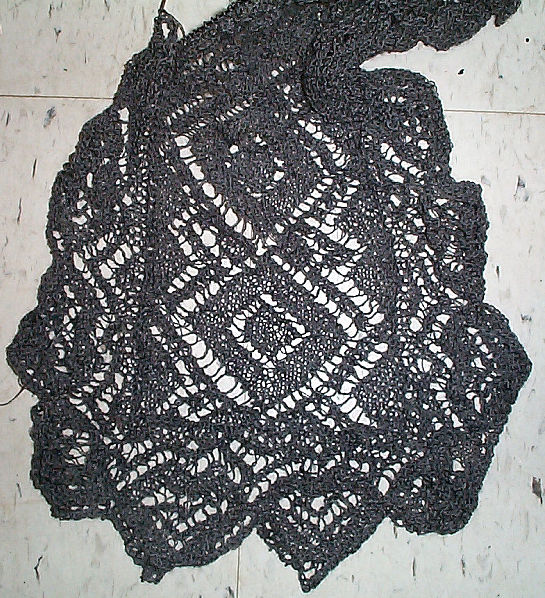
And on the lace shawl, I’m over the half-way mark in constructing the center square. I’ve got only one or two repeats left before my proportions are correct.
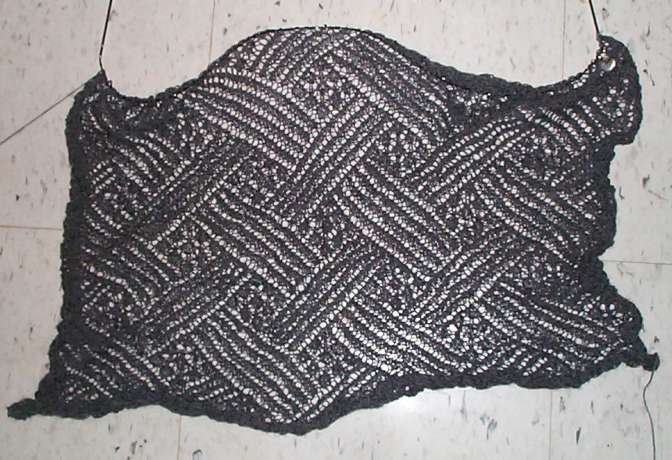
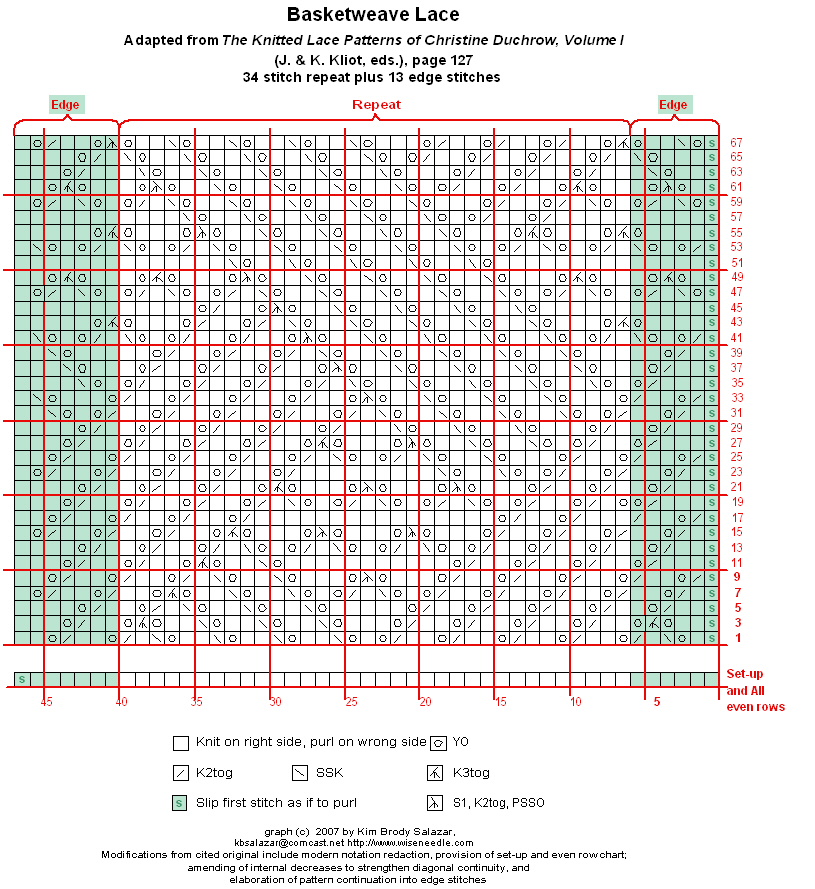
I’ve also tinkered a bit with the base pattern, translating it to modern notation and changing the directionality of some of the decreases to sharpen the lines. Since I have changed it somewhat and recharted it, I present the result. Click on the thumbnail below to load a full-size image
The original lacy knitting pattern from The Knitted Lace Patterns of Christine Duchrow, Vol. 1 was presented as part of two complex garment designs – a blouse and a baby bonnet. There are a couple of complementary simple band patterns for cuffs and trim on those projects. Except for the introduction (which provides a helpful translation key for the symbols and some historical German knitting terms), the entire book is in the original German. From what little knitting German I’ve picked up I can tell that even the written parts aren’t quite modern German knitting prose. Like English knitting instruction writing, the conventions in German have changed over time. While I can work from the chart to make my own whatever, it would be an extreme challenge to knit up the blouse as described.
As the editors of this book report, Duchrow was among the first to try to present knitting instructions in graphical rather than prose format. Her graphs are idiosyncratic by modern standards and use letters and symbols rather than visual representations to represent the various stitches, but with a bit of practice her graphs are not difficult to knit from. Even though I can’t read a word of the accompanying text in Vol. I, I’ve ordered a couple more books in the same Duchrow reprint series. If you’re a lace and lacy knitting fiend, you’ll probably have as much fun with Duchrow patterns as I am.
I feel confident I can share the design because I have redacted it into modern symbols, included corrections, and made changes in the pattern as presented. While my graph is recognizable as a variant of the historical one, there are subtle differences. For example, the original graph for this pattern treats all double decreases identically, rather than using directional variants to reinforce the framing diagonals. It also didn’t continue the pattern into the edge areas as uniformly. It also didn’t show the even numbered row. But for all of that, the pattern works up quite nicely even in the original presentation. I share my redaction/correction as tribute to the original author and the editors of this work, to help other knitters bridge from modern instructions to historical ones, and to encourage others to seek out these patterns and knit them without fear.
Interesting conjecture – from the style of the blouse, it would not be a stretch to say that it was current around the time my house was built. For all I know, the original owner may have sat in the library 95 years ago, knitting the same lace patterns I am working from today.
 String-Or-Nothing