OP ART DONE!
My Knitty Op Art blanket is done:
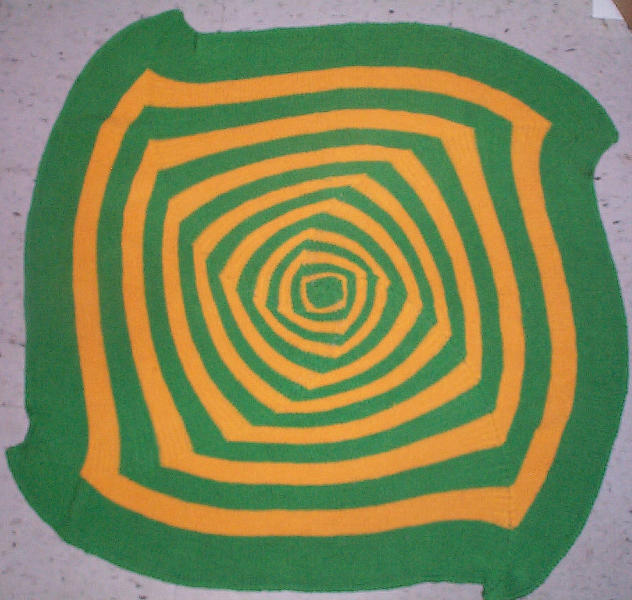
It’s about 47 inches across the center. I used about six skeins of green and five of yellow Austermann Record 210. I had begun another round of yellow but I didn’t have enough yarn to complete the next progression, so I ripped it back, opting instead to use up all available green for the outer, larger framing section. Obviously, I haven’t attempted blocking yet. Cotton yarn as a rule does not deform as well under blocking as does wool, and this dense cotton in particular has a mind of its own. I suspect I’ll have to pin this to within an inch of its life, then steam block it rather than just damp blocking. But that’s an exercise for another day. Even if I don’t get around to it, the odd shape (although unorthodox) isn’t unappealing.
In other knitting news, I continue to slog away at the spiderweb section of my growing olive green tablecloth, but pix of the standard indistinct and blurry snood shape object won’t reveal much beyond the fact that it still exists. Also I was tempted too long by the skein of Noro Kureyon Sock Yarn that’s been sitting atop my monitor since I posted about its acquisition back in July. I had thought about doing something unusual with it rather than just socks, but the lure of those colors proved too strong.
At that time I bought it I posited that each color area would last about three or four rows in a sock. My instinct was more or less correct, but the yarn has more transitions and in-between gradations than I expected. Knit up, the color sections look like they last much longer, but if you examine closely “pure” colors do last for about five or six rows before they begin transforming into the long “tweener” blend areas:

For the record, I’m using 00s, and am working at the relatively large gauge (for me) of 8 stitches per inch. Although I usually prefer my socks knit tighter, this yarn is a bit heavy compared to the sock yarns I usually use. It’s also a single, with a fair bit of unevenness – some parts are thinner than others – and a fair bit of overtwist. The overtwist can be a pain because the yarn will kink up on itself if a long section is drawn from the skein. I’ve also noticed that other knitters have complained about Kureyon Sock’s feel, thinking it a bit on the coarse side. It is hard on the fingers as it is being knit, but the resulting sock at my gauge is nice and cushy and feels much softer than palpitating the skein promises.
This pair won’t be finished any time soon. Now that the first sock has been kicked off, I’ve relegated it to “briefcase project” status. That’s the small, portable project I keep on hand to knit at doctors’ appointments, while waiting on line at the post office, and other stolen oddments of time. My socks will be done. Eventually.
ACTUAL PROGRESS. AMAZING.
I feel like I’ve landed on the planet of the domestic divas. Everything I did this weekend involved knitting, sewing or cooking.
First, the Chicken Viking Hat is finished!

It’s shown here on a random stuffed toy – no infants of appropriate size being to hand at the moment.
The CVH is quick knit, although getting the legs on and finished were both a bit fiddly. Luckily I had some stuffing left over from a previous project because I violated Knitting Rule #4, and didn’t bother to read the whole thing through before I sat down to attempt it.
My only other caution is a minor one – If anyone is going to knit up your own CVH, be advised that on the diagram of how to pick up the stitches that form the leg, there is one 90-degree corner, and three slightly rounded ones. That 90-degree corner indicates the direction that the feetie part of the drumstick will point. I didn’t make the mistake of making the two feeties go in different directions, but I can see that doing so might be a very easy and natural error. (Why do I call them feeties? Because that’s what we’d call the real thing when as kids we’d haunt the kitchen when my grandmother made chicken soup. Only the best behaved kids got feeties from the stock pot as a pre-dinner special treat.)
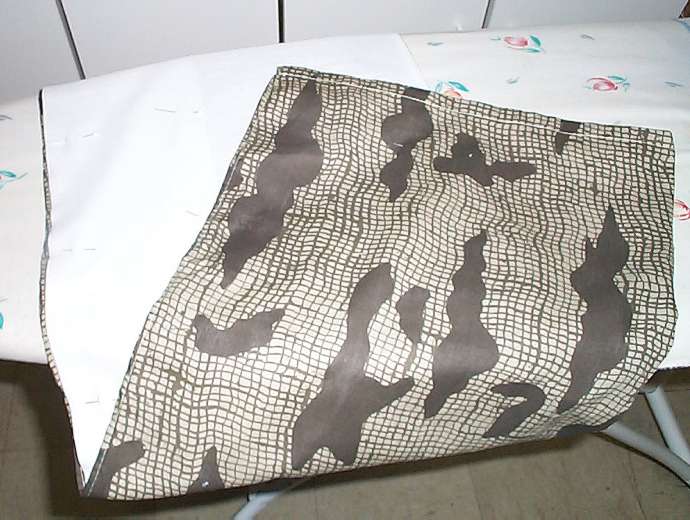
My camo valences are also coming along. Everything is proceeding as per the plan and diagram in the last entry. Here’s Valence #1, all ironed out and pinned prior to stitching.
And I also managed today to do my community service obligation. I baked for the Election Day bake sale, to be held at (and benefit) Younger Daughter’s elementary school. Class for both kids is canceled on Tuesday. Usually voting happens with no interruption of school. My guess is that they’re anticipating record turn-out. That means lots of people hungry to express their political will, who might also be hungry for cinnamon hazelnut teacake, or cocoa spritz cookies.
On the teacakes, I used a mini loaf pan that produces four small cakes, sort of like this one.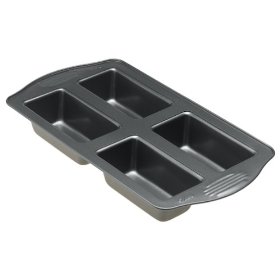
One recipe of the batter (plus about a half cup of ground hazelnuts in the batter and another half cup in the topping) worked perfectly in it although I did end end up baking the cakes for about 10 minutes longer than the recipe advocates. All four cakes turned out quite nicely.
The cookies also were a success, with one iteration of the recipe making approximately 115 1.5-inch cocoa stars. However I find that most published cookie press cookie recipes are way too stiff for my presses and this one was no exception. I want my batter to be something like refrigerated peanut butter in consistency. It should be so soft that it must be shoveled into the tube – not something that can be taken up and rolled into neat cylinders and inserted. I used an extra tablespoon of cocoa in the spritz cookies, plus considerably more milk than it calls for to achieve my target texture. I used sour whole milk in both the teacakes and the cookies, having some in the fridge this week. It worked nicely, providing both with a tiny bit tangier taste than usual.
SIDE TRIP INTO HOME SEWING – CAMO VALENCES
Elder Daughter is now in the Doc Martins and camo phase of teenage self expression. That expression has spiraled out to her immediate surroundings. As a result, last fall we replaced her pre-teen starry night sheets with a bed-in-a-bag set on this theme:

It came with a top sheet, a fitted bottom sheet, a comforter and a pillowcase. And for some reason – a bed skirt. To those who don’t suckle at the breast of Martha Stewart, a bed skirt is a somewhat prissy patterned dust ruffle that lies between the mattress and box spring on most beds, with the fashion fabric curtaining off the under-bed area from general view. Far be it from me to question the wisdom of the marketers who thought that someone favoring camouflage patterns might use and appreciate such a thing.
In any case, her bed is a high platform with built-in drawers underneath and a bed skirt is irrelevant. Still, the skirt came with the set, and I abhor waste, so together Elder Daughter and I decided to remake it into a pair of narrow valences for the windows in her room. It’s taken this long to start the project because my ancient Elna sewing machine has been up on blocks awaiting repairs. The machine has now been overhauled and I am no longer able to endure the puppy looks and pleading, so I’ve begun.
Here’s our general plan. My goal is to minimize sewing as much as possible, by re-using existing finished edges and seams:

I’m at the first step (upper left of the diagram), slicing the camo fabric off from the foot of the skirt and picking out the box pleated corners:
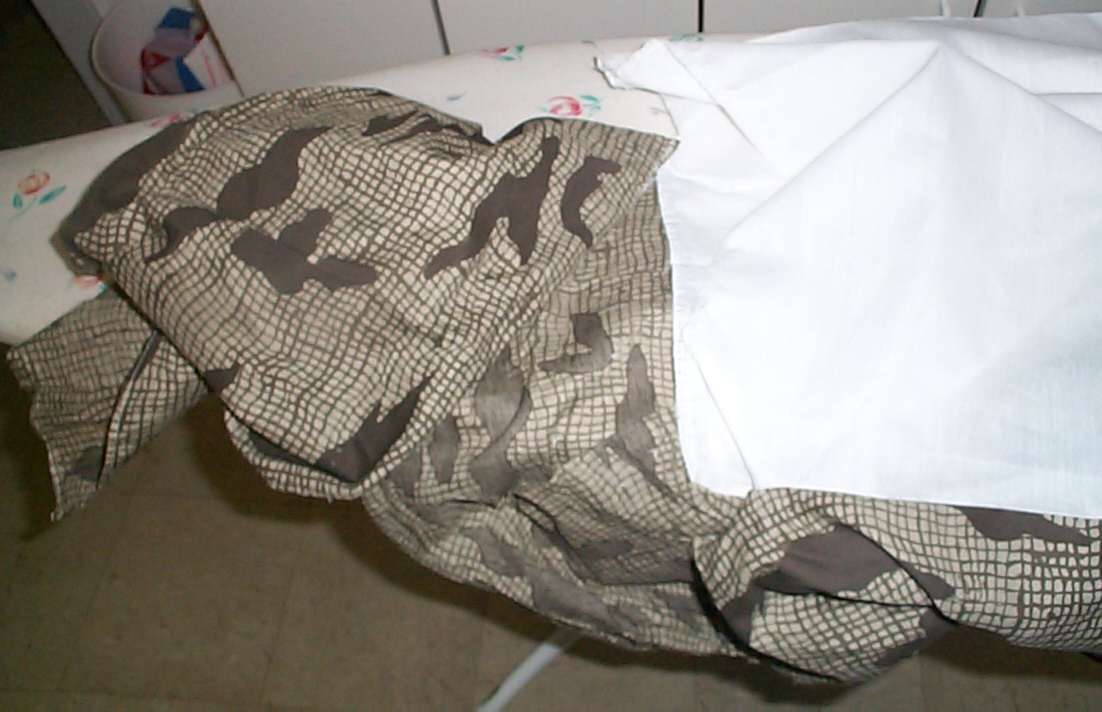
We have no ideas on what to do with the excised bit from the former foot. Various pillow and stuffed animal suggestions have been floated. I also considered (then discarded as too fiddly) the idea of using some of it to make curtain tabs rather than a simple rod casing.
I think I’ll take this opportunity to introduce Elder Daughter to Ancient Elna. Long straight seams are easy and sewing is a life skill. More on this as we progress.
BABY GIFT #3 FINISHED
Just before the fourth of July week, I got some yarn to make baby gifts. One of the items was this cleverly packaged kit from Plymouth:

It contains a ball of Cotton Kisses yarn, three little ducky buttons, and two patterns – one for a three button cardigan (below), and one for a three button placket pullover (shown on the yarn ball). Both patterns are given for three sizes, from newborn through 1 year. The entire thing was $14. at my favorite local yarn store in Lexington, MA. This weekend past I went on a small kid-free vacation, and while away, knit it up while sitting on the beach.

I did the cardigan in the 6 month size. It’s finished except for sewing on the buttons. I made buttonholes on both sides of the button band. When I find out the sex of the target baby, I’ll sew the buttons onto the appropriate spot, covering up the unneeded set of buttonholes. I had ample yarn left over – probably enough to do matching socklets, so there should be plenty of yarn to make the largest size.
This was a very inexpensive and quick project. The directions are clear and simple. There is minimal shaping, and interest is provided by a double welt garter ridge detail at the bottom of the body and ends of the sleeves. The only vague bit was the direction to make three evenly spaced buttonholes. I substituted two stitch one-row buttonholes for the K2tog/yo ones written up. All in all a new knitter could handle the creation and assembly of this project with ease.
My only caution is a very mild one on the yarn itself. Cotton Kisses is a loosely plied multi-strand cotton blend. One of the strands is fuzzy cotton, slubby and puffy, the other three are thin binder strands of the blend fibers. All are very inelastic, as one would expect from a yarn of this composition. While the resulting texture is extremely soft and pleasingly random, hiding any imperfections in stockinette stitch formation, working with it does take a tiny bit of concentration to avoid splitting the strands. (The variegated color I was using also camouflages any stitch irregularities.) People who don’t like the inelasticity of cotton would also probably not like working with this one. Still – for a very economical quick knit baby project that’s cute and easy to do, with a yarn that with a tiny bit of patience gives an excellent result even for new knitters struggling for stitch evenness – this one is a go.
WHERE LOTS OF SOCKS HAVE GONE BEFORE
Of late my life has been ruled by deadlines. The pressure should abate somewhat soon because we’ve managed to find another proposal person at work. I am looking forward to evenings and weekends again. Also knitting.
In the mean time more in the manner of keeping sanity rather than making any real progress, I dashed off another pair of socks last week. This one was on huge-as-logs 2mm needles, standard toe-ups with the figure 8 toe and short rowed heel, on only 64 stitches (not my usual 72-80) . No fancy patterning, no nothing. Just mindless stockinette to let the yarn’s native colors play. The result looks rather Star Trek – with the standard Trek swoosh – albeit sideways – in crew uniform colors on a dark navy background.

The yarn’s official name is Regia Galaxy 4-Fadig Color. I suspect that in Europe it’s sold as Regia Jupiter, because of the small blurb about Jupiter inside the label. I worked it on such large needles because the color repeat didn’t work very well at my standard smaller gauge. The label recommends 2-3mm needles. As you can see, the swoosh factored in nicely enough at 2mm.
I’m not quite sure what larger project to begin next. I’m still finishing Elder Daughter’s Kyoto sleeves. But that’s my downstairs project, for when I have time to sit with the family and play video games or watch movies. My upstairs project sits in the library, where the adults of the house take their relaxation after the kids have gone to bed. That’s usually the most involved thing I am working on at any one time, and the project for which I now find myself in need of inspiration.
WOMEN IN ENGINEERING – THE FUTURE?
UPDATE: THE PANEL INSERTION PATTERN BELOW HAS BEEN ADDED TO THE PDF COLLECTION AT THE KNITTING PATTERNS LINK, ABOVE.
Like most parents, I spend a lot of time rolling my eyes at what passes for homework and school assignments. There are way too many feel-good tasks – making posters and collages, even well into high school. Where are the analytical reading pieces? Where is learning how to write a convincing essay? But every once and a while something engaging and creative is requested.
This month Smaller Daughter (now 9) had to construct a Rube Goldberg device, with a goal of popping a balloon. I sat on my hands and watched her experiment for the better part of a week. She scribbled out her designs and went down several possible paths before settling on her device components. She constructed (and re-constructed) each station scrounged from toys and oddments at hand, testing out each one individually, then assembled them into her final chain reaction. Eventually, after much tinkering she got it just right, and the whole thing worked as intended.
I wish I had a video camera, but you’ll have to use your imagination. Especially the part where the balloon makes a satisfying pop, and she leaps up in triumph.
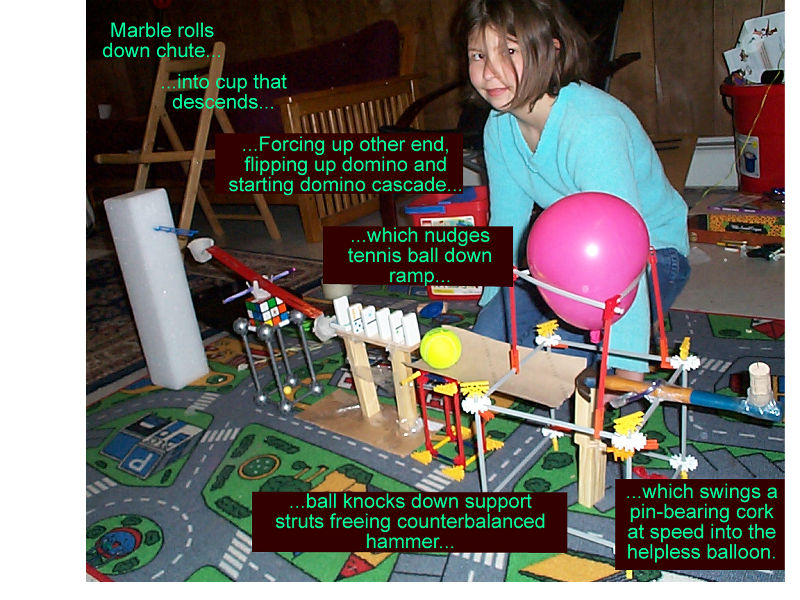 Click on any thumbnail on this website to see detailed pix.
Someday I will loose this proto-engineer on the world. I hope the world will be ready.
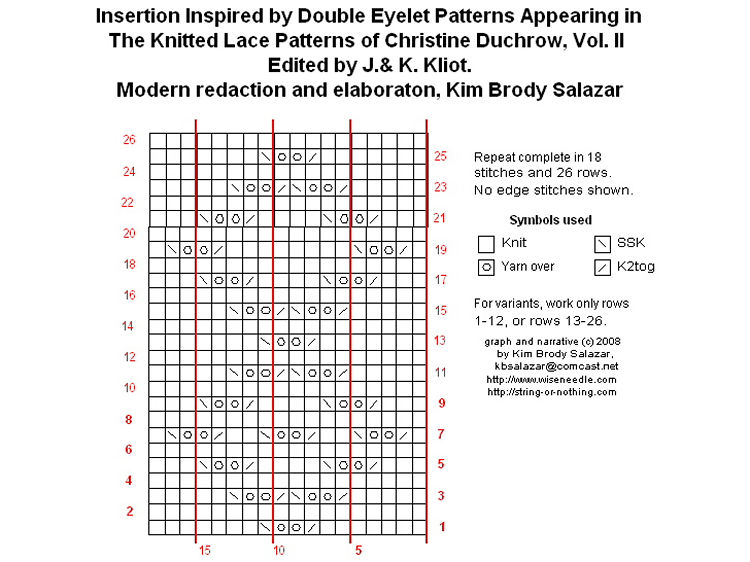
In knitting news – not much. I’ve been working like a demon. All I’ve had time to do over the past two weeks is one mindless sock. For me to take two weeks to knit one sock says a lot. This one is a standard 72 stitch sock with a figure-8 toe and short rowed heel, worked using five DPNs. That calculates out to 18 stitches per needle. My insertion strip is 18 stitches wide as graphed below, so I do the pattern in its entirety once on each of the four working needles. I’ve stuffed a piece of white paper inside the sock so you can see the diamond patterning. and provided a chart for the simple design .
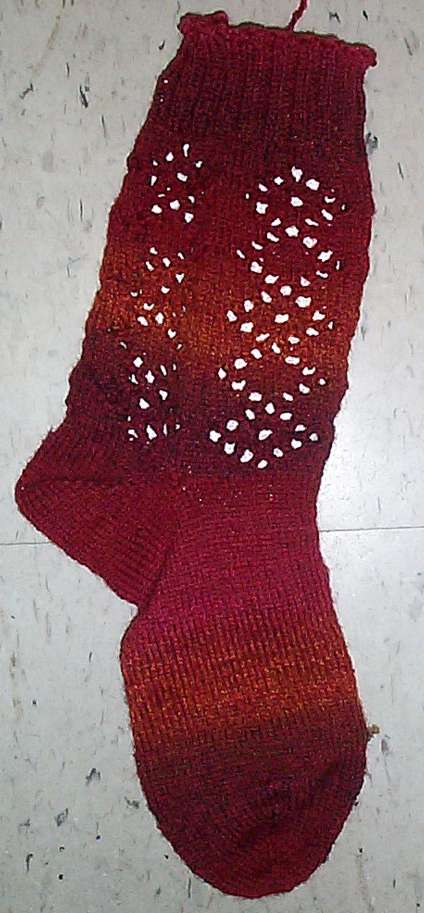
I used Meilenweit Mega Boot Stretch, knit at about 9spi. The shaded reds with the touch of orange is color #709. I’m not wild about this yarn. It feels nice and cushy knit up, but I don’t enjoy tensioning it. The stretch is throwing my gauge off a bit, especially on my heel’s purl rows. It also is rather lofty unstretched, and prone to catch and split on needle tips. I’ll post a review of the stuff when the pair is finished.
WHISTLING DEMONS AND BLACK LACE GLOVES
For your holiday themed enjoyment (and because I’ve been stacked with precious little knitting time of late), I present our very own whistling demon. This candid of Younger Daughter is courtesy of a kids’ Halloween trick or treat party hosted by my employer, and the clever camera of Ms. L. Smith:

Elder Daughter however has more elaborate costuming in mind. She loves the black lace doodle scarf, but wants to complement it with black lace fingerless mitts. Never one to back down from a challenge, I’ve been playing with the concept – flying without a pattern, but as you can see – not without a black lace net.

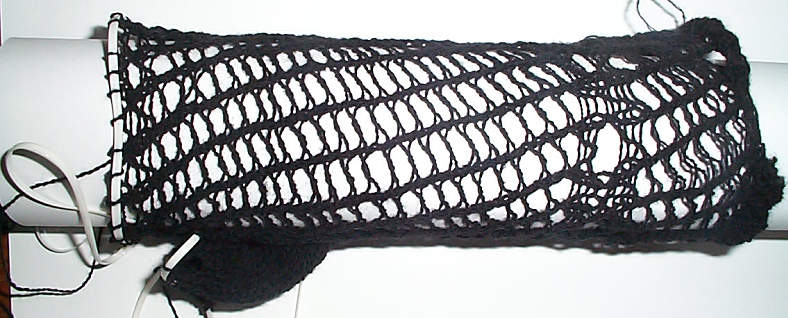
Left is the thing patted flat, right is the mitt stretched out a bit on a roll of paper. I began at the cuff with a provisional cast-on, then worked a fused picot hem (barely seen here). I continued in pattern, with a mega-eyelet band after I’d done a bit of cuff. I might end up threading a wide ribbon through those eyelets – or not, depending on the bespeaker’s preference. The thumb gusset is done entirely in stockinette, and both the thumb and the top are also finished off with a picot hem, although on the cast-off row, I’ll need to take a tapestry needle and stitch down the live stitches now stowed on the white cord, cast-off fusing being a bit too fussy for the inside of such small spaces. I don’t know if anyone is interested in a stitch by stitch pattern. If so, I’ll consider writing one up from my notes.
The white cord itself is a handy tip. It’s plastic lanyard string (aka gimp or boondoggle). I’ve found it to be quite handy for provisional cast-ons, and as a flexible stitch holder for exactly this purpose. It’s stiff enough to make threading the stitches onto it easy, can be cut to any length, and it’s very inexpensive, especially if you scoop up a spool in an unpopular color from the craft store’s discount bin.
COLONIALS INVADE
Life continues to intrude on my knitting time. Besides the regular flock of work-related obligations last week, I was surprised by Smaller Daughter. Thursday morning, rummaging in her backpack looking for her lunchbox, I found a notice for her elementary school’s Colonial Day. It’s an interactive festival sort of day, but one that requires all of the kids to dress in some attempt at a historical costume. (To be fair, I had heard about it long ago but forgotten.) So with a costume needed within 7 days, but my being away on a business trip starting Monday, my Memorial day weekend activities now included a close huddle with my ancient Elna sewing machine.
I wanted to make something relatively early – closer to first encounter than the Revolutionary War so that target child had a chance of wearing her outfit again. I pelted over to the fabric store during lunch hour on Friday and picked up a couple of remnants – 2.75 yards of a soft green twill whatever (plus matching thread), and one yard of a linen-look in white, all for about $10.00. The price was right.
Then I came home and thought about what to make. I had already made her a puffy white pirate shirt that could double as a chemise, and I have a small white cap and coif set. A skirt, a bodice of some sort, plus an apron would be enough. Drawstring skirts are easy enough, but the bodice part was tougher. Front lacing (instead of buttons) would do. Thankfully the topography of an 8-year old is easier to accommodate than that of a post-pubescent. I took measurements and drafted out a simple tab-bottom bodice with short sleeves. To make it substantial enough, I cut two of everything, so that the whole thing is self-lined. Here are the resulting pattern pieces, snipped from Red Sox coverage in the Boston Globe, plus all of the pieces sewn and assembled into the final bodice/jacket.
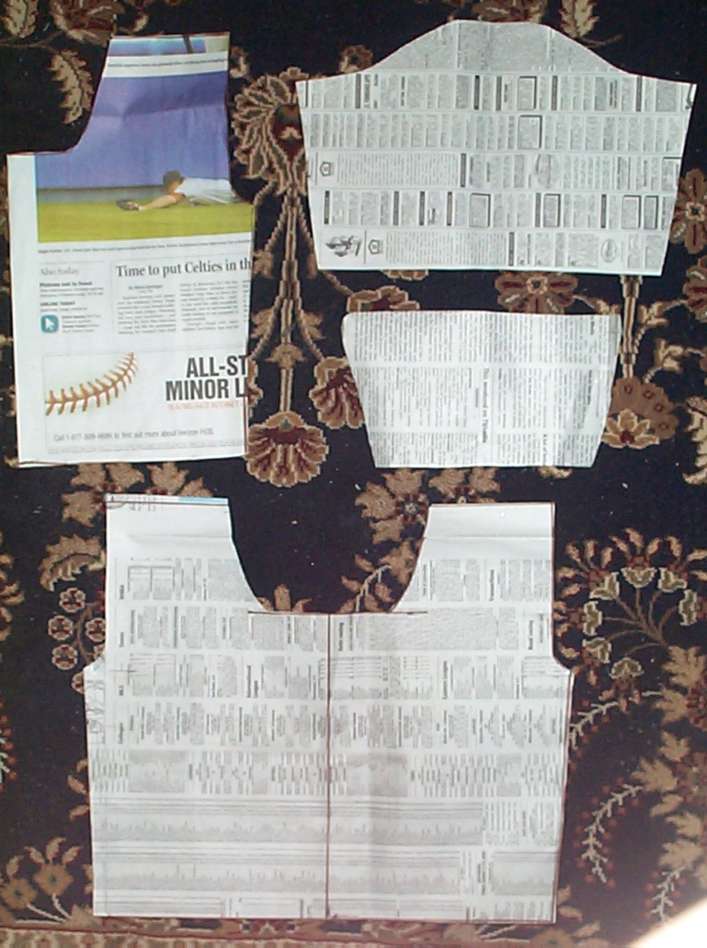
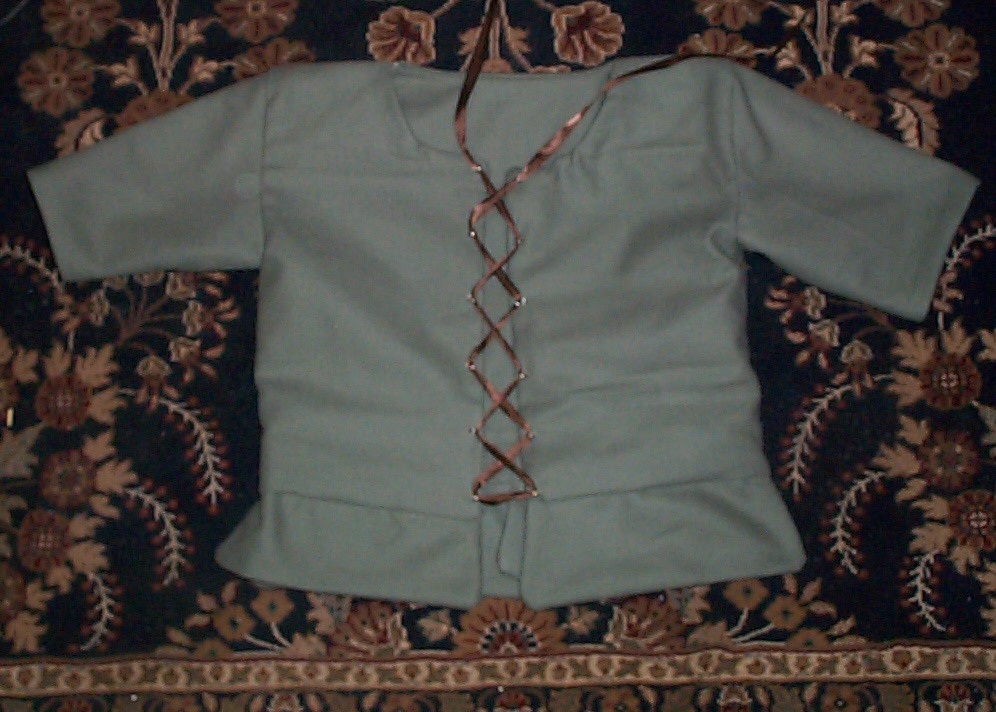
Things went pretty smoothly. I started by sewing the shoulder seams of the outer and inner shells, then uniting them along the neckline by sewing them together up the center front closure and around the neck. Then I sewed the side seams of the inner and outer shell, inverted the inner lining and pressed everything flat. The sleeves went together quickly, too. I sewed the inner and outer sleeve along the bottom edge, then did the underarm seam for the united unit all at once. I inverted the inner linings and pressed my sleeves. Once the sleeves were together, I set them in the bodice. Then I sewed together the inner and outer side of the tabs (that odd shaped piece below the sleeve) – making one for each quadrant of the garment. I turned them inside out and seamed them to the bottom edge of the outer shell. Last, I folded the inner shell’s lower edge down to cover the raw edges of the tabs, and hemstitched it down by hand (too may layers for my sewing machine to cope with).
Since I didn’t have much time, I didn’t go with a zillion buttons or hand-made lacing holes. There’s little if any tension on a little girl’s bodice, so I didn’t bother with reinforcing the lacing edge. I opted for the not very historical but really quick stage option – small rings sewn along the lacing edge to hold the fastening ribbon. Sacrificing a dozen split rings, formerly in use as place markers for lace knitting, I stitched them down by hand.
The apron was also easy. I cut two strips off the top of my yardage and lapping them end to end, pressed the seam lines for the apron’s band and strings. Then I sewed the edges of the remaining piece (again doing it double-sided for additional body), gathered the raw edge and encapsulated it in the center of the apron. Time from taking the first measurements to final hemming – approximately 16 hours of work.
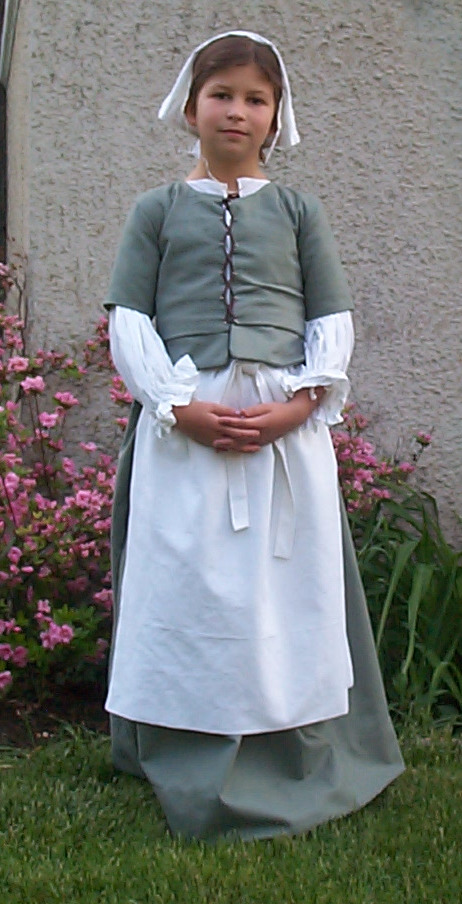
Here’s the end result: one semi-historical kid-suit, inspiration from the 1620s. And yes, Target Child did help, learning how to use the sewing machine and working it for long, straight seams, tracing the pattern pieces with chalk, and doing a bit of the hand-work.
Knitting? I finished my vintage lace scarf. Blocking was postponed on account of Colonial Day.
TAMING WILD SOCK YARNS AND USING UP LEFTOVERS
Self stripers, multi-ply color twist yarns, and hand-dyed yarns are lots of fun. There’s a ton of color there to enjoy. But sometimes a vast and unbroken expanse of color play can be boring or can produce some oddly pooled or cluttered results that look nowhere as nice as the yarn did in the skein. That’s why I like to fool around with multicolor yarns, trying to find a way that they play best, or are shown to better advantage. Sometimes it’s not easy (regular readers here know of at least two of my multicolor yarn experiments have landed in the limbo of my Chest of Knitting Horrorstm over the past couple years. But sometimes it is easy.
I finished up a pair of socks as a “chaser” after the vest was done. I used a stash-aged 50g ball of Stahl Wolle Socka Color, in a multistrand twist of maroon, pine, blue, and marigold – #9140, plus another well-aged 50g ball of Patons Kroy Socks in hunter green – #409. While the colors aren’t exact matches, they are close enough to complement each other. Both of these were found in last-ball sales, but several years and many miles apart. Since I need around 80-90g of most fingering weight sock yarns to make a pair, between the two bargain basement balls I had enough to finish and still have leftovers – provided I used more or less equal amounts of each.
My solution was to work heels, toes, and ribbing, plus about a little under a third of the sock’s body in my solid green, plus the remainder in the multicolor. I used very simple seven-row striping repeat, working five rows of multi, and then two rows of solid green (2/7 = about 28% of my sock’s body). I like how the multi is visually broken by the bands of solid green. The end result has at once more contrast and more subtlety than working the whole sock from multi alone, even if I still did contrasting color toes, heels and ribbing.
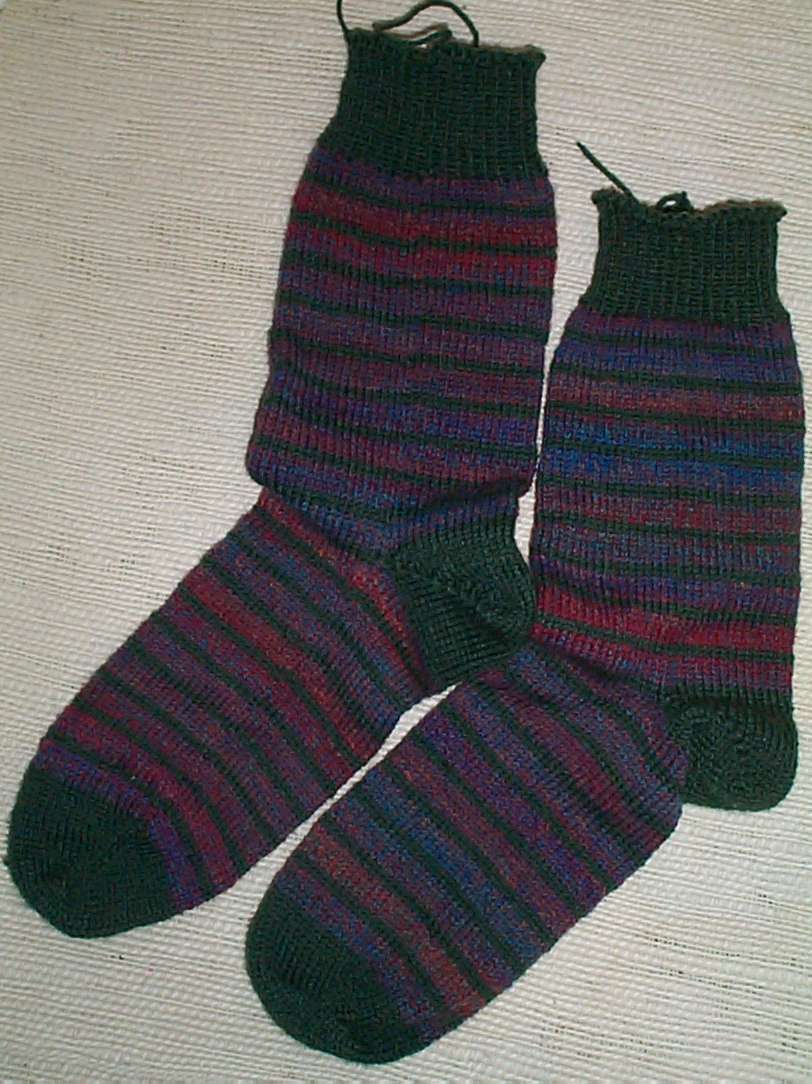
Of course the other advantage of working simple stripes on socks is to idiot-proof achieving two socks of identical size. It’s very easy to count five row units and two row units. When I had completed ten muticolored stripes, it was time to start the heel, which is much easier than having to count every row or trust in doing a measured or eyeballed estimation of foot length.
So. If you find yourself with odd lots of sock yarn, don’t despair. 100g of fingering weight sock yarn knitting is ample for most socks up to around men’s US shoe size 10.5 or so (slightly smaller if yarn-eating textures are used). You can either work color block style, using up one leftover and then another, or you can stripe. But how wide to make the stripes?
Heels, toes, and ribbing in my standard short-rowed heel sock consume about 25g (a conservative estimate). I have large and wide feet for a fem, so if you are knitting for yourself chances are that you use roughly what I do or less. Weigh it out and set it aside. Then weigh the rest of your leftovers. If you have (for example) 40g of blue, 20g of yellow and 20g of green, you’ve got a ratio of 2:1:1. If you worked a stripe repeat conforming to that ratio (let’s say two rows of blue, two rows of yellow, two rows of blue, two rows of green), you should have enough of each color to complete the pair.
Obviously, I had enough and did complete my pair. And I did have leftovers. As expected, I had a bit more of the multi left than I did the green, because my heels, toes, and narrow green stripes added up to about 60% of total yarn consumption.
SHOULDERS
I’m up to finishing the big gray ribbed leaf pullover now. In the best of all worlds, I would have blocked it first. Yes, I know this is heresy, but I’m short on blocking space right now (the aftermath of a minor basement flood in last week’s mega-rain), and the texture pattern is relatively well behaved. I have only minor curling, so I thought I’d finish out the collar first. Then if I were to be feeling less lazy and more accepting of playing with moisture, I’d block out the piece before setting the sleeves.
In the mean time, here’s one of the shoulders:
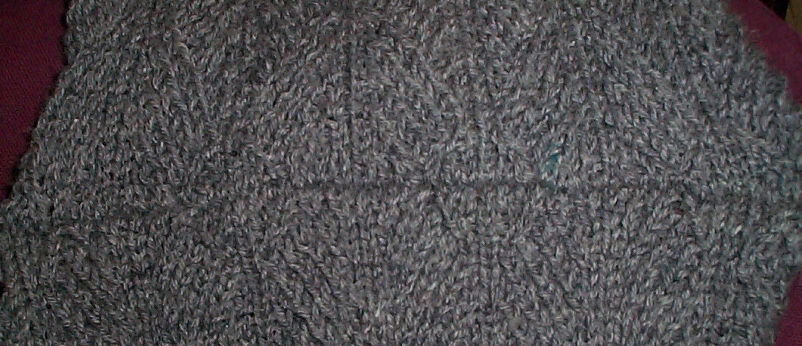
I know the pix are blurry, but I’m hoping you can make out that I’ve managed to match the design elements on either side of the seam. My ribbed leaf texture has a distinct center line for each repeat. Also the front and back ended on the same row of the texture pattern, making direct matching a bit easier. Each piece was bound off at the shoulder. I then butted the two shoulders up against each other and did a stitch-for-stitch-style seam into the stitch immediately under the bound-off edge. The two edges ended up being turned back like selvages. They are however useful, providing seam stability and resistance to stretch. Grafting the two shoulders together as live stitches without the reinforcement of the shoulder seam could lead to distortion of the shoulder region, as the weight of the garment pulled it down. Plus, as a modified dropped shoulder piece, the weight of the sleeve would also tend to distort that area.
Now, why don’t I use three-needle bind-off? Bulk. I find that treatment effective, but heavier than my chosen seaming method. The same goes for back stitch.
Tonight I pick up stitches around the neck edge and begin working the collar.
In other knitting news, I finished the rainbow scarf that matches the rainbow hat. Again, quick and easy to knit, but a bit fiddly to finish. As in the hat, the ends are left super long, then crocheted in chain stitch to make tendril-like fringes. Additional lengths of yarn are cut and added to the opposite end of the scarf to make fringes on it, too. I had one skein of Frog Tree in each color, and had ample yarn left over after making both pieces.

All in all a good project for autopilot knitting. Switching colors meant that progress was easy to see, the bright colors made me happy, the yarn was soft and easy to knit quickly, and the recipient is delighted. My next piece of autopilot knitting is another Klein Bottle hat – yet another special request. This one in conservative Navy blue, with a touch of yellow here and there. I am using a yarn that’s new to me – Garnstudio Drops Camelia Superwash Sport. It’s a very smooth true sport weight, quite soft and with a good hand-feel for a superwash. I’ll probably cannibalize my bright yellow Frog Tree leftovers to do the yellow highlights. What they will be, I haven’t a clue.
And the “gotta make something” bug here isn’t limited to adults. Smaller daughter is in the midst of bead lizard mania right now. I’ve got more geckos in the house today than can be found on a warm Florida lanai at sunset.

 String-Or-Nothing