STILL ALIVE
I’m doing fine, but my base station computer is lying on the dining
room table, completely gutted. A new motherboard, new power
supply, and a new video card are arrayed nearby. But you didn’t
come here to read about my digital woes.
I’m working up a follow-on to the charting articles – a set of
thumbnail reviews of the knitting pattern books on my shelves.
I’ve got most of the standards, plus a couple of the harder to find
items. But that’s much easier to do when I’m working in the same
room the books are.
In the mean time, I’ve been working on various small projects – mostly
holiday related. I’ve finished off several more pairs of booties
(there must be something in the water, as there appears to be spike up
in the local numbers of the gravid). Socks march on, with the
latest pair being toe-ups in a very conservative gray, possibly with an
inverted flap heel and the placement of a spot motif on the
ankle. Those bits may yield something of interest to write
about. Plus a quick stitched piece that is destined to be given
to an unsung hero at work. More on that tomorrow.
In the mean time, I present with a bit of sadness, the knit fake chain
mail coif and hauberk I made for Older Daughter when she was five:
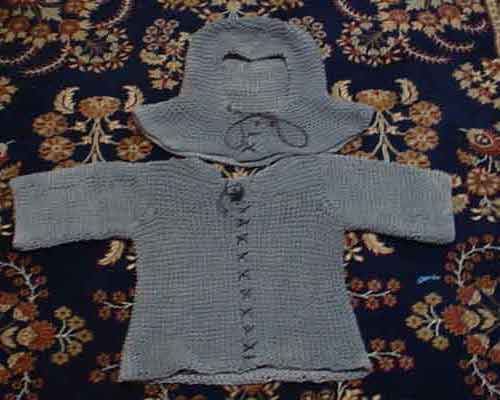
Apologies for the even lousier than normal picture quality. I don’t have access to the photo editing tools I normally use.
This is the knight costume that was featured in the note I wrote that
ended up in the first volume of KnitLit. I made it for Elder
Daughter in 1996, when she was in Kindergarten. The sadness
creeps in because Younger Daughter just wore it for Halloween, and it
was clear that this is the last year that she will be able to do
so. The coif will still figure in fantasy play for or a while,
but the mail shirt is ready for The Box of Knitting That No Longer Fits.
In the mean time, if you want to knit up some play armor for your own miniature warrior, the method description is on wiseNeedle.
MINOR ACCOMPLISHMENTS
A person left a comment on one of the counterpane pages here, asking
for help identifying the technique or stitches used in blanket she
owns. She neglected to leave an eMail address. I’d be interested in
seeing a photo and possibly posting it here for discussion, but without
contact info not much can be done.
Yes, in the midst of all the
charting stuff I was knitting. I finished up the Harvey Kombu, and I
did a pair of plain toe-up socks from Lana Gross Meilenweit. I’m not
sure which color variety it is, as I lost the label in an airport. It’s
not Fantasy, the repeat is too short. It’ s not Multieffect, or
any of the MultiRingel colors, either. It’s possible it was part
of last winter’s Jacquard color crop.
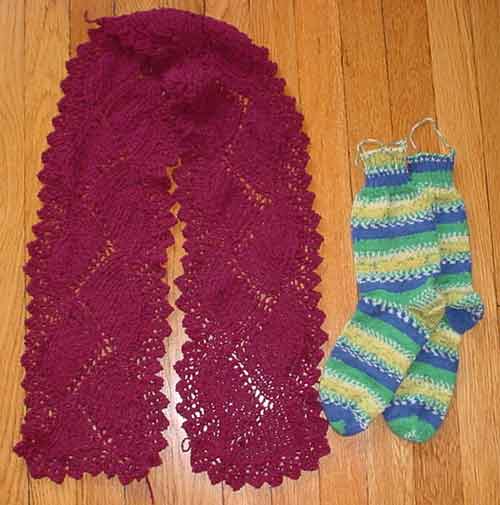
You’ll notice ends dangling off both pieces. I really can’t say
why I do this (perhaps it’s a personal superstition, perhaps it’s a
reminder not to use the item myself), but when I make gifts in advance,
I don’t darn in the final ends until I have decided whom the recipient
will be. I’m not quite sure who will be receiving these, so the
ends are still there. Go figure.
The socks were done on US #0s (2mm) needles – 72 stitches around.
That makes them rather large in gauge for me. I used the standard
figure-8 toe and short-row heel I use in all the sock patterns on the wiseNeedle pattern page.
Nothing fancy here, just miles and miles of plain old stockinette,
finished off with a K2P2 ribbing at the top. The pattern for the
Kombu scarf is also there. In this case, I used a US #6 (4mm),
and used just under two full balls of my ancient stash-aged Lang Harvey yarn.
Finally, one other person asked about how I construct my charts.
As I’ve described at length before, I use Microsoft Visio. I’m sharing my Visio stencils. If you’ve tried graphing knitting or stitching patterns using them and have feedback or questions, please let me know.
SOCK YARN RUN DOWN
Some random questions popped into my inbox this week. I try to answer:
You said you
knit a lot of socks, and the colorful bits on the booties are
leftovers. Leftovers from what? What are your favorite sock
yarns?
I like the Euro-style classic finish hard twist wool/nylon blend sock
yarns best (I don’t care for either wearing or knitting cotton
socks). My short list includes Socka/Fortissima, Regia, Meilenweit, and the like. I’m slightly less fond of Reynold’s
sock yarns, finding them a bit coarser than I like. I knit with
Opal once, the yarn’s texture was nice and the colors were interesting,
but not so much that I’d pay a premium to find more. I’ve
also tried Kroy 4 ply (aka Kroy Sock), Special Blauband, and Brown Sheep Wildfoote.
I’m not as fond of those. Brown Sheep is too thin, splitty and
flabby. Special Blauband is also thin compared to my usual (their
Blauband Ringel
yarns though are more comparable to the Socka type). Kroy is a
bit less densely spun than the Euro yarns, but it’s economical and is
stocked in solid colors. Once it was difficult to find multicolor
sock yarn, now it’s tough to find solids. I use solids for
contrast, so I was very happy to find Kroy.
I’ve also tried some of the higher priced yarns, like Koigu and Lorna’s Laces.
In truth, though the Koigu colors were fantastic, I was less pleased
with its performance in a sock than most. I found it too thick to
make socks I can wear in most of my shoes, plus even under careful
hand-wash, I found it fuzzed and lost that surface sheen that makes the
colors pop. The socks are wearing well, but they’ve lost that
special something that the yarn had in the skein. I’d use Koigu
again in a heartbeat – but not for socks. The Lorna’s Laces yarn
was a bit loftier than my usual hard twist stuff, but worked up
nicely. It’s wearing quite well.
I’ve also tried a salad of other sock yarns – Alpine, Marathon, Happy Strumpf, Trekking
– whatever wandered into my local yarn store that looked
interesting. While all made suitable socks, none stood out as
things I’d want to seek out for repeat use. Alpine was a Euro
style yarn – good texture, boring colors; the others were heavier than
I prefer.
I haven’t tried the less expensive sock yarns from KnitPicks or Elann. I tend not to buy yarn via the Web if I can get the equivalent locally, and I live in a very sock yarn rich region. (Actually touching yarn before I buy it is a requirement.)
The links above just go to one representative of larger, similarly
named sock lines. If you need more info on sock yarns, try
wiseNeedle. Go to the search page and
look up a sock yarn by name, or select "sock" from the drop down list
of yarn types. About 135 are currently listed – 85% with at least
one review. You can also find a chart showing some repeat lengths of common sock yarn self stripers here.
Still working on the scarf?

I like it better when you write about little stuff. The big projects are boring. What little stuff are you planning?
Unfortunately, I don’t plan my knitting to fuel this blog. I knit
wherever I want to wander, and the blog gets pulled along behind.
That being said, I have to finish this latest crop of booties plus the
Harvey Kombu, then rescue Elder Daughter’s Rogue before returning to my
large blanket. Plus the holidays are coming. I’ve promised
a ton of socks, plus there are some other special gifts that I really
should make. You’ll see quite a few quickies over the coming two
months, I guarantee.
Late breaking addition:? Ooooh. Mittens!? Haven’t done full patterend mittens yet. Thank you , Wendy!
CROWN OR PETAL EDGING
There must be something in the water (please excuse me for not drinking).
I find myself knitting booties for a flood of the newly
expecting. So many in fact that over the past two weeks, for the
sake of fun I’ve taken to playing with ankle part after the eyelet
holes for the drawstring style bow.
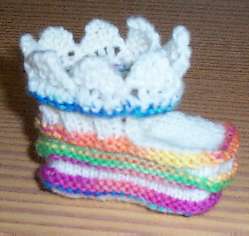
This bootie is a combo of Dale Baby Ull and tiny leftovers from three
candy color different self-striping sock yarns. Like I wrote
before, just a yard is enough to do a stripe, so I save every scrap.
You could argue that my petaled bootie isn’t entirely successful, that
the top round of contrasting welting should be deeper, and that I
should have worked a round in white before launching into the crown-like
points at the top. But hey – these booties are the knitting
equivalent of potato chips – quick snacks tossed off in between more
substantial meals. However they are excellent for playing with
some basic concepts before risking those ideas on a larger piece.
In this case, I looked at the thing (shown above before the bow tie is
inserted), and thought that I’d like a pointy finish. I didn’t
want it elaborate or deep, and was too lazy to haul myself over to my
bookshelf and dig through my collection of stitch pattern books.
It being a no-brain night, I decided to improvise on the fly and do a
no-brain edging knit onto the live stitches of my bootie ankle to
eliminate seaming (a pain on something so small.)
These booties finish out with 40 stitches – 10 on each of four
needles. 40 is a good number, it’s an even multiple of 4 or 5, so
an edging worked on 40 live stitches can have a 4 or 5 stitch
repeat. For no reason whatsoever, I picked 5.
I cast two stitches onto a DPN, and knit one, then did a yarn over and
worked the second together with the first stitch of my bootie ankle
using a SSK. On the second bootie-out and all subsequent
bootie-out rows, I flipped the thing over and knit back to the outer
edge. On the next and edge-in subsequent rows, I knit until just
before the last stitch, finishing out the row with a YO, SSK
incorporating one stitch from the bootie ankle. After I’d "eaten"
up four stitches of the bootie ankle and was ready for the fifth edge
in row, I bound off until I had one stitch on the right hand needle and
one stitch on the left. This last stitch I worked together with
the fifth bootie ankle stitch. Voila!? A very simple 10-row
petal edging custom-matched to the stitch count of the piece being
trimmed. I did seven more points (eight in all – two per bootie
ankle needle) and grafted the last two stitches to the cast on
row. Bootie done, and neither seaming nor casting off was
required.
Neither knitting an edging onto live stitches nor creating a very
simple edging in this manner are new ideas, but both evoke a bit of
"How did you do that" when seen outside of lace knitting circles.
I would improve this a bit were I to do it again. Instead of each
point "eating" five ankle stitches and taking 10 rows to complete, I’d
cheat a bit. I’d do an 8-row repeat, working my bind off on the
fourth edge in row instead of the fifth, BUT instead of working a SSK
with one edging stitch and one bootie stitch to conclude the bind-off
row, I’d work a SSSK, fusing together one edging stitch and TWO bootie
ankle stitches. In effect, I’d be working an 8-row repeat
attached to five ankle stitches. This will draw in just a bit and
counter the tendency for the edging to stretch the live stitches, and
be wider than the tube of the item it completes. Most lace
projects that? are ended off with an edging knit perpendicular to
the body and don’t exploit this natural tendency to ruffle do vary the
stitch attachment count in a ratio closer to 3:2 than 1:1.
So, the next time you do a top-down hat, a tubular iPod case, or even a
toe-up sock, think of finishing it off with a bunch of slightly silly,
fluttery petals instead of the standard bind-off row. Or if you
feel really ambitious – thumb through the lace edging section of your
stitch dictionary, pick one with an appropriate row count and try it
out out to put a crowning touch on your piece.
STILL WASTING TIME
I’m still sweeping out mental cobwebs, occupying my fingers with
interim quickie projects. Saturday’s was another pair of booties, in
the bootie pattern I’ve blogged about before:

This
pair is in lime green Dale Baby Ull, and the leftover of some tweed
sock yarn long since separated from its label of origin. It just takes
a couple of yards to do one of the purl welts. I’ve worked them in
contrast (as shown here), even working each welt in a different color
yarn. Sometimes I do the ties in the same color as the contrast,
sometimes not. It all depends on how much I’ve got. This is why I never
throw away sock yarn leftovers. The smallest bit is enough to accent a
pair of these booties.
I’m still repacking my stash after our
near escape from a basement flood. In doing so I’m running across all
sorts of goodies I had forgotten about. In the same box as my
Kureopatora leftovers, I found about seven or eight balls of Harvey. Lang Harvey
was a wool blend salad with a boucl? finish – 40% wool, 32% acrylic,
15% polyamide nylon, 10% alpaca, and 3% viscose. I’m pretty sure I
scavenged it from a bargain bin at a (long gone) yarn shop I used to
frequent in College Park, Maryland. And I’m also pretty sure that I
bought it circa 1990 or so. Possibly earlier, so the chance of anyone finding more outside their own stash is slim to none. The original intent was
to make a vest, but although I liked the yarn I didn’t like the way it
worked with my chosen pattern, so I stashed it.
What’s boucl?
you ask? It’s a style of yarn that has fallen out of favor. You don’t
see that many of them around any more, the textured yarn niche having
been consumed entirely by the fluttery fur monster.
Boucl?s have an
airy hand. If you think of classic finish multi-strand yarns
(like Cascade 220) as dense cream cheese, boucl?s would be the whipped
variety. Unlike chenille where the fluffiness is made by little
strands that are bound by some kind of "keeper thread," boucl?s have no
fuzz to come unbound. The yarn’s structure is of one or more
two-ply strands. One ply is relatively taught, usually a very
fine nylon thread. The other ply is looser spun, almost slubby,
and is under far less tension. The looser strand is sort of
gathered and lumped around the nylon base thread, resulting in
something that has more loft and that has higher yardage per unit
weight.
Here’s Harvey:
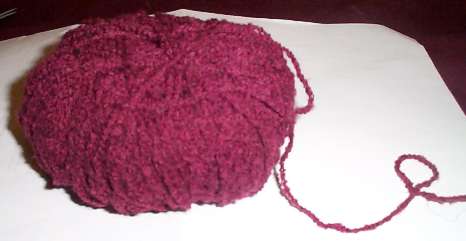
Harvey has two two-ply strands. You can see how nubbly and slubby
it looks. While it reminds me in color and visual appearance of
the iron-upholstered sofa in my grandmother’s apartment (the one that
would sand your thighs off if you sat on it while wearing a skirt in
the summer), it is in fact an exceptionally luxurious feeling, soft and easy to wear yarn.
Some boucl?s are even more fluffy or bumpy than this. Some
have a loopy construction (I’m not sure at what exact point something
stops being a boucl? and becomes – for example – a mohair loop, but I’m
sure one of the spinning folk who read here will enlighten
us.)?? My Harvey is marked at worsted gauge (20 st x 34 rows
= 4 inches or 10cm) . It’s about 126 meters or about 138
yards. A classic worsted like Cascade 220 is about 110 yards for
50 grams. Even taking the fiber salad composition of Harvey into
consideration, 28 yards in 50 grams is a major difference in
yardage.
Now. How does Harvey knit up??
The first time I tried it out I was disappointed, but I had picked a
pattern for which it wasn’t suited at all. I tried it out using a
knit/purl texture pattern that was totally eaten by the yarn’s
texture and dark color. While it isn’t optimal for showing detail
on something like my Kombu, I thought it might be fun to try out in
that pattern:
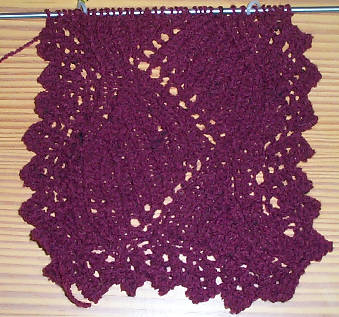
Again, the ribbed detail is partially obscured, although it shows up
better in person than it does in a photo. But the softness and
drape can’t be topped. I’ll be finishing out my Harvey Kombu and
stowing it for the upcoming gift season. I’ll probably have
enough to do a matching hat, too.
Oh, and for an exceptional Kombu that really shows off the pattern’s
texture better than my own attempts at both knitting and photography
(and not to mention her superior execution of the idea) check out Kerstin’s Strickforum. Beautiful!
PROGRESS – MITTS AND SNAKE
In answer to so many questions – yes, I did finish the halfie mittens I showed last week:

Except
for darning in the ends, that is. You’ll note that the thumbs are on
the same side in the picture above. That’s because I’m trying to show
the palm (stockinette) and the back of the hand (textured) of the pair.
A little ending off, and they’re ready to go into my hamper of
potential holiday gifts. Or if it gets cold here before I get around to
distribution, being pressed into immediate service.
My snake scarf continues to grow:

It’s
just at the point of Scarf Length Viability, but not really long enough
yet As you can see I’m just about done with my first full ball of yarn.
That leaves just one. I don’t think I’ll be able to save out my second
for edging. It’s going to get consumed just doing scarf body. Some have
pointed out that I really don’t need edging, but I haven’t abandoned
the idea. Getting more of this yarn is of course impossible, but
perhaps something in black.
As soon as I end off the top end, I’ll write up a how-to on this one.
KUREOPATORA OUT FROM THE NILE
Thank you to all who saw something redeemable in yesterday’s blanket. I
think the most telling thing of all is that the entire time I was
working on it, my parents smiled sweetly and offered up yarn leftovers
and encouragement. At no time did they grimace, giggle, or point. That
sort of unconditional support must be something one learns in Secret
Parent School, because I find myself smiling sweetly at earnest yet
flawed first attempts made by my own kids.
On
the knitting front, I’m still blowing the cobwebs out of my brain. This
weekend past we narrowly averted a minor flood, and in doing so learned
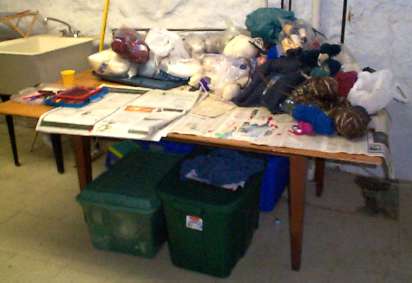
yet another advantage of keeping a large yarn stash stored in plastic boxes. What we see here is several tubs of yarn,
dumped out on the projects table in the basement, and an "after" shot
of the flood site, with the now empty and drying tubs perched on top of
the sump they helped drain.
 |
 |
Had I not had a bunch of tubs lying around the house I would not have been able to stem my mini-tide.
In the course of the whole thing, I ran across two and a half balls of
Noro’s Kureopatora Plus. This is a multicolor wool/cotton blend
yarn that’s about six years old. The label calls it out at 23 st
= 4 inches, but it knits up more like a heavy DK or even a
worsted. It’s long since discontinued which is unfortunate.
Although it won’t full like the Noro multis popular right now,
Kureopatra’s cotton content makes it softer than they are. The
colors are distributed not through dying but through spinning.
It’s double ply in construction. It looks like the spinner did a
thick/thin thing on each ply, starting with one color and introducing
fiber of the second in the thinner sections. Change is gradual
(with occasional slubs) from color to color. Then two strands
were plied, with the thin strand of one matching up with the thicker
section of the other, so that the contrast color of the thinner strand
is very evident against the puffy part of the other strand.
I started my latest bit of gratification by working up another of my
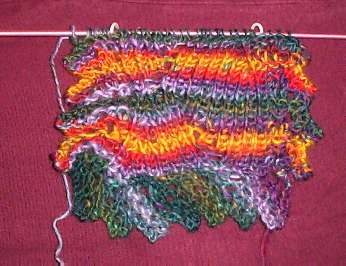
Kombu scarves. Hey – it worked with a multicolor before,
right? But I didn’t like the look. The rainbow of this yarn
is too strident for the textured Kombu:
 |
 |
So I ripped it out (hard going with this loosely plied fuzzy stuff);
and began again. This time with my own off the top of my head
variant on the single repeat entrelac rooted multidirectional
idea. Mine is done in ribbing on 30 stitches. Provided I
have enough yarn, I intend on finishing it with some sort of edging
knit on after the main body is done:
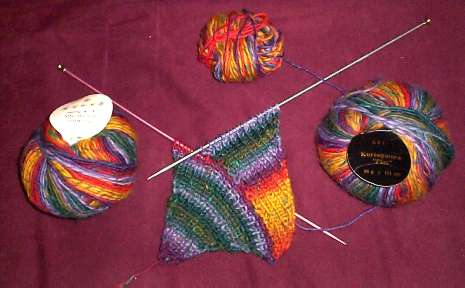
I like this much better. Thank goodness my color sense has matured since 14.
INSTANT GRATIFICATION
After the overland slog on the Mystery Project, I felt the need for some instant gratification. I did a couple of pairs of booties (already distributed to the deserving, and not available for photographs). Then I took that beautiful hand-dyed sock yarn I mentioned the other day and started in on another pair of halfie mittens. I started (more or less) with the Fingerless Whatever pattern written up here earlier, but went free-form pretty early on.
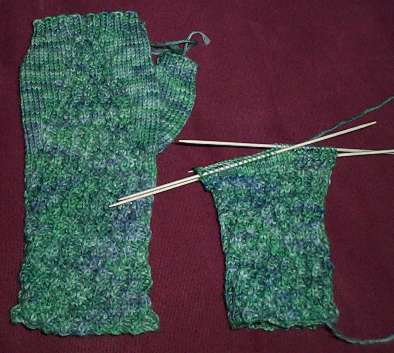
To
start, I’m using a traveling twisted stitch instead of ribbing. It
goes all the way around the cuff portion, but when the thing gets to
the heel of the hand, the palm side switches to plain stockinette.

After the heel of the hand transition, the twisted traveling stitch
pattern drops a half-repeat at each cable crossing, and ends up forming
a slave bracelet sort of triangle on the back of the hand. The thumb
gusset is worked in the plain stockinette part, and is exactly the same
as the one on Fingerless Whatevers. The hand and thumb bit end off with
a bit of plain old K2, P2 rib.
Yes, the patterning would be
shown to greater advantage were I not using hand-dyed yarn. But I like
the seaweed-like effect of the mottled greens and blues, and the way
the colors play with the highly embossed texture vs. the flat
stockinette part. I’m pleased with my minor diversion, and as
this yarn was a gift, thank yous are in order. (Plus I’m sure the
giver would be curious to see what her offspring ended up becoming.)
Another postscript
Strange intersections of my professional employment and personal avocation keep cropping up elsewhere. I will soon be forced to knit my own robot.
WHAT DROVE ME TO KNIT
It was this:
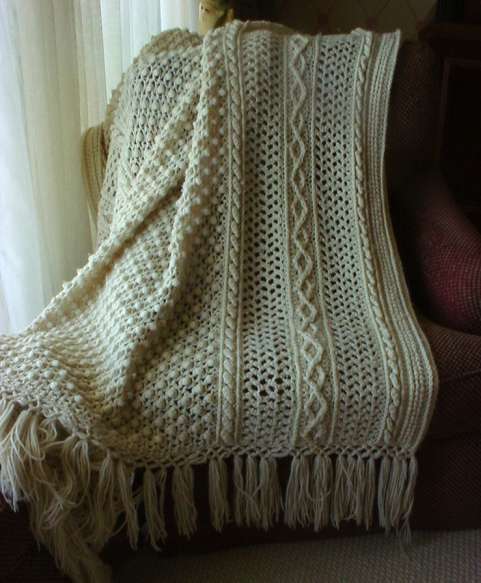
I crocheted this from the American School of Needlework pattern leaflet Original Fisherman Crochet for the Family by Anne Rabun Ough (LA #151):

Well, sort of. Actually I took the poncho pattern in this booklet, expanded it a bit in both length and width, adding extra panels of texture stitches, and edged it with a two-knot macrame fringe. (I tinkered with patterns even before I started knitting). It ate yarn. Crochet uses more yardage than knitting to make an equivalent sized piece. The finished blanket weighs a ton. Even though crochet is usually faster than knitting, it took a long time to make. See those fake cables? Those were done as little semi-detached bits, anchored at the tip several stitches away. The solid parts were panels of slip stitch or single crochet. The narrow, wandering cable was applied slip stitch worked after the piece was finished. The bobble section took forever and a half to finish. I can safely say that I haven’t crocheted a bobble since.
I made this piece as a thank-you gift for my mother, for all that she did in handling our wedding preparations. That was roughly 27 years ago but the thing has aged well, surviving washings and daily sofa or bed-throw use for all these years without pilling, discoloring, shrinking, or snagging. I’m not quite sure which 100% wool yarn I used, but I do remember it had an Irish-inspired name (possibly Plymouth Galway). In any case, here’s yet another example of the lasting power of quality materials.
Why did it inspire me to finally learn to knit? Lots of reasons. For one, bobble exhaustion. Plus at the time there were (and still are) comparatively few attractive, interesting, wearable crochet patterns compared to the wealth of knitting patterns out there. The crocheted faux Aran imitators were certainly interesting to make, but like the ones on the cover of the leaflet, cursed by that "loving hands at home" look. I wanted to make more than just fine lace, fancy tablecloths, and heavy blankets. I envied the style and wearability of knitting. Yes, I know that crochet can be used for far more, and that it can be wildly attractive, but especially at the time it was pretty much limited to tablecloths, blankets, baby things, odd lumpen pullovers done in yarns far to thick for comfortable wear, and granny square ponchos.
So I was primed for learning how to knit. From a book even. But that’s another story.
BRIEFCASE SOCKS
Not much knitting progress to report on Rogue. Other priorities intrude this week. I have however gotten a fair bit done on my "briefcase sock."? That’s the pair of socks in progress that live in my work backpack. I like to keep one going that’s done while waiting for appointments, in line at the post office, and in those other bits of time that would otherwise be frittered away.
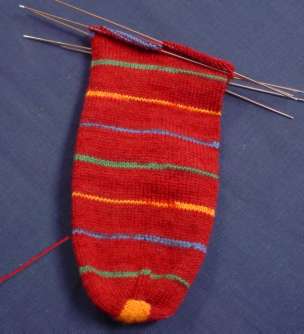
Briefcase socks are usually not of the most elaborate styling or construction. They have to be able to be picked up and put down without losing one’s place in a pattern, and mindless enough to do with only minimal attention. As such, self-patterning yarns are ideal. This pair is in Reynolds Swizzle. It’s marked at 7.5 stitches on a US #1 or #2. I’m using 1.25mm needles (US #0000), and getting 10.5 spi. This particular sock is 80 stitches around. As you can see, even at the much smaller gauge, I’m getting accent stripes that are perfectly satisfactory. They’re mostly one row wide, with a two row overlap of about 25-29 stitches. This pair is being done in the standard toe-up/short-row heel style that has become my automatic default. I began the sock at the very beginning of a yellow stripe. I’ve just started the short-row heel section at the blue stripe now just off the needles. I’ll probably begin the second sock at the start of either the blue or green accent stripe, just to be playful and have a pair of fraternal rather than identical twins.
Why do I knit my socks at such annoyingly tiny gauges?? I like them better. I find densely knit socks to be more comfortable, with none of that walking on pebbles feeling others report as a reason for not liking hand-knit socks. I have found that densely knit socks wear better and last longer, especially ones that are a bit tight on the foot. Socks that are large enough around to permit shifting can bunch up inside the shoe and either wear themselves thinner over time, or create blisters.
I find that most 4-ply fingering weight sock yarns work just fine for knitting at gauges significantly finer than they are marked. Three ply weight fingering is even thinner. It’s tough to find it now that the old Kroy 3-ply is history, but I can get up to 12 stitches per inch out of a good 3-ply. That’s fine enough to knit many pre-1900 era sock patterns verbatim. Cast on 96 stitches?? No problem with a 3-ply.
Finally how am I liking the Swizzle compared to other sock yarns?? It’s o.k. Not great. I find it a tad harsher than the Regia line and the Fortissima/Socka line. It’s also thinner looking un-knit, but denser (less airy) than the other two. The narrow, widely spaced skinny stripe is different, but boring. I may try to liven up the sock ankle a bit by either purling the accent rows, or by playing with a slip stitch or mosaic pattern on them.
Aside:? Welcome to my Japanese visitors!? I have no idea what the referring page says, but you are more than welcome to wander around and rummage through my past entries. Google translation tells me this
???????!
means "Happy knitting!"?? Although automatic translations are usually too literal (and usually produce silly output) I hope it’s not too far off.
 String-Or-Nothing