CROWDSOURCE #1 AND SOCK DISAPPEARANCE
Back from vacation! A week of Cape Cod sun, sand, salt water and doing as little as possible except enjoying those things.



This year my mom came with us and we had a great time. We spent most of our time on the sands right at our hotel, sitting, swimming, kayaking, even watching Provincetown fireworks from our room’s deck. We did our now traditional beach paella, salmon teriyaki on the grill, and flank steak kabobs. I am rested but could be easily persuaded to do a wash-rinse-repeat of the whole week’s experience. Seven days is not enough.
Arriving back home, I checked gMail to see if anyone had volunteered a graphed pattern for the crowdsource project. Lo and behold! There was one:

I present Design #1 – Twerp’s StarBee. The first design in the series. Red lines indicate straight lines “off the grid” or not at 180/90/45-degree angles. I like this cheeky little fellow. A nice one, Twerp!
If you want to draw up one of your own to be posted here, please feel free to download the JPG at the project’s kickoff page, then draw on it by hand or using any graphics program. You can email the resulting file, a photo or a scan of your design to me at kbsalazar (at) gmail (dot) com. Let me know whether or not you want your name or a link posted with your offering. I do reserve the right to do light editorial selection (this is a family-rated website).
Now, what progress have I made on my own stitching?
Some, mostly prior to our departure. I concentrated on two pairs of socks while we were on the beach.

I knit a pair of guy socks, with a simple broken rib ankle and k1p1 ribbing to finish. There is only one in this picture. The other is now at parts unknown. At best guess, I dropped it at dusk on the beach and didn’t notice that it was gone. Either seagulls or the sea made off with it. Somewhere there is either a lobster or a tern sporting a new brown habitat. And I need to get another ball of the same yarn and knit a third to make a pair. (Grrrr.) The other pair has a lacy pattern in the ankle. More on that another day.
And here’s the latest strip on my sampler:

To which I will return once the socks are done.
One last note – to date (using the click-through count of the fourth part) – over 1,000 people have downloaded the complete Ensamplario Atlantio since I posted it two weeks ago. If you are looking for it, it’s here. It’s a PDF file – you need a recent version Acrobat Reader to open it. You can get Reader for free, for both Mac and Windows. Although I’ve gotten some thank-you posts and a couple of questions from people unfamiliar with Acrobat, I’ve had very little other feedback, and only one bug report – of fonts not displaying properly on an iPad II running the latest version of Safari. I’m looking into that problem and may repost the files later this week.
BABY HAT TO MATCH ANN KRECKEL’S BABY BOOTIES
UPDATE: THIS PATTERN IS NOW AVAILABLE IN AN EASY-TO-PRINT PDF FORMAT, AT THE KNITTING PATTERNS LINK, ABOVE.
Yes, it’s been dark here longer than usual at String. My life has not been my own, with raging work-related deadlines consuming every inch of me. But in spite of those, I had a special commission from The Resident Male. He asked me to do some baby knitting for a workpal of his, whose wife is expecting. So I whipped out my needles and made up a pair of standard booties, from the Ann Kreckel pattern I favor, and improvised a matching hat. I’ve posted about the booties many times before, including an illustrated tutorial.
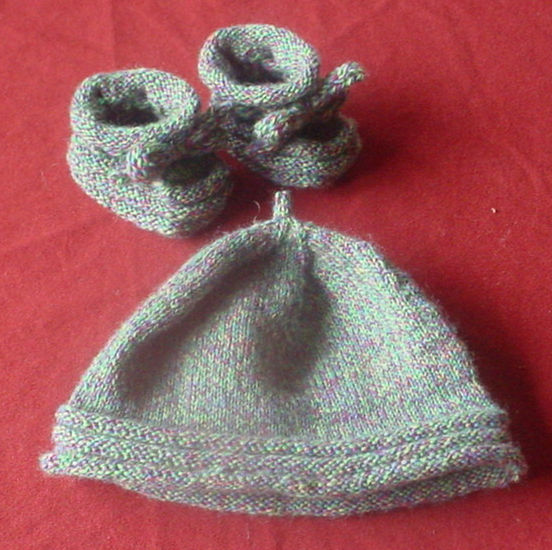
My matching hat is a simple beanie shape knit in the round, with three welts around the bottom edge to match the three welts that run around the sides of the stay-on bootie. I know that many other people enjoy making these booties, so I share the matching hat pattern here.
Baby Beanie to Match Jane’s Stay-On Booties
Materials:
50g fingering weight or sock yarn
1.5 mm (US #000) double pointed knitting needles (can be worked on 1 or two circs if preferred)
4 or 5 stitch markers
Tapestry needle for darning in ends
Gauge
9 stitches = 1 inch on 1.5mm needles
Finished dimensions
Measured across the opening, unstretched = approx. 7 inches
Notes
For the record, my hat is on the small side and should fit a petite newborn. I haven’t tried it yet, but using a 1.75mm (US #00) or a 2mm (US #0) at a slightly less extreme gauge should produce a hat for a larger newborn and 3 month size, respectively. If you want to work this at a standard gauge of 7 stitches per inch but end up with the same size hat as I made, cast on 100 stitches, and place your markers every 20 stitches. Follow the instructions as written EXCEPT that instead of following the (K23, K2tog), (K22, K2tog) or (K21,K2tog) directions instead ALWAYS knit until two stitches remain before your marker, then knit those two stitches together. I had plenty of yarn left over from my hat and booties from my one 50 gram skein of sock yarn, you shouldn’t run out even if you knit a larger hat or a hat at a less extreme gauge.
Directions
Using a very stretchy cast on (I used half-hitch) cast on 120 stitches and divide among your needles. If you are using one or more circs, mark the beginning of the row with a stitch marker for convenience.
Knit 12 rounds. Purl 4 rounds. Knit 4 rounds. Purl 4 rounds. At the end of this, counting the self-rolling bit of stockinette around the hat’s edge, you should have the appearance of three welts at the hat’s bottom edge.
Continue knitting until the hat measures 2.5 inches from the bottom. (Measure this with the curling edge curled. Don’t flatten it out.) On the next row knit 24 stitches, place a marker, then repeat. If you’re using DPNs, you’ll have 4 markers in your work, with the division point for the last one being the break between needles that aligns with the dangly cast-on end. If you’re using circs, you’ll have five markers in your work.
On the next round, (knit 23, K2tog). Do this five times total to complete out the round. Each decrease will occur JUST BEFORE a marker. Knit 4 rounds.
On the next round (knit 22, K2tog). Do this five times total to complete out the round. Knit 3 rounds.
On the next round (knit 21, K2tog). Do this five times total to complete out the round. Again each decrease will occur just before a marker. Knit 2 rounds.
On the next round knit to two stitches before the marker, then knit 2 tog. Do this five times total to complete out the round. Knit 1 round.
From here on in every round is the same – Knit until two stitches before a marker, knit those two stitches together. Repeat to complete out the round. Keep doing this until only five stitches remain on your needles. When only five stitches remain, work them I-Cord style for five rounds, then end off. Darn in both ends.
(SOFT) BOOK OF AGES
Obviously I bored most of the reading audience here totally to tears with the last post. How about something simpler today?
Quite a while ago I tried my hand at submitting patterns to print and on-line magazines. I quickly found out that it’s impossible to arrange creativity on a schedule, and that because my career is 100% hard-stop deadline driven, adding deadlines to my hobbies sucked all the fun out of them faster than teenage vampires exsanguinate each other. Be that as it may, I had limited success – some of my designs were published. See Saw Socks in an early edition of KnitNet, a pattern that helped launch the popularity of self-striping yarns:

I had some pieces published by Classic Elite, a few of which remain in their print collections, and one small item – also published by KnitNet – that I thought had disappeared entirely.
But nothing in my house disappears forever. It might become entombed in a box somewhere, but forgotten in this case is not the same as gone. I was doing some spring cleaning and de-cluttering this weekend and found the soft book baby toy that I knit long before the arrival of Younger Daughter (now in middle school).
This piece does not photograph well, and for my limited camera skills poses an additional challenge. It was knit in a long strip, with “pages” each framed by garter stitch. There are three of them, each with a different motif:


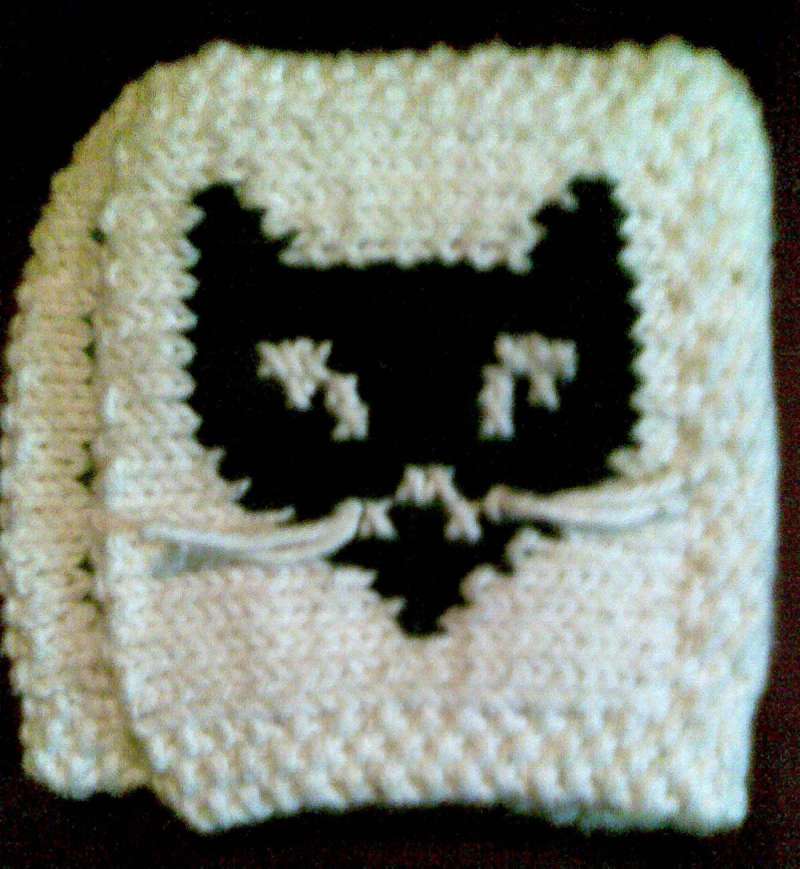
After the strip was knit, it was folded accordion style, and the tops and bottoms of each page were seamed together. Finally the leftmost edge of the front page and the rightmost edge of the last were sewn up to make the spine (I’d left the garter stitch edging on those two ends longer to compensate for the bulk of the book).
I used Bernat Handicrafter cotton at about 5 stitches per inch. The pages are each approximately 5 inches square. The two number-bearing squares each sport bobbles, one on the 1 page, two on the 2 page. The whiskers on the cat face are solidly knotted bits of the same yarn. The idea being that nothing on the book should come loose if it was mauled by the target recipient.
I had plans to offer up a whole bunch of additional simple graphed motifs in concert with the knit sample, but KnitNet was only interested in the original six. I have no idea if anyone else ever made this, but the original book was well loved (and chewed) by Younger Daughter when she was in the toy-ingestion phase. As you can see, the Handicrafter held up well, surviving lots of hot washes, although the yellow triangle and pink 2 pages both are no where near as vibrant as they once were.
LONG REPEATS, OTHER USES
Not much progress for this week, but my time has not been my own.
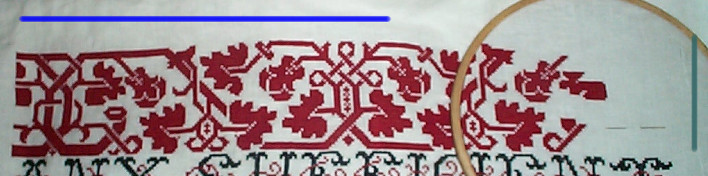
This strip will continue marching on to the right, ending approximately at the green stripe. The horizontal blue stripe shows the approximate length of the graph for the repeat as it appears in my book. More on that below…
First, thank you to those who have left comments or sent notes of support. I know that lots of knitting readers are disappointed that I’ve been stitching lately. The huge drop off in visitors is a clue, but some of that is due to other factors. Ravelry for instance has just about killed all but the most popular independent knitting sites. So it goes.
Back to stitching. I’ve got three comments I’d like to address here. The first one is of interest to knitters. Faithful Reader TexAnne points out that long block unit repeats like the one I’m working now would adapt very nicely for double sided double knit scarves. An excellent observation, thank you! I add that anything worked in strips, like a large lap throw, an edging around a circularly knit skirt hem would also show this pattern (and its kin) quite well. I’ve done double knitting from these before. My oven head hat is knit up from an outtake that didn’t make it into TNCM. You can see the negative/positive effect in the flipped up brim:

The chart for this hat appears in a follow-on post to the hat description. And, although not double sided, my Knot A Hat earwarmer band (which appears to have lost its picture link, although the chart link works) uses another historical knotwork strip for knitting:

Charts for both these repeats can be found by following the links above.
The second comment contains questions from Ellen R. She asks if I’ve ever worked these patterns before, and if they can be done in voided (Assisi) style. Here’s an answer to both:
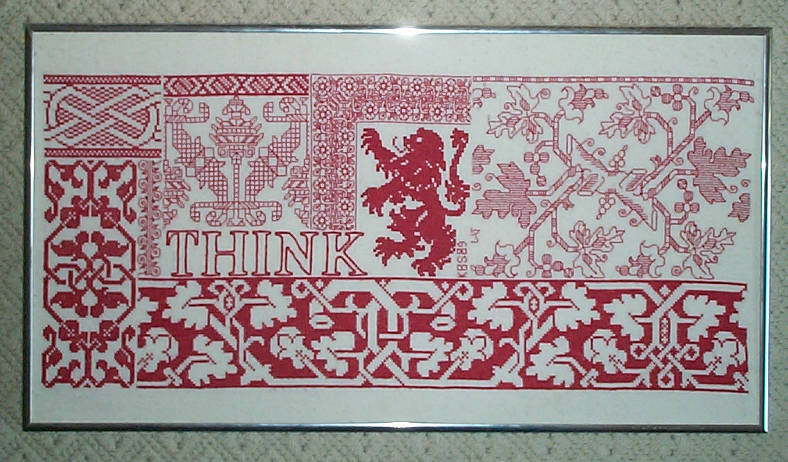
I did “Think” in 1989 and gave it to my husband to hang in his office. At the time he was working for a company that used the Scots lion as its logo. All of these patterns are in TNCM, and you can see the one I’m working on now across the bottom of the piece. It’s upside down compared to the strip I’m working now, and is worked voided – with the background instead of the foreground stitched. The effect is a bit different. To my eye, it’s more formal done this way. You can also see more of the repeat, although even this strip doesn’t capture one full cycle. I’ve worked quite a few of these many times, although even I haven’t done every pattern in TNCM (darn near close, though).
The last comment comes from Anne in Atenveldt, (an SCA region that includes parts of California and Utah). She’s got a copy of my book and notes that the chart for the current strip shows the two interlaces and the segment between, but is much shorter than the length of the strip I’m working now (or for that matter, what’s in the Think sampler). She wants to know how I do the additional segments.
I attempt to answer. The extra length is a mirror image of the section presented in the book. I work along as shown for the center point interlace and then the area between it and the next interlace as shown. On the far side of the second interlace, enough of the established pattern is shown to keep the stitcher on target, but after that point a bit of mental gymnastics is required. The stitcher has to continue on by inverting the graphed segment, mirror image style until the next mirror reflection point is reached. Again, I do show some of the area on both sides of that second bounce point to assist in navigation (and because in this case the interlaces are eccentric), but space prohibits showing a full cycle of the repeat.
Now this doesn’t present a problem for me, but as you can see, I’ve been flogging myself with this sort of thing for a long time. And it’s no shame to say that doing this in-mind reflection is difficult for you. It’s a matter of wiring, and not everyone can do this with ease, no more than can everyone use a map or read music.
If chart flipping presents problems, I do know of one easy shortcut. Office supply stores still carry transparency sheets for overhead projectors. They’re far less common in these days of Powerpoint and projectors, but many schools still use them so they’re kept in stock. They come in several flavors for various types of photocopier or printer, so be sure you’ve got the right kind for your machine. (Hot process laser printers and photocopiers for example use a melt resistant plastic, and can be fouled by using something not designed for them). Copy your chart onto the transparent sheet. Put it in a page protector sleeve with a piece of plain white paper. Work off it as usual. When time comes to do the flip, turn it over inside the page protector. Instant mirror image. The only caveat is that on pattens with eccentric interlaces as the flip point (like the one I’m working now), you’ll need to finish the interlace as charted before flipping to work the “in-between” portion.
In all, thanks to all who continue to read here. I do hope that my prattling on is useful to someone.
PATTERN – RED DIAMONDS BABY BLANKET
UPDATE: THIS PATTERN IS NOW AVAILABLE AS AN EASY TO PRINT PDF AT THE KNITTING PATTERNS LINK, ABOVE.
It’s finished and about to be mailed to the target recipient, so I can post my final pattern for this simple knit/purl texture, quick knit, lap size baby blanket.
RED DIAMONDS BABY BLANKET

Finished dimensions:
About 26.6″ x 36″
Materials:
Approximately 550 yards (about 500 meters) of a lofty wool/acrylic blend super bulky weight yarn, with a native gauge of 12 stitches and 18 rows to four inches. Washable is better.
One US size 10.5 circular needle at least 24 inches long.
Four stitch markers.
Tapestry needle for darning in ends.
Project Gauge:
Just over 2 stitches per inch in stockinette. (Approximate gauge is good enough on a blanket).
Method:
Cast on 77 total stitches but to make life easier when knitting the repeats cast on 5, place marker, cast on 22, place marker, cast on 22 place marker, cast on 23 place marker, cast on 5.
Slip the first stitch purlwise, then continue across the row in K1, P1 seed stitch; knit the last stitch of the row the back of the loop (In seed stitch you make a bumpy texture. If knitting in the flat, you knit every stitch that presents as a purl, and purl every stitch that presents as a knit. If you get ribbing you need to rip out your offending row and begin it again using a knit if you started with a purl or a purl if you started with a knit). Repeat this start-up row 7 times for a total of 8 rows of seed stitch. This will make a nice no-curl lower edge with a neat slip stitch selvedge.
Continuing in seed stitch pattern and making sure to continue the slip stitch selvedge, work seed stitch until you reach marker #1. Then work the white stitches in Row #1 of the following chart. On the final repeat just before the final marker, work the blue stitch in Row #1, then finish with seed stitch, continuing the established pattern of the lower edge.
Flip the work over. Remember that you’re going to be working the wrong side of the blanket and on this row (Row #2 of the chart) and all even side rows thereafter, you need to follow the WRONG SIDE directions for the chart. Again slip that first stitch, work seed to the first marker, now work the blue stitch on the chart (wrong side version), and continue across the chart Row #2. After the last marker finish the row out in seed stitch, knitting the final stitch of the row through the back of the loop.

Click on pix above for a larger version of the chart.)
Continue in this manner until you have worked four full vertical repeats of the chart.
Finish off the blanket with another 8 rows of seed stitch with slip stitch edges, and bind off loosely. Darn in all ends.
NEAT FINISHING FOR SUPER BULKY YARNS
I’ve finished knitting my bulky red baby blanket, and am up to the dreaded “darning in the ends” stage. Now I note that most of the criticism of the now discontinued Kool Wool was laid against its bulk and the number of ends inherent in any short yardage yarn of that weight. There are a lot of ends when you make something – especially a large something – out of a yarn that is only 60 yards per skien; and bulky yarn when darned in can look like large, creepy, and dreadfully obvious caterpillars crawling on the knitting’s surface.
While I can’t do anything about the sheer number of ends, I can make the darning in way less obvious. This fix works for any yarn that is made up of two or more constituent plies. It won’t work for a single.
Here you see my target end. Because this baby blanket will be seen from both sides, it really doesn’t have a front and back. Therefore for each end pair, I threaded one end to each side – at each new yarn ball join point one strand peeks out on the front, and the other peeks out on the back:

You can see my yarn is a thick, noodly cable style strand. Here I’ve separated the six plies into three two-ply bunches:

Why the color is so different in this shot, I haven’t a clue, but I have lousy camera skills. Still, if you squint you can make out that I’ve frayed the end into three sub-units. I then end off each of them individually, burying them in the surrounding stitches for about an inch, then doubling back, still buried to anchor them off; and finally clipping the ends close to the surface.
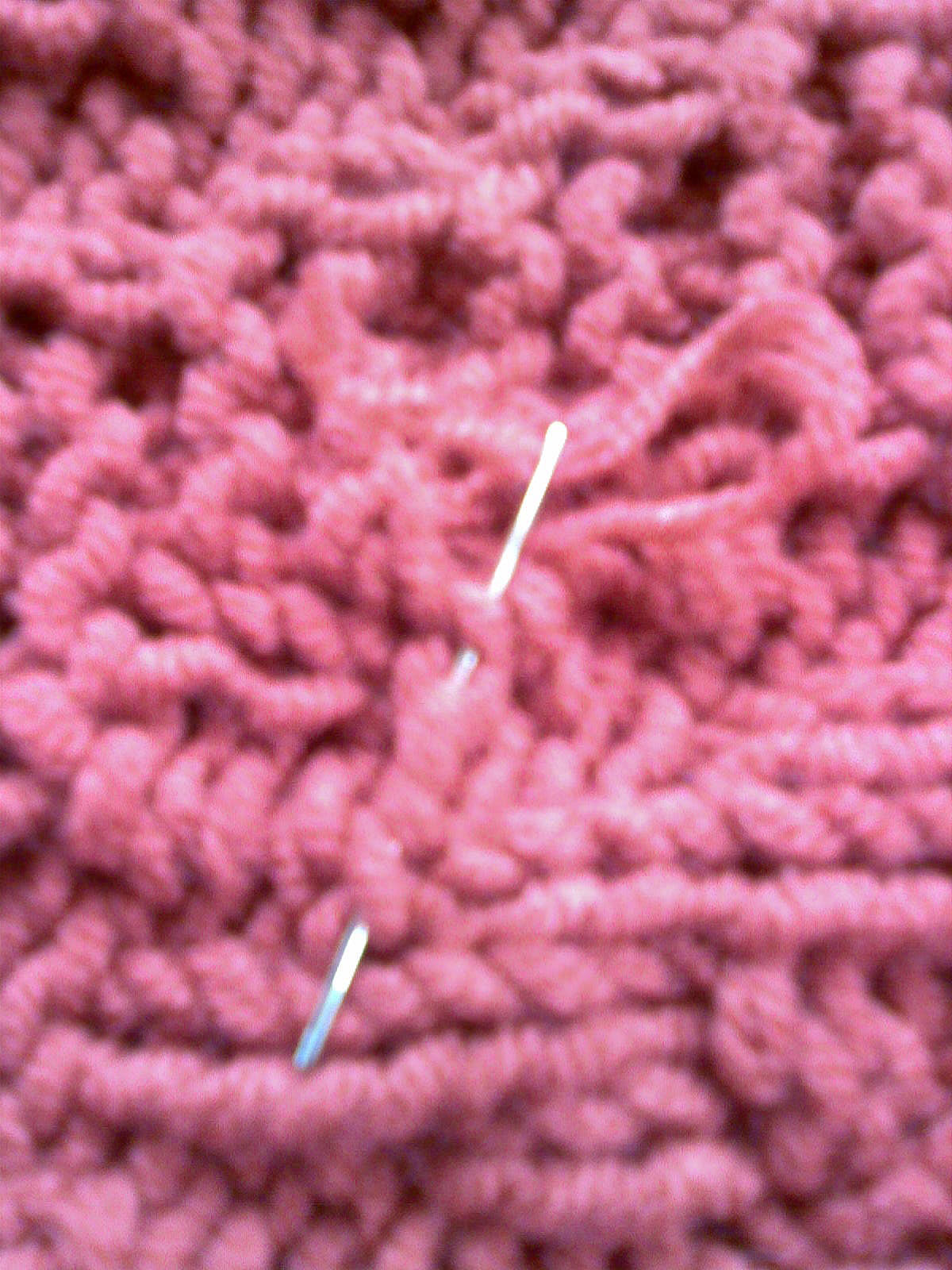
More bizarre color migration, but you can see the burial idea. And here’s the final result. Ends darned in near invisibly in spite of the yarn weight:

As for the true color of the piece, it’s “none of the above.” It’s more like this. Finished object pix tomorrow, I promise. Then it’s box and mail to the target baby, who by the time the package arrives, should be here too.
FASTER THAN LIGHT
I have to admit that I detest knitting at large gauges. The heaviest yarn I enjoy using is worsted weight (true worsted at 5 spi), beyond that I find that I tire faster and tired fingers = uneven stitches. Still, for all of that I also have to admit that stuff knit at huge gauges goes incredibly quickly. I only get to knit about an hour each evening, and can knock out an entire skein’s worth of progress in that short time:

It’s a good thing that this yarn is inexpensive – doubly so for me because I got it dirt cheap at an odd lot retailer. Knitting would be a very expensive hobby if I favored working at this gauge with good materials.
Chalk up another benefit for lace knitting. It’s got the most cost effective bang-for-the-buck. Twenty dollars worth of lace yarn can keep me amused for a couple of months. Twenty dollars of bulky weight might make a hat and a half and be totally consumed in one night.
MILE A MINUTE PROGRESS
Red blanket continues to grow. As I expected, quite quickly. Here’s two evening’s progress – approximately four 60 yard skeins, and about one and three quarters of the 40 row repeat. I’ve got lots more, and will have more than enough to finish.
This is the front.
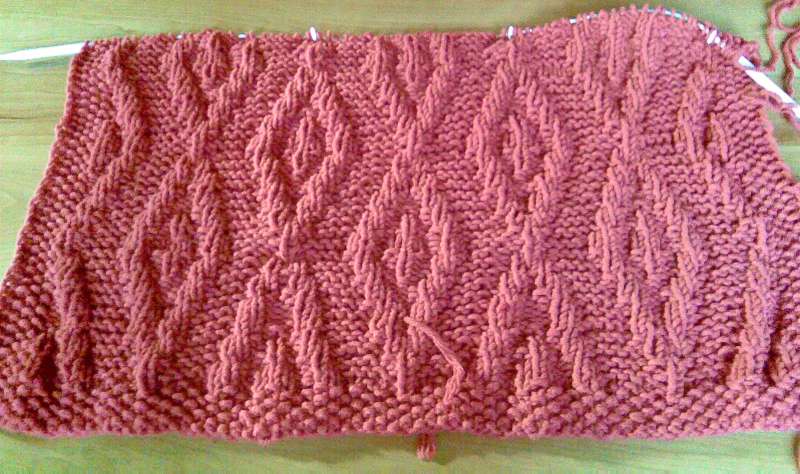
This is just a three repeats wide of a simple knit/purl pattern, an extremely easy big bang-for-buck texture well within the beginning knitter’s toolset. The back is slightly different, but also of passable appearance:
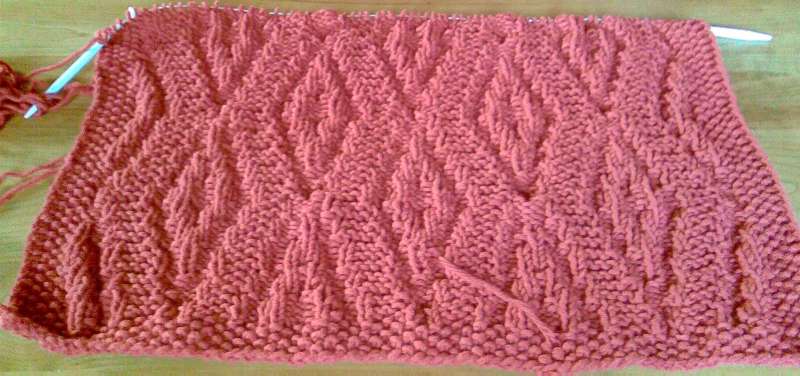
Colors on both of the above are a bit skew – the thing is a really vivid tomato red. (The new in-phone camera is a marked improvement over the old one in terms of sharpness, but it doesn’t have an effective flash.)
RACE TO THE FINISH
As mentioned earlier, I have the joy of increased familial demand for baby blankets. In fact, I just found out about a cousin who is expecting a baby within the month. So what’s to do? Go stash-diving to find a good candidate yarn, preferably in a quick-to-knit gauge, then knit it up for expedited shipment.
In this case the best candidate quick-knit yarn to hand is a bag of Lion Brand Kool Wool in a vivid tomato red. This discontinued yarn has been stashed for a couple of years, ever since I found it for a song at a local odd-lot retailer. It’s a superbulky, super soft, noodly 50% acrylic/50% merino wool yarn – marked at 12 st and 18 rows to 4 inches on US 10.5 (6.5mm) needles. The texture ensures that I will need to be creative when end darning happens. I’ll probably have to separate the yarn’s many plies and bury them in different directions in order to avoid inconveniently ugly joins.
Why red? I happen to like bright colors for babies. Regardless of ethnic origin, babies are such pallid, helpless creatures to begin with, giving them a jewel like surround seems warranted. But I am violating a core precept – this yarn is marked as hand wash in cool water. I generally avoid hand-wash yarns for baby gifts, but the 50% acrylic content makes me want to risk it. One sign that shrinking/fulling will be less of an issue – I can’t spit-splice this yarn. I will be washing this prior to giving it to the recipient, just to make sure that the red stays where it’s supposed to and there are no other laundry surprises.
Now what to make…
I happen to like lacy patterns. At first I thought about doing a simple lace panel in the yarn’s big gauge. Some quick experimentation showed that decreases in this pudgy yarn are clumpy looking and unattractive. The knit togethers used in modular knitting also rule out simple directionals. Then I thought of doing something center-out, like a big medallion or swirl. Ditto. It’s just too bulky to show fancy patterning to any good advantage. Rather than continuing to fight the materials, I’ve opted to take advantage of what this yarn does do well – simple knit/purl, and work up a heavily embossed knit/purl repeat, edged with moss stitch. After some noodling around, I’ve picked the Elongated Diamond Pattern from B. Walker’s first Treasury (p.35).
As I experiment with this pattern I encounter the prose direction challenge. I know that lots of knitters prefer their directions to be written out rather than charted. Visually impaired knitters have good reason to want this because charts can’t be voice recorded easily, or fed into computer based reading assist programs. And some of us are wired differently – charts can be confusing if you’re not visually attuned to them, there’s no shame in that. But I’m firmly in the charts-good camp, and find prose directions mind numbingly frustrating. So the first thing to do was to graph up the Walker pattern:
Once graphed, the basic logic of the pattern becomes easy to see. The duplicate column of stitches at the end (or beginning) of each row is easy to spot, as is the stepwise movement of garter stripes around diamonds formed by knit stitches on a purl stitch background.
I’ve cast on three repeats plus 4 stitches of moss border and an edge stitch on either side:
Repeats Edge
((3*22)+1) + 2(4+1)) = 77 stitches
And worked 6 rows of K1, P1 moss stitch. This being an odd number of stitches, each of my full width moss rows begins with a K1. Here are the larval beginnings of the project, on circular #11s, which I chose to increase softness and drape.


We’ll see how happy I am with it as the project as it grows. With luck, it will quite quickly because it will be a race to see which is hatched first: target baby or her blanket.
CELEBRATE CREATIVITY!
Most of you who visit String are probably here just for the Kureopatora Snake Scarf. I’m surprised at how popular that pattern has been, and its popularity keeps growing. I’ve seen postings from folk all over the world who have made it, with knitters in Japan taking it up first.
Now comes an additional bit of cleverness. Jill from Michigan made several Snakes, and then seamed them together to make a throw. She used Kaleidoscope 100%wool, and calls this her Hummingbird Wrap. Here’s her picture of it, reproduced with her permission:
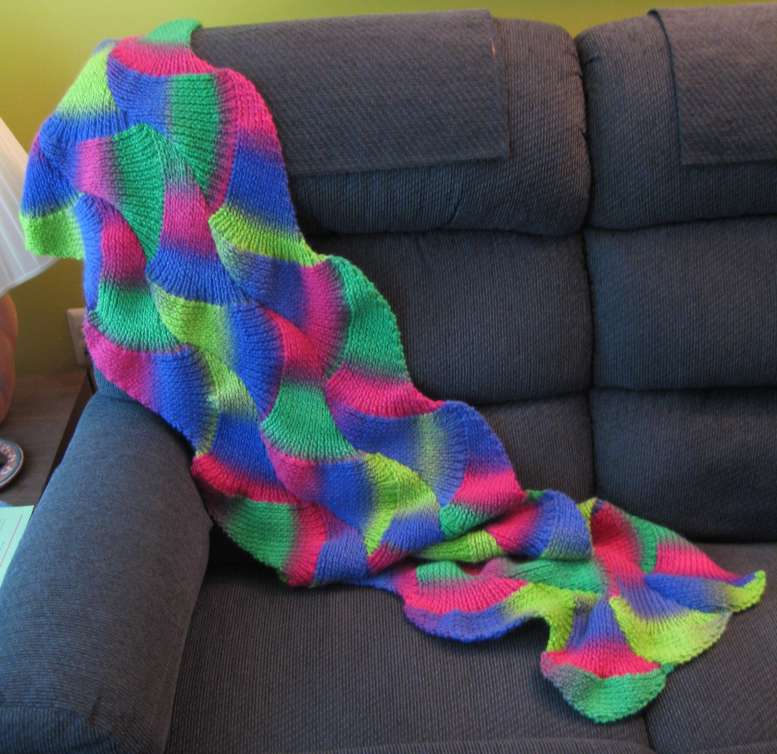
I hadn’t thought of doing that, and it’s a great idea!
If you ever knit something from one of my patterns please feel free to send me a snapshot. Since I do this for knit-love not knit-money, seeing what my pattern-children are up to out in the real world is my main payback. And if you give permission, I’ll post it here to the gallery. Thanks, Jill for this bit of inspired happiness!
 String-Or-Nothing