MORE DOILY MODS
[Repost of material originally appearing on 18 August 2006]
Yesterday’s mod was clearly indicated by comparing the directions to the photo. But today’s are a result of NOT wanting to make something that looks like the original.
Around the outer edge of my doily are 24 arrowhead or heart-like shapes, with the pointy tip facing the thing’s edge. In the original photo and directions, these are oddly placed. While they could have easily fit in between the points of the larger leaf/tulip motifs in the previous ring of design, they are skewed off the repeat, almost as if they were tossed on as afterthought. I like the minor asymmetry of the base of the leaf/tulips. It made sense there both visually and in knitting logic. This outer ring’s perturbation however is just …odd.
So not being able to leave well enough alone, I played with the thing, centering the arrowhead shapes in the areas between the leaf/tulip points. I haven’t changed the motifs – just shifted them to the left by a couple of stitches so they align between the ribs formed by the center stitch of the leaf/tulips. I think it’s an improvement:
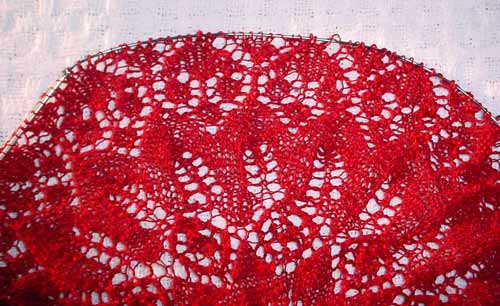
If anyone else is interested in doing this pattern, here’s the whole modification – rows 63-71.
I’m using the pattern’s own notation system present in the rest of Nurhanne’s translation. Note that while it’s written for sl1-k1-psso type decreases, when working, I substituted SSKs throughout.
Alternate final motif area for FANDUGEN
Row 63. *K7, k2tog, yo, K1, yo, sl1-k1-psso*
Row 65. ->1stitch *K5, k2tog, yo, k3, yo, sl1-k1-psso*
Row 67. -> 1 stitch *K3, k2tog, yo, k5, yo, sl1-k1-psso*
Row 69. -> 1 stitch *(K1, K2tog, yo, k1, yo, sl1-k1-psso)2x*
Row 71. ->2 stitches (sl1-k2tog-psso, yo, k3, yo)2x*
DOILY – NOW WITH VISIBLE PHOTO!
[Repost of material originally appearing on 17 August 2006]
O.K. I’ve found a mistake in the FANDUGEN pattern. It appears to be in the original Danish pattern, and is carried through into the uber-accurate translation posted on Nurhanne’s Yarn Over website.
Here’s the original problem line:
Row 61: <- 1 stitch, *K3, yo, sl1, k2tog, psso, yo*
It should read:
Row 61: <- 1 stitch, *Sl1-k2tog-psso, yo, K3, yo*
It’s a simple transposition of the k3 unit and the double decrease. It’s very evident in the photo that accompanies the pattern that the area of small roundels at the top of the tulip like unit contain three little round units, and that the outer two of each triad are finished the same way as the innermost one. If you work the pattern as written, the little circles aren’t finished off nicely with that center double decrease. It just doesn’t look right and the oddness in logic leaps out at the knitter immediately.
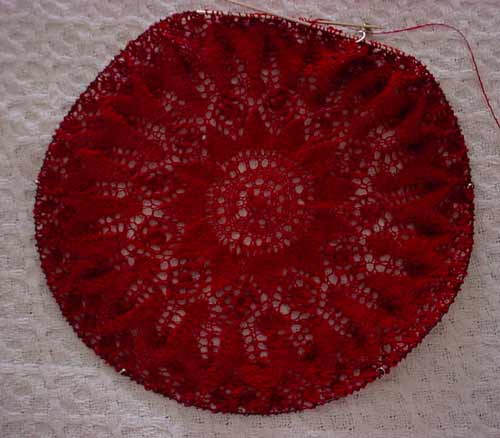
Here’s the result so far, schlepped around the house to find something light colored against which to take the photo:
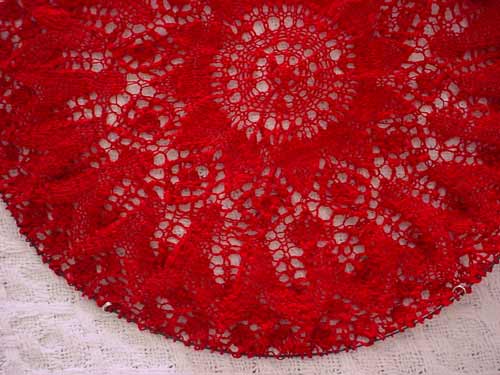
And a detail shot:
Single Crochet
On the UK usage of “single crochet” I admit that it’s very rare today, but it’s not unknown. Especially in historical patterns. If I had the time I’d comb through my collection and find examples. I know that I’ve worked my way through this problem more than once, having made the erroneous assumption that because I saw the term “single crochet” the rest of the pattern’s nomenclature must be American usage. I learned long ago never to say “never.”
DOILY PROGRESS
[Repost of material originally appearing on 16 August 2006]
Miserable excuse for a camera and non-existent photo skills aside, you can see that I’m making good progress on the red doily. I have just completed row 52 of 72, and am beginning to think how I would like to end it off.
The original instructions use a very simple crocheted bind-off, using one single crochet to gather together three knitting stitches, then chaining nine before gathering the next three knits with another single crochet. Two small complications – the instructions are from Europe and with 99% probability conform to UK term standards. That means that there’s a high possibility that the stitch referred to as a SC in the instructions, here in the US (and parts of Canada) is known as a slip stitch. More on this problem here. I’d have to play with both to see which look I like better.
The second complication is a minor one – the photo of the original pattern clearly shows two rounds of the stuff, with the first worked to end off the knit stitches, and the second worked “belly to belly” of the chains formed in the first round. It would also not be a bad guess to surmise that the second round of slip stitch/chain loops uses chain segments that are one or two stitches longer than the previous row. Experimentation would be advised.
Now. Do I stick with the original simple-yet-elegant crochet bind-off solution, or do I do something nutsy like knitting around the thing with a small saw-tooth edging? Only time will tell. That and the final diameter of my piece. The lousy photo? Here:
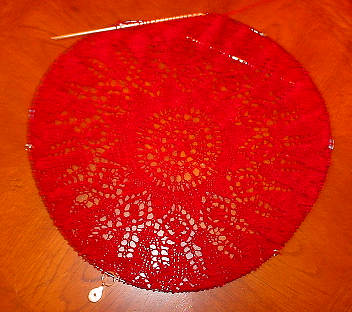
So far no errors whatsoever, and the pattern has been very easy to follow.
PLACEMAT OR DOILY
[Repost of material originally appearing 14 August 2006]
I don’t know if anyone else has “doily emergencies.” but I do. Here’s the problem scenario. Cozy library/TV room, comfy chairs, optimally placed small table just big enough for a wine bottle and two glasses (and a remote or two). But I don’t want to drip all over the new small table.

I suppose I could haul out coasters or adapt one of the dining room placemats. But why overlook a perfectly good opportunity for the application of knitting. So it’s off to the stash to get my massive amount of red lace-weight, left over from Alcazar (rayon but borderline washable and expendable), then hunt down one of Nurhanne’s translations of a traditional Danish doily. Yes, I know. It’s red, not the classic white. But hey. Red won’t show wine spills as quickly.
I end up here. Then cast on and knit a bit. Here’s the result. I’m somewhere north of a third of the way through the rows, on Round 37:
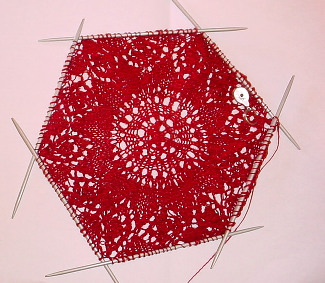
I’ve finished the center star and am at the beginning of the tulip-like shapes that surround it. My piece is about 6 inches across. I chose this particular pattern because there are several good stopping points from a design perspective. I needn’t finish it all the way to the end if my piece is sufficiently wide before then. So far Nurhanne’s translation is spot on. No problems at all.
Still, for domestic consumption, this piece is filed under the category “placemat” not “doily.” It seems less …prissy.
MORE TRURO QUESTIONS
[Repost of material originally appearing 7 August 2006]
More North Truro questions from my inbox:
Why are there blue boxes on the hex graph? They’re not in the symbol key.
That’s an example of what happens when you write for yourself, use the same graph oodles of time, and then release it into the wild without doing a due diligence review. I shaded them for myself, as a reminder that those stitches were supposed to be purled because on the first couple of iterations, I’d forget and breeze right over them in stockinette. When I publish a full version of the pattern I’ll remember to kill the blue shading.
How do you cast on at the center of the hex? Your directions just sort of assume that there are six stitching somewhere. How do they get there?
For this particular piece, I usually cast six stitches onto one needle, using a half-hitch cast-on. Then I move three stitches onto a second needle. I hold the two needles like this,

and using a third needle, begin working my rounds, starting with the first stitch I cast on. I’ll introduce more needles as the thing grows, redistributing the stitches (or mentally spanning one side over the spot where two needles meet if required). By the sixth round, I’ll have all seven needles employed (one per side, plus one in the hand).
Do you use the same cast-on for all the units?
No. For the squares and triangles, I do a standard long-tail cast-on, but work it over two needles held together. This introduces a bit more looseness into that first row, which can be impossibly tight in a non-stretchy yarn like my cotton. Credit for this very simple trick goes to my mom, who showed it to me an aeon ago during her initial fruitless attempts to teach a 10-year old me how to knit.
How many hexes did you knit this week?
Sadly, none. It was super hot here last week. I couldn’t bear to knit anything at all. This weekend though I have started in again, easing my way with a sock. Pix as soon as I find my misplaced camera and the batteries to power it.
NORTH TRURO COUNTERPANE – ELEVEN’S THE TICKET
[Repost of material originally appearing on 28 July 2006]
On the North Truro Counterpane, it really is an ideal summer beach project. The pieces are small and quick to finish. I’ve memorized the triangle and square units (I still have to refer to the pattern for the big hex). The soft cotton handles nicely in hot weather. I can sit and knit a pile of pieces during the day, then sew them onto the growing blanket in the evening. Or now that I’m home, I can knit pieces one by one and sew them on as I finish them. Note that I’m not bothering to block these. I suppose I should, but given the sheer number of units, doing so would be unwieldy. In this case laziness wins. As far as my rate of production now that I’m home and back to knitting only an hour or two in the evenings, I’d say that I can complete about one meta-motif in a week. Not a fabulous rate of progress to be sure…
I’m considering posting the graphs for the units here if enough people are interested. It won’t be a finished pattern, as I will not be doing the calculations for yarn consumption needed for various size blankets, nor will I make a yarn recommendation (the stuff I used is an anonymous coned Webs special, roughly between DK and Sport in weight). So having said that – here’s my progress.

Between beach work and finishing up at home (in and around the Baby Surprise and other projects) I managed to complete two more meta-motifs, and start a third. I’ve got eleven now. The blanket is sitting on a 6×8 foot rug, so it’s just about 5.5 feet across its widest dimension. I am still aiming for something to put on my queen size bed (about 7.5 feet x 8 feet) so I’d say I’m a little over a third of the way there.
The biggest drawback of a project like this? No. It’s not that it takes a geological age to finish – even more if you only work on it seasonally like I do. It’s the *)#$-load of ends to darn in after sewing all those pieces together.
With each meta-motif using 13 units (1 hex, 6 triangles, 6 squares), plus one plain triangle between units, so far I’ve got 28 ends x 11 meta-motifs (more or less). That’s 308 so far even though I’ve been leaving tails long so I can use them to sew the motifs together and avoid introducing even more to end off. I’ve not been fastidious about ending them off right away because I do sometimes need to go back and use an available tail for that purpose. Although I’ve been nibbling away at that greater total, I fear that even when I’ve finally finished the thing (invented half hexes and companion units to square off the edges plus a coordinated lace edging to finish all) I’ll still have at least another summer of just darning in before I’m truly done with my Truro.

MORE SURPRISE
[Repost of material originally appearing on 27 July 2006]
After yesterday’s post about the Baby Surprise, Alyse asked if I had any comments or tips on using the pattern as published in Knitters, and whether I’d knit it up before.
I reply that this was my first attempt at a Surprise. I can say that it worked up extremely quickly, and that while how it will all come together was not intuitively obvious at the time of production, once the body was done and I figured out that the single seam on the garment goes across the top of the sleeves and across the back – all doubts were settled.
I think that the proportions of the thing look a little off. If I do another, I’d make it wider across the body. The sleeve width and depth looks o.k., but the body diameter seems a bit skimpy, especially when buttoned. I’d probably do this by adding a few stitches to the center back and to each side prior to starting the sleeve increases.
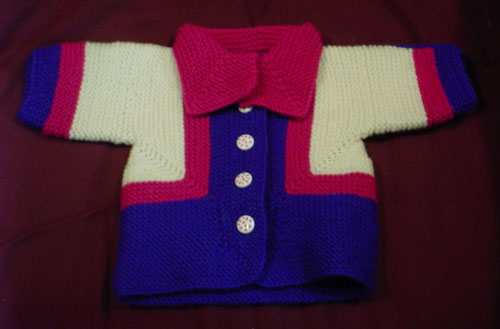
Uberknits wants to know if I used the white because I ran out of leftover purple and pink, and if the white was Encore, too.
No. I have over 3/4 of a skein of pink left, and about 10% of the purple remaining. I decided to tame the pink/purple with the white and went stash diving to see what I had on hand that was washable and of the same weight. I ended up using some orphaned Canadiana. (There is no such thing as surplus yarn, there is just yarn that is waiting to make it into the next garment). It’s not as soft as the Encore, and it’s just a tiny bit heavier, but not enough to have a major impact on gauge.
As to the proportions of the colors used – since I didn’t have a clear idea of how the thing was going to come together up until after I was half-way through the white, what you see is more serendipity than planning. Still, you can’t go far wrong if you stick to proportions. The pink stripe is half as wide as the buttonhole area of the purple. The mechanics of the pattern itself made the lower purple area come out three times the width of the buttonhole band. The white area to the underarm increases is approximately twice the width of the pink stripe. And when I was nearing the end, I made sure that the final pink and purple stripes (on the cuff) were the same width as the first pink stripe. Overall, in spite of some floppiness of the collar, I’m pleased.
BUBBLING UP FROM THE DEPTHS
[Repost of material originally appearing on 26 July 2006]
So. Where have I been? Between work deadlines; preparing for a family vacation; coming back and having the smallest one hit by a sticky mystery illness (she’s better now); and getting the kids packed off to summer camp, life has been getting in the way.
I can report that we all had a fabulous time doing absolutely nothing on Cape Cod. We mostly enjoyed the beach right at the hotel, took strolls around Provincetown and Wellfleet, kayaked a bit, golfed, read a lot of beach books, saw an unusual production of As You Like It. ate great food, and some of us knit.
I can report that I finished the two quickie sweaters previously reported – one in the fuschia shown, and one in screaming purple. I also did a couple pairs of socks, and started in again on my perennial summer project – my North Truro Counterpane. I’ve got no pix of the sweaters or socks as they all made their way to the intended recipients before I could find time to take snapshots, but I will show progress on the counterpane later this week.
On the two small kidsweaters from the 1,2, Top Down #609 pattern from Cabin Fever – it knit up quickly with no problems in both sizes, and final finishing was a breeze. My only criticism is that the thing comes in just two sizes – 2/4 and 6/8, with the difference between the 2 and 4, and the 6 and 8 being length, not width (2 and 4 share widths, with the sleeves/body of 4 being slightly longer; 6 and 8 work similarly). I knit a 4 and a 6. The 4 looks about right in terms of size, but the 6 will probably be ragamuffin large on the target kid. That’s not a major problem as kids are not known to shrink, and baggy/huge is a cute look on little ones. I’d also note that in both sizes I had more than ample leftovers from my skeins of Encore. Especially in the 6. I did need to crack into that last skein, but just barely so.
Oh. I’ve got one more knit thing to report. Since the two sister sweaters were for two little girls who are about to become bigger sisters to a third daughter, I took the leftovers from their pullovers and knit up a quick Zimmerman Baby Surprise, as described in Knitter’s Magazine’s Fall 1999 issue (#56). I added my own collar to the thing. Please don’t ask me how I did it. All I can say is that far too much local Chardonnay and beach air intervened, so no notes were taken and memory is hazy.
SEPARATED AT BIRTH
[ported repost of material appearing on 12 June 2006]
My version of Joan McGowan-Michael’s White Lies Shapely Tee – a semi fitted tee shape with a shaped waste and bust darts, used with the optional set-in sleeves (excellent pattern, and most graciously on Joan’s part – available free). Completed April 24th, 2004 and blogged about extensively here. Berroco Suede ribbon yarn, featuring two rounds of B. Walker’s Indian Cross Stitch around the gently contoured bottom hem, one turn of it around the scoop neck collar, and one at the bottom edge of the short sleeves:
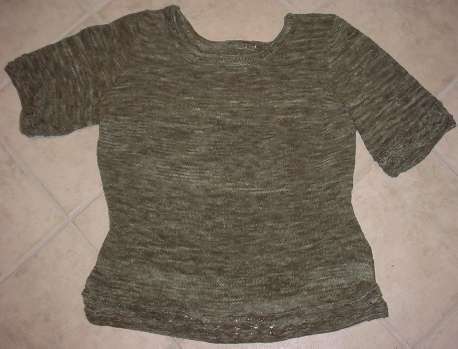
Compare this from the latest issue of Knitters. Tee shape, ribbon yarn, two rounds of B. Walker’s Indian Stitch around the hem, one around the crew neck, and one around the sleeve hems. Plus a texture stitch in the body that’s almost invisible in the photos.
Mine fits better.
NORTH TRURO COUNTERPANE LAYOUT
[Repost of material originally appearing on 3 August 2006]
First, here’s a picture showing one finished meta-unit, plus one that’s mid-assembly. You can see the swirl hex in the center, plus where the square and triangle units fit.
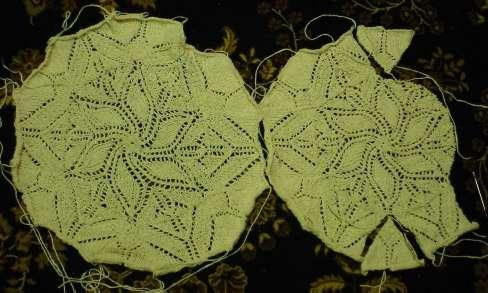
In the layout I’m using, these meta-units fit together with plain triangles inserted at the point where three meta-units meet.

I suppose I could have made just one big triangle for those spots instead of four smaller ones. That design variant will have to wait for a future blanket. In the next photo you can see how the concept above actually works:

Finally, here are some other arrangements for the same basic units. The swift will note that the one in the upper right is in fact the layout I am using:

In addition to these, the squares and triangles can also be used by themselves, or in combo. LATE UPDATE: The two layouts on the right are in fact different. While both employ entire meta-units, with plain triangles where they meet, the top one butts the meta-units up against each other by uniting the edges of the squares, the other unites the edges of the triangles. The differences are subtle, but the lines of the piece do look different if the lower right hand arrangement is made.
In terms of technique used and hints for seaming – the squares fit stitch for stitch along the edge of the hex. Due to decrease ratios, the triangles are in fact just a bit wide at the base. To eat up that extra width, I play with ease, plus I sew them in using mattress stitch. I take a slightly bigger “bite” out of the triangles’ sides than I do out of the edges of the squares to which I am sewing them. So far it has worked out well enough. Other spots where cast-on/bind-off edges meet are sewn together with whip stitch, picking up the innermost edges of the chains formed by the cast-on or bind off (or if no chain was formed, the equivalent edgemost stitch).
I do note that I’ve gone back and forth several times between working the hex, then sewing on the squares, or working the hex, then working the squares directly onto it’s live stitches. I had forgotten I had done this as I began this summer’s production, but looking at my finished blanket, I’m hard pressed to identfy the abberant sewn-on squares. I’ll go back to the knit-on method on the next meta-unit. In the mean time, I’ll just sit here in the heat and think about knitting, because at over 100-deg F indoors, it’s too hot to actually do anything more than sit in one spot and pant like a dog.
Now. Has anyone else tried the hex yet?
 String-Or-Nothing