ABSOULTELY NOTHING TO DO WITH KNITTING
I was poking around my hard disk in the wee hours, and happened upon this illustration. Since summer is in rapid retreat, it looked like a good idea to get it out there before we allreturn to our wooly cocoons for the winter.
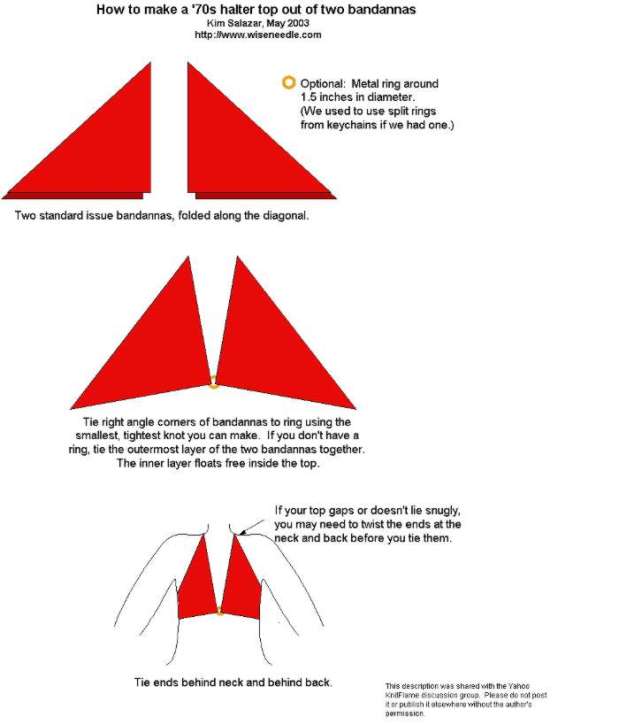
Yes, I used to wear bandannas this way. Now I’m old and not ready for fall. [sigh]
TWISTING THE NIGHT AWAY
I was showing something about twisted stitchesto a knitting pal the other day, and I thought that other knitters might like to see it too. I know that I’ve discussed them here before as part of the post about knitting backwards, but I’ll recap.

Twisted stitches are made when you knit or purl into the back as opposed to the leading leg of an existing stitch. Sometimes people make them inadvertently when they work a stitch as usual, but that stitch was mounted with the leading leg behind the needle:
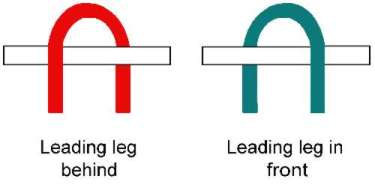
The person I was working with does exactly what my mother does – forming stitches so that she routinely ending up with leading legs behind after working a knit row, then untwisting the stitch on the purl row. Ifmom is working stockinettein the flat, the final product looks like everyone else’s knitting, but ifshe’s working stockinette in the round, they end up with all twisted stitches because there are no purl rows on which to de-twist. My knitting pal was having the same problem. We worked on being able to tell the difference between legs in front and legs behind so that she could choose to either compensate or alter her technique. While learning to recognize and compensate is certainly a good solution, it is a limiting one. To this day my mom prefers knitting in the flat and working intarsia to knitting in the round or doing texture patterns. She especially dislikes texture patterns that do not include rows of plain purling in between the rows in which other manipulations occur. With no plain purl rows to un-discombobulate her stitches, she runs into that same twisting problem.
But twisted stitches aren’t entirely bad. Sometimes there’s good reason to make them. They’re great decorative accents, and have structural uses as well. I happen to like using twisted stitches in my work. In terms of structure, Ifind them particularly useful for working ribbing on cottons, silks and linens because they are a bit firmer than regular knit stitches, and help the ribbings in those fibers keep their shape between washings. That firmness and crispness of line is also a great tool to use in surface decoration. Here’s an example from a pattern available on wiseNeedle.

The pattern is for a lacy blouse with a wide vee neck and clingy fit. The combo of the diagonal lines of openwork and the vertical ribs makes it especially flattering to the zaftig among us. Here the firmness of the twisted stitches is put to use making the cotton yarn hold its ribbed, body-hugging shape. Also the verticals formed by the twisted ribbing really stand out. I chose to do them synchopated, so that the K2, P2 ribs don’t line up after they’ve been intersected by the eyelet diagonal. That movement of line makes the piece more lively, with a more interesting total surface effect. (Or so I think.)
Here’s another nifty use for twisted stitches. In this case, I can take credit only for execution. The pattern is from Reynolds, and was put out around four years ago in a summer book for their Saucy Sport yarn. Look at the nifty way the twisted stitches are used to make the lobster’s outlines, feet, feelers, and to differentiate the textures of the filled-in areas in head, body, tail, and claws. All in all, a very clever design:

Apologies both for the quality of the photo, and for the wear-and-tear on the lobster. This is one of my favorite summer sweaters, and he’s no longer fresh from the trap.
What yarn are these two samples knit in? It so happens that I used the same yarn for both. It’s Silk City Spaghetti, a cotton sport-weight woven tape, now long discontinued. I love this stuff, and even though it does shrink in the wash(my lobster sleeves are now about an inch too short), I’d buy it in a flash were I to find it still available. I do have enough left over from my cones of the khaki and paprika that I might be able to do a shell out of each. Or if I could countenance the resulting color combo, combine them in some sort of a two-tone piece. The jury is still out on the color combo thing.
OTHER PROJECTS – MYSTERY OBJECT
Reaching back into time (and into the bottom of a box that surfaced during unpacking yesterday) I come up with my first-ever attempt at both knitting in the round on DPNs, and at stranded colorwork in the round:
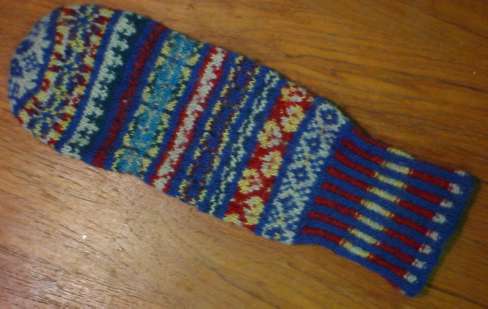
I did ita couple of yearsafter I started knitting, about the same time I began becoming rabid about knitting in general. I used a bunch of Shetland scraps raided from my mother’s stash. Like most samplers I do, I didn’t bother planning or charting anything out before hand, I just did it on the fly, experimenting with technique, color, size of floats, number of DPNs (I tried out everything from 3-6 on this piece), and pattern.
Now. Have you guessed what this thing is? It’s not a mitten or glove. It’s not a sock. It’s not a piece of gentleman’s intimate apparel, either (were it so, the size alone would make it pretty spectacular, athough the itch-factor might be somewhat limiting).
It’s a putter cover I made for The Resident Male. He took up serious golfing around the same time as I picked up serious knitting. No connection between the two pursuits other than this item.
There’s a social history lesson connected with this cover, too. I knit on this mostly at lunch hour at work, and on a couple of business trips because I wanted it to be a surprise gift. My boss at the time saw me knitting away on the thing in the airport, and upon our return to D.C., called me into his office.
He gave me a long lecture on why I should **never** let anyone who knew me in a professional capacity **ever** see me doing needlework. He went on to say that I should **never** wear or display my own products at work, because no one would take me seriously in the world of work if they connected me with domestic pursuits.
To be fair, even though it was the mid ’80s, I was working in a big-time construction/project management firm – in an extremely conservative industry largely devoid of women. But this particular workplace was backwards-thinking in the extreme. To illustrate the mindset there – I once got an employee recognition award given to me in public,with the introduction "And here’s the little lady who put the lie into the statement that you can’t have boobs and brains both."[shudder]
Back to knitting, I can report that I
- blissfully ignored his advice and kept knitting,
- moved on to another employer after it was explained to me that my promotion track as a fem was nil; and
- to this day, proudlywear and display my products everywhere I work.
For those of you born after the Carter administration, the attitude displayed by my former boss was common. Another oft-heard diatribe was that women shouldn’t do needlework, because all forms of needlework were artificesthat restricted women’s sphere of interest and creativity. This attitude was more hurtful, as it largely came from other women. (If you think I’m kidding about this, look into the book The Subversive Stitch by Rozsika Parker.) For a long time this attitude wasin part responsible for the decline in interest in knitting and stitching among younger women.
I am delighted today that things are on the upswing. I can be an aging grrlnerd, and have interests and accomplishments as diverse as fine embroidery, lace knitting, computer gaming,and SCA heavy list fighting, and no one will think the less of me for doing or having done any of them in particular. Now if only I could do something about that "aging" part, as it is having a real drag effect on employability…
THE UNSEEN AND MORE HERESY
More distraction while I accumulate enough progress on my dragon panel to be worth displaying.
As promised, after much fiddling with the frame and expenditure of batteries (still close-ups are difficult with a two-bit digital camera) I present the reverse of my red embroidered yoke:

Sort of neat, but not compulsively so. And yes – Heresy #1 – I use knots on one-sided pieces. My knots however are well formed and placed, and do not pull through to the front of the work.
Heresy #2 – Blackwork in Color
Like I said the other day, there’s a time to be absolutely historically accurate, and there’s a time to burst out in a fit of playfulness. Yes, the patterns on this piece are (mostly) from historical sources. No, the fabric (Hardanger cloth); color choices;and mode of employing these colors have zero reason toexist besides the fact that I felt like doodling with them at the time. I started this piece as a wedding present for a couple whose engagement did not last longer than the stitching. Blame the bride for the insipid country-kitchen colors.
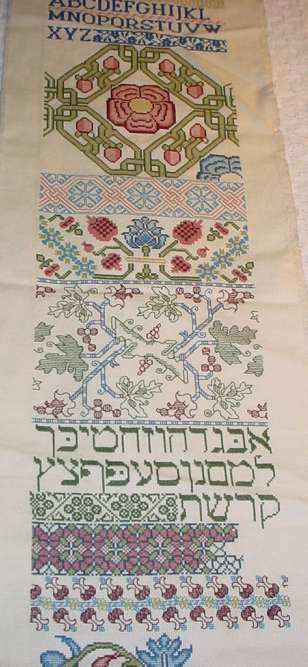
You see about a third of the total length. The rest of the piece includes a bit of inhabited blackwork; plus another standard Roman alphabet; and lots more cross stitch and strapwork patterns. Some day I might finish it. Or maybe not.
Recognize the squash/lily-form tulipflowers (bottom-most whole strip)? Yup. They were on my Anything Worth Doing sampler, too. The framing strawberry chain here done in pinks and greens also shows upin blackworkonmy Forever Coif. Think of it as pattern recycling.
ANOTHER HELPING OF DRAGON
A quick post today as I dash from errand to errand. More progress:
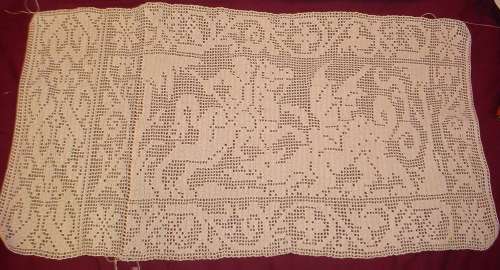
I’ve finished the border panel on the left, and am starting its companion on the right. I’m still nooding out the logistics of attaching the top and bottom borders. I’m still favoring the crochet-on-as-you-go method, but I admit it would have been easier hadI not decided early on to leave a two open mesh divide between all pattern elements. I’ve got my two empty rows top and bottom. Now to do the attach-as-I-go top and bottom strips, I’ll have to do my slip stitch on a filled rather than empty mesh. That may turn out to be a bit more noticeable. Tinkering is called for…
And in response to still more requests – tune in tomorrow to see what the back of the red embroidery looks like. Off to get my car (belatedly) inspected.
EVEN MORE QUESTIONS
Apparently the redbit of stitching I posted yesterday piqued a bit of interest. I received some questions on it:
I can’t see the pattern you describe. Can you post a detail shot?
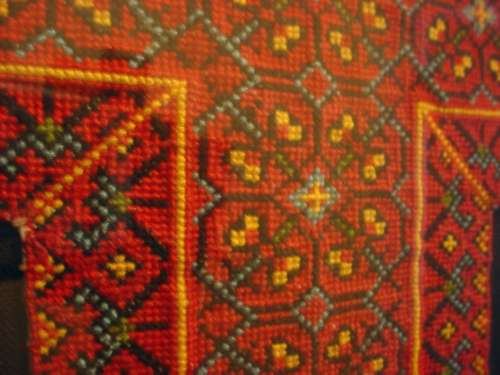
Here’s the best I can do:
Where did you get red muslin?
I didn’t. As you can see in the detail shot, the ground isn’t red. In fact you can’t see the ground fabric at all – the entire piece is completely overstitched in red, black, yellow, green and light blue.
What thread did you use, what stitches, how big is the piece?
Thinking back to ’75 or so when I made this, and hoping I remember it all – I used two strands teased from standard DMC embroidery floss. The entire piece is done in plain old cross stitch, nothing fancy. The muslin was a remnant from the discount table of a neighborhood fabric store, back in the days before big box crafts stores. Iworked mycross stitchover 2×2 threads of my muslin ground. And yes – all the top legs are crossing in the same direction.
The entire thing is about 11 inches wide and 14 inches deep, both measurements taken at its widest points. As far as gauge or stitches per inch, the weave of the muslin wasn’t square, so my cross stitches aren’t square. The flower motifs themselves graph out exactly square, but because of the weave-induced distortion, they end up looking like rectangles. Across the motif (the stretched dimension) it measures out to about16-17 cross stitch units per inch. Up and down the motif (the squished dimension) it measures out to about 21-22 cross stitch units per inch. The imprecision is there because I have the piece mounted in a frame, and it’s tough to hold a ruler close enough to get an accurate count.
The mounting glass is also why this is photographed at an angle. I hoped to bounce the flash so I didn’t get a glare or – like yesterday – a ghost image of me taking the picture reflected by the frame.
What’s the design source for this one? Why is it a funny shape?
I started with a couple of traditional Ukranian counted thread patterns, most notablyan illustration in Mary Gostelow’s Complete International Book of Embroidery, then played with them a bit. What I ended up with was a yoke for a blouse or dress. I did wear this yoke, appliqued onto two garments. The first was a very thick linen peasant-style blouse, smockedjust beneath the panel and finished with gathered and tied cuffs. After that blouse met an untimely soy sauce/bleach-related death, the second was a black straighttunic-type linen top, rather North African in shape. Thankfully the embroidery itself was unharmed by the soy sauce and subsequent attempt to clean it. Another thing – this is the piece that was recognized with the Nellie Custis Lewis prize at the Woodlawn Plantation Needlework exhibition in ’93. That year the special prize was given for garment trim or accessories.
So, what relevance does all this have to knitting anyway?
One thing that gets me fired up is the possibility of cross-pollination among needlecrafts. Why can’t I take a 16th century pattern intended for lacis, counted embroidery or weaving, and use it in filet crochet or knitting? Why do I have to stick to traditional Scandanavian, North Sea island, and Baltic motifs for stranded colorwork? For example, why not mess with this red bit of stitching, adapting its motifs for knitting?
Why for that matter do I have to stick to any one type of needlework? I’ve done that. I’ve made the repro historical pieces.It’s virtuoso work when done to the nth level, but it’s also limiting. I want to do more. What gets me trulyinvolvedis moving away fromstaid verbatimreproductionin one of two directions, either –
- Making an entirely original and new piece, but doing it in such a way that were it transported back in time it would be accepted as yet another contemporary example of its type.
- Taking motifs, designs, or aesthetics from one branch of traditional needle arts and using them either in combo with another form, or for use entirely in another form.
Thisattitude one of the things that makes me a Rogue Laurel in the SCA. Yes, making an exacting reproduction of a meticulously researched and documented artifact is a manifestation of skill (and perseverence) on a high order, but I don’t see it as the ultimate expression of the deepest level of understanding.
Believe it or not, I seethe elusive goal of true mastery of a needlework formas having parallels in martial arts. It’s one thing to learn fencing, Judo, Karate or Aikido exercises perfectly and to perform them with grace and precision when required. It’s another thing to abstract the principles behind the exercises, and be able to summon them up to defend oneself from someone who doesn’t know the otherside of the script. It’s the inner form of these arts, the part that you can recognize at a visceral level, internalize, and use as a point of spontaneousapplicationthat is the goal of practicing the outer form of the techniques.
So from street fighting, I cycle back to stitching and knitting. I have donemany of these other things amd tried out many different needle artsbecause I see deeper parallels among them; because the lessons I learn in onepursuit inform my investigations of others. And bogus pseudo-philosophy aside – mostly I do these things because they make me happy.
Footnotes: SCA = Society for Creative Anachronism. Laurel = SCA’s kindgom-level award for achievement in the arts – one of the highest achievements possible withing the group, and an ardently sought-after goal. Iam honored to have been recognized in the East Kingdom in ’79 for fostering the practice of historically accurate embroidery, in specific – blackwork and related styles. Rogue Laurel = one so honored whose opinions differ from the established consensus, who ends up being in the minority on most arts-related issues, see related entries under "pain in the butt," and "gadfly." I’m mostly retired from active participation in the SCA these days, but I can still be found on occasion at events in Carolingia (greater Boston, Massachusetts area branch).
FILET OF DRAGON – MORE QUESTIONS
More questions from my inbox:
Can you use the same type ofchartedpattern for knitting?
Why not? It’s a plain graph. You can use anycharted pattern for knitting, darned net, embroidery, colorwork or filet crochet so long as you understand the proportions of the units your chosen craft employs. Even though the original was graphed in square units, my units are rectangles. As a result, my piece is a bit squashed left to right because my units are wider than they are tall, and I worked across the piece’s short dimension. Had I worked the long way across, my dragon and George would have been squashed top to bottom instead.
By carefully choosing the direction of one’s work one can either minimize the effect of non-square units, or employ it as a design feature. Here’s a cross-stitch embroidery I did on white muslin. The original graph was square. The muslin’s weave wasn’t. The flower units end up being squashed top to bottom, but that turned into a design feature.

There are some ways around the problem if you want to work a square graph on a non-square medium but want to preserve the original height:width ratio. Depending on their gauge, some knitters replicate every third or fourth row when working from a square unit chart. This practice is built on the premise that knitting stitches are usually wider than they are tall (more rows than stitches per inch). Others use drafting software with layering capabilities, importing the original chart, then overlaying a custom grid built to their stitch height:width ratio, finally knitting or crocheting off the new gridding. Finally, some people manipulate their craft to produce units that are more square. For example, I’ve seen some knitters take graphs and translate each box unit into a unit of 2 stitches x 3 rows. While that "blows up" the design, making it a much larger piece than would working one stitch per one charted square, it usually does produce a result that is more visually true to the original.
Me? I don’t bother regraphing. I play with the ratios and pattern placement instead. For example, the Knot A Hat headband on wiseNeedle is worked from a square unit graph (available as a *.pdf via link on the pattern page).

My knitted version is elongated along the length because my stitches are like most stockinette – wider than they are tall. But I don’t care. I think the design’s stretch isn’t out of place and until I pointed it out, you probably wouldn’t have noticed.
How did you get your mesh to look so even?
The same way you get to Carnagie Hall – practice, practice, practice. [grin] Seriously, in crochet just like inknitting one gets used to the hand motions of making a stitch, and providing the optimal tension on the thread becomes second nature. I find if I concentrate on keeping things even, they go all to hell, but if I relax and just do the work – my stitches are all the same size. Some crochet beginnersstrangle the hook, pulling the loops way too tight and making the formation of stitches more difficult than it should be. Others make their stitches waaaay up the needle’s shaft where the shank gets wider to accommodate gripping. Those folks often end up with loose, irregularstitches as their too-big loops are distorted by the actions of making a stitch. Again, not to be a smart-ass – but practice and patience are key.
Filet looks nifty. I didn’t know crochet did more than granny square blankets. What other types are there? Where can I learn more?
There are all sorts of crochet books out there. Not as many as there are knitting books, it’s true, but there are quite a few. Some are pattern collections, some are technique instruction books, and some are toss-the-rules and be creative sources of general inspiration and encouragement. Crochet history however is harder to come by.
The best source of info on crochet history and styles I’ve got is Lis Paludan’s Crochet: History and Technique. It’s a fair size tome that details not only crochet’s murky historical beginnings, also covers how the craft developed over time. It gives copious illustrations of various styles, mostly fromengravings and other period sources,and even has a nifty how-to section in the back. Unfortunately it appears to be in rather limited supply, although I still see copies at the original retail price on bookstore and needlework specialty store shelves. It’s also pretty well represented on library shelves. [Reminder to self: Add rider to homeowner’s insurance to cover out of print needlework book collection!]
WORKING REPORT – EVEN MORE DRAGON
Progress continues. Here’s the latest:
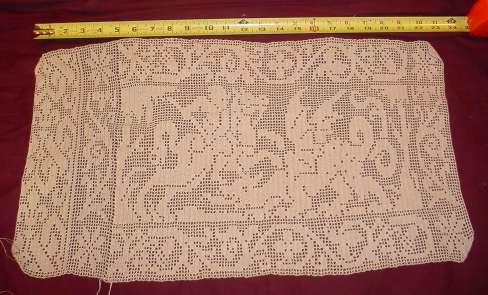
I’ve included the tape measure because a couple of people who have seen the thing in person thought it was much larger, and were surprised by how small the individual meshes were. It’s not exactly teeny, but at around 8×6 meshes per inch, it’s not exatly honking huge, either.
You can see the edge frame, now well developed along the left. In the original (and in my book) it appears as a single-wide. Here I’ve mirrored it along the long side. There will be another block of the same at the right edge,but the top and bottom (right now) look like they’re going to be single-wide. I have to say I like the piece, and I’m quite pleased. It will be killer on the door.
Inhouse-related news, String Central is mostly put back together. We’ve completed the network wiring on the basement and first floor, and I’ve been able to unpack and set up my base station machine and comfy chair. Goodbye laptop! Goodbye typing on top of the oil tank! Slowly but surely I’m making a dent in the Continental Divide of boxes that separates room from room. Yesterday’s find was the long-lost lid to my spaghetti pot. At this point I’m truly thankful for similar small points of progress.
Other questions that have come in via eMail:
How is crochet to do for long periods compared to knitting?
I find crochet slightly more tiring. The way I hold my hook and thread involves a good deal of wrist rotation to form stitches. By contrast, my knitting requires almost no wrist movement. Also at the small gauge I’m working, my overripe eyes need a fair bit of light, otherwise I end up squinting and workng by feel. Stab. Ouch. Got it? Nope. Re-stab. Ouch. Got it! Grab loop, loop, loop. Repeat. That’s hard on both the eyes and fingertips. As a result, I can knit happily with no ill effects for long stretches of time, but I can only crochet for a couple of hours before eyes, fingers, and wrists all demand stopping for a glass of wine.
What thread and hook size are you using again?
I’m using Coats & Clark Royale, size 30; and a recently made Bates US #10/1.5mm. I posted a short discussion of hook sizes several digests back. So far I’ve used 1.8 balls, but don’t anticipate using more than three total.
Where did you buy the pattern for your curtain/please send me the pattern.
If you’ve been reading along, you’ll know there is no pattern. I’m feeling this one out as I go along. As for sending out the graph for the dragon or the edgings I’ve used, I might consider posting one or more of them on wiseNeedle some time in the future, but other than that, I am not sending any of them out. If you’ve got access to my book on embroidery, all three are in there. If you’ve got access to other needlework resources, including microfilm and other repro collections of early pattern books, here are the citations:
- Dragon panel – Siebmacher, Johann. Schon Neues Modelbuch von allerly lustigen Modeln naczunehen Zuqurcken un Zusticke. Nurnburg, 1597(?), 1602/3/4. (Plate 30:1 in my book)
- Acorn, Leaf, and Flower Meandering Repeat – Pagano, Matteo. Honesto Essemplo del Vertuoso desiderio che hanno le donne di nobil ingegno, cira lo imparare i punti tagliati a fogliami. Venice, 1550. (Plate 27:3 in my book).
- Framed Twist and Flower Border or All-Over Repeat – Troveon, Jean. Patrons de diverse manieres inventez tressubtilement Duysans a brodeurs et lingieres et a ceulx lequelz vrayment veullent par bon entendement User Dantique et Roboesque frize et moderne proprement en comprenant aussi Moresque. Lyons, 1533. (Plate 28:4 in my book).
Of course, looking these up in a research library will entail actual work. It’s been my experience that people who idly ask for free patterns are rarely disposed to bestirring themselves to expend the effort. However if there is sufficient interest, I’ll considerpublishing my graphs on-line.
THE DRAGON’S VALUES
Elissa wrote to me to ask how I could tell what graphed patterns might go together well as I was looking for more borders to eke out the edges of the dragon panel. I am not quite sure I can answer, in part because I’m not quite sure I’ve made successful picks yet. I do a fair bit of this type of composing in the course of stitching up monochrome embroideries. The best way I can discuss this is to show a blackwork sampler I did a while ago:

I stitched this upwhile I was working on my book of embroidery patterns. Some of the patterns on this piece made it into the book, others didn’t. The ones I left out were ones that turned out to be too late in origin for inclusion in the book, or whose documentation and provenanceweren’t complete or accurate as the rest.
You can see several things on this mostly-blackwork piece. First, even though I was working exclusively in double running stitch (aka Spanish Stitch, Holbein Stitch) and cross stitch, there is a tremendous variation in density and the depth of tonal values among the various patterns. There is also variation in the delicacy of line, even comparing the airy double running stitch patterns. The highly geometric bit in a similar style to Jane Seymour’s cuffs (center top) presents a very different look than the curled plume-like leaves in the bottommost left.
Now this piece is far from entirely successful for several reasons, design by accretion being the leading one. Like my dragon curtain it was done "bungee jump" style. I took my ground cloth and just began stitching, picking my patterns one by one as I finished the last. The first bit I did was the sorrel leaf stripin the upper left (looks like clovers). I worked more or less across and then down from there, leaving the center blank until I hit upon something to put there. That happened to be my father’s favorite saying, and a large yale, but I certainly didn’t plan on them being there when I started. (A yaleis a heraldic goat with skewed horns, although someheraldicspecialistswill debate whether this is a goat or a yale.) The last bit to be filled in was the small rectangular area just below the yale, which I patched in with several smaller scale fillings commonly used in inhabited blackwork, finishing up with my sig strip at the center bottom (KBS ’83). I used a couple of these in my blackwork underskirt and Forever Coif, too.
Had I actually sat down and planned the piece, I would have better balanced the placement of light and dark areas, and the apportionment of delicate curved lines with harsher block geometrics would have been more pleasing. Those sorrel leaves for example are way out of place. They’re too light and too leggy sitting as they are on top of the darker knot strip. The large double star motif beneath the yale’s back hoof is also out of place. While it balances nicely with the English acorns on top of "Worth Doing" and the star and fleur de lyse at the center right edge, in combo with the Chinese peonies just above it theheavyvisual densityweighs down thecomposition along the left edge.
All this is a long way to go to answer Elissa’s question. In a piece as small as the dragon curtain, with a limited number of patterns, I wanted to call attention first to the center panel. To that end, I framed it with a strip repeat lighter in value than the average tone of the dragon and knight unit. I tried not to "fight" with the center panel, picking a repeat that was rather delicate in line rather than a heavier one to avoid the the overpowering effect demonstrated on my Anything sampler. However, once that frame was completed and I wanted to add more width, I decided to usestrips of aheavier, more geometric border around the whole piece. With luck, now that the lighter inner area has been established (sort of like matting a painting), the denser second border will serve the same purpose as a dark carved wood frame on a painting – defining the inner space inside the frame and accenting the center, by contrasting with both the mat and the piece’s focus.
ANOTHER HELPING OF FILET OF DRAGON
More progress. Here’s the beginnings of the second border strip on the left:
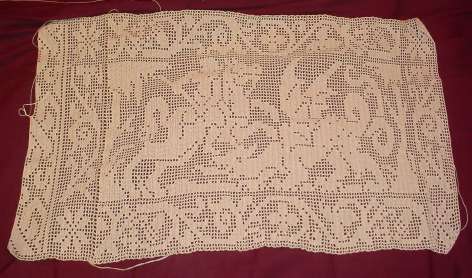
It’s denser and less delicate than the central motif or inner frame. With luck the contrast should work out. What you’re seeing is a bit more than half of theoriginalmotif. Remember that I’m doubling the width, so this works out to a bit more than a quarter of the final as I will be working it. Note the upside down curlique along the edge. When I mirror the strip longitudinally that curlique will be right-side up down the center, and will merge its left and right halves to become a sort of fleur de lys.
Found in Russia
Thank you to Kate from Somerset in the UK and to Lisa (blogdogblog) Young, both who sent me to the Russian website I was searching for (best viewed with your sound off). The English translation is probably machine-generated, but the mitten designs speak for themselves (click on the Knitting link in that site’s left margin).
One thing I remember that’s not there anymore (and I may be conflating two different Russian websites) was a series of traditional counted patterns for cross stitch and pattern darning, done in black and red. While the bulk of this site is a commercial one dedicated to cross stitch, machine and punch-needle embroidery, the site I remember offered these traditional motifs free for the download.
A feature of this site that’s worth visiting though is the recipe section. Click on the "I invite you to dinner" link and be prepared, both for foods enticing (anda fewa bit suspect), and for the trip into a world of amusing translations. While I won’t be making "Pancakes with Liver" any time soon, "Meat in Pots"and Beshbarmak bothlook good. Think puzzle/creative though to decode the translations. For example, "laurel sheet" = bay leaf.
 String-Or-Nothing
