IN WHICH WE BUY EMBROIDERIES – PART I
Just back from a five-day Diwali break trip to Agra and Delhi. In Agra we toured the Taj Mahal, Agra Fort, Ram Bagh (a magnificent Mughal era garden), and Chini Ka Rauza (mausoleum of Shah Jehan’s prime minister Afzal Khan Aalmi, himself a noted poet). In Delhi, we did a hilarious, whirlwind auto-rickshaw tour of Government center area, including the India Gate, houses of Parliament, and the embassy area; then a day in the National Museum, the Crafts Museum (a must-see if you are a weaving or textiles fan), the Red Fort, and at the end – a shopping trip to Dilli Haat. If you are ever in Delhi, insist on going to Dilli Haat. Your driver may try to steer you to a different crafts or souvenir store, but stand firm. You’ll find better quality goods at much lower prices, and without the “foreigner tax” so often encountered elsewhere.
The week was unforgettable, and I’m sure I’ll be posting some select tourist pix over the coming week. But folk here are reading for needlework content, so I’ll lead with that.
I wanted to bring home examples of Indian needlecraft that are a bit more interesting than the usual items sold to tourists – the hastily stitched pieces of sketchy construction in lurid colors. I had wanted to find examples of Kasuthi, of course, but so far, I haven’t. Perhaps when we go a bit south in Maharashtra later in the spring I’ll find some. But other than the iconic piece at the National Museum, pictured on the cover of my Kasuthi book, I haven’t seen a single example. Nor did I find quality shisha (mirror) work, although I did see a couple of pieces locally here in Pune that I may go back to buy. In crafts, like in all other areas of economic opportunity, bad drives out good. It’s hard to find honest quality pieces when less well executed items command the same price. But I did look hard, and we did buy several items, almost all from government designated regional or ethnic artisanal cooperatives in fair trade markets or sponsored cooperative stores. Here is the first selection:
My dodo curtain. Now anyone can find elephants or peacocks,even tigers, on cloth here. They’re everywhere. But this cotton curtain (about the size of a king size bedspread) is totally covered with roundels inhabited by dodos. Why dodos, I haven’t a clue. But in addition to the pudgy charm of the off-beat motifs, it was the best stitched and best composed of the large pieces I saw. My big disappointment is that I didn’t get a provenance on it, but I suspect Uttar Pradesh from the style:


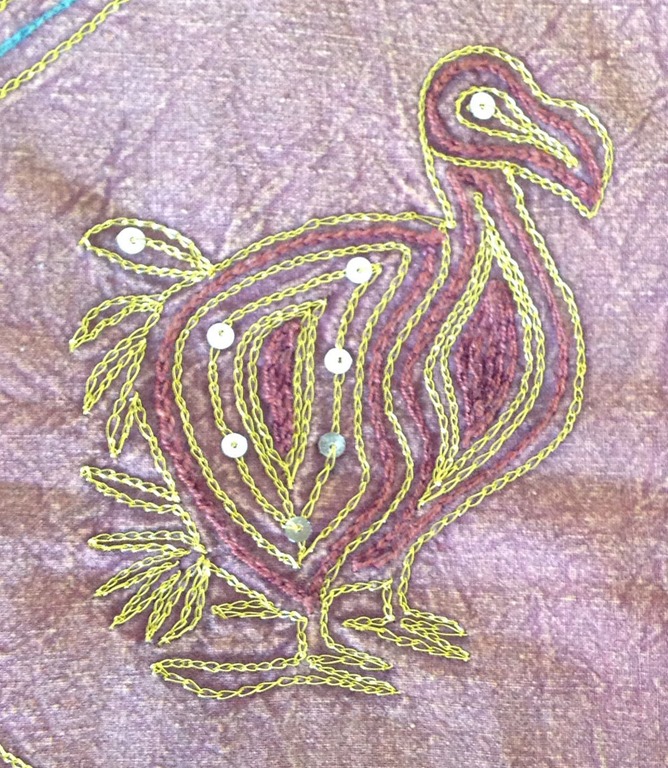
The pictures above look rather pinkish, but the actual background color is more dun than salmon or orchid. The dodos are worked in tambour-worked chain stitch in gold and brick, olive and mustard perle cotton on a double-thick cotton ground, then heavily washed. The sequins are affixed along the lines of the gold stitching. That along with the treatment of threads on the back clinches the working method for me.
I hope to mount this as a room divider curtain on a brass rod between our living room and dining room. Long ago there was just such a brass rod in that wide opening, and now I have something worthy of replacing it.
Long live the dodo!
KASHMIRI TAMBOUR-EMBROIDERED CARPET
Mary Corbet over at Needle n’ Thread has just posted an interesting piece contrasting tambour needle produced chain stitch with the same stitch produced by a traditional threaded needle. She notes the speed, density and coverage factor of tambour stitching. I present a truly huge sample to corroborate her observations.
I have an entire room-size floor carpet done in tambour work.
For those of you who don’t know what tambour is, it’s a method of producing an even embroidery stitch with a chained appearance, by plunging a hook through a base fabric, catching a loop of decorative thread, then repeating the process to create a line. The hook used (called arhi, here) looks a bit like a fine crochet hook, but the end of the hook is a bit more pointed, to make piercing the ground fabric easier. Mary offers up some excellent discussions of the technique, so I’ll skip doing so.
In any case, Mary’s piece made me think about the rug we recently purchased:
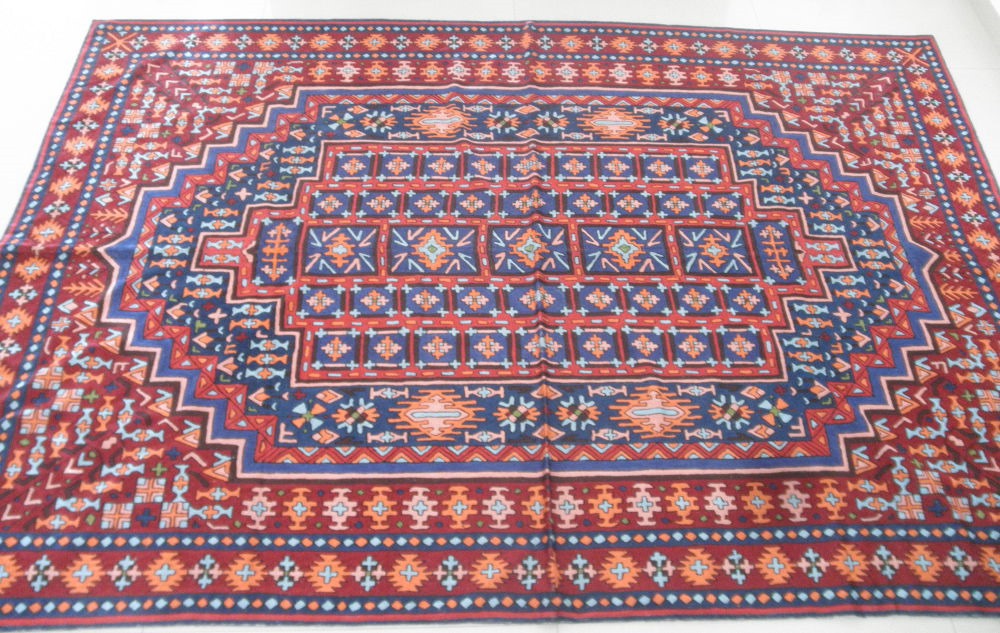
This piece is roughly 6’ x 9’ (1.8 x 2.7 meters). Everything you see here is stitching. The white cotton ground is totally covered by vibrant, dense-pack chain stitch in jewel colored cotton:

By getting close up with my gauge square, I can see that the stitch count varies between 10 and 12 stitches per inch, with the longer stitches being in the plain areas like the simple straight pink and brown runs at the bottom of the detail, above. For width, about three rows of stitching equals 1/3 of an inch, with the longer stitch areas being a bit narrower in addition to leggier. Perhaps the less skilled stitchers were assigned the boring border areas, and the more skilled artisans did the intricate motifs. In any case, because of the variability of stitch length and some small mistakes here and there, I am pretty confident that this rug was done by hand and not with a sewing machine.
If I flex the heavy canvas ground cloth, I can see some pencil lines behind the stitching that mark off major design areas, but not every area or motif is indicated. Finally, the entire piece is backed with another layer of cotton sheeting, slightly thinner than the natural color ground cloth.
Our rug came from the Kashmiri area further north, the source of so many of the handcrafts available here in Pune. It’s a bit unusual because this type of stitching is more commonly done in wool. Namdas for example, are tambour stitched rugs worked in wool (or sometimes today, wool/acrylic blend or even cotton) on a felted wool ground cloth. I’ve seen them both here, and occasionally in import stores in the US.
Back to our carpet – how long did it take to make? Tambour is speedy, but 6’ x 9’ is a huge amount of handwork. The crafts merchant who sold it to us said that these pieces were the product of family manufacture. It typically takes several people (I’m thinking four to six, more can’t easily fit around the cloth to work) about two weeks to make one this size. I base this on the fact that he says one family can produce between two and four big pieces per month. Ours was one of the largest. Most of the other samples of cotton tambour were about half this size. To my stitcher’s eye, ours was also the most accomplished of the four available cotton rugs. It was the most evenly and densely stitched, with the best color balance and patterning.
The stitched surface is holding up nicely to moderate traffic, although we are careful with it. We do not wear shoes in the house, and I do not subject this piece to the vacuum. Instead I light surface sweep with a soft plastic broom, and supplement that with occasional shake-outs. Thankfully, nothing has spilled on it. Yet.
We bought this piece because we fell in love with the brilliant color, intricate patterning; and because I appreciated the skill that it took to produce, and the magnitude of labor it represents. It’s time and care, rendered in cotton, and will be one of my favorite keepsakes, long after we return home.
KEEPING BUSY
In all of this observational and research posting what’s been missing has been reporting on my own projects.
I’ve been busy since finishing the Ganeshji piece. I’ve finished Younger Daughter’s red pullover:

Purists will note that we ended up eliminating the belled lower sleeves. They ended up being a bit too much for India’s climate. The thing fits quite nicely. My only caution is that in the chosen cotton DK it’s quite warm.
I also knit up a small teddy bear as an as-yet ungiven gift. I used the free Berroco Foliage Bear pattern, and Bernat Mosaic on US #9 (5.5mm) needles. There’s enough in one skein of multicolor Mosaic to knit at least one more bear of this size. Stuffing was cannibalized from an inexpensive throw pillow bought at the local supermarket; crafts stores and virgin stuffing materials not being exactly common in Pune.
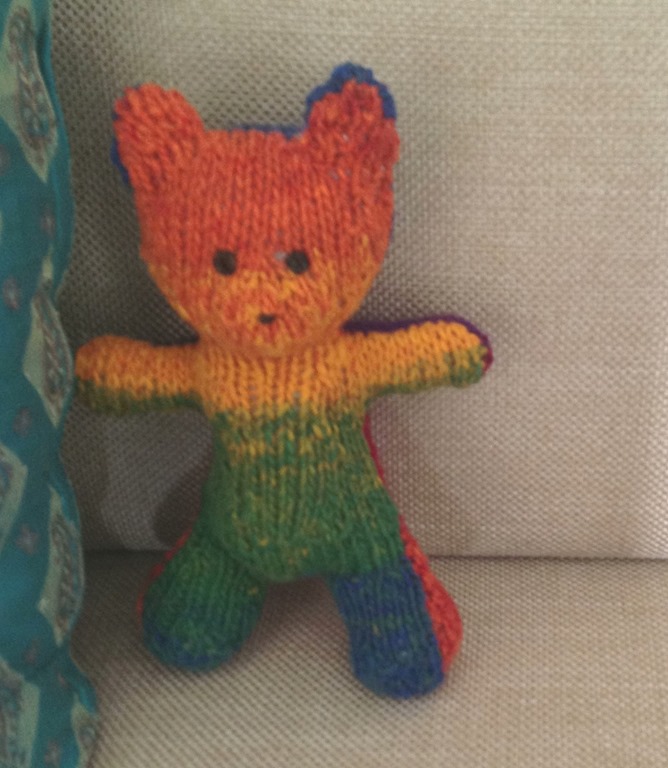
Special thanks to long time needlework pal and multi-century enabler Kathryn, who gave me this wildly bright acrylic skein to share with my kids. I sheepishly admit that it crept into my backpack, and I diverted it to my own use.
I also finished yet another pair of socks. I’ve taken to knitting at the bus stop while waiting with Younger Daughter in the morning. This pair is done, and there is another behind it, well along on the needles:

It’s my standard figure-8 cast-on, toe-up sock, but done on log-huge US #1s – 64 stitches around. The lacy meander on the side is from the first Duchrow collection (page 35). I’ve used it before on a baby blanket. These stripy blue socks are also meant as a gift, along with the men’s pair I’m working on now.
And I’ve started doodling with Kasuthi embroidery. I’ve got a large piece of somewhat even-weave fabric. Big enough to make a half dozen napkins. So I am doing a different motif, totally double sided, on each one. I will stitch all six motifs, then cut apart the cloth and hem the napkins. Motif Number One is complete:

You can see the stepwise logic of the filling pattern in the star flower’s petals. The resemblance to stepwise Western band patterns (like Jane Seymour’s famous cuffs and Anna Meyer’s sleeves) is even more pronounced in Kasuthi border/edging designs. A couple of those are on deck for future napkins. But first, I’ve GOT to do one of the traditional elephants…
UNTIL THE COWS COME HOME
We’ve all heard the expression “You’ll be doing that until the cows come home.”
But when exactly is that?
It turns out that on this street there’s a small herd of Indian Urban Cows. They commute each day to local grazing, much like the businessmen in the surrounding high rise buildings go back and forth to work. Our street’s five cows amble out and back, shepherded by a guy on a bicycle (or occasionally on foot).

Having tracked the data, I can now say exactly what time they come home.
Roughly at around 4:30pm.
Here’s the data for October:

Amusingly, you can see that the trendline correlates with the slowly shortening days, as the sun rises later and sets earlier as the month progresses.
So if someone says that a task won’t be finished “Until the cows come home,” you can pipe up and say, “I’ll be back at 4:30 to pick it up.”
Another mystery of the ages, put to bed by scientific observation.
THE TWAIN DO MEET
That old adage “East is East, and West is West, and never the twain shall meet,” is hogwash. The more I nose around and see new things, the more echoes and possible connections turn up.
First it was the early modelbooks, mostly German and Italian of the early 1500s, some of which appear to have copied textiles or ornament from further south and east. In TNCM, I pointed out that some designs in Schonsperger’s 1526 Ein Neu Modelbuch were possible transcriptions of Islamic Kufic script, often used in woven and stitched Tiraz bands (TNCM 18:2). A knit cushion from the tomb of Fernando de la Cerda of Castile (d. 1275) is another example of similar script (Richard Rutt, History of Hand Knitting,1987, p. 41, and TNCM 18:4).
The Islamic link in elaborate stepped double running stitch embroidery – the precursor to European blackwork strapwork styles – is now well documented. The talented Mathilde Eisenbach presents a summary and samples of Medieval Egyptian counted work (among others).
But it didn’t start there. Double running stitch done in steps and little squares may well have its origins further east, and European style blackwork most definitely has an Indian cousin, with its own long and murky history.
It’s pretty obvious that double running stitch is one of the simplest of all embroidery stitches. It can be used both on the count and “free” to produce linear designs of all types, with the advantage of producing double-sided work. Most of the strapwork and counted styles I favor lean upon it heavily, either alone, or in combo with other stitches. I’ve often noted its persistence through time and across distance. It’s so common a stitch that it’s extremely difficult to say its use in one locale or culture predates another, but it’s so tempting to find parallels and relationships among its various incarnations.
First, time out for megathanks to new knitting/stitching penpal Jayashree Madan Gopal, who took the time to get me started on this path.
Meet Kasuthi (Kasuti, Kashida), an embroidery style now practiced as a traditional art in Karnataka, India. This style is not very well known in the West, with the phrase “Indian embroidery” more often invoking thoughts of shisha mirror work, tambour chain stitch, or shadow work. But it should be better known, especially among those interested in the historical roots and cousins of European Medieval and Renaissance stitching.
Kasuthi embroidery is a style that many sources claim dates back to Persian influences in the 7th century, which found a home in the northern Karnataka region. According to Jayashree’s research, it spread during the Chalukya period, and was considered one of the fine arts of accomplishment (the 64 Kalas). Kasuthi embroidery, also called Karnatak Kashida, is still practiced widely today, traditionally worked on bridal saris, cholis (sari blouses) given to expectant mothers, and in contemporary works – shawls, bedspreads, cushion covers and other decorative textiles and wearables.
Many of the designs used in Kasuthi have become traditional motifs – recognizable icons with commonly accepted names linked to flowers, birds, animals, architecture (temples) and devotional items.
Kasuthi incorporates double running, squared stitches (DR done in squares or as tiered step diagonals); pattern darning; and cross stitches. Although it’s totally geometrical, and has strong associations with its counted thread origins, today’s Kasuthi is not always worked on a discernible even weave ground. It is occasionally done stitched freehand, on fine silk grounds, following markings. The following images have been shamelessly reposted from various sites – please click on them to be taken to their sources:


In a research paper shared by Jayashree, she and Anita Choudapurkar outline some early history of Kasuthi. Their findings are abstracted below.
Karnataka is an area on the west side of India, inland from the Goa region, and north of Mysore and Bangalore. The region famous for the stitching is closer to Goa than Bangalore. Persian influences were strong in this area’s Chalukyan empire, in the 7th century. Jayashree/Anita’s paper discusses the transmutation of these influences into the Kasuthi style, incorporating elements of ritual architecture, religious symbolism and ornament, and the style’s codification into a cherished folk tradition.
Like many traditional styles of ornament, Kasuthi motifs are conservatively interpreted over time, and “collectable,” in that they are recognizable, and often bear specific names and associations. An excellent collection of motifs is presented in the book Karnataki Kashida by Anita Chawadapurkar (yes, the same person who co-authored the paper above, spellings of transliterated names often vary), and Menaka Prakashan.

The only drawback of this magnificent little volume is that it is written in Marathi. I hope to find someone to read and translate parts of it for me, soon.
For the record, I bought my copy at a local Crosswords, which is Pune’s shopping mall bookstore, similar to a B. Dalton, or Barnes & Noble in the US and didn’t order from the hyperlinked site, above.
For your further delectation, on line collections of Kasuthi motifs and/or work samples can be found at
- IsisCat/Maya Heath
- Sarah’s Hand Embroidery Tutorials
- Mridula Nagarajan
- Indus Ladies
- Click Hubli.com
- Komal53
- Kasuti Tutorial
- Story of Kannadiga, Kannada and Karnata
Now, how does this style link in with Western blackwork? If I had to posit, I’d say that the northern Persian origin is highly plausible. A good many things spread through the same area during the rough time window cited by Jayashree’s paper: stirrups, and chess are two examples of this cultural and technological “bundle.” I would not be surprised to find that the Ur-ancestor of Kasuthi was part of that migration.
I suggest that the ancestor style made its way down to India, and over trade routes to the Levant and Egypt, where it informed other styles that persisted over long spans of time. For example, here’s an Egyptian snippet of the 13th to 16th century, in the collection of the Museum of Fine Arts, Boston. And here is my re-use of the pattern on a book cover:
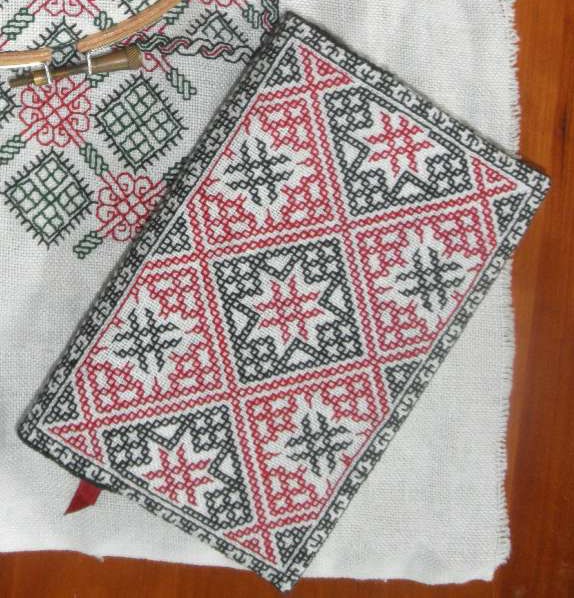
Aside: I stitched this while I was on my first trip to India. As I worked in the hotel lobby waiting for my car, two people asked me if I had taken a class in Kasuthi work, and whether I was in India to study it, since I was so obviously working on some.
From the eastern Mediterranean across North Africa, and up trade routes to the wreckage of Byzantium, across the Aegean – these are also established vectors of trade and cultural dissemination. I would not be surprised to find double running stitch traditions further east on the Silk Road, too.
After wandering the world paralleling conquest, trade, and the Islamic expansion, double running stitch hitchhiked into Britain, where it undoubtedly was already known. But it was “rebranded” as Spanish Stitch or Spanish Work – popularized through association with the Spanish princess and first bride of Henry VIII, Katherine of Aragon. We often know it under the name Holbein Stitch, named after the court painter who depicted it with exact detail on so many portraits.
So, after our own long wander – we see a possible pan-cultural spread of a stitching style, in which many now separately named types of embroidery have common roots. Would that people today recognize a similar fraternity of time and origin…
THANK YOU, FLIGHT ENGINEER NYBERG
I can’t get over how cool this is:

Credit: This is a NASA photo, of the stuffed dinosaur Karen Nyberg sewed on the International Space Station. This little T-Rex is floating weightless now, but by mid-November when the crew returns, will be a present for Nyberg’s 3-year old son. There’s more on this here.
I said on Facebook that this was cooler than Alan Shepherd’s golf shot on the moon. That was certainly neat, but it was a one-off – almost performance art. This is tangible, and more meaningful on so many levels.
First, this little toy, made by a parent far away from children presents an immediate and personal connection to far-flung families working through voluntary or enforced separation.
As a product of a traditional female craft floating in a world of shiny engineering, it makes a statement to millions of women and girls, who are often told that they have to choose between hard science or the softer pursuits. It’s not an either/or world out there. You CAN be an astronaut and sew for fun.
It’s entertainment – doing the familiar in an unfamiliar environment for stress abatement. That’s something I can certainly identify with, having taken a mini-stash of stitching and knitting supplies with me here to India.
It’s creativity and the boundless urge to make something out of what little is at hand. The ingenuity of making a toy from the unlikeliest of scrounged discards is admirable.
It’s whimsical, and adorable (and very nicely stitched). It speaks of a charming sense of humor, and of a very happy little boy. And for all I know, it may be a sly nod to the Dr. Who episode “Dinosaurs on a Spaceship”.
It’s a tangible that will come home with Flight Engineer Nyberg, and (as long as it lasts) be a reminder of where she was able to go. It’s an heirloom of her house now, a priceless and totally unique souvenir of her achievements.
Finally Mr. Saurus is a statement that space is a new normal – a place where people will increasingly commute to work, and come home again. “I’m from Iowa, I only work in space” – brought to life off the movie screen.
So thank you Ms. Nyberg! You’ve made my day!
FESTIVALS PAST
There’s always something a bit bittersweet about the end of a holiday or festival. All that preparation before, then the exuberance of celebration, followed by an ending. And then all that’s left is clean-up, thinking on the past, planning for the future, and looking over the pictures.
Yesterday was the end of the 10-day annual celebration in honor of Lord Ganesh. We didn’t get to see the very heart of the festival in Pune – that was accessible only by wading on foot through blocks and blocks of dense crowds in the old parts of the city at night, something inadvisable for Western women on their own. But thanks to the resourcefulness of Driver Rupesh, we did get to catch some of the sights and excitement around the edges.
First, there are over a thousand sanctioned celebratory platforms (pandals) raised by various affinity groups – civic associations, merchant groups, political parties, charitable organizations, religious affiliates and so on. And there are easily as many “unofficial” pandals, not registered, erected by still other smaller groups; in addition to an uncountable number of displays and altars in private homes.
Rupesh drove us around the edges of the area cordoned off for pedestrian traffic only. We saw only a very small portion of the pandals, but even so, we lost count at around 50. The only thing these displays have in common is that there is a revered image of Lord Ganesh at the center, as the focal point for devotion and offerings. The housings differ in size, elaborateness, decoration, and other activities. Some include stages for live performances, and in between devotions show live action tableaux, plays, musical performances, puppet shows, or other in-person entertainments. Others include audio-animatronic spectacles, illustrating scenes from sacred texts, classical literature, or history. Some are total light shows, with throbbing music and choreographed displays of thousands of LEDs blinking in time to the beat. Still others include video loops or public speakers espousing various noble causes – respect for women, clean water, universal education, and the like.
Some, belonging to smaller, less affluent organizations, pass up the expensive lights and fireworks. Those are decorated with flowers and plaited banana leaves, paper ornaments, or modest household textiles. The most poignant were totally bare, with signs that said that the money the group would otherwise have used for decoration this year has been donated to flood relief in Uttarakhand, the province in which thousands of pilgrims and hundreds of villages were swept away during the June monsoon rains.
Here are a few photos of what we saw. Apologies on the image quality. Taking photos at night from a moving car in the rain requires a better camera and a steadier hand than we possess.
The architectural fantasy on the left had a large stage with dance performances. The LED creation on the right twirled and throbbed like a Las Vegas sign.


Here’s a GIF made up of images we took, that conveys a (silent) impression of the frenetic dancing lights at yet another pandal. But you’re missing out on the disco-beat drums of the accompanying sound track.
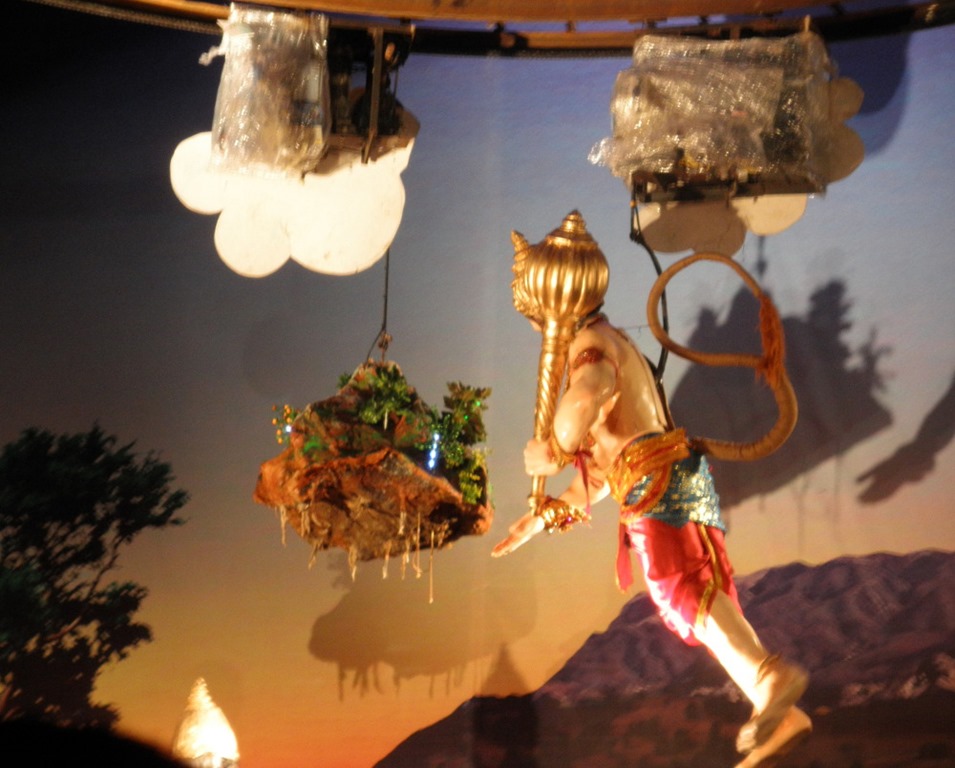

The animatronic display at the site above is of a pivotal scene from the Ramayana. In this story, Lakshmana, the son of Lord Rama has been gravely wounded during the wars against Ravana, king of demons. The only thing that can heal him is a herb that grows on a certain mountain in the Himalayas. Lord Hanuman, comrade of Lakshmana undertakes the quest. Prevailing against a hindering Ravana, the hero Hanuman arrives at the mountain, but even after stretching time for his search by delaying the sunrise, he cannot identify exactly which of its plants the healing herb might be. He solves the dilemma by fetching back the entire mountain (image at left). Lakshmana is saved (image at right), and Hanuman is extoled as a sworn brother of Lord Rama.
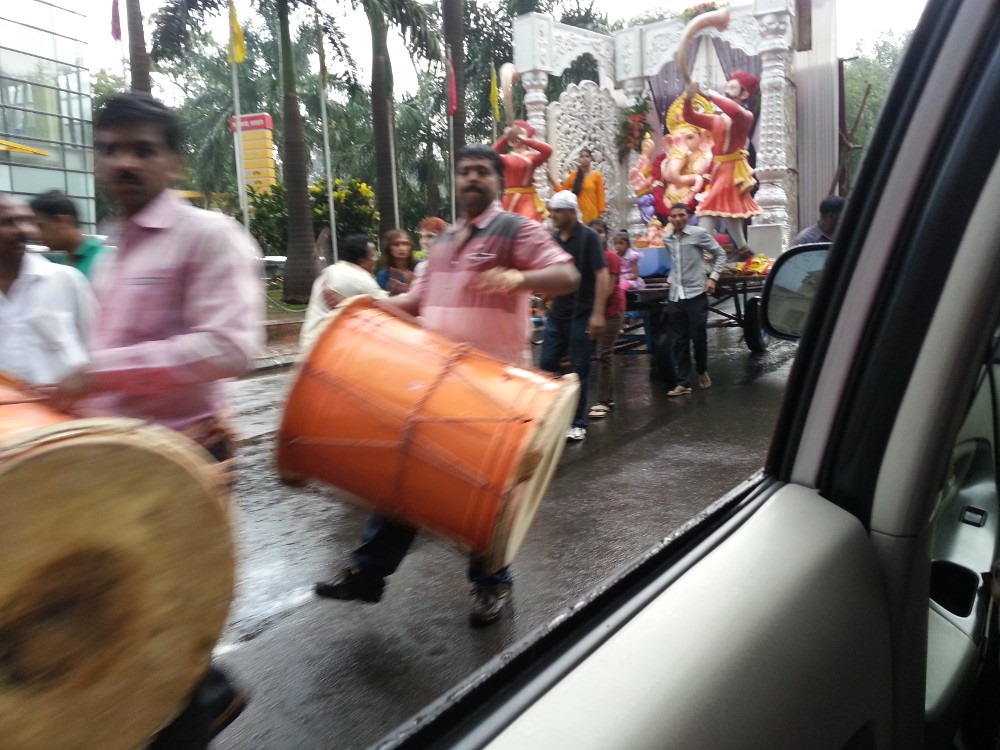
Pandals are the centers of celebration for ten days and nights, with most of the activity occurring after dark. On the last day, the images and devotional offerings are honorably retired by immersion, preferably in a flowing body of water. This is accomplished via procession, with as much music, dancing, singing, and general merriment as possible. Here you see a small family image being escorted down our street (seen from our balcony, above). What you can’t hear is the singing, chanting and cymbals that marked this progress:

The celebrants are stained with red because they launch red powder at the image as they make their way to the river, three blocks away from our flat.
It seems that on the last day, half of the city is in motion, conveying Ganpati to designated immersion spots. Big ones travel in luxury, in massive lorries and carts decorated as elaborately as the pandals (below). Smaller ones are pushed on hand carts (also decorated); or as above – carried by hand. In all cases, the images are accompanied with chanting, drums or marching bands, singing, and dancing.
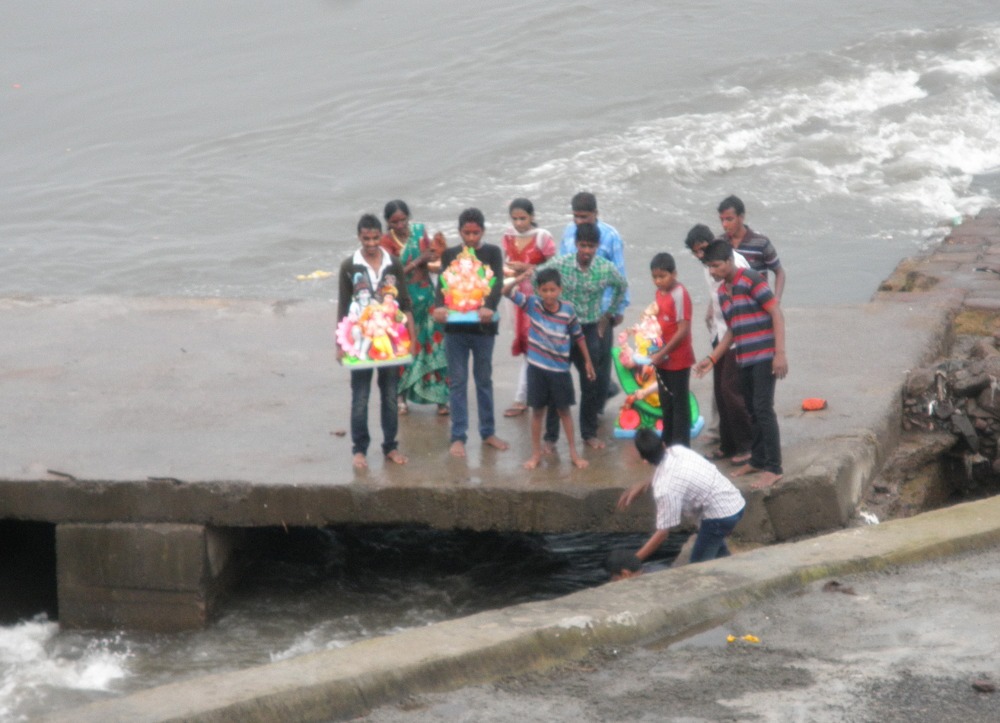
Most processions converge on one of the official staging areas, where the images are handed to special groups hired to perform the final ritual to sink them into the river, either from boats or (if size is a limiting factor) being carried by teams of bearers and swimmers (left). Some families opt for non-official immersion spots, and even risking the rapids themselves (right).

Now today, the day after, the city seems empty. Pandals are still standing, but their sacred inhabitants are gone. The structures are being slowly disassembled. They have a slightly forlorn and empty air, as if all of the past ten days of celebration can still be heard echoing across the empty platforms, playing out before their absent Lord.
HEMMING AND HAWING
Well, not “hawing.” Just hemming.
In answer to the question, “What do you mean by ‘Italian hemming’ since there are so many things that go by that name?” I trot out this picture of my Lord Ganesh cloth’s corner:


The person who asked the question is spot on. There are many types of hemming with confusing, occasionally overlapping names. Some are single pass rolled or folded hems like mine, others are double rows of stitching. I don’t remember where I learned this, but “Italian hemming” was the name attached.
Basically, the stitch I learned is similar to a hemming technique employed in withdrawn thread work, but in this case is done without removing any threads, as a pulled thread stitch. This style of hemming is worked on the reverse, and folds up/fixes the hem/makes the decorative pulled thread “dots” all in one pass. The stitches that make the vertical legs (as opposed to the stitches that do the horizontal bundling), are worked solely through the hem fold, and do not pierce the front or display side of the piece. All of the folding up is done with finger-pressing, neatly crimping the edges tight between thumb and forefinger, just ahead of the actual stitching. The same for the mitered corners – no ironing here, just careful folding along the threads of the weave, going slowly and working under a strong light.
I’m not the neatest at it, being long out of practice, but I’m finished, and not entirely displeased with the final product.
LORD GANESH–ENDINGS AND BEGINNINGS
The stitching part of my Lord Ganesh is complete:

All that’s left now is a little bit of finishing around the edges of the cloth. I may try out some Italian hemming, just for the fun of it.
Although I didn’t create this stitching specifically in honor of the festival, it is fortuitous that the project’s completion will coincide with Ganeshotsav or Ganesh Chaturthi.
Ganesh Chaturthi is celebrated throughout India, although it holds special significance in western areas of the country, including Maharashtra, the state in which we live. Lord Ganesh is venerated at the time of his rebirth. He is beloved as the patron of arts and sciences, who watches over the good beginnings of any venture. As I mentioned before, Ganeshji is a daily presence in life here. His images protect almost every vehicle on the road, and guard the front door of most homes. His shrines are everywhere.
In spite of this ubiquity, the festival itself is not all that ancient, becoming popular as a protest movement in the 1890s. It was revived as a unifying, mass assembly of people for a very public celebration, in opposition to anti-gathering laws in place during the British rule of India.
Modern celebrations include the erection of decorated avenues and temporary platforms, on which images are displayed. These festival areas are also the center of both scheduled and street performances – everything from music and theatrics to impromptu dancing. During the festival, offerings and devotions are also performed at the platforms (pandals).
You can see signs of the upcoming festival now all over Pune, with street constructions sprouting in neighborhoods, near temples and shrines, and along commercial streets, as civic, religious or community affinity groups try to put on the most beautiful and elaborate display. Some of the modern displays and performances are dedicated to additional causes, especially those of social justice. Families make (or buy) special delicacies for the celebration and reunite to enjoy the time together. Devotions culminate at the end of the holy week with huge processions, in which the images are escorted to bodies of running water, where they are immersed and destroyed, in a ritual that echoes the impermanence of the universe – be it of gods or men.
This ritual immersion presents a number of logistical and environmental problems. Many of the images are crafted from plaster of Paris, and are decorated with paints containing heavy metals. The sheer number of these can produce major pollution events, and can leave toxic residues in the bodies of water used. There is growing awareness of this problem, even among the most traditional of the devout. Clay, as opposed to plaster of Paris statues are more widely sold, albeit at greater cost. Some people are making their own rather than buying them. There are even calls for volunteers to recover immersed floral offerings, similarly retired to the waters after the festival, in order to reduce the effects of a large biomass of decomposing vegetation.
Logistical challenges include crowd safety, personal security, and fire awareness for unbelievably large throngs of people, all of whom are intent on getting the best view, having a good time, and enjoying the day and night time displays (complete with light shows and fireworks). There are also civic infrastructure challenges – in the cities, pandal construction damages the streets when holes for the supporting poles are drilled. Electricity for lights and loudspeakers is leeched off street poles, with improvised connections. And construction of the platforms and drapery-lined avenues can also be problematic, with enthusiasm often outstripping engineering for the anticipated loads or required clearances.
Still, for all of the challenges, the city is poised for what looks like it will be a major celebration. I’m hoping we can experience some of the edges of the festival, and come back with memories and pictures to post here.
CROSS-CULTURAL STITCHING
Lord Ganesh is a beloved and hard-working Deity here in India. His image is omnipresent. Aside from gracing his many temples, Lord Ganesh rides on dashboards all over the nation, protecting almost every car, truck, and bus. He wards the door of most homes; and blesses many shops, schools and public buildings. His image has been rendered in just about every medium, from exquisite woodcarving to molded pink plastic. He has been sculpted, printed, woven, painted, and stitched. Hmm. Stitched.
So of course, I had to work my own.
I tried to draw up my own freehand design, but decided in the long run that it would be easier to use an established image. That way I couldn’t get the iconography wrong. I found a kids’ coloring book page via Google. Its simple shapes were particularly suited to inhabited blackwork – the traditional form with heavy outlines enclosing counted thread fillings. I sized the design for some cloth I had on hand, and printed it out. Here you see the cloth and the design taped to a window – a free version of a light table – for pattern tracing:

And here’s progress to date – about four days’ worth:

He’s red because red is a happy color. I’m about two-thirds done, with one ear, some “filler” and some of the lotus frame left to go. I’m very pleased with the way he’s turning out.
For the record, I’m using plain old DMC six strand cotton floss, color #498; two strands for the fillings, three four the chain stitch outlines. I’m working on a coarse cotton/acrylic “linen” that’s not quite even weave (you can see the distortion in the floral pattern in the face, with the north-south axis looking slightly squished compared to east-west). I’m doing this at (for me) a huge gauge of 16 stitches per inch, and the entire piece measures across from lotus-point to lotus point is approximately 8 inches across. All of the fillings above are from my free Ensamplario Atlantio collection.
I have a special purpose for my Lord Ganesh, which will be revealed in time.
 String-Or-Nothing