SQUEE!
Folk who know me either through String or in person know that I’m generally not prone to enthusiastic gushing. Passionate ranting, perhaps, but prancing around in delight is not part of my idiom.
Until today.
I’ve been pacing the floors since my last big embroidery project ended, keeping busy by knitting small things:
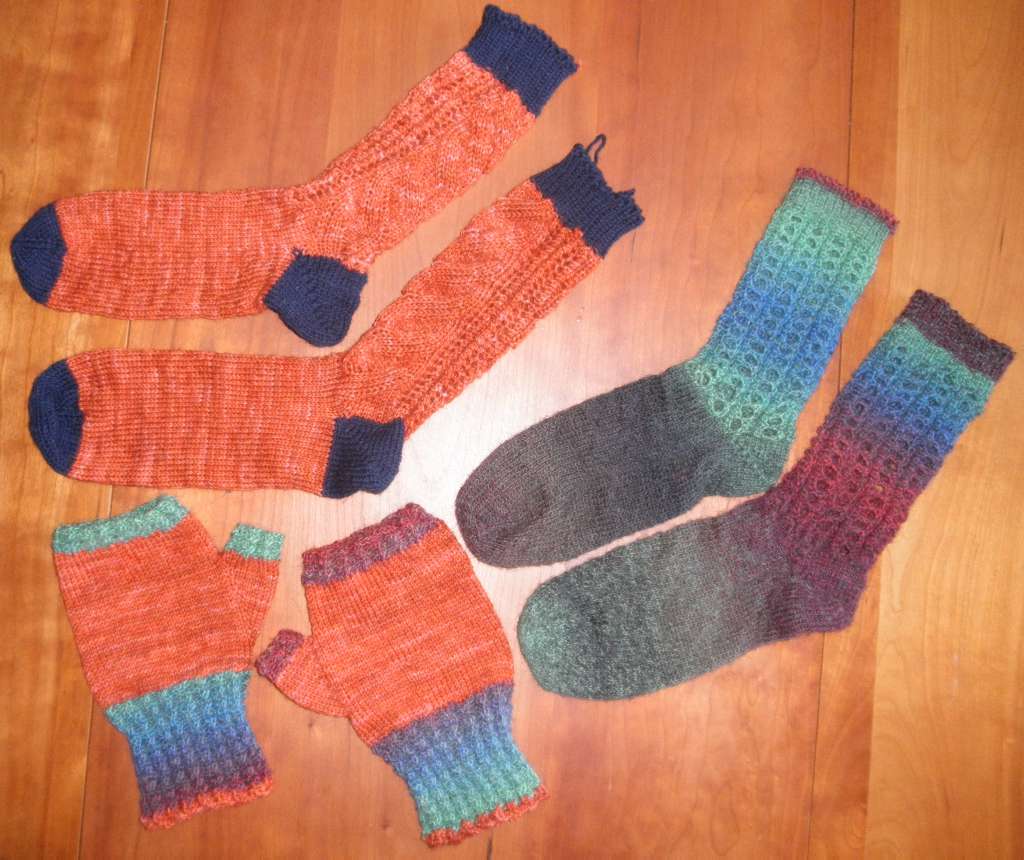
Two pairs of socks and a pair of Fingerless Whatevers. Socks are headed to Elder Daughter, whose pitiful pleas will now be gratified.
But finally, my Needle Needs Millennium Frame has arrived, all the way from the UK:
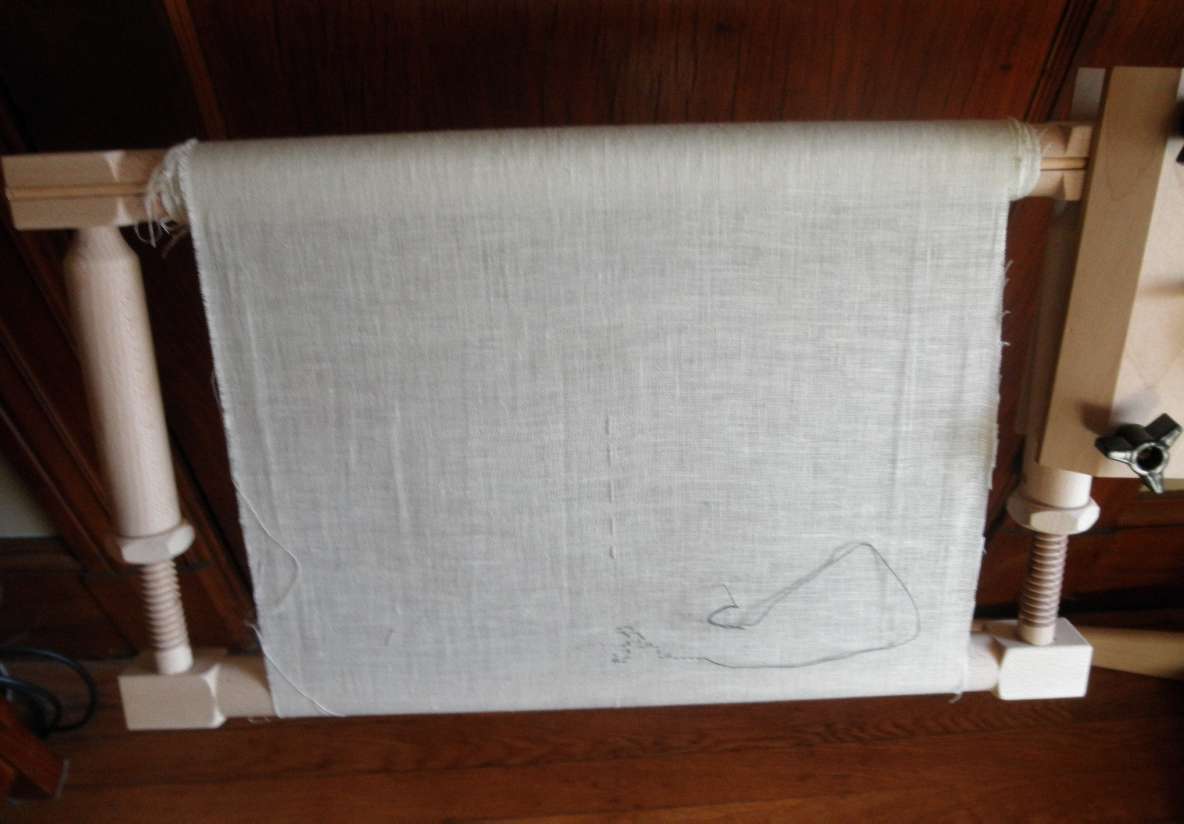
I’ve wanted to get a new flat frame for quite a while. My old one having been bought in the early ’70s, using babysitting money when I was still in high school. Frame technology has advanced. I was very impressed by the review of the thing over at Needle ‘n Thread. Her pix are better than I could manage, and I agree with her observations wholeheartedly. The frame is well made, and works exactly as presented. It’s easy to load with the work (minimal frame dressing), easy to adjust, and a delight to use. All in all a quantum leap over my old one.
The only problem is one faced by all round frame enthusiasts when they “move up” to a flat frame. It’s large. You need three or four hands to use it. One or two to hold the frame, and two to stitch. But I’ve faced this problem before. Behold my ancient Grip-It frame, bought about 20 years ago when I started working on my Forever Coif:

It holds my Millennium nicely in its omnivorous grasp. Just barely, though. I will take the three bolts that make up the fastening mechanism of the jaws to the hardware store this weekend, and look for some that are a bit longer.
And if having this miracle of modern needlework support infrastructure wasn’t enough to hyperventilate about, I have more to celebrate!
If you’re familiar with 16th and 17th century embroidery – the long red pattern strips that probably bordered domestic linens – you’ve seen that odd mesh background. Some museums call it “Punto di Milano”. Others call it “Point Lace” “Punto Quadro” or “Tela Tirata.”

This is the Metropolitan Museum of Art’s artifact “Strip.” Accession number 79.1.81.c
Stitch attributions range all over, in part because there are several ways that a mesh background can be achieved (withdrawn thread; withdrawn thread to make a grid, then darning; pulled thread, etc.) Some books specify that these patterns used Italian Two-Sided Cross Stitch, others say Four-Sided Stitch in addition (or instead) of using an Italian stitch/style name. At this point, I’ll agree with them all because all are feasible. But after long experimentation I’ve finally found a method that’s achievable.
I played with several pulled thread stitches before coming up with this:

It’s the same pattern as the museum piece. I’m working the mesh in two passes. The first is an easy to count pass of double sided cross stitch, worked double and pulled very tightly. The second is a pass in which the bars formed between the cross stitch are whipped four times (two times on edges butting up on un-mesh areas). It’s totally two-sided, identical front and back. While not exactly speedy, using the initial pass to establish the counted pattern is easy, and the fill-in whipping to create the mesh is far less think-intensive than working the same pattern in hard-to-see-the-count long-armed cross stitch. Is this Punto di Milano or Tela Tirata? I am not sure. But it’s darn close!
Requisites for production:
- Flat frame on a stand. You need two hands to do this.
- Relatively loosely woven ground cloth. Most modern even weaves are too dense. This nice, airy piece of linen was provided by StitchPal Pam (Hi, Pam!), who found it too gauzy for her needs. But it’s perfect for mine.
- High thread count ground. Although the weave density on this is good, it’s a bit coarse for this work. To achieve the compression that leaves nice big holes, stitches need to span 3-4 (or more) threads. I’m using 40 count here, stitching over 4 threads. 60 count would be MUCH better, although I’d have to find finer silk thread. I’ll have to investigate this on a future project.
- Silk thread. Cotton isn’t strong enough for all the pulling. Linen would have the strength, but it would be thicker, filling the holes more (and it was also done in linen historically, for white on white stitching).
- Slightly blunted slender needle with a small eye. This is only one strand of silk floss, and you need to spread rather than pierce the ground cloth threads. Still, a total tapestry blunt is too rounded for this delicate work.
Yaay!
A MAGNUM OPUS!
I’m delighted to announce that my Long Time Needlework Pal Kathryn, aka Mistress Kathryn Goodwyn, OL (Kathryn Newell) has released her labor of love. She’s been working on re-issuing her Flowers of the Needle collection – reprints of seven historical embroidery pattern books from the 1500s. After years of labor, retouching the originals that made up her initial publication – she is done, and the series is ready. You can enjoy it here:
http://www.flowersoftheneedle.com
She has also reposted her German Renaissance embroidery book reproduction, and her treatise on voided style embroidery, known in its modern form as “Assisi Work.”
Best of all – she’s releasing all of her documents as free downloads. Pop on over there and be amazed at Kathryn’s diligence and bounty! You’ll find ample materials there for all sorts of historical embroidery and lace styles, plus lots of inspiration for modern reinterpretation in knitting, filet crochet, or other crafts.
Now we’ll all have to join her in her standard litany – “Too many centuries, too little time!”
Yaay, Kathryn!
FINISHED!
At long last I can present my finish photo. Not my mounted and ready to display shot, but my “all stitching done” pix:

and proof that I’ve signed the thing:

I finished it up within 24 hours of my last post. Where have I been since then?
Wallowing in post-project ennui. Knitting socks for Elder Daughter. Treating myself to a flat Millennium Frame for the next stitched project, which being silk, is not a good candidate for a round frame. Working on a lecture on embroidery patterns, to be given at the Hrim Schola XVI (also here)– an SCA event focused on sharing learning about needlework, to be held on 17 March. Working on TNCM2, which now looks to be topping out at 60 plates of source-annotated historical patterns, more or less. Handling work deadlines. Shuttling said Elder Daughter back to college, and Younger Daughter to fencing class. Mocking The Resident Male for being a latecomer to blogging. The usual.
Imminent Death of wiseNeedle
On a more serious note, I am also preparing to take down wiseNeedle. Some of the content will be salvaged and re-offered, like the patterns and the glossary. But the rest won’t be.
Why do this after a on-the-Web run dating back to 1995? Mostly economics. I’ve supported the thing out of my own pocket since the beginning. It wasn’t cheap because we need a commercial grade SQL service to support the yarn review collection, plus incorporation to protect family assets from potential suits by folks upset by yarn review content. Ad revenue made it a business, and taxes on that tiny income stream had to be handled, too.
Thanks to the advertising, wiseNeedle broke even for several years, but no longer. Yarndex made a slight dent in readership, but our independent non-sponsored stance preserved interest. Folk knew that when they saw wiseNeedle reviews posted, the information was all-volunteer and totally unsponsored. But when Ravelry broke loose, traffic here nosedived and never recovered. It’s now at about 8 percent of what it was back then. They now take up the lion’s share of knitting traffic on the Web, with their own advice boards and yarn review collection. It’s clear that concerns beyond the hobbyist level – small time independents like wiseNeedle no longer have a place on the ‘Net. Ravelry as a newly minted 500-pound gorilla, wins.
String and its URL will continue although we will be porting it to a lower cost service later this year. I am hoping to preserve String’s back content, but I’m not sure how to handle wiseNeedle’s sublinks. All of those (plus String’s) may break. It’s a shame that the yarn review back catalog of info will be lost. It covers lots of yarns dating back through time and is still a valuable resource for people looking to make substitutions. Unless there’s an entity interested in buying and hosting the database (sans contributors addresses, to preserve their anonymity), it will be going away soon.
ONLY INCHES AWAY FROM DONE
O.k. Here I am:

Only inches away from total done-ness. Just a tiny bit more gridded void fill at the uppermost left hand corner, and to finish out two narrow strips in the final section:

I’ll probably finish all of it up tonight or tomorrow. Then the only thing that remains is the signature strip.

I’m plotting that out right now.
Post-project separation sadness has already set in.
BLACKWORK SAMPLER – YEAR 2
This is new for me. I’ve had projects that spanned years (decades, even), but never before have I had one embroidery project that I worked on without stopping, that has taken more than a year. Even my blackwork underskirt was done in 10 months. But as of mid December, I have now spent an entire year working on my big blackwork sampler. I’m not quite done. Almost, but not quite:

You can see that I’m filling in the area to the left of the dragon. I’ve finished the first dark band, and am now on a lighter one just above it. Two more to go, balancing the progression of shade values on the dragon’s right. Then it’s a sliver of the voided leaf panel at the top of the work, to finish that off even with the edge of the strips below. And finally – I will sign the piece in the strip beneath the dark panel on the leftmost edge. And it will be done. Maybe two more weeks? More if work deadlines intrude.
Here’s a close-up of the latest two strips:

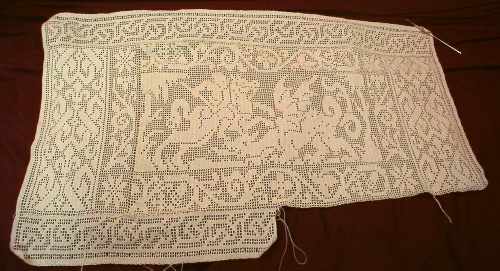
The sharp-eyed will note that the voided one on the bottom is included in TNCM, on Plate 28:4. It’s from Jean Troveon’s Patrons de diuerse manieres…, published in Lyon in 1533. Those of long memory may remember that I’ve used it before. It’s doubled, and appears on the left and right-most edges of my filet crochet dragon window curtain.
The Troveon’s original is shown single width, but the halved fleur-de-lys motifs seemed to beg use as an all-over pattern. Also, the graph of the original is shown in reverse of mine color placement, with the foreground emphasized rather than the background, more like the treatment in the crocheted piece. (Come to think of it, that knot strip along the top of the curtain might be a candidate for the dark strip at the top of my current sampler section. Hmmm….)
The lighter strip I’m currently working on will be in TNCM2. It’s adapted from a non-graphed (but oh-so-obviously-intended-to-be) design in Ostaus’ La Vera Perfezione del Disegno…, Venice, 1561 and 1567. I’ve chosen to augment it here with the frilly edge treatment.
In any case, the holidays have departed here at String. The tree is undecorated, the cookies, panforte, goose, cassoulet, and other goodies have been consumed or distributed. And the long slog through the year commences.
HOLIDAY REPORT
Altogether a satisfying holiday season here at String Central.
We started off festivities last Friday, with a latke-fest.
We decorated the tree and deployed the M&M Man Army on Christmas Eve day, while the dinner was cooking:
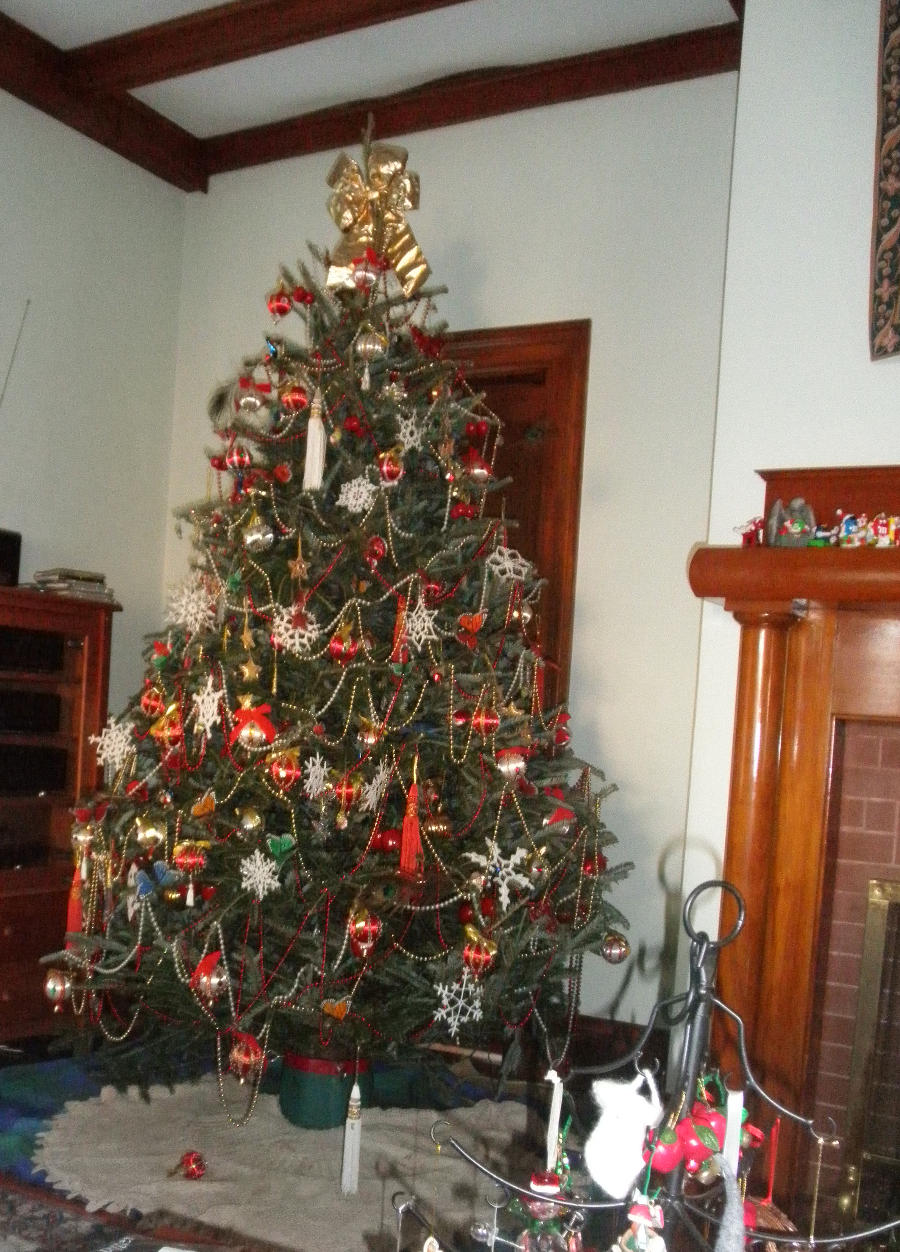
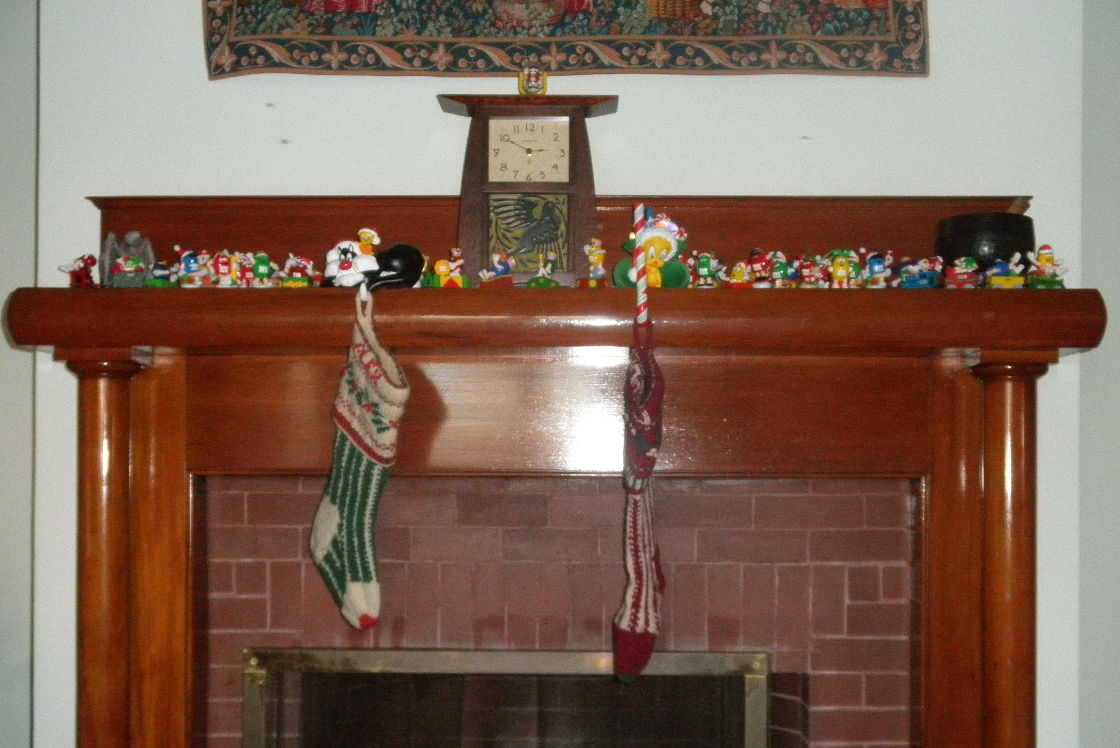
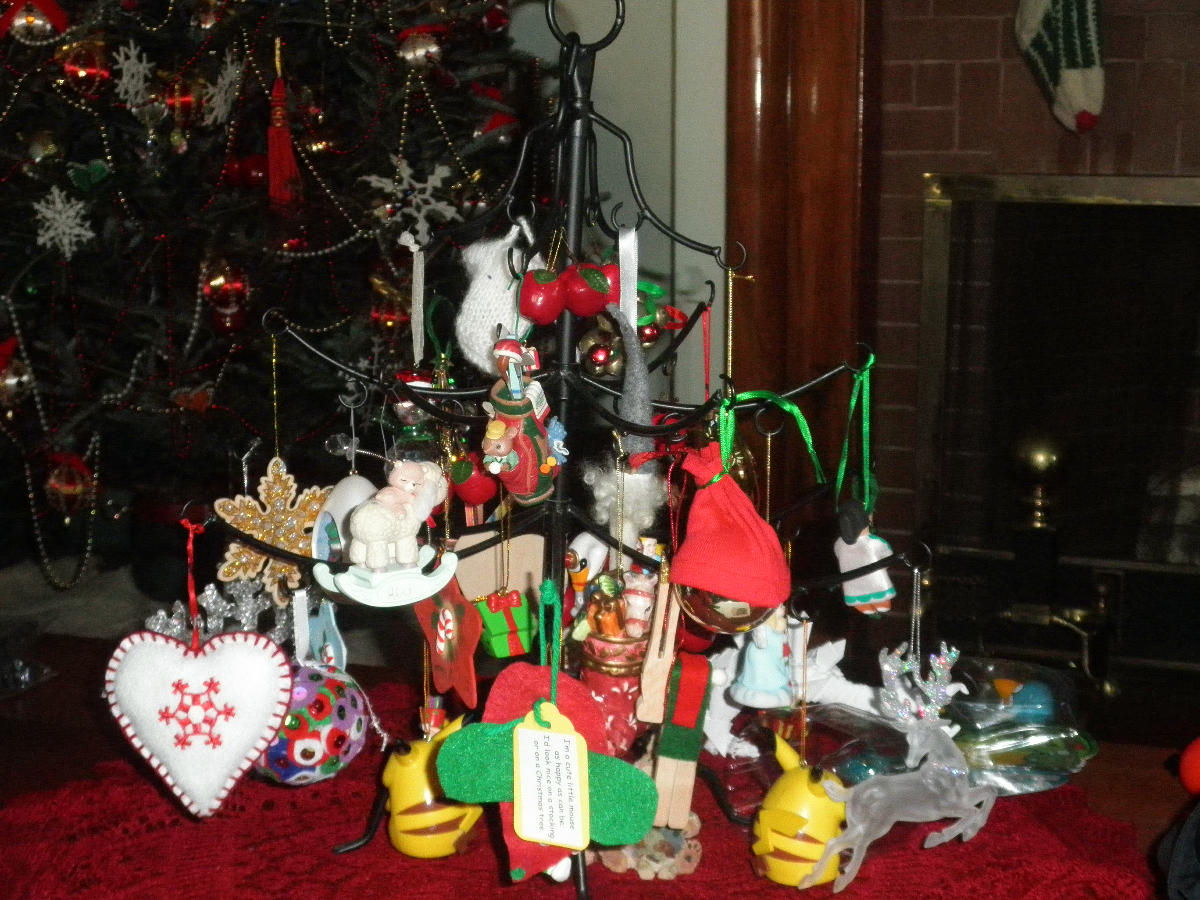
There’s no such thing as too many ornaments in this house, but with so many on the tree, the special ones get overlooked. So they go on a small wrought-iron stand that sits on the coffee table:
Saturday brought Christmas Even dinner. The Resident Male outdid himself, with lobster bisque, pan-seared foie gras, a succulent and crispy-skinned roast goose with chestnut stuffing, ragout of wild mushrooms, and roasted golden beets. He even made an apple charlotte for dessert.
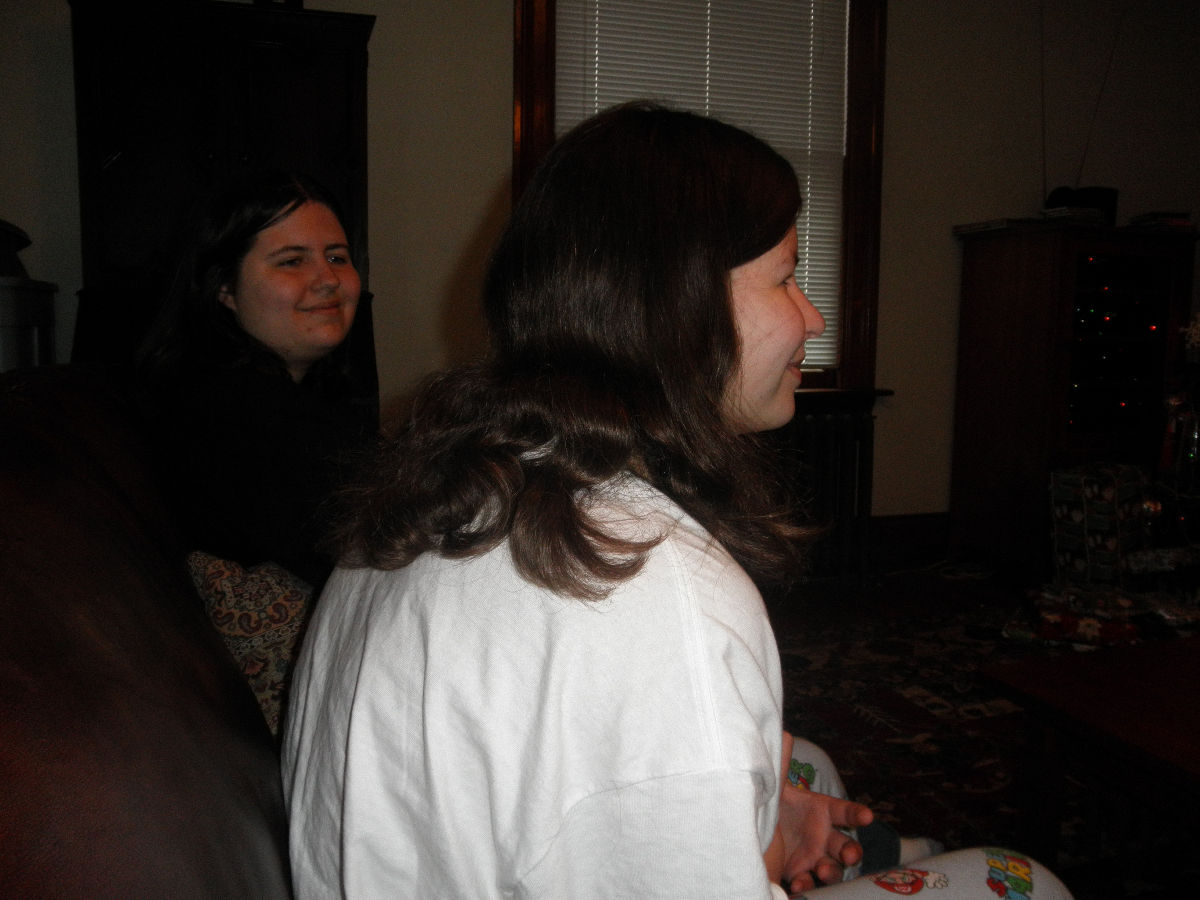
Sunday morning was rife with the traditional anticipation until everyone was awake:
Christmas day was another goose. (You can’t beat a two-goose holiday!) This time at the now-traditional gathering hosted by an old friend. It started as an “orphans’ holiday” in which those of us who had not gone to visit family for Christmas celebrated together. Over the years the gathering has become its own family, with themed dinners. This year’s was Swedish, with a warm and savory fruit soup to start, mushroom tarts, gravalax, the goose, three-meat stew, cream cake and many other goodies I’ve omitted mentioning. And a lot of good fun.
In terms of holiday present haul, I made out like a book bandit, courtesy of The Resident Male and Elder Daughter. Chief among my booty are these two volumes from the husband:
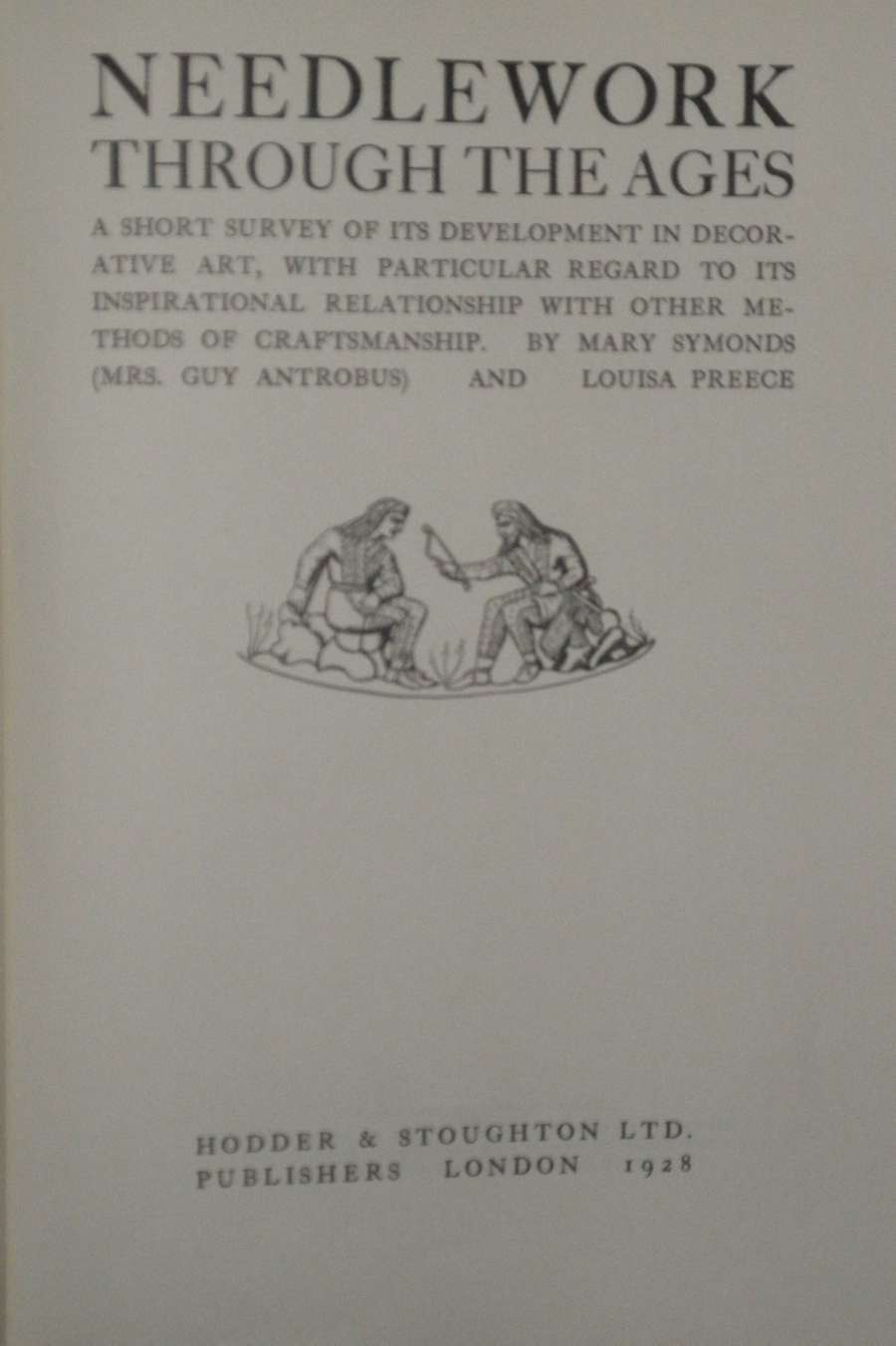
Needlework Through the Ages by Mary Symonds Antrobus and Louisa Preece is a huge tome published in 1928. It’s lavishly illustrated with photos (most black and white but a few in color). It’s a general survey course of embroidery starting at earliest known bits, through the end of the 1800s. A highly opinionated survey, I might add. Many of the photos are of items that are still in private collections, rarely included in other works. I will have much fun reading this, raising eyebrows at the authors’ various diatribes, and exploring the photos it contains.
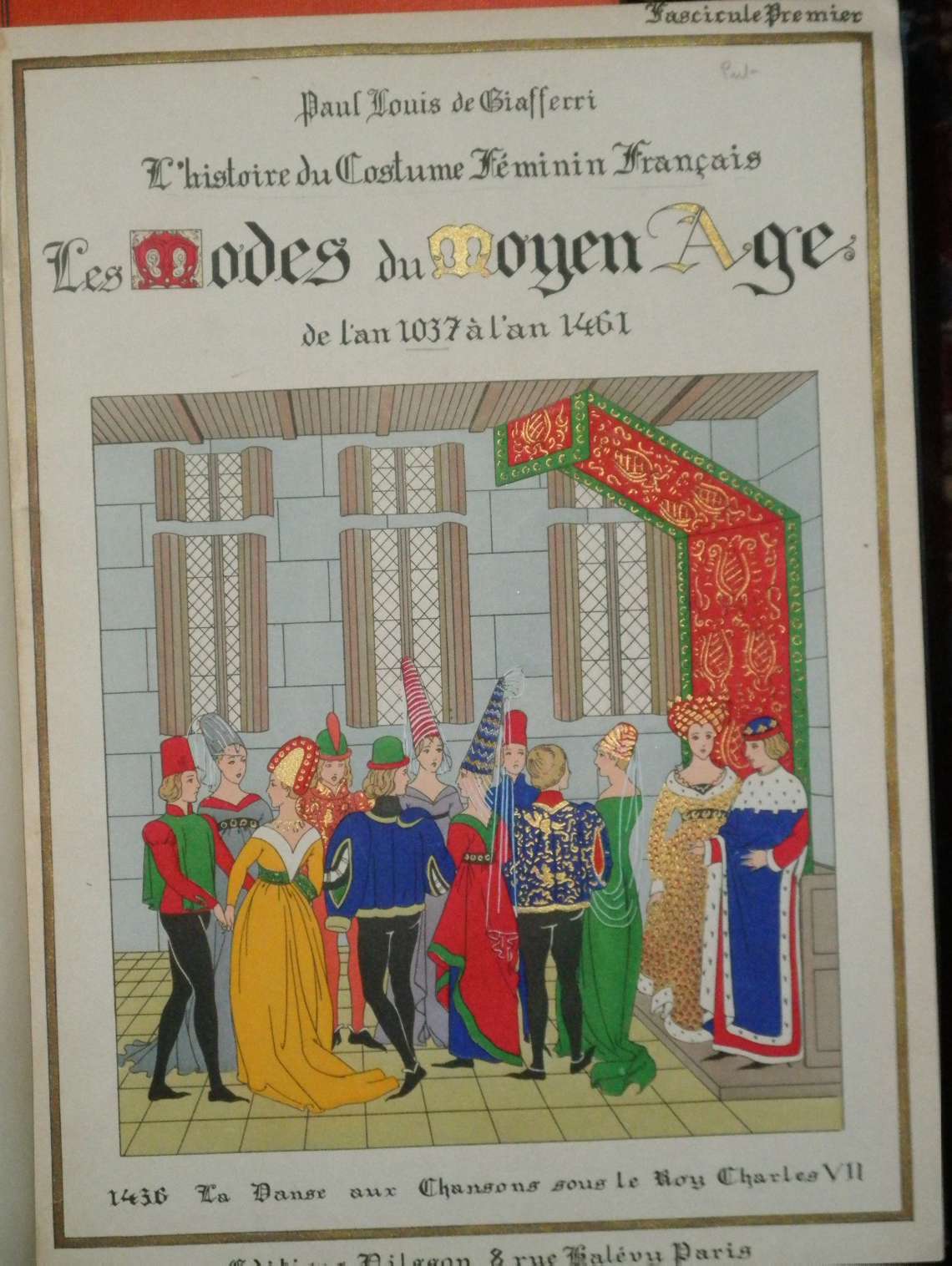
My other gem is L’Histoire du Costume Femmes Francais 1037-1774 by Paul Louis de Giafferi – the first volume of a two-volume work issued around 1925. (The second volume spans the years from 1774 through 1870.) Each volume contains multiple albums of illustrations – stencil colored (as opposed to ink press printed) – with accompanying descriptions. Some of the plates from this first volume are available on line, and some are available in a 1981 paperback re-issue. But the original is magnificent. And inspirational! My French may be rusty, but reading is easier to speaking, so this is more than a “pretty pictures” book, for sure.
He also gave me a contemporary work, Viking Clothing by Thor Ewing. This looks to be an excellent reference for accurate re-creation of men’s and women’s dress of the period.
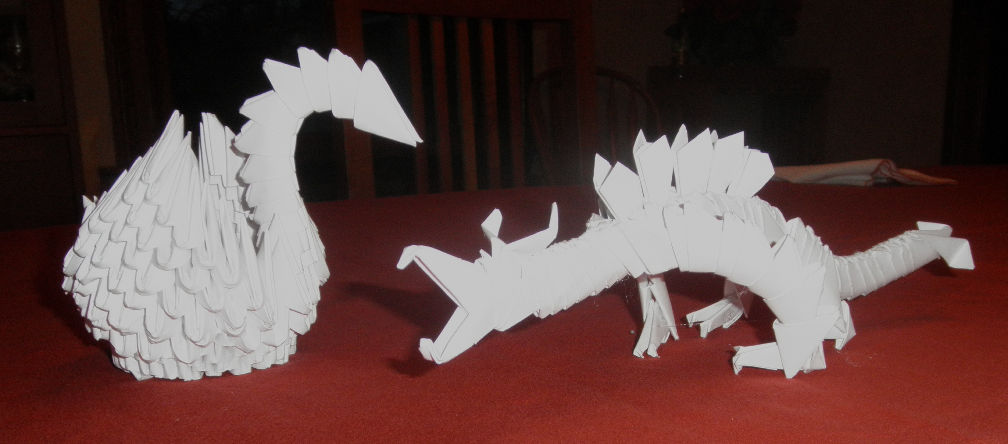
Elder Daughter also caught the historical spirit, but in a lighter mood. She gave me Kate Beaton’s book, Hark! A Vagrant. Highly funny. And Younger Daughter crafted paper sculptures. For me, a swan basket. For The Resident Male, a desk dragon:
Low key festivities continue, with the majority of us being all or mostly off from school and work. Hope your holiday is similarly pleasant, filled with family, friends, good food, and fun.
NIGHT OF THE LIVING COOKIE
Long time readers here will remember that December can’t happen without sufficient cookies. Ten kinds. This year, plus panforte and fudge. Which makes quite a pile on the sideboard:

What kinds?

Starting from the top, and going around clockwise, and ending in the center
1. Mexican Wedding Cakes – a pecan shortbread type. Very yummy.
2. Raspberry Thumbprints – Still looking for a good jam thumbprint cookie whose dough retains it shape better. And I suppose I’d be better off with jam instead of preserves, which don’t melt as evenly.
3. Mint Cocoa Swirls – Mint baking pieces were a gift from Needlework Pal Kathryn to Younger Daughter, who produced these. Slice and bake is an underrated cookie type. Will have to explore this more deeply in the future.
4. Oysters – a hazelnut spritz with dark chocolate ganache filling (my own invention).
5. Thin Ginger-Spice – this one (with a handful of finely minced preserved ginger for extra oomph) is rolled out with a peculiar gizmo to impart the design instead of using cookie cutters. I am told that cookies formed this way are called Spekulatius in Germany – Thanks Rainer!
6. Buffalo Bourbon Balls – I usually use rum in these but we were out, so I reverted to the original recipe and used bourbon.
7. Peanut Butter Sunburst – Instead of the traditional fork marking, we use a cookie stamp.
8. Earthquakes – a brownie bite style Chocolate Crinkle cookie, rich and very chocolaty. Nicknamed for the obvious fault lines.
9. Chocolate Chip – the traditional Toll House recipe, with nuts.
10. Lemon Cut-Outs – a standard sugar cookie, with extra lemon juice and zest in the cookie, plus a confectioners sugar icing made with lemon juice instead of the recommended royal icing.
The fudge declines to make an appearance, being still under sentence of refrigeration prior to being chunked into pieces. And yes, those are the two panfortes on the sideboard, marinating in Armagnac. I’ll top those with melted chocolate prior to consumption.
SNEAKING UP ON A YEAR
O.k., I’ve finished the upper right hand corner, shown here in a traditional String pre-dawn fuzzy photo:

And here is all that’s left to go:

Just the upper left. You can see I’m finishing out the leaf strip that runs across the entire top. Then I’ll find several smaller strip patterns for the area beneath it. I’ll use two relatively narrow dark strips to set off the space, similar to what I did on the right, then fill in with lighter ones. But they will be different from the set on the right. I used five total there. I might use six on the left. It will depend on what strikes my fancy when I get there. After that the only thing that will remain will be signing the piece in the small blank area immediately beneath the mega-dark strip on the left hand center edge.
I get notes from folk marveling on my rapid progress. But it hasn’t been all that speedy. The first note I posted about this project was on 2 January of this year. I had already been stitching on the piece since around the second week of last December, but hadn’t written about it because I was in the middle of posting my tutorial on graphing line unit patterns using GIMP (November-December 2010). Here’s the first snap of the thing, so you can see the progress since:

To be fair, just the small area I completed yesterday is larger than many contemporary commercial samplers, but even so, a project in a simple technique that takes more than year to finish even when working with daily diligence, isn’t exactly being worked at light speed. Or is being stitched by someone with a day job…
In other news, there are major seasonal celebrations afoot. First is a happy birthday to Long Time Needlework Pal Kathryn Goodwyn -she of “Too many centuries, too little time.” Long may she research and stitch! And I tease readers here again about her forthcoming Flowers of the Needle series, which I’ve had the opportunity to see in preview. It’s worth every bit of slavering, panting anticipation.
Plus it’s Cookie Season again in String Central’s kitchens. That means the obligate ten varieties, plus Panforte again this year. I delight in having an apprentice baker now, and no longer having to staff the entire manufactory myself.
STORMING THE CASTLE
UPDATE: THE UNICORN PATTERN BELOW IS NOW AVAILABLE AS AN EASY DOWNLOAD PDF AT THE EMBROIDERY PATTERNS LINK, ABOVE.
Holiday over, we slowly revert to standard routine here at String Central. However, that doesn’t mean we have nothing to show off.
First, Smaller Daughter – her class built models of castles, manor farms, and cathedrals as part of their Middle Ages history unit. You can’t see the details she lavished on hers – the working drawbridge, the flower garden, the well (with working bucket), the stables, or the forces manning the towers, but now you know they’re there:
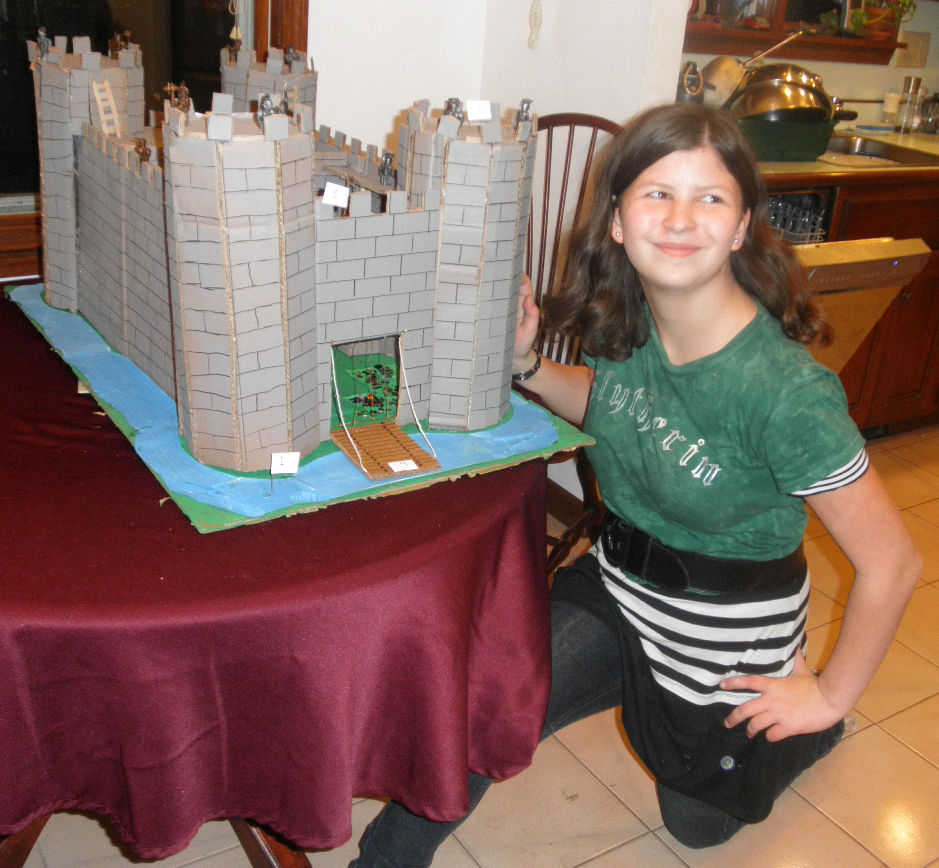
Slytherin? Well, we are Salazars, after all… And there’s the inevitable Castle Uprising Aftermath:

Too bad the teachers don’t grade them on general post-project carnage.
Not less for being presented second, Elder Daughter has been taken with double sided double knitting. She has been adding double knit squares bearing mythical creatures to her Barbara Walker Learn to Knit sampler afghan. Here’s a graph for her next square, an original unicorn, based loosely on a Siebmacher yale (heraldic goat):
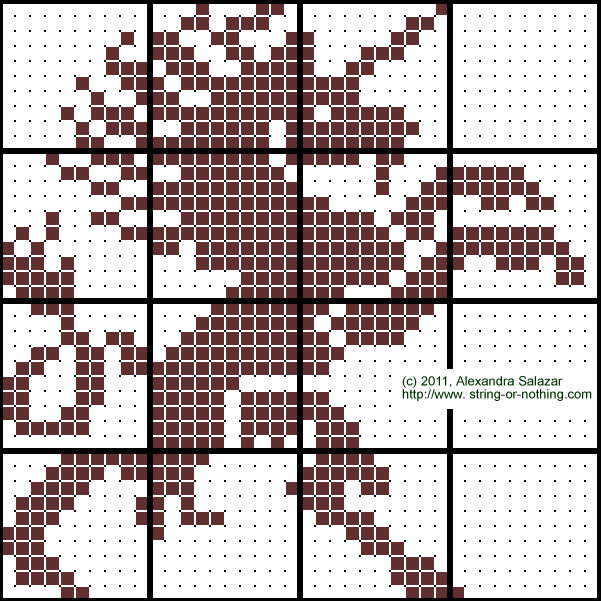
Apple. Tree. Lack of distance between the two is noted. With considerable pride, I might add.
And finally in spite of the welcome and happy chaos of a house crammed full of family, turkey, and way too many pies – I did manage to move a bit forward on the great blackwork sampler:

The dark band with the frilly edging will be in TNCM2. The one just below it was in my first 1974 booklet. I recently rediscovered that I had graphed it from my all time favorite source. It’s the pattern I used for my double sided double running stitch logic lesson back in August, 2010. You can find the lesson (and the pattern) here.
YOU GUESSED IT – MORE PROGRESS!
A boring progress post today. I’m still filling in the upper right hand area, next to the dragon:

Three bands, about 60% of the height of the area filled. These patterns are all in TNCM2.
And speaking of upcoming books – I’ve been busy lending a hand to Long Time Needlework Pal Kathryn, helping her over some minor layout hassles as she readies her greatly spiffed up and recomposed Flowers of the Needle re-issue. I can’t break official silence to say when and where, but I can assure you that it’s going to be well worth the wait; and that I’ll be sure to post links to Kathryn’s site when it goes live.
In the mean time, off to bake pies and sterilize the house in preparation for the holiday.
 String-Or-Nothing