PATTERNS PLATE 1
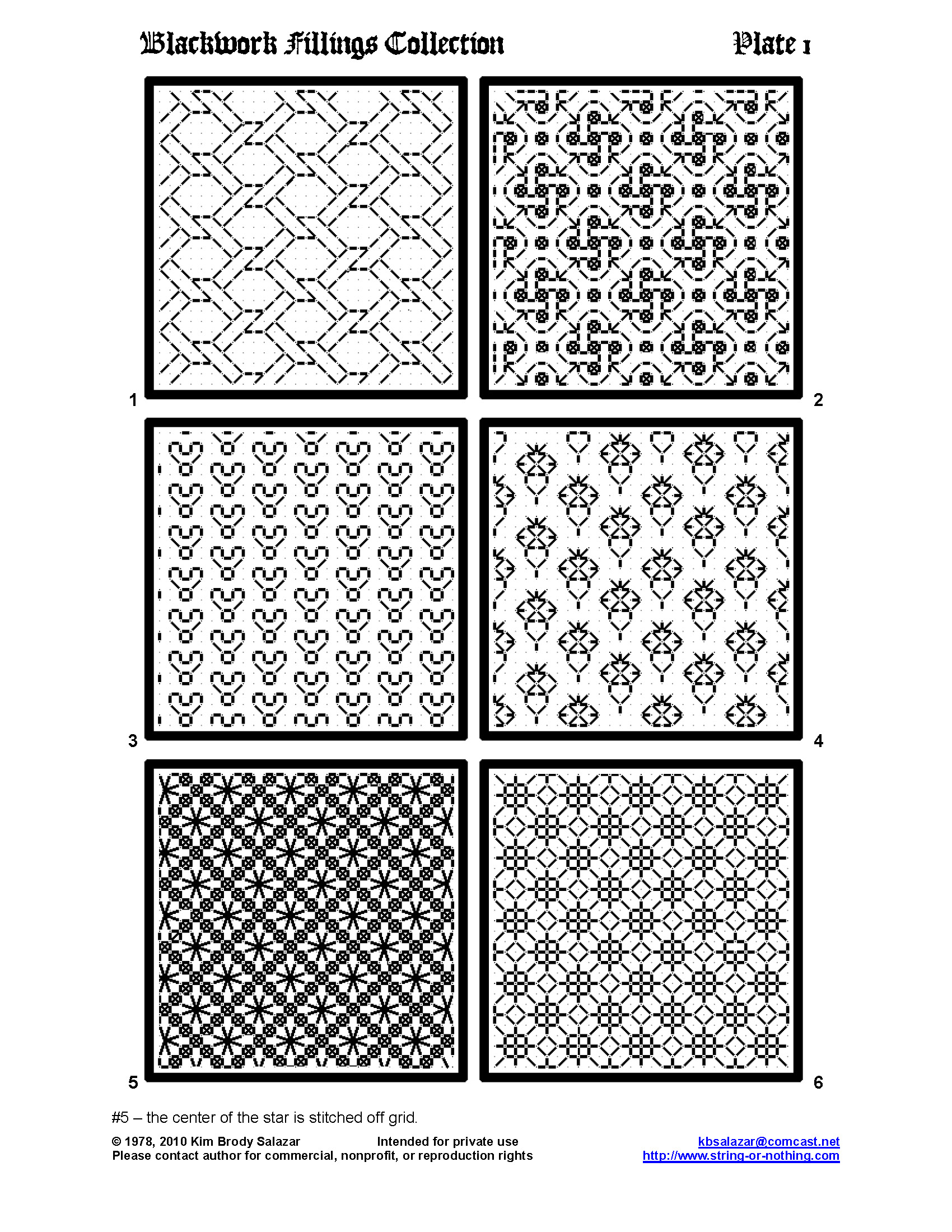
Here’s the first page of the Blackwork FillingsCollection, as discussed in my last post. I intend to publish a page each day or so until I run out of pages. (I may take some time off over the upcoming US holiday week though.)
The doc below is a full page JPG (click on it to view/download it at full scale). Eventually, when all the pages have been shown here (and I expect that to be in the neighborhood of 20 or so), I intend to also offer the entire collection as a single PDF, for home printing or viewing on any PDF-capable reader.
As far as the provenance for these patterns – my notes from 1978 aren’t complete. Some I found by examining historical blackwork samples. Others I doodled up as I worked on what became my underdress. And a few (though none on this page) are fresh, invented as I played with graphing up the others.
I did try to constrain the angles employed in all of my filling patterns to 90 and 45 degrees in order to maintain a visual symmetry among all of the geometrics used, and to restrict all lines to the native grid of the fabric (no half stitches or stitches displaced one thread over from the standard 2×2 thread matrix). However, there are a couple of exceptions. One is Pattern #5 on today’s plate. The stitching logic for that one is to work the diagonals of squared cross stitches; then take the long stitches from each of the “shoulders” of the stairstep diamonds formed by the intersecting lines of cross stitches into the centermost point of each diamond. It’s easy if you’re using plain even weave linen – that center hole is very evident. But if you’re using Aida, or another ground cloth a bit of fiddling may be in order.
As to what I mean by the copyright restriction on the page – if you’re working up your own sampler, have at these patterns. Enjoy! If you’re planning on making works for sale or donation based on these fillings – either finished stitched pieces or published designs, please contact me. In all probability I’ll freely grant permission, but the courtesy of notification and formality of reply is respectful to all parties involved. And if you’re looking to republish or reproduce these pages or the patterns on them, please contact me for specific license to do so before reposting, reprinting, or republishing my work.
Thanks to all who voiced support for this venture. I hope the forthcoming pages prove useful, and whet everyone’s appetite for other full scale works to come. Questions, comments, criticisms and other feedback is most welcome.
SQUARES!
Given Chris Laning’s confirmation of our independently devised charting method, and my own impatience to get started, I’ve decided that using GIMP in the multi-layer mode is the way to meet my graphing challenge. That means one layer for background grid, one for pattern, and a “mask” layer of little white donuts around each grid point to separate the solid pattern lines into stitch units. Thanks also to Ariel who had a very innovative suggestion about using MetaPost, but the complexity of some of the patterns I will be doing will quickly exceed the practicality of her solution.
To practice up for these more complex designs I decided to regraph the collection of 72 blackwork fillings I published back in 1978, plus some more from my own notebooks that didn’t make it into that booklet. These are the fillings I used in the blackwork underskirt I stitched back in 1976-1977.


Not being able to resist a doodle-capable medium, I’ve done up a few more, too. I’ve got about 100 of these fillings now graphed out in neat little squares and ready to share, but I’ve not decided on the most efficient sharing method. I’m leaning to composing them into pages, and sharing the pages one by one, so that they can be seen before they’re downloaded. An alternative would be making a new PDF booklet and post that. In either case, my intent is to publish them here for free download under my own copyright, rather than try to sell the thing.
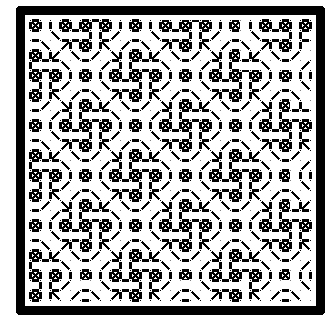
Here are two samples to whet your appetite. Any feedback? Suggestions?

And special thanks again to Chris, who has asked that I spread the word among both SCA and non-SCA stitchers about a valuable embroidery resource. The SCA’s West Kingdom’s Needleworkers’ Guild maintains a very useful on-line library of articles on historical stitching – all from the hands-on perspective. You can find it here. I guarantee hours of fascinating reading and inspiration!
GRAPHING CHALLENGE
I’m still trying to work up my favorite mode of double running graphing. I’ve pretty much dismissed all of the dedicated charting programs. They don’t allow the dot/stitch metaphor that I find far easier to stitch from than heavy lines superimposed on a background lighter grid.
Again, here’s that jester snippet from TNCM. I find this clear enough to stitch direct from the thumbnail, even at its tiny size/poor resolution.
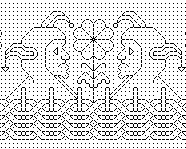
It’s small, but it’s clear. The lines are stitches, the dots represent the “holes” in the cloth being stitched. In something like Aida, Hardanger or Fiddlers Cloth, each dot is an actual hole in the weave. If one is using plain weave linen, each dot corresponds to the interstices between each two (or three, or more) threads over which the stitches are taken.
Here’s the same pattern, graphed out in one of the stitching programs (click on this, to see it better than it is shown in the thumbnail):
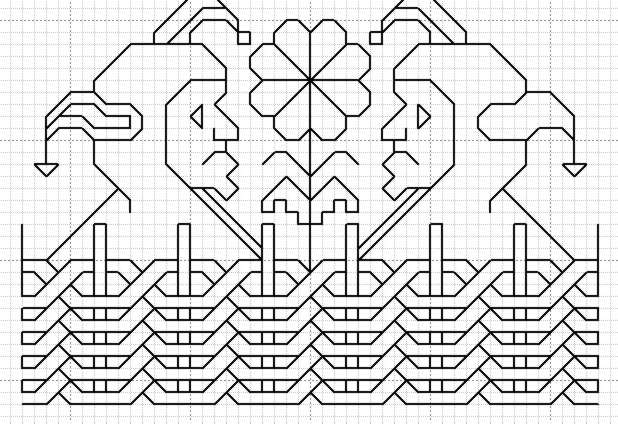
Yes, there are some aids built into the stitching program, like decimal bars on the graphs (every 10th bar indicated), and stitch counts along the margins, but those can be added to my style of illustration.
My main beef with ALL of the stitch graphing programs is that they treat back stitch, double running or other straight stitches as an afterthought. Sometimes the back/double running notation can’t be easily mirrored or manipulated (as in KG-Chart LE, which I used for the bit above). In others it always appears as an undifferentiated or symbol-represented line, with no indication of individual stitches. And in all of these programs, scale is limited. They’ve been invented for folk who stitch at larger gauges than I favor. My 18 stitches per inch (36 count linen) is a bit smaller than the 7, 10 or 12 stitches per inch many modern stitchers favor. Patterns plot out waaay too large for easy display or reproduction on book size pages. So far I’ve taken the demos of quite a few of the dedicated stitching programs for a test drive. To date I’ve tried and discarded PCStitch 9; WinStitch, SitchR-XP, DigiStitch, KG-Chart, Easy Cross, Easy Grapher Pro, STOIK Stitch Creator, and Cross Stitch Professional. I will say though that most of them do a fine job at turning photos or drawings into cross stitch. (I am a bit frustrated with programs that allow very limited trial periods. I work. Lots. My hobby investigations take place over months, not days. I would have liked to have gone back and re-tried some of the earlier programs I encountered later on, but was unable to do so because my 3-day trial had expired. Their loss, not mine).
Now I’ve turned to general purpose graphics programs. I need one that lets the user manipulate grid density and representation, that allows mirroring and rotation, and grid-constrained line drawing. Ideally I want one that allows either patterned lines, or that allows some sort of logic-based display controls (black pixel overlaid with white pixel = white pixel as displayed; black pixel overlaid with black pixel = black pixel as displayed; white pixel overlaid with black pixel = black pixel – you get the idea).
I’m not quite at the optimal yet. But I’m getting close. I did the bit below using GIMP – a general purpose open source graphics manipulation tool. Elder daughter (the one jumping up and down, waving madly over there in her dorm room) gave some vital assistance with layer manipulation and masking. Here’s the result (click on this one too):

I’m not quite happy with the dots/voids. I find my original method from TNCM much easier to parse out visually than I do the new version, with dots in the center of each void. But that may be just me.
I’m going to soldier on, looking for something – anything – that can get close to my original. For the record, that was done on my long gone Mac IIcx using Aldus Superpaint. A program that has no direct cognate today.
All advice/leads on possibles are gratefully accepted. In fact, if someone manages to put me onto an effective solution to produce the look in the first snippet above using Windows software, and I end up using their method for my next book, I will reward them with a highly suitable stitching related gift.
CLARKE’S LAW SAMPLER – FINAL SOURCES ROUND-UP (LONG)
UPDATE ON 24 APRIL 2022 – For some unknown reason, the majority of this page disappeared. I’ve gone back to find and restore the missing info. Apologies if the links are still broken. This is a work in progress.
———–ORIGINAL POST – RESTORED MATERIAL FIRST PUBLISHED ON 24 OCTOBER 2010 ———–
I seem to have picked up some new readers here this week. I answer questions and comments from Kabira, Annanna, H. from Japan, and others. Recognizing that upon completion this heads to my pile of “finish me for display”, is unlikely to emerge before the holidays are over (and may not be seen again before spring) I post my wrap-up now on the almost-completed piece. Apologies for the length of this post.
First, thanks for your kind words. I’ve had a lot of fun stitching this piece. My sampler is more of an exercise in perseverance than anything else. The wide pattern strips, though complex, are not appreciably more difficult to stitch than are the narrow ones. All follow the same basic logic, and once a stitcher is used to following that logic the only thing that can go wrong is miscounting threads. (Bright, indirect light helps with that).
My sampler is worked on 36 count even weave linen, using one or two strands of standard DMC embroidery floss, colors #310 (black) and #498 (deep crimson). Worked over 2×2 threads, it’s done at 18 stitches per inch (about 7 per cm). The entire embroidered area measures out to roughly 16 x 32 inches (40.6 x 81.3 cm). I did not work it double sided, but the double sided logic does prevail.
The Clarke’s Law sampler, like all embroideries on this site, is an original composition. However the individual strips are adapted from or inspired by historical sources. I comb period modelbooks (mostly pattern books printed before 1650) and photos of museum artifacts, looking for goodies. Then I graph them out and stitch them up. I’ve been playing with patterns this way since the early 1970s, and over the years I’ve amassed a collection of designs. I put out a couple of leaflets within the Society for Creative Anachronism, the first one being issued in 1977/1978, and reprinted a couple of times thereafter. I released a second, better documented leaflet in 1983.
Then in in the ’90s some friends convinced me that others would find my notebooks useful (the leaflets containing only a small bit of what I’d been collecting) and introduced me to a publisher. The result was The New Carolingian Modelbook: Counted Embroidery Patterns from Before 1600 (TNCM). Sadly, the publisher turned out to be either exploitative or incompetent, or both, and to this day I’ve seen almost no return for the effort. But the book is out there, and continues to sell on the used book market for absurd prices. New copies continue to trickle in via eBay and a used book seller in New Mexico, so somewhere out there beyond my reach, there is still a source.
Be that as it may, I continue to collect and “play test” patterns on samplers like this one. Here’s an index to the sources for the 22 patterns used on the Clarke’s Law sampler:

1. TNCM Plate 32:1 “Twined Blossom and Interlace Meandering Repeat”. Known affectionately as “The Brooklyn Pattern.” Ultimate source – Domenico daSera. Opera Noua composta per Domenico da Sera detto il Francoisino. Venice, 1546 – one of my all time favorite modelbooks.
2. The alphabet for the main quote is from Sajou #55, posted by pattern archivist Ramzi at his Free Easy Cross, Pattern Maker, PC Stitch Charts and Free Historic Old Pattern Books blog site. Thanks, Ramzi! I played with it a bit, working the curlicues in red and weaving them over/under the letter forms.
3. TNCM Plate 69:1 “Grape Motif or Border Repeat”. I graphed it up originally from a photo in Drysdale’s Art of Blackwork Embroidery that showed the Victoria & Albert Museum’s artifact T.14-1931. The picture available on line is MUCH better than Drysdale’s black and white photo. Many of the other patterns on this piece come from this same source. Drysdale cites it as being Spanish, from the late 16th/early 17th Century. The V&A’s attribution is Italian, 16th Century. I’d go with the museum’s judgment on this one, and if given the chance to republish, would amend TNCM’s listing accordingly.
4. Plume Flowers. Victoria & Albert Museum’s artifact T.14-1931. I’ve charted this out on paper but other than stitching it here, I haven’t published it yet.
5. Hops. Victoria & Albert Museum’s artifact T.14-1931. I’ve charted this out on paper but other than stitching it here, I haven’t published it yet.
6. Column and Wreathe Repeat. Victoria & Albert Museum’s artifact T.14-1931. I’ve charted this out on paper but other than stitching it here, I haven’t published it yet.
7. TNCM 68:2 “Seam Decoration or Border Repeat”. Graphed from photo in Pascoe’s Blackwork Embroidery: Design and Technique. Pascoe cites this as being from 1545. The original was worked along the shoulder seam join line of a butted sleeve man’s shirt, stitched in all black.
8. Another alphabet from Ramzi’s Sajou collection. This one is from #172. It’s interesting to note that several of the late 1800s/early 1900s booklets he’s got quote some early modelbook patterns closely enough to recognize the direct line of heritage.
9. Meander Repeat. Victoria & Albert Museum’s artifact T.14-1931, BUT this one appears on at least one other source, also on display at the V&A. The keeper of the www.drakt.org website shows a display case with what’s clearly a close kin to the T.14-1931 pattern, but worked voided style. [2022 Edit note – I have since tracked down the particular strip that was included in the massed display artifact shown on the defunct drakt.org website – it’s Victoria & Albert Museum’s Border, dated 1600s, accession 503-1877. The massed display in which it is mounted is also pictured on the V&A’s page.]
10. Yet Another Meander Repeat (I’m running out of descriptive names). This one is also from Victoria & Albert Museum’s artifact T.14-1931. I’ve charted this out on paper but other than stitching it here, I haven’t published it yet. I worked it voided, although the original is in double running only.
11 a-d (top to bottom)
a. TNCM 55:1. “Snail Border Repeat”. My original, inspired by period designs.
b. TNCM 51:1 “Brier Rose Twining Border Repeat” My original, inspired by period sources. Also in my second booklet, Counted Thread Patterns from Before 1600, published informally in the SCA circa 1983.
c. My first booket, Blackwork published in 1978. Pattern #j, which I cited as being Italian counted thread work from the 1500s. No citation though, which is why it didn’t make the cut for later booklets.
d. TNCM 52:2. “Flower and Bud Meandering Border Repeat”. My original, inspired by period designs.
12 a-d (top to bottom)
a. My first booket, Blackwork published in 1978. Pattern #gg, which I cited as being English, very early 1500s. No exact source though, and I didn’t include it in TNCM for that reason.
b. TNCM 54:3 “Pomegranate Meandering Repeat” and #53 Counted Thread Patterns from Before 1600. Another one of my own, inspired by period sources.
c. TNCM 49:2 “Acorn Meandering Border Repeat” One of the early set I graphed from the photo in Drysdale’s Art of Blackwork Embroidery that showed the Victoria & Albert Museum’s artifact T.14-1931.
d. TNCM 44:2 “Acanthus Meandering Border Repeat” also #55 from Counted Thread Patterns from Before 1600. Yet another from the Drysdale photo of Victoria & Albert Museum’s artifact T.14-1931. (I do adore that source!)
13. Wreath and Columns Repeat. Victoria & Albert Museum’s artifact T.14-1931. I’ve charted this out by hand but other than stitching it here, I haven’t published it yet.
14. Columbines(?) and Twists Voided Repeat. This one also appears on the same Drakt website photo taken at the V&A as one of the sources for #9, above. I can’t make out the artifact’s accession number though. And yes – I graphed it direct from the on line photo, as seen on the screen.
15. TNCM 58:1 “Strawberries and Violets Meandering Border Repeat.” Also #61 in Counted Thread Patterns from Before 1600. This is the pattern adapted from the very famous Jane Bostocke sampler, also resident in the V&A. But my source materials were photos in Gostelow’s International Book of Embroidery and King and Levy’s The Victoria and Albert Museum’s Textile Collection: Embroidery in Britain from 1200 to 1750. If you’re familiar with those sources you’ll understand why my squinting at them came up with the odd raspberries in between the flowers, instead of what can now be plainly seen as simple twists on the V&A’s own photo page. I’d amend the description to “After Bostocke..” were I to republish TNCM now.
16. Black strip pattern. From page 57 of Louisa Pesel’s Historical Designs for Embroidery, but I worked it outlined and voided instead of foreground stitched.
The patterns I tested on this piece will probably make their way into a sequel to TNCM – once I find a graphing program capable of handling double running stitch with ease, and that can chart out giant repeats at a small, but useful gauge. I want to be able to present largest of these patterns on a single page, and to do it using a background dots and voided line style of presentation which I came up with for use in TNCM, and which I find much easier to follow than regular dark line on background graph paper charts:
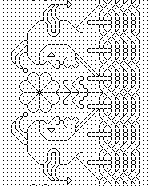 (Snippet of Jesters pattern, TNCM 69:2)
What’s next? I’m not sure. I’m certainly not stitched out. I’d like to do another big sampler to try out more patterns, but I haven’t decided on its size or form yet. There’s also the possibility of a set of matched but not matched napkins – six all using the same colors, but all different. There’s also a pile of holiday knitting to achieve between now and the end of the year. Rest assured – I won’t be idle.
WHOLE DARNED THING (STITCHED, ACTUALLY)
It’s been a while since I posted a whole-sampler shot of my Clarke’s Law piece:

As you can see, I’m on the last little bit of the final strip at the very bottom. I like this one (but I like all of them). I think it would be exquisite as a narrow edging band around cuffs and collar of a Renaissance era woman’s shift or man’s shirt, like those on these Veneto paintings circa 1502-1531.
Even with my anticipated workload this week I should be able to knock out that teensy bit by Thursday, latest. All that’s left after that is to fill in some of the shorter line ends with a bit of blackwork fillings; to sign the thing somewhere; and to finish it off with a black fabric mitered edge. Jury is still out on whether I’ll frame or scroll mount the thing for final display, but once it’s up my wall will be home to one of the universe’s ten most nerdy samplers.
ON THE LAST STRIP
If you follow here you know I do try to keep personal bits out of this blog, but my absence over the past two weeks was due to a family funeral. My mother’s husband passed away. He was an upright guy, an affectionate and attentive companion, an avid reader, splendid raconteur, bon vivant, and just fun to be around. He made her very happy for all too short a time, and will be sorely missed by our family and his.
In spite of being away, work has been progressing (ever so slowly) on my Clarke’s Law sampler. I finished the strawberry band, and started in on the narrow strip at the very bottom:


Apologies for the dark photos. It’s a dark morning. Click on either one for a more legible enlargement.
The design of the narrow black strip is based on a pattern published in Louisa Pesel’s Historical Designs for Embroidery, but I worked it outlined and voided instead of foreground stitched.
Knitters, be enheartened. I also started a pair of socks on the plane. I’m about half way through sock one, working Knitty’s Outside In by Janice Kang in a screaming russet – the orange favored by Elder Daughter. Who will be thrilled to read this post.
FERNANDO STEW
O.K. Having lost most of the readers here because I strayed away from knitting into embroidery, I now digress even further for a day.
It’s no secret that The Resident Male and I met in the Society for Creative Anachronism (SCA), lo these many aeons ago. We were pretty active during our college and post college years, until other priorities, careers, homes, and eventually offspring crowded in on our lives. We still maintain a peripheral presence in the Barony of Carolingia (the Boston area group) because many of our oldest and dearest friends remain active.
This weekend past we received this artifact of the elder days as a gift:

The few folk here who are SCA veterans and who went to Pennsic Wars past may recognize it. Our good friend Marian of Edwinstowe (now of blessed memory) had it hanging on the dayboard in her Sated Tyger Inn, and later in her Battlefield Bakery. Both were well-loved Pennsic-based food selling establishments she ran with friends and family for many years. We had largely disappeared from Pennsic by the time the Tyger had made the move from private subscription/cooperative cooking group to open-to-all eatery.
But now comes the story. What’s with the carrots?
Upon returning from oblivion about 10 years ago, and showing up to an event with a feast, we ran into comments like “You’re THAT Fernando,” and “Too many carrots for you?” The “THAT Fernando” comment we sort of understood. Duke Vissevald is a close family friend, and we were sure that his collection of stories included ones of Fernando, featuring a greater or lesser balance between entertainment value and veracity. But the carrot thing was a total mystery.
Eventually we found out about the continuing popularity of “Fernando Stew.” He had in fact served it at a feast we had run. It’s a simple beef in beer, Flemish style stew, and we’ve made it ourselves many times over the years since. But we always include lots of carrots in ours. Also sometimes parsnips…
More memory wracking was in order. Here’s what we’ve figured out must have happened.
On the day of the feast that included the stew, I was running the front of the house, and Fernando was commanding the kitchen. Several people were helping, among them Embla Willsdottir, a good friend, who had mutual/reciprocal lampooning rights with Fernando, dating back to the dawn of time. I’m sure he commanded her to cut up the carrots for the stew, and in all probability gave annoyingly exact specifications for the task. She did it and set them aside, but when the stew came together the carrots were forgotten by all.
At serving time, Embla probably chided Fernando about forgetting the carrots. I can envision her there, behind an apron, hand on one hip, waggling a forlorn carrot in his face. And I can predict his larger-than-life response. It probably ran something like “Carrots??? I need to nose up no miserable roots. I disdain them, and will not permit them to sully this stew. Take your tuber, cease this carroty caterwauling, and be off with you!” All accompanied by a well brandished spoon, and in a voice that would carry from kitchen to hall (and all in good fun).
So the stew went out with no carrots; an easy to make and satisfying group dish gained a following; and an anti-vegetable reputation was born. Now people all over the Known World know that Fernando hates carrots. Or so they think.
In any case, Marian’s Fernando Stew sign has made its way to us. We have hung it in our kitchen with pride and fond remembrance.
FLOWER SPOT MOTIF
UPDATE: An easy-to-print PDF page of this pattern is now available at the Embroidery Patterns link, above.
Still crunching along on my strawberries band on the Clarke’s Law sampler. But last night I stumbled across this simple and sweet little pattern while web-walking through various museums’ on line collections, and I had to graph it up.

This chart was inspired by a photo detail shot of a coif and forehead cloth in the Manchester Art Gallery’s collection (thanks to Needleprint for calling my attention to their website). If you head over to the Manchester Art Gallery website and search on item 2003.63/2 you’ll find it. The photo itself is copyright and can’t be reproduced here.
The description cites the original as being linen, embroidered with silk, with the stitching being worked in back, buttonhole and knot stitches. It also notes that the original was worked on the diagonal. I particularly liked the one unit offset in the repeat arrangement of the sprigs. It brings life and movement what might otherwise be a very static pattern.
It’s unclear in the original where the stitches cited are placed. From the photo it looks like little accent dot to the lower right of each flower is a group of four knot stitches as shown in the upper row of my charted repeat. The holes in the cloth where the stitches have eroded seem to support this (if the dots were formed by straight stitches, there would be a fifth stitching hole in the center of the dot unit). Still, I present an alternate interpretation in the lower row, using a group of 8 straight stitches in a diamond shape to define the dot unit. This pattern would also look nifty if spangles were sewn on in place of either the knots or the straight stitch diamonds.
Enjoy!
PENULTIMATE BAND – ALMOST HALFWAY DONE
A look at how far I’ve gotten on this last strip, sans frame:
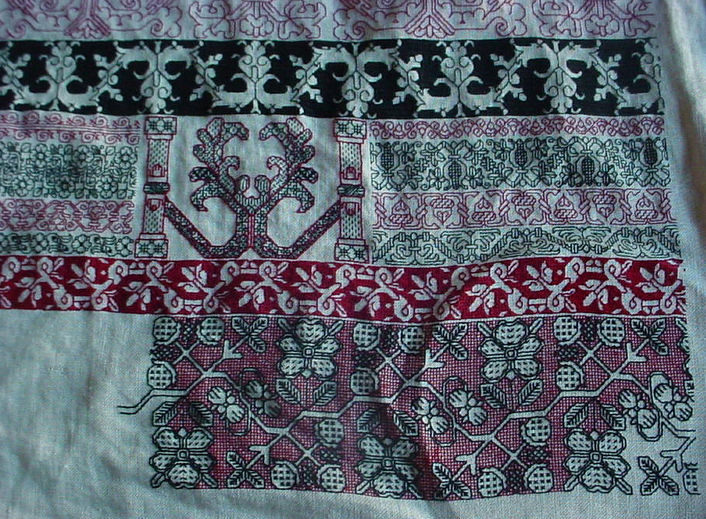
I still think a narrow dark black strip is needed below this panel to establish a visual border along the bottom edge. After that the only stitching left is to fill in some small doodles at the motto’s line ends where my text didn’t span horizon to horizon. And to finish off the thing I need to edge out the piece with mitered fabric strips (sort of a self-matting made from cloth), and figure out whether to frame or rod-suspend the final piece. I’ve been working on this now since the first week of December, averaging between 30 and 45 minutes per day. Not particularly fast, but about what I thought it would take when I embarked on my project.
To answer my far-flung offspring – What’s next? Not sure. I owe a ton of holiday socks, so I may take a knitting interlude. But I haven’t broken the stitch itch yet, and will probably start another randomly executed band sampler, although I haven’t decided it it should include a saying, some alphabets, or be just another collection of patterns I’m auditioning for future publication.
Another possibility is the immense dragon from my favorite source (seen at the left of center in the photo). I’ve already begun charting it up. It’s gigantic. Just the little pepper shaped blossom object at the lower right spans more than 40 stitches. Given that few people appear to be interested in this stitching style at the level of complexity that fascinates me, I’m not sure if a multi-page dragon graph would be of use to anyone else. Still, I might do it just for the fun of just doing it. We’ll see.
BACK TO THE STRAWBERRIES
Evidence of progress on my penultimate (possibly ultimate) strawberry panel, way down at the bottom of my Clarke’s Law sampler:
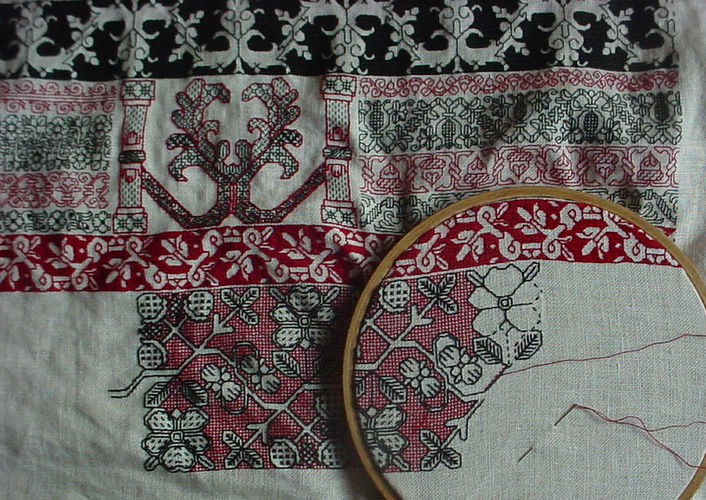
A strip this wide with a voided filling does take a bit of time to complete. Still, I’m chugging along, about a quarter of the way through, perhaps a bit more. And I’m thinking on what to do next. I do owe a ton of holiday socks that need to be knit between now and the end of the year. But I’m just not engaged to produce socks right now. What I want to do is to keep stitching. It’s always a bittersweet moment when a project is within sight of the end. There’s impatience to be done with it and be on to the next. There’s indecision about the direction of the next work. And there’s dissatisfaction with and pride in the current piece mixed 50/50. I can see what I’d have done differently on this one, and I can also point to bits that turned out even better than I expected.
In the mean time, I hope someone got use out of the three part tutorial on stitching logic. Here are recap direct links to all of the posts:
Double Running Stitch Logic 101 – Two Sided Work and Baseline Identification
Double Running Stitch Logic 102 – Working from the Baseline
Double Running Stitch Logic 103 – Accreted and Hybrid Approaches
I also took an earlier and less organized stab at the subject here:
 String-Or-Nothing
