IMPROVISED GADGETS – THREAD REELS
More progress on my Do Right sampler.
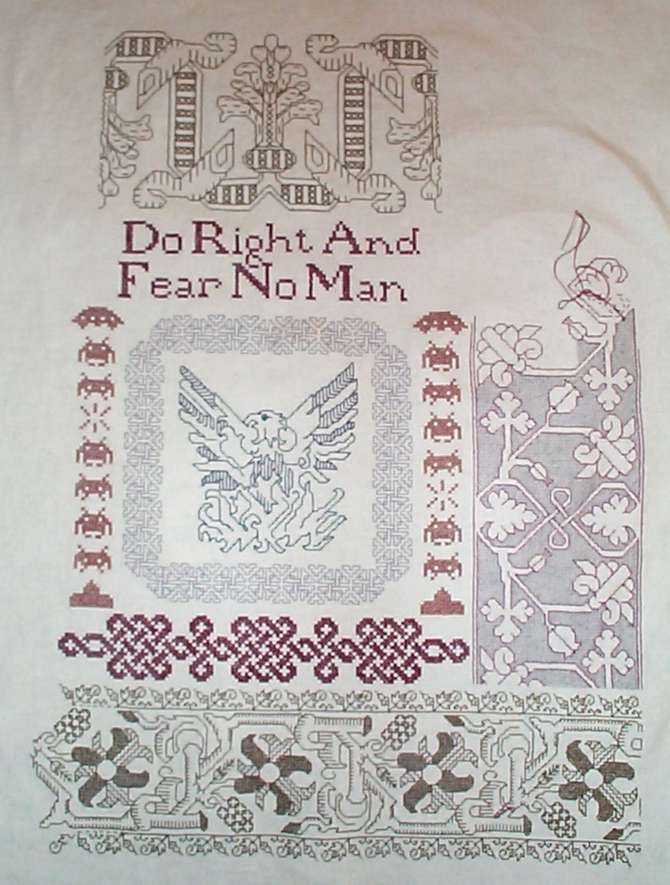
It’s going slow due to mounting work-related deadline pressure, but it’s moving along. Here’s a close-up of the latest strip:

Half cross stitch doesn’t provide anywhere near as dense a background cover as regular cross stitch or long-armed cross stitch, but it does give an interesting twill-like effect to the ground. Plus it uses far less thread.
And in the realm of improvised tools and gadgets – today’s is the lowly thread reel. Flower Thread comes in pull skeins. Or I should say – alleged pull skeins. They are not as well behaved as standard 6-ply floss skeins. Because I hate putting my work down to wrestle with my materials I tend to wind each skein of the Flower Thread as I use it. This is a very traditional thing to do. Little flat thread winders of various configurations were common work basket items prior to the introduction of spooled and reeled threads. You can still buy bone, mother of pearl and wooden thread winders. They’re a wonderful addition to one’s general stitching ambiance, especially for those who pursue needle arts in costumed settings.
But me – I’m cheap. Very cheap. I also am mostly retired from SCA events these days, and no longer need to keep up appearances. I make my own thread reels from business cards. Business cards are a renewable resource for me, new ones cross my desk almost daily. Once I transcribe the giver’s information into an electronic storage, I have little need for the small cardboard rectangles. But they are made from thicker, higher quality paperboard than index cards, manila folders, magazine inserts or other similar items. As a result business cards make sturdier, more durable thread reels. And did I mention that they’re free?
One business card yields two thread reels. As you can see from my samples, precision snipping is optional.


MORE EMBROIDERED DOODLES
During the feral burrowing to exhume some of my long put by stitching supplies, I came upon a few never-finished pieces of embroidery. For fun I share them here:
This piece is a true sampler. It’s a doodle cloth I use to try out some techniques and patterns prior to full implementation on a larger piece. It’s done in black linen thread on a rather coarse piece of not-quite-even weave imitation linen – about 26 tpi – 13 stitches per inch.

All of these are patterns in TNCM. The sharp eyed will recognize the same Dragon/George panel that made it onto my filet crochet door curtain, shown partially completed here:
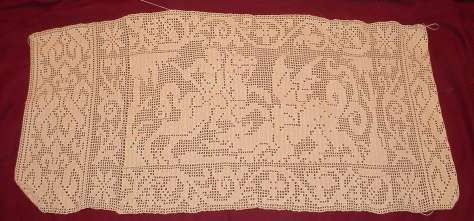
The original modelbook page is here.
I’m especially fond of the background fill vine and bud pattern, second from the bottom on the left. That’s a very small slice of the one I want to use on my library curtains, which I’m inching up on actually starting, once I find the right linen for the work.
I never intended that this cloth be shown in finished form. It lived in my work bag, pulled out and doodled on when I felt like playing with it.
This one on the other hand did start out as an Actual Project. It was going to be a challah cloth or matzo cover for a couple of pals, intended as a wedding gift back in the days when I had more time than money for gift giving Sadly, the engagement only lasted for about as long as the stitching shown here. I can’t say I’m superstitious, but after my friends’ break-up I never had the energy to finish off the project for another recipient.
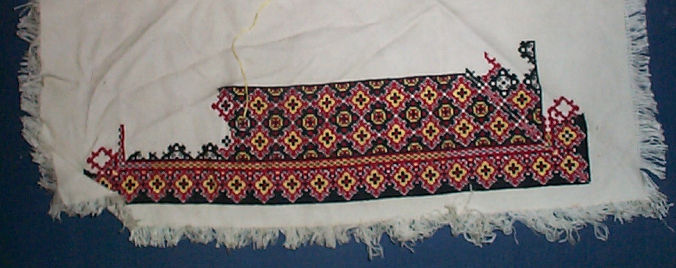
This piece is worked in DMC embroidery floss on Hardanger cloth (roughly 22 units per inch). It’s in cross stitch – 22 per inch, inspired by (but not a duplicate of) a Siebmacher modelbook pattern. The edging is the closest to the original, but it’s not exact. The field pattern in the inner ring is my own elaboration. The corners and mitering too are my own invention. Mitering patterns for knitted lace is different in execution but very similar in theory, so doing them isn’t a wild leap into the unknown for me.
This close-up shows the pattern and corner slightly better (a rare un-blurry photo for String):

Three of the edge motifs takes up a bit under two inches, and I finished the edging for one 13 inch long side, but was only about 70% done with the inner loop for that side. I used three colors – black, red and yellow. The small white accents are bits of the ground cloth showing through. The idea was to run the border and the inner motif ring all the way around the square, leaving the center bare, with the intention of stitching something relevant to the couple there – a Hebrew verse, or perhaps the date of their wedding. But it was not to be.
WIDENING OUT
Yes, in addition to finishing up the phoenix graph I posted yesterday, I was able to make a bit of progress on the sampler over the weekend. Not much because work obligations intruded, but some.
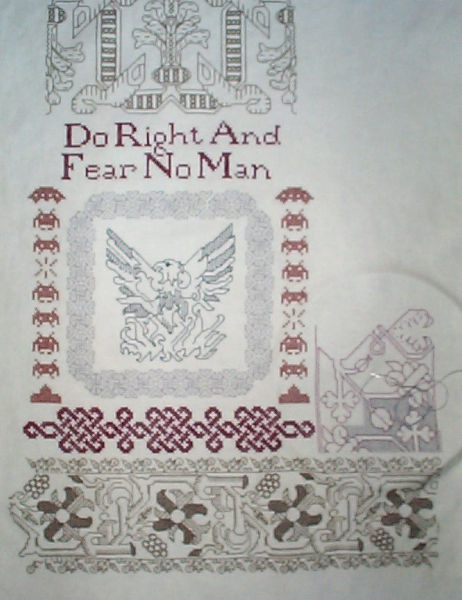
In this typically blurry String photo you see the center strip, with the handkerchief panel stretching across a wider area. I’ve started filling in another strip panel on the right. Since I’m winging this rather than planning it out fully prior to execution, I wanted to begin that panel so I would know how wide to make the bottom strip. There will be another two-tone panel of some type (pattern as yet unspecified) at the left hand edge. I’m going to try to make these both the height of the entire sampler, minus perhaps another as-yet unidentified narrow strip across the entire top.
This new pattern, like the majority of the others is pictured in The New Carolingian Modelbook. This one is the other pattern on Plate 63 (63:1). The ribbon bit at the center top is on that same page. This one I graphed up from a photo of an artifact appearing in Lanto Synge’s Royal School of Needlework Book of Needlework and Embroidery. It’s a curious piece, stitched without background in blue silk. The curious part is the reverse gives clues that it might have been done in something like reverse chain stitch, with the chains on the back, showing a top appearance similar to double running. I’m working it in plain old double running, and have chosen to accent the pattern with a background of half-cross stitch. I’m working the background with verticals and horizontals on the reverse rather than reversibly as true double running because I’m short on the gray thread, and want to economize as much as possible. Better pix on this panel soon, I promise.
PHOENIX CHART
As promised, here’s the chart for my double running stitch phoenix


Click on the chart thumbnail to see a larger version. Apologies to those with slow connections – it’s big.
LATE ADDITION: For those of you who would like a larger, clearer version of the chart, it’s available at the Embroidery Patterns link, above
Enjoy!
DETAILS, DETAILS
Progress continues to mount on my Do Right sampler. The band at the bottom will be wider than the present stitched area, and the upper part will be flanked by two longer vertical strips. These may be two-toned, possibly with foreground in double running and some sort of background, but I’ve not decided yet for sure. My thread quantities are very limited, to the point where doing full up long-armed cross stitch is precluded.
Here’s what I’ve got so far. Details of the honeysuckle strip from the V&A handkerchief photo, and of my phoenix are presented for NeedleGal and Maria, respectively. Enjoy!
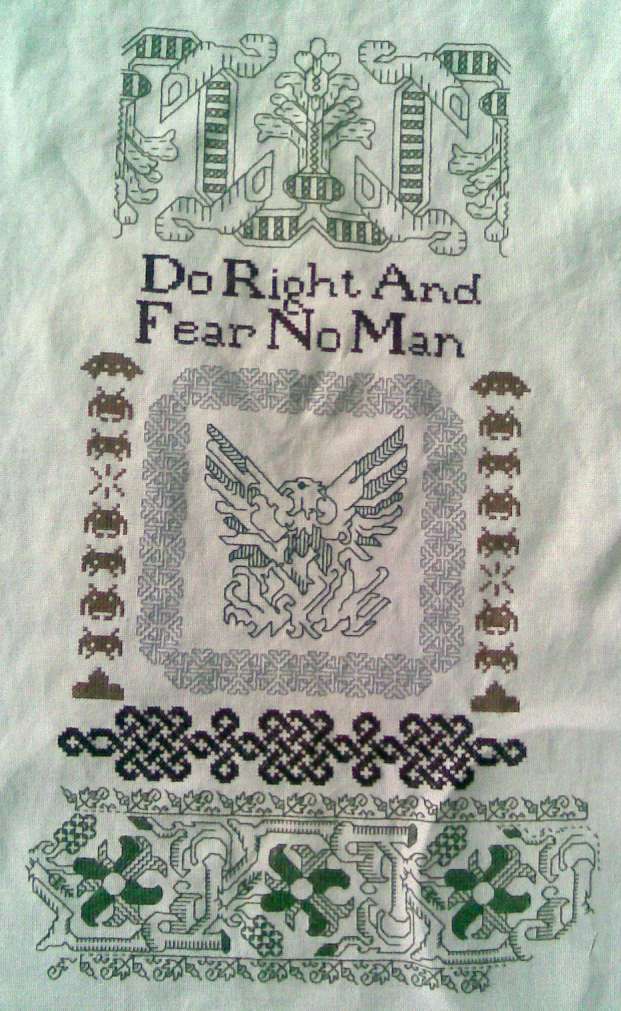

Stitches used so far are the obvious ones – double running (aka Holbein Stitch, Spanish Stitch), and plain old cross stitch. Nothing fancy at all. The back is neat, but not compulsive, due to the nature of the stitching it’s almost reversible, although I’ve taken no special pains to make it so, and yes – I do practice the stitching heresy of using knots on the back of my non-reversible pieces.
Oh. And I’m cleaning up my graph for the phoenix, translating my pencil scratchings and the as-stitched presentation into something usable by others.
A FAMOUS PATTERN TURNS UP ON DO-RIGHT
The latest addition to the Do Right sampler is this strip, which will run across the bottom of the piece.

The few who might be familiar with this type of work will spot it right away as being a Famous Design. The original is in the Victoria and Albert Museum – it’s a handkerchief, dated to between 1580-1600. Among embroiderers it’s a near iconic artifact, and has been pictured in many books including Digby’s Elizabethan Embroidery, and King and Levy’s The Victoria and Albert Museum’s Textile Collection: Embroidery in Britain from 1200 to 1750. I’ve got a graph of the design noodled out from artifact photos in TNCM (Plate 64:1), and there’s a simplified version of a very similar pattern in Pesel’s Historical Designs for Embroidery, Linen and Cross Stitch, although Pesel cites her source as a sampler dated 1658. (Perhaps there’s a point of origin for this design in a now lost pattern book or broadside that both historical stitchers used).
In any case, you can see one whole repeat here, and I’ve started on the second. In complex double running stitch designs of this type I proceed in one of two ways, both of which can be seen on this piece. The first is the baseline method. I identify a baseline, then if I encounter a branch or digression along that baseline I follow it to completion. If you look at the narrow strip acorn and leaf border at the top of this segment along the left hand side you’ll see that I’ve been working in that manner. The baseline here is very easy to see – it’s the single solid line at the base of the acorn/leaf units. I’ve traveled along it, then up into each sprig as I encountered it, completing the sprig and returning to the baseline. When I work on that strip again I’ll start on the baseline and fill in the remaining few double running stitches before continuing on to work more sprigs.
The second method works better on more complex designs. While I could establish a baseline and then fill in every deviation from it on the honeysuckle and vine center motif, if I were to do that and then discover that my stitching was out of alignment, there would be much swearing and stomping around, not to mention endless hours of meticulously picking out previously finished areas. So for these bits, I generally try to rough in major areas with a line of stitching that establishes their boundaries. Then I go back and fill in the detail. You can see this on the second flower. I’ve done a jog around the outside edge of the flower, confirming its position relative to previously stitched bits. Once I’m satisfied that there are no mistakes in the placement of the flower, I go back and do the more detailed infilling bits. Here’s another detail of the working method, from a piece previously featured here:
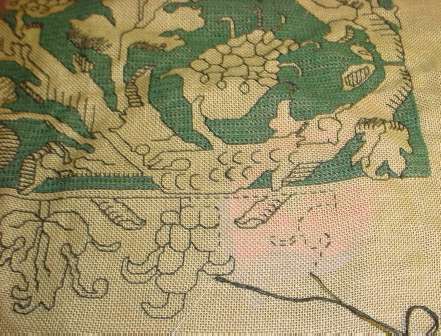
As I’ve said before, while I dearly enjoy knitting, it’s a vacation from my first love – embroidery.
NO FEAR MARCHES ON
Knots are now finished.

It’s time for the larger framing strips across the bottom and on the left and right. I’m not sure what I will do. Left and right should balance in density and I’ll probably also work them them in the same color, but I haven’t decided on the actual designs yet. Ditto for the bottom. Lighter than the knots, perhaps as dense as the ribbon strip at the top. In terms of space, I’ve got free ground at the bottom that’s about 80% as wide as the ribbon strip, and space left and right that’s about 50% as wide as that strip. The bottom strip will be the same olive green as the top unit.
I’ll start by thumbing through TNCM and see if anything hits me. I’ll also look through my earlier hand-drawn booklet. Most of the patterns in there made it into TNCM, but there were several that on further investigation turned out to be too late, or of uncertain provenance. Since provenance doesn’t matter on this work, I may use one or more of them.
Or maybe I’ll finally graph up the indistinct large band that’s just above the red strawberries on Jane Bostocke’s sampler from 1598.
It’s also time to start contemplating finishing. In all probability I’ll back this with another fabric for stability, maybe with some kind of thin interfacing, then do the bars-top-and-bottom-with-a-hanging-string treatment. One small sticky hook should do for actual suspension on the wall. Framing would be too elaborate for dorm use. It can always be remounted down the road.
KNOT MORE KNOTS!
UPDATE: AN EASY TO PRINT PDF OF THIS PATTERN IS NOW AVAILABLE AT THE EMBROIDERY PATTERNS LINK, ABOVE.
To follow up yesterday’s post and to answer the question “What do you mean by deconstructing and reassembling the knot motif?” I present this:

Click on the image above to get the pattern JPG at a useful size.
The original motif is presented in my book in negative, as it is in the 16th century originals – with the background blocks filled in and the foreground left plain, but this way works, too. They had to do this by hand-carving a wood block, the fewer flimsy little lines interrupting clear areas, the better. I have the luxury of Visio.
The strip at the top is representative of how the pattern was shown in those originals – a three unit knot with a one unit spacer. But that design is full of possibilities. The center interlaces, end units and terminal twists can be recombined into an infinite array of patterns. I present some that I just doodled up tonight.
So look at those old pattern books, historical or contemporary with a new eye. See how the pattern repeats – where it can be broken apart and recombined. You may end up with something entirely new and pleasing, perfect for your next project.
KNOTTY PROBLEMS
Invaders having been secured, I add another panel pattern. This time it’s a nifty knotwork interlace, also graphed out in TNCM, on plate 31:1.

What exactly it looks like will become clearer as I move along. This block unit pattern appears in several early books. I spotted it in a Ensamplario di Lavori published by Vavassore in 1532, and also in a different modelbook entitled Convivio Delle Belle Donne, also dated between 1530 and 1540. If you look at enough of these early pattern books, you can see all sorts of reprintings, adaptations, regraphings, possible block trading, and very probable plagiarism as the various semi-itinerant publishers interacted.
If you consider that each print block was very laborious to create (these patterns not being amenable to moveable type), the habit of publishers of re-issuing some of their old pages in new collections is easy to understand. Trading is, too. I can imagine two publishers based in different areas, but who traveled around a circuit (or who had agents who did) exchanging blocks so that each would have new material at minimal additional invested effort.
The “borrowing” is also easy to conceptualize. These pattern books were very popular, and the designs in them were highly sought after. It’s quicker to copy a design from a competitor’s book than it is to come up with a totally new one yourself, especially in the days when pre-printed graph paper was a rarity (some of the pattern books are mostly just that – blank graph paper, with a few pages of pre-done patterns as intro.)
How to identify copying versus trading? You have to get up close and personal with the patterns. As I regraphed them for TNCM I noticed small variants among different versions of the same basic design. Peter Quentel’s two-birds panel from 1527, reproduced on this page from blog Feeling Stitchy is well represented, and exists in many very close variants. There are very slight differences among them in the layout of the flowers, the position of the birds’ feet. This same pattern persisted in middle European folk embroidery, gaining and losing detail over time as it was copied and recopied, in sort of a multi-generational needlework game of telephone.
This particular knotwork pattern has always been a favorite of mine because of its versatility. You see a three-loop knot at the center of the piece I’m stitching now. The knot itself is easy to deconstruct and reassemble. I’ll be using the three-loop center, with a one-loop iteration on either side. Then depending on spacing and relative room, I’ll either do another two or three-loop knot followed by a one or more little terminal center loops to finish.
And finally to answer the person who wrote to say that they liked my stitching but found it woefully modern, and thought TNCM was “contaminated” by my including my own designs – I have to respectfully disagree. I took extreme pains to carefully document every design in the book. The ones that were “inspired by” rather than transcribed bear that notation. Original work is always marked and is less than 10% of the book. Most of it is there to fill out pages so that no space would be wasted.
[controversial thought warning for the following]
I do not believe that producing a slavish copy of a period original is the highest form of expression or understanding. Yes, it does demonstrate extreme mastery, perseverance, and skill that deserve praise. But to create a totally new piece that were it compared side by side with its historical siblings, and see that piece as an absolute exemplar of the type – to the point that were it transported back to the point of origin, it would be unquestioningly accepted – that’s mastery of the inner form. It’s parallel to martial arts practice. Knowing the katas and training forms perfectly is a matter of high skill, but that skill might not equate to being able to abstract the lessons in those forms and apply them in an un-choreographed street fight.
I do not pretend that my doodle samplers and contemporary stitching approach the new-artifact level (with the possible exception of my forever coif). But I do think that the few original designs presented in TNCM do come close, and the reaction some readers that they feel “cheated” proves my point. If those designs were somehow substandard and not tempting, people would not be expressing frustration. Do those looking for meticulous documentation to substantiate and produce a pedigreed work for an SCA Arts and Sciences competition want use my original designs? Some might, from an aesthetic standpoint, but they wouldn’t do so because those patterns can’t be sourced back to a specific stitch-for-stitch or published historical original. But that’s why they’re marked as mine.
KNITTING IN SOCIAL GATHERINGS?
I don’t know if this link will remain live for long, but it’s to an “Ask Amy” column appearing in the Washington Post on-line edition (free sign in may be required). The advice columnist printed a letter from a California knitter who was asking about the propriety of knitting at an informal gathering of friends.
The gist of the letter is that the writer’s friends gather for a lazy afternoon of chitchat, drinks and snacks on the porch of a friend’s cabin. At the last of these recurring afternoons overlooking the river, the knitter (gasp) brought her knitting. She brought something simple, was an active eye-contact participant in conversations (as opposed to sitting in a corner squirreled away with her yarn); and was a general all-around helpful house guest, assisting the host with whatever prep and clean-up was at hand. However, the knitter’s husband when asked about what he thought of the knitter’s activity voiced a negative opinion, saying it was rude of her to have taken out her needlework.
The Ask Amy columnist was very supportive of the knitter, saying that the activity within the bounds cited wasn’t rude, and “the world would be a more congenial place if more people laid aside their handheld devices and picked up some needles and yarn.” She suggested asking the husband why he found needlework in an informal gathering to be an inappropriate activity.
I for one don’t feel that the knitter was in the least rude, and I encourage her to raise the banner for public knitting.
Knitting at chitchat gatherings has a long history, and in the past genteel needlework was considered almost a required accessory for informal visits. I often bring needlework with me to social gatherings, judging when I get there as to whether or not the circumstance is comfortable for me to pull it out. But apparently some aren’t convinced about this type of behavior. (I also think the husband might have been annoyed because less attention was being paid in specific to him, but that’s another story.)
So – as an item for discussion – Would you feel comfortable knitting at a lazy afternoon gathering of convivial friends? Would your spouse or significant other object? Why?
 String-Or-Nothing

