INVASION CONTINUES
This is going to be a STRANGE sampler, to be sure!

(I do have to pick out and redo the mother ship and invaders on the right side, they’re one unit too far from the center block). Not sure what goes underneath the phoenix. Probably something in brick or chocolate cross stitch to maintain balance, then on to fill up the rest of the cloth with various double running patterns. Maybe some more heraldic/mythical beasties in the corners… We’ll see.
MAN THE BATTLEMENTS!
Invaders!
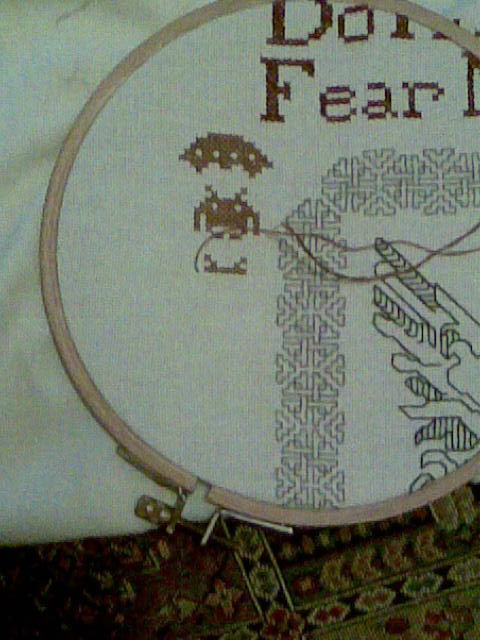
I never claimed this was going to be a period piece, or a compendium of solely historical stitching. And what better thing to give a gamrchx than something ornamented with sprites?
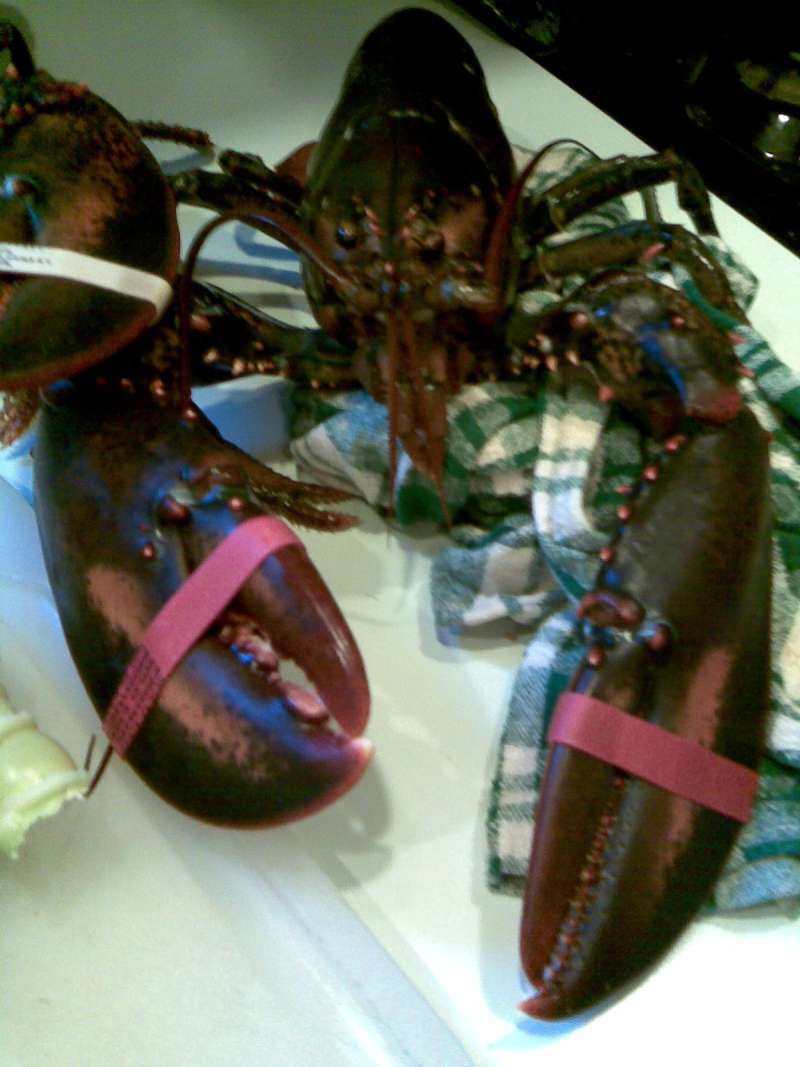
In other news, the best season of all is creeping up on New England. The tops of the sugar maples are beginning to go red; the air is crisp and clear; kids are headed back to school; and lobster is reasonably priced. What’s not to like?
DO RIGHT (BUT NOT OF THE MOUNTIES)
Not much to report here on the knitting end, but I have been stitching. The Do Right sampler for Eldest Daughter continues to grow:
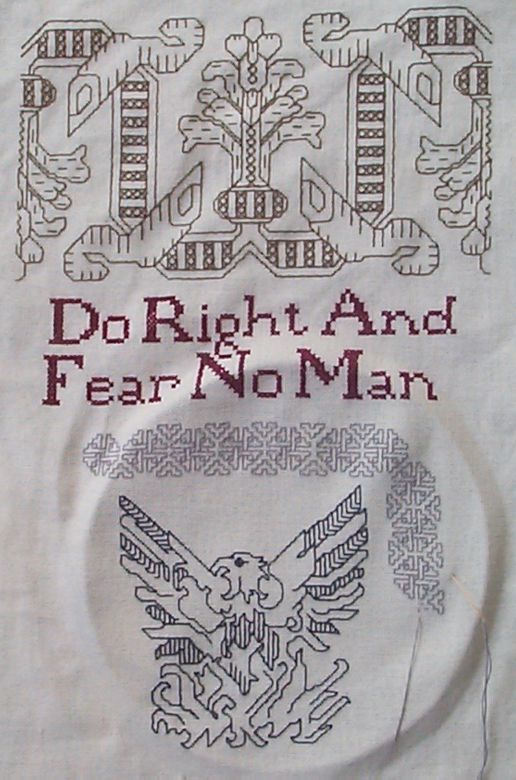
In answer to a question, I’m probably going to use the two stitch styles shown (cross stitch and Spanish Stitch – aka double running, Holbein stitch) and possibly long-armed cross stitch. The jury is still out on the latter because it’s dense and heavy compared to these lighter styles, and I don’t want to overwhelm the piece with it. No, this isn’t all that will be, there’s ample blank cloth surrounding this center part that I am going to defile with additional stitching.
The large green ribbon motif and the gray frame around the phoenix can both be found in my book The New Carolingian Modelbook. The ribbon is shown in plate 63:2, adapted from an early Spanish sampler; and the frame is adapted from the strip motif in plate 52:3 (it’s original, but inspired by historical motifs). The phoenix is new. I drew it up this week past just for this project. If there’s interest, I can post it here, along with another Visio stencil optimized for the production of line unit patterns.
RECIPE – OYSTERS, A HAZELNUT-CHOCOLATE SANDWICH COOKIE
I tried to share my Oyster cookie recipe with some folks today, only to find that the page that contained it has disappeared off this blog. I don’t seem to have it handy in back-up either, so I’m reposting the thing.
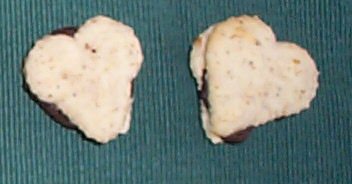
You can’t say that this is an original recipe, since plain spritz and chocolate fillings of this type are cookbook standards, but I can say that I noodled what is here out myself. I’ve made them now about eight years in a row, and they remain a family favorite. They got their strange name from the first batch I made. I didn’t grind the nuts finely enough, and bits stuck in the holes of my cookie press. The cookies that resulted were rather haphazardly shaped oozy lumps rather than nice, neat spritz cookie shapes like the hearts below. I mated up the oddball cookies as best I could, but my kids thought the weirdo sandwiches looked a lot like inhabited oyster shells, and the name stuck.
Oysters
A hazelnut spritz cookie with dark chocolate filling
Ingredient and process notes:
Chocolate – The better the chocolate used for the filling, the better the cookie. We like the bitterness and texture of Ghirardelli Double Chocolate Chips for these. They’re a nice contrast with the sweet, airy cookies. Feel free to go upscale from here.
Hazelnuts – It’s difficult to find shelled hazelnuts. We buy ours at Trader Joes. A one -pound bag will make about two or three batches of cookies, so my best guess is that between a third and a half pound of whole shelled nuts will yield the 2 cups needed for this recipe. I’ve also cracked in-shell nuts for this, but I don’t have a good feel for what weight of in-shell nuts will yield the amount of finely ground nut kernels cited. Note that both the bagged shelled nuts I buy and in-shell nuts still have the inner peels on them. I’ve tried all of the conventional peeling methods, but they are time-consuming in the extreme. I settle for a half-way measure. After I’ve toasted the nuts in the oven, I freeze them. Just before grinding them up for use in the recipe, I take them and handful by handful, rub them between my palms over the sink. About half of the skins will slip off the nuts as they are rubbed. I pop the still-cold nuts into the food processor and grind them up as they are. It’s not a perfect solution, but I don’t mind the look of the cookies with the tiny flecks of brown left by the remaining skins. I also think that using frozen nuts helps keep them from turning into filbert-butter when I’m trying to get a fine grind.
Batter -The batter for this cookie is very soft, almost the consistency of room temperature cream cheese. I do not have a problem handling it in my cookie press, but people who haven’t used them much might prefer a slightly stiffer texture. Popping the batter in the fridge for an hour or two will firm it up and make for easier handling.
Makes around 90 finished filled cookies.
Ingredients for cookies
- 3/4 cup Vegetable shortening
- 1 1/2 cup Granulated white sugar
- 2 Extra-large eggs
- 1 tsp Vanilla
- 2 cups All purpose unbleached flour
- 1/4 tsp Salt
- 6 Tbs Milk or cream
- 2 cup Finely ground whole hazelnuts, removed from the shell. These are best if bought whole, then lightly toasted in a 250 oven for about a half hour until they are fragrant, and some of them have toasty-looking edges. Peeling off the inner skin of the nuts is optional (see note above). Once cooled, they should be run through a food processor until they’re very finely ground.
Ingredients for chocolate filling
- 6 oz. Semisweet or Bittersweet chocolate chips (I use Ghirardelli Double Chocolate)
- 1/2 cup Heavy cream
Special equipment
- Cookie press
- Food processor
- Cookie sheets (parchment or silicon baking liners are optional)
- Cooling racks
Directions for cookies:
- Preheat oven to 375 F
- Cream shortening.
- Add sugar and eggs to shortening and mix until fluffy.
- In a separate bowl, mix flour and salt
- Measure out milk or cream. Add vanilla to milk or cream.
- Alternately add flour/salt and milk/vanilla mix to shortening/eggs/sugar until all is incorporated. (I usually do this by thirds.) You will get a very sloppy, sticky cookie batter.
- Stir in ground nuts. If you like you can refrigerate it at this point and bake the cookies later. The dough will get a bit firmer when cool, but will still be soft enough to pipe through the cookie press. (see note above). If the cookie batter is stiffer than Play-Doh, drizzle in a bit more milk or cream and mix to combine.
- Pipe dough through cookie press onto lightly greased cookie sheets, or onto cookie sheets with parchment or silicon liners. Use a cookie press die with relatively large holes, because the ground nuts will clog up the dies with small holes.
- Bake cookies in 375 for about 8-10 minutes. If you used a bare, greased cookie sheet let the cookies rest undisturbed on the on the hot cookie sheet for a couple of minutes after you take them out of the oven before removing them to a cooling rack. If you used a cookie sheet with a liner, slide the liner onto a cooling rack and remove the cookies from the liner onto a rack when they’ve cooled and set for a couple of minutes. When completely cool, store cookies in an airtight container. They do not need to be refrigerated.
- Cookies must be completely cooled before filling. I usually bake these one day, then fill them the next.
Directions for filling:
- Warm heavy cream in small saucepan over low heat until it just begins to simmer around the edges. Stir constantly while warming to prevent skin from forming.
- When cream is hot, stir in chocolate chips. Remove from heat. Continue to stir off the heat until chocolate is melted and mixture is smooth and spreadable, with no lumps of unmelted chocolate. This will make a very heavy, fudge ganache. Add more cream if you prefer it thinner.
- Find two cookies of approximately the same size. While the filling is still warm, spoon a small bit (about tsp) of filling onto one cookie, then press the other on top of the filling. Let the filled cookies cool off on a rack so the chocolate filling firms up, then return them to the airtight container.
Variants: Use walnuts, pecans or almonds in place of hazelnuts. Fill with preserves instead of chocolate. Flavor the chocolate filling with two tablespoons of liqueur.
Do Right and Fear No Man
Knitpals please bear with me, I’m taking an excursion into counted embroidery.
As reported here before, Eldest Daughter has gone off to college. Nagging has gotten considerably harder to do, being parceled out via eMail and texting, so I decided to invest all that correctional energy in a more tangible reminder. I’m doing a stitched piece for her wall. I’m still wrestling with this camera, but you can see the beginnings here:

I’m working on 32 count linen, using discontinued DMC Flower Thread (I’ve got a stitching stash, too). The mark of the tambour frame is very evident, although I took it off so you could see the words. The astute may note that the alphabets used for the first and second lines are slightly different, with the top line being compressed by one unit. That and the non-standard, non-lockstep alignment of the words (including the g encroaching on the N) were done on purpose, to give the thing a less rigid look.
This piece will be multicolor, but in subdued ashen hues, and aside from the motto, mostly in linear stitching like double running. If you’ve got a copy of my book The New Carolingian Modelbook, you may recognize the snippet above “Right” as being from Plate 63:2, a meandering repeat I charted from a late 16th/early 17th century Spanish sampler photographed in Drysdale’s Art of Blackwork Embroidery.
I’m not sure what I will do to fill the cloth. This like so many other of my embroidery pieces is going to grow through accretion rather than planning, but I will not be constraining myself to historical motifs only. Expect some surprises as I find them.
What will target Elder Daughter think of all this? Probably that she’s being nagged in front of the whole Internet…
PATTERN – RED DIAMONDS BABY BLANKET
UPDATE: THIS PATTERN IS NOW AVAILABLE AS AN EASY TO PRINT PDF AT THE KNITTING PATTERNS LINK, ABOVE.
It’s finished and about to be mailed to the target recipient, so I can post my final pattern for this simple knit/purl texture, quick knit, lap size baby blanket.
RED DIAMONDS BABY BLANKET

Finished dimensions:
About 26.6″ x 36″
Materials:
Approximately 550 yards (about 500 meters) of a lofty wool/acrylic blend super bulky weight yarn, with a native gauge of 12 stitches and 18 rows to four inches. Washable is better.
One US size 10.5 circular needle at least 24 inches long.
Four stitch markers.
Tapestry needle for darning in ends.
Project Gauge:
Just over 2 stitches per inch in stockinette. (Approximate gauge is good enough on a blanket).
Method:
Cast on 77 total stitches but to make life easier when knitting the repeats cast on 5, place marker, cast on 22, place marker, cast on 22 place marker, cast on 23 place marker, cast on 5.
Slip the first stitch purlwise, then continue across the row in K1, P1 seed stitch; knit the last stitch of the row the back of the loop (In seed stitch you make a bumpy texture. If knitting in the flat, you knit every stitch that presents as a purl, and purl every stitch that presents as a knit. If you get ribbing you need to rip out your offending row and begin it again using a knit if you started with a purl or a purl if you started with a knit). Repeat this start-up row 7 times for a total of 8 rows of seed stitch. This will make a nice no-curl lower edge with a neat slip stitch selvedge.
Continuing in seed stitch pattern and making sure to continue the slip stitch selvedge, work seed stitch until you reach marker #1. Then work the white stitches in Row #1 of the following chart. On the final repeat just before the final marker, work the blue stitch in Row #1, then finish with seed stitch, continuing the established pattern of the lower edge.
Flip the work over. Remember that you’re going to be working the wrong side of the blanket and on this row (Row #2 of the chart) and all even side rows thereafter, you need to follow the WRONG SIDE directions for the chart. Again slip that first stitch, work seed to the first marker, now work the blue stitch on the chart (wrong side version), and continue across the chart Row #2. After the last marker finish the row out in seed stitch, knitting the final stitch of the row through the back of the loop.

Click on pix above for a larger version of the chart.)
Continue in this manner until you have worked four full vertical repeats of the chart.
Finish off the blanket with another 8 rows of seed stitch with slip stitch edges, and bind off loosely. Darn in all ends.
NEAT FINISHING FOR SUPER BULKY YARNS
I’ve finished knitting my bulky red baby blanket, and am up to the dreaded “darning in the ends” stage. Now I note that most of the criticism of the now discontinued Kool Wool was laid against its bulk and the number of ends inherent in any short yardage yarn of that weight. There are a lot of ends when you make something – especially a large something – out of a yarn that is only 60 yards per skien; and bulky yarn when darned in can look like large, creepy, and dreadfully obvious caterpillars crawling on the knitting’s surface.
While I can’t do anything about the sheer number of ends, I can make the darning in way less obvious. This fix works for any yarn that is made up of two or more constituent plies. It won’t work for a single.
Here you see my target end. Because this baby blanket will be seen from both sides, it really doesn’t have a front and back. Therefore for each end pair, I threaded one end to each side – at each new yarn ball join point one strand peeks out on the front, and the other peeks out on the back:

You can see my yarn is a thick, noodly cable style strand. Here I’ve separated the six plies into three two-ply bunches:

Why the color is so different in this shot, I haven’t a clue, but I have lousy camera skills. Still, if you squint you can make out that I’ve frayed the end into three sub-units. I then end off each of them individually, burying them in the surrounding stitches for about an inch, then doubling back, still buried to anchor them off; and finally clipping the ends close to the surface.
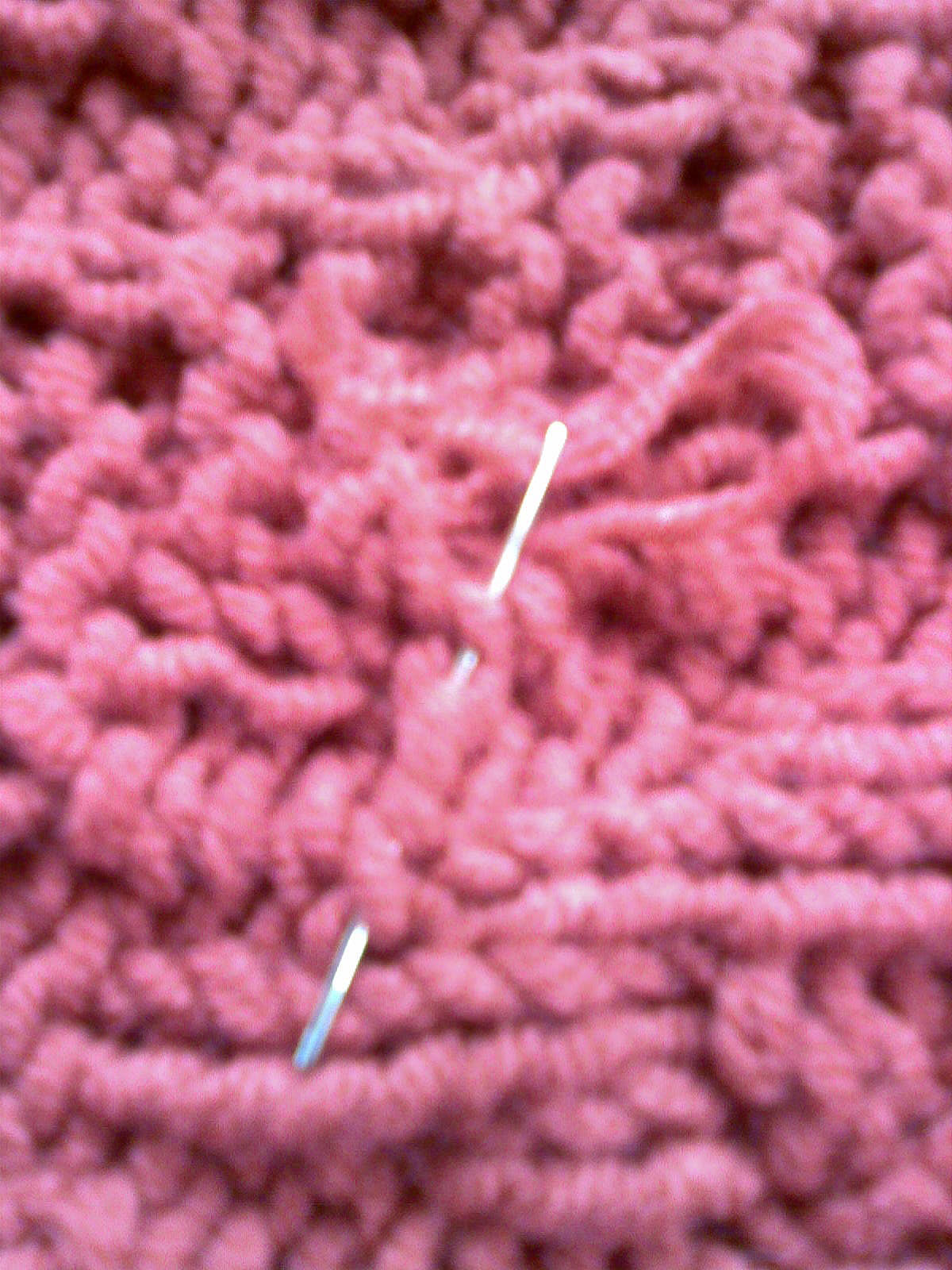
More bizarre color migration, but you can see the burial idea. And here’s the final result. Ends darned in near invisibly in spite of the yarn weight:

As for the true color of the piece, it’s “none of the above.” It’s more like this. Finished object pix tomorrow, I promise. Then it’s box and mail to the target baby, who by the time the package arrives, should be here too.
MR BUNN GOES TO COLLEGE
Back from dropping Mr. Bunn (and Eldest Daughter) off at college.

She brought all the essentials – computer and statistical calculator, desk lamp, clothes, electric kettle and tea, backrest pillow and bedding, her parents’ money – and her knitting. I anticipate a string of texts, notes, and letters reporting Mr. Bunn’s travails as a freshbun. Will relay any that are particularly amusing and/or full of knitting content.
FASTER THAN LIGHT
I have to admit that I detest knitting at large gauges. The heaviest yarn I enjoy using is worsted weight (true worsted at 5 spi), beyond that I find that I tire faster and tired fingers = uneven stitches. Still, for all of that I also have to admit that stuff knit at huge gauges goes incredibly quickly. I only get to knit about an hour each evening, and can knock out an entire skein’s worth of progress in that short time:

It’s a good thing that this yarn is inexpensive – doubly so for me because I got it dirt cheap at an odd lot retailer. Knitting would be a very expensive hobby if I favored working at this gauge with good materials.
Chalk up another benefit for lace knitting. It’s got the most cost effective bang-for-the-buck. Twenty dollars worth of lace yarn can keep me amused for a couple of months. Twenty dollars of bulky weight might make a hat and a half and be totally consumed in one night.
MILE A MINUTE PROGRESS
Red blanket continues to grow. As I expected, quite quickly. Here’s two evening’s progress – approximately four 60 yard skeins, and about one and three quarters of the 40 row repeat. I’ve got lots more, and will have more than enough to finish.
This is the front.
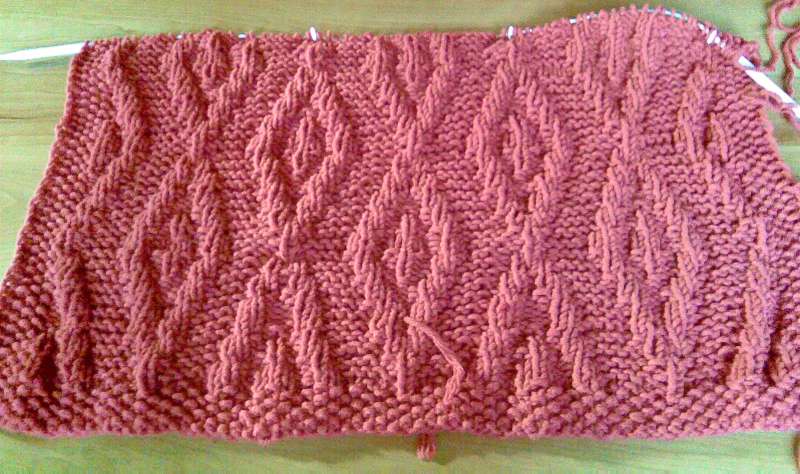
This is just a three repeats wide of a simple knit/purl pattern, an extremely easy big bang-for-buck texture well within the beginning knitter’s toolset. The back is slightly different, but also of passable appearance:
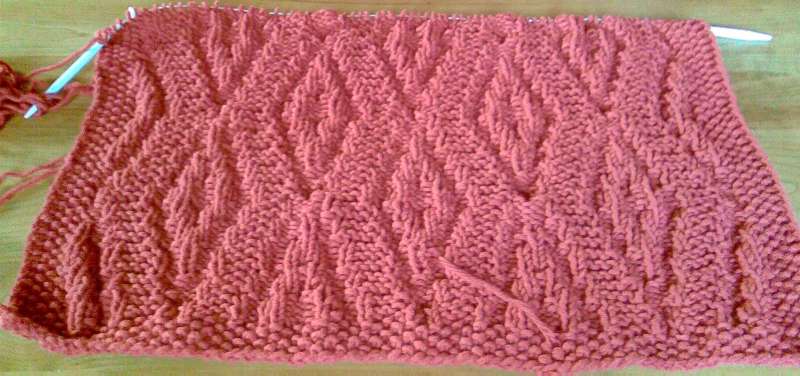
Colors on both of the above are a bit skew – the thing is a really vivid tomato red. (The new in-phone camera is a marked improvement over the old one in terms of sharpness, but it doesn’t have an effective flash.)
 String-Or-Nothing