MORE SOCKS – LIKE POTATO CHIPS, BUT FUZZY
I’m back from a horrific spate of deadlines prior to a trip to see family in Florida for the holiday, and about to launch into another round of equally horrific deadlines. (I need to embroider a sampler that says “Another Day, Another Deadline.”)
But in the mean time, I can present the mindless knitting I did on the plane. I finished the pair of Noro Kureyon Sock slouch socks, and have almost finished another totally boring and featureless sock, this one of Regia 4-Ply, in their Design Line color grouping endorsed by Kaffee Fassett (Color 04455). Interesting play of colors, but like all stripers with no texture, miles of plain old stockinette.
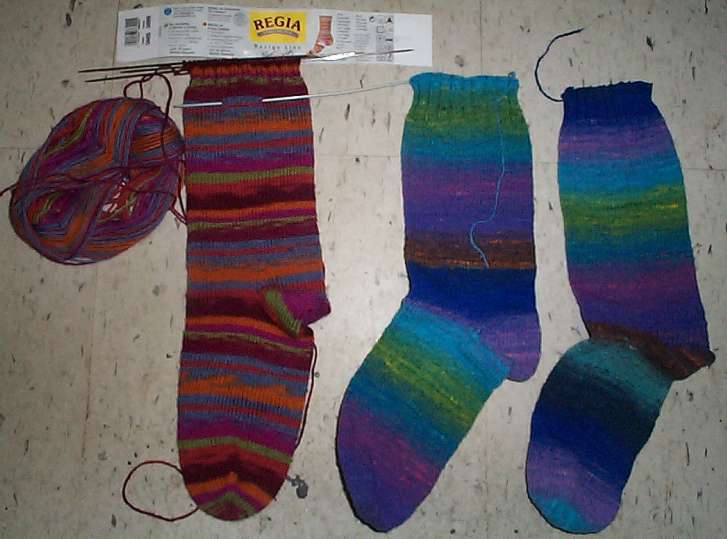
Why knit these boring socks? Because I’m not a good traveler. The motion of the plane coupled with the gentle aroma of blended jet fuel exhaust and unwashed traveler, compounded by the coffin like minimalist seating squash makes me green. I can only work on things I don’t have to watch closely. Knitting from written or charted directions is a special challenge to both my personal equilibrium, and ability to contort to hold all in view without elbowing my seatmates. So for the trip, it’s plain old socks or some similar non-challenging bit of work.
On the ground in Florida I started a lace scarf. Again, separated from my reference library I relied on a simple printed pattern. In this case, the Estonian Lace Scarf by Nancy Bush, offered up on Knitting Daily for a limited time (it’s a reprint from Interweave Knits back in the Fall of 2001, if you still have access to that issue).
I’m using some Malabrigio Baby Merino Laceweight in a garnet-strawberry blend. It is not an optimal yarn for this project. First of all, it’s heavier than what I would consider to be a true laceweight, and would look better on a larger size needle than recommended in the pattern (the only one I packed for the trip). It’s a highly twisted single, more similar to a 3-ply in bulk. Second, the color variegation is fighting with the lace patterning. In particular the highly-annoying-to-work p7tog nupps (aka mini-bobbles) totally disappear. If I put in that finger twisting effort, I want the result to be seen. And finally, the pattern specifies 504 yards of yarn to complete. One skein of the Malabrigio is 470 or so yards. To save yarn, I planned on shortening the scarf by one repeat and improvising an edging instead of working the one shown. Even so, I am not pleased with the result:
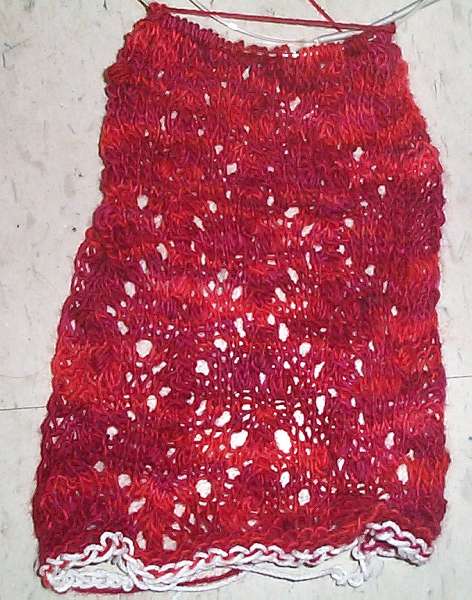
I’m now thinking of carefully ripping it all out and starting over, either working this same pattern on a larger needle, or (now that I’m home) drafting out a different lace pattern that would be better suited to the color combo and available yardage. So it goes.
LIFE KNITTING AND BOOTIES
Google Images now contains Life Magazine’s vast photo archive. If you’re old enough to remember the heyday of home delivered magazines, you will most certainly remember that glossy, oversized, highly visual catalog of each week’s events. It was spectacular.
Buried in that archive are a nice set of knitting-related images, mostly from the 1930s and 1940s. Most of them are from three issues, a 1939 one on knitting for the British army, a 1941 how-to-knit issue, and a 1952 home/baby knitting article. The accompanying articles aren’t in this archive, but the how-to and finished object pictures that formed the core are. There is also a smattering of celebrities at rest/with family pictures, some travelogue/news shots of women knitting abroad, and a couple of college girls knitting from the late ’40s/ early ’50s – the last time there was an on-campus knitting fad.
The 1941 how-to series pix are interesting because they show the pencil grip throwing style (even though some of the series pix are missing_. There are also at least one 1952 vintage how-to, showing Continental method:
- Long tail cast on
- K2tog decrease
- Binding off technique #1
- Binding off technique #2
- Binding off technique #3
- Purling #1
- Purling #4
- K2,P2 Ribbing
- Picking up along an edge #1
- Picking up along an edge #2
- Knit stitch (Continental , from 1952 article)
And some finished objects
- Knitted faceless Balaclava or hood
- Hat/scarf combo (open end of tube scarf forms hat)
- Another shot of the hat/scarf
- Soaker
Here are some of the other shots:
- Celebrity knitter Eleanor Roosevelt knitting on a plane? train?, 1937
- British showgirls knitting, 1937
- Cover picture from the 1941 how to knit issue
- British store clerk knitting (1939)
- Celebrity knitter Prisca Bunau-Varilla (French Ambassador’s daughter) 1960
- Cute woman gas station attendant knitting
- British waiter doing troop knitting (note method of holding yarn)
- Celebrity knitter Eve Arden, 1959
- Hotel page boys knitting, 1939
- Height of the campus argyle knitting craze, 1948
- Wounded Finnish soldier and nurse knitting, (note that he’s using Continental method, she’s throwing. I bet he learned as a kid at home.) 1940
- Lose weight while knitting? 1940
- Celebrity knitter Jane Froman, 1936
- Chinese girls knitting on long bamboo(?) DPNs, 1946
- Gangsters’ wives knit, too. 1949
- Celebrity knitter JoAnne Woodward. Perhaps Paul is getting socks, 1958
- British toddler playing with knitting 1939
- Celebrity knitter Barbara Bel Geddes 1959
- Striking women auto workers knitting (France), 1937
- British ambulance driver knitting, 1937
- Knitting in public, 1944
- Troop knitting 1939
- Celebrity knitting Byron Nelson and wife (wife knitting), 1945
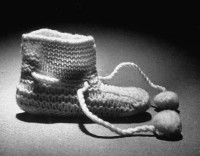
But to me, the most interesting picture is that of this little bootie, from 1952. Although I prefer not to repost the pix of others, I think fair use here applies so you can see these side by side:
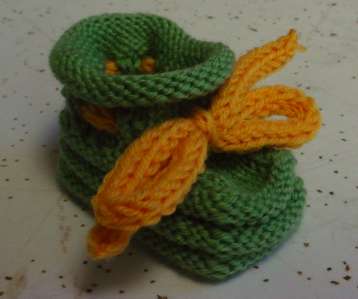
The “Janes Booties” (at right) I often knit are one of those much loved, scribbled-on-an-envelope patterns passed hand to hand. The version I use was posted to the KnitList by Ann Kreckel in 1995. I did a step by step how-to for Ann’s pattern in 2005. Extremely similar patterns have appeared in a letter to Threads Magazine, and in the 1999 Knitters Socks Socks Socks competition book. The Threads letter was printed in the 1991s, and was penned by an elderly lady who said she’d been knitting them since her girlhood. My guess is that the ur-source for this pattern might have been a magazine article or leaflet appearing sometime between 1900 and 1920.
I’m always on the lookout for earlier manifestations of Janes Booties so this shot grabbed my attention. The Life magazine bootie looks a bit squashed and shallow compared to my green bootie, but I can see that it shares basic construction with the pattern I use. First, the bottom looks to be a rectangle of garter stitch. The sides of the bootie look like more garter stitch picked up around the edge of the sole plate strip, then knit in the round. The top of the toe looks like it was worked flat, back and forth, culminating with the tube-knit ankle part, worked in the round on the ankle stitches plus those from the top of the foot. Eyelets form the holes for the tie string.
While the Life bootie is much less plump, with a shallow toe area and overall less boxy appearance (no garter stitch welts to form the sides), and ended off in a plain garter anklet rather than a rolled stockinette top, it was made the same way. I’d consider it a first cousin to Ann Kreckel’s pattern. If anyone spots earlier incarnations of similarly constructed booties in historical sources, please let me know!
ADVENTURES IN THE UNSEEN
I was wrong and I freely admit it. Remember the post in which I described a method for estimating the depth of stripes that would be produced by a skein of space dyed or multicolor patch yarn? I applied that method to my skein of Noro Kureyon Sock, and it flat out missed the mark.
Based on skein size and color strand counting, I estimated that each solid color stripe would last 4-6 rows or so before shading into the next. I still stand by that for the yarn on the outside of the skein, but I didn’t factor into my estimation how seemingly random Noro yarns can be. Here’s the skein:

I see lots of turquoise and magenta, with side trips to royal blue and deep green. The color segments of the yarn on the outside of the skein appear to last for the lengths I indicated.
But here’s the resulting slouch sock (a sock with a deliberately wide ankle part), knit from the center of the ball out. It’s brother is just a tiny turquoise cast-on speck right now:
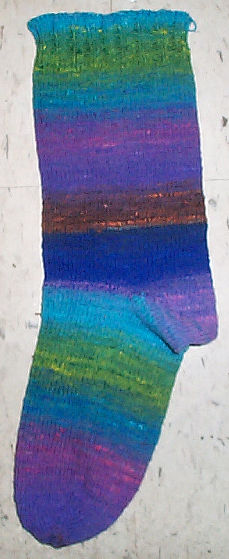
Huh? where did that huge lump of royal blue above the heel come from? And the green/orange mix directly above that? And why is the pink/purple section so unexpectedly wide? Counting the strands on the inner layer visible on the un-dissected skein, pink/purple should be equal in width to green. What gives?
I might have been less surprised had there been more than one skein of this color number available on the day I bought the yarn. Looking at several, each starting at a different spot in the color progression might have revealed larger (or different) color segments than I anticipated. In any case, the color repeat has gone through about one and a half cycles in this sock, hitting the toe’s hue blend about halfway between orange stripe and densest part of the magenta, although factoring in the wider circumference of the ankle part than the foot, the second appearance of the pink/purple is longer than that combo’s debut.
So there’s my caveat. I still say my estimation method works. Mostly. Except for Noro, where all bets are off.
Pattern footnote:
How to do a slouch sock? Easy. US #00s. Standard figure-8 cast on toe, worked on a set of five DPNs. Increase to 17 stitches per needle until just before the heel (68 st total). Increase one stitch per needle to 18 (72 st total), work a standard short row heel across two needles (36 stitches), instead of decreasing away the two sneaky stitches used to minimize any top-of-heel-decrease gaps, keep them, and increase one stitch each on the two non-heel needles for a total of 19 stitches per needle (76 st total). Work leg part equal in length to foot (folded along the heel’s natural equator), then work about 20 rows of K2, P2 ribbing and end off.
Why do a slouch sock? Between the wild colors, thick/thin spin, and overtwist, any lacy or texture pattern would be lost in this stuff. Also this yarn isn’t a good candidate for stranding or striping with another (although two different but closely related skeins in a simple stranding pattern might be interesting). I’ve had some breakage, and I’m not inclined to use this stuff for a nice, snug sock that takes a lot of stretching to put on. The roomy top will diminish that strain.
NOT-SO-ANTIQUE SAMPLER
I was rooting around in some boxes last weekend as I searched for left-over batting to stuff the chicken hat. I ran across a truly ancient one, full of dawn of time artifacts. Among them was this.

This sad little sampler is the second thing I ever embroidered. It’s a pattern stamped on linen, stitched in whatever leftovers were in my grandmother’s thread basket. I must have been around 5 when I did it because I remember bringing it finished into my first grade class show and tell during the first week of school.
I also remember picking it out. My grandmother and I went to a small, dark shop somewhere in a neighborhood in Brooklyn, NY. It was a hot summer day, and even though the sun was out, the street was heavily shadowed by an elevated subway track. The store specialized in needlework supplies. I remember there being a tabletop display of sorts, one of those elevated shallow wooden bins, slopping over with small squares of this type. Thinking back, most were probably iron-ons that the shop applied to their own yardage, but there were also pre-printed strips for applique onto other items, plus toaster cozies and pillowcases. I remember Sunbonnet Sues and lots of flowers, but not that many with mottoes, and none with alphabets. That last point sticks with me because I wanted to stitch an alphabet sampler. And I remember taking the subway back home, anxious to sit down with my grandmother and start sewing.
The stitches are oddly leggy and none too precise. The inopportune colors have faded (the pale pink now was a very dark carnation when new). Thread coverage is spindly, – a haphazard mix of Perle cotton and stranded floss. The French knots are knobby growths, and the tension on the detached chains makes them look like squinty little eyes. The back is a horror.
But I can see the spots that I did last are neater, and by the end of the project I had learned to make all my top legs lie in the same direction. But most of all – I finished the thing.
It may be an ugly little artifact, but I’m proud of it.
OP ART DONE!
My Knitty Op Art blanket is done:
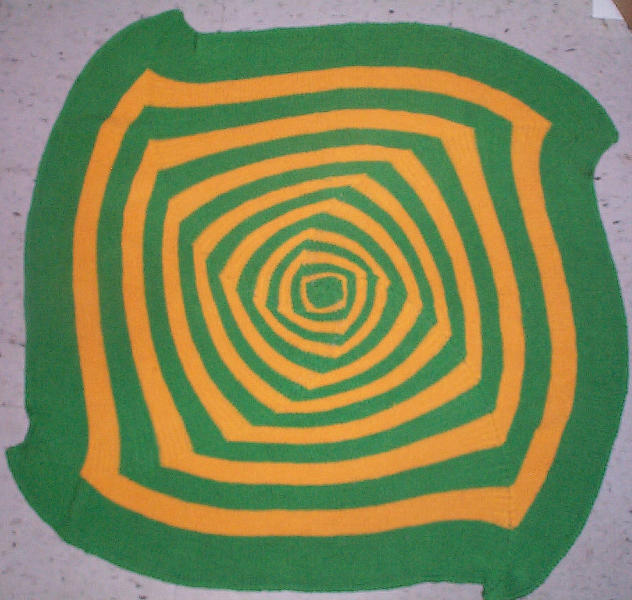
It’s about 47 inches across the center. I used about six skeins of green and five of yellow Austermann Record 210. I had begun another round of yellow but I didn’t have enough yarn to complete the next progression, so I ripped it back, opting instead to use up all available green for the outer, larger framing section. Obviously, I haven’t attempted blocking yet. Cotton yarn as a rule does not deform as well under blocking as does wool, and this dense cotton in particular has a mind of its own. I suspect I’ll have to pin this to within an inch of its life, then steam block it rather than just damp blocking. But that’s an exercise for another day. Even if I don’t get around to it, the odd shape (although unorthodox) isn’t unappealing.
In other knitting news, I continue to slog away at the spiderweb section of my growing olive green tablecloth, but pix of the standard indistinct and blurry snood shape object won’t reveal much beyond the fact that it still exists. Also I was tempted too long by the skein of Noro Kureyon Sock Yarn that’s been sitting atop my monitor since I posted about its acquisition back in July. I had thought about doing something unusual with it rather than just socks, but the lure of those colors proved too strong.
At that time I bought it I posited that each color area would last about three or four rows in a sock. My instinct was more or less correct, but the yarn has more transitions and in-between gradations than I expected. Knit up, the color sections look like they last much longer, but if you examine closely “pure” colors do last for about five or six rows before they begin transforming into the long “tweener” blend areas:

For the record, I’m using 00s, and am working at the relatively large gauge (for me) of 8 stitches per inch. Although I usually prefer my socks knit tighter, this yarn is a bit heavy compared to the sock yarns I usually use. It’s also a single, with a fair bit of unevenness – some parts are thinner than others – and a fair bit of overtwist. The overtwist can be a pain because the yarn will kink up on itself if a long section is drawn from the skein. I’ve also noticed that other knitters have complained about Kureyon Sock’s feel, thinking it a bit on the coarse side. It is hard on the fingers as it is being knit, but the resulting sock at my gauge is nice and cushy and feels much softer than palpitating the skein promises.
This pair won’t be finished any time soon. Now that the first sock has been kicked off, I’ve relegated it to “briefcase project” status. That’s the small, portable project I keep on hand to knit at doctors’ appointments, while waiting on line at the post office, and other stolen oddments of time. My socks will be done. Eventually.
ACTUAL PROGRESS. AMAZING.
I feel like I’ve landed on the planet of the domestic divas. Everything I did this weekend involved knitting, sewing or cooking.
First, the Chicken Viking Hat is finished!

It’s shown here on a random stuffed toy – no infants of appropriate size being to hand at the moment.
The CVH is quick knit, although getting the legs on and finished were both a bit fiddly. Luckily I had some stuffing left over from a previous project because I violated Knitting Rule #4, and didn’t bother to read the whole thing through before I sat down to attempt it.
My only other caution is a minor one – If anyone is going to knit up your own CVH, be advised that on the diagram of how to pick up the stitches that form the leg, there is one 90-degree corner, and three slightly rounded ones. That 90-degree corner indicates the direction that the feetie part of the drumstick will point. I didn’t make the mistake of making the two feeties go in different directions, but I can see that doing so might be a very easy and natural error. (Why do I call them feeties? Because that’s what we’d call the real thing when as kids we’d haunt the kitchen when my grandmother made chicken soup. Only the best behaved kids got feeties from the stock pot as a pre-dinner special treat.)
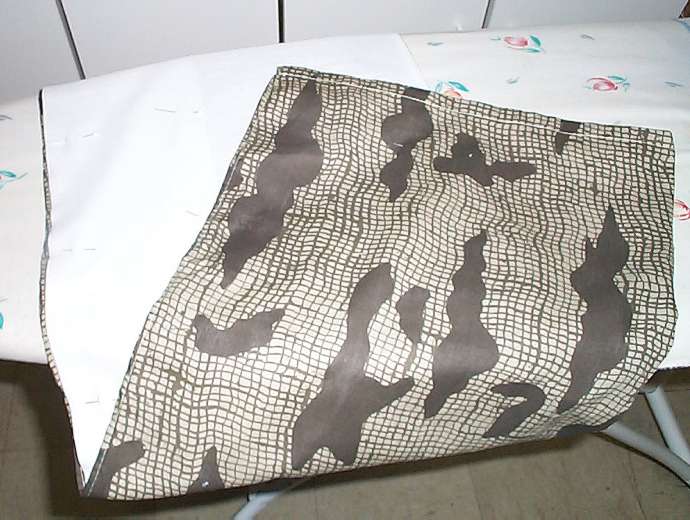
My camo valences are also coming along. Everything is proceeding as per the plan and diagram in the last entry. Here’s Valence #1, all ironed out and pinned prior to stitching.
And I also managed today to do my community service obligation. I baked for the Election Day bake sale, to be held at (and benefit) Younger Daughter’s elementary school. Class for both kids is canceled on Tuesday. Usually voting happens with no interruption of school. My guess is that they’re anticipating record turn-out. That means lots of people hungry to express their political will, who might also be hungry for cinnamon hazelnut teacake, or cocoa spritz cookies.
On the teacakes, I used a mini loaf pan that produces four small cakes, sort of like this one.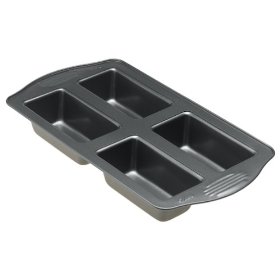
One recipe of the batter (plus about a half cup of ground hazelnuts in the batter and another half cup in the topping) worked perfectly in it although I did end end up baking the cakes for about 10 minutes longer than the recipe advocates. All four cakes turned out quite nicely.
The cookies also were a success, with one iteration of the recipe making approximately 115 1.5-inch cocoa stars. However I find that most published cookie press cookie recipes are way too stiff for my presses and this one was no exception. I want my batter to be something like refrigerated peanut butter in consistency. It should be so soft that it must be shoveled into the tube – not something that can be taken up and rolled into neat cylinders and inserted. I used an extra tablespoon of cocoa in the spritz cookies, plus considerably more milk than it calls for to achieve my target texture. I used sour whole milk in both the teacakes and the cookies, having some in the fridge this week. It worked nicely, providing both with a tiny bit tangier taste than usual.
SIDE TRIP INTO HOME SEWING – CAMO VALENCES
Elder Daughter is now in the Doc Martins and camo phase of teenage self expression. That expression has spiraled out to her immediate surroundings. As a result, last fall we replaced her pre-teen starry night sheets with a bed-in-a-bag set on this theme:

It came with a top sheet, a fitted bottom sheet, a comforter and a pillowcase. And for some reason – a bed skirt. To those who don’t suckle at the breast of Martha Stewart, a bed skirt is a somewhat prissy patterned dust ruffle that lies between the mattress and box spring on most beds, with the fashion fabric curtaining off the under-bed area from general view. Far be it from me to question the wisdom of the marketers who thought that someone favoring camouflage patterns might use and appreciate such a thing.
In any case, her bed is a high platform with built-in drawers underneath and a bed skirt is irrelevant. Still, the skirt came with the set, and I abhor waste, so together Elder Daughter and I decided to remake it into a pair of narrow valences for the windows in her room. It’s taken this long to start the project because my ancient Elna sewing machine has been up on blocks awaiting repairs. The machine has now been overhauled and I am no longer able to endure the puppy looks and pleading, so I’ve begun.
Here’s our general plan. My goal is to minimize sewing as much as possible, by re-using existing finished edges and seams:

I’m at the first step (upper left of the diagram), slicing the camo fabric off from the foot of the skirt and picking out the box pleated corners:
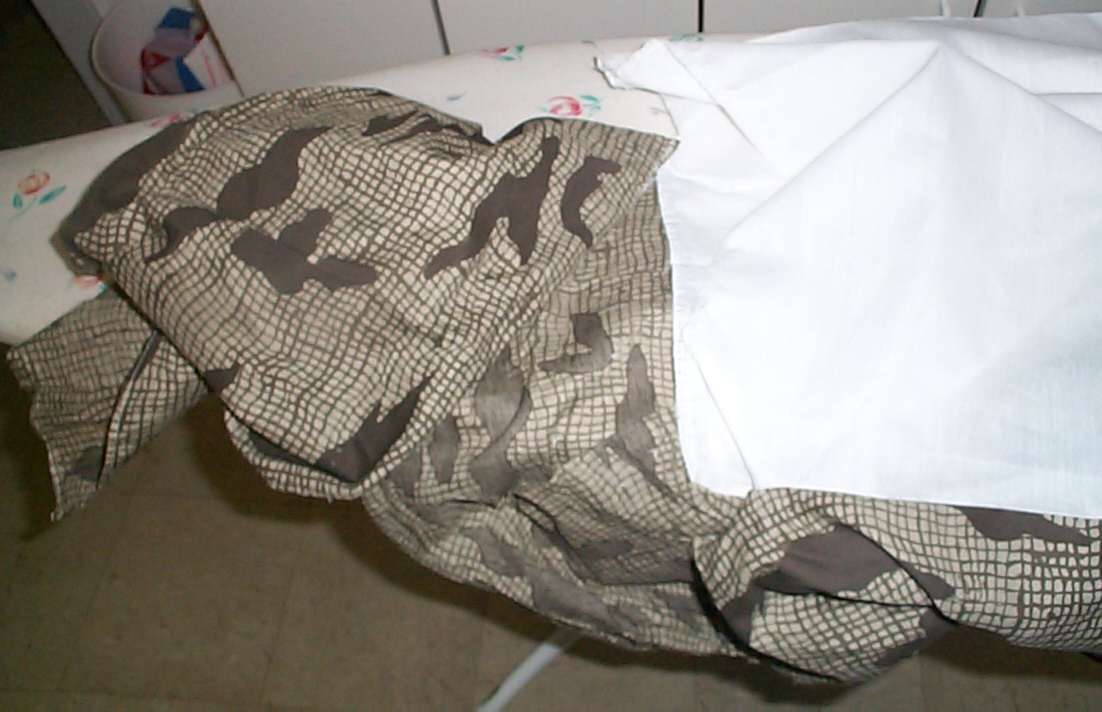
We have no ideas on what to do with the excised bit from the former foot. Various pillow and stuffed animal suggestions have been floated. I also considered (then discarded as too fiddly) the idea of using some of it to make curtain tabs rather than a simple rod casing.
I think I’ll take this opportunity to introduce Elder Daughter to Ancient Elna. Long straight seams are easy and sewing is a life skill. More on this as we progress.
CROWING FOR LITTLE REASON
And the Chicken Viking Hat it is. Turns out that in addition to his week-old baby boy the recipient has 1) a sense of humor; 2) a wife similarly blessed; and 3) backyard chickens. It’s a perfect fit:

So far it’s been a quick knit. Two evenings knitting while watching a movie and I’m finished with the hat body. You can see I am starting on the protruding ornamental drumsticks. Chicken Viking knit up with no problems. I worked the whole thing on DPNs rather than a small circ. Newer knitters attempting this one should remember that “continue in pattern” means that as the decreases that make the crown happen, the placement of the one-purl goosebumps should follow the established distribution and spacing, even if the decreases eat into the beginnings of the repeat sequence. As a result post-decrease rows won’t begin at the specified spot described in the goosebump stitch pattern sequence. But the pattern is extremely simple and figuring out the right place to begin won’t be a problem.
My only departure from the written pattern so far is that instead of ending off the ear flaps by binding off the last four stitches, then attaching some strands of yarn to braid to make the ties, I reduced those last four down one final time to two stitches, then made my hat strings by working a two-stitch I-cord of requisite length. It came out nicely, sort of like lucet cord, I-cord’s ancient cousin. On the materials, nothing special here. I used remnants of a mass market 100% acrylic, in the “grade inflation” weight that is labeled worsted but has a natural gauge of 18-19 stitches = 4 inches. I did this because I wanted to make sure the thing was absolutely washable, and because of the heft of the yarn. This stuff has heft. The drumsticks will stick out on their own. A cotton as recommended would work well, too but most wool blends and all wools would make soft, droopy drumsticks. So it’s Soylent Green for this project.
I expect to knock this hat off by mid week, even allowing for the severely decreased knitting time that accompanies deadline crunches at work. Stay tuned.
UNLEASH THE INNER PUMPKIN
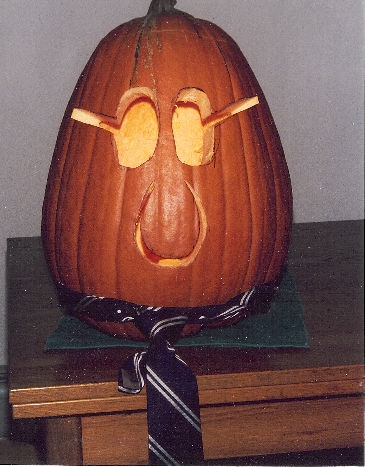
Sometimes the materials speak:
On the knitting front, I’ve been totally consumed again at work. I’ve managed to do a couple more rows of the spiderweb section on my olive green tablecloth, and a little bit more on the OpArt blanket – but not much of either.
I’ve also received a special request for an unusual baby hat, the amazing flood of co-worker fecundity continuing unabated. I am contemplating either the now classic Chicken Viking Hat or the Baby Squid Hat, although I am open to suggestions of other similarly absurd headgear.
A PRESENT
Here’s a present for the new year, or to celebrate arrival of fall, whichever has more meaning to you. I post my grandmother’s savory noodle kugel recipe – from the same grandmother whose latke and blintz recipes I’ve shared before (but not on String – I’ll have to fix that). I see lots of how-tos on the web for sweet noodle kugels, with cottage cheese, sugar and even cinnamon and raisins, but very few for non-dairy savory ones to serve as a meat meal side dish. As a kid, this noodle kugel with onions was one of my favorites, especially alongside roast chicken.
One quick note about noodles. The curlier the ribbon style noodle, the looser texture your finished kugel will be. Many brands of bagged egg noodles have a very slight spiral to their shape, to make them look fluffier when cooked. You can see the spiral in these:
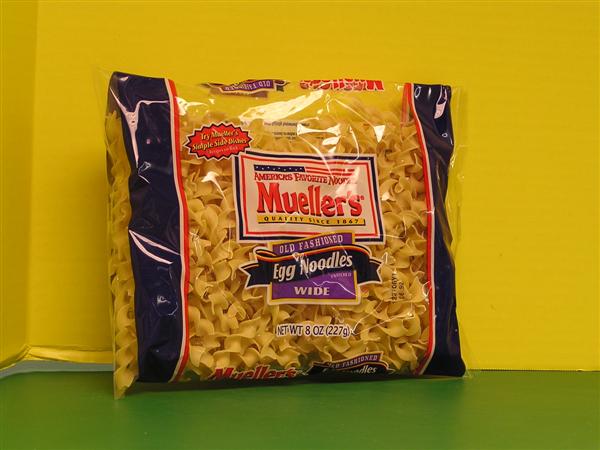
If you can find them, choose a flatter rather than a more curly noodle, preferably of medium width. This will make a denser, moister kugel. If you can’t find flatter noodles, use the others, but be prepared for a final product that’s drier, crunchier throughout, and that falls apart when cut. Manischewitz, Streits and Goodman all make the “old fashioned” flatter type noodles.
You can use either yesterday’s leftover noodles (which is what I do when I make a little kugel), or cook up noodles just for this dish. If you cook up noodles to make this, you’ll get the best results if they are room temperature or cool from the fridge rather than just-drained and steamy hot.
On what to cook this in – I strongly suggest a Pyrex dish or pan. A clear or tinted glass pan will let you see when the bottom is brown and done. A glass pie plate will work in a pinch, but I prefer something deeper, and depending on the size of my kugel will use either a clear glass loaf pan, 8″ square baking dish, or a slightly larger oval glass casserole dish. Whatever pan you use, make sure that it is both VERY well oiled, and pre-heated before putting the noodles in it. Doing both will eliminate sticking.
Apologies for not having pix of the finished product, but we ate every bit of it before I thought to write up this entry.
Minnie Leibowitz’ Noodle Kugel (in three sizes)
Small – (Fills one loaf pan, about 4 servings)
About 2 cups of leftover cooked egg noodles (measured after cooking)
1/2 medium onion, sliced very thin
2 Tbs vegetable oil
2 eggs
Salt and pepper to taste
Large – (Fills one 8″ baking dish, about 8 servings)
1 whole 12-oz box or bag of egg noodles, previously cooked.
1 medium onion, sliced very thin
2-3 Tbs vegetable oil
3 eggs
Salt and pepper to taste
Giant – (Fills one large oval glass casserole dish, about 10-12 servings)
1 whole 16-oz box or bag of egg noodles, previously cooked.
1 and a half medium onions, sliced very thin
3 Tbs vegetable oil
4 eggs
Salt and pepper to taste
Method (all)
Preheat oven to 350, pour oil into Pyrex pan and oil the bottom and sides very generously. Pour remaining oil out of Pyrex pan and into a saute or small frying pan. Saute onions in oil until they are golden. While sauteing, put the Pyrex dish in the oven to heat it up.
When onions are done (takes about 15 min or so), beat the eggs in a large mixing bowl and dump in the noodles. Scrape the onions into the mixing bowl. Toss noodles, egg and onions together to separate the noodles and combine the ingredients, adding salt and pepper. When well mixed, remove the Pyrex pan from the oven and turn the noodle/egg/onion mass into it. Return Pyrex pan to oven, turn the heat down to 325 and cook until noodles are brown and bubbly on the bottom and crunchy on the top, about 45 min to an hour, depending on the size of your kugel.
When done, it’s best to let rest a few minutes before cutting into portions, especially if you used a curlier noodle. Can be served hot, warm or cold.
Enjoy!
 String-Or-Nothing