BABY GIFT #2 (MOSTLY) DONE
The yellow baby blanket is mostly done. All that’s left is to graft the beginning of the edging to its end, and darn in the dangling ends. Here it is patted out and pinned to the back of the sofa, which accounts for the strange dimensional distortion.
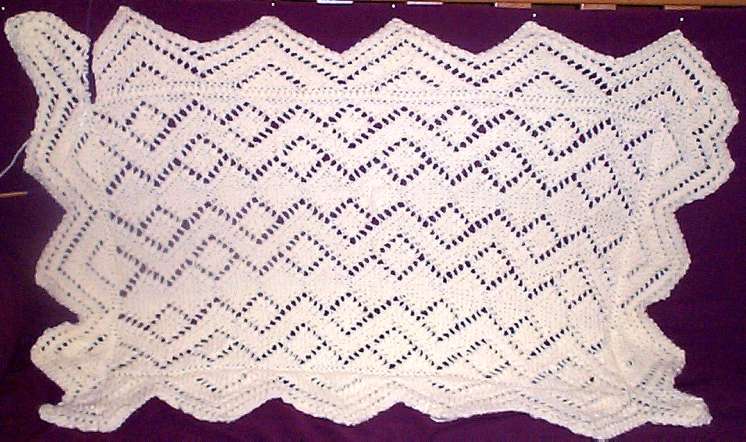
I’m 80% satisfied with it. It’s small, more like basket or car seat size than crib size. I only had four skeins and used all but about ten yards of it. I’m only halfway pleased with the corners. The math worked out to be a multiple of a half repeat. That means that two corners were mitered starting at the narrowest point of the repeat, and two were mitered starting at the widest point. I will say that mitering at the narrowest point for this symmetrical edging worked better. That corner is in the upper left of the photo. Its opposite at the upper right looks clunky by comparison. If I had the thing to do over again (with more yarn) I’d work another three inches of the center panel so that all four corners could begin at the narrowest spot on the edging repeat.
The stitch patterns for this one also came from the the first Duchrow book. The center is pretty much verbatim, and can be found on page 35. The edging is inspired by the companion edging presented on the same page. My version is truncated by about a third of the original width. I arbitrarily cut off about eleven right hand side stitches, turning what were diamonds framed by a zig zag on the dagged side and triangles on the join side into plain old triangles, and eliminating a column of fagoting. Along the way I noticed that a smaller “junior” version of the same thing could be worked by using only a portion of my rows. I present both in the pattern graph below (click on it for full size version).
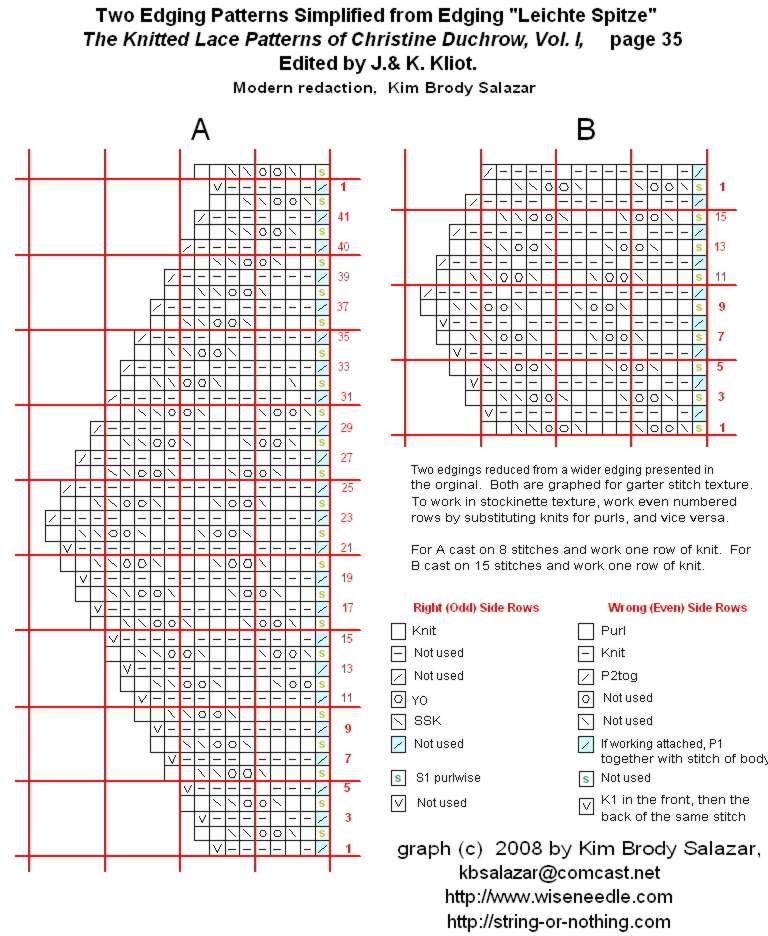
How to miter the corners? It’s easier than you think on a symmetrical pattern like this. I do them on the wrong-side rows, working one stitch fewer each wrong side row and wrapping the last stitch I work in each wrong side row until I reach the reflection point of the repeat (the shortest or tallest point depending on where I start), then I reverse the process, re-incorporating one previously wrapped stitch (along with the wrap at its base) on each wrong side row until I’ve reclaimed my full width and returned to the same point in the repeat where I started. Sounds confusing, but give it at try.
Now on to Baby Gift #3 – the little sweater kit. It turns out that there’s yet another in queue, after the sweater it looks like I’ll be knitting at least one more small blanket, plus some other thing to be determined when inspiration strikes.
BLANKET REBORN
I ended up ripping out the entire yellow blanket and restarting it. But I made the central part narrower – only three instead of four repeats. I slimmed it down based on yarn consumption estimates, and because I decided to trim it out with an edging rather than leaving it plain. I haven’t done much thinking about the edging’s corners. I’m winging it when I get to each. Photography is hard right now, so I present the traditional String photo of something wadded up into a mega-snood on a circ:

One of the things I find most comforting about knitting is that mistakes are not forever. Unlike say woodworking in which once your lumber is cut, it’s cut, with some minor exceptions, it’s always possible to rip out knitting and begin again. Since I’m one of the process rather than end-product oriented knitters, and deplore deadlines of any kind outside of my professional life, having to rip back isn’t a major burden. Of course, I do sometimes get annoyed at wasted effort and sometimes am frustrated enough to consign a project to Chest of Knitting Horrors(tm) limbo, most of the time it’s just grab the end and rewind.
Work schedule willing, I should have this blanket finished by next week. That will be Baby Gift #2 done, and I’ll be on to #3.
NOT PAYING ATTENTION
In the name of expediency I started on Baby Gift #2, but instead of working in the fingering weight wool I had bought on sale, I dipped into my pile of recently received gift yarn for an Aran weight acrylic in baby yellow. It’s unstretchy and slightly fuzzy, but very soft. I figured that on US #10 needles, I’d make short work of a quick blanket. And it looked to be heading that way:

Can you see the problem? Takes a while if you’re not looking for it.
See the zig-zag on the left? In the first four repeats, it’s flanked by little diamonds on alternate sides. That’s how the repeat is SUPPOSED to look. Those other zig-zags with the diamonds soldiering up one side or the other? Nope. That’s wrong. My first 1.5 repeats across are correct, after that all goes to hell.
Now why did this happen?
Because I was too cocky and wasn’t paying attention. I can usually memorize a pattern this simple in a pass or two. I thought I had it licked, and continued to knit away on autopilot, without checking the Duchrow book pattern chart I was following or looking at my work. In fact, I didn’t notice the problem until I patted the blanket out for this morning’s photo.
What next?
Ripping back the one and a half skein of knitting you see above. The good thing is that I cast on for this only on Friday. That’s just three evenings worth above. The bad thing is that this yarn is surface fuzzy, and taking it out will be a pain. But if I go back to the very beginning I’ll get to do some minor engineering. I think that I’ll do something deliberate with the repeat, possibly with some mirroring or (on purpose and symmetrical) distortion.
Idiot me….
FLOOD OF BABY GIFTS – ROUND 1 DONE
Finished the fuzzy Entrelac blanket.

Because I began it with a cast on row plus two garter ridges all the way across before starting the foundation triangle row, I finished it in parallel by picking up stitches across the top and working two more garter ridges and the cast off row. Now all that remains is to wash it and darn in the ends. For some reason I never do that until just before I am ready to give the gift.
On to the next baby gift – #2 of 4. At the same LYS mega-sale where I got the fuzzy, I also picked up some Asa Gjestal Spinneri Baby Superwash in a light turquoise. It’s marked at 28 st = 10 cm, about 7 spi, but feels comparable to Dale Baby Ull. I could do a strip or medallion blanket throw out of it, or I could work up a sweater and hat set. Not sure. I’ve also got a couple of lots of soft acrylic at worsted weight given to me by a friend. There’s enough there to make a couple of blankets, too – one pale yellow, one pale blue, and another white with flecks one similar to the one I did back in the early Spring:
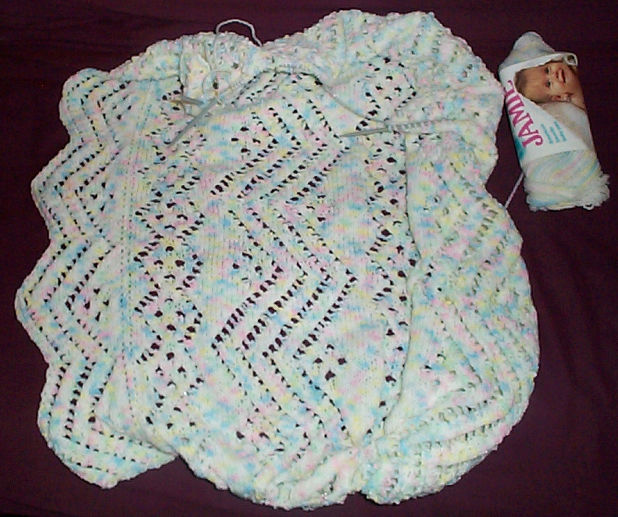
The other thing I bought was not on sale. It’s a cleverly packaged kit from Plymouth Yarns. It contains one large ball of Cotton Kisses yarn (mine is a baby multicolor), four duck-shaped buttons, and instructions to make one of two sweaters – either a v-neck cardigan or a placket pull-over, both knit on US #5s and #7s. There’s enough yarn in the kit to make one item in one of three sizes – newborn, 3-6mos, and 6-9mos. If you figure a leaflet is usually two or three dollars, and four buttons of this type would run two bucks, too, this all-except-needles pack was very reasonably priced at $14.00 for the whole thing. I’m holding off starting it until I know the sex of the target baby. Although there’s no real reason to differentiate, I think I’d make the placket for a boy and the cardigan for a girl.

So, I’m off to experiment, not quite sure which of these projects I’ll start tonight.
ON BUYING AND USING MULTICOLOR YARN
I got a private note yesterday from a knitter who seeing the fuzzy entrelac blanket posted yesterday, wanted to know how I knew the spotty yarn would work well for it. I reply.
Frankly, I wasn’t sure what I was going to do with my spotted yarn. But multicolors come in several flavors. While there are no hard and fast rules in knitting, there are some general principles I use to help figure out what to do with multicolors, especially because I’m one of the yarn-first folk. I rarely have a specific project in mind when I purchase yarn, and usually have to find or invent something to do with my new treasures. Also, as long time readers here have seen – I don’t always hit on the best use right away. Sometimes it takes me a couple of starts before things work out. I don’t mind ripping back. To me it’s part of the process of exploration and discovery. Now these thoughts are things that work for me. Your taste is probably different from mine, and there’s nothing wrong with that, so please don’t think these are put forward as rules for everyone.
For me, first comes yarn choice. Multicolors come in all sorts of types and color combos. I have to like the color set and mix proportions as a whole. I like to look at my target yarn from a distance – 10 feet at least, to see if the skeins “read” well as an aggregate. Lots of times one or more of the colors pops out strangely from a more harmonious background. I tend to avoid those mixes. I do however like multicolors that are composed of different colors but similar intensities.
Once a color combo has caught my eye, I look at the length of the repeat. On skeined yarn, this is relatively easy, especially if the yarn shop allows customers to untwist a skein. Never do this unless you have asked permission and you know you can return the yarn to the original twist, neat enough to be indistinguishable from the on-shelf stock. Then do so once you’ve made your evaluation. Or ask the yarn shop staff if they can untwist/retwist for you.
On DK and worsted gauge, I figure about 1.5 stitches per linear inch of yarn. On sport and fingering, figure 2.5-3.5 stitches per inch of yarn. A run of a single color as wide as my palm on a DK is probably a bit over 5 stitches when knit up – just under an inch worth of knitting in DK gauge. Shorter areas of color end up looking like little spots. Longer ones produce broken stripes. Really long segments produce larger stripes (depending on the circumference of the piece being knit and the gauge).
What to do if the yarn comes in a ball rather than a skein? You’ve got to guess and estimate. Look at the put-up. Estimate about how long one circumference wrap of the ball is. For example, if you look at the Noro Kureyon Sock below you can see that the wrap goes diagonally around the ball, and that there are about four or five wraps before the color changes.
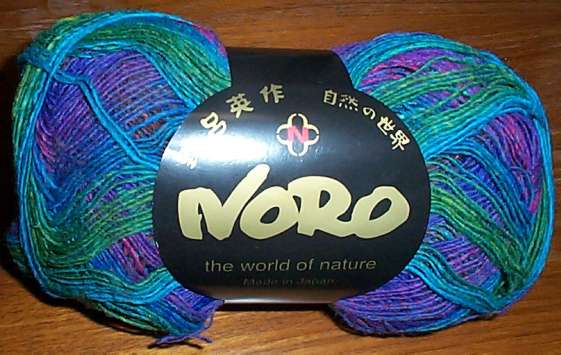
The ball is approximately 7 inches long (the spread from my index tip to small finger tip with my hand splayed – it’s good to know some standard biometrics of your own hand for guesstimation), so a rough estimate is that one wrap around the ball would be about 15-16 inches. The individual color patches on this yarn are probably on the order of 65-75 inches long, probably something like 24-30 linear inches of knitting at an approximate sock gauge. (My socks are about 11.5 inches in circumference on the ankle, so for socks one color segment would probably make a stripe a bit over two or three rows deep).
A yarn with lots of rapid color changes will read very differently from a yarn that’s mostly background color with scattered spots. The rapid color change yarn will, from a distance, almost seem to do an impressionist’s blend, and appear as a hue median to all the colors being represented. That means that a yarn with a zillion little spots of color, each individually quite clear will end up looking like a muted blend of all of them from a distance. Tweeds and multi-strand ragg style yarns (two or more plies of different, sometimes variegated color twisted together) are good examples of this effect. My Impossible Socks uses a ragg-twist multicolor tweed in combo with solid blue. The overall effect of the tweedy yarn is much darker and muddier than its constituent bits, even without the navy stripes.
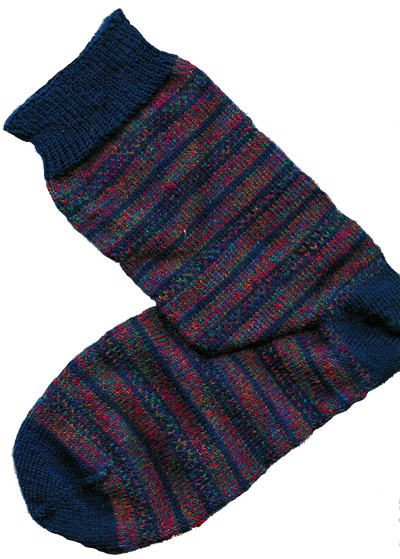
Colors that blend one to the next can also present problems. Sometimes the nondescript areas between vivid colors predominate if evaluated as a general proportion of total skein length. A lovely multicolor on the shelf may actually knit up rather muddy, with only small flashes of the marquee hues. Conversely, colors that shift abruptly from one to the next can produce a rather motley and jarring effect, with each jostling against its neighbors. In longer repeats, I tend to favor yarns that have few or no blended transitions. I also prefer that any transition areas make up less than 10% of the total color cycle.
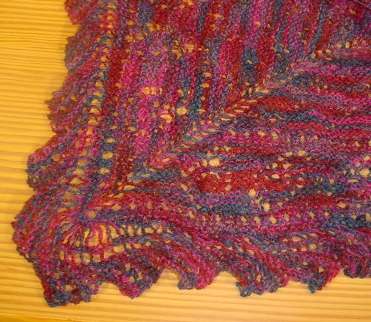
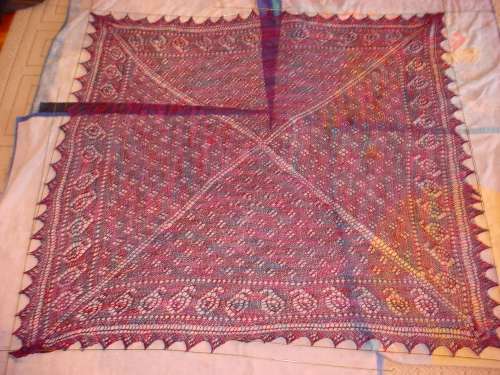
Because of the “tweens” challenge with shading multicolors and the perceived meld problem in general, I tend to stay away from yarns with wildly disparate color combos, and stick mostly to multicolors with either a well established and pleasing uniting background color; to yarns that present either multiple variants of the same color (like a continuum from light blue to navy); or to yarns that offer up two or at the most three closely allied colors (like red to yellow, with side trips to orange). The Paisley shawl illustrates this visual mind meld. It’s a raspberry to blueberry blend. The detail shows the color spots clearly, but the big picture blends both into a medium purply garnet.
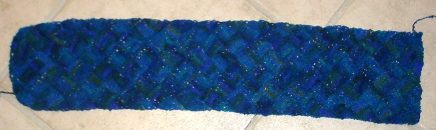
In terms of color repeat length, I try to match projects to the repeat length. I’ve found in general that unless I can engineer repeats to deliberately and predictably flash, I am not wildly fond of large areas of multicolor yarns knit flat. They’re just not very interesting to me worked that way. I much prefer trying to introduce movement or to break up the large-field effect. Entrelac works nicely. The color repeats in the strip below (from my Chest of Knitting Horrors graveyard of unfinished projects) uses Entrelac to make the most of a short color repeat. Each square is only about an inch across.
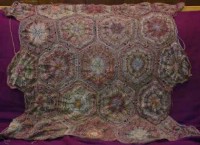
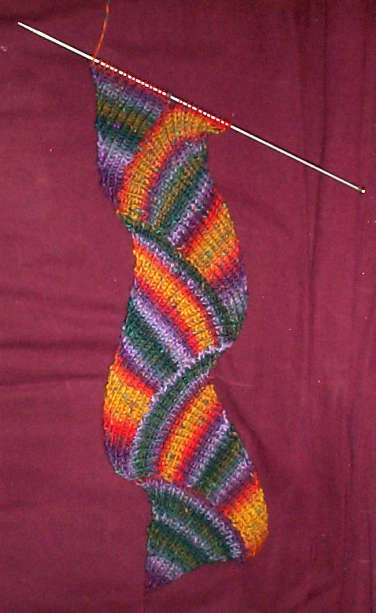
If the repeat is long, you can engineer something fun like my Snake scarf, displaying the long repeat’s gradations to maximum advantage, or working center-out medallions that radiate from one color to another (the brown throw is all knit from the same color number Blauband sock yarn).
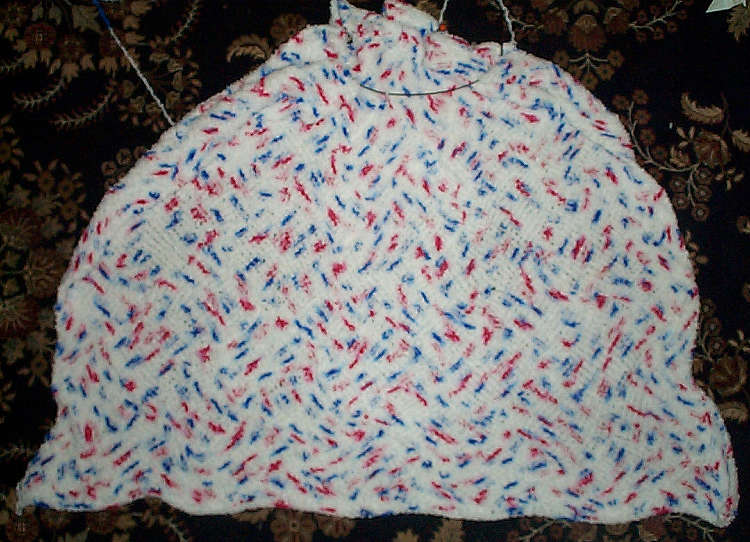
If the color bits are extremely short, the diagonal movement introduced by the Entrelac patches combined with the narrow “bounce area” of the patch width evens out the distribution of the spots, and makes them look like ice cream sprinkles (jimmies to my fellow Bostonians).
Sometimes I’ve broken the rules and used directional-distortion texture patterns with self stripers to break up the march of concentric rings of color by zigging the texture this way and that. My SeeSaw socks, published in KnitNet ages ago are a good example. These are in fact my original SeeSaws, still in service after all these years:

If I can engineer it, I really like making yarns flash – knitting them in the round so that patches of the same color align on top of each other to create an almost painterly effect. The wildly jarring colors of my Rainbow Mills Matisse sweater would not have worked well together if the piece hadn’t been designed to flash. Look at the cuffs and waist ribbing to see how muddy and non-descript the blend is without color stacking. You can also see the difference in the flash pattern produced by the difference in body and sleeve circumference.

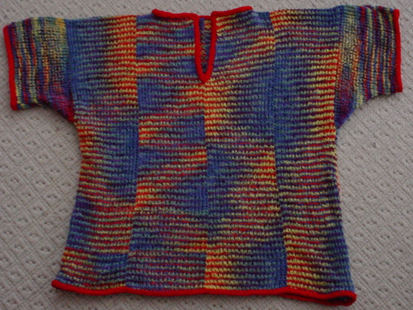
An alternative approach is to limit the width of the strip so that colors bounce back and forth across a narrower strip of ground. That can make the individual stripes deeper, and add interest by adding the “collision lines” where the repeats abut. The piece below was interesting because it was made from four skeins of hand-dyed from the same batch. They were close, but different enough to each present its own periodicity of repeat when knit into strips of equal width.
Sometimes I’m faced with multicolors that just can’t be tamed by stitch direction, calculating garment widths to make them flash, or working them in narrow strips. My favorite solution for those yarns is to find another yarn that coordinates – either by picking up a color from the repeat itself, or by adding another color in contrast. Then I work my solid along with the variegated in stripes or other patterning, in a proportion that tames the wild mix, in effect forcing an new uniting background color into the repeat. In the sock top below, the solid is the magenta. The variegated was turquoise, yellow and hunter green. An unlikely and loud combo, but one that worked.
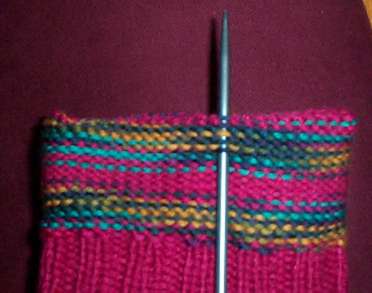
So to sum up, there’s a use for almost every multicolor yarn. Things that make using multicolors easier include harmonious, balanced color sets (even if they’re bright), and a minimum of muddy areas. Introducing movement by stitch direction or by narrowing the strip being knit can be more interesting than the same yarn knit totally flat in stockinette. It IS possible to use texture patterns with multicolors, and even the most savage multicolor can usually be tamed by introducing a background or contrasting solid.
Hope someone finds this useful, so that a skein that’s been languishing in stash somewhere finally meets inspiration.
BACK FROM LIMBO – ENTRELAC FUZZY BLANKET
Here I am. Remember me?
I’ve managed to survive a perfect storm of deadlines at work – about 3 months of +80 hour weeks, odd improvised snacks instead of meals, and barely seeing the Resident Male and the kids. Then I collapsed into our week long escape to Cape Cod family vacation. Seven blissful days with no TV, no computers, no cell phones. Just watching the tide reclaim and surrender the strand, reading, playing golf, knitting, playing Killer Bunnies, cooking on the beach, and paddling Feckless II – our replacement kayak. (Feckless I was swept away during a storm last summer).
I’m now back, facing a double whammy here at String. Not only am I months behind on wiseNeedle and String-related mail and maintenance, plus my personal eMail inbox, I also find that I was hit by the dread Comcast Port 25 block outgoing mail problem, which appears to have started out as an intermittent nuisance before hardening into impenetrability. If you’ve been looking for a note from me starting around early May, deepest apologies. I think we’ve got the thing licked now, switching to a different outgoing port, and mail both in and out should be flowing again.
Now, what did I knit on the beach? Nothing exciting. I didn’t take my green lace piece. I’ve tried to knit lace yarn in windy dampness before and haven’t been happy. I didn’t take my North Truro counterpane. I had intended on doing so, but I came home late on Friday and we had to be in the car and on the road before breakfast on Saturday. I didn’t have time to dig it out, and make sure that all was ready to go. Instead I opted for something new, quick and near-mindless. I took a bag of yarn I got at my LYS’ annual sale with the intention of figuring out a baby blanket to do with it.
The yarn is a bit unusual. It’s Lana Grossa Bambino, machine washable acrylic/polyester blend worsted weight novelty yarn. It’s a short plush/fuzzy, with splotches of contrasting color. It knits up into an extremely soft, terry-like fabric. However the heavy plush obscures almost all stitch texture, and the spots of color compound the problem. About all you can do with this stuff is stockinette, garter or very wide ribs (think k5, p5 at the least). Anything else is totally lost.
So what to do?
First I considered something very flat and very plain. But the thought of knitting all that garter or stockinette was too boring for words. Plus the spots would have that loving-hands-at home look. Not fun. So I played a bit and came up with something simple that puts more movement into the color splotches.
I cast on for the width of the piece and knit four rows, to make two garter ridges, then I began working out in garter stitch Entrelac, on squares of 16 stitches (yes, I cast on a multiple of 16). It’s still all knit, and not the most exciting thing in the world to produce, but it’s more interesting that working the piece plain and flat. And the movement of stitch direction stirs the color splotches a jaunty jig. Compare the very first couple of rows at the bottom to the body and you’ll see what I mean. For once it’s my subject that’s fuzzy and not my photography.
[If pix above aren’t showing, we’re experiencing technical difficulties. Apologies! Will work on resolving them tonight.]
Not an exciting project, but a simple and satisfying one. Plus it’s only two courses of squares away from being done.
WRIGGLING MORE OLIVE OUT OF THE JAR
Not much progress here. My knitting (and blogging) time is severely curtailed by work obligations. I have moved a bit further into the pattern. It’s slow going. In addition to not having lots of time to sit down and make an systematic investigation – the pattern itself continues to present challenges.

I’m still struggling with the $ notation. Sometimes it means k1tbl, sometimes it means k2tbl. At this point I’m using the chart as a point of base information on my quest to make the finished knitting look somewhat like the book’s engraved illustration. Each row is an exercise in winging it, with occasional rip-backs after a repeat or two if they don’t quite work out.
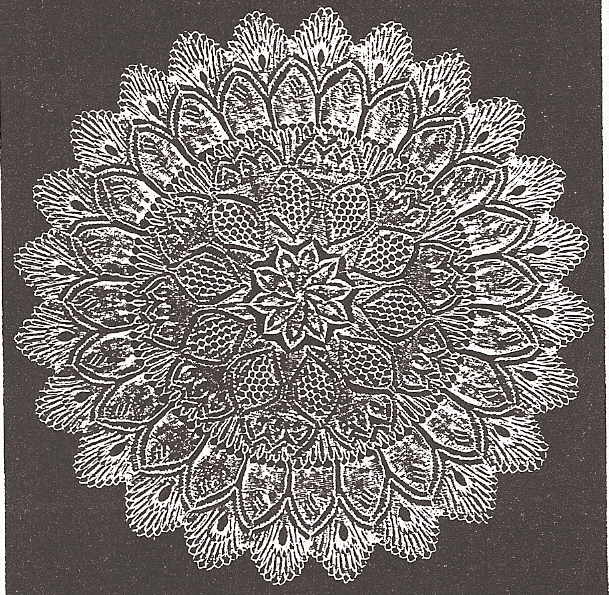
As you can see – I’m close. Right now I’ve just finished the row where the triple peacock tail like elements are topped off with a double decreases, bringing their three lobes to sharp points. After that I’ve got a couple of rounds of a ground type pattern with vertical stripe like lace bars, then I launch into the supplemental graph for the zillion petal border repeat.
It’s hard to say exactly how large this piece is right now, all scrunched together in typical snood-type style on my circs and unblocked, but I estimate that I’m at about 24 inches across. Based on a crude assessment of proportions, I’d say that by the time I’m done with the petal section, I’ll be at 36-40 inches across. Still too small for my intended table, but I’ll worry about that when I get there. Maybe I’ll add another simple ground element, and then a judiciously chosen edging knitted around the circumference as opposed to center-out.
I take it from the astounding silence on recent projects that I’m pretty much the only person in the blogosphere (or at least the tiny minority of the knitworld that visits here) who is working from the Duchrow books. This is a pity, because in spite of the difficulties I’m having now, they are a marvelous source of inspiration. Don’t be daunted by the antique notation, the fact that they’re written in another language, and that on occasion a bit of creative insight has to be applied to make things work out well. This last bit hasn’t been common. I’ve worked up about a dozen items from various Duchrow charts and this is the first one that’s been a struggle. This stuff is Xtreme Knitting at its purest. If you like lace and like a challenge, consider this set.
Rats. I just noticed that I knocked two repeats off the end of the needle getting the radius measurement. Perfection in my work as in everything else, is asymptotic.
OLIVE UPDATE
I imposed upon a German speaking co-worker today, asking if he could help me with a line or two of the Duchrow annotation. Although fluent in his native language, he didn’t speak knitting, but between the two of us we pieced together a bit more detail.
It turns out that the instructions on this one have a special note that II is in fact to be interpreted as one YO, not two. But again – about half the time in order to make the required stitch count on the next patterned row the intervening plain knit row needs to place two stitches into that YO. There is no alternate direction on when to k2 into a YO and when not to do so; nor is there direction on when $ means k1tbl, and when it means k2tbl. So even though I now have the relevant bit of annotation translated, I am no more enlightened than I was yesterday.
To answer some privately posted questions
- The yarn I’m using was a gift. I’m afraid it has no brand name, and I’m unfamiliar with its original provenance.
- I’m knitting directly off the cone. I haven’t bothered to rewind a smaller quantity.
- I don’t have a good feel for how big my final piece will be, and that doesn’t bother me one bit. The directions say that the finished cloth is around 60cm (a little over 23.6 inches), but I think my piece will be larger. Probably on the order of 30-33 inches across if I work it as given. I’d like to go significantly larger – possibly 56 inches across. I may add a course or two of other repeats. We’ll see when I get there. There’s a ton of yarn, so the only limits are my own perseverance and willingness to tinker.
Now I have questions of my own.
- Is there anyone else out there working from the Duchrow series?
- If not those books – has anyone knit from the K. Ichida “Knitted Lace Designs of the Modern Mode” series – the Japanese language Modern Lace series reissuing classic European patterns?
Progress? Not really. I’m entering another chaos period at work, and had to rip back tonight. I managed to drop some stitches when I did yesterday’s photo. I wasn’t able to rework them, so I had to go back four rounds. Three steps forward, one step back.
OLIVES FOR THE TABLE?
Just because lace is an abiding addition, I had the yarn in the house and the book beside my favorite knitting chair, and I can’t stand to be without something to twiddle, I started another interim project from Duchrow’s Volume III.

This one is a stab at one of the in-the-round tablecloth patterns. The chart I’m using is on page 76 if you’ve got the book. (Aside to Long Time Needlework Pal Kathryn – yes, this is one of the charts guaranteed to make eyeballs bleed…)
However, I’m finding this chart a bit more open to reinterpretation than Duchrow’s rectangular ones. To date, I’ve found her charts to have been exacting to follow but largely consistent and error-free. But on this one I’ve found a couple of spots where the symbols were flat out wrong, and a couple of others where the in-book English translation might be off. For example, in this particular pattern the symbol:
ll
is supposed to mean a double YO. In many but not all instances it’s followed on the next patterned row with the symbol
$
which the glossary calls out as being a K1 through the back of the loop. But unless you knit both of the stitches previously formed by the double YO together, the stitch count and resulting look/feel of the piece are both flat out wrong.
It’s also not a given that the double yarn over is supposed to carry only one knit stitch on the subsequent plain knit row, with that second YO loop being dropped (which would make the single k1tbl logical) because in some but not all spots I need that extra stitch to be eaten into a later k2tog or ssk decrease. So the first repeat on each row has been an exercise in looking at the tiny blurry engraving of what the final product is supposed to be, counting stitches and proofing the repeat chart.
Still, the thing is beginning to grow. Here’s the traditional lousy String snapshot of yet another snood-like object wadded up onto needles.

In terms of the yarn – what I’m using is pretty thin. It’s 75% cotton, 25% linen marked as 2/30 – thinner than cobweb or Perle Cotton. I’d say it’s the equivalent of two plies of standard embroidery floss. I’m working it on nice, big 2.5mm needles and getting a quite satisfactory light and open texture. I do have a minor concern with ruffling, but unless I stop and put the whole piece on a temporary holder and spread it out, I won’t know how justified that concern might be.
Olive green may be a bit non traditional for lace, but over a navy tablecloth on my kitchen table, underneath white dishes with navy rims, it will look smashing. And once more, copious thanks to Friend Dena the Lace Enabler, who gave me the cone of yarn.
2008 GORE PLACE SHEEP SHEARING FESTIVAL
I took the kids today out on one of our now traditional Spring jaunts – the Gore Place Sheep Shearing Festival in Waltham, Massachusetts. We’ve been there most years since we moved here in 1996, missing only a couple of the rainiest days.
This year I am of mixed feelings about the day. To be fair, there are far more activities and displays now than there ever were. The festival has grown quite a bit over the years. They’ve added a magic show, expanded the food offerings, added more animal exhibits (oxen, chickens, sheep, goats, vicunas); they’ve added an equestrian demonstration, and now feature a Revolutionary War era re-enactment bivouac. The day is full of things to see and do. Attendance is way up, especially among those with kids under the age of 10. But sadly what fiber arts focus there was in the past appears to be on the way out.
Sheep are still being shorn, both with mechanical clippers and hand-operated snips. The family that does the sheepdog demonstrations still does its fascinating display. The lacemakers are still there, working their exacting way through spectacular pillow lace patterns. There are some beautiful vicunas on display, and one fiber-related exhibit tent remains. Four out of six slots were filled in the fiber tent. One was local shop stalwart Minds Eye Yarns. It was an excellent booth, filled with lots of yarn, but most of it was commercial product that I can buy in the shop itself, or in my local yarn store. Minds Eye did have a display of their own hand-dyed – mostly sock and worsted weight. Bartlett Yarns also had stock of their rustic Maine style worsteds and heavy worsteds. There were two other yarn vendors there, too. One selling rovings and combed/dyed fleeces, and one selling spun hand-dyed worsted.
There were a couple of other yarn sellers scattered through the crafts fair and historical display areas. One was a vendor offering reclaimed cashmere yarn – she buys discarded sweaters, unravels them, washes the yardage, and plies it into sock and DK weight. Interesting but short yardage, and I would have preferred non-pastels, and something that was lace weight. The other two were hand spinners offering a variety of their own products. One was nice enough but in short quantity and plied to worsted weight. The other had mostly yarns whose unevenness, color combos, and overtwist plying were appealing to some, but left me cold.
I miss the booths of some of the other smaller producers – Moorehouse Merinos, Nicks Meadow Farm, and several other concerns that have offered beautiful hand-spun or dyed sport weight and finer yarns. I also missed the fiber/textile facts tent sponsored in previous years by the Boston Area Spinners and Dyers Guild. That one had hands-on activities for the kids, and was something they looked forward to, too.
Maybe the early date of the event posed problems for the Guild and the other fiber tent regulars. It’s usually around mid-May. Maybe for the small suppliers the cost of attending wasn’t covered by income earned at previous events, or travel expense is prohibitive given current gas prices. Who knows… But I can say that this is the first year I tried hard to find something interesting, preferably unique but well made, in a color that sang to me, and came up with nothing.
Yes, it’s true. I came home from fiber festival without a single bit of yarn.
 String-Or-Nothing