THINKING BLOGGER
It looks like I’ve been tagged as a “Thinking Blogger” by several people, including Jenna at Girl from Auntie, and Swapna. I’m flattered, also delighted to be food for thought for someone out there.
Although I don’t do memes, I’ll bend the rule and tag some other websites that make me think. But they’re not necessarily knitting blogs. Believe it or not, I don’t think about knitting all the time. Besides almost all of the knitting-related sites I would have tagged have been touched over the last month. That’s a basic problem with referential memes in special interest communities – they loop back on themselves quickly, like big ripples in a small pool.
- Things Magazine – Wandering compendium of fascinating links to explore. Most have a tie to architecture or art (but not all do). Some are departure points for contemplation, some are just plain neat. Others are immediately useful. Today’s for example has a link to an international dress size converter.
- Chocolate and Zucchini – What’s it like to be 20-something, food-smart with a participatory bent, an analytical mind, and living in Paris? Go through the archives here and melt with envy. The author has issued a cookbook, which is the first and only blog-related book I’ve ever bought.
- Bibliodyssey – This author combs through on-line libraries looking for masterpieces of illustration. What’s presented is a jumble of everything from Medieval manuscript illumination and incunabula, to early 20th century childrens’ books, with detours through academic illustration, Japanese and Chinese scrolls, natural history compendiums, Islamic calligraphy, and early mechanical drawings.
And two knitting blogs that (to my knowledge) haven’t been tagged yet:
- Twosheep – June “DNA Scarf” Oshiro is playing in her garden right now, but when she turns to spinning and knitting, all sorts of explorations happen. If I ever pick up spinning, it will be her fault. As it is, I’m looking at worms differently this morning.
- TECHknitting – How-tos, presented by a far better illustrator, tech writer, and indexer than I’ll ever be.
PRESENTS!
My self-awarded belated birthday present has arrived! I ordered three specialty books on lace knitting, only one of which is in English. They’re not out of print, but I don’t have a separate blog category for current works, so they’ve ended up under that classification:
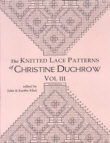


My first present to me is The Knitted Lace Patterns of Christine Duchrow, Vol. III, edited by Jules and Kaethe Kliot. It’s 144 pages in German, with an English foreword and symbol glossary. The patterns are presented in the same graphed format as the Volume I book I am knitting from now. This collection is a bit larger, and is mostly home-decorative items (doilies, tablecloths, tea cloths, and a smattering of counterpanes), although a few caps, stoles, collars, jabots, and a blouse are presented, too. These 100+ patterns are also quite a bit more complex than the ones in Vol. I. I’m especially interested in the large oval shaped doilies, and in a a curious appendix of hand-drawn charts, in another somewhat related notation set, but unaccompanied by as-knit photos. Plus there’s one unusual geometric insertion strip (p 86) and a photo of a lace edging (p.2 but no graph or English pattern provided), both of which may end up on my current very geometric stole. I’m very pleased with this one. The hand-drawn appendix is an appreciated lagniappe, but it is haunting me. I’m too much of a Pandora not to want to discover how those charts knit up.
Old World Treasures is 35-page leaflet in English, presenting patterns entirely in prose notation in a relatively large 12-point font (fellow bifocal victims, take heed!). The 21 patterns mostly for small motifs knit in the round (in the 40-75 row range), useful for doilies, insertions, cap backs, and the like. Three of the patterns are much larger, with one going up to just over 200 rows, and another appearing to be composed of eight smaller doilies stitched onto a larger separately made complementary center. There are motifs with 4, 6, and 8 sided symmetry. Stitch counts at the end of significant rows are given, which is a help. I’m not a big fan of prose directions, so my first step in working from this book would be to graph up anything I knit from this leaflet. Still, I am sorely tempted to attempt a “flower garden” sampler throw based on the centers of the various motifs presented. To do that I’d select either the 6-side or 8-side symmetry patterns and work them all up to the same row, then stitch them together with some plain (or simple leaf-bearing) motifs to complement their mixed complexity. There’s ample food for thought here.
The last book is Knitted Lace (Kunst-Stricken), also edited by Jules and Kaethe Kliot – a 71-page collection of patterns by Marie Niedner. This is another collection of lacy knitting patterns of German origin, and using another early charting system unique to this particular original author. The designs presented are considerably less complex than the Duchrow ones, and includes a fair number of less-lacy textures. The charts are relatively small, and are not always near the text and illustrations they accompany. The collection includes edgings and insertions (many of which are closely related to patterns in the Walker treasuries), plus a strip sampler collection, several long-armed lace fingerless mittens, a couple of counterpanes, the expected flock of doilies and table spreads, plus bonnets, a couple of lace stoles and lace/beaded drawstring purses, and a couple of blouses/jackets – one of which may be intended for a baby or toddler. One quick idea gleaned from this book is an interesting way to finish out scallop shell motif counterpanes using half-motifs to eke out the left and right edges. While there are some interesting pieces here, this book is of as immediate inspiration as are the other two. Had I been able to browse the contents prior to purchase, I might have opted for the second Duchrow volume, or two more of the Penning-edited leaflets in its place. Still, I am not disappointed, and will be working something from this book. Someday.
On an entirely different front – I’ve mailed off my No Sheep Swap package. I included a ball of one of my favorite non-wool blends, a couple of beaded stitch markers of personal significance, and a vintage pattern magazine from my collection. I hope the package gets where it is going because my downstream swap partner never wrote back to confirm her address or preferences.
INCHING ALONG
Incremental progress on two fronts here at String. First, demolition is now complete. Evil Upstairs Bathroom having been stripped to the studs now finds itself at the very beginnings of build-out. The new larger shower stall has been roughed in, and the electrical work has commenced.

You can see the back side of the lath and plaster hallway walls on the outside of the old wall studs. 1912 was deep in the pre-drywall and wallboard era.
And on the lace shawl, I’m over the half-way mark in constructing the center square. I’ve got only one or two repeats left before my proportions are correct.
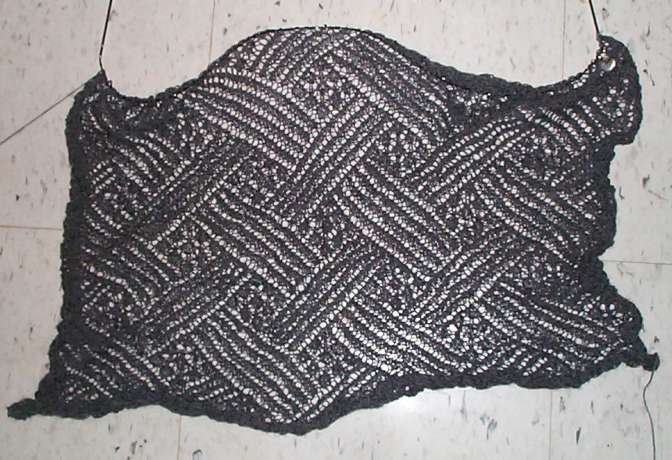
I’ve also tinkered a bit with the base pattern, translating it to modern notation and changing the directionality of some of the decreases to sharpen the lines. Since I have changed it somewhat and recharted it, I present the result. Click on the thumbnail below to load a full-size image
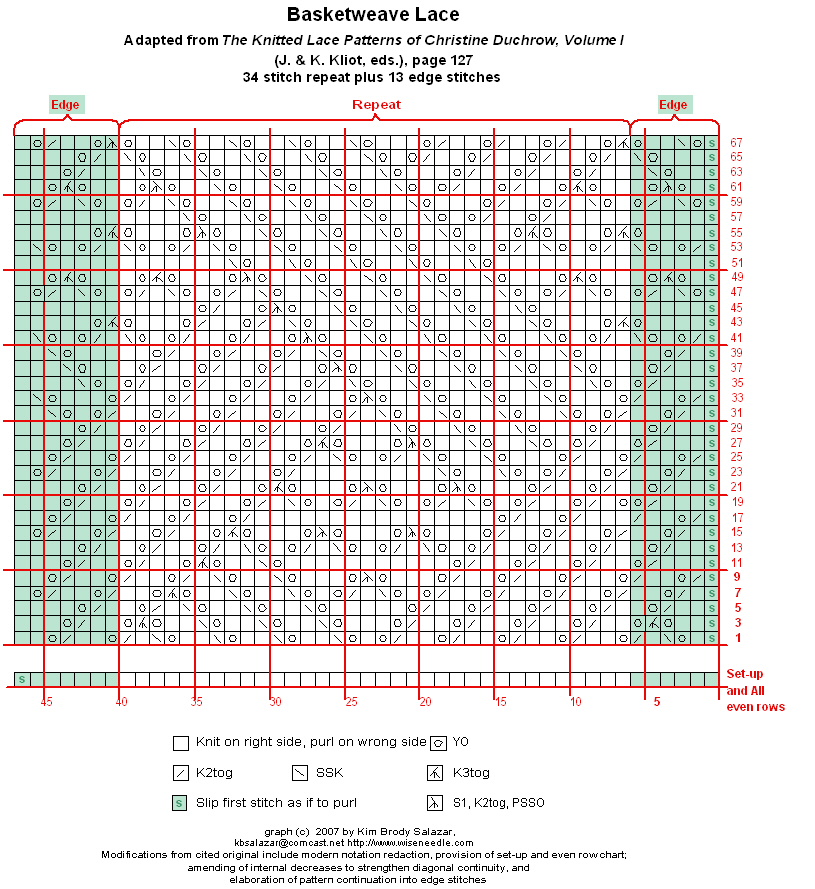
The original lacy knitting pattern from The Knitted Lace Patterns of Christine Duchrow, Vol. 1 was presented as part of two complex garment designs – a blouse and a baby bonnet. There are a couple of complementary simple band patterns for cuffs and trim on those projects. Except for the introduction (which provides a helpful translation key for the symbols and some historical German knitting terms), the entire book is in the original German. From what little knitting German I’ve picked up I can tell that even the written parts aren’t quite modern German knitting prose. Like English knitting instruction writing, the conventions in German have changed over time. While I can work from the chart to make my own whatever, it would be an extreme challenge to knit up the blouse as described.
As the editors of this book report, Duchrow was among the first to try to present knitting instructions in graphical rather than prose format. Her graphs are idiosyncratic by modern standards and use letters and symbols rather than visual representations to represent the various stitches, but with a bit of practice her graphs are not difficult to knit from. Even though I can’t read a word of the accompanying text in Vol. I, I’ve ordered a couple more books in the same Duchrow reprint series. If you’re a lace and lacy knitting fiend, you’ll probably have as much fun with Duchrow patterns as I am.
I feel confident I can share the design because I have redacted it into modern symbols, included corrections, and made changes in the pattern as presented. While my graph is recognizable as a variant of the historical one, there are subtle differences. For example, the original graph for this pattern treats all double decreases identically, rather than using directional variants to reinforce the framing diagonals. It also didn’t continue the pattern into the edge areas as uniformly. It also didn’t show the even numbered row. But for all of that, the pattern works up quite nicely even in the original presentation. I share my redaction/correction as tribute to the original author and the editors of this work, to help other knitters bridge from modern instructions to historical ones, and to encourage others to seek out these patterns and knit them without fear.
Interesting conjecture – from the style of the blouse, it would not be a stretch to say that it was current around the time my house was built. For all I know, the original owner may have sat in the library 95 years ago, knitting the same lace patterns I am working from today.
BATHROOM INSPIRATION
I’ve gotten a couple of questions about the bathroom project – in specific, what we’re aiming for. While we’re not doing a historical restoration type true-to-period room, we are taking inspiration from the downstairs bathroom. It’s been less meddled with than the upstairs horror:

The downstairs bath has one-inch white hex tile on the floor, white railroad tile (with high rail detail) on the walls, a very similar stained glass window to the one upstairs, and pedestal fixtures. I especially like the little sitzbath – it’s great for kids’ bird baths or foot washing when you don’t want to fill a bigger tub. Along the way this bathroom has lost its original sink faucets and high tank toilet, but in addition to the mini-tub it still has an extra long full size tub (not in the photo); and a simple built-in wooden storage cabinet. We’ll be replacing the toilet again as part of the current work due to some unfixable slow leaks on the one that’s there. Someday we’ll also do the sink hardware, but that’s small peanuts compared to the awful upstairs. The rest of the downstairs bath works well enough, and is perfect for the house.
The upstairs bath will pick up the white hex floor and railroad tile with high rail look, with the addition of a green pencil line tile just under the rail. That should accent the green in the window. The upper walls will be painted white. We didn’t want to go the restored tub route (weight, mostly plus some cautionary experiences from my earlier days working for an architectural antiquarian), and couldn’t find a new pedestal tub in our price range, so we opted for the plainest white with-feet new tub we could find.
The other big departure from historical accuracy is a vanity stand that’s natural oak color rather than one that’s painted white. It’s a free-standing furniture type piece rather than cabinetry, and will be topped with green stone and an underset white porcelain sink. Since the storage cabinet downstairs is original to the house and has never been painted, maybe the “only white painted woodwork in a bathroom restoration” rule isn’t hard and fast.. Plain brushed nickel finish fixtures with white porcelain butterfly handles round it all out. And we’ve opted to keep the separate shower stall rather than combining the shower with the tub. The new shower will be the same depth but a bit wider than the old one (taking up some of the room previously wasted on the double sink vanity), with a very plain frosted glass door instead of a billowy curtain. We’ll also keep the mini-radiator, but clean it and paint it white.
That’s it. No over the top fancy fixtures, no bowl-mount waterfall sinks or spring rain experiences, no criminally expensive imported tile or lighting, no sybaritic soaking tubs or sauna showers. Just classic stuff, relatively unfussy and congruent with the style of the (mostly) untouched 1912 house. And with luck it will all work well together nicely, be easy to keep clean, and enjoyable to live with.
INUNDATION, DEMOLITION AND TRADING
A hectic past couple of days here at String. First, the website itself was attacked by spammer ‘bots. Between Sunday afternoon and Monday night, they posted over 2,300 individual pingbacks to a collection of specious websites. I’ve been trolling through all past pages here, deleting the references. I think I’ve got them all now, but if you see one, please don’t click on it – let me know instead and I’ll deal with the blasted thing.
The other major event has been the kickoff of our long-awaited upstairs bathroom renovation. We’ve been in this house now about 2.5 years. All that time our upstairs family bath was only partly functional, with poorly functioning plumbing, 1960s-vintage yellow, clammy plastic paneling (impossible to get or keep clean), patched vinyl flooring, hideous pizza parlor hills-of-Tuscany wallpaper, crumbling laminate over particle board cabinetry, and awful mustard fixtures with gold tone faucets. The only nice thing about it was a stained glass window (partly visible in the first shot):

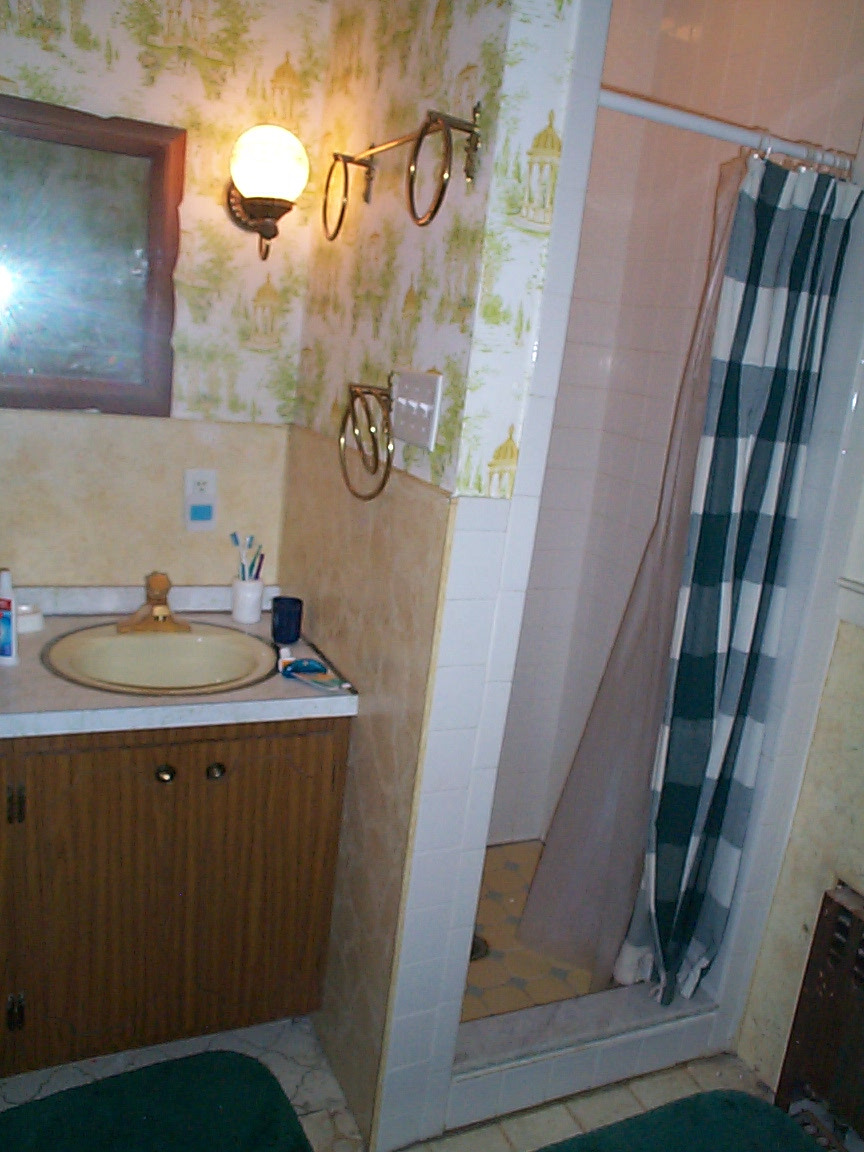
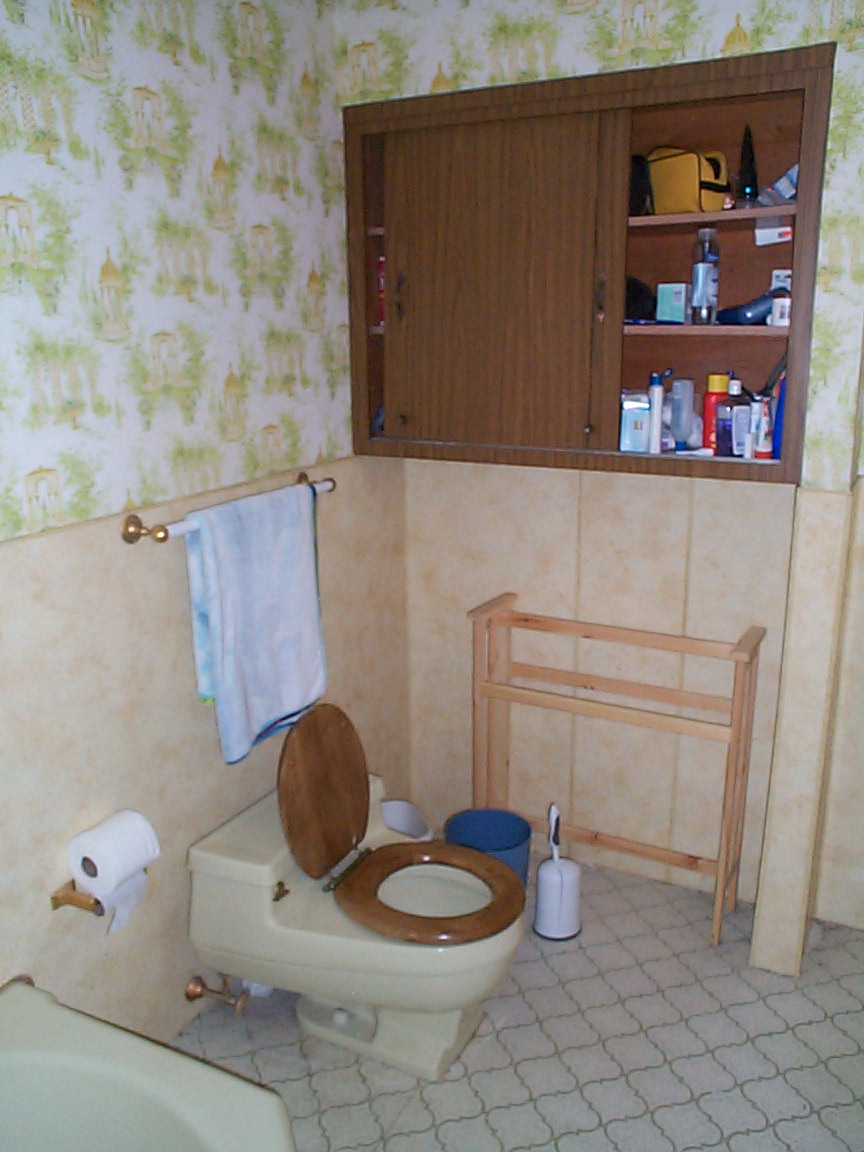
We’ve been plotting and planning to replace the whole lot with something functional, clean, and historical in mood. Yesterday the project began in earnest, with the contractor carefully removing the antique window and door, then gutting the rest. I promise not to make this a home-improvement blog, but if anything interesting happens, I might report it here.
And finally, just before the aforementioned chaos hit I had a happy not-so-surprise. I signed up for the No Sheep Swap. I generally don’t participate in swaps or knit-alongs, but this one sounded like fun. My gracious and generous upstream swap partner (and all-around fascinating person) sent me this package of goodies:
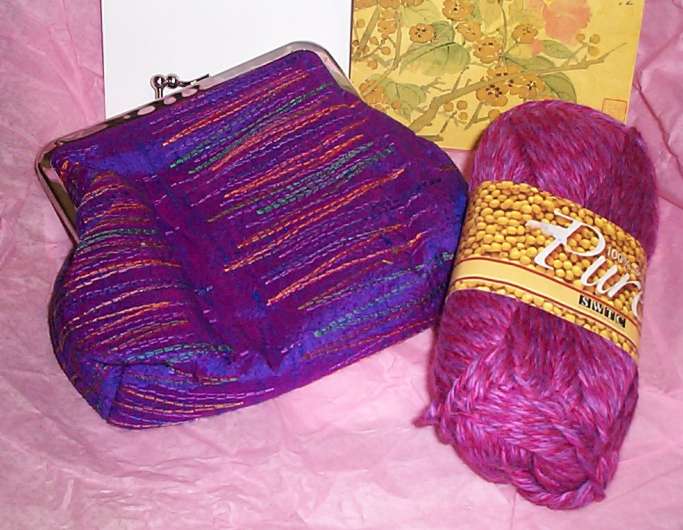
It’s a skein of South West Trading Company’s Pure, a 100% soy silk yarn in happy berry colors, plus an embroidered purse big enough to be used for knitting accessory wrangling. Thank you, Melanie! I’ll post back here after I’ve tried it out.
On the downstream end, I have been waiting to hear back from my assigned recipient, but my notes and card have gone unanswered. I can’t wait any longer because to abide within the rules of the swap, I have to have her package in the mail shortly. I’ll have to pick something out without guidance on color or yarn weight preference, and hope 1) she’s there; and 2) she likes it.
[Aside: Apologies to Dena, who inadvertently was awarded an extra E when I was spelling her name. It stands for “excellent” and being obvious, intruded itself smack in the middle of my orthography. Thanks again for the fantastic lace-weight. I’m pretty sure I have enough, but if I do run out, I will resort to all sorts of begging, pleading, groveling, offering, trading, negotiating and bribery to secure some more.]
BACK FROM SAVANNAH
Back from the conference and trying to catch up, I show off my airplane knitting – the beginnings of the lace shawl I mentioned in my last post.

I’ve pinned it out somewhat so you can see the detail. The lace texture pattern is from Knitted Lace Patterns of Christine Duchrow (Vol. 1). It’s the last one in the book, and is shown as a bodice and a cap. The book itself is in German, with an idiosyncratic (but charted) notation system. Judy Gibson has posted a nice set of hints for working from Duchrow charts for people like me who don’t read German. As far as difficulty, the 34 stitch repeat – though large – is pretty easy to memorize. Once it’s established, the progression is very logical. My piece contains four full repeats plus about 14 edge stitches.
My plan is to work a square of this basketweave pattern, then pick up around the edges and work one or two tiers of patterns outward, mitered at the corner; then finish the entire thing with a knitted on edging. I haven’t chosen the next set of framing patterns yet. By the time I get there, I’ll have figured it out.
As far as the proposal conference went, it was valuable from a couple of viewpoints. First, it turns out that I know more about my subject than I thought. Second, the state of the art has moved on in the last dozen years since I went to official proposal training. I did pick up quite a bit. The next challenge will be to impose the improved structures and tools in the workplace.
In other news – my upstream No Sheep swap partner sent me some wonderful goodies (more on this in the next post), but I have not heard from my downstream receiving partner yet. If I don’t hear tell of her preferences by mid week, I’ll have to pick something out with no guidance on yarn weight or color type. I hope I guess correctly.
And finally, I celebrate another birthday that came and went while I was away at the conference. I was treated to an excellent dinner at Savannah’s Olde Pink House by a dear friend, but also to celebrate, I just ordered myself three more books on lace knitting. Happy birthday, me!

POSTING FROM THE ROAD
Not sure if this will work o.k., but I’ll give it a try.
I’m away from home base this week – attending a professional proposal managers’ conference in Savannah, Georgia. (There is no activity too obscure not to have its own professional association.) Posting will be severely hampered by lack of time and camera until I return.
In the mean time I can say I brought a couple of things to work on. One is a pair of standard socks. The other is the beginnigs of a more or less original lace shawl (more because I’m working it out on the fly, less because the patterns in it will be adapted from existing sources.) I’ve started with an unusual large repeat lacy pattern from a Rachel Schnelling pattern compendium, published in German. I’m using a magnificent tobacco color cashmere light laceweight given to me by long time knitpal Friend Deena. (Hi, Deena!) Pix upon my return. I promise.
COLONIALS INVADE
Life continues to intrude on my knitting time. Besides the regular flock of work-related obligations last week, I was surprised by Smaller Daughter. Thursday morning, rummaging in her backpack looking for her lunchbox, I found a notice for her elementary school’s Colonial Day. It’s an interactive festival sort of day, but one that requires all of the kids to dress in some attempt at a historical costume. (To be fair, I had heard about it long ago but forgotten.) So with a costume needed within 7 days, but my being away on a business trip starting Monday, my Memorial day weekend activities now included a close huddle with my ancient Elna sewing machine.
I wanted to make something relatively early – closer to first encounter than the Revolutionary War so that target child had a chance of wearing her outfit again. I pelted over to the fabric store during lunch hour on Friday and picked up a couple of remnants – 2.75 yards of a soft green twill whatever (plus matching thread), and one yard of a linen-look in white, all for about $10.00. The price was right.
Then I came home and thought about what to make. I had already made her a puffy white pirate shirt that could double as a chemise, and I have a small white cap and coif set. A skirt, a bodice of some sort, plus an apron would be enough. Drawstring skirts are easy enough, but the bodice part was tougher. Front lacing (instead of buttons) would do. Thankfully the topography of an 8-year old is easier to accommodate than that of a post-pubescent. I took measurements and drafted out a simple tab-bottom bodice with short sleeves. To make it substantial enough, I cut two of everything, so that the whole thing is self-lined. Here are the resulting pattern pieces, snipped from Red Sox coverage in the Boston Globe, plus all of the pieces sewn and assembled into the final bodice/jacket.
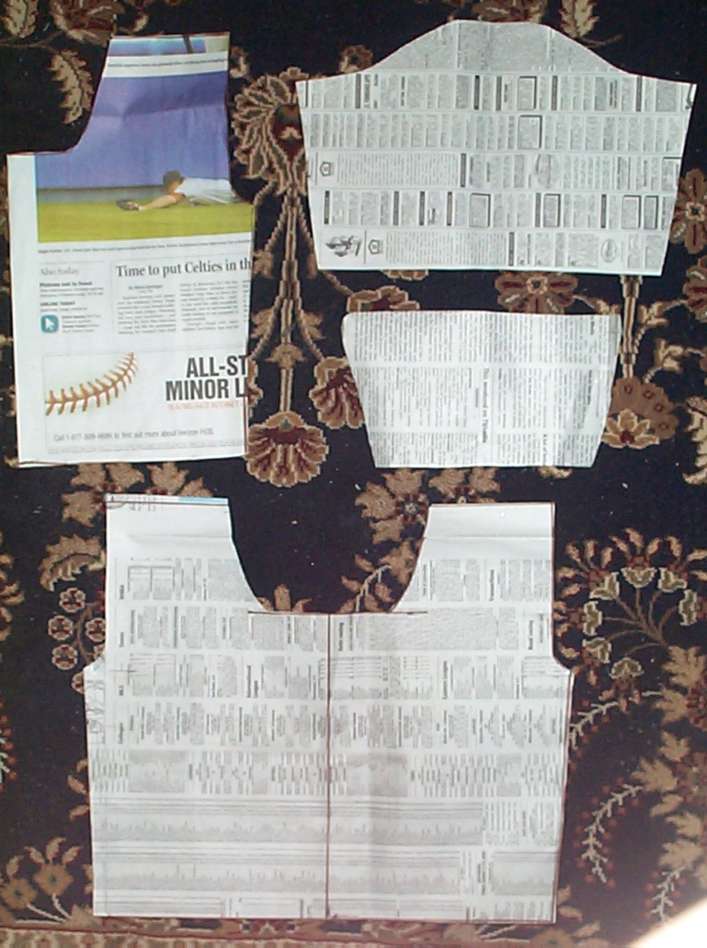
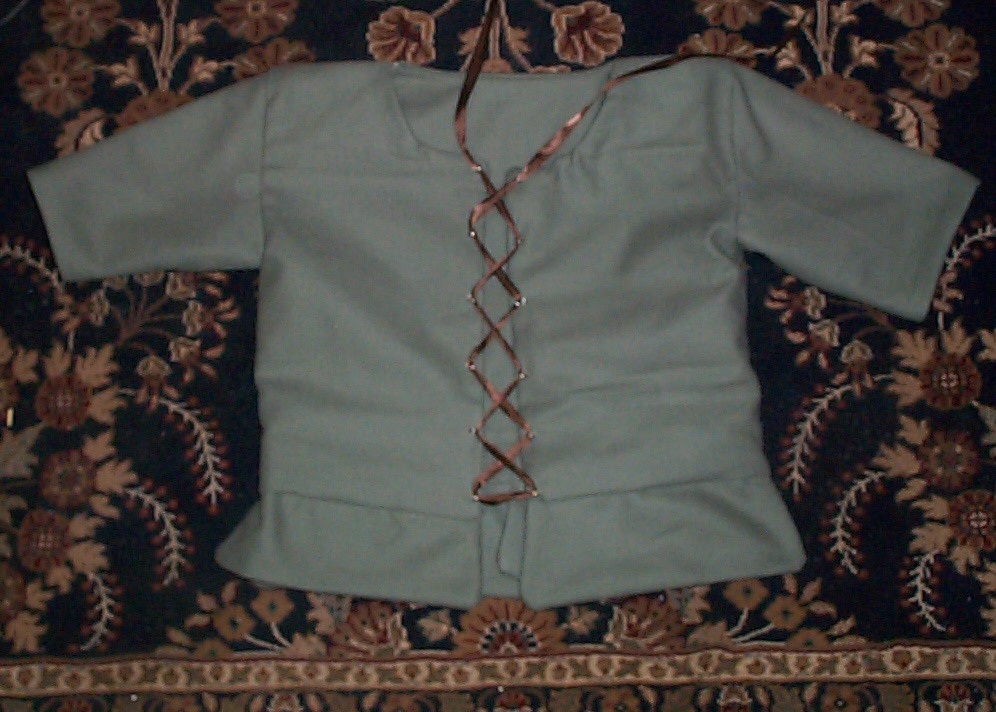
Things went pretty smoothly. I started by sewing the shoulder seams of the outer and inner shells, then uniting them along the neckline by sewing them together up the center front closure and around the neck. Then I sewed the side seams of the inner and outer shell, inverted the inner lining and pressed everything flat. The sleeves went together quickly, too. I sewed the inner and outer sleeve along the bottom edge, then did the underarm seam for the united unit all at once. I inverted the inner linings and pressed my sleeves. Once the sleeves were together, I set them in the bodice. Then I sewed together the inner and outer side of the tabs (that odd shaped piece below the sleeve) – making one for each quadrant of the garment. I turned them inside out and seamed them to the bottom edge of the outer shell. Last, I folded the inner shell’s lower edge down to cover the raw edges of the tabs, and hemstitched it down by hand (too may layers for my sewing machine to cope with).
Since I didn’t have much time, I didn’t go with a zillion buttons or hand-made lacing holes. There’s little if any tension on a little girl’s bodice, so I didn’t bother with reinforcing the lacing edge. I opted for the not very historical but really quick stage option – small rings sewn along the lacing edge to hold the fastening ribbon. Sacrificing a dozen split rings, formerly in use as place markers for lace knitting, I stitched them down by hand.
The apron was also easy. I cut two strips off the top of my yardage and lapping them end to end, pressed the seam lines for the apron’s band and strings. Then I sewed the edges of the remaining piece (again doing it double-sided for additional body), gathered the raw edge and encapsulated it in the center of the apron. Time from taking the first measurements to final hemming – approximately 16 hours of work.
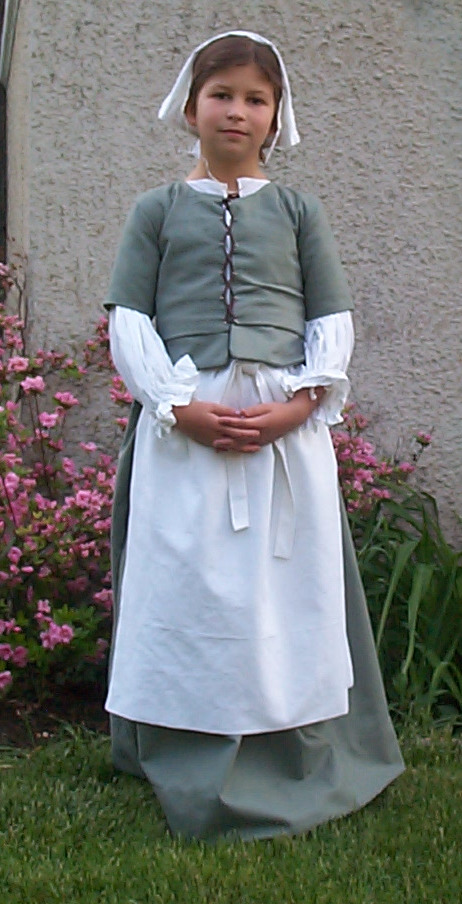
Here’s the end result: one semi-historical kid-suit, inspiration from the 1620s. And yes, Target Child did help, learning how to use the sewing machine and working it for long, straight seams, tracing the pattern pieces with chalk, and doing a bit of the hand-work.
Knitting? I finished my vintage lace scarf. Blocking was postponed on account of Colonial Day.
VINTAGE LACE SCARF; ATTACHING LACY EDGINGS
Where have I been? Well, first there was another spate of chaos deadlines at work. Then it was the beginning of Birthday Week here in the String household (they’re 7 years and four days apart, with mine shortly thereafter). And to no one’s surprise, I came down with a nasty flu. I’m not yet over that, but it was severe enough for me to stay home from work – something I’ve done only once or twice in the last decade.
For her birthday Smaller Daughter specified a volcano cake with a dragon on it. She’d seen something like this in a kiddie cookbook – a bundt with a lava-like frosting poured on, surmounted by some clever marzipan decorations. So we made it a group project. I provided the almond bundt with chocolate fudge filling and frosting; Older Daughter molded the marzipan dragon with dried apricot wings; and Smaller Daughter made the strange red prey creatures fleeing from the dragon:
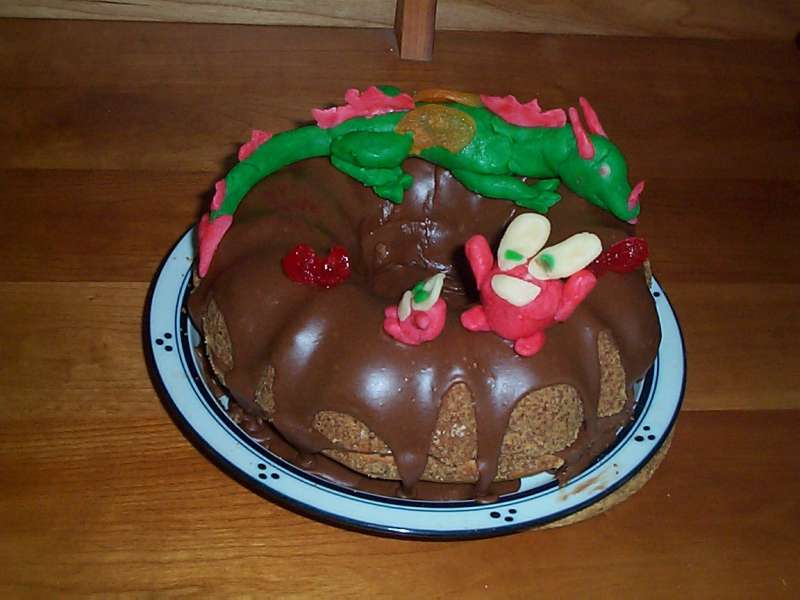
We were hard pressed to find enough room for the obligatory birthday candles. The cake and decorations however were delicious.
I did manage to make some progress on the lace scarf over the last week. I’ve finished the center section, and am working on the edging. It looks like I’ll have to nip into my third skein of Prescott, so I’m thinking of pausing on the edging to go back and add some length to the center section before lapping all the way around that last end. I’m not doing anything fancy here – no mitered corners. I’m just working an extra repeat of the pattern into the cornermost stitch, and hoping that all blocks out evenly later.
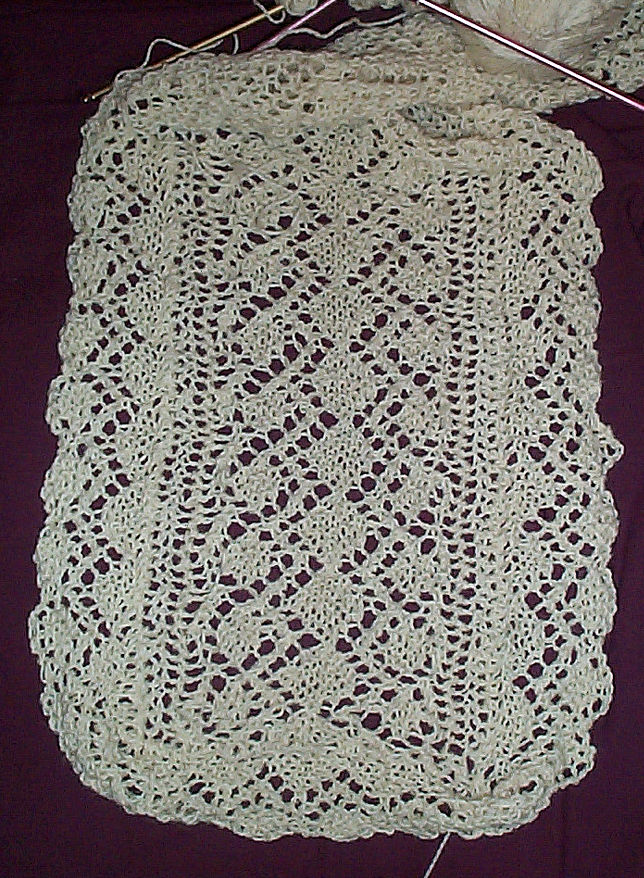
UPDATE: THE LACY EDGING BELOW IS NOW AVAILABLE AS A SINGLE PATTERN DOWNLOAD UNDER THE KNITTING PATTERNS LINK, ABOVE.
I played with quite a few edging patterns for this piece, finally settling on the “Doris Edging” from Miller’s Heirloom Lace. It has framed diamonds that exactly complement the center strip. Along the way I noodled up another simple triangle-based edging. This is an out-take, and didn’t end up on the scarf. I won’t violate copyright by sharing Miller’s edging (which I used more or less verbatim), but I will share this one:
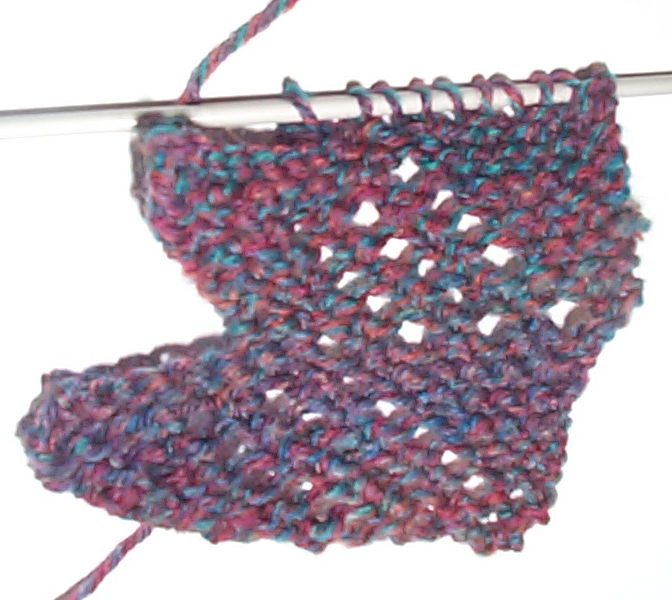

Knitting an edging onto a piece isn’t difficult. It helps if your base item was worked with a slip stitch selvage edge, but that’s not mandatory. I’ve knit edgings onto all sorts of things, including finished fulled/felted items, fabric, and leather (some caveats on this, below). The slip stitch selvage just makes it easier. Your chosen trim will have one edge intended to hang free. Most often that will be dagged, serrated, scalloped or otherwise fancified. It will also have one (more or less) straight edge. This straight edge is intended to be sewn or knit onto something else. I like to work in the orientation shown in the knit sample and pattern, above – with my straight edge on the right, and the fancy edge on the left. My right-side rows commence from my main piece outward, and my wrong-side rows return from the fancy edge back to the main piece.
Sometimes I use a provisional cast-on and start my lace rows immediately after it. Other times I use a half hitch cast on, then work one row back in knits before starting my lace patterns. There’s no real rhyme or reason here. It’s just what I felt like doing at the time. In this case, I cast on using half-hitch, and worked a row of knits back, working my first join on that “back from cast-on” non-repeated row. The join itself is quite simple. When I get to the last stitch of my wrong side row, I pick up one stitch in the edge of my established body piece. Then, for the first stitch of my right-side lace row, I either knit or purl that newly created stitch along with the next stitch after it on my needle.
If I knit those two together I end up with a neat column of stitches that makes a visual line between the lace edge and the main body. While this can be desirable in some cases, it does present a different appearance on the front and reverse of the work. Because the lace center of this piece is garter, and the edging is also presented in garter, I used a P2tog to make the join. The front and back of the work look less different from each other if I purl the join instead of knit it. Once the join is made, I work out the remainder of my right-side lacy row, and the return row. So long as I remember to pick up one stitch at the end of every wrong-side/return row, then work that stitch together with the next one as I begin the right side row, my edging will be firmly united with my main body.
Sometimes you don’t want to do a row-for-row join. Occasionally the stretch of the lace edging or the ratio of the edging rows to body rows isn’t 1:1. This might happen if you are working the edging on smaller needles; or if you are working the edging across a row of live stitches (or across the top or bottom cast-on or bound-off edge) rather than along the “long side” of the work, parallel to the main body’s knitting. In that case you may need to either work additional non-attached lace rows every so often, or pick up at the end of the wrong-side/return rows by knitting two body stitches together, again every so often. The former adds more length to the lace, the latter subtracts width from the body. Which method is used depends on the stretch of the body.
The biggest caveat in attaching knitting by knitting on rather than by seaming is that if you do so, the lace is no longer “portable.” Let’s say in a fit of Suzy Homemaker frenzy, you edged out a set of exquisite hand towels. It’s now some years later, and your children have stained those towels beyond recognition, but the edging still looked good. If you had knit the edging separately and seamed it on it would be very easy to remove and re-apply to new towels. But even if you had run a band of slip stitch crochet down the edge of the towel to provide an easy edge for attachment first, if you had knit that edging onto the towel, removing the fancy lace from the towel will be …problematic.
As far as knitting onto fabric, fulled material or leather – it CAN be done. If the edge can be pierced by a needle tip (or was conveniently punched beforehand), you can knit right onto the edge of anything. BUT the warning about not being able to take the lace off again or adjust it later is strongly in effect. If you want to attach a lace edging to any of these substrates, it’s worth it to work one row of slip stitch or single crochet along the item first, then knit (or seam) your knitted edging onto that crocheted foundation row. The foundation row of crochet gives you a stable, evenly placed line of stitches for the joins, and stabilizes the base item’s edge somewhat. It also (in the case of leather) makes working into previously punched holes easier (a crochet hook is much easier to thread through and grab a strand than is a knitting needle’s tip). Plus, if you think the item being trimmed might shrink, consider seaming rather than knitting on so you can make adjustments later.
So. If you plan on using a lace edging again on another item, or you think your base item might shrink – take the time to seam (collars, cuffs, bed or bath linens). If the edging will remain on that piece, living and dying with the item that bears it – consider knitting on instead (knit counterpanes, scarves). To illustrate this post I wish I still had the denim jacket I trimmed out in knitted lace, or the baseball jacket that used strips of recycled fur interposed with white Aran style heavy cables…
In any case, back to sniffling and a nice lie-down.
CHARTING 107 – WORKING FROM ANTIQUE KNITTING PATTERNS
Apparently my post on knitting patterns from books published prior to 1920 or so has struck a chord. I’ve gotten a couple of requests on how to go about translating these older knitting patterns to modern notation. I did a six part section on how to graph up patterns from written notation before (Charting 101, 102, 103, 104, 105 and 106 ), so this sort of follows as optional post-lesson workshop.
This time I’ll start with a web-available pattern. K. Harris at Vintage Connection has posted a transcription of a knitted insertion pattern that first appeared in The Delineator magazine, in June 1896. I’ll be producing a modern notation graph for that lace panel. Before we begin, it’s worth noting some common features of turn-of-the-century knitting. Not every technique known today was widely used, and terms varied a bit – even more widely than they do now. I’ll try to cover some of the most common notations.
Knit and purl – k, p
Not much difference. Basic knits and purls were pretty much as we know them. There were however a couple of associated usages that are less common today. Knit plain usually meant work in knit stitch only. One complication – it follows then that for things knit in the round knit plain came to mean “work in stockinette.” Occasionally by extension knit plain was used to indicate stockinette done in the flat rather than in the round, even though intervening rows of purl by necessity exist. I’ve also seen it used very infrequently to mean “continue working in established pattern,” but that’s rare. More often the term work even was used in that context.
Another alternate usage – purls were sometimes referred to by the term seam, as in the instruction “knit two, seam two” to produce k2 p2 rib. This is probably a hold-over from early sock making, in which a column of purls on the back of the leg was used in imitation of a seam line.
Narrow – n, k. 2t, t,
The modern equivalent of narrow is K2tog – the standard right leaning decrease. Sometimes this is written up as K2, with the “tog” part of K2tog being left out entirely. Older patterns did not use SSK. Occasionally they call out a SSK equivalent of “slip one, knit one, pass slip stitch over” (see below) but most often they don’t bother with a left leaning decrease, and use K2tog, even when the cognate would be visually more balanced or appealing. Close inspection of accompanying illustrations reveals that the knitters did employ K2tog for almost all decreases. Less frequently this decrease is referred to as together (t) or knit 2 together (k. 2t.).
One unusual notation on narrow – a couple of patterns I’ve seen use n followed by the note “by slipping the needle through the back of the stitches.” This does sound a bit like a proto-SSK. But unless otherwise modified or explained, it’s pretty safe to assume that any n means k2tog.
Slip – s
Another movement that’s pretty standard. Unless otherwise modified, slip in historical context means slip purlwise – transferring the stitch from the left to the right hand needle without changing its orientation.
Slip and bind off – sb, sbo, sl&b,
Another historical way of referring to the left leaning decrease or SSK equivalent, this refers to the s1-k1-psso unit.
Over – o, th, w, tho, th. o,
Yarn overs or eyelet producing increases – still a source of multiple terms today – have even more names if you go back through time. I’ve seen YO referred to as over (o), throw (th), throw over needle (tho or thn) eyelet (e), widen (w), make (m), put over (po), yarn on needle aka yarn over needle (yon), wool round needle (wo, wrn, won).
Special note on double YOs. Most of the time modern patterns use a multiple-unit YO if a really big eyelet is needed. But in historical patterns when YOs were used to make columns of fagot-stitch lace, it was common for the YO that formed them to be specified as a double yarn over, probably because of the yarn manipulation used to create them needed to allow for a subsequent p2tog. If a pattern with fagoting calls for a double yarn over but the stitch count on the subsequent row doesn’t account for the additional new stitch (or doesn’t mention dropping it), it’s a good indication that a modern redaction will call for only one YO and not two.
Make – m
This can be problematic. It’s on the previous list as a euphemism for YO, but it is also used in historical patterns for invisible increases – where an additional stitch is added without creating the eyelet hole formed by a YO. Modern “make” is usually interpreted as a raised bar increase, although other forms of adding a stitch like knitting into a stitch on the row below are also sometimes used. A bit of close examination of any illustrations or even experimentation may be called for here. The term made stitch is also sometimes used to indicate the new stitch formed by a YO in a previous row – especially when more than one YO created multiple adjacent loops on the needle.
Purl two together – p. 2 t., p2to, pto
Purl two together was a very common instruction, especially when columns of fagoting style lacy knitting were used.
Crossed knit – c, t, b, tw
Crossed knits are modern twisted knit stitches, produced by knitting into the back of a stitch (ktbl). I haven’t seen a historical pattern that includes a purl through the back of the loop (ptbl), but that doesn’t mean that one doesn’t exist.
Now with all this set out, I can graph up the diamond insertion from the Delineator. It starts out with a cast-on of 23 stitches. It includes double YOs, but all double YOs are followed by p2tog units, producing the columns of fagoting in either side of the center design. I’ll show the progression from as-described rows through modern notation.
First, as written, preserving the double YOs; without flipping the wrong-side rows in accordance with the modern charting convention of showing the work as it appears on the front (public) side; and without centering the rows or norming the chart to have parallel edges we get this: (click on images below for larger versions):

We quickly see that stitch counts vary from row to row, although the pattern is more or less internally proofed because wrong side rows do contain the same number of stitches as the right side rows that preceded them. We also see that the double YO followed by P2tog problem is here. Were those YOs to each be “real” each following wrong side row would need to be two stitches longer, and the lacy effect would not be achieved.
Other features of this pattern are pretty straightforward. YOs are YOs, whether they appear on the front or reverse side rows. The K3tog unit only shows up on front (even) side rows. P2tog when seen from the back is a plain old k2tog, so that’s also easy to flip.
So. Norming the presentation so that wrong-side rows are shown using the correct right-side row equivalent symbol, and isolating the side columns of fagot stitch, and consolidating the YOs we get:
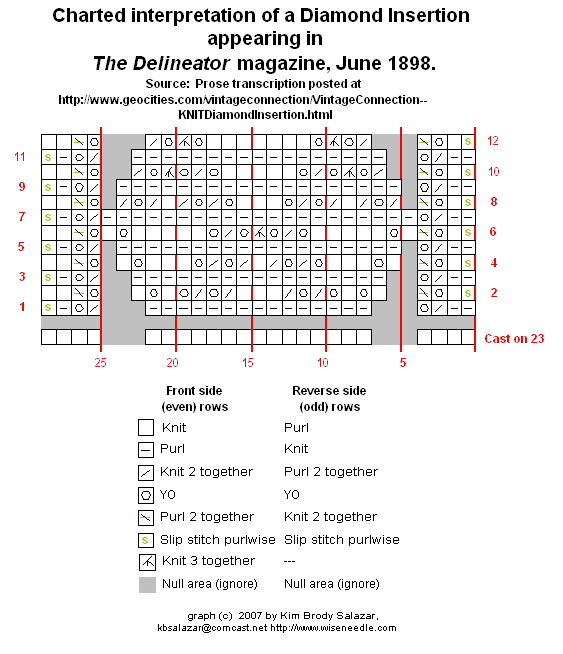
I’ve gone through all of this not only for the fun of sharing, but also because I am using this particular pattern to knit up a new quick lace scarf. I’ll edge the thing out with something complementary, but for now, here’s how it looks:

Knit somewhat overscale in Swift River Prescott on US #8s, one panel of this lacy pattern is perfect for a scarf – curl-free and totally reversible!
 String-Or-Nothing
