INVERTED HEEL – FURTHER EXPLORATIONS
?Thanks to everyone who left recommendations on inverting heel flap
heels for toe-up socks. There probably are lots of "official"
ways to do it. Leah mentioned one in Gibson-Roberts Ethnic Socks and Stockings. Kathryn says there’s one in Church’s Sensational Socks. Brigid sends us to the KnitSocks Blog.
Emily says just to do a plain old flap heel, as written for cuff-downs,
and Rob points out a totally different approach adapted from Rehfeldt’s
Toe Up Techniques for HandKnit Socks.
You know sometimes there’s a reason to bow to the giants who have gone
before. And sometimes for no reason other than personal
perversity and the joy of fiddling with something on one’s own, there’s
a reason to keep on plugging away despite all the world’s advice to the
contrary. I’ve been feeling contrary.
I worked my heel as described in yesterday’s post. Here’s the result:

I tried it on. It fit, but the sock ended up being too
long. Plus I wasn’t entirely satisfied with the location of the
gusset. it was centered too low on the foot, with too much above. Fabric sort of lumped up on top of the ankle. So in
this aspect at least taking a recommendation from Emily, I ripped my
sock back to about a half-inch below the heel and reknit the thing on
50% of the total stitches. I ended up picking up 15 stitches on
either side of my heel flap.

I like this better. I had thought that not having a heel cup (the
turning the heel bit) that I’d end up with little wings at the corners
of the heel flap. The sock unworn kind of looks that way, but
when worn, everything fills out and no little corners protrude.
Perhaps that’s because my feet are so wide. This particular pair
is a gift, so I’ll have to knit another pair using this heel and give
them a thorough wear testing. I am keeping this heel. (The color on this second photo is closer to Real Life.)
In any case, I’m now up to the ankle part and am about to place the
knit/purl motif I’ve drafted up. It’s a very simple geometric design
based on some rectangles. Thinking on the way knit/purl
patterning looks, I’ll work the foreground in knits, and the background
in purls. I’ll either place it in a stripe of purl that goes
completely around, or box the motif in a purl field. More on this
tomorrow…
INVERTED HEEL FLAP FOR TOE UPS
A couple of people wrote to me yesterday to report on faux chain mail
sightings – mostly in movies. With the exception of a couple of very
recent mega-budget fantasy and historical pictures, the majority of
movie mail is the fake stuff. For example, in Branagh’s Henry V,
a couple of the leads wear real chain (laughably without the padding
that actual use would require), but the majority of the cast including
some characters with significant screen time wear knit yarn mail.
On the knitting front, I am finally tinkering with the reverse Dutch heel flap for toe ups thought experiment
I wrote about back in March. I’m working a fingering weight sock on US
#0s, on 68 stitches around (17 stitches each on four DPNs). The method
I wrote about then looks confusing to me, even in retrospect, but
trying it out all became (sort of) clear.
I knit my foot until
I achieved the length I thought I’d need from toe to hard up on the
ankle. Then, taking care to center the pre-heel bottom of the foot
stitches on the bottom of the foot – I worked a protruding flap on
about 20% of the heel’s stitches (more on the figure later). I slipped
the first and last stitch of the flap to make picking up along it
easier, and knit it about 1.5 inches long. When the flap was that
length, and finishing with a knit row, I picked up the stitches along
the flap’s left side, then knit across the top of the foot, and picked
up the stitches on the flap’s right side. I then was ready to begin my
gusset decreases. I worked along for a while, decreasing at either side
of the picked up stitches every other row.
It quickly became
clear that this heel – although structurally correct, was flawed. I had
a narrow band of stitches along the center bottom of the foot, with two
prominent ridges made by picking up on either side of the heel. I had
extra depth in the ankle, but the heel itself was too shallow for a
comfortable fit. So I ripped back and began the heel again.
Right
now I’m inspired by Emily Cartier’s suggestion from the blog comment
she left on the entry cited above. She suggests working a reverse flap
heel on 50% of the available stitches rather than 20%. Bigger is most
certainly warranted here, but 50% looked a bit big to me. So
(apologies, Emily) I’m going to try a figure closer to 30%. Now I’m at
the large rumply yarn clot formed by ripping back, and naked foot
stitches just before the heel begins stage, but this is what I’ll do,
and how I’ll go about working the heel on 4 DPNs.
- I’ll
look at my toe and identify the center of the bottom of the foot (no
point in working a heel akimbo). That point will lie between two of my
DPNs, as I work my socks using a set of five. - I’ll arbitrarily
set my bottom of the foot flap at 22 stitches total. Since I’m working
with 17 stitches on each needle, I’ll slide six stitches from the
leftmost bottom of the foot needle left to the one that normally holds
only the top of the foot; and I’ll slide six stitches from the
rightmost bottom of the foot needle right onto the other top of the
foot needle. Finally, just to make things a little clearer, I’ll
consolidate all the heel flap needle onto one needle. I now have three
needles in my work: one holding 22 flap stitches, and two I’ll ignore
for a while, each holding 23 stitches. - I’ll knit back and
forth in stockinette on the 22 heel flap stitches, slipping the first
and knitting the last stitch on all rows (making chain selvedges on
both sides of the flap), until the flap is about 2 inches long. I’m not
sure how many rows this will be – I could do the row gauge computation,
but the exact number of rows is pretty much immaterial. - Once
I’ve decided my flap is long enough (some trying on may be required),
I’ll make sure I finish at the end of a knit row. Then I’ll pick
up stitches along the left hand edge of the flap, taking advantage of
the chain selvedge to do so. I’ll remember this number.
Then I’ll knit across the top of the foot, back to the base of the
flap, and pick up the same number of stitches I picked up before, this
time heading up the right side of the flap. - While I’m working the pick-up row I’ll reallocate my stitches
onto four needles. The two needles that hold the top of foot
stitches each have six extras. When I finish the pick up row, I
should return to having the 17 original stitches on each of the two top
of foot needles. The other two needles will each hold half of the
remaining stitches. They’ll be a bit crowded, but the goal will
be to work the gusset decreases until they too have 17 stitches each. - I’ll begin the gusset decreases by looking at my left-most heel
stitch needle, and noting which stitch is the last of the ones I picked
up along the heel flap. The stitch after that one – the first
stitch of the actual foot is the one that will be the top stitch of the
SSK decrease column on this side of the ankle. Likewise, the last
stitch of the actual foot will form the top stitch of the K2tog
decrease column on the other side of the ankle. - I’ll work in plain old stockinette until I get to the last picked
up stitch, identified above. I’ll do my SSK, then work across the
top of the foot. I’ll continue in stockinette until the last
actual foot stitch before the picked up stitches on the other side of
the heel flap. I’ll do a K2tog with this stitch and the first
picked up stitch, then finish out my round by knitting to the center of
the heel. - I’ll work a complete round in plain stockinette with no decreases.
- I’ll repeat the last two steps above until I have 17 stitches on each needle again. At that point the heel should be done.
Now, there’s no guarantee that things will actually work out as
planned. This is theory only. I have to try it out and see
if the heel flap is too narrow (solution – try again with more stitches
allocated to it); if the gussets are too shallow (fix – knit the
initial flap to be longer); or if the total heel is too deep (fix – rip
back a bit of the foot before starting the heel again).
Now – why is there no picture to accompany this grand experiment?
Because all I’ve got is a sock foot knit in solid gray Regia on four
needles, sitting next to a rat’s nest of rippled yarn. Not
exciting in the least. That and I’m still relegated to posting away from my base station because my computer is still in the throes of reassembly.
STILL ALIVE
I’m doing fine, but my base station computer is lying on the dining
room table, completely gutted. A new motherboard, new power
supply, and a new video card are arrayed nearby. But you didn’t
come here to read about my digital woes.
I’m working up a follow-on to the charting articles – a set of
thumbnail reviews of the knitting pattern books on my shelves.
I’ve got most of the standards, plus a couple of the harder to find
items. But that’s much easier to do when I’m working in the same
room the books are.
In the mean time, I’ve been working on various small projects – mostly
holiday related. I’ve finished off several more pairs of booties
(there must be something in the water, as there appears to be spike up
in the local numbers of the gravid). Socks march on, with the
latest pair being toe-ups in a very conservative gray, possibly with an
inverted flap heel and the placement of a spot motif on the
ankle. Those bits may yield something of interest to write
about. Plus a quick stitched piece that is destined to be given
to an unsung hero at work. More on that tomorrow.
In the mean time, I present with a bit of sadness, the knit fake chain
mail coif and hauberk I made for Older Daughter when she was five:
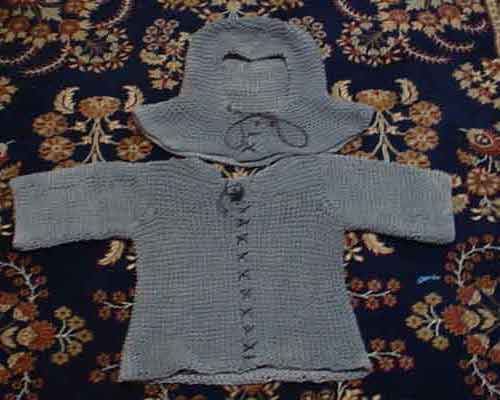
Apologies for the even lousier than normal picture quality. I don’t have access to the photo editing tools I normally use.
This is the knight costume that was featured in the note I wrote that
ended up in the first volume of KnitLit. I made it for Elder
Daughter in 1996, when she was in Kindergarten. The sadness
creeps in because Younger Daughter just wore it for Halloween, and it
was clear that this is the last year that she will be able to do
so. The coif will still figure in fantasy play for or a while,
but the mail shirt is ready for The Box of Knitting That No Longer Fits.
In the mean time, if you want to knit up some play armor for your own miniature warrior, the method description is on wiseNeedle.
WHERE’S STRING?
Computer failure at this end. Please bear with me. I’ll return to offering up tangled knitting thoughts ASAP.
MINOR ACCOMPLISHMENTS
A person left a comment on one of the counterpane pages here, asking
for help identifying the technique or stitches used in blanket she
owns. She neglected to leave an eMail address. I’d be interested in
seeing a photo and possibly posting it here for discussion, but without
contact info not much can be done.
Yes, in the midst of all the
charting stuff I was knitting. I finished up the Harvey Kombu, and I
did a pair of plain toe-up socks from Lana Gross Meilenweit. I’m not
sure which color variety it is, as I lost the label in an airport. It’s
not Fantasy, the repeat is too short. It’ s not Multieffect, or
any of the MultiRingel colors, either. It’s possible it was part
of last winter’s Jacquard color crop.
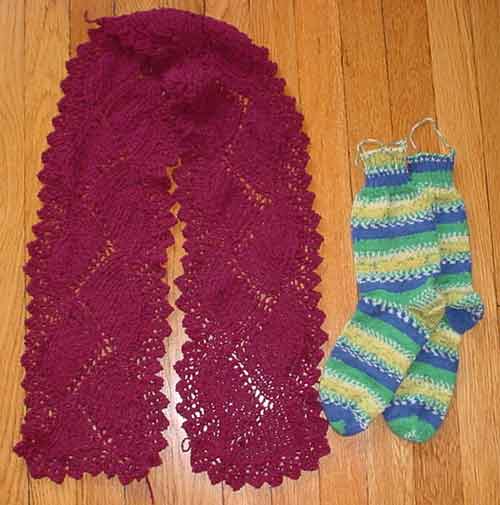
You’ll notice ends dangling off both pieces. I really can’t say
why I do this (perhaps it’s a personal superstition, perhaps it’s a
reminder not to use the item myself), but when I make gifts in advance,
I don’t darn in the final ends until I have decided whom the recipient
will be. I’m not quite sure who will be receiving these, so the
ends are still there. Go figure.
The socks were done on US #0s (2mm) needles – 72 stitches around.
That makes them rather large in gauge for me. I used the standard
figure-8 toe and short-row heel I use in all the sock patterns on the wiseNeedle pattern page.
Nothing fancy here, just miles and miles of plain old stockinette,
finished off with a K2P2 ribbing at the top. The pattern for the
Kombu scarf is also there. In this case, I used a US #6 (4mm),
and used just under two full balls of my ancient stash-aged Lang Harvey yarn.
Finally, one other person asked about how I construct my charts.
As I’ve described at length before, I use Microsoft Visio. I’m sharing my Visio stencils. If you’ve tried graphing knitting or stitching patterns using them and have feedback or questions, please let me know.
OLD EMBROIDERY – DENIM JACKET
To recover from the charting series, I present tiny mental vacation in
the past. 1972 to be exact. That was the year I embroidered
this jacket.

It was well before The Warner Brothers Store and WB characters being
available on licensed merchandise. I drew my Roadrunner freehand
from cartoons on TV. As you can see by the variant color (the
official Roadrunner is blue), my Looney Tunes years were spent in front
of a black and white TV.
I had a lot of embroidered clothing back then – a pair of jeans with
large phoenix that wound up one leg, starting in flames at the
cuff and finishing with a peacock-frilled head on the hip pocket; a
blue workshirt covered with wildflowers copied from herbals; and a
denim vest done in Shisha mirrorwork.
Except for the denim jacket all are long gone, sold while I was in
college to pay for books. You might have seen the other pieces if
you wandered past the window of the Red Dog second hand clothing
boutique in Harvard Square,
Cambridge, MA, sometime between ’75 and
’78 (back when the Square was more edgy and gritty than it is in
its current Urban Redevelopment/Mall of America glory). I’ve always
wondered who bought my pieces.

My Roadrunner is done in plain old 6-strand cotton floss, mostly in
chain stitch. The two-tone tail happened when the store that sold
Coats & Clarks embroidery thread dropped it in favor of the DMC
line. I
ran out of my original stock and had to do the closest color match I
could. You can barely make out the blue sig block below the front foot.
When I stitched this, the denim ground was the same color blue as that
block.
Elder Daughter wears this now (fraying and all), and would
kill for the other pieces. They may be long gone, probably
discarded from the homes of others, but I still have some of the Medieval history
textbooks they funded.
CHARTING 106 – SECOND EXAMPLE
Here’s the last item in the chart series. Thank you for all the kind
words. I’m delighted that people are finding this useful.
I
have gotten some questions about why I am not using the standard
Japanese symbol set. That set is quite broad compared to most of the
sets in Western books. My answer is that it’s relatively unknown in the
US and Europe. Perhaps I’ll add a symbol glossary that equates its
symbols to notations used by other more commonly available sources.
That’s a big project though, and might be better suited for wiseNeedle
than for this blog.
Barbara Walker’s Starlight Lace, Second Treasury of Knitting Patterns, p.288
I
will use this last Walker pattern to show some more complications to
charting life. This time, the pattern’s stitch count varies in a couple
of rows, plus there is a large number of edge stitches. My method is to
graph out everything verbatim row to row, then (if needed) introduce
no-stitch boxes for clarity. Again, all quotations from Walker are in
bold. Here goes…
Multiple of 6 st plus 5
Row 1 (wrong side): and all other wrong-side rows – Purl.
Row 2: K2 *yo, ssk, k1, yo, ssk, k1-b; rep from *; end yo, ssk, k1.
The
repeat is only 6 stitches, but I think I’ll chart out three repeats plus
edge stitches. That should give me enough room to see the play of the
edge stitches, and the staggered effect of the offset design itself.
Row 1 is plain old purl, but it’s a wrong side row, so it graphs out as
shown below, with the “1” on the left hand edge rather than the right
hand edge. Remember, I’m just graphing verbatim at this point. I’m
making no effort to read ahead. I just want to get the stitches down on
my chart.

We’ve
got 23 stitches [(6×3) + 5]. Note that the k1-b (knit one stitch
through the back of the loop to twist it) has its own symbol. All wrong
side rows in this pattern are plain – worked as purls if the thing is
knit flat, and as knits if it’s worked in the round.
Digression:
Most modern texture patterns alternate rows with something happening on
them (cable crossings, decreases, increases, etc.) with plain rows, and
many pattern authors don’t bother graphing the alternate rows if
they’re all plain. This can cause a bit of confusion. I got tripped up
recently by Hazel Carter’s Spider Queen shawl. It’s a masterful bit of
charting, but the first chart is stripped of those plain wrong-side
rows. The later charts include them. I wasn’t paying attention, and
didn’t notice that the numbering on that first chart labeled every row,
but counted by twos. I ended up having to rip back a bit when I noticed
that my piece didn’t looklike the project photo. So be warned. Look
at the numbering. If it begins with “1” on the left, and you’re
knitting flat you start off with a wrong-side row. If the “1” is on the
right and you’re knitting flat, you start off with a right-side row. If
every other number is missing, you’ve got a pattern with the plain rows
left out. Look elsewhere in the write-up to find out if those plain
rows are to be knit or purled.
I’ll skip writing up the plain rows, but I will include them in my growing graph:
Row 4: K3, *k2tog, yo, k1-b, yo, ssk, k1-b, rep from *; end k2
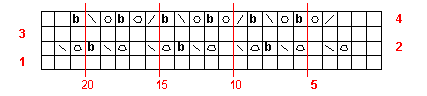
Again,
no problems here. Everything graphs out nicely and stitch count is
constant. There are equal numbers of stitches increased (the yos) and
stitches decreased (the ssks and k2togs).
Sometimes if I’m
having problems with a repeat, even if it’s charted, I’ll grab a piece
of graph paper and draw out my stitches. Sometimes I catch an error in
my knitting using my pencil that went totally unnoticed on my needles.
Row 6: k2, k2tog * yo, sl2-k1-p2sso, yo, sl1-k2tog-psso; rep from * end yo, sl2-k1-p2sso, yo ssk, k2.
This
is where that “off to hell in a handbasket” feeling begins to creep in.
We’ve got double decreases, both with the rightmost leg on top
(sl1-k2tog-psso), and with the centermost stitch on top (sl2-k1-p2sso).
We’ve also got a number of yarn overs, and just for fun – a couple of
plain old decreases, and an unknown number of times to do the ** repeat
between the k2, k2tog opening unit, and the end yo, sl2-k1-p2sso, yo,
ssk, k2 closing unit.
To figure this out, we need to remember
that we’ve got 23 base stitches on the previous row. That’s 23 stitches
to play with. All of the plain knits plus the stitches in the decreases
on Row 6 must add up to 23. Let’s look at the math:
- One ** repeat on this row adds up to six stitches (the two double decreases).
- The pre-** opening row unit is four stitches (k2 plus one k2tog)
- The after-** closing row unit is seven stitches (one double decrease plus one ssk and k2)
If
you add up our fixed numbers (the pre- and post-** stitches) you get 11
stitches. The previous row contained 23, and we subtract those 11 from
the total. We get 12, which (serendipity) is a multiple of our ** unit.
We graph out the pre-* stitches (shown in blue) plus two repeats of the
** unit, followed by the post-** unit (also shown in blue.

We’re out of that handbasket, even though our graph is showing a very
short row. Not to worry. Going through and counting stitches confirms
that we’ve got the correct number here. We’ll worry about neatening
everything up and inserting those no-stitch boxes after we get all the
rows charted. So let’s move on.
Row 8: K3, *k1-b, yo, k1, yo, k1-b, k1; rep from*, end k2.
This
row is also problematic. How many times to repeat the stuff between the
**s? Again , stitch count comes to our rescue. Evil Row 6 brought the
stitch count down to 17. Row 7 (worked plain) preserved that count. Now
on Row 8, there are increases, and “as-is” stitches but no decreases.
There should be 17 stitches on this row EXCLUSIVE of the YOs. Again we
do the math. We start with 17 stitches, then account for the three
before the *, and the 2 after – that’s 12 stitches left. NOT counting
YOs, each between the ** repeat contains 4 stitches. We need to graph
out three iterations of the stuff between the **s. Happily once we
graph in these instructions (including the 6 YOs) that restores us to
the original stitch count of 23.

Remember,
we’re not worrying about lining stitches up right now, our only concern
is getting the correct number of them on the chart. We’ll think about
how to represent those low-count rows 6 and 7 later.
Row 10: K2, *yo, ssk, k1-b, yo, ssk,k1; rep from * end yo, ssk, k1
We’re
back to a stable stitch count, with the same number of increases and
decreases per row. Graphing it up is easy. I notice something here
though:

See
those two blue units? They’re identical. It looks like this pattern is
formed by an exact duplicate of rows 1-6, offset by three stitches (one
half of the repeat). While you can see it (sort of) in the prose
directions, the duplication leaps out in the charted ones. I find this
sort of half-drop duplication and charting makes the pattern really
easy to memorize. More on this later, after we’ve charted some more
rows.
Row 12: *K2tog, yo, k1-b, yo, ssk, k1-b; rep from *, end k2 tog, yo, k1-b, yo, ssk.
Again this looks veeerrrryyyy familiar! I’ve highlighted the repeat (in fact I just cut and pasted those boxes).
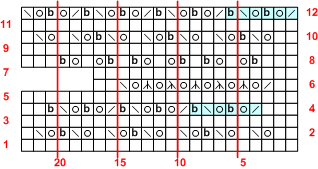
Row 14: K1, *yo, sl2-k1-p2sso, yo, sl1-k2tog-psso; rep from *, end yo, sl2-k1-p2sso, yo, k1.
Remember
Evil Row 6, with all those double decreases? It’s back! Offset three
stitches, but otherwise the same. We start with 23 stitches on the
previous row, then subtract the 1 before the **, and the 4 after the
**, leaving 18 stitches – so we do the 6-stitch bit between the **s
three times.

Row 16: K1, k1-b, *k1, yo, k1-b, k1, k1-b, yo; rep from * end k1, k1-b, k1.
Just
like row 8, offset again by three stitches. Again we’ve got 17 stitches
on the previous row to account for. Not counting the YOs, we’ve got 2
stitches before and 3 stitches after the ** accounted for, leaving 12 –
so we do the 4-stitch ** unit three times. One you add in the YOs,
we’re back up to to the 23 stitches of our original count.

Now
to add the finishing touches. It looks like each of the decrease units
on Rows 6 and 14 visually caps off the clusters of decreases on the
rows below. So I’ll spread them out across the row, adding in my
no-stitch boxes as best I can to maximize the read of the pattern
compared to the photo of the worked swatch.
I’ll also add in
my stitch key, header and footer info at this point. Remember that
there are NO increases or decreases on alternate rows. Therefore I
don’t need to include that second column of “if it’s a
right-side/wrong-side row” instructions that I had to include in
yesterday’s write-up.
One final note, there is one small bit of
strangeness here. Because of the way that the repeat works out, and the
way that edge stitches are handled, the last decrease on Row 6 is
handled differently if it is the final stitch of an “inside repeat” or
if it is the final stitch of the last repeat on the row. Since this
isn’t easy to graph, I’ve added a special note about it, and made it
blue on the chart.
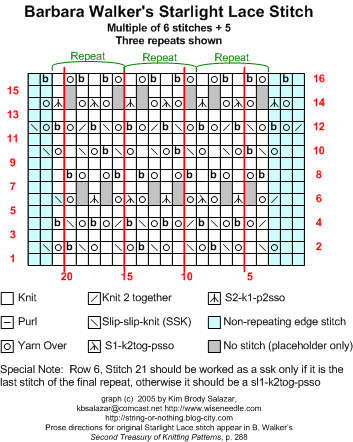
The memorization thing?? This pattern looks complicated at first glance. Especially if you just look at the prose directions. However it’s not that tough. There are only four substantive rows – 2, 4, 6, and 8. The entire pattern repeat is only six stitches wide. Everything else is a repeat, either straight on the same row, or (in the case of rows 10-16) offset by three stitches (one half the width of the repeat). ? I can’t remember the prose directions verbatim, but I can and do memorize the pattern in its visual representation. Not everyone can memorize a nonverbal visual representation (and it’s no shame not to have that bit of wiring) but many people can, and have surprised themselves by being able to do so after becoming comfortable with charts.
This
concludes my mini-series on graphing – how to read them, how to build
them, and how to solve common problems translating prose directions to
charts. Please feel free to post additional questions about graphing
and reinterpreting prose instructions as charts, but please know I will
not be offering a graphing service here. My goal is to show others how
to do it for themselves, not do it for them.
One last tech note
– the visual presentation of the charts changes mid-way through this
note because I experienced a massive computer failure. I ended up
finishing this post on a different machine using a different version of
MS Visio. The later version has a slightly different GIF translator
than the earlier version I normally use. So it’s not your monitor –
it’s me. Apologies for the visual confusion.
CHARTING 105 – EXERCISES
So far the nominations for stitches to use as object lessons have been rather sparse. I’ve gotten suggestions to do:
- Porcupine Stitch from B. Walker’s Second Treasury of Knitting Patterns, p. 282
- Drooping Elm Leaves from B. Walker’s A Treasury of Knitting Patterns, p. 217
I’ve also gotten notes from people who said that given the hints posted over the past week they’ve been able to graph up
- Mermaid Mesh from Walker’s Second Treasury, p. 267
- Madeira Cascade from Walker’s A Treasury, p. 222
As the big boss at work would say, “Good on ‘ya!”
These two patterns are not quite straightforward. Cascade has five stitches above and beyond the repeat that need to be apportioned into edge stitches. It does however have a very strong central spine – a double decrease that lines up on all right-side rows. Mesh is a bit harder in that it has both lots of edge stitches, plus a massive number of decreases and increases that use natural slant of the decreases to
visually wander left and right. Certainly not a pattern for the
faint-hearted to graph!
For the object lesson I’ll do Porcupine and Walker’s Starlight Lace (Second Treasury, p 288). Drooping Elm is interesting, but doesn’t pose some of the conundrums that these two do. I’ll start today with Porcupine. Starlight will appear later in the week.
Porcupine Stitch from B. Walker’s Second Treasury of Knitting Patterns, p. 282
Porcupine has some interesting features. It’s a 9 row repeat, in which only three rows are substantive. BUT those three rows are each repeated at least twice, and the same instructions are repeated on both the right and wrong side rows of the piece. There are also four stitches requested over the 12 stitch repeat count that will have to be accounted for in edge stitches, but they seem to always stay outside the ** repeat marks, so keeping track of them shouldn’t be a problem.
Walker notes that this texture design is of Victorian origin. It does have a major feature that was much more common in early instructions than in later ones. Porcupine includes patterning on both right side and wrong side rows. You don’t see this often as most modern? patterns confine increases, decreases or other shaping elements to right-side rows only. Flipping the instructions for decreases is far more confusing than just translating knits to purls and vice versa.
My write-up will intersperse the as Walker gives them with how that row ends up being graphed. The Walker quotations will be in bold.
Multiple of 12 stitches plus 4
Row 1: K2, *Yo, K2tog; rep from * to last 2 sts, end k2
Looking at the pattern, I suspect it will be a good idea to graph out two repeats of the pattern, that’s 24+4 = 28 stitches across my chart. We start with a right-side row:

Row 2 and 4: K2, purl to last 2 st, end k2
Very easy. Remember this is a wrong side row, and that mental inversion thing should be invoked to “flip” knits to purls and vice versa.
Row 3: Knit
Because Row 4 is the same as Row 2, I’ll graph up both 3 and 4 here. 
Row 5 and 8: K2, *sl1-k2tog-psso, k4, yo, k1, yo, k4, re from *, end k2
Now it begins to get interesting. Still, stitch counts are maintained. How can I tell this? By looking at the part between the **s. It includes a double decrease that finishes with the rightmost stitch on top, plus
two yos to compensate for the two stitches eaten by the double decrease. Warning though. It’s not all that hard to visualize row 5, it’s a right-side (odd numbered) row, but I can sense some hyperventilation among those who have noticed that this same sequence is repeated on a wrong-side (even numbered) row. We’ll deal with that bit of chaos when we get there.
Row 6, 7 and 9: K2* p3tog, p4, yo, p1, yo, p4, rep from * end k2
We have now hit the twilight zone row – the one that will cause many people to give up graphing. But it’s not impossible. Remember that mental flip thing? Flex your brain because we’re now going to do some gymnastics.
On Row 6, we’ve been told to do a p3tog on a wrong side row. Now, a p3tog on a wrong side row, if viewed from the right side of the work is a dead ringer for a k3tog. How do I know this? The Sainted Barbara tells me so in the glossary of chart symbols in her Charted Knitting Designs (aka Walker III), and A Fourth Treasury of Knitting Patterns (aka Walker IV). Also I experimented. I’ll use my symbol for k3tog, BUT
I’ll remember to build a double column glossary to accompany this pattern that describes what should be done when this symbol is encountered on both right-side and wrong-side rows.

Now on Row 7, we’re told to do the same thing as on Row 6. But we’re on a right-side row. A p3tog on a right side row is a p3tog on a right side row. I don’t have a symbol in my set for a p3tog, so I’ll have to make one up. Visually, in a P3tog done on an odd numbered row, the right hand most stitch of the three worked together ends up on top. I’ll make a hybrid symbol that sort of reminds me that three stitches are being worked together, the right hand most one will end up on top, and that it’s a purl. If it turns out that I like this symbol, I’ll add it to my permanent stencil collection in Visio:

Row 5 and 8: K2, *sl1-k2tog-psso, k4, yo, k1, yo, k4, re from *, end k2
Row 8 is a repeat of Row 5, but it’s done on a wrong-side as opposed to right-side row. Again referring to the Sainted Barbara, we see that a s1-k2tog-psso done on the right side has as its wrong-side counterpart
the delightfully awkward p3tog through the back of the loop. Again – remember we don’t actually have to DO a p3tog through the back of the loop here unless we are doing this pattern in the round, but the symbol we use on the chart is the same one that would be used for one of those awkward puppies worked on the right side. I don’t happen to have a standard symbol for p3tog through the back of the loop, so I’ll invent one.
Row 6, 7 and 9: K2* p3tog, p4, yo, p1, yo, p4, rep from * end k2
Row 9 is a duplicate of Row 7. We’ve already graphed that. So we now have the nine rows of our repeat. It’s also become clear that stitch counts are rock-stable row to row, and that the four extra stitches here are just garter stitch selvedges there for convenience, and aren’t required to eke out partial repeats of the pattern. I’ll mark the four extras off in blue.
But we’re not quite done even though all nine rows are graphed out. We’ve got a repeat made up of an odd number of rows. That means that Row 1 repeats on Row 10. In fact, although rows 10-18 are the same as Rows 1-9, each one graphs up as its opposite-side sibling. (I can sense I’ve lost quite a few of you, so I’ll show rows 10-13: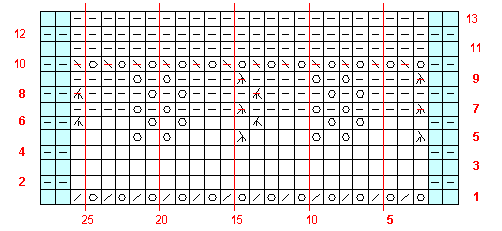
Row 10 duplicates the action of Row 1, but does it on a wrong-side row. Therefore, the stitches that graph up as K2togs in Row 1 use a different symbol in Row 11. Likewise the knits/purls of rows 11-13 show as their opposite.
Row 14 duplicates Row 5, but as a wrong-side row. We’ve already graphed that bit of twisted thinking on Row 8, so adding it isn’t a problem. Row 15 replicates Row 6, again we already did that flip on Row 9, so a simple cut and paste takes care if it, too.
Row 16 duplicates Row 7, which has its wrong-side counterpart originally on Row 6. Row 17 is another Row 8 in its right-side expression (Row 5). Row 18 is another Row 9 flipped for the wrong side (Row 6). If you place all of them on the chart, add the stitch key, grids, titles, and attributions you end up with this:

Now this may seem a long way to go for a short drink of water compared to Walker’s original write-up. In this case, the prose description is only five lines long, but the chart takes up half a page. There’s no bonus
for brevity awarded for the charted format. But there is one major advantage to having this described in a graph. This chart is equally useful to people knitting in the flat and people knitting in the round, because all the right/wrong side transformations have been done.
People knitting in the round experience every row as a right-side row. To knit this reversible pattern entirely in the round, they’d cast on an even number of the stitch multiple (without the four blue extra stitches) then they’d follow every row starting at the right hand edge of the graph, and using the key symbols as interpreted in the “On Right-Side Rows” column. People knitting in the flat would follow the chart in the manner I described before, starting the odd numbered rows at the right edge, and the even numbered rows at the left, alternately using the appropriate columns from the accompanying symbol key.
Have fun with this one. Try out Porcupine Stitch in a swatch. You’ll find the lacy effect is magnified if a larger needle than one would usually use for a given yarn is used. Lacy or dense, the result will be rather puffy. Given the appropriate yarn it would make nice two-sided scarves, shawls, or blankets. Stay tuned for more adventures in charting!
CHARTING 104 – THINGS THAT MAKE LIFE DIFFICULT
In a perfect world there would be an intuitive set of graphing symbols
that would be quick and easy to understand. They’d cover all possible
maneuvers in knitting, and would be useful in every circumstance. This
is however, a total pipe dream. Knitting is near infinite, and
knitters are fiendishly clever in the variant ways they have found to
produce their desired results. There are a number of knitting
techniques and stitches that pose special problems to charting:
Large numbers of stitches increased or decreased at the same time
When you see instructions like “make 5 in next stitch” you’ll need to invent
a symbol to handle it. I’ve seen German and Japanese charts that use a
variant on something like this:

Decreasing a large number into one stitch would generate need for something
similar, perhaps with the V upside down, and the number of stitches to
be eaten indicated between its open toes.
Also unless you’re dealing with an edging, it will probably be impossible to graph up a
pattern containing massive group increases or decreases without using the
no-stitch boxes we discussed yesterday. Still, these problems fall into
the “inconvenient but not insurmountable” camp.
Bobble and bell-shaped semi-detached units
Some bobble and bell units are produced by knitting back and forth over a
small number of stitches, to make a blister-like addition that’s
attached to the main work at top and bottom. Most chart authors treat
this type of unit as a separate sub-process. The main chart may have a
single box with a specified symbol in it, indicating where the unit is
to be placed. The unit itself will be described either in prose, or in
a “mini-chart” accompanying the main chart as a sidebar. Another
“inconvenient but not fatal” challenge.
Patterns containing stitches either slipped from or knit into the row below
These can pose real charting problems, especially in linen stitch family
textures where large numbers of stitches are worked “out of row.” I’ve
seen large V-shapes superimposed on the graph that are supposed to
represent these distended stitches, but they are visually difficult to
deal with. If there are lots of them, the clutter can be overwhelming,
and some linen stitch or slip-stitch based patterns may be impossible
to graph at all.
It is interesting to note that B. Walker used a special charting notation for her slip-stitch based mosaic colorwork. In that format each row of the chart represented two rows of knitting
instead of the more conventional one row worked = one row charted
ratio. She didn’t try to show stitch deformation by the use of a symbol
set, instead she stuck to two-color mosaic patterns that swapped colors
every two rows. The squares on her charts indicate whether one is to
form the next stitch by working with the current strand, or slipping
the color of the previous two-row set up onto the needle.
Threaded stitches or stitches with right-side floats, or decorative wraps spanning one or more stitches
There are some patterns that form colorwork or texture patterning by using
separate strands that are threaded back and forth through live stitches
during knitting. Other patterns use as decorative elements floats or
wraps of one or more stitches, deliberately formed on the right side of
the work. These are both very difficult to represent in charts. I’d
probably go with some sort of notation in the main chart that Effect #1
happens here, and accompany the chart with a separate detail write-up.
Novelty stitches
Some popular novelty stitches are near impossible to chart. Loop Stitch is a
good example. That’s the stitch used to make a surface completely
covered in shag-rug style loops. The manipulations required to make the
loops don’t lend themselves to graphing, and beyond noting which
stitches carry the loops in a piece that uses both adorned and
unadorned areas for contrast, indicating their presence is of little
value.
In spite of these exceptions, if a pattern contains just knits, purls, cables, simple increases and decreases – even twisted stitches – it can probably be graphed. The graph may be massive, but it can be done.
I’ve got only one nomination for a particularly vexing pattern to use in tomorrow’s object lesson. If you’re got one to suggest, please send me an eMail (replace the “AT” in the address with the standard @ sign).
CHARTING 103 – THE STITCH THAT ISN’T THERE
We’ve covered basic charting, and charting variable width edgings. Now
for panels and insertions. Those are patterns that can be used as
accents in the main body of your piece. Sometimes they show up as
single strip scarves, sometimes several repeats of the design are
combined across to make an all-over design (occasionally fitted
together with half-drop variations), sometimes a single panel is
repeated to make a long stripe in combo with a stockinette ground,
sometimes just one vertical repeat of the design is used as a spot
accent, sometimes panels of different patterns show up side by side.
What makes them different from edging patterns is that they can be
embedded in the center of a piece, and that piece can be knit in the
round.
These insertion style patterns can have either stable or variable stitch
counts from row to row. One with a stable count (either no
increases/decreases or an equal number of increases to decreases on
every row where they occur) are graphed more or less the same way as
the pattern in Charting 101. The ones with changing stitch counts do
pose special problems.
Let’s consider this simple variable count
insertion. It’s my own write up of a simple embossed leaf inside a
framing K2, P2 rib:
Cast on 9
Row 1 (wrong side): P2, K5, P2
Row 2: K2, P2, (K,P,K in one stitch), P1, K2
Row 3: P2, K2, P3, K2, P2
Row 4: K2, P2, (K1, YO)2x, K1, P2, K2
Row 5: P2, K2, P5, K2, P2
Row 6: K2, P2, K2, YO, K1, YO, K2, P2, K2
Row 7: P2, K2, P7, K2, P2
Row 8: K2, P2, K3, YO, K1, YO, K3, P2, K2
Row 9: P2, K2, P9, K2, P2
Row 10: K2, P2, SSK, K5, K2tog, P2, K2
Row 11: P2, K2, P7, K2, P2
Row 12: K2, P2, SSK, K3, K2tog, P2, K2
Row 13: P2, K2, P5, K2, P2
Row 14: K2, P2, SSK, K1, K2tog, P2, K2
Row 15: P2, K2, P3, K2, P2
Row 16: K2, P2, K3tog, P2, K2
As you can see, the thing starts out being nine stitches across, but grows on row 9 to 17 stitches across.
How to chart? The symbol set is pretty straightforward. Each
individual row poses no problems. For example, here’s row 8:

If we normed one edge like we did with the edging patterns, we’d end up with this:
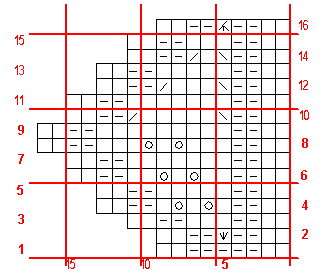
While all the info is there and this chart could be worked from, it’s
deceptive in that it looks like an edging. Plus one of charting’s prime
directives – representing knitting in a format that’s visually akin to
the finished product – has been fouled.
So. Let’s look closer at this pattern, looking for obvious points of internal symmetry or
reference. We quickly see that the thing IS symmetrical. There’s a
center stitch in every row. Let’s stack our rows on the center stitch:
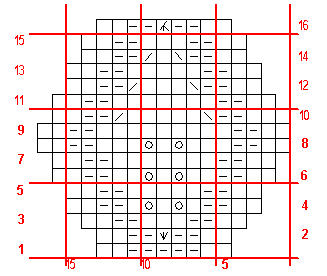
That’s closer. You can begin to see the leaf shape in the center,
but the wiggly edges are still a bit confusing. Here’s another
cut at the same basic concept. This time however, I’ve lined up
not only the center stitch, but also the knit ribs that frame it:
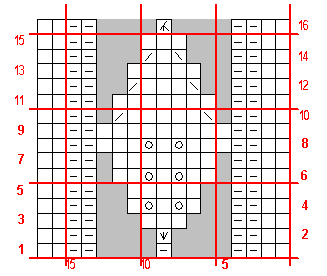
Those gray areas? They don’t exist. Flat out aren’t
there. They’re the equivalent of the stage attendants dressed in
all black who move props around in full view of the audience during a
drama or puppet performance. You’re not supposed to see them, even
though they’re in plain sight.
The grayed out areas are spacing mechanisms introduced for the sake of
visual clarity in the rest of the pattern. They have no
correlation to stitches in the actual knitted piece. Working from
this chart, I’d skip right over the gray background. My first row would
be P2, K5, P2, just as in the written directions. Now different
authors represent non-charted “no stitch” or null spaces
differently. I chose to use a general background shading, with no
boxes marking individual stitches. Other people don’t bother
removing the box notation from the no-stitch spaces. On their
charts the no-stitch boxes can be a bit harder to interpret.
How to know when to use mystery no-stitch boxes? Although it’s a
matter of personal preference, sometimes they’re absolutely necessary
because there just isn’t room to graph out your piece unless they’re in
the mix. I could graph out my embossed leaf without the
no-stitch areas, but if this leaf was part of a larger graph covering a
wider area, the distortion introduced by the width of the longest row
might ripple out and perturb the representation of design elements to
either side. In that case, using the no-stitch boxes would keep
my two edges parallel and let the leaf panel sit more comfortably in
the total project chart. That in turn would help the
knitter keep his or her place on the wider graph.
Tomorrow I’ll look at patterns that are extremely hard (if not
impossible) to chart out. The final piece in this series I’ll
build one chart for a lacy or complex cabled design that has presented
a special challenge. Nominations for the final object lesson will
be accepted. Please contact me off-list before Thursday night if you know of a prose texture pattern you’d like to suggest for group edification.
 String-Or-Nothing