AND PROGRESS ON OTHER FRONTS
The holidays being party over, our latke party, Christmas Eve feast, present exchanges being done, the luxury of time is creeping back into our daily routine. So I can post about my other two big end of year projects.
First is my Italian-inspired cloth. Still not sure what I will do with it, although it’s looking likely that it will end up as a piece of honor on a credenza here in the house. I have finished the outer frame. I started this one on 19 September, at the center of the left hand edge, as seen in the photo below. I marched around the perimeter, opting to go a bit shy on the right hand side to preserve use of the “perfect” corner I charted out. I joined up with the starting spot last week via an extended tendril just to confirm the count and that no fudging would be needed. Spot on, no alignment problems at all. I finished out the join and all of the panel detail last night.
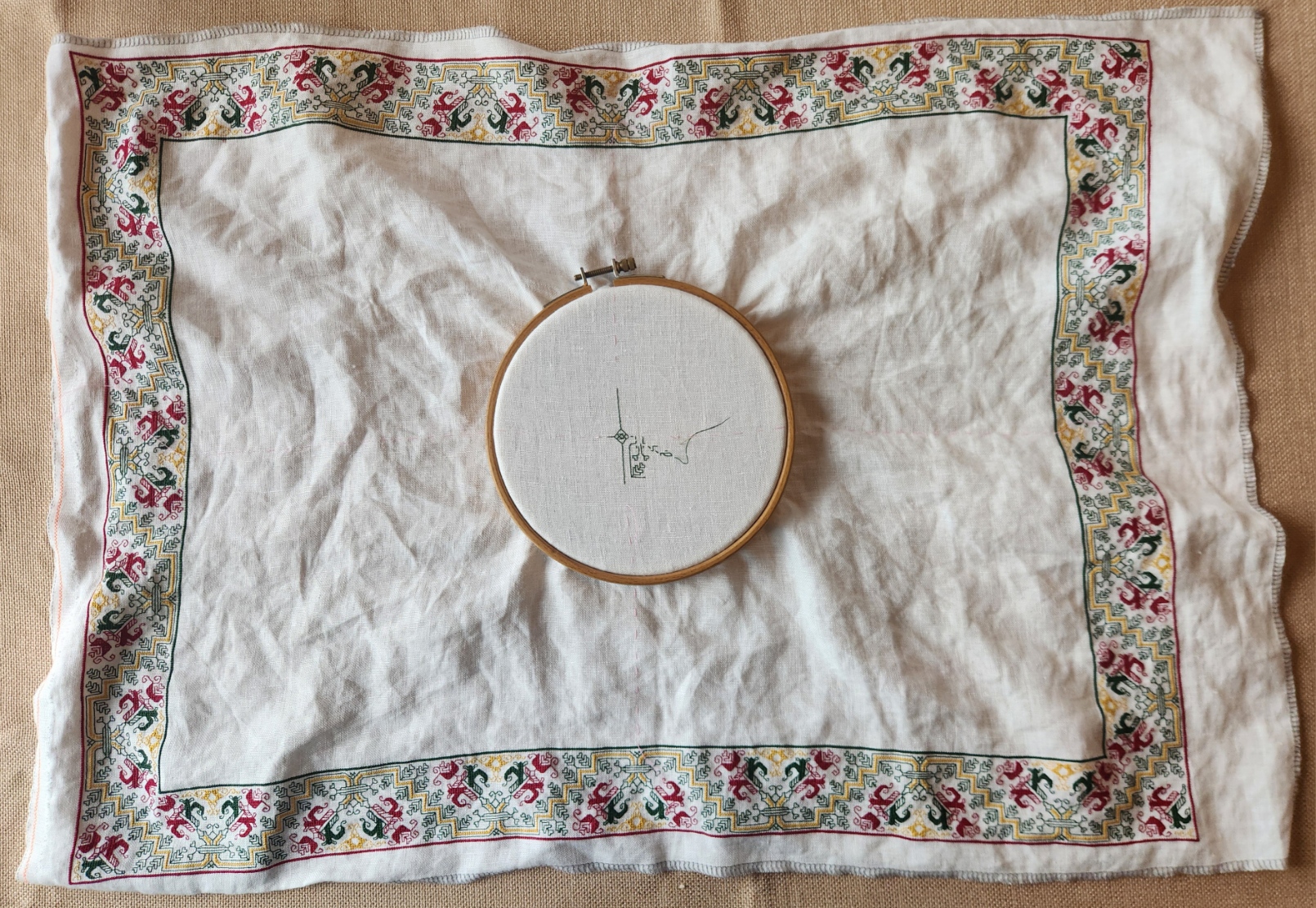
And surprise! I’m not done!
I am working a doubled variant of the edge pattern across the center. Possibly flanked by two single panels. I haven’t decided on those yet. I want to capture the spirit of the original, a towel done in Punto Scritto and Punto a Spina Pesce MFA Accession 83.242, Italian, 16th century, silks on linen. The original is quite large, more than four times the size of my rendition.

More on the developing center panel as it grows, of course.
The other big project was my set of frog hats. Five of them have been given to the recipients, all received with delight and enthusiasm. Four shown below, on consenting adults.
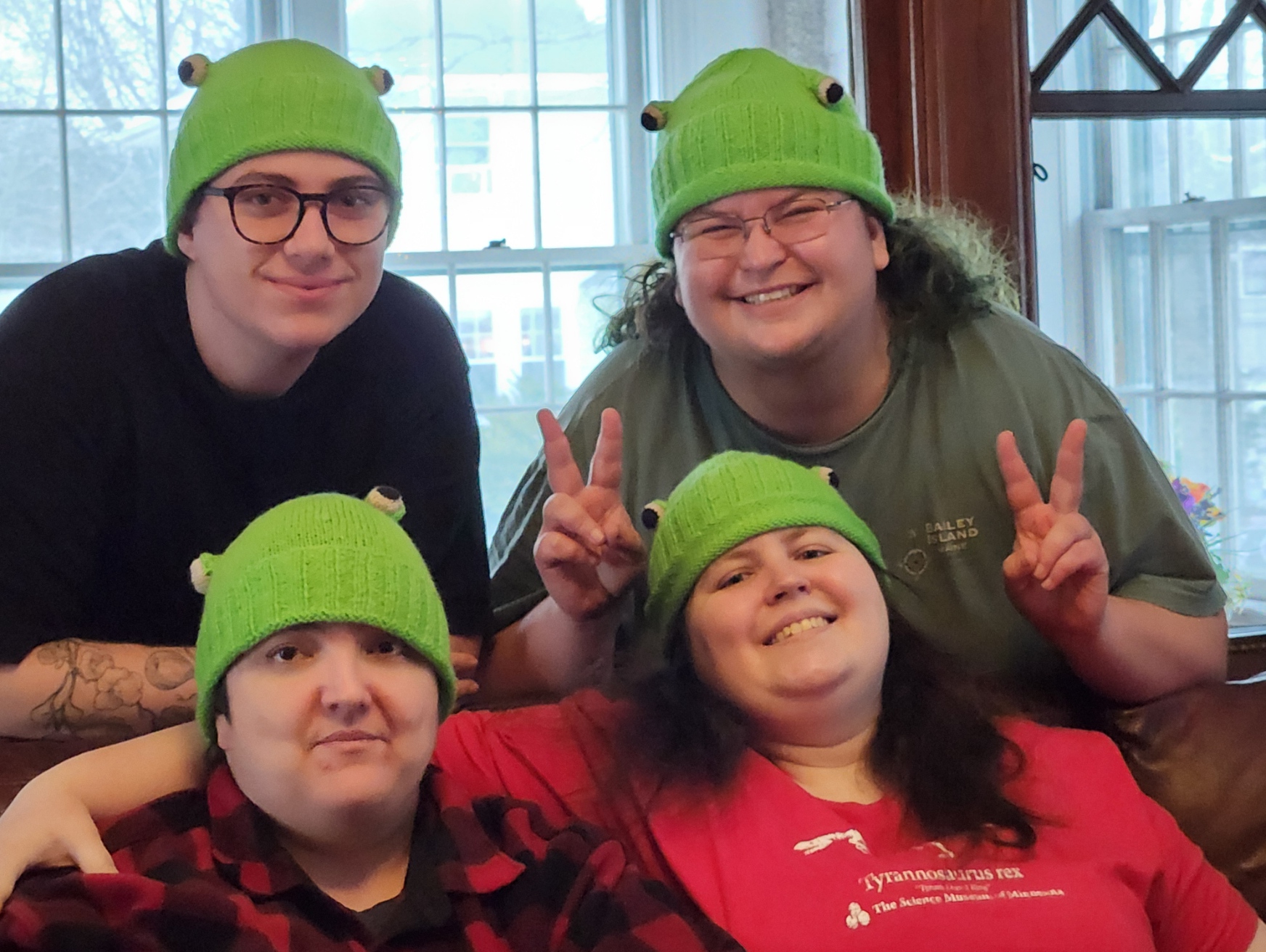
I’ll be finishing up the eyes on the last two this week. I am not sure if I can put out a full method description because it’s a bit complex to explain exactly what I did. But here goes…
First, I knit up seven hats, working in the round on two circular needles, roughly following the general pattern I am using as my source. I’ve used a different cast-on, swapped in K2P2 ribbing for the original K1P1, and arranged the thing so that when the brim is folded, the more attractive side of my cast-on is on the outside of the hat.
Then I took inspiration from a free published pattern for eyeballs, changing the color progression slightly. I used much smaller DPNs for the eyeballs than I used for the hat body, largely to contain the stuffing. Seven hats meant 14 eyes. In retrospect I think I should have made them bigger, but the hat is still true to the concept.
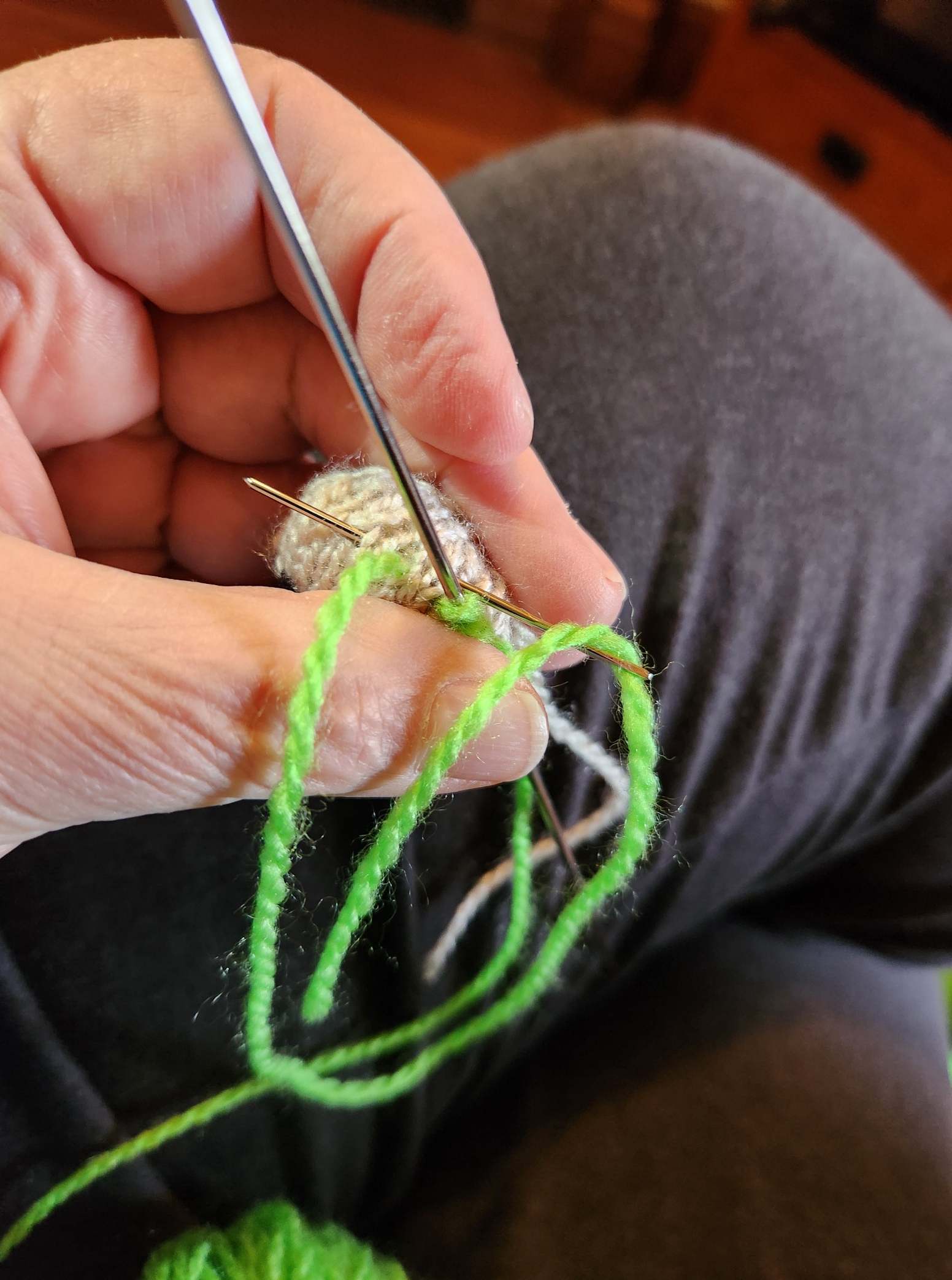
Once the little eyeball spheres were knit, stuffed, and ended off, I had to add eyelids. To do that I used a threaded needle and embroidered backstitch. I looped my backstitches over my DPNs to set up the foundation for a row of knit-on I-Cord. Three needles’ worth, five stitches each. I did this via sewing because picking up stitches across the surface of the eyeball was difficult to do without disturbing the stuffing.
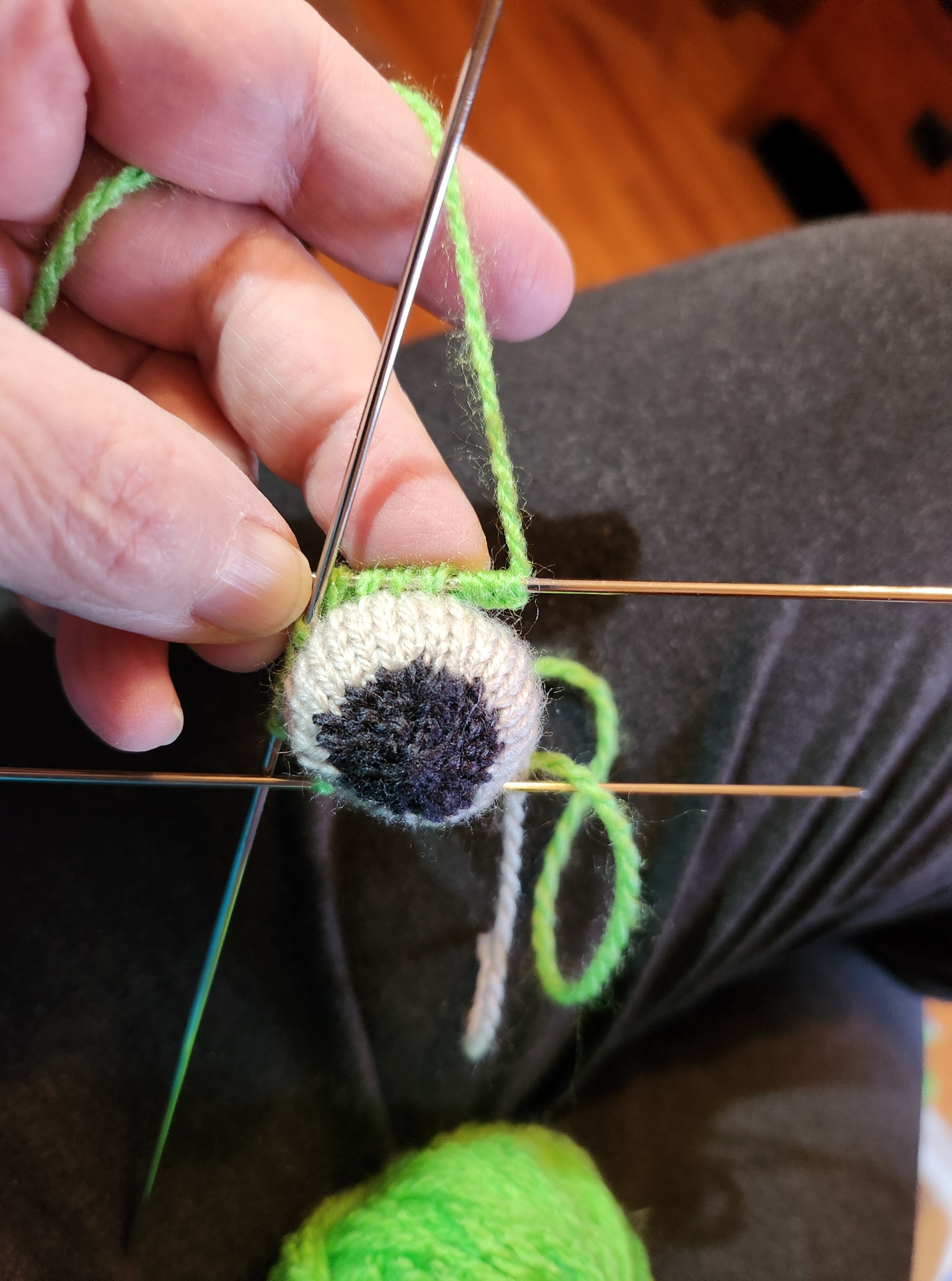
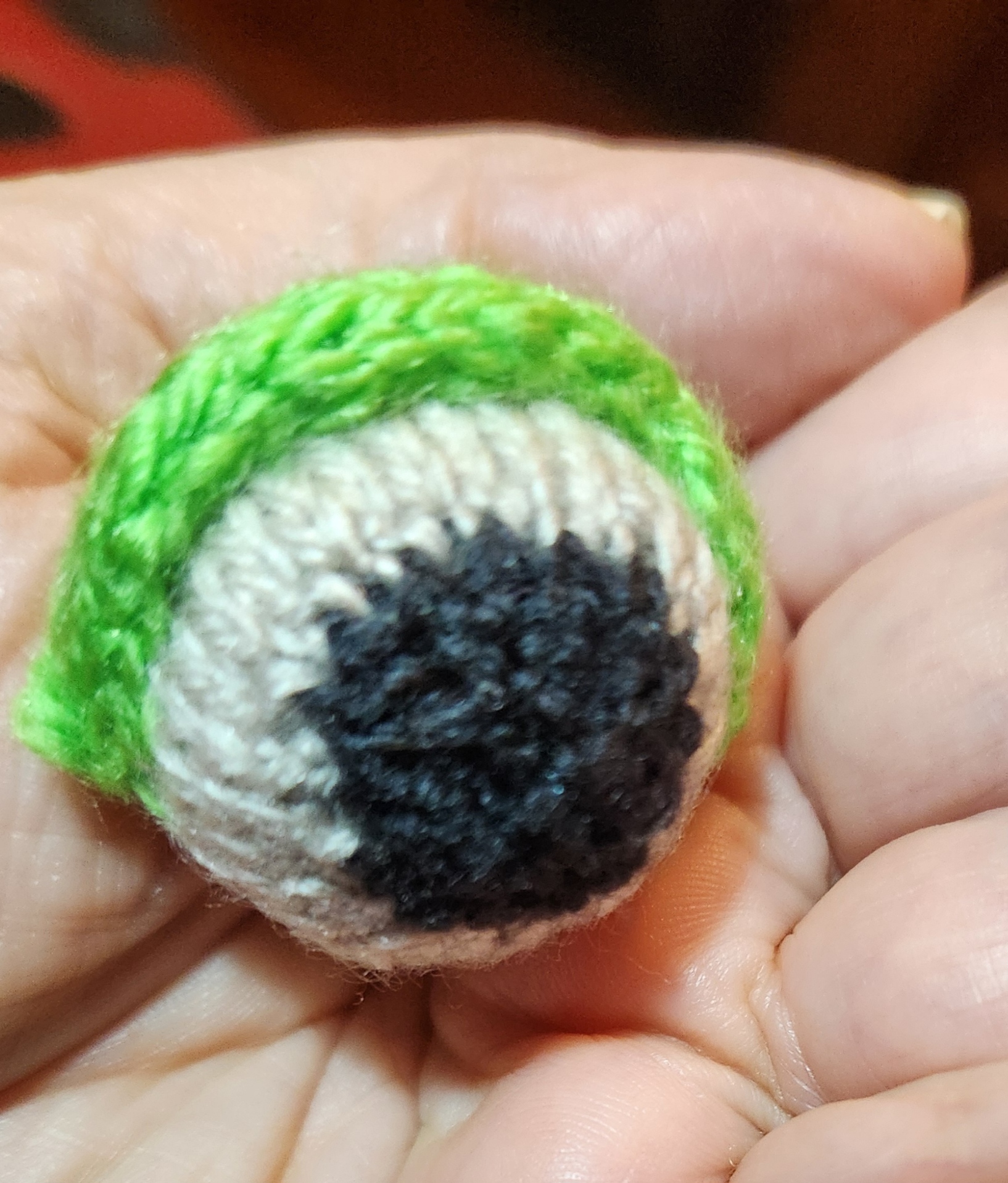
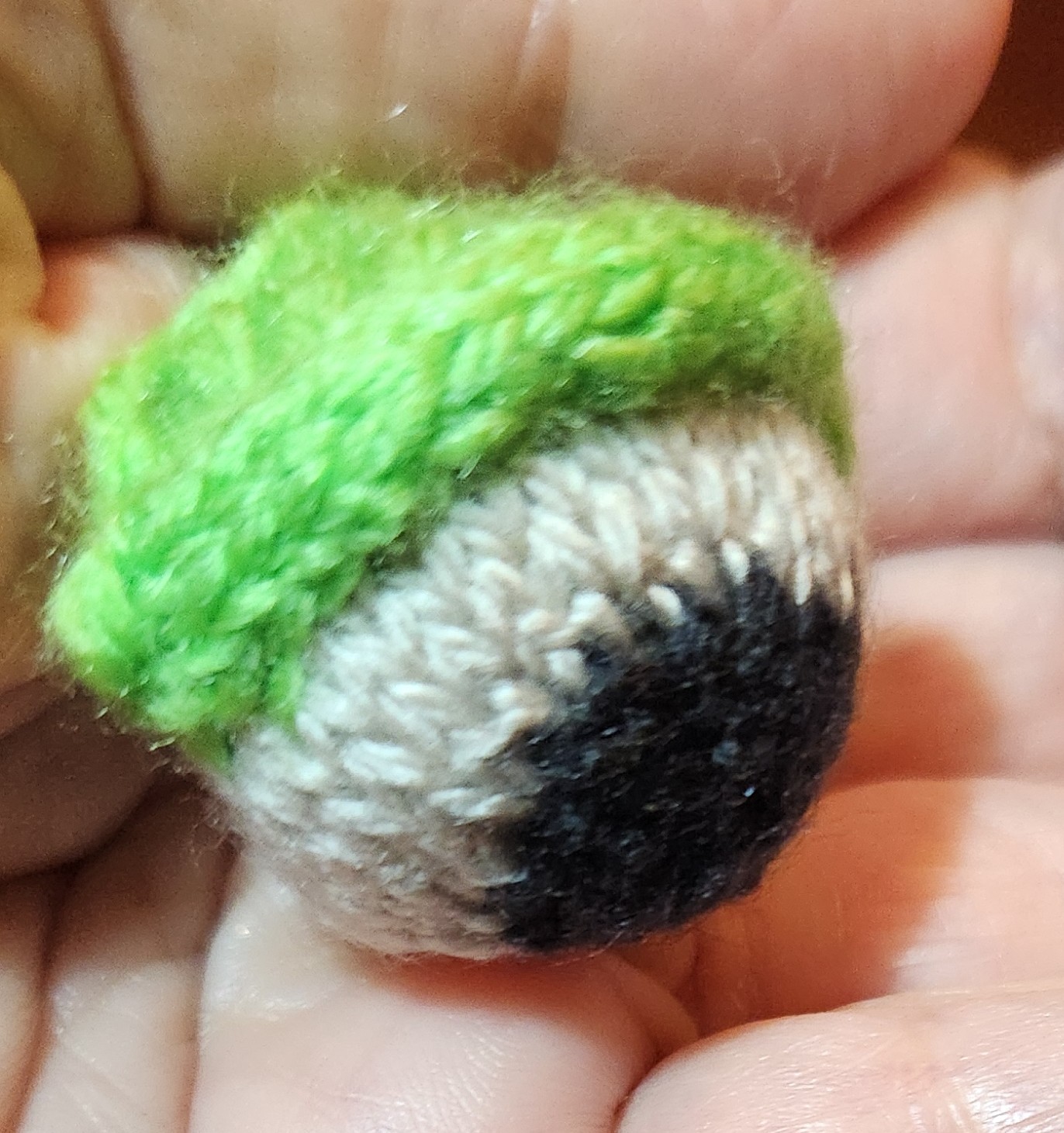
Once the eyelid was done, I went back and using a small crochet hook, picked up a line of knit stitches across the base of the I-Cord on the back, where it joined the eyeball. Those I knit into a triangle to make a dormer-window style cowling. I have to admit that I don’t think I did any two of them exactly the same way, because no two of the eyeballs themselves were exactly alike. That alone would make any specific write-up extremely difficult.
After the eyeball/eyelid, connectors were completed I sewed those units onto the hats, using mattress stitch.
I still have to finish the eyelids and final assembly on two more hats by the end of this week. I’ll stroll towards that completion. No hurry.
A BUSY JUNE SO FAR
Who said that retirement would be boring? Wrong, wrong, wrong.
We’ve spent the last month quite busy, buzzing back and forth to the Cape to escape the heat and enjoy the late pre-season quiet of the beach. We’ve kept at the garden I detailed in the last post. So far everything is surviving. Bushes and flowers bloomed and my tiny raised bed garden is beginning to offer up a small, but appreciated harvest of peppers and herbs. The eggplant will catch up eventually. And of course I’ve been doing needlework projects. The chair recover is in hiatus until the fall – too much infrastructure to schlep around, but smaller, portable projects have been thriving.
First up, a stitching finish on a WIP that’s been bopping around since before the Unstitched Coif. This is a forehead cloth, in more modern terms – a kerchief. I had made two some years back, and have loved them to pieces. The stitched body of each is still in perfect shape, but the ties on them have died. Here is the new one, not yet assembled into final, wearable form.
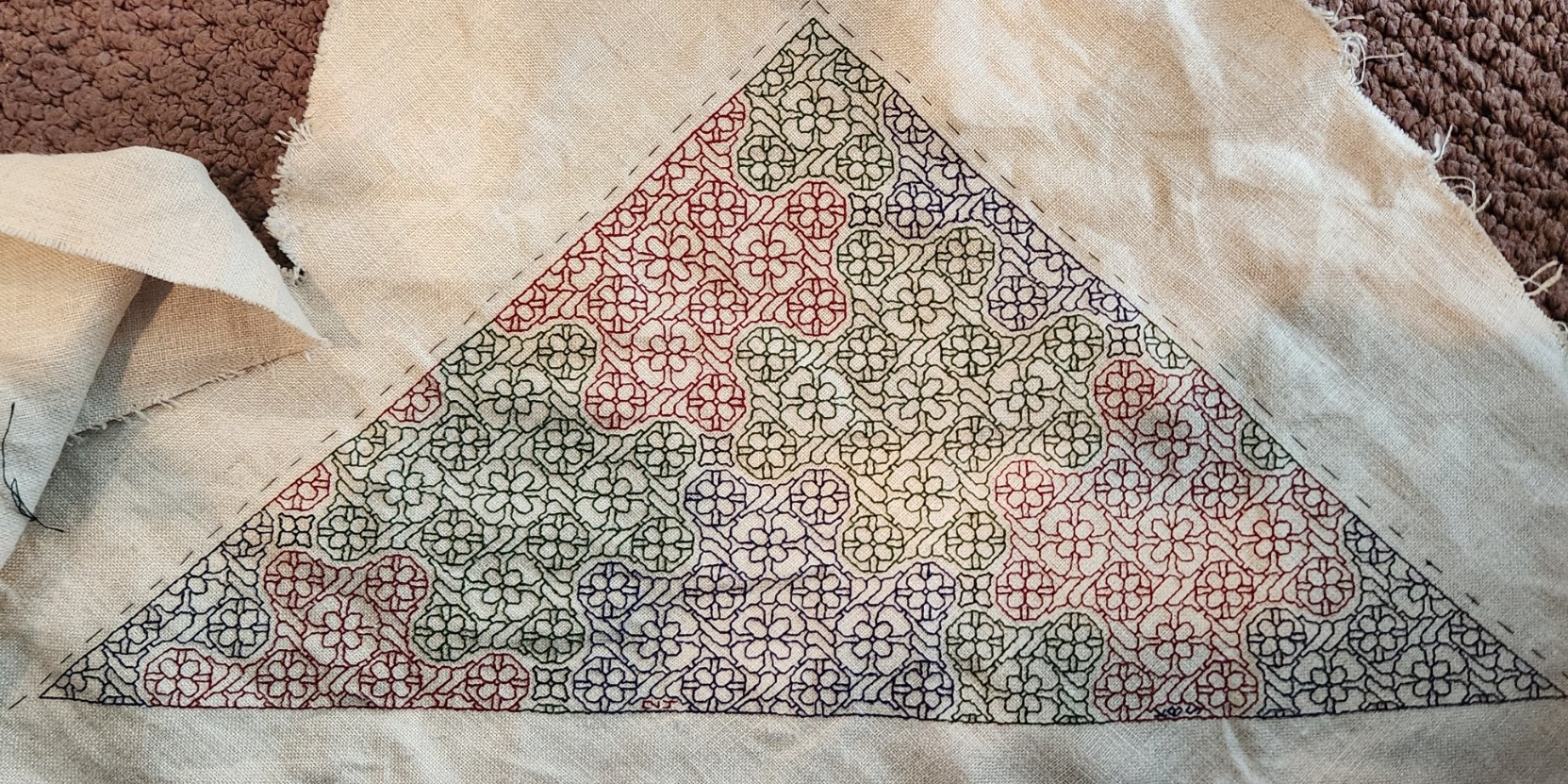
This is a doodle of a pattern that will be in Ensamplario Atlantio Volume III. I’ve been working on that, too and have about 20 plates of new fills. I’m planning on including several pages of larger patterns, strips, and even yokes, too. I am still dithering about including the free patterns that make up my Epic Fandom Stitch Along in it, too. It’s already a wildly anachronistic work, and it might be handy to have all that content in one place. In any case, EnsAtl III is very much a work in progress, and will be out as soon as I can manage it.
Back to this piece. It’s an experiment. I wanted to try out Sulky 30, a spooled thread sold for hand and machine embroidery. I’m working on 32 count linen, and two strands of the Sulky work nicely in terms of coverage and line depth. There are four colors here – an almost-cranberry red, a forest green, a navy blue, and (hard to see) small motifs filling problem spaces, worked in black. There are LOTS of mistakes in this. Places I missed a stitch, or substituted the wrong twist or size center flower, but since this is a quick stitch, meant to be worn to death and not a future heirloom of my house, I didn’t bother to go back and pick them out. I did fix mistakes that would have thrown off the design as a whole, though.
My thoughts on the Sulky? Not my favorite. It’s very hard twist and dense. While that makes a nice, clean line, it does make intersections a bit more difficult to keep even. Plus when picked out, both the blue and the green crock a bit – leaving color residue on the cloth independent of fiber crumbs. I’ll probably use up what I have on things I intend to wash savagely, but I won’t be buying more. The Unstitched Coif project spoiled me. Silk over cotton, any day.
I can’t report on the origin of the ground. It’s a scrap left over from something else. A garment has been cut from it. I did get a pile of linen scraps from someone here in town, via one of the local waste-nothing exchange groups. I’m pretty sure this was one of the pieces. So my guess is that it was yard goods, not custom-sold for needlework. Even so, the count is remarkably even. There’s some slubbing but not overly much, and the thread count is something like 32×33 threads. No selvedge left so I can’t guess about warp vs weft counts.
I am going to investigate narrow twill tape for the ties this time – both for this forehead cloth and to replace the now frayed and ruined ties of the older two. I had used the ground itself, double folded and seamed for the ties on the old one. Better I should use something more densely woven and robust, and that can be easily replaced.
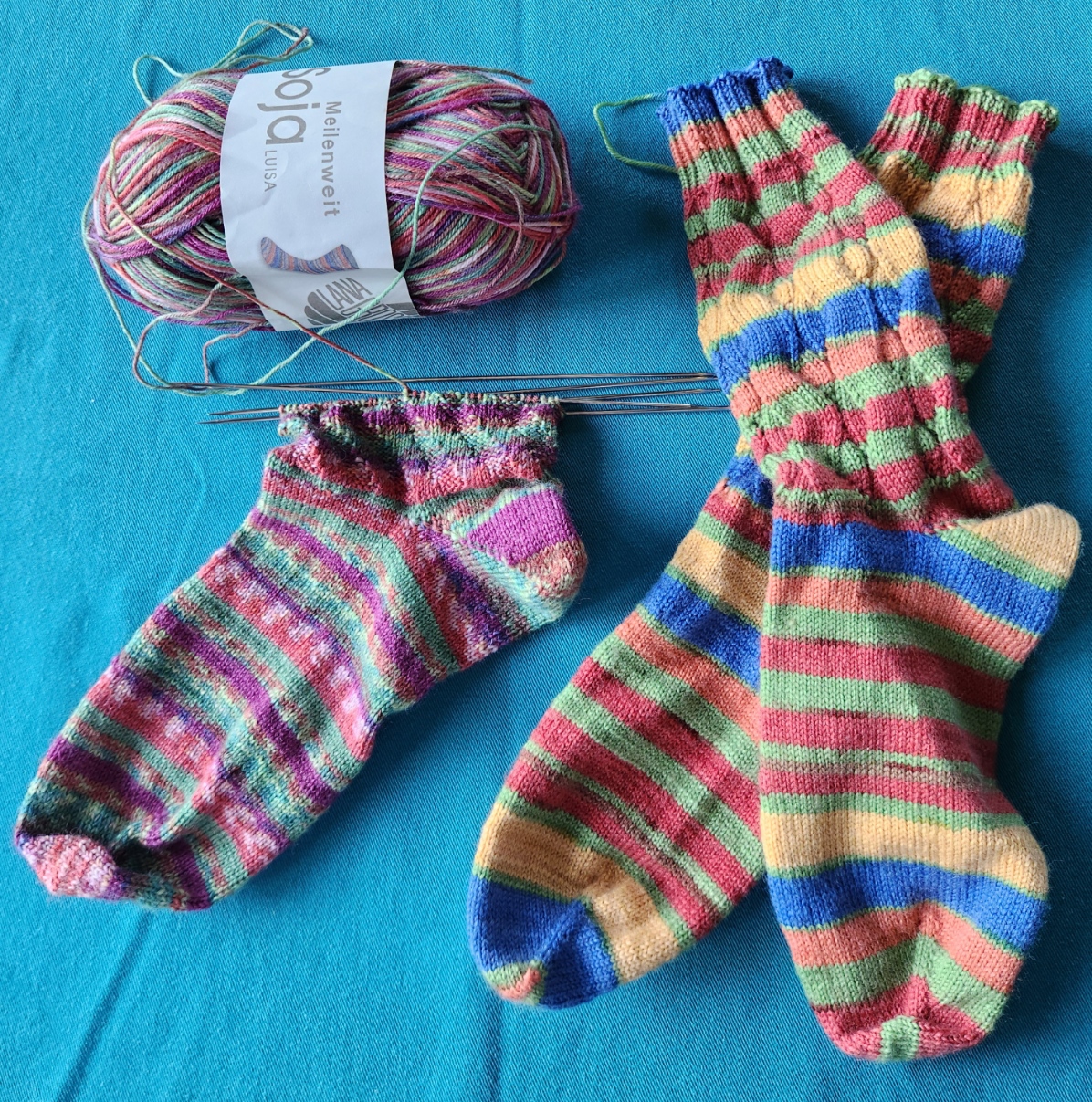
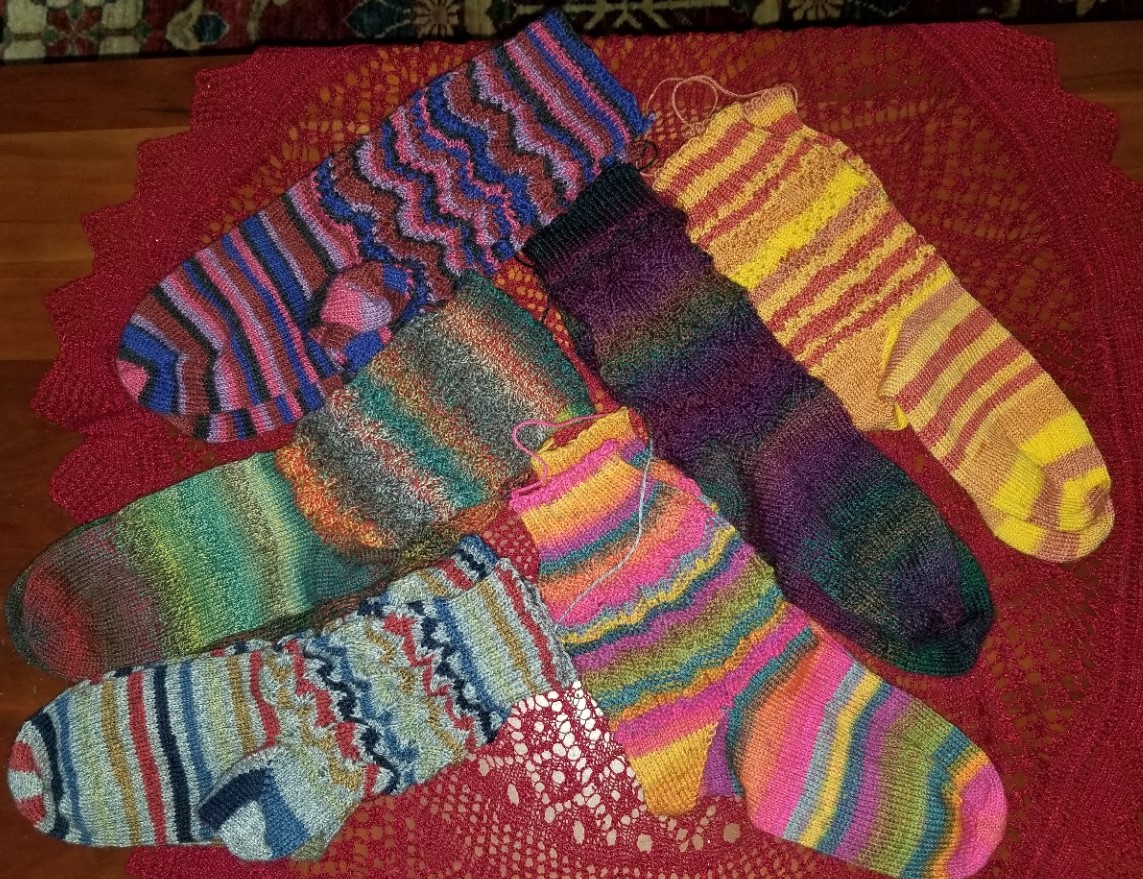
I’ve also been knitting and crocheting. Here are July’s socks. Not sure what made me knit the wide-stripe pair so tightly, but I did. They are the same stitch count around as the other pair, but are significantly narrower. I can wear them (just), but not all of my target audience can. So they will either stay home with me or find a narrow footed new friend with whom to play.
And I’ve been crocheting snowflakes. Not to keep cool but as a probably-the-case present for Elder Spawn, who has moved cross-country. It’s unlikely that we will be able to enjoy the family tree together this year come holiday time. A first for Casa Magnifica. So I have promised to make new snowflakes for what is now Casa Magnifica del Oeste, and ship them plus some of the family ornament stash, to furnish the new tree. I’ve got a half dozen complete. Six more to go, plus pin blocking and stiffening them for best display. Here are the first three, still looking sad and crumpled, right off the hook.
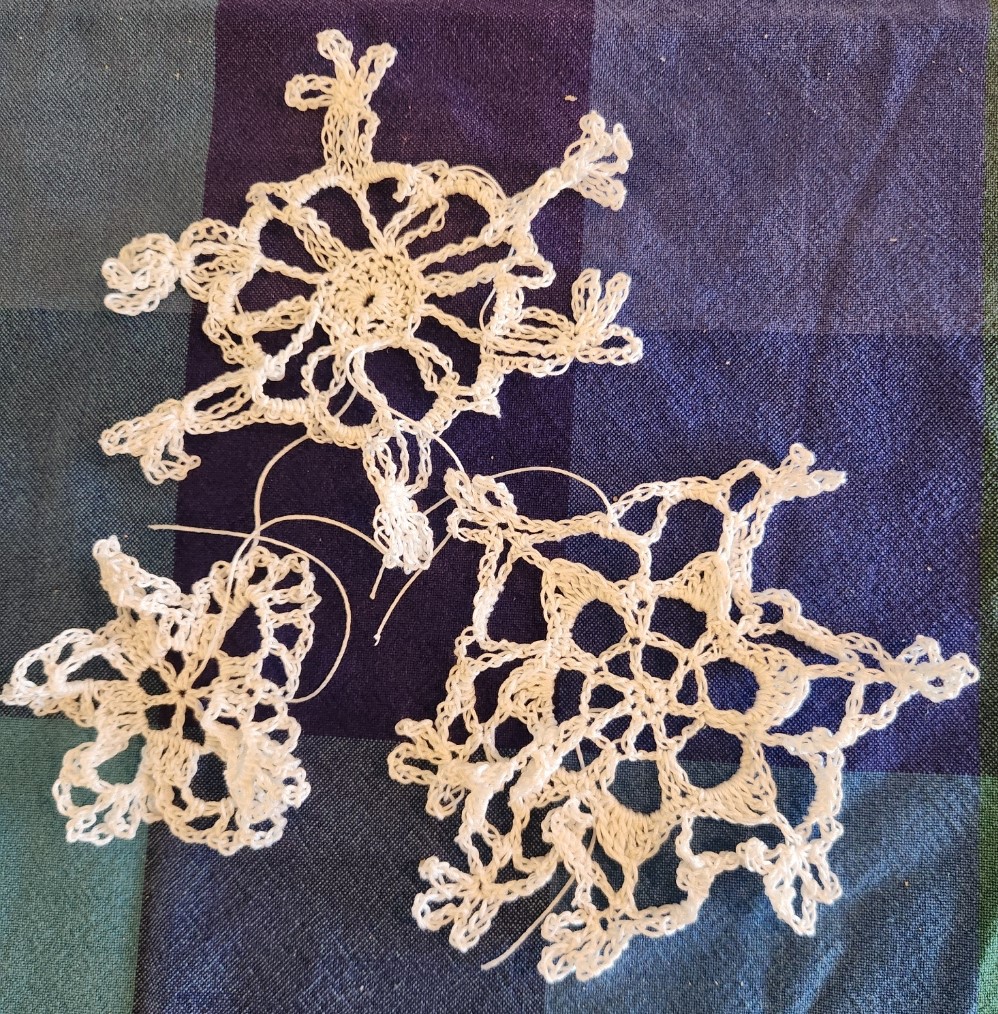
All of these are from this book. I have another one with better patterns. Someplace…

What’s next? Another stitched doodle on a thrifted linen rectangle, possibly to use up some of that black Sulky on a higher count ground. But more on that later this week.
SAVAGE BLOCKING
The merino/possum wool shoulder shawl turned out to be one of the quickest completing projects I’ve done in a while. It took only four evenings to knit.
For the record again, I used a wonderful luxury yarn – a gift from a pal. It’s Happy-Go-Knitty’s Ahuru 8, labeled as DK, but I like it as a worsted weight. It’s airier and less compressed at a stockinette gauge of 20 stitches for 4 inches/10 cm than at the DK gauge of 22. I started with a Knitty pattern from almost 10 years ago – Wavedeck, by Kate Atherley.
I made a couple of minor departures from Kate’s original. In the feather detail motif that constitutes the bottom round of the design, I worked the feathering for 15 odd number rows, not 12. Being a bit taller I thought a bit of extra length would be nice. I might have done at least three more because I had enough yarn to do so, but I was worried that blocking might not work out if I added too much depth.
Also, on the final round of bind-off, at each natural point formed by the feather border, I added a small cast-on/cast-off picot, both to accentuate those points, and to make a nice, sturdy spot for extra tugging during blocking. (To do this as I bound off according to directions, when I got to the centermost stich of each feather’s middle rib I cast on three extra stitches using the cable cast on, then immediately cast them off as per the method specified in the pattern. This made a little triangular nub at the base of each feather.
All in all, I used 1.75 skeins worth of yarn (estimate). I think I have enough left over for a pair of small wristlets, which will be a nice, comfy use for this super soft and super warm yarn.
Now for the blocking, savage or otherwise – you be the judge.
First we start with the completed, unstretched knit. Measuring with more precision but without stretch, it’s about 23 inches deep from center neck to center bottom, and about 46 inches across the wingspan (58.42cm x 116.84cm). You can see the little nubbins I added to each feather spine.

The first step is to get it nice and wet. I didn’t bother washing it with Eucalan or Kookaburra. It wasn’t dragged around enough in four days to get it grimy. Wetting was enough. Once wet, I gently squeezed out some of the water weight (no wringing, or rubbing, just a couple of compressions. Then I laid the piece folded in half on a bath towel, and rolled it up into a big jellyroll.

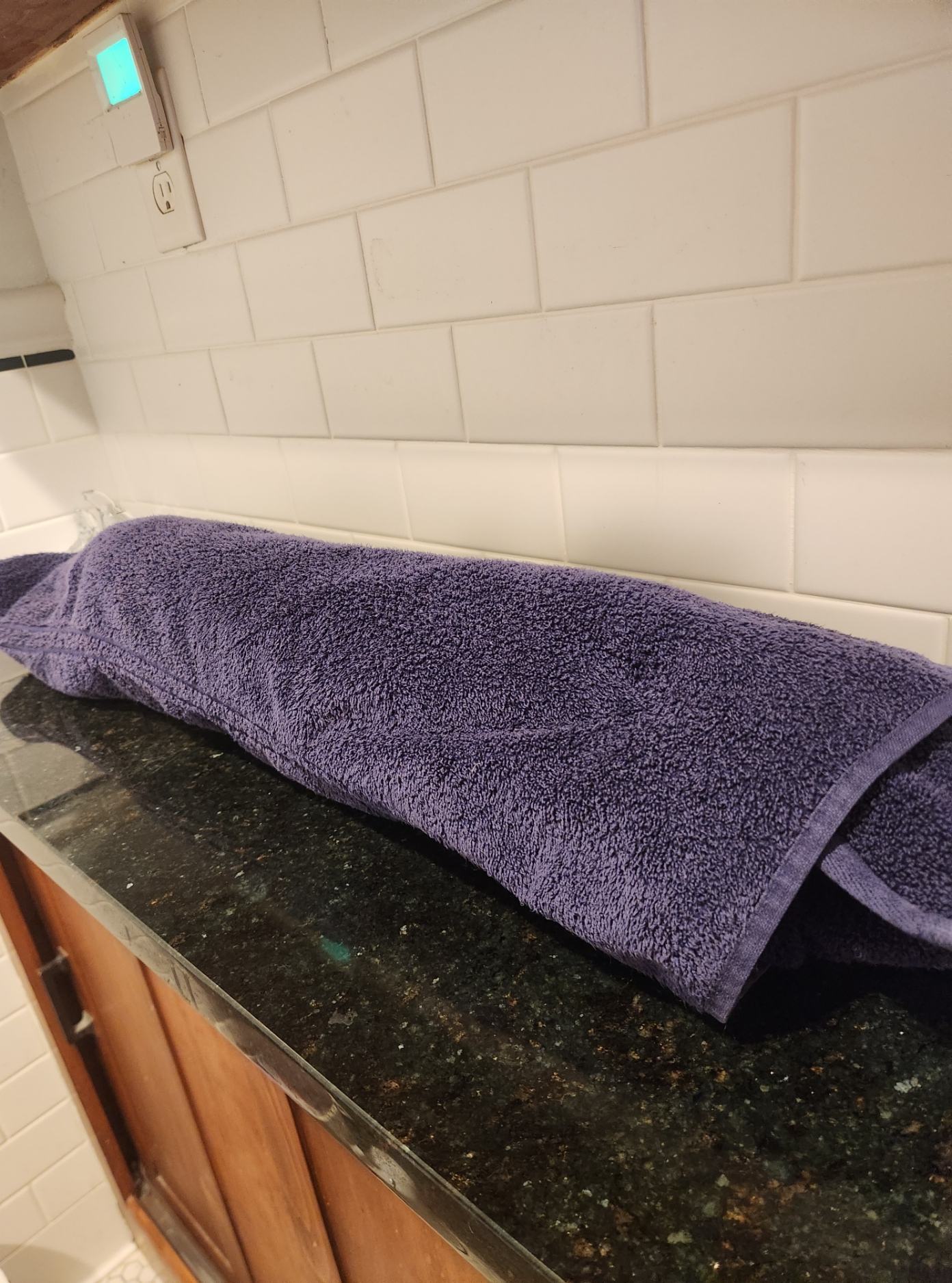
I leaned on the jellyroll to squeeze water into the towel, rotating it several times to get as much out as I could, but without subjecting the shawl to any undue stress.
Then I prepared my blocking area. First I laid out my usual blocking sheet – a rally checked flat twin sheet I found years ago at a yard sale, spread over a sturdy braided wool throw rug. Then I assembled my other blocking tools – blocking wires (some hand-me-downs from long time stitching and knitting pal Kathryn), and my long pins.
I began on the long side, threading every garter stitch edge bump along the straight edge onto blocking wires. Note that I used three of them. I deliberately left about a third of each wire bare, doubling up for about six stitches when I changed from one wire to the next. The reason I did this to leave room for stretching during blocking. If I filled up each wire completely, then stretched the thing during pin-out, stitches would fall of the end of the wires. Better to have lots of extra room and overlap. Bump threading below.

After wires were placed along the straight edge, I pinned them out following one of the horizontals of my checked sheet. I started at the center and tried to place pins and stretch evenly both to the left and right. The blocks of the sheet’s print helped me keep that stretch even.
Once the straight edge was laid out, again starting in the center I began pulling the points. There is no feather point at the center of this piece, so using the two points to the left and right of the center line, I used the sheet’s checks to make sure that the visual center line of the piece was perpendicular to the straight edge, and began pinning the points out from there. Now I’m not the best blocker. Were I so I would have calculated the angular difference at my chosen circumference, and marked it, pinning each to the exact spot on the indicated, scribed half circle. But that’s not me. I just winged it by eyeball. Good enough for home consumption.

Pinned out like this it’s about 30 inches deep, and 60 inches across (76.2cm x 152.4cm) roughly a gain of 7.6% in the stretching. It will probably relax a little bit once it’s released from savagery.
The next steps include letting it dry completely, unpinning and unthreading it from the blocking wires, and darning in a few ends. But at this point, it’s done. Four days of knitting, and 45 minutes of blocking, and fewer individual stitches than a single sock at my usual gauge. And one super cozy shoulder shawl, soft as whispers, to wear come autumn.
PLAYING (WITH) POSSUM
Fueled by Friend Kim who surprised me with a yarn gift, I dawdle a bit more in the Land of Knitting. I’ve done a ton of socks since finishing my Unstitched Coif submission – 14 pairs to be precise. But charmed by this super soft yarn I decided to do up a larger project – a shawl.
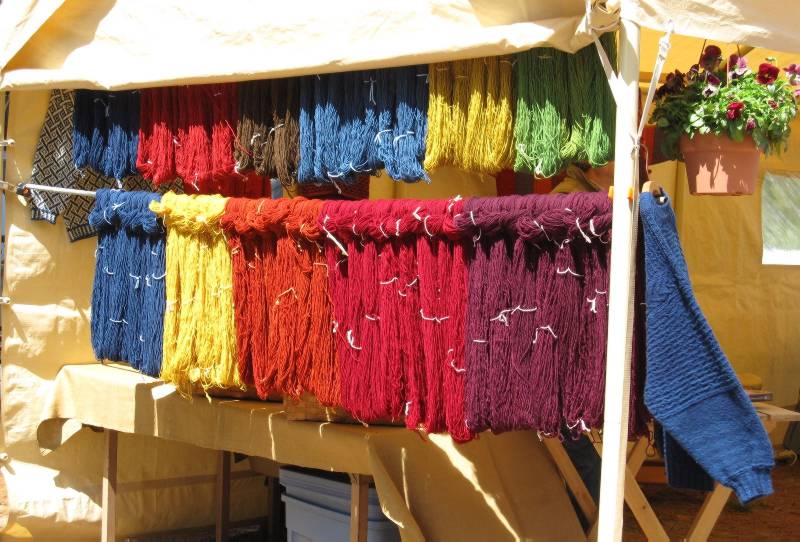
First the yarn. It’s an exotic fiber – a blend of possum and merino – the yarn on the right in the photo below. It’s Happy-Go-Knitty’s Ahuru 8, labeled as DK, but knitting up more like a true worsted. It’s soft as butter; very warm; extremely light, airy and compressible; and adaptable to being knit down possibly as far as sport (24 stitches for 10 cm/4 inches) and up to worsted (20 stitches for 10cm/4 inches). The color name of my skeins is Caramel, possibly the undyed color of the possums themselves. The mixed color sock weight (red supplement with a brown to ecru main skein) from Prosper Yarns will decide what it wants to be later. That one is a luscious merino/nylon blend. I think the red accent skein is intended for toes and heels.
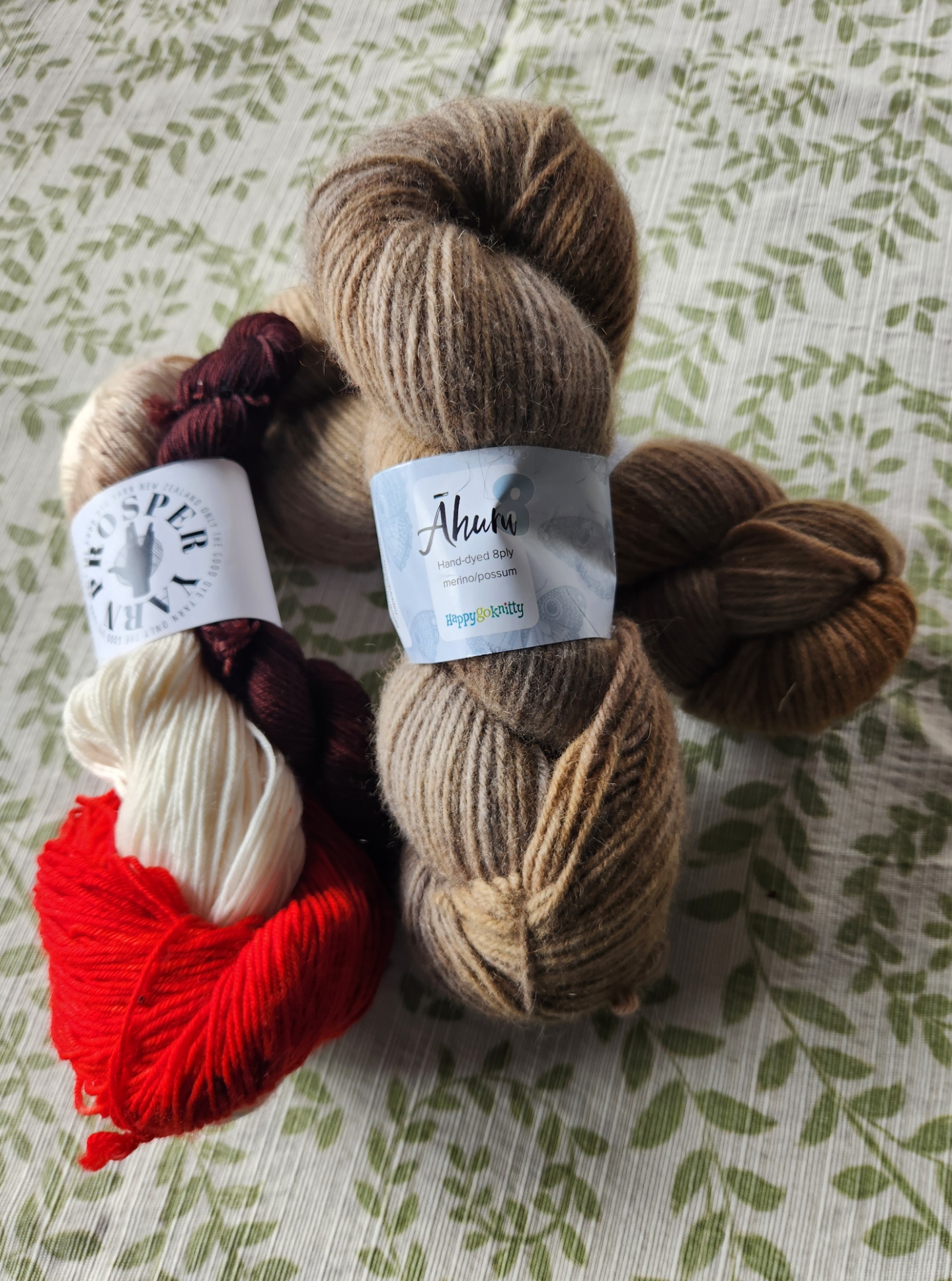
Back to the Ahuru. Now possum isn’t North American Opossum, it’s a New Zealand beast. It was introduced there from Australia and became an uncontrolled and invasive nuisance. But folk in New Zealand appear to be quite practical – there is now an entire yarn industry based on the controlled harvest of these creatures, limiting the ecological disruption they cause and furnishing some lovely fiber and (so I’ve heard) pet food.
Now the project. I have about 476 meters, roughly 520 yards. I initially thought of using it in combo with another yarn to make a yoke style pullover, but I decided that this stuff needed to shine on its own merits. So I went looking for something else. I hit upon Wavedeck, a Knitty project from 2014. It’s a half circle shawl based on the Pi Shawl principle, heavily textured with YO/decrease pairs, directionally arranged to create flower petals, with feather edging that can keep going until the yarn runs out. If it ends up a few rounds longer or shorter than the official count, it won’t matter.
Although this one looks complicated, with massive charts, it’s nowhere near as difficult as first glance would make out. The patterns are extremely logical, requiring mostly that one keep track of the current row number (odd rows only – all the even rows are the same). My only deviation so far is to use a US size 8 needle (5mm) instead of the pattern’s recommended size 7 (4.5mm). I liked the slightly looser drape of the produced fabric better with the larger size.
Here’s two evenings’ progress. I had forgotten how quickly knitting at this gauge goes. I’m up to Row 25 of the largest chart, and halfway through it.
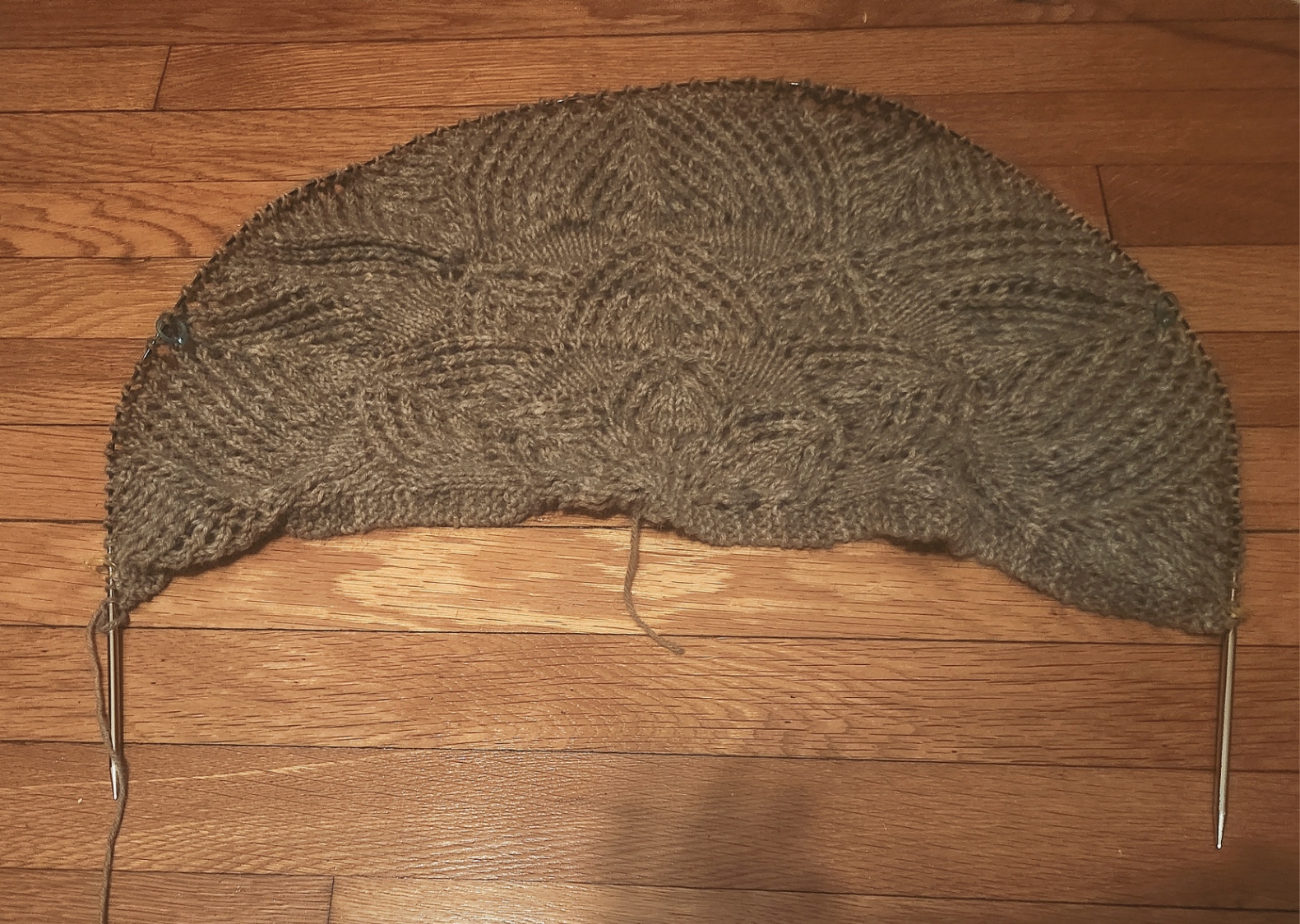
I really like the stitch definition I am getting with the Ahuru. The mottled colors come across a bit more orange than they are in the late night indoor illumination, but in person the color spread is grey to a tannish smoke brown, with spots of ecru and occasional bits of a darker chocolate, all with a tiny hint of mustard. Sounds like a mishmash, but in person it looks very Vintage Camouflage.
Knitty tags this one as “tangy” – their euphemism for “slightly challenging.” It’s one step up their four-step scale from beginner to complex. So far I’ve found it very easy to follow. If you are comfortable with yarn overs, left and right leaning decreases (K2tog and SSK), and can manage a center double decrease (three stitches merged into one, with the centermost presenting on top), and can pick up along an edge, you can do this one. Use sticky notes or a magnet board to focus on the current row, and go for it.
I’ll post back when I’ve run out of yarn and declare the project complete. After this, I’m not sure what will be next. Always a pair of socks as a guard against waiting room boredom. But I itch to stitch. Something…
LOOKING BACK AT AN OLD PROJECT
I’ve been tidying up my closets and drawers. I stumbled across a couple of items that I haven’t worn in a long time. Luckily they still fit well enough, so they’ve been rescued and added to the regular rotation. One was this T-shirt style pullover.

It’s one of the most intricate projects I did, mostly because I designed it myself. I did it back before Russian language sites became notorious for malware dissemination and wholesale piracy/copyright infringement. There were a few knitting sites back then that were clearly hobbyist-generated, with hand drawn charts for texture patterns. Needless to say there are many reasons why I do not recommend visiting any of them now and strongly caution against it, but I do confess that in the early days of the international Internet, I did browse worldwide.
In any case I stumbled across a hand drawn texture pattern thumbnail that led to this diagonal design. It wasn’t as tall a repeat as I present, and the drawing didn’t show a center mirroring, but both that detail and elongation were so obvious to me at the time. So to maximize the fun, I doodled up a pattern. The resulting repeat with its offset verticals was SO large that to this day it remains one of the largest knitting charts I’ve ever drafted.
The yarn I used was a bit unusual. I knit this from Silk City’s Spaghetti – a narrow cotton tape ribbon, with a native gauge that was roughly sport weight (24 stitches to 4 inches/10cm). The result was both crisp and springy, making a negative-ease garment that was quite come-hither and curve-hugging. Any hard twist sport weight cotton, linen or ramie can be used. As dense and tightly twisted as possible for maximum display of the textures.
I knit this project before I began blogging with intent – probably around 1991 or so. I shared an initial write-up in the ancient KnitList email based chat group, and eventually revised it and posted it on an earlier incarnation of String-or-Nothing in 2004. It’s been up and available ever since, but I don’t know of anyone else who has tried to knit it. The short length and close fit however seem spot on with current street fashion so I present it again. If I had a full length mirror I’d post an as-worn, but I am quite a bit older, and a bit bigger these days. The pattern is offered in just one size, and given the stretch would probably fit a US size 14-20 of ample endowment. I knit and wore it as a 16-18, and can still present it credibly if a bit brazenly as size 20. You could probably tinker it down a couple sizes using a slightly thinner yarn and smaller needles.
The name? I named it after the middle name my mom always thought was hers, until a birth certificate was obtained and she found out she’d been saddled with another. Since it was a Russian derived name and my mom has always been my knitting inspiration, it seemed fitting.
You can download the pattern for Raiisa here,
or from the sweaters section of the free Knitting Patterns Page tab available elsewhere on this blog.
DETOUR INTO KNITTING – FIREFLIES IN THE WINTER
It’s true I haven’t knit in a while. But I did do nine pairs of socks for the holidays this year, some of which are shown below. And while I was at it, I dropped hints to Younger Offspring, who was enthused by the thought of a new pullover.
I first knit this classic Penny Straker unisex design decades ago. It was probably the third sweater I made and was a present for one of my sisters. This is the cover photo from the original leaflet. Note the armhole depth (we’ll get back to that later).

It was the early 1980s – long before blogging, so I don’t have pictures or notes detailing my first attempt, but it was a happy success. I’m pretty sure I used Germantown worsted, in a deep burgundy and a lighter, coordinating plum. I do remember that it was super thick and stiff because of the Eye of Partridge stitch uses a lot of slip stitches, making a double-thick fabric. In fact that stitch often used as a self-reinforcing treatment for sock heels, to make them both cushier and more wear-resistant.
My sister’s sweater ended up being a great outdoor activity wearable – perfect for someone engaged in winter exercise like cross country skiing, and too warm for indoor wear. But as we were flipping through some possibilities it was the one that caught Younger Offspring’s eye. So I downloaded a copy of the revised pattern from the Straker website (it’s now offered in an extended size range) and off we went to Webs, making a small detour out in western Massachusetts on the official Deposit-Child-Back-At-Home-Away-From-Home trip to Troy, New York.
At Webs I found a candidate yarn that came in the desired black and screaming chartreuse colors – Euro Baby Babe 100. It’s a butter-soft acrylic/polyamide (nylon) blend, and at 356 yards for 100g, a great value.

But it’s not a true worsted. It’s a DK. That means that instead of the standard 5 stitches per inch (spi) in stockinette, it works better at 5.5 spi in stockinette.
Complications ensue.
Although the pattern is clearly written for a heavier yarn, but I took a risk and bought the Babe anyway. I swatched until I found a needle combo and gauge that I liked. In this case, 6 spi/8 rows per inch (rpi) on US #7s (4.5mm) in Eye of Partridge instead of the pattern’s specified 5 spi/7 rpi on US #8s (5mm).
I’ve done the math for Younger Offspring’s chosen size (a swim-in-it oversize fit), and have cast on the revised number of stitches, plus two more – I always add selvedge stitches for easy seaming. I will work my new number until I am close to the specified length for the below-arm torso, then I will figure out the raglan shaping, taking notes so I can match the row count on the sleeves. I know that these Straker patterns were all written with very tight armholes by modern standards. It was the style back then. So there is room for me to err on the up side. If I need a few more rows to accommodate the raglan shaping than the original used, that will be ok. The armhole will end up a smidge larger, and that won’t be bad at all.
So to finish this already over-long, stitching-free post, here’s three evening’s worth of progress on the back. The drape is fluid, and the yarn is super soft and luxurious, uncommon in an acrylic. The color contrast reminds me of fireflies on a dark night. With luck this one should knit up quickly into a bundle of fun.

YARN WEIGHTS – YET ANOTHER RANT
Although I’ve mostly been stitching of late, and my old yarn review/knitters’ advice board/pattern website WiseNeedle that lasted for 13 years is but a distant memory, I have not given up knitting. I keep a sock project or two going at all times, and consult for my mom as her remote “knitting lady.” The patterns from WiseNeedle can all be found here, as can some of my advice, hints, and rants from the past, although the WiseNeedle question-answer board is gone. But of late I’ve seen quite a few complaints on knitting forums about yarn weights – confusion, botched projects, and misapprehension. I chime in and try to help.
First of all, the universal yarn weight system introduced by the Craft Yarn Council around 2004 continues to sow havoc. It’s misguided, untrustworthy, and has destroyed many knitters hopes and aspirations. To recap, this was the system that divided all yarns into numbered groups, initially 6, now expanded to 8:

The yarns within these groups are not instantly substitutable for each other because the definitions are overly broad. Here’s a breakdown:
| Group 0 | Group 1 | Group 2 | Group 3 | Group 4 | Group 5 | Group 6 | Group 7 | |
| Type of Yarns in Category | Fingering, 10 count crochet thread | Sock, Fingering, Baby | Sport, Baby | DK, Light Worsted | Worsted, Afghan, Aran | Chunky, Craft, Rug | Bulky, Roving | Jumbo, Roving |
| Knit Gauge Range* in Stockinette Stitch to 4 inches | 33-40 sts | 27-32 sts | 23-26 sts | 21-24 sts | 16-20 sts | 12-15 sts | 6-11 sts | 6 sts and fewer |
| Recommended Needle in Metric Size Range | 1.5-2.25 mm | 2.25-3.25 mm | 3.25-3.75 mm | 3.75-4.5 mm | 4.5-5.5 mm | 5.5-8 mm | 8-12.75 mm | 12.75 mm and larger |
| Recommended Needle U.S. Size Range | 000-1 | 1-3 | 3-5 | 5-7 | 7-9 | 9-11 | 11-17 | 17 and larger |
| Crochet Gauge Ranges in Single Crochet to 4 inch | 32-42 double crochets | 21-32 sts | 16-20 sts | 12-17 sts | 11-14 sts | 8-11 sts | 5-9 sts | 6 sts and fewer |
| Recommended Hook in Metric Size Range | Steel 1.6-1.4mm; Regular hook 2.25mm | 2.25-3.5 mm | 3.5-4.5 mm | 4.5-5.5 mm | 5.5-6.5 mm | 6.5-9 mm | 9-15 mm | 15 mm and larger |
| Recommended Hook U.S. Size Range | Steel 6,7,8; Regular hook B-1 | B-1 to E-4 | E-4 to 7 | 7 to I-9 | I-?9 to K-10 1⁄2 | K-10 1⁄2 to M-13 | M-13 to Q | Q and larger |
(source: Craft Yarn Council’s http://www.yarnstandards.com/weight-system.html)
To be fair, there are all sorts of caveats on this chart at the original site that include “Guidelines only,” “…always follow the gauge in your pattern,” and more. Even so, it’s wildly misleading.
The core of it (Groups 1-6) were created at the time that the industry thought that busy women had less time to knit and appreciated projects that finished up quickly. To compensate the “gauge creep” move was led by big craft yarn makers. Yarns that were formerly labeled Aran or Light Bulky were rebranded as Worsted, with the idea that fewer stitches per inch would make the projects zip along, This was especially evident among makers of mass market acrylics, and the heritage of that movement is seen in the groupings above. In fact it’s hard today to find a true worsted weight Worsted because most yarns labeled “Worsted” knit up to Aran gauge.
Now in a reversal because fiber of all types is getting more expensive, many makers are “slimming down” their yarns to keep project price points more attractive – less fiber = lower per skein price; and thinner yarns are now creeping into designations formerly reserved for heavier ones. This has resulted in a new round of confusion, once again long loved patterns no longer produce the same results as they did with yarn of prior years.
Regardless of yarn size fluctuations the basic flaw of this chart, however footnoted and expanded, remains. The yarn categories cover wide ranges of gauges, and are unsuitable as type descriptors or as guides for determining suitability for interchange.
Now. What is more useful?
Easy. The ancient Ply System.
Now note this as absolutely nothing to do with the actual number of plies a yarn contains. You can have a fat single, or a multi-ply extremely fine yarn. The ply system is based on comparison of the strand thickness of the yarn being described to a canonical batch of yarns that can be made by combining one or more strands of a mythical standard thickness yarn. That system has far more specificity to the standard gauges on yarn labels, and along with those gauges plus yarn fiber and loft (how airy or tightly twisted/dense the yarn is), is far more likely to result in good substitution choices. It also is a good guide for what happens when you double your yarn. In fact, the popular yarn weight “Double Knitting” (DK) refers to a yarn that is twice what used to be called “Knitting.” Knitting was the equivalent of today’s fingering or sock yarns. Two strands of fingering are still roughly the equivalent of today’s DK.
| Ply System Number | Traditional Name | Standard Knitting Gauge over Stockinette (4 inches/10 cm) | Comments | Typical Examples (off the top of my head) |
| 1 | Cobweb | No consistent close knit gauge – used with variety of larger needles to maximize airy look. | Jamieson & Smith 1ply Cobweb | |
| 2 | Lace | No consistent close knit gauge – used with variety of larger needles to maximize airy look. | Lopi Einband; Rowan Fine Lace; Jamieson & Smith 2ply Lace Weight | |
| 3 | Light Fingering/Baby | 32-36 | “Baby” on the label is now near meaningless because in modern use it designates yarns in pastel colors and easy care fibers, regardless of gauge. | Brown Sheep Wildfoote; Peter Pan 3 Ply Baby; Red Heart Its a Wrap; |
| 4 | Fingering/Sock | 28-32 | Cascade Heritage Sock; Regia sock yarns; Opal sock yarns; Lang sock yarns | |
| 5 | Gansey | 26-28 | Frangipani 5 Ply; Upton Guernsey Wool; | |
| 6 | Sport | 24-26 | KnitPicks High Desert Sport; Herrschners 2 Ply; Lion Dotted Line | |
| 7 | Not used | |||
| 8 | Double Knitting | 22 | Rowan Felted Tweed DK; Berroco Comfort DK; Wendy Supreme DK; Lion Ice Cream; Herrshners Baby Yarn | |
| 9 | Not used | |||
| 10 | Worsted | 20 | Cascade 220; Plymouth Encore; Germantown Worsted; Plymouth Pima Rino; Sirdar Country Classic Worsted | |
| 11 | Not used | |||
| 12 | Aran/Triple Knitting | 18 | KnitPicks Muse. Herrschners Worsted 8; Red Heart Roly Poly; Lion Crayola; Caron Simply Soft; Tahki Donegal Tweed | |
| 13 | Not used | |||
| 14 | Bulky/ | 12-16 | Plymouth Encore Chunky; Cascade 128; Lamb’s Pride Bulky; Lion Re-Tweed | |
| 15 | Not used | |||
| 16 | Super Bulky | 8-12 | Malabrigo Rasta; Plymouth Encore Mega |
Now again – caveats on density, fiber choice, and construction. Some examples:
- When worked, a tightly plied and twisted yarn will have a different drape than a fat single ply yarn, even if the fiber composition is the same.
- A 90% wool/10% acrylic blend will have a different feel than a 10% wool/90% acrylic blend. For best equivalency try to match fiber composition/mix proportions.
- And a cotton yarn and a wool yarn of equal weight will behave differently – enough differently to generally not sub one for the other without taking the extra mass and lack of elasticity of the cotton when compared to wool of equivalent size.
- In a delightful bit of industry internal obfuscation the term “worsted” in addition to being a yarn weight category also is used to describe a style of spinning. But not everything that’s labeled Worsted conforms to that specification.
- Some yarns can be knit down or up in gauge. For example a lofty 100% wool Aran with a “native gauge” of 18 st = 4 inches/10cm might also be able to be knit at worsted gauge 20 stitches = 4 inches/10cm. The drape will be different but it may be satisfactory for some purposes. Note that NOT ALL YARN can be manipulated this way, and lumping many adjacent weights into broad and misleading groups is just asking for trouble.
To sum up, please people, look beyond the CYC Yarn Group designation. Look at gauge, fiber, and density. And take guidance from these older systems. They were created by people who knew their wool and fiber, and there still is a lot of wisdom in them.
MUDDLING THROUGH MIDWINTER
It’s doldrums here at String Central. Younger Daughter is back to university. Others are back to work. I fill my time with nosing around for grant and proposal contract assignments, and my various projects.
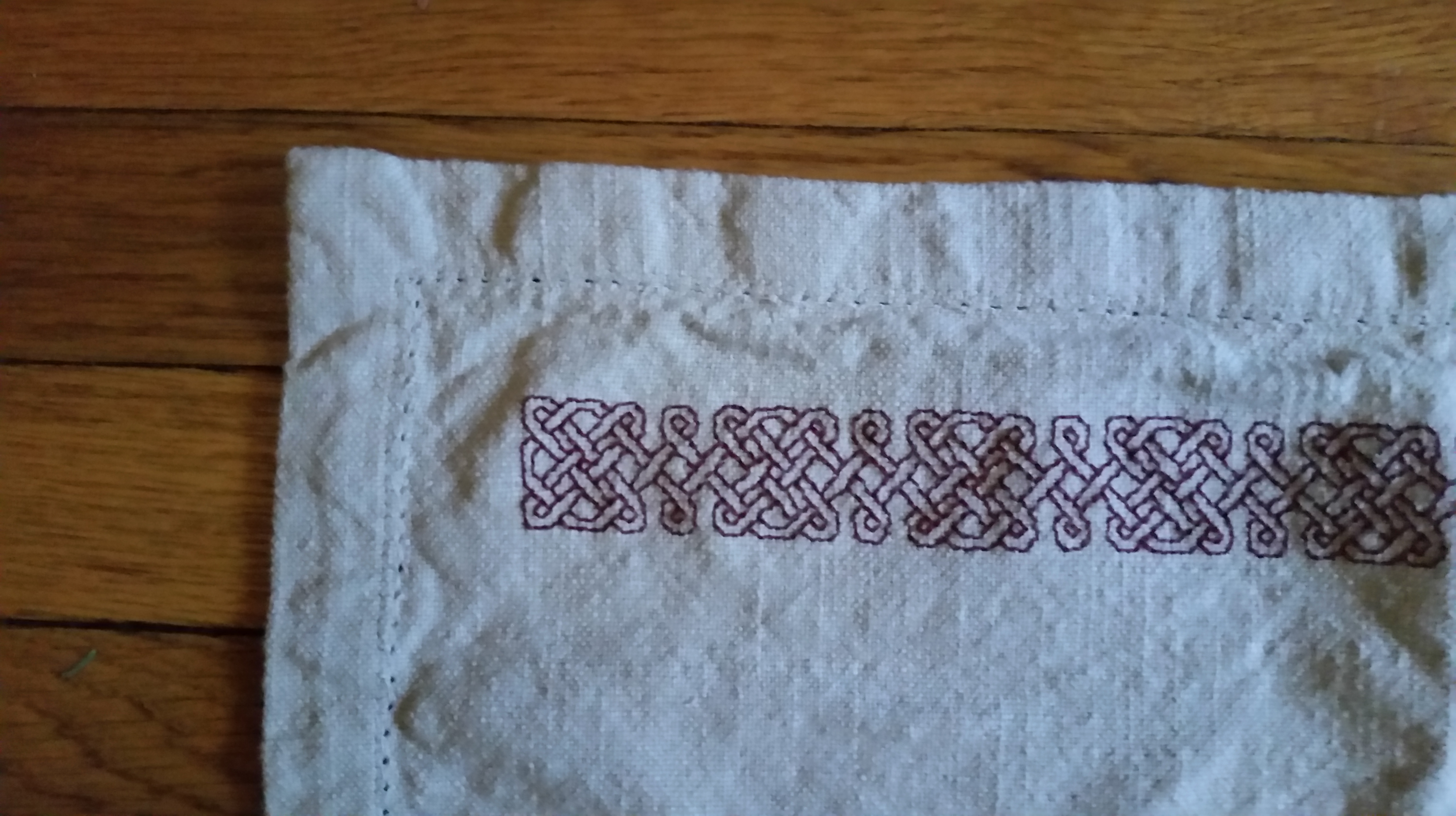
First, my sanity project – the doodled decoration on the pre-finished napkins I bought on sale from Wayfair, using the cotton four-ply embroidery floss I picked up when we visited Sajou in Paris (stitching with three plies). I can show a modicum of progress. I’m just picking out random designs from my books and doing them rather informally, with a different design along a single edge of each of eight napkins. The first of my mismatched set is complete. The second in process.
The linen is soft and once washed, a bit mushy. That makes count work a bit more troublesome than it otherwise would be, especially on so coarse a ground. But it’s still rather quick work. The first napkin with the interlace took three evenings (about half shown). The in process photo shows only one evening’s worth of work.

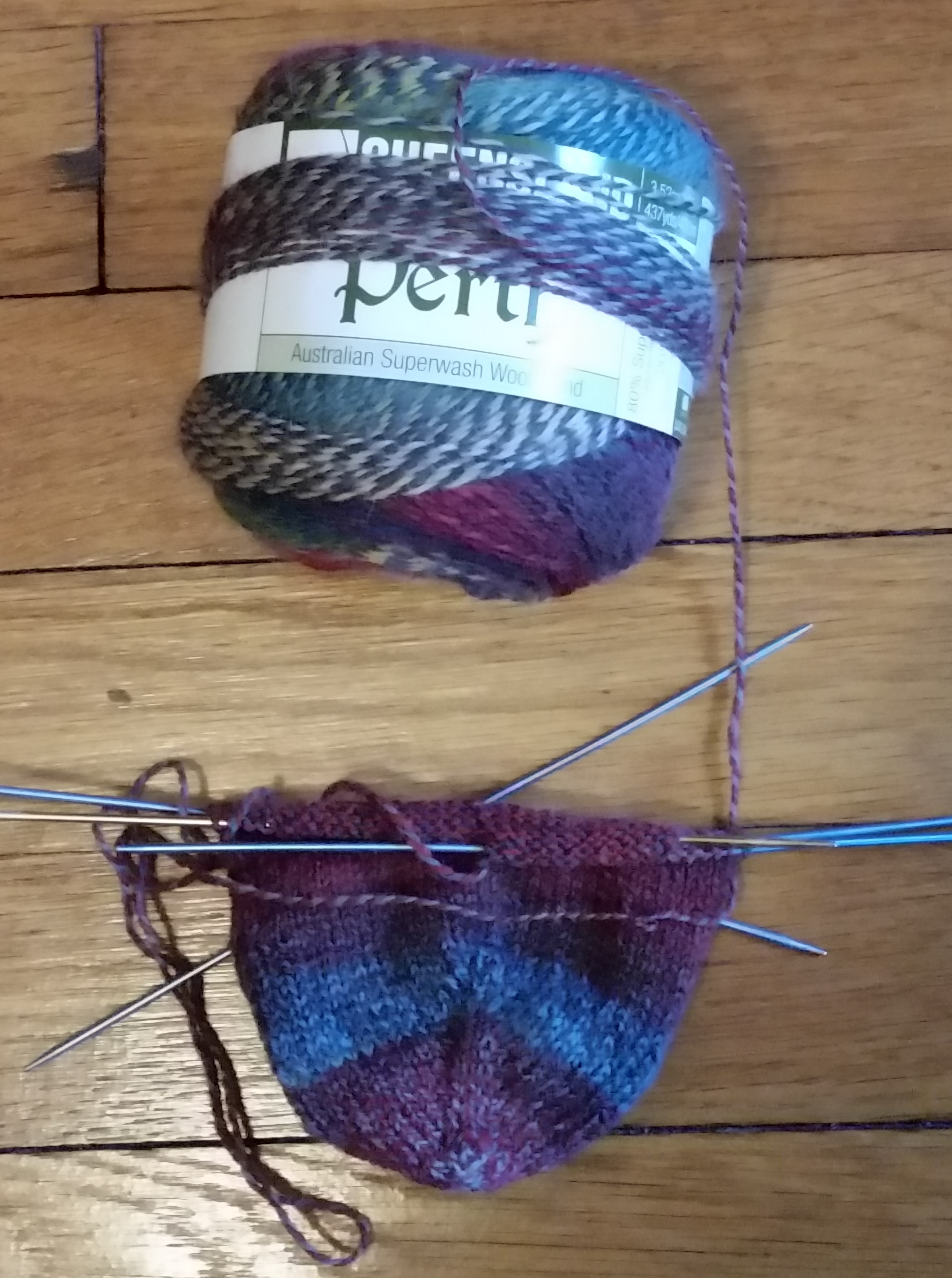
On to knitting. I finished a pair of socks, packed up and sent to the recipient before I remembered to take a photo. They were my “briefcase project” – the thing I always have with me to work on while I wait on telephone hold, on line at the post office, or for appointments. Since I ALWAYS have a pair on the needles, the next pair is already cast on and sitting it its bag, itself waiting for me to be waiting. This pair however is special. Younger Daughter picked out this yarn with the proviso that I knit something for myself with it. I comply.
And my project of long suffering guilt. I promised these Octopus Mittens to my niece late last winter. It was inadvertently destroyed, then was re-started with new yarn, and is now sitting next to my project chair, chiding me that it is being neglected. I plead laziness, lack of inspiration, and frustration with stranding using two strands of DK, knit at sock yarn gauge for warmth.
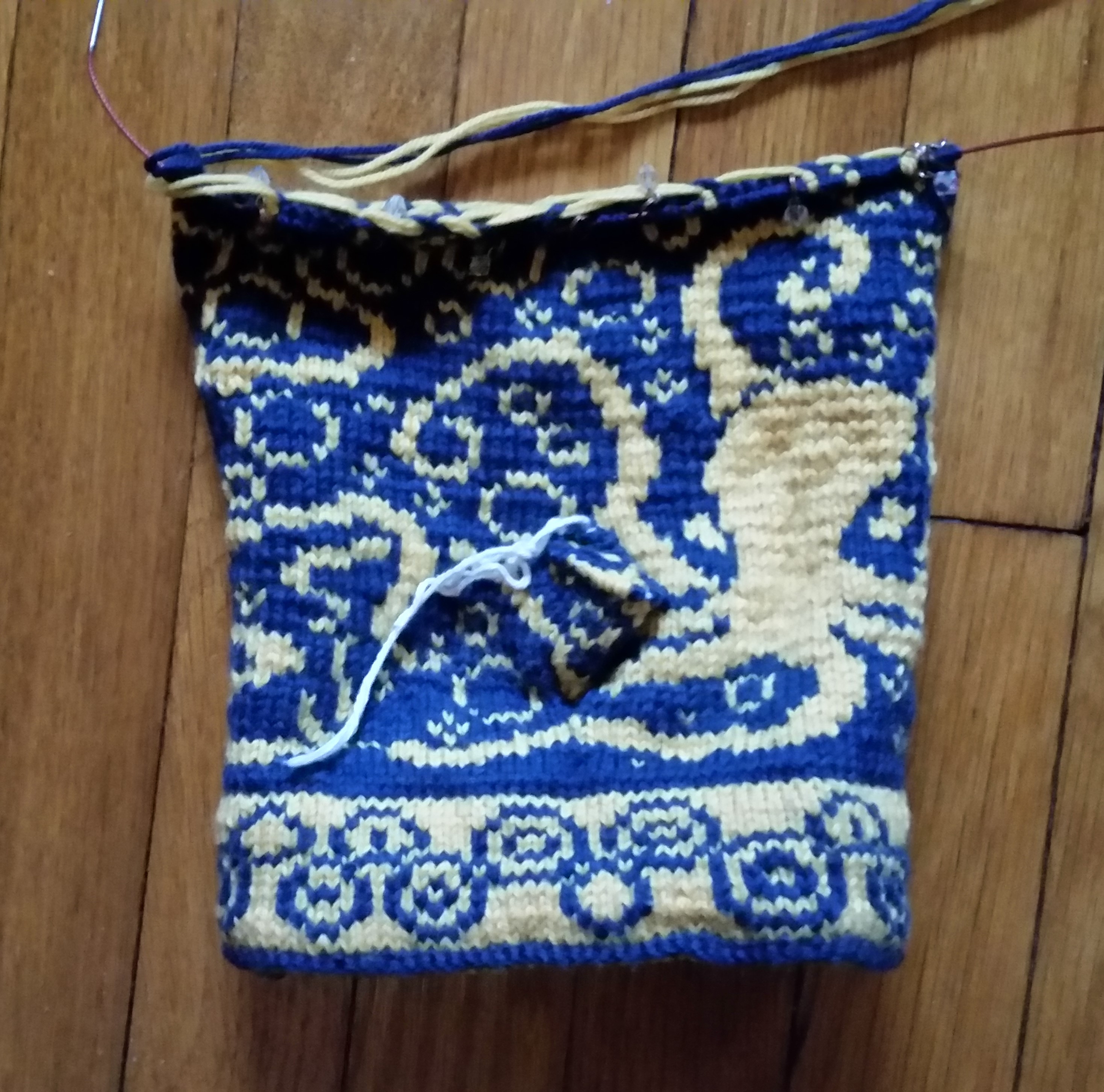
I MUST finish these. I promised.
How do you flog yourself back into working on a sidelined project? All suggestions gratefully accepted.
Oh, And if you know of anyone looking for a project manager/writer/editor specializing in high tech grants and proposals – send them my way, please.
ANOMALOUS MUSHROOM
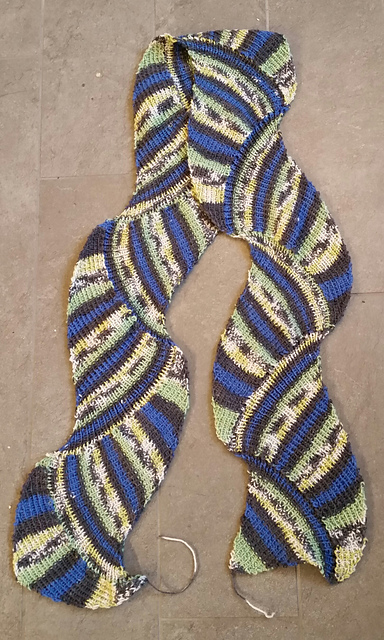
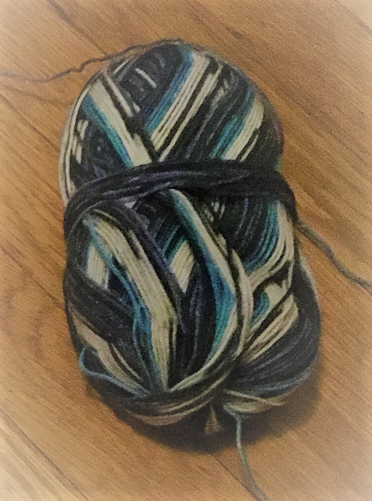
I continue to produce samples for the Chanterelle pattern. This one is in a narrow self-striper – the kind of sock yarn that when knit up, makes socks with stripes of two or at most three rounds.
And for reference, what the ball looked like before it was consumed:

This scarf is another oddity. It has the same gauge and width as all of the others. The Steinback Aktiv Effekt yarn is marked as being 421 meters (460 yards) – comparable to the others.
BUT.
I was only able to knit up nine full trumpet sections, plus the beginning and end section. I did have a bit of yarn left over, but only enough for about a third of a trumpet. So based on what I’ve seen so far, here’s the scarf length to yardage result. As you can see, it doesn’t quite make sense.
|
Maker/Yarn |
Description |
Labeled length |
Number of Full Trumpet Segments and Length |
| Steinback Wolle Aktiv Effekt |
Self-striper Narrow stripes with one faux Fair Isle inclusion |
460 yards 421 meters |
9 segments |
| Schoeller + Stahl Fortissima Colori Socka Color |
Self-striper Combo of narrow red and white stripes with one medium length blue/white stripe |
459.3 yards 420 meters |
10 segments |
| Zwerger Garn Opal 4 fach |
Self-striper Half medium, half narrow stripes. One faux Fair Isle inclusion |
465 yards 425.2 meters |
10 segments |
| Schoppel-Wolle Zauberball Crazy |
Gradient with two independently shading plies | 459 yards 419.7 meters |
11 segments |
| Schoppel-Wolle Zauberball Crazy |
Gradient with two independently shading plies | 459 yards 419.7 meters |
10 segments |
The saving grace of the pattern is that the trumpet segment and the final section are identical until one is half-way through the trumpet sequence. At that point the knitter can look at the remaining yarn and decide on whether or not to risk finishing out the last trumpet and then going on to the final segment (which would require about 36 yards remaining), or punting and just finishing off the segment at hand according to the instructions for the final section.
MORE CHANTERELLES
Well, this pattern has wound my curiosity up around itself. The basic design of the Chanterelle scarf is quite simple, but it can look quite different depending on the yarn chosen. I have written it for any 100g ball of fingering/sock weight yarn, and finding out what the various yarns end up looking like when knit up – that’s turning out to be tons of fun.
So let’s start.
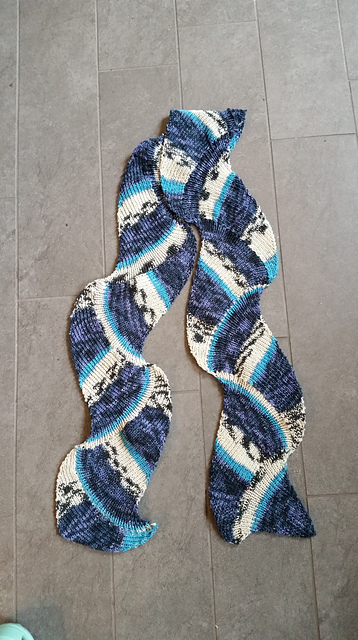
So far I’ve used two different Schoppel Zauberball Crazy colors: the autumn/purples mix of the original, plus a lilac/cream/navy mix. The pix below the scarves are photos of the SAME color numbers of Zauberball as the ones I knit from. There is considerable variation between balls of the stuff, but you can get an idea of how the original yarn looked, none the less.


The ends look different because for some reason although the balls were marked with identical yardage, the one on the left was significantly shorter, and yielded only ten trumpet sections, while the shades-of-purple one yielded 11. Go figure… In any case, it’s nice that regardless of how many full sections are knit, the ends still complement the piece.
Here’s the third try. This one is a stash-aged Opal yarn, whose label with its color number has long since gone the way of all things.
You can see that the color runs are pretty wide, and unlike the happy chaos of Zauberball Crazy, the repeat is very predictable. Variation happens because the yardage required to produce one trumpet isn’t in synch with that of the yarn’s printed repeat, so the colors wander up and down the trumpet motifs, and the faux Fair Isle spot manifests differently each time it pops up, shaped mostly by the width of the section where it appears.
I’m now trying for Chanterelle #4. This one is from another stash-aged yarn – another ball that was a gift from the generous Nancys. It’s Schoeller and Stahl’s Fortisimma Socka Color, # 1776 – a red, white, and blue mix. This one looks to have small to medium width stripes.
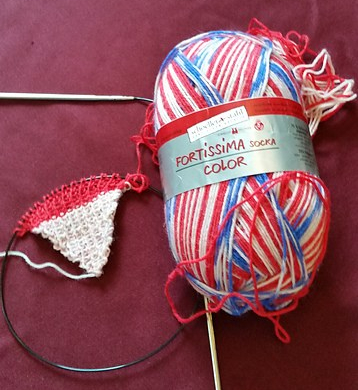
We’ll see how these stripes manifest. I’ve obviously not gotten this out of my system yet, so I’m sure I’ll be doing some more Chanterelles. Luckily they are a quick and mindless knit, and can be done while watching subtitled movies and shows on TV.
If you want to do up a Chanterelle and would like me to post it, you can find the free pattern under the Scarves section of the Knitting Patterns tab at the top of this page. I’d be grateful for pix of the skein and pix of the finished product, as done above. That will help others decide whether or not this design would work for their beautiful but problematic yarns, too.
 String-Or-Nothing