MINOR TRAGEDY – TATANIA UNBOUND
This may well belong under a Chest of Knitting HorrorsTM entry, but I’m sorely disappointed with something I made for myself last year.
I knit up Berroco’s Tatania pattern. I didn’t use the recommended Berroco Sensuwool, instead I used an oddly labeled but beautiful wool that knit to the same gauge. After long and hard study (and after finally seeing other yarns by the same maker), I’ve decided that this stuff was Filtes King Australian Merinos Collection Irrestringible – a 100% Merino wool of about sport gauge. It was hard to tell exactly who made this yarn because the label also lists "Rosina Filati" and "Filtes Genoa", and placement of the name was confusing. I’ve listed it in the yarn review collection as Rosina King Australian Merinos, but I plan on correcting that the next time I do a database edit.

Knitting up this pullover was mostly pleasant. The wool is soft and forgiving to use, although it is a splitter. The pattern however has a serious error in it. The unusual neckline shaping should be formed by increases rather than decreases as written. Once I subbed "inc" for every "dec" on the neck part, everything came out o.k.
The (minor) tragedy of this piece has happened since. The yarn is a soft cabled multi-ply multi-color. I’ve been told it looks like Missoni Stampato, with two plies of deep blue, and two plies of variegated jewel color loosely twisted together. Sadly even though those plies are nicely twisted, and I found no imperfections or knots in the balls themselves the yarn has chosen to break in several spots. I now have a nifty sweater sitting in my darning basket waiting for me to Kitchener up at least three holes.
What caused this? I don’t know. I’ve got no moths, and didn’t notice any fiber weakness while knitting. I only wore it twice before I noticed the breaks, and spray blocked it instead of dunking it; so it hasn’t even undergone washing yet.
What am I doing about it? For now, letting it sit in the "to be mended" pile until my enthusiasm grows and/or I can figure out how to prevent more holes. I guess it really should be included with the rest of the HorrorsTM.
CHEST OF KNITTING HORRORS – NORTH TRURO COUNTERPANE
I promised I’d post pix of some of my HorrorsTM. Here’s the first: North Truro – my bulletproof cotton counterpane.
I’m fascinated by the way pieced quilting is composed. In it, thegeometric shapesbuild increasingly more visually complex units by the way they interact either in color, texture or line. Knitted counterpanes by contrast rarely offer that sort of interplay. Usually they’re made up of all one shape. Sometimes two, but rarely more. I wanted to build something that used several units, and in which the design built upon itself unit by unit. In this case, I’ve combined a hex, a patterned square, a patterned triangle, and a plain triangle to make a larger repeat. All of these units are my own design (I’ve highlighted the units so you can spot them):

I reallylike the way the squares and triangles extend the hex, making larger compass roses. I like the way the lines of eyelets draw the eye from rose to rose. Interestingly enough, this layout isn’t the only one possible. The swirl hexes can be used alone, and the compass rose unit can be arranged in one of several ways (the last one is layout shown above):

The name? North Truro, Cape Cod, Massachusettsis where we vacation each summer, and is one of my all-time favorite places. This piece was composed and knit on the beach. Also the compass rose design resonates with that town’sseafaring heritage.
Sadly this project languishes only because of Bad Yarn Choice. The DK-weight yarn I used is too heavy. The central swirl-star hex measures 9 inches across. The compass rose unit measures about 16 inches across. When I do this again I’ll do it up in sport or lighter (on smaller needles of course). Eventually I’llinvent a companion half-hex and border. I do however have all the units pictured above graphed up already, and do have enough done to illustrate the concept. If people are interested, I’ll consider posting what I’ve got so far to the free patterns page at wiseNeedle. Unless of course some well-heeledpattern publisher wishes to offer me oodles of cash to finish it up. Since the chance of that happening is slightly less than zero, you can count of seeing it on wiseNeedle sometime soon.
WHERE HAVE ALL THE ENTRIES GONE?
Beats me…
They were just here, but seem to have hidden themselves. They’re not gone though. I can see them all on my admin page. To help people find info, I’ve added sidebar links to most of them.
With luck blog-city will get itself into gear, or someone will be able to tell me what I might have done to cause this mess. In the mean time, help yourself to the (side)bar.
WORKING REPORT – SUEDE T
Progress continues to be made. I have now finished the front (complete with darts), and am starting the back. The Berroco Suede yarn continues to be annoying to knit, but produces a quite pleasing fabric. An additional note though – it’s HEAVY, even compared to a similar gauge cotton. This will end up being quite a weighty T-shirt. Jury is still out on the warmth factor, but the thingbeing 100% nylon, it probably be on thetoasty side.

I’m planning to finish the border around the neck with an abbreviated strip of the same edgedesign I used earlier. I’m also especially pleased by the dart shaping. Being far from planar myself, flat cut Ts never quite fit me correctly. I’m looking forward to seeing how the Shapely T fits.
TRIVIAL QUESTION
A couple of people have written afternoticing the origin ofthis blog’s name. They’ve asked if hobbits knit. I’m not a gushing "look what they’ve done in the movies" follower, nor am I aline-by-line memorizer of JRRT’s canon, but I’m pretty familiar withthe books.
I can safely say there is absolutely no specific textual reference in Lord of the Rings or The Hobbit for knitting.
Hobbits do wear mufflers (though obviously, never socks) but how those are made isn’t detailed. This however didn’t bind the imagination of the movie makers.There is considerable debate among the fan-boy/fan-gal set thatdoes costume replicationas to whether or not Pippins’ scarf in the recent filmswas knit or woven. Although most of the other specialty textiles in the series were woven, I thinkthe scarf wasknit, using lozenges of purl weltingin a contrasting color broken up byslipped knit stitches:

The sametexture/color pattern is foundin this Schaefer cardigan. Still, I’m not going to run out and make one myself. I’ll leave that for the truefan-boys/gals.
WORKING REPORT – STROLLING DOWN THE PATH
Well, here it is. Nine months in the making – my Forest Path stole is finally finished. (Pattern from Summer 2003 Interweave Knits). Biggest Lesson Learned: There’s a reason why most people knit lace in white or light colors. I encourage anyone wanting to do this (or any piece) in black to have their head and eyes examined. Not necessarily in that order.
We start with a clean sheet on the carpet, a sodden mass, eight three-foot long lengths of 1/16th inch brass tubing, and assorted straight pins:

Threading the tubing through the edge stitches was a bit tedious. It would have gone faster had the tubing nice knitting needle style points. The ends though didn’t snag very much, they were quite smooth. The only difficulty was that the adhesive used to attach the price labels in the hardware store was difficult to get off. Rubbing alcohol didn’t do it. I needed to resort to nail polish remover.

I have to admit, I’m pretty pleased with this one. I like the Suri Alpaca. For the record, I used two full skeins, and managed to eke out 21 tiers of motifs. I had only a tiny bit left over. My stole ended up being 29" x 75" (73.6cm x 190.5cm). Now with the Spider Queen and the Forest Path under my belt – both gifts for others – I’m looking around for killer lace shawl or stoleto make for myself. What to do next? Possibly Hazel Carter’s Alcazar (no affiliation, just gloming pix), or one of the many spectacular Niebling designs worked atshawl-let rather than doily scale (pix of many can be found off of Yarn Over, Nurhanne’s knitted lace website.) But there remains one problem: I am not the lace-wearing type…

MY OTHER LIFE
I thought readers here might like something interesting to look at while they were waiting for me to post a picture of my Forest Path stole in mid-block.
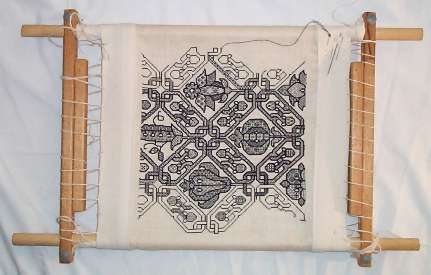
Knitting isn’t my only needlework pursuit. I also embroider A while back I pulled together a book of historical counted thread embroidery patterns. It proved as popular as the publisher proved to be untrustworthy. Both are now hard to find. The publisher appears to have disappeared, and the book is out of print. Be that as it may, I still enjoy counted thread embroidery – especially blackwork. Here’s a piece I’ve been working on for quite a while. (In fact, were it knitting it would qualify for inclusion in my Chest of Knitting HorrorsTM just for the amount of time it’s taking to finish.)
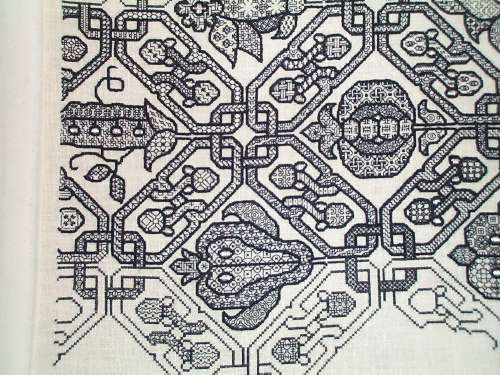
It’s going to be a blackwork coif. That’s a small, flat bonnet-shaped hat. The design is partly original, and partly adapted from 17th century sources. I’m doing it in black Krenik silk on 50-count linen. he working method of doing first rows of cross stitch, which are later entirely oversewn by a raised outline stitch (in this case, chain stitch) is something I’m toying with after seeing a similar approach in a photo of a half-done piece in a book of sources (excuse small images, something screwy is going on at PicServer. I’ll put the big ones back when they become available again).
And a detail shot:
WORKING REPORT – VARIOUS
Progress continues to be made on my two current projects. I’m just below the armholes on the front of my Shapely T in Suede, that places me smack in the midst of the short rows that provide extra fullness in the bust (and that make the piece live up to its name). I’m looking forward to seeing how this topography overlies my own. In the mean time, I can report on my quest for blocking wires.
Having read so much about the effectiveness of threading stiff wires through the edges of lace pieces undergoing blocking, and having struggled with pin blocking my Spider Queen shawl last year, I decided to treat myself to blocking wires. Here’s the Spider Queen all finished, laid out on my living room floor:

And a detail of it mid-block. I was fortunate enough to come across a pair of flat checked bedsheets in an odd lot discount store a couple of years ago. The two-inch squares are VERY convenient if you need to lay something out evenly. You can see how the pins worked o.k. with this piece, which has lots of dagged points along the edges. The Forest Path stole however is straight-edged, without points. I was afraid that using pins would distort the edges.

Since no local knitshops sell the wires packaged up for this use, I went to several local hardware stores instead. I was looking for long straight lengths of non-corroding wire, preferably stainless steel. I didn’t find them. Instead I settled for brass. I had two choices in brass – 1/16-inch rods and 1/16th-inch tubes. Both came in 3-foot lengths. I opted for the tubes because they were more flexible than the rods. I bought eight at $1.65 each. They were slightly oily and sticky, so I washed and dried them thoroughly. Tomorrow I plan on washing my Forest Path stole and blocking it with my new wires. Pix will ensue…
WORKING REPORT – SUEDE T
My T-shirt in Berroco Suede progresses. I have gotten used to knitting with the Suede, but am not loving it. But I do like the look and the Shapely T pattern. Here’s document of my progress:

The Shapely T pattern starts off with some garter stitch, and then includes some short-row shaping to make a rounded shirt-tail style bottom edge. I’ve increased the depth of the border below the shaping. I used a row of Indian Cross Stitch (Walker, Vol 1, p. 112), framed by garter stitch ridges and a row of elongated knit stitch (wrap yarn twice per stitch on Row 1; k1, drop extra loop on Row 2):

Because my bottom edge will be deeper than the original pattern, I cast on more stitches than the pattern called for, and hid some evenly spaced decreases in the garter stitch ridges. With luck, my extra width will compensate for wrapping a wider bottom edge around the shirttail shaping on the hem, and I’ll end up with (mostly) straight side seams.
UPCOMING EVENT – GORE PLACE SHEEPSHEARING FESTIVAL
It’s spring! Although the weather service promises heavy snow tonight, it’s mud season in New England. In addition to mud, one sure fire sign of spring is the annual Gore Place Sheepshearing Day in Waltham, Massachusetts on April 24. It’s certainly one my daughters and I enjoy immensely. It’s a micro-event in terms of the bigger sheep/wool festivals, but this small, local event is great fun.
The site is very hilly, but manageable even with small children in tow. Light strollers should have no problem unless it’s very wet. Wheelchairs might have a greater problem given the hill and the soft ground common in Massachusetts in the spring.
There are usually about fifty general handcrafts vendors; a sheepdog demo; sheepshearing, spinning, dyeing, knitting and weaving demos;live music and dance performances; a barnyard animal zoo, and food vendors. There are also usually between three and ten small, localyarn and fleece sellers, and a couple of vendors selling spinning equipment.
Pack a picnic, dress in warm wools, and (with luck) enjoy a post-winter day outside.
 String-Or-Nothing