LOST MY MARBLES
My modular blanket in Marble continues to grow. Of course, there are the two glaring missing squares, but I can knit them separately, then sew them in:
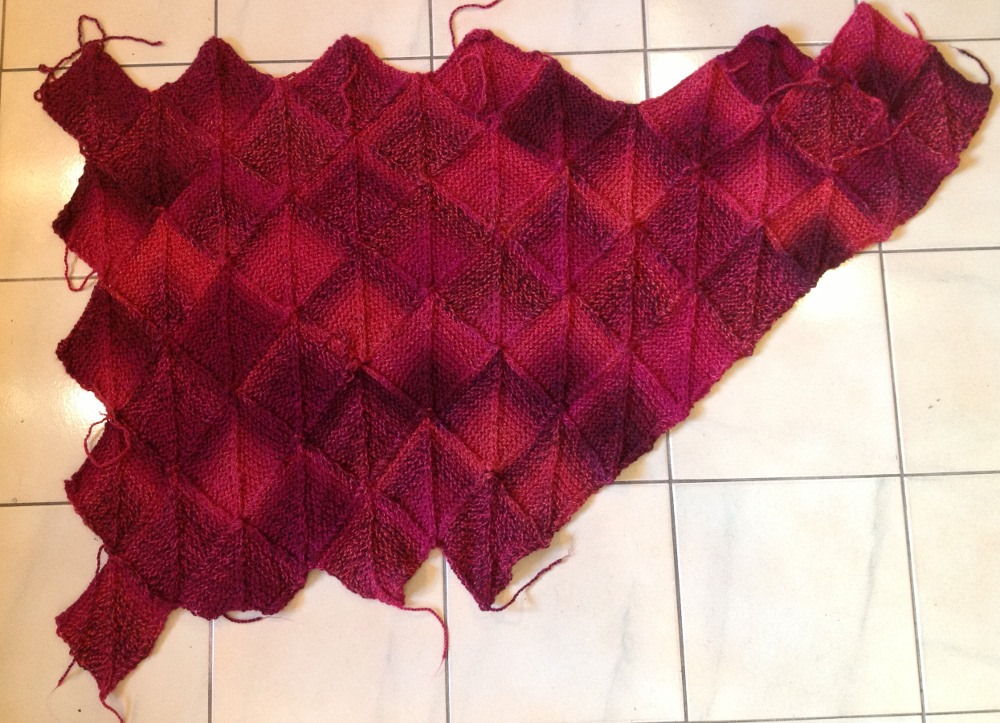
The floor is tiled in 1-foot squares, so you have an idea of the size so far. This is as large as the outside is going to get. I’m on the third of my five big balls of Marble. After I finish out the corner (and the missing blocks), I’ll do the triangles to make the thing into a nice, even rectangle. Then I’ll do some sort of banding around the edge, possibly an adaptation of one of the bias scarves so often done in long repeat variegated yarns. I’ll probably miter the corners. After that, if I have enough yarn, possibly an edging, although a simple band of I-Cord or double I-Cord may be just the ticket.
In other news, Younger Daughter is back from an early stay at Roads End Farm – heaven on earth for horse-mad girls.


This year in addition to the fun of riding and friendships, the thrice-clever Margaret taught the kids how to do needle felting. Younger Daughter has found her fiber calling:

Yesterday’s production: Stumpy pony, small dino with coffee mug, evil kitten, stubby squid, bird perched in mug handle, and tiny stegosaurus. All were done with remnants of rustic wool yarns from my stash, snipped into short lengths, and combed out somewhat using two old wire hairbrushes.
Other than that, we’re in the final throes of preparation for migration back to Pune, India.
MODULAR EXPERIMENT
A quick bit of knitting to keep the fingers occupied.
Using some of the yarn I got during the Wild & Woolly’s close-out sale, I started an improvised modular blanket. I’ve seen lots of these on line, knit in small units with a double decrease providing the shaping. Some are worked in modular style as the piece grows so there is no seaming later, others are produced one unit at a time and then stitched into the final form. Because of the directionality and relatively small width of the individual squares, they can be used to show off a gradient, long repeat, or self striping yarn.
I’m not using a pattern, I’m just noodling this out as I go, knowing that others have done so before me. This isn’t invention, it’s reverse engineering on the fly.

I chose the simplest of shapes – the square. It’s fifteen stitches on a side, worked in garter stitch, with a center double decrease providing the fish-scale or tree-leaf spine. I also chose to use the modular knit-on style.
I started by making two single unit squares (the rightmost two on the bottom row). Then I made the dark top square just underneath the needle, starting it by picking up stitches along the top edges of the two established squares. Having established a diagonal direction of working, I then picked up half of the stitches to make the middle square on the right edge, casting on the remaining half. When I finished that one I broke the yarn and started another diagonal row of squares to the left of the finished ones. You can see that I’m mid-way through yet another diagonal run right now.
I’m using JC Brett Marble Chunky, a very soft all-acrylic that comes in large 200g/341 yard (312m) puffballs. It’s slightly reminiscent of Lion Homespun (also made in Turkey), but in nicer colors, and without the annoying thread binder that tortures Homespun into its crinkly shape. Marble is machine wash in cool water. I’d dry it flat to keep its texture.
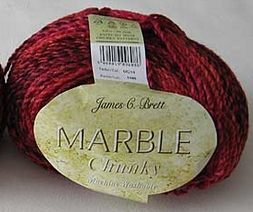
I’m working on US #11 (8mm) needles in order to get a nice drape on the finished item. It’s a quick knit – about 15 minutes per square, so this should move along at a good clip. The yarn is interesting, with the shading of the two constituent plies meandering from rose to deep maroon, with side trips that introduce a little bit of orange and purple. I like the loft and texture of the finished garter stitch on the #11s. I had tried this on smaller needles (the label recommends 6mm – US #10, but the fabric was too stiff for a blanket, although adequate for a sweater). However, I am not fond of the yarn’s tendency to shred and split. It’s relatively softly spun, and needle tips – even massive #11 needle tips – catch on stray bits as I work. This makes ripping back difficult, especially on the center double decrease (slip 2 tog knitwise, k1, pass slipped stitches over). Still, the annoyance is mostly passed, now that I’ve decided on what to do with the stuff, and what size needles to use.
As usual, I’m bungee-jumping here. The particulars are being decided upon as I go. I’m not sure how big the final piece will be, or whether I’ll stick with the established pattern of squares throughout, or even how big this center area (if it ends up being just a center area) might be in relation to any framing or edging elements. I may add edge triangles to norm the zig-zag sides, then do something else for an edging. There are several possibilities once the thing is a nice, even rectangle:
- A couple of rounds of concentric I-cord, or perhaps double I-cord
- Another round of some type of modular units
- Narrow strips knit perpendicular to the blanket’s body, so that the yarn’s gradients show well, probably with mitered corners, just for fun.
- Some kind of edging that uses garter texture and diagonals, to echo what will be happening in the center area.
Why a blanket now, and not continued work on the lace-in-process? Well first, new yarn burns a hole in one’s pocket with an urge to cast on SOMETHING. Of the yarns I’ve gotten at the sale, this is the only project that would be quick enough to complete before my return to India, and all of the yarns I’ve gotten are too massy to fit into my luggage. Also, aside from three warm days, it’s been rather cool here for spring in Massachusetts. A nice, cozy throw just appealed to me.
Finally, the last point of pondering… ANOTHER blanket? Who’s going to get this one? Younger Daughter has piped up, so it may end up being hers.
WORLD IN AN ONION
So, I’ve been back in the US now for roughly four weeks, with several more to go before returning to India for a year. I’m seeing things differently, with the new perspective afforded by the five month stay just completed.
Take the humble onion. Onions are everywhere, and just about every really tasty recipe in just about every food tradition starts out with “take an onion…”
Onions in Pune are small and red-skinned, with white flesh. If you find one the size of a billiard ball, you’ve found a giant. They’re neither as sharp nor as sweet as selected varieties here. But they’re very tasty. And it doesn’t matter where you shop for onions. The same variety is available everywhere, from the most exclusive supermarkets catering to the well-heeled elite, to the smallest street vendor’s basket. I’ve also seen the same variety, picked when the bulbs are barely there (but larger than scallions here), and sold as spring onions. Now to be fair, there may be more available after monsoon season, and what I saw may be just the tail end of the agricultural year.
In contrast, I counted the variety of onions available in our local supermarket here in Arlington, Massachusetts. It’s a plain old supermarket in a standard suburban area, and not a fancy gourmet store. There are plain yellow keeper onions, big white Spanish onions, huge red sweet onions, Vidalias, tiny white boiling onions, the small, ovoid yellow Cipollinis, Bermuda onions, ordinary white onions, scallions/spring onions, shallots, and leeks. Plus several of these varieties are also available as “organically grown.” Counting the organics, that’s about 15 separate and distinct onion types, for sale side by side.
One or two of these might be considered local. The Pine Island area of New York near Hudson Valley is still considered a major onion growing area, but by and large – this embarrassment of onion riches is trucked here from all over the country, and some of it is even imported from Mexico, or even flown in from South America or Europe. That means there’s a huge perishable-goods transport and storage network, enabled by cheap shipping, and established distribution channels.
India is evolving very rapidly, but it still has a long way to go before it can match the infrastructure required to support this variety. Produce there is local. Intercity roads and trains exist, but what’s there isn’t sufficient for major distance transport of perishables. Even the sturdy onion.
For example, Mumbai and Pune are major cities, about 95 miles apart – about six miles closer together than Boston and Hartford, CT. Googlemaps shows the travel time between Boston and Hartford as being about 1 hour, 45 min. Having done this trek many times, I know it’s 4-6 lane interstate highways all the way, and (unless it’s rush hour) most folk exceed the mostly 65mph speed limit where they can.
The road from Pune to Mumbai is well traveled, and is considered a major toll highway. It’s 2-4 lanes throughout, with some interchange areas a bit wider, and for India is pretty uniformly paved. It twists and winds a good bit, ascending up steep hills, and goes through several rock-cut tunnels. However, traffic moves extremely slowly, even on this best-of-roads. Traffic moves slowly, winding around lumbering trucks, three-wheeled goods transporters (Tempos), and a sea of two-wheeled vehicles. On parts there are even local three wheeled taxis and animal carts, although other parts of the highway are restricted. Googlemaps says that it should take about 2 hours and 25 minutes. However cars even in uncrowded times would be lucky to 80kph (about 50mph), tops, and that only on the few straight sections with good visibility, if no slowly lumbering trucks are around. The trip rarely takes less than three hours, and often significantly longer, with mammoth multi-mile traffic jams of the type seen in the US mostly on holiday weekends being the daily norm.
Now, if travel on this best of highways is “twice as far” in terms of travel time compared to US roads, you can begin to see the logistics challenge. Add to that the high cost of fuel, the lack of refrigerated trucks, the average size of a farm’s plot being something smaller than a third of a football field, lack of distribution centers, and the challenges really pile up. For a supermarket just to obtain onions in a quantity sufficient for its sales, it would have to deal with a middleman who collected produce from several smallhold farmers. Then the goods would have to make their way over land to the city. Slowly. So it’s no wonder that eating in India is a localvore’s experience, that produce is only available in season, and that varieties are limited.
I’m sure that there are other cross-cultural lessons to be learned by peeling back the layers of this onion – land ownership and transfer, relationships between agricultural and urban areas, the economics of small vs. large scale farming, how limited transportation on the part of consumers shapes retail buying, and the like. But for now, I look at the wealth of onions and marvel at the profligacy and indulgence, and have a First-World Guilt moment as I mince my way through some while cooking dinner.
 String-Or-Nothing