A MISSING LINK?
Folk who play around poking into historical styles of counted work often note far flung similarities and make wild conjectures about cross-pollination, imported influences, and neighbors-in-commerce catering to each other’s markets. I’m no different. But I try to contain myself. Still sometimes things present at just too convenient a time or place to NOT raise eyebrows, and make one wish one had the time for real academic research.
Oxford’s Ashmolean Museum houses several artifacts that make my heart flutter.
Where did the style of inhabited blackwork come from? By inhabited blackwork, I mean the style characterized by heavy outlines and geometric fills (ok, sometimes they are freehand, and are not always counted). My old coronation dress underskirt is a classic example.

The style hit big time in Tudor England, cloaked in vague associations with Moorish styles imported from the Iberian regions. There were certainly monochrome or limited palette pieces done before then, scrolling leaves/flowers worked with outlines, and certainly things done on the count. But all of those elements together? And where are “ancestral pieces” in Spain? What can we point to as a seed of the style?
Apparently there isn’t much. Some folkloric associations with Queen Catherine of Aragon, and “general knowledge” but not a lot of actual items that are clear ancestors of the Great Tudor Blackwork Explosion.
That’s where the Ashmolean’s Newberry Collection of Islamic Artifacts comes in. Dating is not very precise, and the provenance is Fustat, Egypt, where many fragments were found, preserved by the dry climate and fortuitous funerary customs. There are lots of bits there that look like the precursors of double running strapwork – bands of repeats done stepwise, that look a like the famous Meyer bands in the Holbein painting.

But there are also these.
Ashmolean Jameel Centre Newberry Collection, “Textile Fragment with leaves and squares”. Egypt, Fustat. 10th to 15th century. 6 x 47cm (warp x weft approx 18 x 19 thread count/cm) Accession EA1993.222

Ashmolean Jameel Centre Newberry Collection, “Textile Fragment with scrolling vine leaves, flowers, and leaves”. Egypt, Fustat. 10th to 15th century. 6 x 47cm (warp x weft approx 18 x 19 thread count/cm) Accession EA1993.223

These are not Spanish, but they are from a part of the greater Islamic world. They are not monochrome. Being rather broadly dated they only vaguely inch up to the period of inhabited blackwork’s rise to popularity (The 1400s are not the 1500s).
BUT. What we do see here are scrolling leaf and flower forms, with prominent outlines, and simple geometric/abstract fills, with a strong stylized (as opposed to representational) iconic feel. They would have been thought to have vague Moorish associations at the time blackwork arose.
Did works of this type make their way across the entire length of the Mediterranean to Spain, and by extension – to England, to influence the style we know so well? Trading and travel were robust, so it’s not an impossibility. Remember, we have no way to know for sure.
You have to admit though, it’s a juicy bit of speculation…
VOIDED NARRATIVE PANELS
Voided work is a catch-all term for a family of embroideries where the background is covered by stitching, and voids in that solid stitching make up the motifs (the foreground). Sometimes the foreground is further ornamented by additional stitching, sometimes not. There are many different styles of this work, lots of posited points of origin/provenance, and just as many design or pattern groupings that have come and gone in and out of style over the centuries that voided work has been done. While modern Assisi (simplified motifs done with cross-stitch backgrounds) is the form of voided work most widely known today, it’s not the only type, and there is a lot to explore in the allied family of voided styles.
Here’s one subgroup – Story Panels. This is a family of works that I’ve run across as I’ve researched counted voided styles, that hangs together as a subset based on a number of commonalities.
First, the examples:
l. From the Cooper-Hewitt collection, Band. Italy, 16th–18th century; silk on linen; H x W: 24.1 x 172.1 cm (9 1/2 x 67 3/4 in.); Gift of Richard C. Greenleaf; 1954-167-5. These four panels show elements of the Adam and Eve story, and the workaday life after Eden . It’s done in red silk on linen, with a densely overworked meshy background. I don’t necessarily agree that it’s long armed cross stitch – that has a different look of directionality. This has more of a meshy appearance. Foregrounds are outlined (back stitch according to the listing), and ornamented by knot stitches.

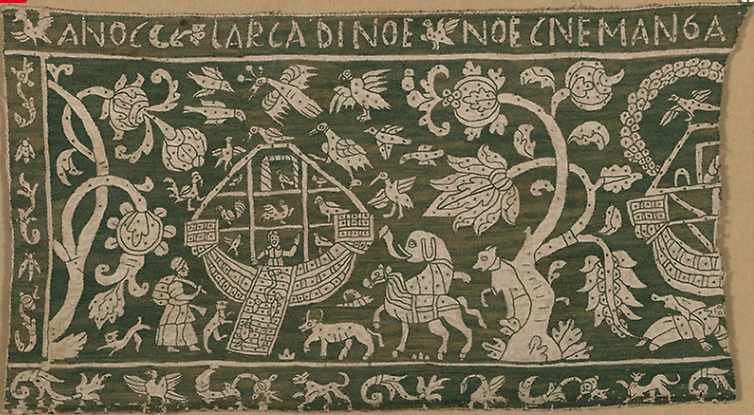
2. From the Art Institute of Chicago, Fragment (from a border), Italy, 1575-1625, silk on linen. 22.8 x 41.4 cm (9 x 16 3/8 in.); Art Institute of Chicago Purchase Fund; 1907.827 Part of the story of Noah. Outlined foreground elements with spot decoration, ground in long armed cross stitch aka LACS (that back and forth almost plaited looking directonality is evident.)
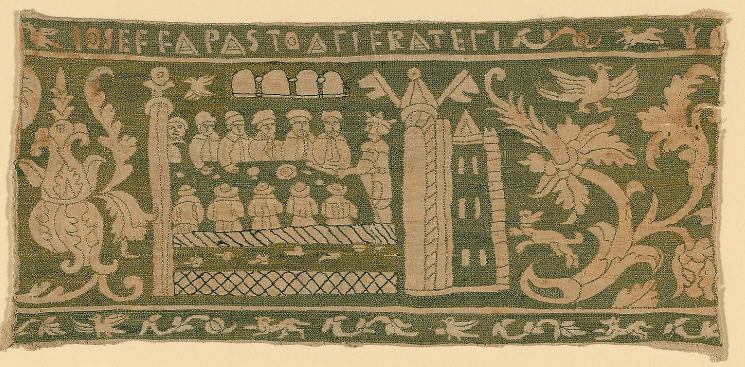
3. Another from the Art Institute of Chicago. Fragment (from a border) Italy, 1575-1625, silk on linen, 19 x 40.6 cm (7 1/2 x 16 in.); Art Institute of Chicago Purchase Fund; 1907.826. Joseph and his brothers. This may or may not be part of the same original (or series of originals) as #2, above. Similar color, and LACS technique, but the heights are different, and the motifs are simpler in this one – less ornamented, less detailed.
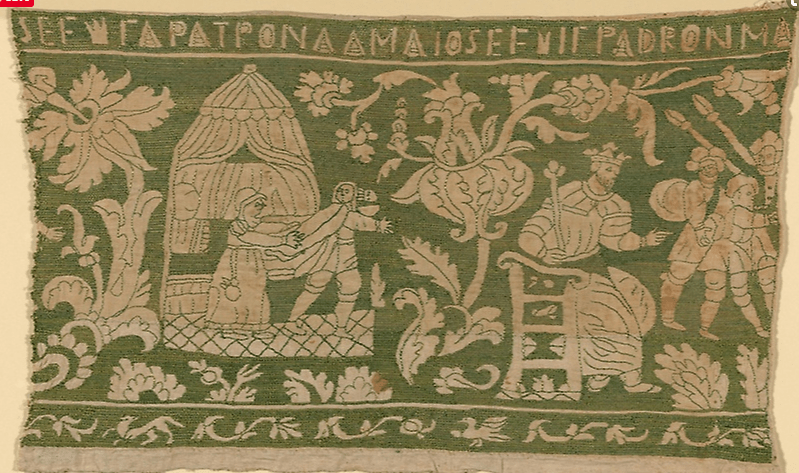
4. And also from The Art Institute of Chicago, Fragment (from a border), Italy, 1575-1625, Linen with silk. 276 x 44.2 cm (10 7/8 x 17 3/8 in.), Art Institute of Chicago Purchase Fund; 1907.825. To my eye based on these photos, it looks like this panel (Joseph and Potiphar’s wife?) is done the same way as #4, above.
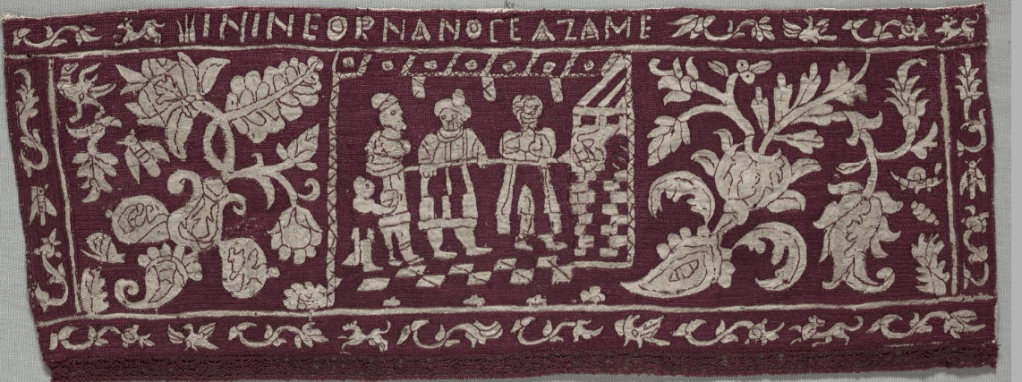
5. From the Cleveland Art Museum, Embroidered Border: The Baking of Unleavened Bread, Italy 16th-17th century. Silk on linen. 18.1×45.4cm (7 1/8 x 17 7/8 in.) Gift of the Textile Arts Club; 1939.354. From Probably LACS (no prominent holes like the meshy style). Foreground lightly outlined with what looks to be a thinner thread, foreground details in back or double running. No knot stitches. I’ve discussed the group of four panels from which this comes once before.
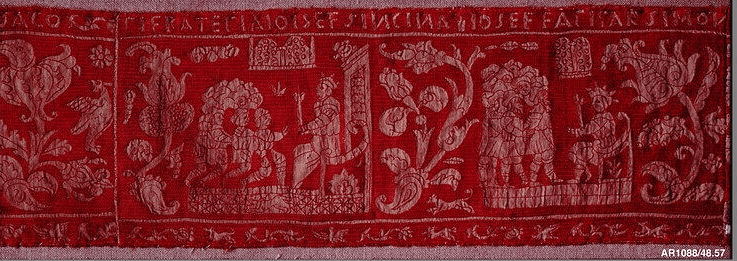
6. From the Metropolitan Museum of Art, Strip, Italy, 16th century, silk on linen, 9 1/8 x 25 in (23.2 x 63.5cm), Gift of Mrs. Harry Ge Friedman; 48.57. I’m guessing from the inscription that this is part of the Joseph in Egypt narrative, where he has dealings with his half-brother Simon. Again, probably long armed cross stitch, with either double running or back stitch outlines of the voids.
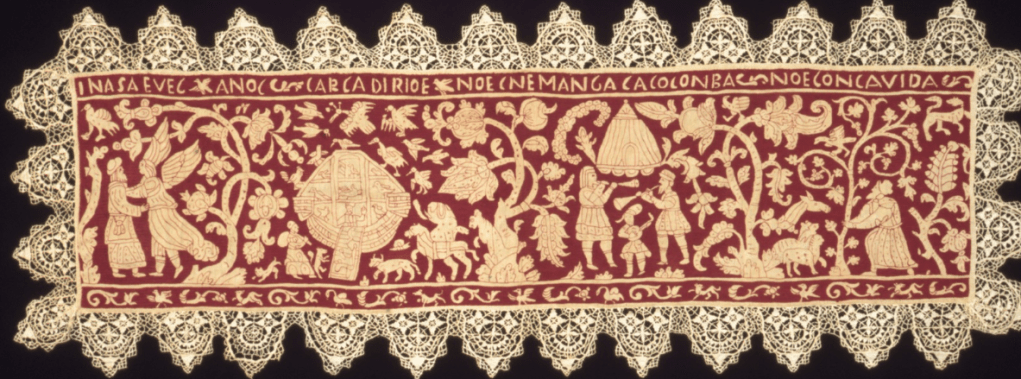
7. Also from the Metropolitan Museum of Art, Panel with Noah’s Ark. Italy, late 16th/early 17th century. Silk on linen. 14 1/4 x 39 1/4 in. (36.2 x 99.7 cm) with lace. Robert Lehman Collection, 1975.11784. Another Noah’s Ark. Note that the base drawing of the ark section is very, very close to the green one, although the follow on panel is different.
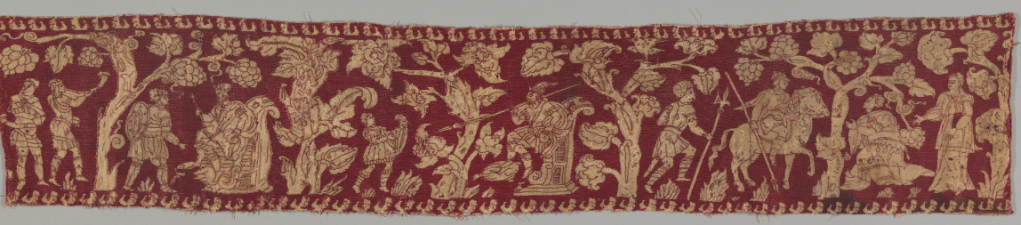
8. Still more. From the Cooper-Hewitt, Band, Italy, Late 16th, early 17th century, linen, silk; H x W: 150 x 19 cm (59 1/16 x 7 1/2 in.); 1950-29-8. The center panel is probably David avoiding Saul’s spear, but the rest of the iconography is hazy and there’s no top line inscription to help. Very clearly long armed cross stitch, possibly double running on the outlines (there are also a few later repairs done using another color, to reunite the stitched ground with the open foreground but that doesn’t count).
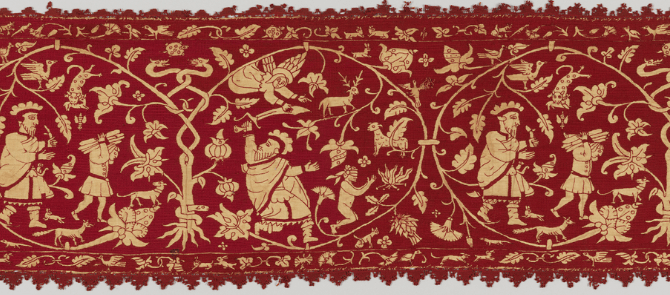
9. From the Cooper Hewitt, Band, Italy. Late 16th, early 17th century. silk embroidery on linen foundation; H x W: 23.5 x 60.6 cm (9 1/4 x 23 7/8 in.); Bequest of Richard Cranch Greenleaf in memory of his mother, Adeline Emma Greenleaf; 1962-52-1. This one doesn’t have lettering at the top, but it’s clearly the story of Isaac. LACS, outlined foreground, some ornamentation of foreground with straight stitches (possibly double running or back stitch).
10. And finally, from the Yale University Art Gallery, Unknown Fragment, Italy, 17th century. Linen ground with red silk, 19.1 x 43.2 cm (7.5 x 17 inches), Gift of Howard L. Goodhart; 1928.151. Very had to tell from the photo but it’s probably LACS, with double running or back stitch for the lines. This bit is probably Jonah and the whale, and is clearly part of a multi-panel piece (or once was).

Now, I am sure there are lots more of these out there, that I haven’t included here. And there are narrative panels done in other stitched styles, but these do seem to hang together, more or less.
First, unlike most (but not all) other voided work examples, they display no symmetry. There are no reflection or bounce points; the designs are not aligned in balance around center urns, trees, or other elements. Each one of these panels stands alone, without a clear repeat inside its sequence.
Second, most (but not all of them) rely on similar framing techniques – a narrative with a very similar looking style of letter representation on top, and the curious mix of birds, dogs, and leaf/branch/flower elements below (which does repeat).
Third, none of these were done on the count. By that I mean that the foreground elements were not carefully copied from a graphed source. They incorporate strange angles and curves, and the ground stitching behind them – which was done on the count – looks to have been “mashed in” around the designs where they present those odd curves and angles.
I posit that these were hand drawn onto the cloth, overstitched using double running or back stitch (or possibly even SINGLE running in some cases); the foreground ornament was done, and then the backgrounds were stitched, in neat lines going back and forth across the cloth. BUT it’s pretty clear that some sort of common cartoon (in the tapestry sense) was used for the two Noah’s Ark panels – #2 and #7. Same ship, same placement of birds, bit players and leaves around it, but with just enough difference of detail and odd angles to look like tracings from the same original, not copies of the same chart.
Fourth, for #1-8 above, there are clear divisions into panels, with strangely familiar fat-fruited, full-leaved vegetation or ruled dividers separating the scenes.
Fifth, all appear to be Old Testament scenes. Given the time and place, it’s kind of strange that no large scale New Testament scenes are included. Now those may exist elsewhere, I don’t claim to have gathered a definitive collection of these fragments, but one would think that there would be a Last Supper, Passion or stray Saint among the lot. The closest we get is the Agnus Dei (lamb with cross standard) in the Jonah panel – #10, and even that is background – not the “featured scene.” It’s also worth noting that even with the popularity of Greek/Roman myth images at the time (just look at emblem books and early pattern books) – we’ve got no Aphrodites, Sieges of Troy, or other mythic representations.
Now, what conclusions can we draw from all this? Sadly very few without further research.
Who made these and why? I am tempted to say there was a small number of professional ateliers producing these in late 16th century Italy, due to the strong similarities of style, and the fact that these examples are relatively few among the large number of other voided work fragments we have today. Given the elaborate nature of the non-repeats and the scale of these sequential multi-panel narratives, I somehow doubt that these were loving-hands-at-home works created for household use.
Many of those other bits are probably domestic works – with designs that are symmetrical, with clear easy to replicate repeats. While it’s certainly possible that these panels were bed or other secular hangings, but I think it is more likely they were made for liturgical/didactic use.
And #9 and #10 – the odd outliers? I think they were clearly influenced by the group as a whole, but given the difference in their visual styles and details, I would not be surprised to find out they were done a bit later – or possibly even by competing contemporary workshops – in emulation of the established style.
Have you found other examples of these stitched comic books (biblical or not)? Share!
UPDATE
Readers have most graciously pointed out additional examples! Thank you – keep them coming
11. Holly found this in The Jewish Museum in New York, Embroidered Panel: The Story of David and Bathsheba. Greece, 19th century. Silk on linen. 10.5 x 29 inches (26.7 x 73.7cm). From the H. Ephriam and Mordecai Benguiat Family Collection, Accession S 202. The date and provenance are different from the rest, but it does appear to have some stylistic commonality with #8, above.

12. Melinda Sherbring alerts us to a holding in the Los Angeles Museum of Art, Embroidered Textile Panel Depicting Scenes from Genesis. Iberian Peninsula (Spain or Portugal), late 16th century. Linen plain weave with silk embroidery. (a): 9 7/8 × 64 1/4 in. (25.08 × 163.2 cm); (b): 35 3/4 × 9 5/8 in. (90.81 × 24.45 cm) Costume Council Fund (M.87.230a-b) . Sadly, there is no shared image available there, but from her detailed descriptions, it’s another version of the Adam and Eve panel (second panel in #1, above), and the Ark panel (#2 and 7 above), done in long armed cross stitch, in red silk. The foreground ornament of both is a bit simplified compared to the other versions posted here.
Melinda and her co-conspirator in textile history high-jinks, Robin Berry, had the opportunity to examine the piece up close. They have given me permission to share their notes on technique:
- Fabric thread count approximately 96 tpi.
- Embroidery floss is filament silk, finer than a single strand of Eterna; possibly Kreinik size 0.
- Motif colors: background color card 19-12 and 19-11 for Genesis, approximately DMC 3687.
- Technique: long armed cross stitch background with backstitch for details and outlines. Looks like the same thread was used for background and for details. Stitches over 3 threads, approximately 18 stitches per inch.
- There are holes along the edges clearly where fabric was nailed or tacked to a support.
Robin additionally points out that voided works with Iberian origins are properly termed “Reserve.”
Melinda agrees with me that the base layout of these pieces were probably traced or drawn rather than established by count. Having three examples of such a work is quite special.
UPDATE – NOVEMBER 2022
13. I’ve found another Old Testament scene stitched in a very similar style. This one is Adam and Eve, from the collection of the Boston Museum of Fine Arts, Accession #83.241. The museum places it as mid-17th century.

It’s most similar to items 1-7 above, with the foreground enhanced by little scattered stitches, the inscription running across the top, and the alternating floral/critter band below.
UPDATE – JANUARY 2024
And another one turns up.

This one is in the collection of the National Museum of Scotland, Accession A.1989.202. It’s attributed as Portuguese, from 1620. The inscription reads “Toreo das Damas Adonas” possibly, bullfight of the Adonas ladies (or so Google Translate tells me). I can’t parse out if there is a biblical reference here, but the drawing style is reminiscent of the others in this group. The ground however is done in meshy – tightly overstitched four-sided stitch, totally covering the threads of the weave. Close examination shows that the ground threads were not cut, just bundled. And that the thread used to outline and work the interior detail of the design are now a different shade of green than the meshy ground. One can even spot that the ground covers or is stitched into those outline threads in places. There are also remnants of red ink behind some of the double running (or back stitch) foreground lines. All of this makes the theory of a drawn cartoon, overworked in double running or back first, then ground filled at a later sitting more probable.
A CASE OF LONG-LOST TWINS, ALSO LOST IN TIME
This post is a largely a capture of material I put up on Facebook. Given the difficulty of finding past material on that platform, and that some of my stitching friends avoid Facebook entirely, I add it here. Note that the attributions on these pieces were current as of today – 7 November 2019. If I see that they change, I’ll update this note.
…..Ah, the consistency of museum dating on embroidered artifacts. Here we see two separate accessions, held by the same institution, that present a minor conundrum.

The one on top is Cooper Hewitt Accession 1971-50-86, and is labeled Band (Italy), 17th century. It was a gift by the noted textile curator and collector, Marian Hague (a personal hero of mine). Probably a legacy upon her passing, or part of her personal collection, donated by a later family member.
The one below is Cooper Hewitt Accession 1944-71-5. It’s labled Band (Italy), 16th century. It was given to the museum by Annie-May Hegeman, in 1944. Ms. Hegeman appears to have been a very wealthy individual, from a wealthy family. She collected and displayed many artifacts in her own famous home, and donated many to various museums over a period of decades.
Not only are these two the same design (which I’m graphing up), they are undeniably fragments of the same artifact – yet another example of the “Separated at Birth/Long-Lost Twins” circumstance. You can piece the one below to the right of the one on top, and achieve continuity.
Why the 100 year difference between the two? Different catalogers? Based on updated scholarship? Unknown. Which is correct? Good question. Perhaps detailed analysis of dye chemistry might give a clue, but for these fragment collections – laid down and rarely revisited – it’s not going to happen any time soon.
ROSE CHART
I’ve long struggled with how to render a heraldic rose in a linear charting. Because of the angles involved in five-fold symmetry, it does not lend itself cleanly to the 45°, 90°, 180° schema that I have found to be almost exclusively used in historical counted styles. (In fact, the only exception to the 45-90-180 rule I’ve seen are designs that include an “eyelet” – where stitches are taken around the periphery of a small area, with one terminus in that circle or square’s center – and those are quite rare.) To manage the angles properly under this constraint would necessitate a very large chart, so that the angles could be fudged slowly over long runs.
But many people over the years have asked about a SMALL graphed-up rose. And just this week I had an extra incentive to work one up.
Duchess Kiena of the East Kingdom (an SCA branch centered on the upper northeast coastal region of the US, and into adjacent areas of Canada) has been doodling up roses as visual gifts/potential ornamental badges for her fellow members of the Order of the Rose (former consorts/co-regnants of those who have won the Eastern Crown.) Her roses are a joy – simple and adorable. Here’s the one she did for me – echoic of my own black rose:


She’s done an entire garden of these so far. They are sweet, and have been adopted by some the recipients for use as avatars on social media. I wanted to return a gift in kind. I also know that some folks may want to embroider these roses, either for themselves or as a gift, so I doodled up a graph based on Kiena’s original outlines.
Note that it includes non-standard “Knights Move” stitches, taken over 2 x 1 units. I’ve marked those in red as an aid to navigation. Not strictly historical, I know, but effective at this small scale.

Feel free to use this as you will. Fills are limited only by your own imagination – the counted/damask fills of blackwork, satin stitch, split stitch or chain, applique, beading – anything goes. Enjoy, and feel free to share your results.
 String-Or-Nothing