And the latest piece continues to grow.
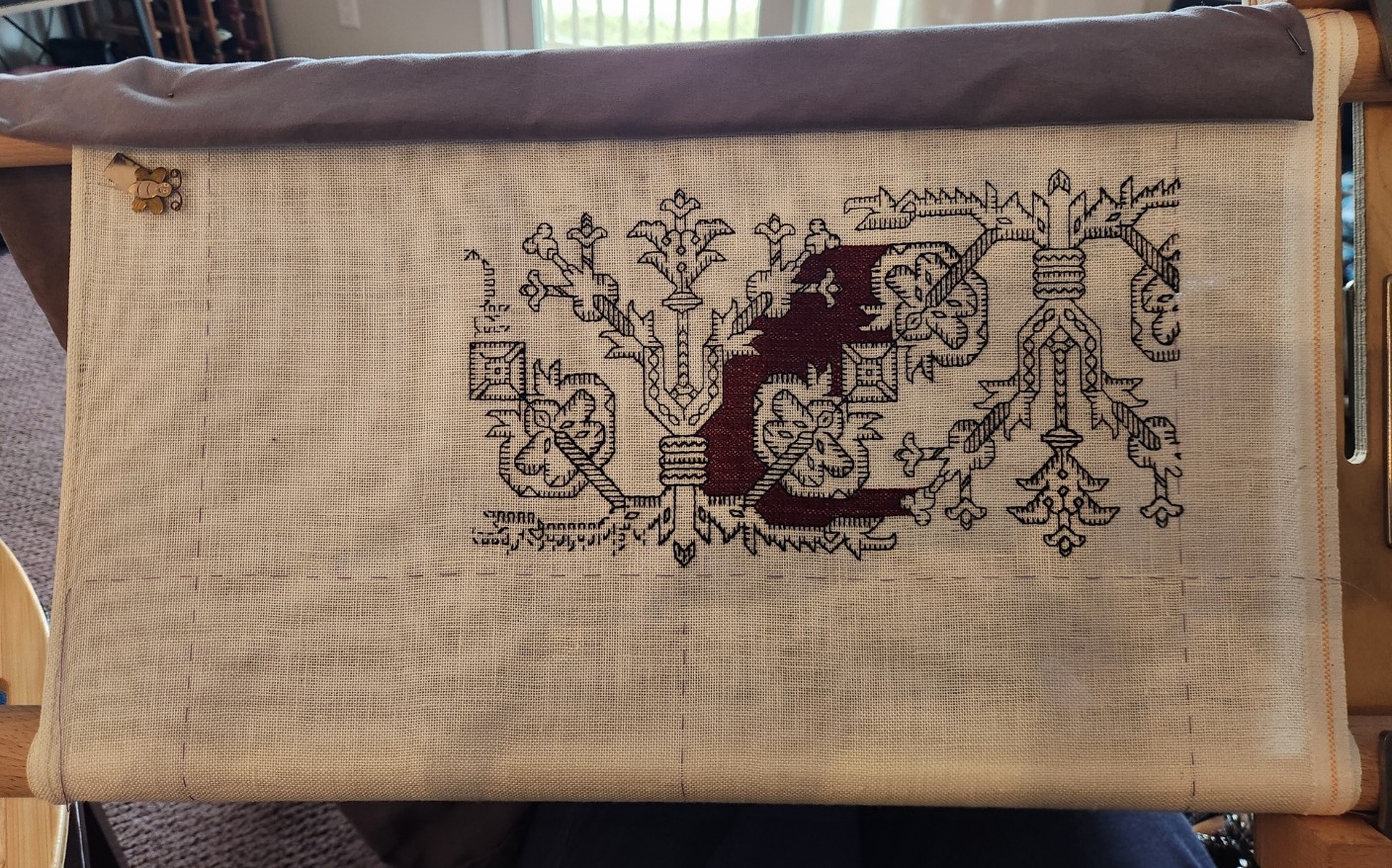
At this massive gauge – 28 threads per inch compared to my normal 40+, it’s mile a minute. All in all I am pleased. While the voiding is sparse (one strand of spun Au Ver a Soie’s Soie D’Alger – a thread economy measure), it is solid enough to be effective.
Another thread economy issue is in the black. The reeled long fiber Alori silk is divisible into four strands. Each of those strands is made up of three plies, not all of uniform thickness, although the thickness of each of the four officially divisible strands is very close. I am dividing each strand into a two ply, and a one ply, using the one ply doubled. No, this is not an advisable practice, and I would not suggest anyone else pursue it. But I am working from stash and want to eke out every inch possible.
As a result of my frugality there is a noticeable variation in the density of the black double running stitch lines. Some are heavier than others. To be fair, this is actually a look pretty common among museum artifacts, but in their it case was caused by the stitcher’s having to finger-spin each length of thread used from a clout of dyed, combed but unspun silk fiber. It’s especially evident on samplers worked by newer/younger stitches, where there is a marked difference in weights and even colors, since intermediate shades were achieved by marling together their parent hues. As with everything, practice helps. Some stitchers were more uniform in their thread thickness or color blending efforts than others. So I am doing my best, trying to mate or meld areas of similar weight so thick/thin dashes don’t occur in the same line of double-running.
In the helpful hacks department, note the old grey pillowcase pinned to the top edge of the work, and hanging down in back. That’s a light shade. I find that minimizing the ambient light shining through the work from windows, low lamps, and the television eases counting. In this case the pillowcase does double duty. This piece on my longest Millennium frame bars is too wide for the travel carrying case I made for on-frame projects. I suppose I could make another, but time does not stand still. I pop this one into that king size bed pillow slip, pin the top end closed, and it’s good to go.
Go we did. I packed up my upstairs Lowery stand (I keep a hex key in my stitching box for this very purpose), disassembling the thing into a heavy canvas tote bag, and bringing the frame, large frame extender, tool chatelaine, and pirate lunchbox of threads and other support materials/tools with us out to our place on Cape Cod. A welcome respite and restorative bayside sojourn. Nothing heals better than watching the tides march in and out.
As to health issues, I have bounced back from the dual biopsies in March – stamina and strength are back to where they were back in February. Findings are not universally great but neither are they dismal. My Danger Lentil might have been any number of tumor types that are far more dire than what was revealed. I do have a secondary chordoma site, at a location not previously documented for that very rare manifestation. But chordoma doesn’t eat brain. It eats bone and connective tissue, and responds well to radiation therapy. I meet with a rad oncology team soon to plan and embark on another round of proton treatments.
In the mean time I am in good spirits, optimistic and full of fight, along with the strength and stubbornness to win. And armed as I am with this easy to see project, plus working on Ensamplario Atlantio Volume 4, and a few pairs of socks to knit – equipped with ample amusements to keep that determination in high gear.
 String-Or-Nothing
I admire your courage and pluck in the face of health challenges.
It might show my ignorance, but your doubling the third strand when you divided 3-ply thread got me thinking. What if you cut two identical lengths, separated them each into a 1-ply and a 2 ply and then, minding their direction, threaded those 2 1-plys together?
I don’t like cutting my threads until I need them. I have a bad habit of letting them hitchhike on me, and ending up with threads all over the house. I cut a length, separate the four strands, and then end up stripping out one ply from each of the four. Those onesies I pair up and use as two ply threads – but as described the constituent plies making up the official strands are NOT always equal in thickness. The four official strands end up being very close in thickness, but they are an average of their building blocks.
It is VERY hard to strip out a ply and it is not always possible to select one based on weight. As a result sometimes the two that remain after one is stripped are thicker than the remaining ply either used double or mated with a spar ply from another strand of the same cut.
If T = fat ply and t = thin ply, and they are hard to split, most often I get a thread that is TTt that yields either a TT and a t; or a Tt and a T. Even if I try to aim for Tt as the ideal weight for this count linen, mathematically the 2:1 ratio guarantees that TT threads are inevitable.
Thank you. I now see the full scope of your challenge with this thread. At my house, singleton’s looking for mates would be dragged into nests behind couch cushions by the resident felines.