LINES, EDGES, AND BELLS
I am back from over a week of waiting on lines at the government visa office to renew our residence paperwork. Let’s just say I’m relieved not to be up close and personal with the bureaucracy today. Sadly, I was unable to take my knitting with me to civilize all those hours. It would have helped.
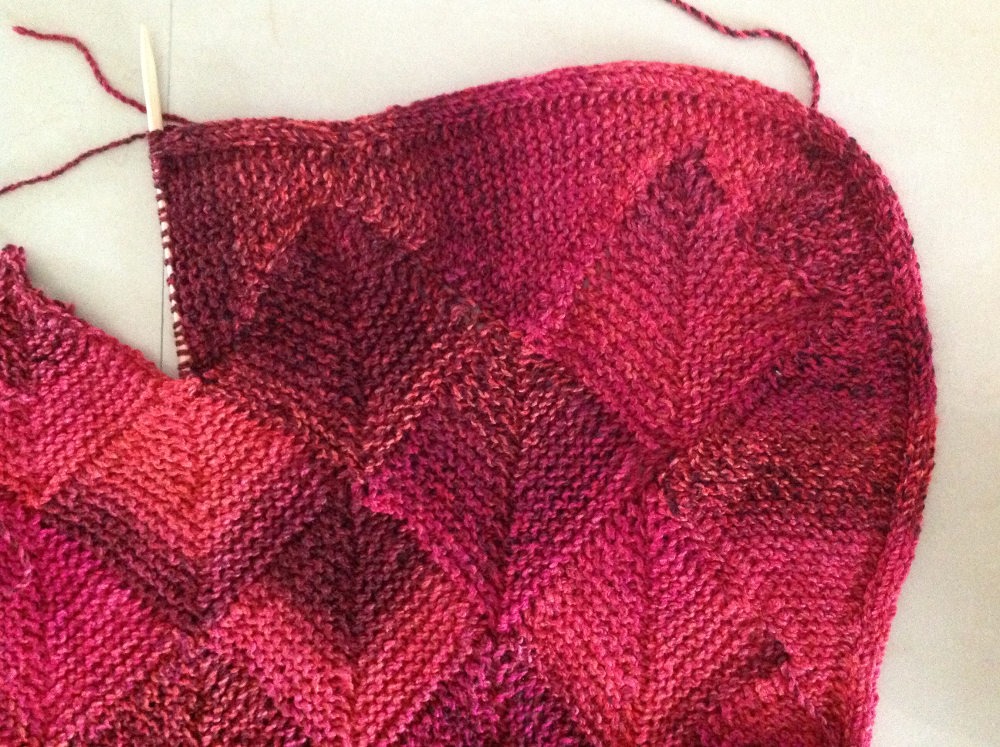
Here’s my latest progress on the big blanket knit from Marble. The current state is on the left, the previous attempt is on the right.


You can see that true to my word, I’ve narrowed down the edge treatment. I’ve also eliminated the mitered corners in another bid to conserve yarn. Instead I just ran the I-cord along the edge of the corner unit diamond. Much faster and simpler that the previous treatment using short rows. In order to prevent cupping, I did do a couple of rounds of I-Cord “free” at each corner point of the diamond, to provide extra ease. I’m at roughly the same point in yarn consumption as my earlier attempt (seen on right, above), but you can see that I’m further along the march around the piece. Fingers are crossed, but with what I’ve got left, I think I’ll be able to finish. I do prefer the older treatment though, and if more yarn was available, I’d have continued with it. Those extra four stitches between the fill-in diamonds and the I-Cord, plus the thicker I-Cord and mitered corner made a smoother, more uniform presentation, and “absorbed” some of the natural rippling that happens when the fill-ins are made. So it goes…
Monsoon continues here, with heavy rain days interspersed with misty, overcast days. The humidity is through the roof. I’m experiencing a bit of climatic dissonance. We do get long periods of grey, dank skies in New England, but they are in the dead of winter, usually when temperatures are down in the low teens or below (that’s -10ºC and under for you Celsius folk), accompanied by intermittent snow. To have this many dark but warm days in a row is new to me.
In spite of the greyness, the omnipresent mud and the acne-like spread of potholes in the imperfectly footed brick surface streets, I’ve mentioned the up-side of the monsoon before. Everything is quite lush, and the city is transformed. Even the dusty, trash-strewn vacant lots in town are covered in deep growth, with occasional splashes of wildflowers. This weekend past we went to a patio restaurant, where we dined under a large open air tent. There was a large tree just outside the tent, hung with dozens of child-size umbrellas and spans of tiny bells. Rain fell throughout dinner, making music as the drops hit leaves, umbrellas and the bells.
Today we travel out into the surrounding hills where Younger Daughter’s school is. Because we went back to the US before her last semester ended, she had special dispensation to take her 9th grade finals all this week, before school resumes at the beginning of August. I’m looking forward to seeing what effect the rains have had on the countryside and hope to take pix to share. And in addition to my camera, I can bring my knitting!
AND BACK TO KNITTING
Now that the hustle of getting ready for our return is over, I have time in the evenings to sit and knit a bit.
I had planned to finish the large red throw prior to the trip, but I ran out of time. Luckily, I didn’t run out of luggage space, and I was able to take it with me:

As you can see, I have completed the center area of modular diamonds, and am now working around the edging. Or I was… More on that below.
I am trimming the thing out into a full rectangle, filling in the missing edge half-diamonds and completing it with an edging. I’m winging it, but have some notes if the world thinks it really needs yet another free pattern for a modular diamond throw. If you are part of that world, please let me know.
One thing of special note – the edging. I’ve used this before. It’s an “un-vention” – something I worked out on my own, but that I’m sure others have discovered before me. I am not a big fan of plain edges on stockinette or garter stitch. To me they look flabby and unfinished. When I do a scarf or blanket, I always try to include a lacy, hemmed or otherwise finished edge. This particular treatment is similar to an edge casing, sort of like a seam binding in sewing. It wraps the edge with I-cord, and is totally reversible (same on both sides). It’s worked at the same time as the body:
It’s particularly useful to create a “Chanel-look” professional detail on the fronts of cardigans. Buttonholes can be introduced between the edge and the main body, too. Or it can be used to create a casing for a drawstring or elastic, on the tops of bags or skirts. It can also be used on both sides of a narrow strip to create a firm strap, either to use as-is, or after fulling. (I posted about this almost 10 years ago).
How to work this edging? Very simple. Decide how many stitches wide you want it to be. Three or four is optimal, but up to six can be managed. Add that number to your total project width count. Let’s use four here for demonstration purposes:
Four-Stitch I-Cord Style Rolled Casing
- Row 1 (wrong side row): Work your project as usual until you get to the last four stitches. Bring the yarn to the front of the work. Leaving the yarn alone, slip the next four stitches as if to purl, transferring them one at a time from the left to the right needle.
- Row 2 (right side row): Just like when working I-cord, knit the first four stitches, making sure to pull the yarn very tightly to create the rolled edge effect. Then work the rest of the row as usual.
Now, what’s this about not quite working the edging on this project?
I had started it by adding five extra stitches of width on top of eking out my edge triangles, supplemented by a four-stitch rolled casing. That’s nine stitches per row extra. I got all the way around the corner, having worked that out, too, using short rows. Then I looked at how much yarn I have left – a little over 1.3 balls. It was highly probable that I’d run out before getting all the way around the blanket. With no way of getting more Marble here in India, I had to rethink.
I ripped out the whole completed edge section (two nights’ work), and began again. This time I’m using only one stitch of extra width, and I’ve cut back the casing from four to three stitches, for a total per row add of only four instead of nine:
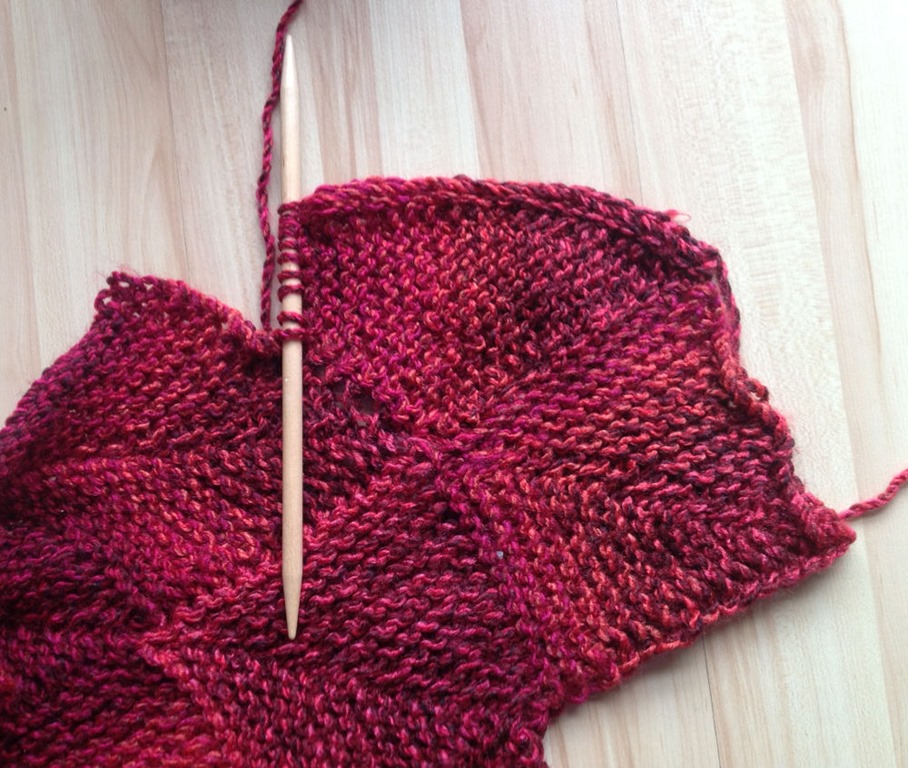
We’ll see how far I get. To be fair, I prefer the proportion of the last attempt, but it is no longer a valid option. So it goes…
If I still don’t have enough yarn, the next possibility is to rip back some of the center diamonds and make the total piece smaller. But because that’s worked on the diagonal, doing so will be a major pain.
Here’s hoping my quick fix is enough.
BACK TO PUNE WITH THE RAIN
I can report that our Great Migration was successful. We’re now re-installed in our Pune flat, having arrived mid-monsoon. We’ll be here until next summer. I was astounded at how the arrival of the rains has changed everything. The region is now green. Very, very green.
First, on the car trip from Mumbai to Pune, inland and up the ridge that marks the edge of the Deccan Plateau (Pune is at about 1800 feet above sea level), the dry and scrubby hills were transformed. Where before there was dust, some sprigs of tenacious, prickly looking shrubs and cacti, are now pillows of lush vegetation and soft grasses. Rocky ledges are now waterfalls, with greater and lesser cascades threading down the slopes, joining to make fast-moving creeks. Dry stream beds that were little more than stagnant puddles and sand shoals are now broad brown rivers, filling their channels bank to bank, and running fast enough to make rapids. We saw newly sprouted fields, and families out planting rice in flooded paddies in village areas. In the cities I saw older people tending the vegetable patches and potted plants which have appeared everywhere a scrap of space can be found. Unfortunately, all of our attempts to take photos showing the waterfalls and green fields were unsuccessful. Here’s the best of the lot:

Through the heavy but intermittent rain people were going about their business as usual, but wetter. The scooter riders were still out in force, but soaked to the skin. Likewise the pedestrians. So were the cars, but on waterlogged, slippery roads. Reduced visibility, road construction pothole puddles, and wet pavement make driving here even more hazardous than usual. I was very thankful that Mr. Rupesh was at the wheel. We did see many accidents and breakdowns on the road, mostly mini-cars that had bottomed out when their tiny wheels tried to swim through deep puddles, or heavy lorries with flats or broken axles from encountering potholes at speed. Sad to say, we did pass a couple of serious accidents with injuries, where two-wheelers and larger vehicles collided.
In spite of the rain, people here are happy to see it. They don’t seem to be all that inconvenienced. In the US, if it rains on our vacation, we’re sad and annoyed. Here the rain is seen as a blessing. Families plan vacations and outdoor activities FOR the rainy season, and TV commercials are full of happy children, frolicking with family in downpours. However embracing the rainy season does occasionally end up in tragedy. Monsoon is also a season of thanksgiving and religious devotion. Earlier this month thousands of unfortunate pilgrims were swept away or stranded by floodwaters in the northern provinces. But in even in the face of terrible loss, the rains are the lifeblood of the land, and are very welcome here.
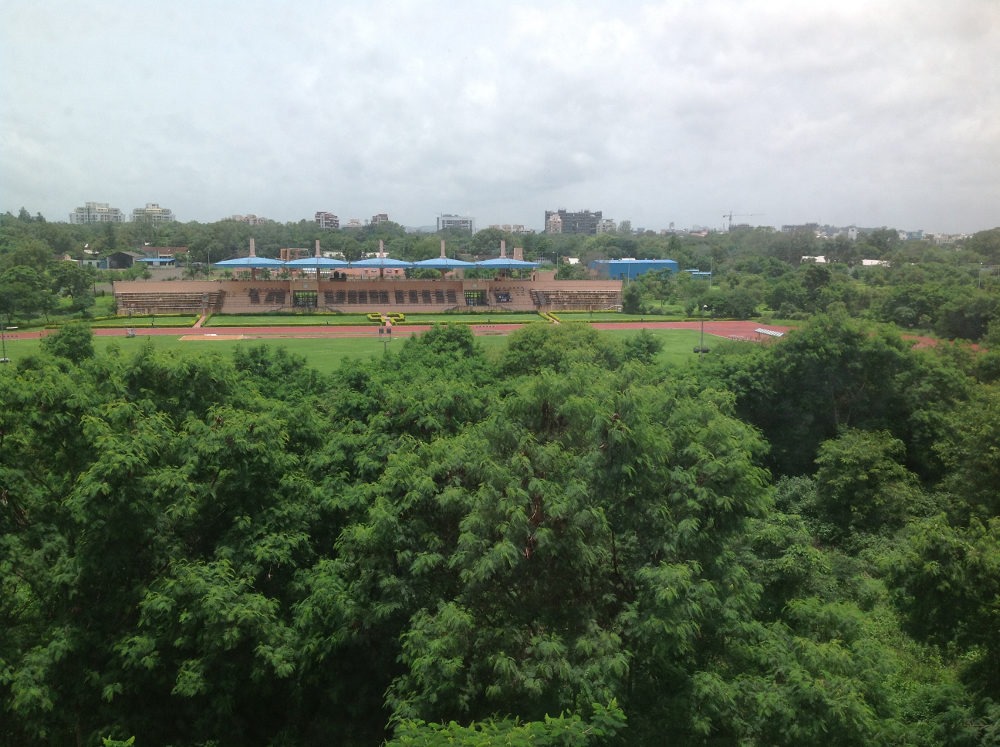
Finally, here’s the view from our balcony. The shot of the sports festival on the left was taken back in late April, just before the rains. The one on the right, not ten minutes ago:

LOST MY MARBLES
My modular blanket in Marble continues to grow. Of course, there are the two glaring missing squares, but I can knit them separately, then sew them in:
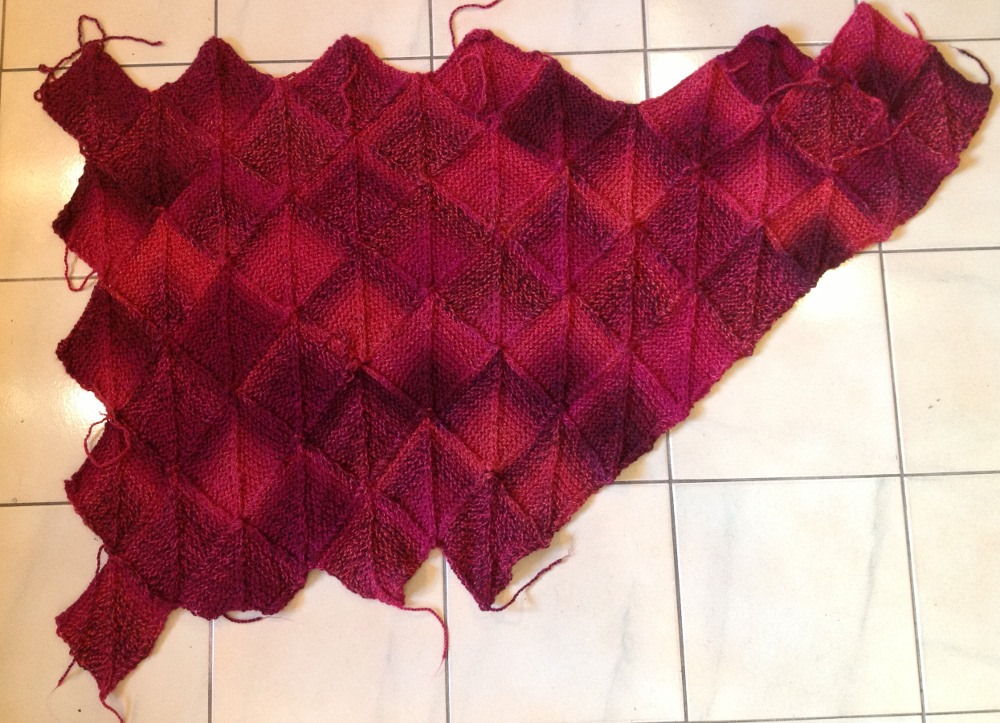
The floor is tiled in 1-foot squares, so you have an idea of the size so far. This is as large as the outside is going to get. I’m on the third of my five big balls of Marble. After I finish out the corner (and the missing blocks), I’ll do the triangles to make the thing into a nice, even rectangle. Then I’ll do some sort of banding around the edge, possibly an adaptation of one of the bias scarves so often done in long repeat variegated yarns. I’ll probably miter the corners. After that, if I have enough yarn, possibly an edging, although a simple band of I-Cord or double I-Cord may be just the ticket.
In other news, Younger Daughter is back from an early stay at Roads End Farm – heaven on earth for horse-mad girls.


This year in addition to the fun of riding and friendships, the thrice-clever Margaret taught the kids how to do needle felting. Younger Daughter has found her fiber calling:

Yesterday’s production: Stumpy pony, small dino with coffee mug, evil kitten, stubby squid, bird perched in mug handle, and tiny stegosaurus. All were done with remnants of rustic wool yarns from my stash, snipped into short lengths, and combed out somewhat using two old wire hairbrushes.
Other than that, we’re in the final throes of preparation for migration back to Pune, India.
MODULAR EXPERIMENT
A quick bit of knitting to keep the fingers occupied.
Using some of the yarn I got during the Wild & Woolly’s close-out sale, I started an improvised modular blanket. I’ve seen lots of these on line, knit in small units with a double decrease providing the shaping. Some are worked in modular style as the piece grows so there is no seaming later, others are produced one unit at a time and then stitched into the final form. Because of the directionality and relatively small width of the individual squares, they can be used to show off a gradient, long repeat, or self striping yarn.
I’m not using a pattern, I’m just noodling this out as I go, knowing that others have done so before me. This isn’t invention, it’s reverse engineering on the fly.

I chose the simplest of shapes – the square. It’s fifteen stitches on a side, worked in garter stitch, with a center double decrease providing the fish-scale or tree-leaf spine. I also chose to use the modular knit-on style.
I started by making two single unit squares (the rightmost two on the bottom row). Then I made the dark top square just underneath the needle, starting it by picking up stitches along the top edges of the two established squares. Having established a diagonal direction of working, I then picked up half of the stitches to make the middle square on the right edge, casting on the remaining half. When I finished that one I broke the yarn and started another diagonal row of squares to the left of the finished ones. You can see that I’m mid-way through yet another diagonal run right now.
I’m using JC Brett Marble Chunky, a very soft all-acrylic that comes in large 200g/341 yard (312m) puffballs. It’s slightly reminiscent of Lion Homespun (also made in Turkey), but in nicer colors, and without the annoying thread binder that tortures Homespun into its crinkly shape. Marble is machine wash in cool water. I’d dry it flat to keep its texture.
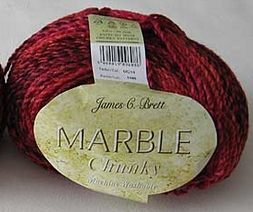
I’m working on US #11 (8mm) needles in order to get a nice drape on the finished item. It’s a quick knit – about 15 minutes per square, so this should move along at a good clip. The yarn is interesting, with the shading of the two constituent plies meandering from rose to deep maroon, with side trips that introduce a little bit of orange and purple. I like the loft and texture of the finished garter stitch on the #11s. I had tried this on smaller needles (the label recommends 6mm – US #10, but the fabric was too stiff for a blanket, although adequate for a sweater). However, I am not fond of the yarn’s tendency to shred and split. It’s relatively softly spun, and needle tips – even massive #11 needle tips – catch on stray bits as I work. This makes ripping back difficult, especially on the center double decrease (slip 2 tog knitwise, k1, pass slipped stitches over). Still, the annoyance is mostly passed, now that I’ve decided on what to do with the stuff, and what size needles to use.
As usual, I’m bungee-jumping here. The particulars are being decided upon as I go. I’m not sure how big the final piece will be, or whether I’ll stick with the established pattern of squares throughout, or even how big this center area (if it ends up being just a center area) might be in relation to any framing or edging elements. I may add edge triangles to norm the zig-zag sides, then do something else for an edging. There are several possibilities once the thing is a nice, even rectangle:
- A couple of rounds of concentric I-cord, or perhaps double I-cord
- Another round of some type of modular units
- Narrow strips knit perpendicular to the blanket’s body, so that the yarn’s gradients show well, probably with mitered corners, just for fun.
- Some kind of edging that uses garter texture and diagonals, to echo what will be happening in the center area.
Why a blanket now, and not continued work on the lace-in-process? Well first, new yarn burns a hole in one’s pocket with an urge to cast on SOMETHING. Of the yarns I’ve gotten at the sale, this is the only project that would be quick enough to complete before my return to India, and all of the yarns I’ve gotten are too massy to fit into my luggage. Also, aside from three warm days, it’s been rather cool here for spring in Massachusetts. A nice, cozy throw just appealed to me.
Finally, the last point of pondering… ANOTHER blanket? Who’s going to get this one? Younger Daughter has piped up, so it may end up being hers.
WORLD IN AN ONION
So, I’ve been back in the US now for roughly four weeks, with several more to go before returning to India for a year. I’m seeing things differently, with the new perspective afforded by the five month stay just completed.
Take the humble onion. Onions are everywhere, and just about every really tasty recipe in just about every food tradition starts out with “take an onion…”
Onions in Pune are small and red-skinned, with white flesh. If you find one the size of a billiard ball, you’ve found a giant. They’re neither as sharp nor as sweet as selected varieties here. But they’re very tasty. And it doesn’t matter where you shop for onions. The same variety is available everywhere, from the most exclusive supermarkets catering to the well-heeled elite, to the smallest street vendor’s basket. I’ve also seen the same variety, picked when the bulbs are barely there (but larger than scallions here), and sold as spring onions. Now to be fair, there may be more available after monsoon season, and what I saw may be just the tail end of the agricultural year.
In contrast, I counted the variety of onions available in our local supermarket here in Arlington, Massachusetts. It’s a plain old supermarket in a standard suburban area, and not a fancy gourmet store. There are plain yellow keeper onions, big white Spanish onions, huge red sweet onions, Vidalias, tiny white boiling onions, the small, ovoid yellow Cipollinis, Bermuda onions, ordinary white onions, scallions/spring onions, shallots, and leeks. Plus several of these varieties are also available as “organically grown.” Counting the organics, that’s about 15 separate and distinct onion types, for sale side by side.
One or two of these might be considered local. The Pine Island area of New York near Hudson Valley is still considered a major onion growing area, but by and large – this embarrassment of onion riches is trucked here from all over the country, and some of it is even imported from Mexico, or even flown in from South America or Europe. That means there’s a huge perishable-goods transport and storage network, enabled by cheap shipping, and established distribution channels.
India is evolving very rapidly, but it still has a long way to go before it can match the infrastructure required to support this variety. Produce there is local. Intercity roads and trains exist, but what’s there isn’t sufficient for major distance transport of perishables. Even the sturdy onion.
For example, Mumbai and Pune are major cities, about 95 miles apart – about six miles closer together than Boston and Hartford, CT. Googlemaps shows the travel time between Boston and Hartford as being about 1 hour, 45 min. Having done this trek many times, I know it’s 4-6 lane interstate highways all the way, and (unless it’s rush hour) most folk exceed the mostly 65mph speed limit where they can.
The road from Pune to Mumbai is well traveled, and is considered a major toll highway. It’s 2-4 lanes throughout, with some interchange areas a bit wider, and for India is pretty uniformly paved. It twists and winds a good bit, ascending up steep hills, and goes through several rock-cut tunnels. However, traffic moves extremely slowly, even on this best-of-roads. Traffic moves slowly, winding around lumbering trucks, three-wheeled goods transporters (Tempos), and a sea of two-wheeled vehicles. On parts there are even local three wheeled taxis and animal carts, although other parts of the highway are restricted. Googlemaps says that it should take about 2 hours and 25 minutes. However cars even in uncrowded times would be lucky to 80kph (about 50mph), tops, and that only on the few straight sections with good visibility, if no slowly lumbering trucks are around. The trip rarely takes less than three hours, and often significantly longer, with mammoth multi-mile traffic jams of the type seen in the US mostly on holiday weekends being the daily norm.
Now, if travel on this best of highways is “twice as far” in terms of travel time compared to US roads, you can begin to see the logistics challenge. Add to that the high cost of fuel, the lack of refrigerated trucks, the average size of a farm’s plot being something smaller than a third of a football field, lack of distribution centers, and the challenges really pile up. For a supermarket just to obtain onions in a quantity sufficient for its sales, it would have to deal with a middleman who collected produce from several smallhold farmers. Then the goods would have to make their way over land to the city. Slowly. So it’s no wonder that eating in India is a localvore’s experience, that produce is only available in season, and that varieties are limited.
I’m sure that there are other cross-cultural lessons to be learned by peeling back the layers of this onion – land ownership and transfer, relationships between agricultural and urban areas, the economics of small vs. large scale farming, how limited transportation on the part of consumers shapes retail buying, and the like. But for now, I look at the wealth of onions and marvel at the profligacy and indulgence, and have a First-World Guilt moment as I mince my way through some while cooking dinner.
SADNESS
It’s true that when one travels, one expects to come home to find everything as it was. But life marches on, and nothing ever stays the same. For example, in my little corner of Massachusetts, several destination or iconic, cherished local businesses have shuttered, or are about to:
Johnnie’s, Arlington – An old school supermarket, not chic, not trendy, and with a limited selection. BUT they did have the only store-made corned beef in the area, and still had in-store butchers who knew how to cut meat, without the fancy gourmet counter prices. Johnnie’s shuttered over the winter months. We’ll eventually be getting a small Whole Foods in the same location, but it won’t be the same.
Nicola’s Pizza, Arlington – Yes, you can’t swing a pepperoni in town without hitting a pizzeria, but Nicola’s was special – hand made as opposed to institutional dough; rich family-recipe sauces; real cheese; excellent quality toppings, all cooked to bready/crispy perfection. Word is murky, that the site, store, and recipes have been sold, and a new owner will continue the Nicola’s tradition; or that the site will continue to be a take-out and sit-down eatery, but with a new menu. In any case, the old family’s ownership and touch will be sorely missed.
Higgins Museum, Worcester – A private museum of arms and armor, endowed by a steel magnate about a hundred years ago, and housed in unique building, set up to feel like a castle. The Higgins will be open until the end of the year, but after that the collection will (in part) be housed by the Worcester Art Museum. Go now, because you’ll never see all of those artifacts in one place in such an atmosphere again.
Wild & Woolly, Lexington – This is the hardest and most personal blow of all. W&W is a specialty yarn shop. It had the biggest selection of yarn in Eastern, Massachusetts, along with the personal touch that only experienced help can give. I counted W&W as more than just a store. It was a “home away from home” – the first place I visited when we moved up from Maryland, and the first folk who befriended me here. Over the years I’ve taught classes there, and helped out during inventories and big sales, or when I was between jobs. I’ve put in a little bit of time helping them prepare for their final clearance sale, which is going on now. Eventually I’ll find other places to buy interesting knitting supplies (especially the non-commodity yarns that need to be assessed in hand for drape, texture and color); but I’ll never replace the “store family” who will now scatter to the winds.
So in summary, you blink and things change. Nothing is forever, so appreciate even the small things, places, friends and services that surround you, because everything is impermanent.
CHECKING IN
Where have I been? In Pune, but now home in the US for a brief visit. What have I been doing? Mostly wallowing in ennui. For whatever reason, I have not been motivated to do much, not working on projects, researching, or writing here.
I can report that aside from the transoceanic trip, we did do one major thing. We hosted a “happy hour” party for 25 of The Resident Male’s coworkers, holding it at the apartment. I did all of the prep and cooking. I made samosas, falafel, hummus, guacamole, and Chinese scallion pancakes (adding some minced hot peppers to the scallions). I also improvised a mixed olive salad, and paneer with a Thai-style peanut sauce. Everyone had a good time, and using consumption as a barometer – the snacks were well received. The scallion pancakes in particular were prime, and a do-again, for sure!
There is some minimal progress on my latest shawl. I test-knit a new MMarioKnits product, but others were far speedier than me. Most of the corrections I found were posted by others, and my finished project was not completed in time for photography for the cover of the pattern. The main reason for this was a major lace disaster. While photographing the piece, I managed to drop upwards of 90 stitches, and needed to ravel back to a solid point and re-knit. After coming in so slowly for completion, I decided to punt the official as-written, minimal bind-off treatment, and add a knit-on lace edging. I selected a simple one from Sharon Miller’s Heirloom Knitting, picked both for complimenting the lines of the shawl’s main motifs, and for being a multiple of 12 rows, and began. I’m about two-thirds of the way around my circumference, and hope to be done soon.

However, just because I’ve been a slouching, IPad/browser game playing slacker, doesn’t mean the rest of the world stands still.
I’ve said before that I get an enormous kick out of seeing what people do with the patterns and designs I post. Occasionally, folk write to me to ask questions, or send me photos. Other times, I track links to my pages back to the point of origin. If I stumble across something I ask the owner if I can repost their work here, with links or attributions as they desire. Here are the products of two people who sent me pix of their stitching this month.
Elaine from Australia delighted me with these two projects that include filling motifs from Ensamplario Atlantio:
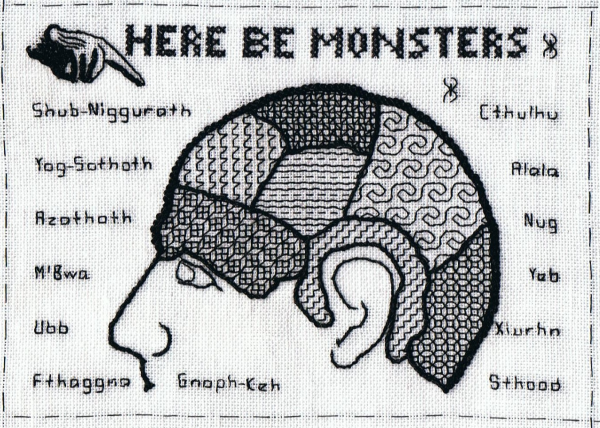

Both were presents for friends. I’m not sure which one I like more – the piece for the Kiwi audiophile, or the one for the Lovecraft aficionado.
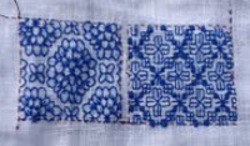
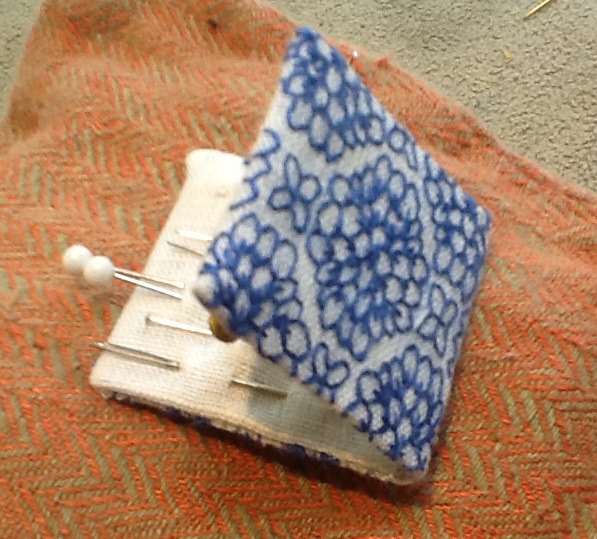
Meanwhile, Jordana in New York used two of the Ensamplario designs for the cover of a charming two-sided needle case. Here are her photos of the work in progress, and the finished item:
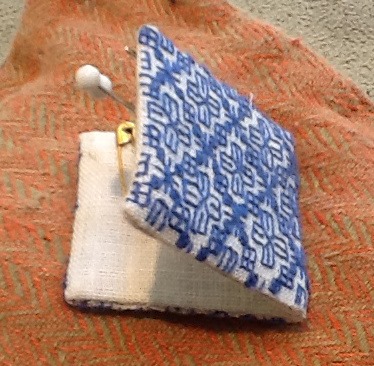
Well done to Elaine and Jordana! Special thanks to both of them for making my day!
HISTORY THROUGH NEEDLEWORK
I was wandering through the free-for-public-use pictures collection recently opened up by the National Archive of the Netherlands, looking for interesting photos of needlework or knitting. “Merklap” is the Dutch word for sampler. Using it, I stumbled across these:


Clicking on each image above will bring you to the original archive site, complete with a very useful zoom feature for close inspection.
Now, from what I understand from the captions, these three unusual counted thread pieces were stitched by Her Majesty, Queen Ingrid of Denmark, consort to King Frederick IX of Denmark. The archives captions says that the three samplers bear images relevant to her life with her parents, King Gustav VI of Sweden, and Princess Margaret of Connaught, and the photos were collected in 1954 (One of the pieces bears a date of 11 November 1952.)
Queen Ingrid was born in 1910 and died in 2000. Reading through the bio snips available, she was an early feminist and thoroughly remarkable woman, widely respected for personal courage and support of the Danish people during the German occupation of Denmark during World War II.
Historical context aside, just look at those motifs! Worked in double running or back stitch, with the background done in cross stitch, the items shown are full of exquisite detail. That horse in the center of the second sampler is on my list for regraphing, for sure. I love the humor, the juxtaposition of high heraldry and honors with the totally mundane.
The first sampler bears Swedish heraldry (the three crowns), and honors her parents. The other two seem to be about her own life and interests, with her seal, and images of her education, sports and leisure activities; and pursuits including art, biology, horticulture (she redid many formal gardens), geology, and antiquities. How can you not be charmed by a Queen who stitches a box of spaghetti, fishing lures, a pilot’s wings, Canasta cards, and a cabin in the woods?
In short, Ingrid may have been a highly influential and important person, but these pieces now offered up to the public make an instant connection to her as an individual with curiosity, energy, and humor. I’ll seek out some better books on her life and times. And I’ll think of her the next time I have spaghetti with a salad, with candy canes (polka grisar) for dessert.
MINAS TIRITH?
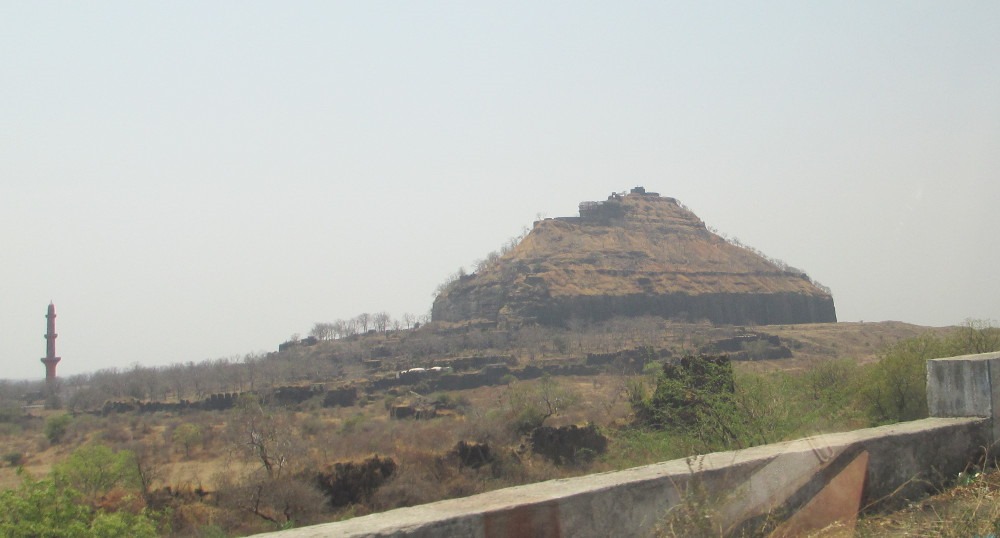
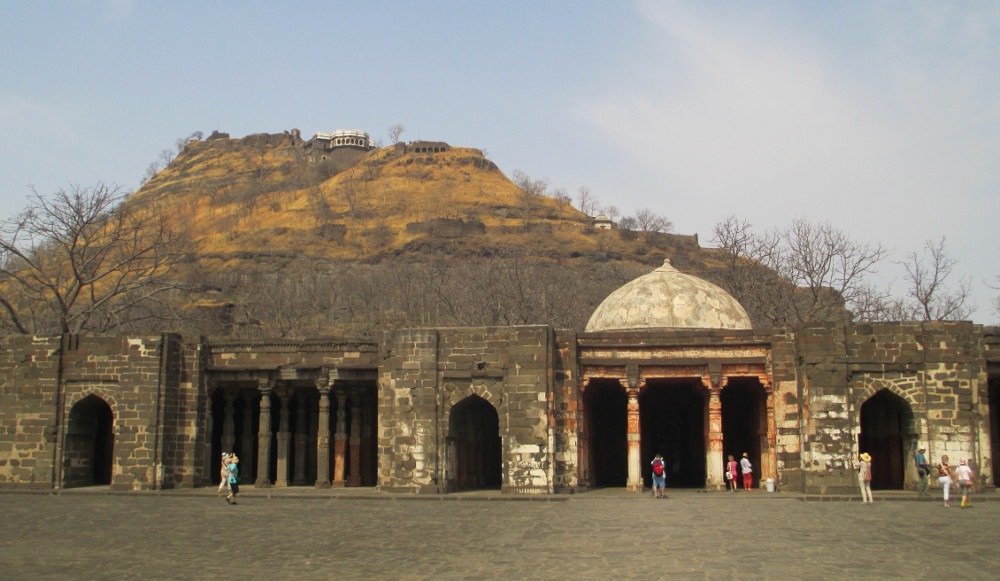
Now that I’ve got your attention, this weekend past, during a trip to see the sights around Aurangabad in Maharastra, we climbed up to the top of Daulatabad Fort (aka Devagiri or Deogiri). It’s a vigorous hike up 200 meters (656 feet) of uneven stone steps and steep ramps, winding through dark passages, up to spectacular views of the surrounding countryside.
Daulatabad and its fort have a long history as a key military and economic stronghold, dating back to the late 1100s. Devagiri was a fortress of the Hindu Yadava dynasty kings from the late 1100s before being seized by Moslem rulers around 1300, who saw its advantages as a military headquarters, and moved their capital to it in 1328. Water and resource shortages later led them to relocate back to Delhi. However it continued to be a center of power and contention for the next several hundred years, passing back and forth among various earlier Hindu, Mughal, Maratha, and later Maratha Peshwa rulers. These struggles, alliances, and inter-ethnic détentes are the foundation of Maharashtra province’s cultural mix to this day.
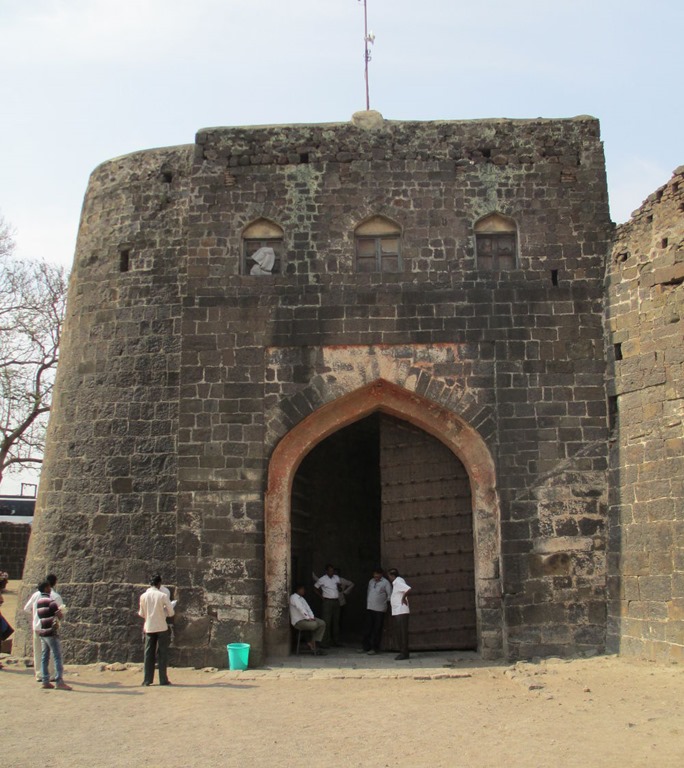
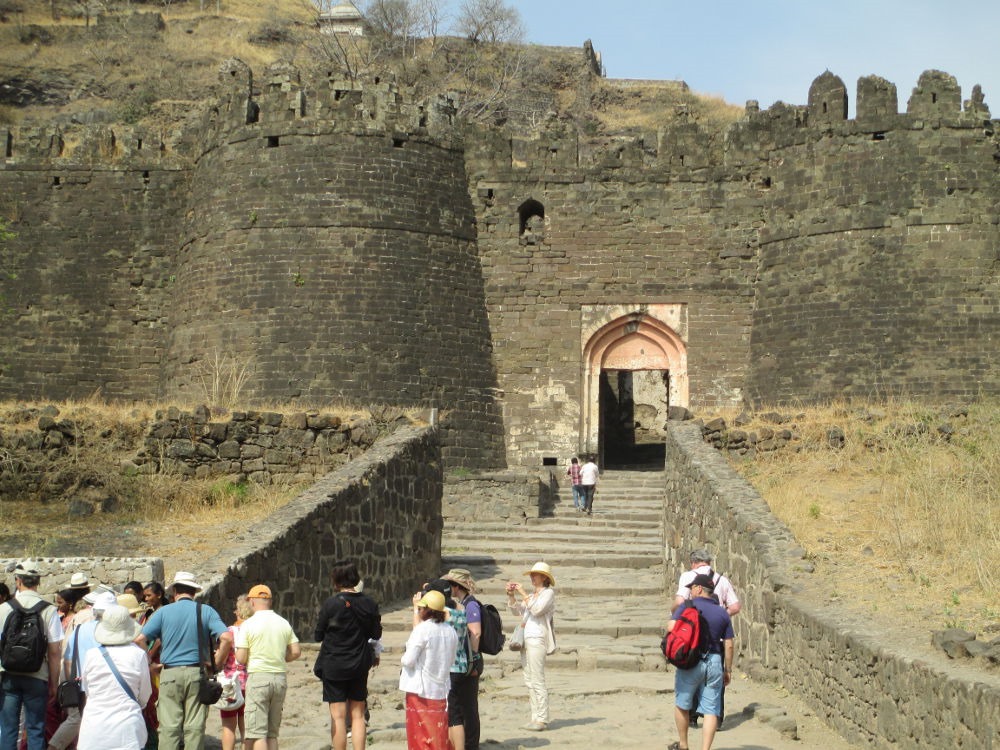

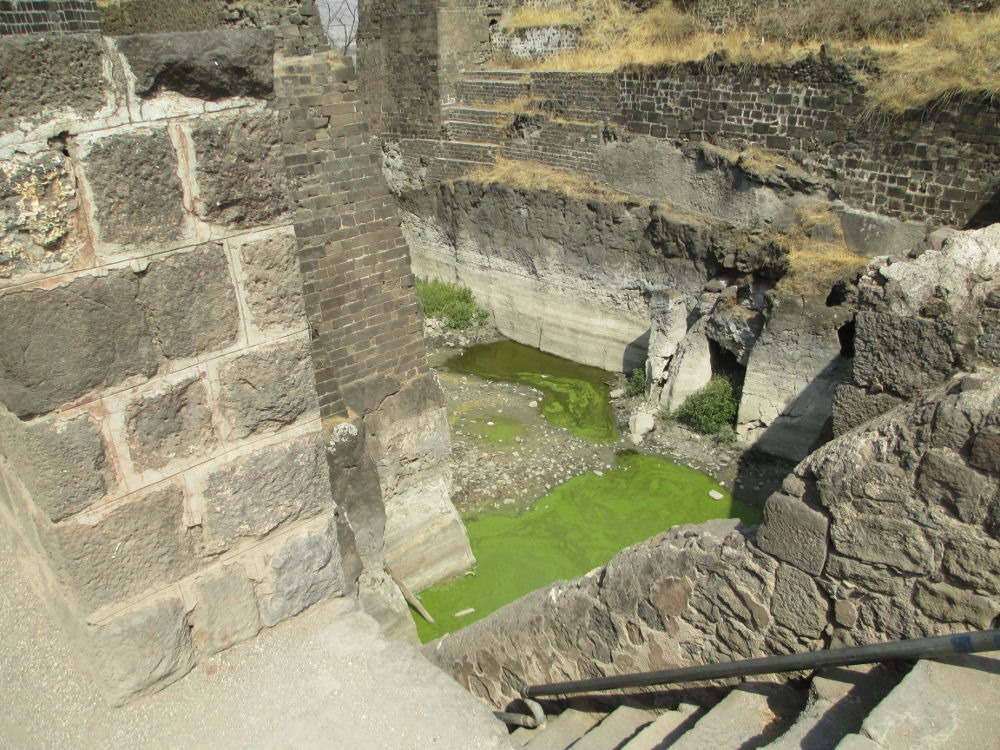
Devagiri’s defenses include many fortified gates, watchtowers, and multiple moats, one of which used to be spanned by a retractable leather bridge, traversable only on foot. Today’s bridge is sturdy iron and wood, a good thing because the moat still retains water, green with algae in this drought.
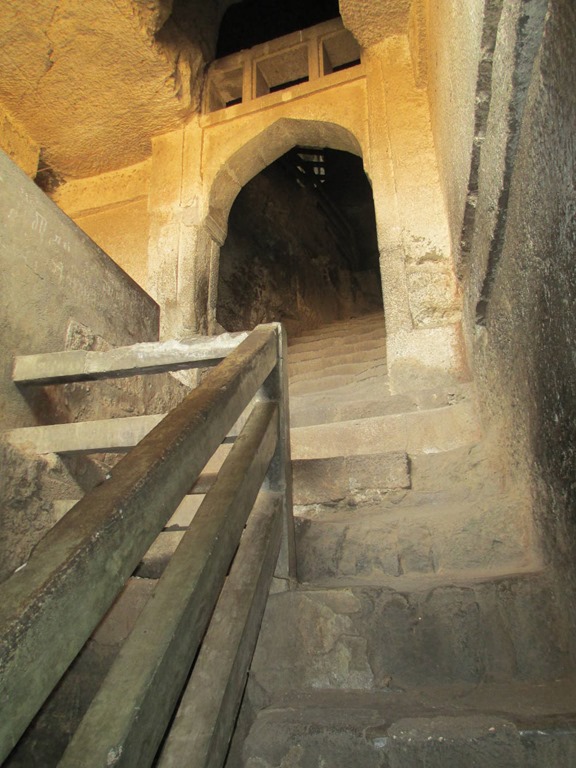
There is a twisty, steep and in places – a very dark passage on the main entry route, with deliberate drop-offs and false paths to lure invaders to their doom (thankfully roped off to protect clueless tourists).
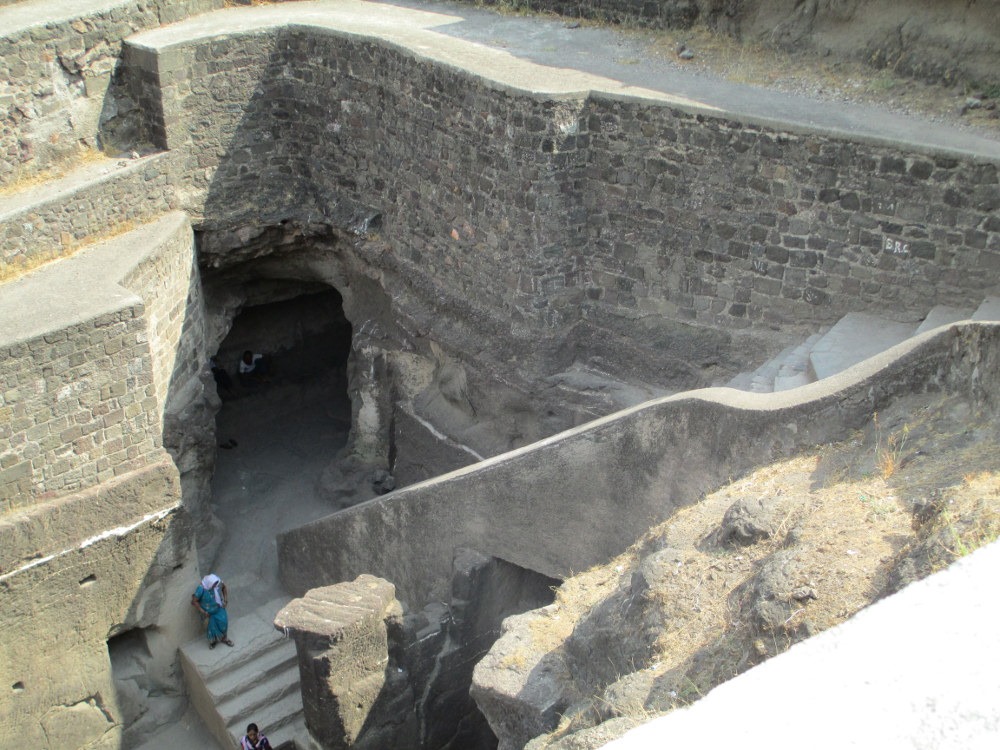
There are sluice gates through which rocks, scalding water or burning oil could be dropped on the unwary; archer holes, hidden sally ports, and cliffs hand cut and polished to make climbing impossible. Later defenses included gigantic brass cannon (as long as a van) mounted on towers. These are cleverly balanced on center pivots so they could batter besieging armies coming from any direction.
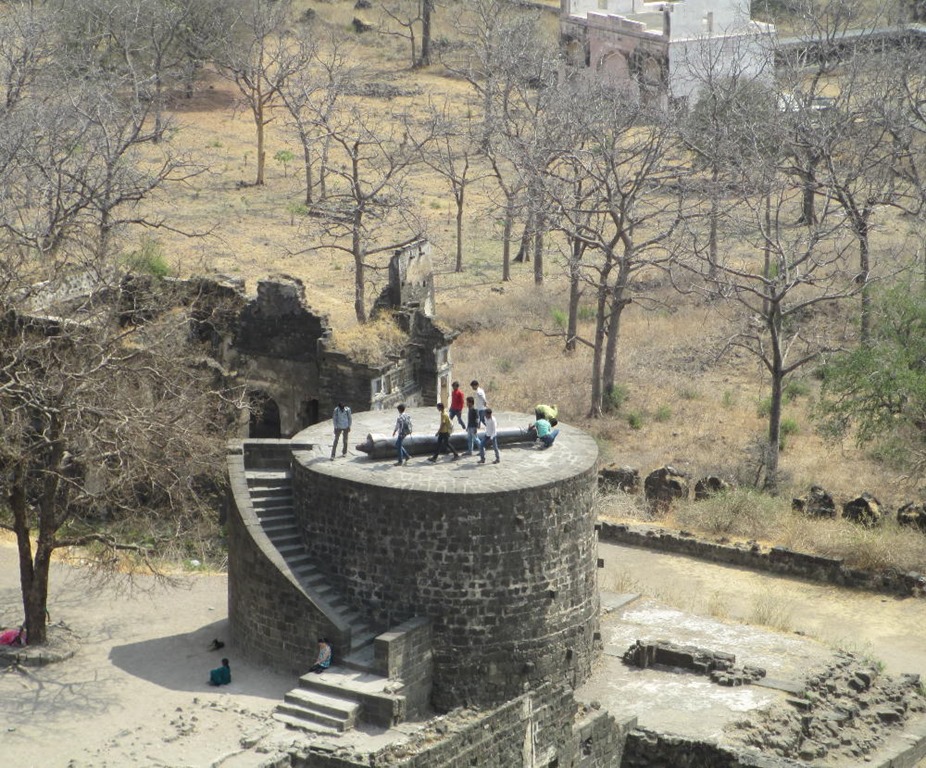
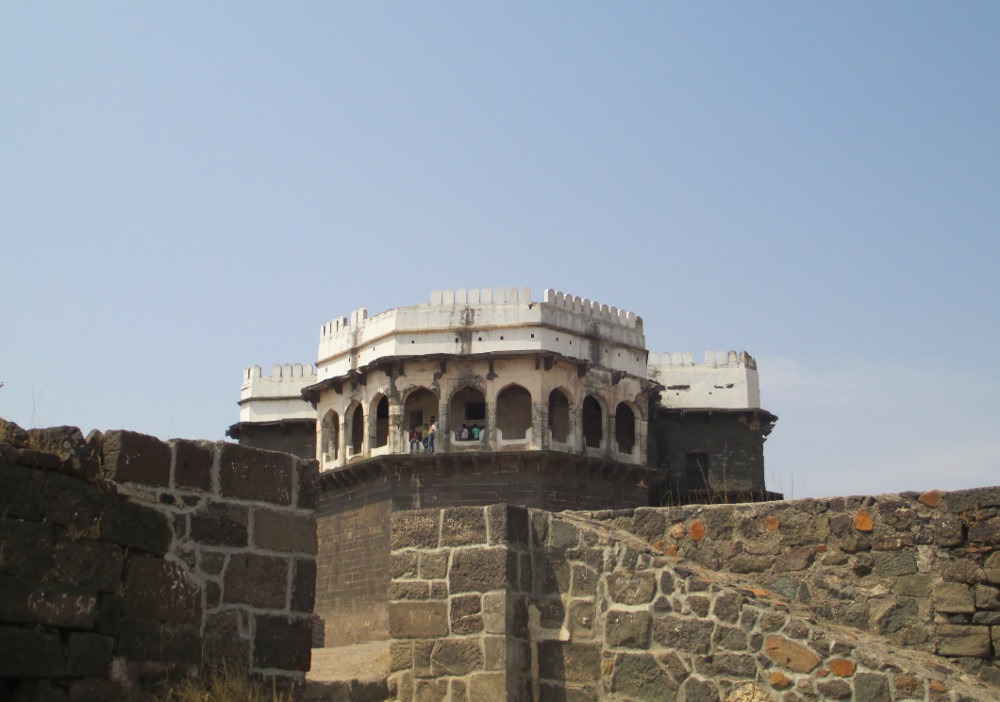
The ramparts are massive, cut into or assembled from the hard basalt stone of the region. Building across the entire site clearly shows multiple periods of construction, ranging from the mighty initial citadel, to later Moghul palaces of graceful stonework, decorated with imported Chinese porcelain tiles and painted stucco.
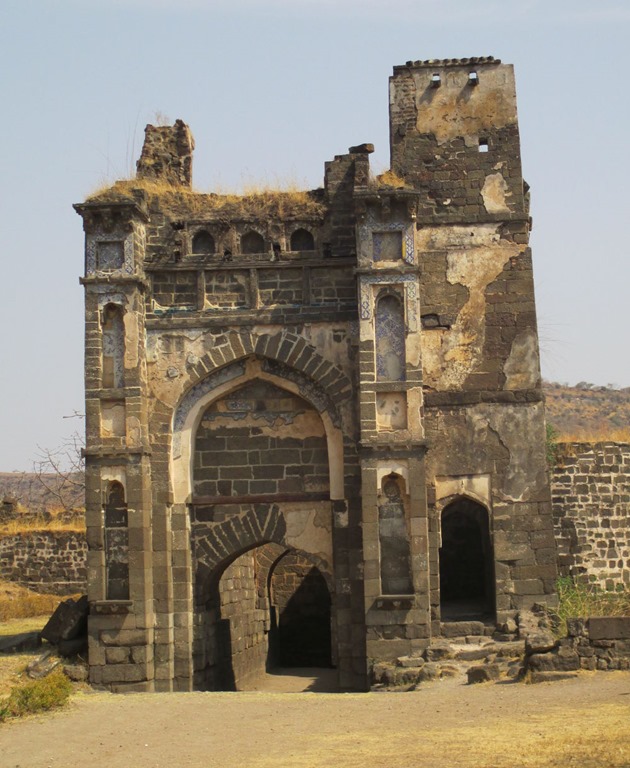
Re-use of older fragments in newer construction is common:
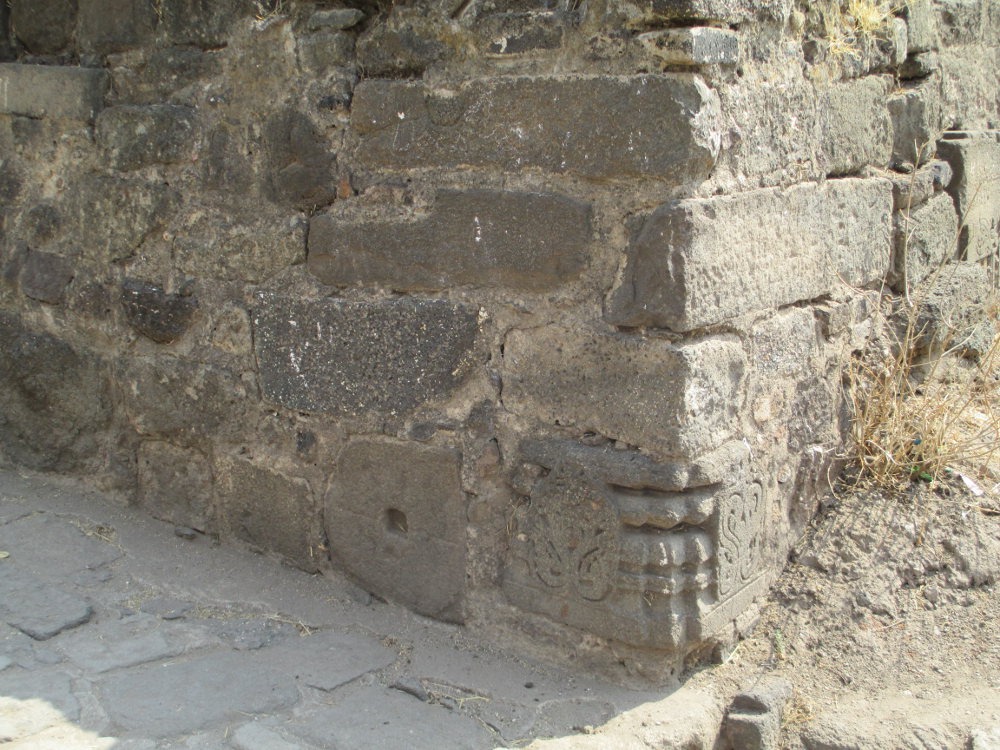
Now why did I invoke Minas Tirith for this post? I’m no Tolkien scholar, but to my novice eyes Devagiri presents some strong parallels to his descriptions. For one, Devagiri is chiseled into a butte-shaped rock outcropping, a freestanding mesa overlooking the surrounding lands. The fort itself is built into, on top of, and around this massive prow-shaped stone:

The fortifications are nested in winding layers, with gates widely offset to delay attackers, and to lead them past ambush points. There are quarters, cisterns, and storehouses all the way to the summit. The lower circles of defense sport wide avenues that circle the hill, passing through defiles that could shelter large numbers of defenders ready to pounce on any incoming troops. Many of the towers, shrines, palaces, and walls (with the exception of a later brick-red minaret) were once covered with white stucco, and must have been an imposing presence, a multi-tiered, gleaming set of ramparts on top of the hill’s sheer, black, hand-chiseled cliffs.
Of course there are many differences, too. Tolkien describes a much larger city, with more circles of defense, and an entire population living inside. There was a town to support Devagiri, inside the outermost circle of fortifications, but it was arrayed at the base of the hill, rather than on the hill itself.
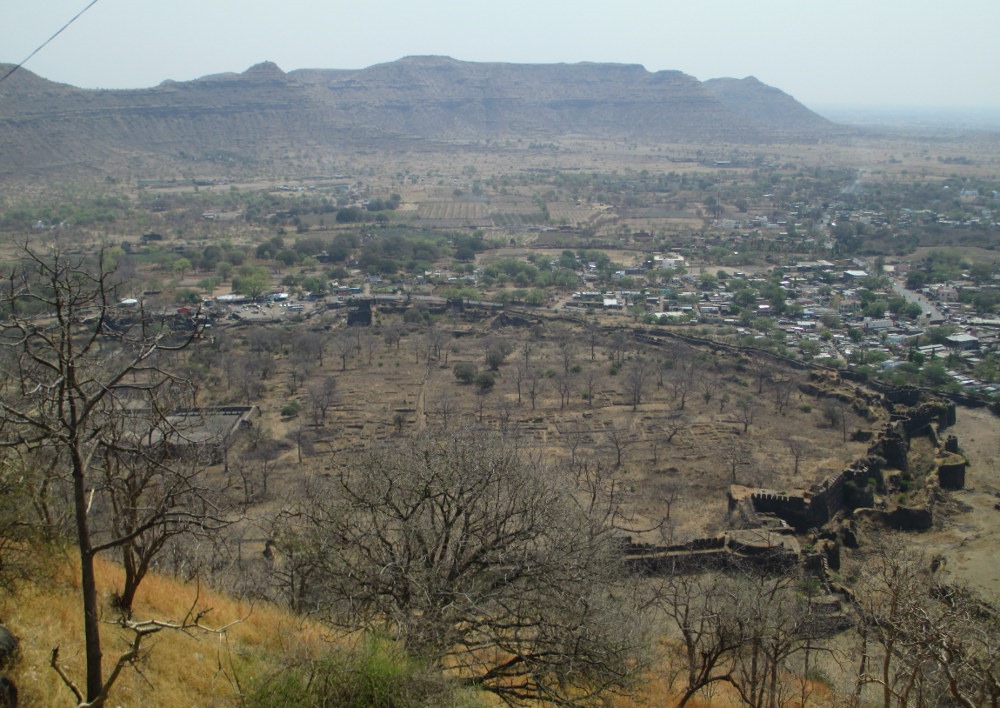
Dautalabad itself is far inland, up on the Deccan Plateau – on an arid high plain punctuated with other hills of similar configuration. There is no navigable river or port for ships, be they from Dol Amroth or Umbar. And while there are far-outer rings of defense enclosing what may have been support lands for agriculture or fodder-lands for war horses and elephants, there is no great wall of Rammas Echor enclosing a Pelennor-sized expanse before the gate.
Devagiri was well-known to the British, and was widely described and depicted as early as the late 1820s, although by the time they arrived it had past its glory, and was no longer a military stronghold. I would not be surprised to learn that the professor had read about it, perhaps as a boy learning the history of Marathi Empire and the three Anglo-Maratha wars that culminated in the British consolidating power over the majority of the Indian subcontinent. Perhaps some student of literature will take this idea as thesis fodder and delve more deeply into it…
No longer the contended redoubt of fierce warrior poets, today Devagiri is the slowly crumbling home of tour guides, elderly temple wardens, souvenir hawkers, gray langur monkeys, stray dogs, and clouds of bats. Romance and idle speculation aside, visiting the fort has taught me much about the area’s history and onion-like culture, with layers of influences laid one on top of the other.
I marvel at the scope of effort and breadth of power a monument of this size still represents.
 String-Or-Nothing