MINT BLANKET TUTORIAL – PATTERN CHOICE AND FINISHED SIZE
In the last post we considered yarn choice and needle choice. Now on to pattern choice and rough dimensions.
The whole point of this small baby blanket (or lap blanket, or pet blanket) project is to try out some new technique or knitting approach in a low-stress project that produces a useful result, and that doesn’t take a ton of time to finish. Because both sides will be visible and the curling inherent in stockinette isn’t desirable, it’s a great place to try out texture patterns, provided there’s a suitable balance between knits and purls – especially in the edge-most two or so inches all the way around. Working a two or three inch border of garter stitch or moss stitch all the way around is a standard approach to fighting curl that results in a pleasing frame around whatever center patterning is chosen. But I’m in the mood to be a bit more adventurous, and to encourage folk to try some lacy knitting and a knit-on border, even if they’ve never done either before, so I’m going to use a lacy knitting pattern with a garter ground. The whole blanket will be in garter stitch, pierced by eyelets, so curling won’t be a problem and the thing will look (mostly) identical on both sides.
On to pattern selection. If we’re going to work the blanket back and forth as one unit, the easiest thing to incorporate is an insertion strip or pattern panel, rather than a large spot motif that needs to be centered north/south. An insertion strip can be begun and worked until the desired length is accomplished. Sometimes there may be a logical endpoint so that the insertion’s larger motifs display in whole units, but for the most part, strips are easy to place with minimal calculation.
There are tons of lacy strip and panel patterns out there. Some are right here on String and wiseNeedle (hit the Patterns link at the right), but there are lots of excellent choices out there in pattern treasury books and on line, written up as stand alone designs and as part of larger patterns to produce other finished objects. Feel free to pick something you like.
I’ve chosen a 33 stitch wide lace insertion panel – yet another design from Duchrow V. II. Here’s a simplified version of the design in modern notation (the original that I’m following is a 64 row repeat, and features two different treatments for the large center diamond area) plus some bobble-like nupps. I worked the original, so you’ll see some differences between my finished item and results from the chart below (caution – it’s a big file):
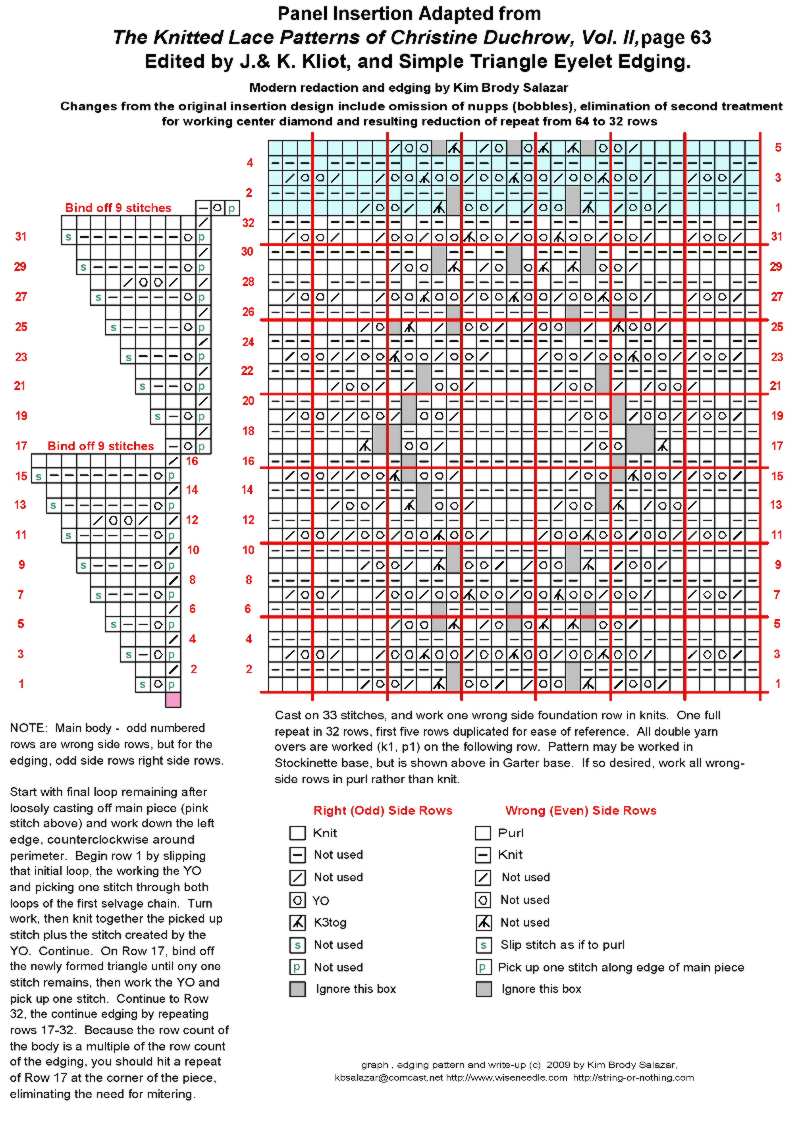
Now how to take a repeat and stuff it onto a blanket?
Easy. Even without doing a gauge swatch, we can make a rough guesstimate of project width. Remember – our blanket only has to hit a window of “usable size.” That gives us lots of wiggle room. I know that in plain garter stitch with lots of eyelets, I’m likely to get about 4 stitches per inch at the absolute most in a worsted yarn using size 8 needles. I know this because I know that using 7s, I usually hit 5 stitches per inch on the dot. Garter on bigger needles is likely to make a slightly looser fabric, so I estimate 4 spi just for the garter. But my chosen design has lots of eyelets. Because of the airy looseness that heavy use of eyelets produces, my end product will in all probability be a tad wider than this estimate. Since precision is optional here, I’m going to wing it but base my calculations on the 4 spi figure.
33 stitches at 4 spi works out to about 8.25 stitches across my panel. I could center one panel on my blanket, but I think that two panels might look nicer. Two repeats will cover 16.5 inches. (Any result over 21 inches before adding an edging would be workable.) Two repeats of my panel would eat 16.5, leaving 4.5 inches to eke out to hit my goal – about 18 stitches at my gauge. If I want to place two panels on a piece that’s roughly 21 inches across (before adding an edging), that means I’ll have to put some of these stitches in a band between the two panels, and some along the left and right sides:

I could put those extra stitches anywhere, on one edge to make an asymmetrical layout, all down the center, or I could distribute them differently, with fewer between the panels and more on the outside edge (or vice versa). I chose to divide them in half, placing half down the center, and splitting the remainder along the right and left edges. When you compose your blanket, you can do whatever you wish. And that includes using more than one texture or lacy pattern to make up your width.
So now we’ve leapt off the pier into the deep water of design and have violated most of knitting’s “must do” rules. We’re starting an original project with only the vaguest notion of yarn quantities, no precise grasp of gauge, and the barest nod to final dimension. But we are serene, none the less.
The next step is casting on and knitting. For this you’ll need yarn, needles, and enough markers to indicate the beginning and end of each section (see diagram above). I find it very useful to mark the first transition point on my right side row with a marker of special color, size or other easily recognizable appearance. It’s very easy to lose track of what side is being worked in garter stitch. Having the quick visual clue of “distinctive marker = beginning right side row” is a big help.
MINT BLANKET – PROJECT KICK-OFF
This series is aimed at people who are just starting to knit, who haven’t tried departing from printed patterns. The goal is to produce a small patterned blanket, of baby-basket/car seat size, with a knit-on edge of some type, and along the way to reduce anxiety about gauge, technique, and project composition.
O.k. let’s start.
The first thing to consider is yarn choice. If this is going to be a blanket for a baby some considerations are:
- Washability. Not every new mom has the time or patience to deal with hand-wash items. I strongly suggest that anything knit for a baby be at the least capable of going through machine wash cool/dry flat care. There are lots of washable wools, acrylics, cottons, and blends out there, in every price range.
- Yarn texture. From personal experience I can say that smooth yarns are a better choice for baby items. Not only do they tend to retain their look after repeated washing, they also tend to shed less than fluffy or fuzzy yarns. Fluffy/fuzzies mat down when soiled and babies ingest every fiber that ends up between their fingers. I also found that yarn with puffballs or other baby-adorable texture additions are a very bad choice. (When one of my kids was an infant in her car seat and not under direct observation/access she plucked and ate every fluffball off her sweater within reach, and then pooped in multicolor for three days.) If you want to use a chenille, velor, or terry type texture yarn, look at it closely and tug at the fibers. If they come off in your hand, look for something else.
- Yarn weight and fiber composition. The thicker the yarn, the quicker the project will be to complete. On the other hand, the thicker the yarn, the heavier the blanket. For quick knit baby blankets, I tend to stick with yarns that have a label gauge of DK, worsted or Aran weight (22, 20, or 18 stitches = 4 inches respectively – go by gauge measurement square on the label, not the often misleading written descriptor).
Also blends with acrylic in them tend to be less massy than all cotton or all wool yarns. Finished wool/acrylic blend blankets will weigh less than 100% wool blankets of the same size, and most blends will have better yardage per ball than 100% wool blankets. The same is even more true for cotton, which weighs more inch for inch than does wool.
- Color. I personally am not a fan of baby pastels, and the whole pink=girl, blue=boy, green or yellow = as yet undetermined thing leaves me cold. But lots of moms-to-be (even the most progressive) favor traditional colors, and like brides can be highly opinionated about color choice. Cultural biases also exist. You may want to ask about the recipient’s color preference before you invest in the yarn for that sweet bellflower blue, arctic white, or strident crimson blanket.
Let’s assume that we’re going to pick a smooth texture washable acrylic Aran weight yarn in a traditional unisex mint green, which is what I happen to have on hand. The next question is “How much to buy?” Since we don’t have a pattern, have only the vaguest sense of final dimensions, and are not going to buy a sample quantity then swatch and do the math, we’re going to go by rough rules of thumb and guesstimate.
- Aran weight (18 st = 4 inches) – 1,000 – 1,200 yards or more
- Worsted weight (20 st = 4 inches) – 1,100 – 1,300 yards or more
- DK weight (22 st = 4 inches) – 1,200 – 1,400 yards or more
I try to buy closer to the top end of those ranges than the bottom, although through judicious size manipulation, being willing to change sizes/edgings on the fly, and watching consumption carefully, I’ve made successful blankets at the lower end of each range. Coincidentally, the lower end of the ranges above are roughly the yardage I’d expect to find in a full bag of 10 50-gram balls of a washable wool/acrylic blend at each of those gauges – the quantity my local yarn shop often puts out at end-of-season discount sales. And I don’t worry about leftovers. Anything left over from this blanket can become a matching newborn hat or two, and/or pair socks or thumbless baby mittens, as appropriate to the season.
Now needle size. Which to use?
A good place to start is the size recommended on the gauge square or gauge notation from the yarn’s label. If you’re a loose knitter or tight knitter you probably know whether you typically have to move up or down a size to get gauge. But we’re not really concerned with accurate gauge on this project, so small deviations won’t matter. I tend to be pretty close to most label gauges for smooth finish yarns in stockinette, but I will usually go up a needle size if I’m going to work a blanket based on a lacy pattern that’s full of eyelet holes. I find the extra needle size relaxes the garter fabric a bit and the eyelets end up being a little larger.
So this project is now kicked off with (in my case) a bargain basement 100% acrylic worsted weight yarn (5 spi by label gauge. recommending a US #7), and US #8 needles. And in my case, I’m using some ancient, mismatched #8s picked up in yard sales that measure a bit bigger than the standard 5.0mm. They’re closer to 5.25mm. I like having some old needles with odd sizing because for projects where gauge is important, sometimes the little bit of difference between standard pairs and the oddball vintage sets makes hitting that magic number easier.
Now that I’ve angered the all-natural fibers crowd, let’s try to smooth ruffled feathers. I do knit with 100% hand wash wool or 100% cotton for my own offspring, and for the few among my family and friends who both appreciate and know how to care for those fibers. I find the natural fibers (and even the improved superwash yarns now available) to offer a more enjoyable knitting experience, and to yield a finished look and feel all their own. But it’s a waste to let ideology stand in the way of usefulness. No one will be converted to fiber truth or sustainable use by receiving a baby blanket they are either afraid of using, or that they destroy in the first wash. So preferring to offer comfort over didactic indoctrination, I use what is at hand that is most suitable for the project and for long term care, rerouting vintage mass market yarns that found their way into flea markets and yard sales into practical baby gifts.
Pix tomorrow, I promise.
BLANKET RIOT
More in the empowering others mode.
Blankets. Think small lap throws and baby blankets.
They’re super easy to do, a great way to try out new techniques, and are much appreciated gifts. Gauge is of little relevance other than being a data point in calculating general yarn consumption. If a blanket turns out an inch over or under target width, no one will notice.
Blankets of every size are useful. The smallest are great for use with baby baskets and carriers, and with car seats. Slightly larger, and they’re play or nap mats. Bigger still and they’re crib blankets (knitted blankets with their large airy, breathe through holes are far safer for babies than quilted or fleece throws). Even bigger and they remain in use through the toddler bed years. Older kids and adults appreciate a small lap blanket to ward off the evening’s chill while watching TV, reading, messing with the computer or doing homework.
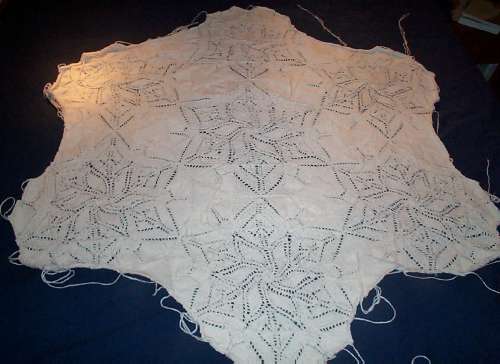
I enjoy making small throws and blankets. I’ve done a ton, only a few of which I’ve managed to photograph. Some have been pieced together from smaller motifs:
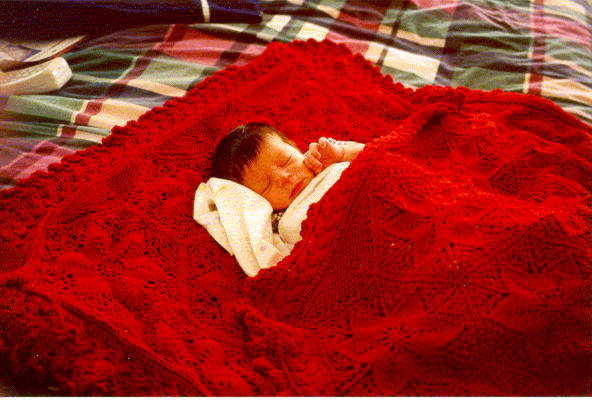
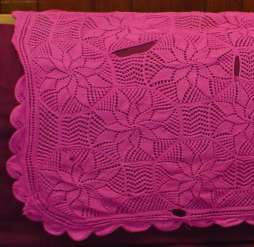

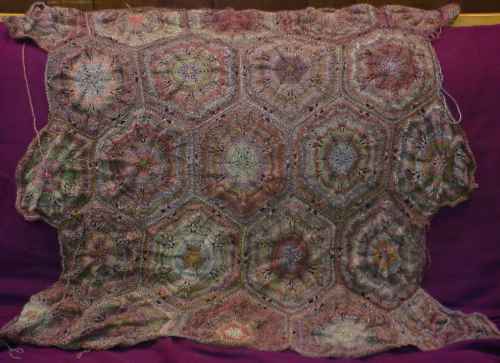
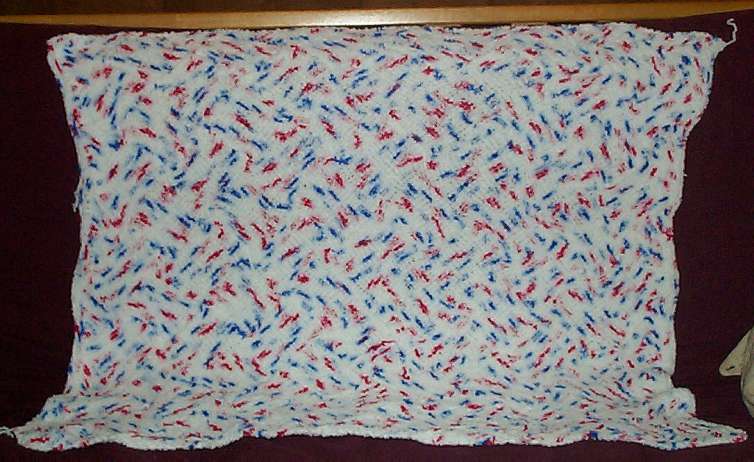
Some are experiments in entrelac or modular knitting:

Some are worked in one piece, either as a single width, or radially out from the center:
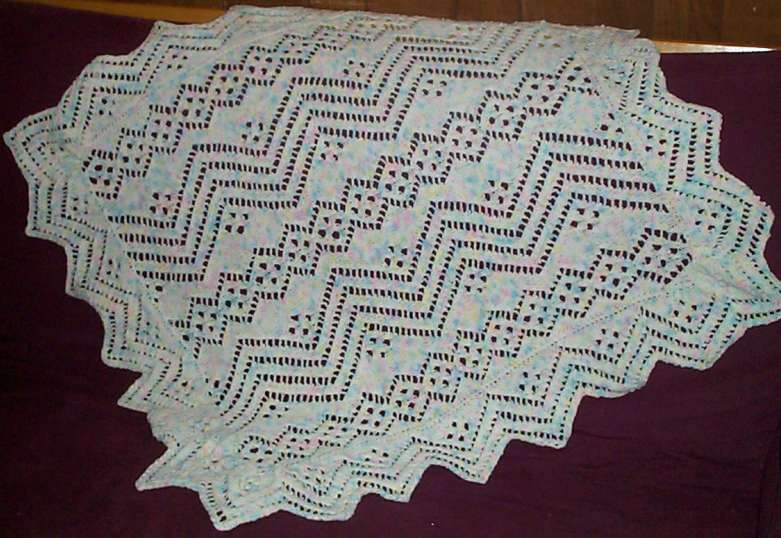

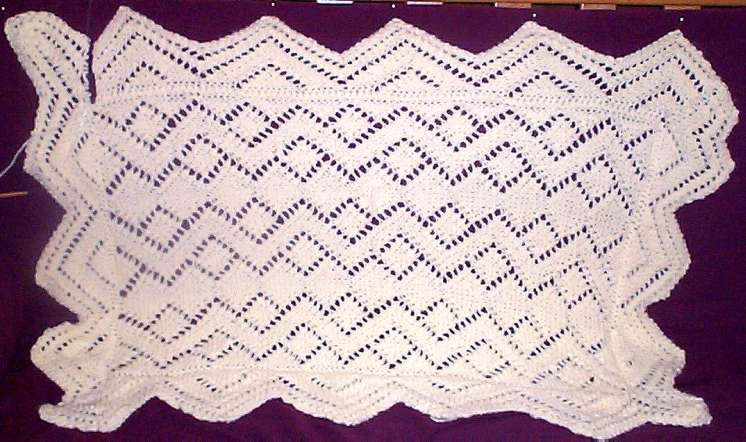

Of the items above the yellow/green swirl Knitty Op Art blanket and the Special Blauband multi-brown Kaleidoscope blanket are kit or on-line patterns, the rest are my own machinations.
The easiest and quickest to do in the bunch, and the type requiring the least finishing is the last type – the blankets knit in one single width. They look quite impressive, but are VERY simple to design and are excellent “first original project” opportunities. All you need is a sufficiency of yarn, one or more strip or panel type patterns, and second-grade level math skills.
I’ll walk through the process on the next new project – a lacy stitch baby blanket in mint green acrylic, with a knit-on edging. Watch this space!
MODULAR KNIT LOG CABIN BABY BLANKET FINISHED!
I’ve finished the baby blanket. In short, log cabin in a self striper or space dyed yarn with the strips worked sequentially around a center is an idea worth additional exploration.
Because this yarn is largely cotton with a lot of acrylic in it and very unstretchy, I won’t be blocking the thing. I’ll probably give it a quick gentle wash and pat dry just on principal (better to give a baby a clean present). I’ll doodle with a top down simple hat today. There’s only about half a skein left. I might be able to eke out a matching stockinette newborn cap with a rolled brim, to make this a home-from-hospital set.
I don’t particularly like the Batika in general. It’s not as soft as I hoped. While it’s not scratchy, I thought the result would be spongy, but the nylon binder bunches the chainette up and gives the yarn a crunchy rather than pillowy surface feel. It also breaks surprisingly easily. It’s a good thing I used the join method I did because I found that the tapestry needle’s eye broke the end strands when I was darning in. If you are going to knit with Batika, take special pains to avoid leaving ends in the middle of rows, and use a VERY large eyed needle when ending off.
In case someone else wants to duplicate my working method and play with this idea, a description of how to work the strips using long-loop joins is here, and the directions for the simple triangle edging are here.
LOG CABIN BLANKET EDGING
Moving on with the modular log cabin baby blanket, I decided to take the center square and finish it off as a rectangle, in order to end up with a more usable object. Due to yarn quantity constraints this is a small basket/car seat size blanket – not a crib size throw. It measured about 20.25″ x 31.5″ before I began adding the simple edge triangles. It’s a bit smaller than the blankets I made recently however I’m not worried. I found with my own kids that small blankets were supremely useful for traveling and naps, and were indispensable parts of the lug-around baby support kit.
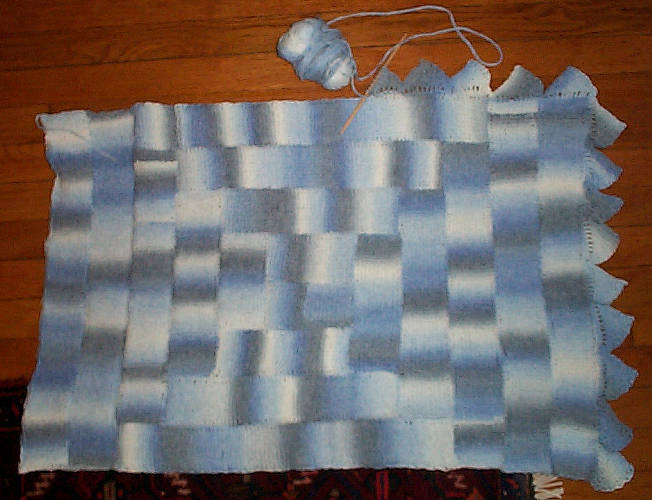
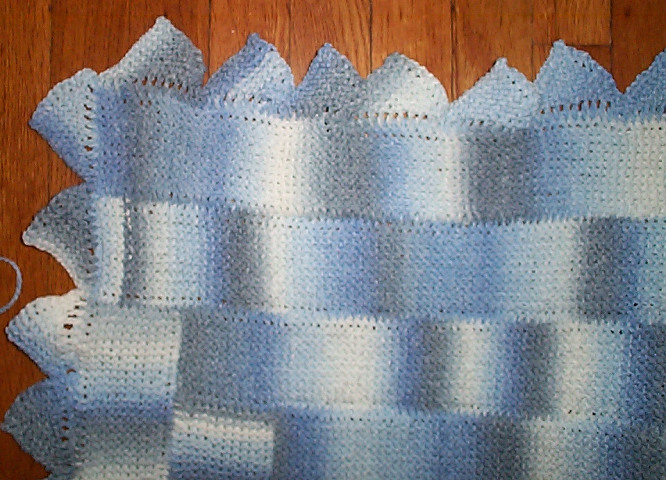
I started with 10 balls of the Batika. I’m working from the ninth right now, and will probably dip into the last one. If I have enough, I’ll make a hat to match from the last ball.
Again, the blues are a bit boring, but I really like the way the strips play with this yarn’s shading. I mixed starting at the center and the outside of my yarn balls, to magnify the helter-skelter effect. I also tried to minimize ends. I was able to join yarn throughout by taking a needle and threading the new strand through the center of this chainette for a couple of inches, then tugging the new strand until its end was completely buried in the center of the working strand.
When I worked the final two non-circumference strips at left and right, to avoid having to cut the yarn and begin again, I worked the outermost strips picking up my attachment points purlwise instead of knitwise, to keep all the “seams” on the reverse. I will have only four ends total to darn in at completion: my cast-on end, the cast-off end on the outermost strip at the left, and the end resulting from rejoining the yarn to make the two final strips on the right. I even started my edging at the bind off point for the final right-most strip, and began my edging without breaking off the yarn. Every other end is already buried.
The edging is super simple. There’s no point in doing anything fancy with the garter stitch texture and the native shading of this yarn. I used the same pull the loop through attachment method I used on all of the strips. About the only thing I did that was in the slightest bit creative was to move the increase point from the outermost stitch of my triangles to the inside attachment edge. I did this in order to keep the edges of the triangles firm and to avoid little baby finger trapping loops.
Because my blanket is made up of garter stitch strips that are 12 stitches wide by 12 ridges, I know for a fact that all of my edges will be multiples of 12. Therefore I’m working a simple edging that is also a multiple of 12. Doing so guarantees that I can avoid working complex corners or mitering. I begin and end each side at Row 1 of my edging, with one stitch on the needle. (If need be and the count of a side is off, I can fudge a stitch or two provided I spread any fudge points out and work them an inch or two before the corner). Super simple.
I’m not done with this concept. I plan to do another piece with a long-repeat yarn. Unfortunately my budget right now constrains me to work from stash for a while, so splurges on blanket quantities of Noro or other similarly demonstrative wild color yarns will have to wait.
Simple Garter Triangles Edging
Multiple of 12 rows
Cast on 1.
Row 1: With right side of your main item facing, pull a 12 inch long loop through the edge-most stitch of the item to be trimmed. Using the loop yarn turn the work over, then YO, K1. (You now have 2 stitches on the needle).
Row 2: Slip the first stitch purlwise, K1. Grab the yarn strand going back to the ball and pull the excess length of the loop to the back of the work, drawing the edging snugly up to the item to be edged, but taking care not to collapse the little “bride” (twisted threads) that will eventually form an arcade of eyelets between the main piece and the edging.
Row 3: Draw another working loop through the next stitch of the main piece. Turn the work over, YO, K2. (You now have 3 stitches on the needle)
Row 4: Slip one purlwise, K2, snug up excess loop length.
Row 5: Draw another working loop through the next stitch of the main piece. Turn the work over, YO K3. (You now have 4 stitches on the needle)
Row 6: Slip one purlwise K3, snug up excess loop length).
Continue rows 7-11 in this manner until you have 12 stitches on your needle, ending after finishing row 11.
Row 12: Bind off 11 stitches. You should have only one stitch left on your needle.
Repeat rows 1-12 as desired.
VISIO STENCILS AGAIN
I noticed quite a few hits in the past couple of days from people looking for my Visio knitting symbol stencils (templates). They’re the tools I use to do all of the charts here on String. However those files appear to have gone astray. I’m having problems going back and editing the original posts to edit the links there, so I am offering up this set of links instead.
I’ve got two sets, both for older versions of Visio. For Visio 5 here’s a Zip file containing the basic shape set, increases and decreases, and cables. And here’s the same thing for Visio 2000. I know for a fact that my stencils work with Visio 5, Visio 2000 and the last version of Visio in MS Office 2003. I haven’t had an opportunity to test the latest Visa version of Visio with my templates yet.
Here’s a link to the original post describing my method, but in short – I’ve built a series of “alphabet blocks” each bearing a standard knit symbol. I build my patterns up block by block. I can group or rotate blocks as needed. Once my blocks are in order, I add chart notations, including my grids and row numbering, and a key. I can also use the same system for colorwork charting by assigning my desired colors either to the whole block, or to a small square unit in a block’s center, as needed.

I offer up these stencils to anyone who wants to use them. For the record, I’ve heard that these blocks can be imported and used in other less expensive graphics programs including Edraw. I know that Edraw can open Visio files, but I don’t know if it uses a stencil or template library that can import Visio stencils. I suspect that to adapt my symbols you’d take one of the files in the zip dowloads above, then use Edraw to open it and copy the symbols out.
If you do use my files to create your own charts, I’d greatly appreciate a link back or a line of acknowledgment in your final work. I hope that someone else finds these useful as I do.
LOG CABIN BLANKET GROWTH AND CREATIVE REPURPOSING
The modular baby blanket continues to grow. To get an idea of large it is, the wooden Brittany birch DPN in the upper left is about 7.5 inches long. I’ve used approximately four balls of yarn so far. Although this yarn is rather ho-hum in its color gradients, I am really liking the effect.

Done in brighter colors, this might have an effect reminiscent of the wonderful play of narrow striping exhibited by larger Kente Cloth pieces made from many strips of narrower weaving.
The Batika yarn is turning out to be a minor annoyance. It’s one of those slipperies, put up in self-destructive puffballs. The balls implode when worked center out, and tangle when worked from the outside end. I’m doing both in order to swap around the color progression. But last night as tomatoes were sliced for dinner, I had a brainflash. The little foam nest that protected the tomato (and that can often be seen around Asian pears) can be repurposed as a yarn tamer for puffball put-ups:
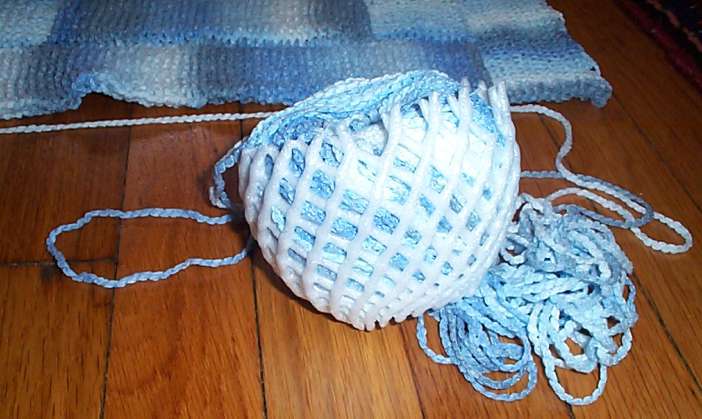
It works quite nicely for this shape yarn ball, even better than the green mesh cylinders that the wine store uses to cushion bottles if you buy more than one (which I also use to tame cylindrical pull skeins).
LOG CABIN MODULAR BLANKET WORKING METHOD AND CROCHETING ON
First, in answer to a question about how to draw up a loop, I do a normal pick-up one into one chain selvage (or bind off, or cast on) stitch, then I grab it and pull more yarn through, distending the newly made stitch until I’ve pulled a foot or more of yarn through. Once I’ve got the giant loop, I use it to knit the next two rows. When I’ve finished the two rows I grab the strand leading back to the ball and give it a firm tug to pull any left-over yarn back out of the loop, and to snick the newly knit piece up closely to the existing work. Here you see the loop being pulled through prior to knitting with it:

After much trial and error, I’ve hit on the best way to cast on for the strips in my modular knit Log Cabin Baby Blanket. (Wish I’d looked at yesterday’s comments before all that fiddling and seen Karen’s suggestion). Crocheting onto a knitting needle, like I do when I start off the waste chain for a provisional cast on, works nicely. It produces an even chain type edge, analogous to the strip’s bind off and chain selvage edges. I’ve described crocheting on before, but here’s another swag at it.
In the snap below I’ve stuck my crochet hook into the final stitch remaining after I’ve cast off the stitches on the last strip. I’m holding the working yarn BEHIND the target knitting needle, and I’m reaching OVER the needle with the crochet hook

I’m grabbing the working strand with the crochet hook and am about to pull the just-grabbed strand through the existing stitch (in effect, I’m making a crochet slip stitch).

Ignoring the errant strand of Smaller Daughter’s hair in the shot above, what we wind up with is a stitch on the knitting needle. I’ve moved the working strand to the back of the knitting needle again, and am poised to make another.
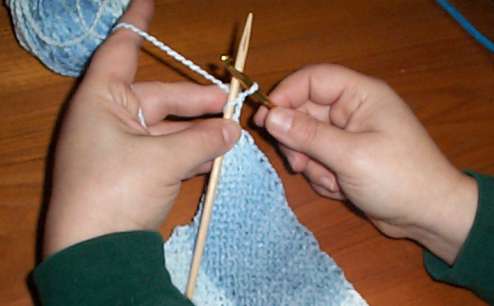
Crocheting on works especially nicely for provisional cast-ons. Instead of crocheting a long chain THEN fiddling with the bumps on the back of the chain, trying to pick them up, this method produces the chain edge and mounts the stitches in one step. It’s one of the core techniques I teach in my occasional “Crocheting for Knitters” workshop.
As you can see, my blanket is growing. According to the logic diagram, I’m in the middle of unit #7:


Finally, here’s the working method. It’s not a pattern because I am not giving yardage estimates, gauge or dimension. These log cabin blocks can be made to any size and assembled like a standard patchwork quilt, or the working logic can be used to make a larger object as a single square. For the record, I’m using Austermann Batika Color, a bulky weight yarn with a native gauge of 4 stitches per inch in stockinette, on 6mm needles. I’m getting roughly 4 stitches per inch and four garter ridges per inch in garter stitch on US #9s (5.25mm). My initial square was about 3×3 inches (roughly 7.6cm), and all my subsequent strips are about 3 inches wide.
The best way to join ends of Batkia when starting a new ball is to thread the new strand into a standard tapestry needle and stitch it through the center of the chainette for about 2 inches, like feeding an one eel to another. Once the doubled length has been knit, any flapping ends can be trimmed back without fear of raveling.
Working Method for Modular Log Cabin Square
First square:
Cast on 12 using crocheting on.
Row 1: Slip the first stitch purlwise, knit 10, k1b.
Repeat Row 1 until you form a square of garter stitch. In all probability there will be 12 chain selvage edge loops running up both sides of the square. Cast off 11. One stitch should remain. Do not break yarn.
Strips:
Using the last remaining loop, crochet on 12 stitches.
Row 1: Slip the first stitch purlwise, knit 10, k1b. Draw a loop through the first available chain selvage stitch on the previous square or strip (it will be the edge to the left of the new strip’s attachment point). Enlarge this loop until it’s big enough to knit with. Turn the work over.
Row 2: Pulling the loop tight and making sure you’re knitting with the anchored side rather than the side that runs free back to your ball of yarn, knit 11, k1b. Turn the work over.
Row 3: Slip the first stitch purlwise, knit 10, k1b.
Repeat Rows 2 and 3 until your new strip runs the whole width of your piece. The first time you do this, it will be a square of 12 stitches x 12 garter ridges. The second strip will be a rectangle of 12 stitches x 24 garter ridges and will run across the top of the first two squares.
Next row: Cast off 11. One stitch should remain. Do not break yarn.
Repeat the strip directions, always adding strips counterclockwise around the perimeter of the piece, with each strip running the full length of the available side.
ANOTHER ONE DONE, MOD KNIT BABY BLANKET METHOD
The latest fish is finished – all ended off, seamed, and eyes affixed.
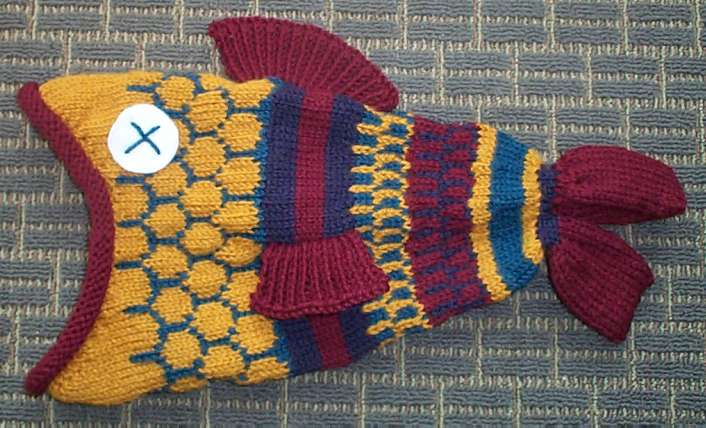
The recipient is thrilled. So am I. I usually don’t like making more than one of anything. I even hate that inevitable second sock, mitten, or sleeve. Exceptions to this are rare. I did four of these fish. It makes my short list of multiple project patterns, right up there with the Wonderful Wallaby sweater (five, for my own kids plus some nephews/nieces); the Ridged Raglan pullover (two, one for my kid and one for a niece); the Cabin Fever 1,2,3 Top Down pullover (for a work pal’s kids); plus several Kombu Scarves, and several Kureopatora’s Snake Scarves. Note to self – I should dig out a couple of the Wallabies to write about here.
The colors on the shot above are truer than the ones in my previous photo, which made the thing look particularly dark and gloomy. Blame sunlight.
On the Log Cabin Baby Blanket, I’m having fun experimenting. I ripped the whole thing out and restarted, using the long loop join I mentioned in the last post. It still makes a ridge, but a far less prominent one. Plus I’ve figured out a couple of tricks to keep all of the ridges on one side. Right now I’m playing with several cast-on methods to start each segment, looking for one that is the easiest foundation for picking up on subsequent segments. I also decided to start not with a centermost group of four squares, but with just one, more in keeping with the traditional quilt block’s geometry. I’m happy with the result, although I think I was overly generous in picking up one of my segments, and need to go back and redo it. I also think that this would be far more spectacular done in a Noro, Daikeito or other long repeat space dyed striping yarns:
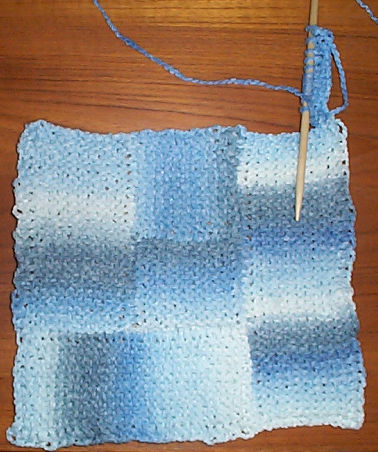
I started with the center square, then worked the one above it, followed by the peripheral strips, counterclockwise. Here you see the reverse side, photographed at an angle to make the ridges stand out:

In general, I cast on 12 stitches and knit a garter square with slip stitch edges (also known as chain selvage). I left the stitches live at the top of the original square, then cast on 12 using a standard half-hitch cast on (more on this later) and knit back to the main square body. Then I knit a second square perpendicular to the first one by pulling a long loop through the next availably body stitch from the first square, and using its yardage to work each pair of rows, At the end of each right side row when I was back at the body (as opposed to the free edge) side, I’d snick up any excess length left over in my drawn loop, and do it again.
Working the second square onto the live stitches of the first one totally eliminated the between-square ridges, BUT not every stitch on every side of every square is live. To continue around making strips joining onto the chain selvages would result in those join ridges – not as prominent as the ones formed by a k2tog or ssk join, but they’d still be there, even if I picked up only one leg of each chain. So I decided to end each square by casting off all except the one final stitch, and treating the cast-off row like a chain selvage row when picking up to knit on subsequent strips. That leaves only the cast-on edge (you can see where it is in the just-begun strip sticking out of the top of the work on the photos above). Half-hitch cast on makes a messy edge for picking up. I don’t like the way it looks. I’m playing right now with some of the knitting on variants, to see if they make a nicer foundation for drawn loop joining.
I’m not sure that I grok this well enough to explain the method better than the sketch above, but if there is interest, I’ll start taking more complete notes and consider doing a full project write-up of the Log Cabin Modular Baby Blanket here on String.
MORE STRAGGLER FISH, MODULAR BABY BLANKET
I’ve finished the knitting on the latest fish:
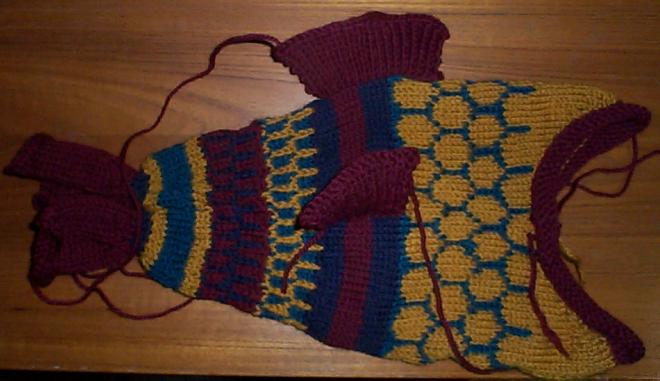
You can see that I used two of the four scale patterns from my last fish post in it, opting instead for plain stripes on the sections that were not divisible by 6 or 3. Now there’s just darning in all those ends, sewing up the tail, and placing the eyeballs. I’m holding off on final completion until I find out from the recipient whether she wants her hat dead or alive.
I also started a new project – a baby blanket worked in modular knitting, along the lines of a traditional log cabin quilt. In typical heedless style, although I’ve seen patterns and descriptions of this style of modular knitting before, I’m not working from a pattern. I’ve got the image of what it should be in my head, and am stumbling towards execution by trial and error.
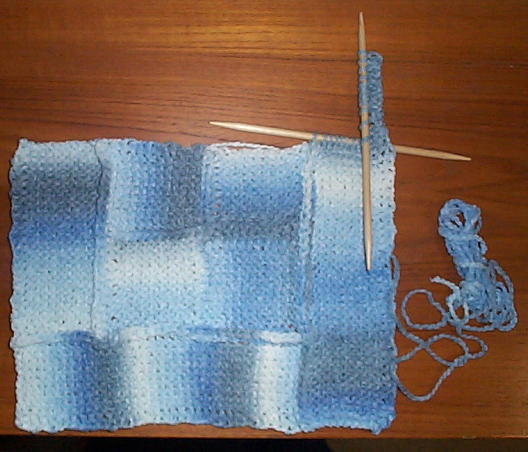
I’m working in Austermann Batika Color, a cotton/acrylic/nylon blend that came out in 2004. I got a bag of it at Wild & Woolly in Lexington at their annual mid-winter sale, for an excellent price. This is a machine wash/dry flat yarn with an interesting texture – sort of a chainette bound by a tight nylon strand. As you can see, it’s a shaded yarn. Knit normally from horizon to horizon, the grays, creams and blues would make partial row tweedy stripes. Worked in narrow 12-stitch wide bands I’m getting more of an umbral effect.
I like what’s happening with the color blending, and I like the analog to the traditional log cabin quilt block layout. I like the working method more than I thought I would. I’m not fond of the prominent seam ridges formed by using ssk to join. What you see is one night’s work, using up most of one ball of yarn. I’m thinking of ripping it all out and restarting, using a different join method. Possibly the long loop join I used in the Lightning scarf pattern. My fall-back is to do a standard throw using medallions knit out from the center, so that the color changes radiate with each medallion starting in a slightly different spot on the sequence. That would work well for this yarn, too – but would involve lots of sewing up, which I was looking forward to avoiding by using the modular technique.
 String-Or-Nothing
