I’ve written several books and pamphlets on historical embroidery. Here is the latest on their contents and availability. Corrections are presented at the bottom of this page
| The New Carolingian Modelbook: Counted Embroidery Patterns from Before 1600. Albuquerque, NM: Outlaw Press, 1995. Sadly now out of print, TNCM is a treasury of counted and block unit patterns primarily for needleworkers. The contents are mostly derived from historical modelbook sources, which at the time of publication were extremely difficult to access. Patterns are accompanied by source information, and indexed by year and place of origin. |  |
| The Second Carolingian Modelbook: A Collection of Historical Charted Patterns for Needleworkers and Artisans. SECOND EDITION Arlington, MA: Wild Puma Press, 2021. A sequel to TNCM, The Second Carolingian Modelbook (T2CM) contains 75 plates of over 250 individual band, border, strapwork, and field designs are clearly depicted for ease of working, and are accompanied by observations on pattern “families”, full source documentation, and descriptions of some of the many techniques that were used to stitch them. It contains linear designs appropriate for double-running or back stitch embroidery; and block unit designs can be used for long armed cross stitch and darned whitework. Block unit designs can also be used in modern context for cross stitch, filet crochet, and knitting. Designs appropriate for reserva or voided work (the ancestor of modern Assisi stitching) are also included. The second edition includes all of the corrections posted in the Errata section at the bottom of this page. |  |
| Ensamplario Atlantio: Being a Collection of Filling Patterns Suitable for Blackwork Embroidery, Second Edition. Arlington, MA: Wild Puma Press 2023 (self published). In the course of working out the pattern drafting methods I used on T2CM, I began organizing and transcribing the blackwork fills I had collected or doodled up over the years. Although none are historically sourced to specific artifacts, these are appropriate for use in inhabited blackwork, the style characterized by heavy outlines and diapered geometric fillings. Patterns that are clearly modern and should be avoided for works intended as re-creations are so marked. REVISED, EXPANDED ONE-PIECE EDITION AVAILABLE AS OF 13 JUNE 2023. | 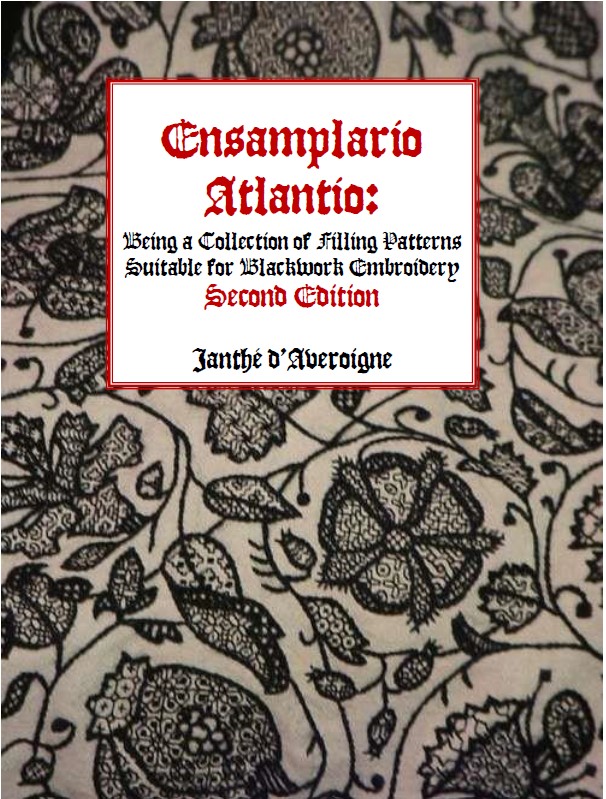 |
| Ensamplario Atlantio II: More Filling Patterns and Borders Suitable for Blackwork Embroidery. Arlington, MA: Wild Puma Press, 2020. (self published). Because my doodle notebook seems to be bottomless, I present another collection of 200 plates for counted work. The collection includes about 180 all-over repeats that can be used for inhabited blackwork or large area repeats; plus something new – a collection of borders (some with coordinated all-overs); an alphabet; and two tunic yokes. While there are about a dozen historically sourced fills, the overwhelming majority of the content is my original work. |  |
| Ensamplario Atlantio III: Even More Filling Patterns and Borders Suitable for Blackwork Embroidery. Arlington, MA: Wild Puma Press, 2024. (self published). Obviously I just can’t stop doodling. This booklet includes all of the new fills I drew or redacted for use in the Unstitched Coif project; plus the strips on the six samplers I stitched between 2023 and 2025. It also has quite a few corners, yokes, and isolated motifs. SCA folk may appreciate mascots for the East Kingdom and Atlantia, plus a belt motif that can be infilled in the colors appropriate for squires, apprentices, and protegées. |  |
| Epic Fandom Stitch-Along. Arlington, MA Wild Puma Press, 2024 (self published). This is a single 50-page booklet containing ALL of the information for the Epic Fandom Stitch-Along, previously released on my SAL page. It came to my attention that folk wanted to have a one-and-done download for the thing, rather than wading through the entire extremely long week by week release accumulation. So I offer it here. |  |
Everything You Always Wanted to Know About Socks… (but were afraid to ask). Arlington, MA: Black Rose Press, 1999 and 2001. (Self published)
A collection of sock patterns from this website, plus a small sample “learner’s sock” I used when teaching workshops on the toe-up/short row heel technique. Includes Judy Gibson’s “You’re Putting Me On” sock pattern by special permission. Some general information on sock sizes/fitting, Kitchener stitch, and some woefully outdated general reference links on sock knitting.
Book Errata
Corrections for my books are presented below.
The Second Carolingian Modelbook, First Edition
UPDATE: All of the T2CM corrections posted below for the First Edition have been added to the Second Edition, published 12 March 2024.
Sadly, no one is perfect – least of all me. And no automated typesetting/publication system is perfect. I will post corrections/emendations/apologies here, as they come to my attention. Thanks to all who have called my attention to these errors. For the record, the standing maxim here is “Only fools proof their own work.” My status is obvious.
Page 10, Diagram series
Whimsey has intervened. While the diagrams are numbered correctly, they appear to have entered into a dance, and some of the rows are shuffled in the final print. Apologies for the inconsistency.
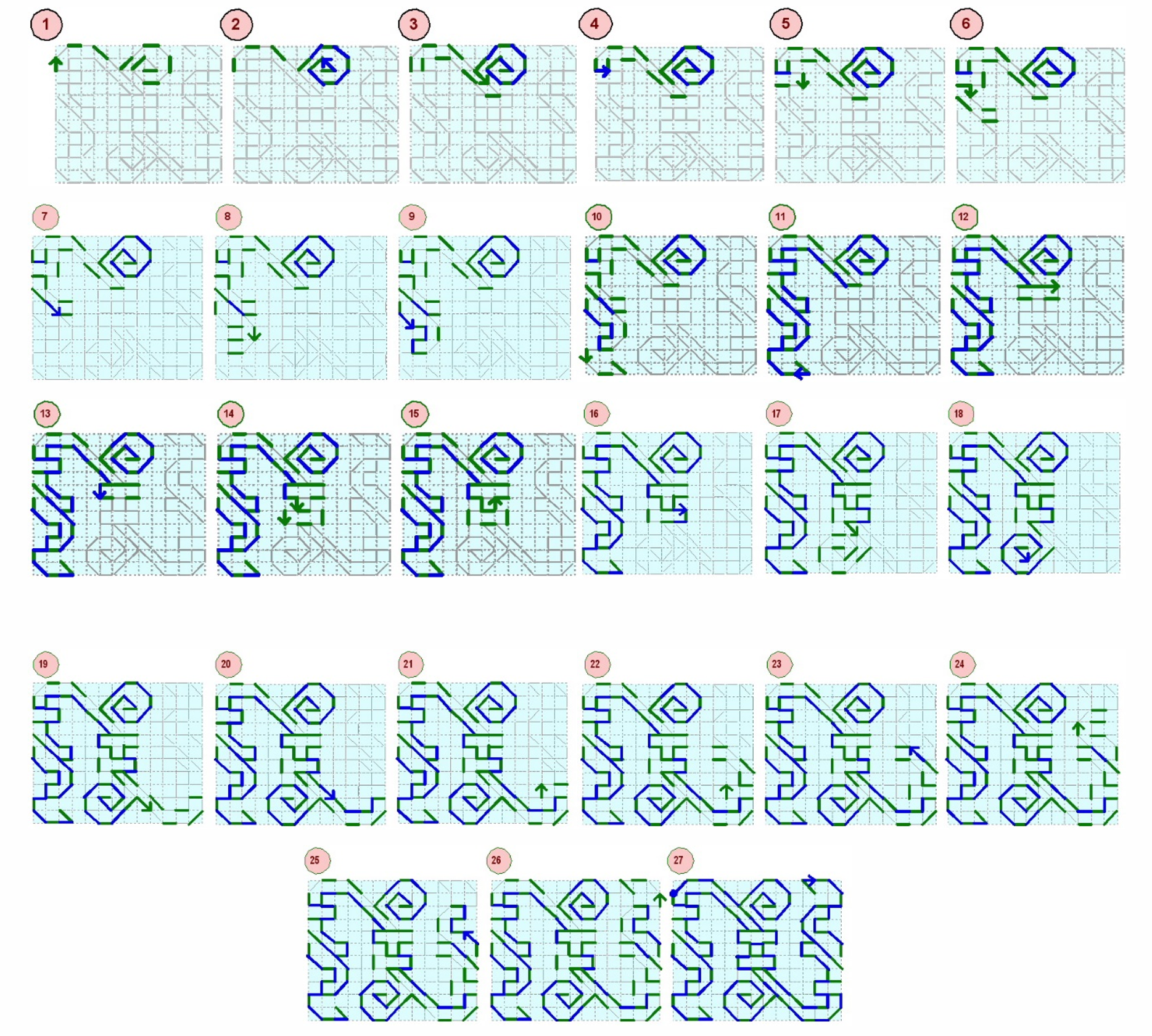
Page 17 , Plate 1
There are four patterns presented. The numbering of those patterns migrated from the bottom to the top of the page. Across the bottom, they should read 1, 2, and 3a. 3a is the bottom half of the rightmost column, and features free-floating lozenge “islands” embedded in two separately worked crenellated rows of linear stitching. 3b begins about mid-way up the rightmost column, and continues to the top of the page. In that very similar looking pattern there are no “islands” – it’s worked entirely in large chunks of linear stitching, and would be much easier to render in double running stitch than 3a is.
Page 62, Pattern Description 24:2, 24:3, and 24:4
The museum attribution for these patterns has changed since April 2014 when I first graphed them. All three are from the same source artifact. In 2014 the description read “Italian or Spanish, Early 17th century.” I’ve confirmed that as of today 7 February 2024, it now reads “Probably Portuguese, Early 17th century.”
Page 104, Plate 45
The last paragraph in the prose description reads “…Plate 45:1 continues the design. The companion edging only partially included here is presented in Plate 45:2.” Those cross references are typos. The design is continued in Plate 46:1 and the edging is presented in Plate 46:2.
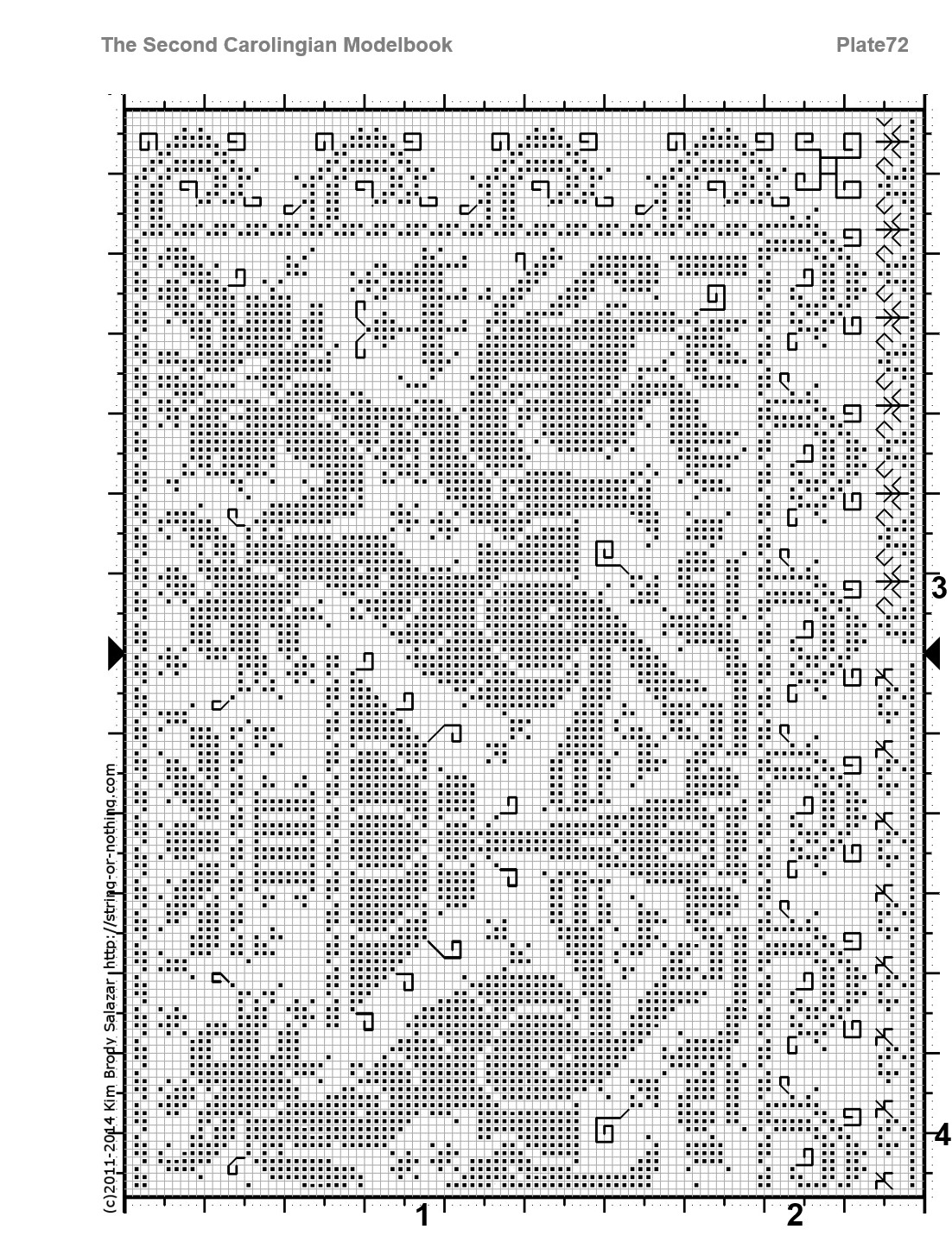
Page 158 and 159, Plate 45
The visuals for designs Plate 45:3 and Plate 45.4 were omitted, along with the description for Plate 45.4. The text for the latter is “4. Original, inspired. Original by author, inspired by period aesthetic. No one single source can be identified. 9×5.” The corrected page is below.
Ensamplario Atlantio, Volume 1, Part 4
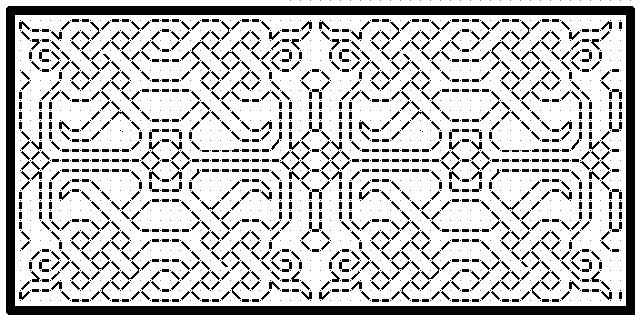
Plate 25:147
Some of the interlaces in the diagram were not properly oriented. The image below is corrected.
UPDATE: Note that this corrected representation is included in the one-part issue, Ensamplario Atlantio Second Edition.

Ensamplario Atlantio, Volume III
In the rush to get this volume out some minor pattern charting errors may still lurk. As I find them I will list them below, with their corrections. With luck I will eventually be able to re-issue the work with everything here included.
Plate 21, pattern 21.2
The New Carolingian Modelbook
Plate 73:1
There are only two small interlace crossings in question for this page, but the correction for the design as a whole is quite large. Please download this PDF file to access it.
 String-Or-Nothing
Thanks! With retirement arriving end of 2012, I’m going to feast on these patterns!
delighted to be of use! I get a thrill out of seeing what mischief the “pattern children” get up to out there in the wide, wide world. Please feel free to send along pix of projects employing them. If you give permission, I’ll post them in the gallery here, too, with thanks and links if so desired. -k.
Will do! Thanks!
Thank you so much for your generosity in sharing your work. I just downloaded the PDFs of your book, as well as your amusing modern patterns (skulls and fsm). I have been trying to find some resources to experiment with blackwork and your site is amazing. I’m in the middle of a few projects right now, but I’ll be sure to share with you whenever I do manage to get to put your charts to use.
The cost of The New Carolingian Modelbook: Counted Embroidery Patterns from Before 1600. is prohibitive – $50 used and $191.50 new. Perhaps it could go on Kindle or some other alternative to make it more available? There was no ‘look inside’ for it either – that would have been nice.
Just from reading your blog and looking at your patterns, I can tell it should be a very interesting book! Thank you for blogging.
Jean, Thanks for your kind words. I’m afraid that I’ve got no contact with the TNCM publisher. He only paid me a couple of months of royalties before dropping off the face of the earth. The book went on to sell at least 2000 additional copies, but I’ve never seen a cent, nor do I have the files needed to do a Kindle-fication. In fact, all I’ve got is my one author’s copy. But be that as it may – I am concentrating right now on putting out a sequel. Once The Second Carolingian Modelbook is out, I’ll turn my attention to re-manufacturing the first. Sorry for the inconvenience. -K.
Thank you for your reply – I saw it only just now. You have given us hope – that is good! Bless you.
Have you finished your second book: The Second Carolingian Modelbook: More Counted Embroidery Patterns from Historical Sources. ?
Thank you so much for enabling the downloading of your Ensamplario Atlantio – what a magnificent resource! I know I will love going through the patterns, and I will someday send you photos when I make something from your book. This is the best blackwork pattern sourcebook I have ever seen! Thank you so much for your work, and for sharing it so generously with the world. I also look forward to going through your past blog entries in depth.
[…] My Books […]
[…] My Books […]
I am interested in your Dance around the corner pattern. Is there a way to purchase a copy?
Thanks Lee T.
It’s free. Click on the Embroidery patterns tab at the top of every page of this site, then scroll down. Click on the thumbnail to download.
Has the Second Carolingian Modelbook been published? I can’t find it for purchase online anywhere.
Not yet. Follow this blog, and you will be among the first to know.
Dear Kim, I have been using your new book for a couple of weeks now and I absolutely love it. Well worth the money (about twenty quid).( I am on the (somewhat obsessive) look out for your first book and will eventually get it I hope). Thank you very much for writing it. Thank you also for the pdf blackwork patterns which I have made good use of for a few years now (book 1, anyway). Take care, and keep publishing! Love, Christine 😊
Delighted you are having fun with it! But I have to warn you that the Second Carolingian Modelbook is far more detailed and complete than its predecessor. And there are a couple of minor mistakes in there I need to correct, too. Please feel free to send along pix of any works derived from my books or broadsides. I will be opening up a Gallery section here on String to showcase creativity and ingenuity. I would be happy to include your work, with or without your name (as you prefer).
[…] Kim Salazar’s books age – https://string-or-nothing.com/books/ […]
[…] My Books […]
I found 13 pieces of filet crochet likely dating from circa 1912 in Auntie’s closet. I’ve been researching the falconry subject but just now found your website. Please could you provide a contact address as I need a bit of coaching. thx!
Not sure what you are asking about. I don’t take private students. But I do answer general questions. You can post here and I will either answer here, or if the question inspires a blog entry, write a longer article in response.
The subject matter resembles the 1500’s scene with the castle on your blog. These panels describe hunting and falcon training.
I’ve been trying to figure out the border – whether that is a vine or tools or insects.
I’m struggling with the dress/clothes and the letters over the ?crossbow.
I have worked out that these panels would be either window privacy screens or table runners. The thread is a heavy ?linen thread.
Can you refer me to specialists who would recognize the motifs, symbols, etc?
Thanks very much!
Olivia
Can you provide a link to the specific panel you are looking at? I do not see any lettering above any of the people or borders as you describe in the examples of the castle I posted in my article on this page: https://string-or-nothing.com/2018/05/30/castles-and-caravels/
Here is the image with the lettering over what looks like a crossbow (it may be mirrored). The âplantsâ on the border might also be weapons(?!). I would love your feedback. ð
Images in comments cannot be transmitted via the WordPress blog commenting software. Sorry about that, nothing I can do to fix that. Can you please provide a link?
Can you see the image I attached? Am not sure how to make a link.
No. Nothing there. If you found it on line, like on a Pinterest board or museum posting, you can send me a link to that. Or if it was in a book, you can send the author, title and page reference. I might be able to track it down.
Maybe I can email to you – I don’t know how to link an image which I have as an attachment.
Go to the About page on String, you will find an address there. I do not repeat it here for anti-spam reasons.
[…] My Books […]
[…] My Books […]
[…] My Books […]